ROUNDABOUT READINGS.
Reading edition
Some of us like our English short, others prefer it expanded. Some of us, for instance, might say that "Nero fiddled while Rome burnt." But this bald statement is obviously quite unsuited to the decorative instincts of the age, for in the Daily Telegraph, only last week, I read that "a notorious Roman Emperor is credited with the performance of a violin solo during the raging of a serious conflagration in the heart of his capital." The omission of Nero's name gives to this sentence a delicate parliamentary flavour, which brings it absolutely up to date.
But what a noble example it is! Henceforward, for instance, if it should ever fall to my lot to write about Henry the Eighth of England, I shall feel a mere fool if I state that he married seven wives. No, no. A British monarch, celebrated in the books of the historians as the Eighth, and hitherto the last of his name, is reported, on the authority of the Ecclesiastical registers of his time, to have entertained so warm and overpowering an affection for the connubial condition commonly known as matrimony, as to have entered into it with a comparatively light heart on as many occasions as would equal the sum total of predecessors bearing his name who have supported the burden of the crown of these realms. For a very slight increase of salary I am prepared to double the length of this sentence without adding a single fact to it.
Here, too, is a delightful extract from a gorgeously illustrated volume issued by a firm of house-agents in praise of what they very properly term "an imposing structure in red brick." "It is difficult," they declare (and after reading their description one can well believe it) "to conceive a more replete Town Mansion, embodying such artistic and delicate schemes of decoration, one where wealth has wrought such a revelation of harmonious and fitly fitments, or where the studious consideration of the minutest detail contributing to health, enjoyment and comfort has been more completely manifested. This, combined with its advantageous position removed from any main thoroughfare with its accompanying turmoil, renders it a perfect dwelling and an idealistic London Home."
No more by White Star or by Guion I leave my native land to roam. I've purchased and I occupy an Idealistic London Home. Last year my London I to quit meant; But now, with all an owner's pride, I gaze upon each fitly fitment, And, lo, desire for flight has died. Place me where schemes of decoration Give both to Art and Health increase, Where Wealth has wrought a Revelation— I ask no more, I rest in peace.
Next let us contemplate a pure gem of descriptive English from a sporting contemporary. It occurs in an account of the athletic contest between Cambridge University and the United Hospitals:—
Scarcely a cloud flecked the blue heaven yesterday afternoon, and a dazzling sky burnished the Stamford Bridge grounds into an acre of reflected sunshine. What a pleasant spot the tryst of the premier athletic club on which to hold athletic revels! It was not to be expected that the people would show a front at the carnival. So much to do nowadays, what with cycling at Hurlingham, and the Beauty wheel show on the Row in Battersea Park. Equal to the occasion though proved many English girls, and it was pleasing indeed to note their presence in the pavilion and enclosures. Bold as Britannia as a rule in this, the nineteenth century. And don't forget this, innocent as a posy all the while.... Think of this now. W. Mendleson (C.U.A.C.), but by birth a New Zealander, figuratively speaking, gazed on the ruins (long jump ruins, of course) of Britishers at Stamford Bridge. It was with a quickened pulse that one watched the Hurdle Race. 'Pon our soul 'twas a difficult problem to solve a few steps from home to tell which would win, Pilkington or Lowe. The flag went up for the visitor from the banks of the Cam. Nevertheless, no one can assert but that the medical banner remained hoisted at the truck in honour of their representatives. Gallant seconds!... Of course H. A. Munro gave us a taste of his quality in the Three Miles. Verily he ran as though able to keep up pacing from sunrise to sunset. 'Twas a glorious victory that he gained. Neither must the plucky bid made by Horan be forgotten. Ah! if he had only been Munro! But he wasn't, so there was no use in thinking about that.
How melancholy are these might-have-beens. If Napoleon had only been Wellington. But he wasn't. So there was no use in thinking about that.
Henley Regatta, I understand, is to be an international festival this year. A Dutch crew has entered for the Thames Cup, but it is not stated that they carry a broom in their bows. Nor is it to be inferred that they will make a clean sweep of the prize. Besides many English crews they will meet a crew from France. Then from Toronto come four Argonauts sailing not for the Golden Fleece, but for the Stewards' Challenge Cap; and from Ithaca, N.Y., eight modern Trojans, undergraduates of Cornell University, have set out intent on the capture of the Grand Challenge Cup. To all of them Mr. Punch extends the right hand of good fellowship, though, being British to the backbone, he cannot wish for their triumph over his own gallant oarsmen. And amongst these he especially welcomes Mr. C. W. Kent, the Hero of Leander, who, having four times stroked his crew to victory, is once more seated on the slide of honour to defend possession of the Grand,—Kent, the pride of joyous Moulsey, whom at his birth the Fates endowed with the triple gifts of cunning, resource and courage, bidding him wield an indomitable oar in undefeated crews. As when a fox, emerging from the tangled covert——But I cannot pursue the Virgilian method any further. Let the event next week speak for itself. Here's luck all round, and may the best crew be an English one. In any case, may the best crew win.
The gentlemen from Cornell have brought over with them, in addition to their boats and oars, a terrible battle-cry, "Cornell, yell, yell, I yell Cornell." Manifestly the members of the London Rowing Club cannot model themselves on this, for to cry, "London, done, done, I'm done, London" would, I trust, be as inappropriate as it would certainly be discouraging.
My recent investigations into the condition of some of our great provincial cities lead me to the depressing belief that something is always wrong with some of their streets. Here, for instance, is "Nemo" writing to the Manchester Guardian to complain that "on Saturday evening the Bury New Road was filthy, whilst the odour was equal to that of the Ship Canal, but different. Formerly there seemed to be an effort made to have the road brushed up on Friday ready for Saturday and Sunday, when thousands of well-dressed and happy people—Jew and Gentile—promenade it on their way to breezy Kersal Moor." But why, may I ask, should there be no well-dressed and happy Christians promenading on their way to Kersal Moor? It may be that they have followed "our local representatives," who, "Nemo" suggests, "are enjoying their holidays, or are immersed in golf," which I take to be a delicate euphemism for bunkered.
A Late-at-Night Riddle.—Q. Why is it probable that the supper provided by the Royal Academicians for their guests at their soirée would be chiefly or entirely vegetarian? A. Because all the dishes are "R. A. dishes."
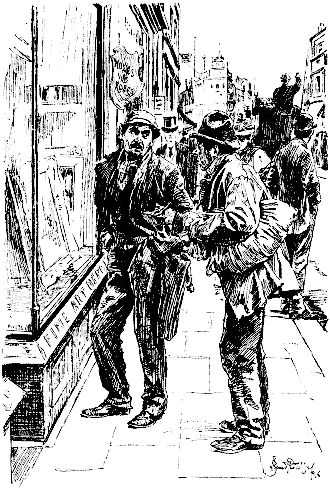
THE TRUE TEST.
First Screever (stopping before a Pastel in a Picture-dealer's window). "'Ullo 'Erbert, look 'ere! Chalks!"
Second Screever. "Ah, very tricky, I dessay. But you set that Chap on the Pivement alongside o' you an' me, to dror 'arf a Salmon an' a nempty 'At, an' where 'ud 'e be?"
First Screever. "Ah!"
[Exeunt ambo.
SCRAPS FROM CHAPS.
Is it well to temper justice with jokes? This important question has been settled in the affirmative in many courts of law, but it has been left for his Honour, Judge Edge, to use his own name (instead of somebody else's) in the playful manner requisite to excite "laughter in the Court." A solicitor recently took upon himself to argue with his Honour in the Plymouth County Court a question of costs in respect of a case heard some months since. He conducted his argument with much warmth and inaccuracy. This combination of bad law and bad temper enabled the Judge to score an easy victory. "Stand down," said his Honour; "if you play with edged tools you must pay for it." Thus triumphed the Law and the Judge, and once more "unquenchable laughter arose amongst the blessed gods" up in the gallery.
The British earthquake has been sadly neglected. Therefore Mr. Charles Davison, M.A., F.G.S., of Birmingham, is writing a History of the British Earthquakes of the Nineteenth Century. With a view to add to the completeness of this work, he has appealed to the readers of the Western Daily Mercury for "notices of British earthquakes, either past or future, of any kind and from any place whatever." He specially desires to become acquainted with earthquakes "of which descriptions appear in the local press, or entries are made in private diaries." All local papers should at once start a special earthquake column—"Earthquakes Day by Day," or "Yesterday's Earthquakes"—and writers of diaries would do well to dive into the past. There are so many remarkable phenomena not otherwise recorded. Here is one. "Dined with Brown last night. Insisted on walking home, instead of taking Brown's advice and a cab. Had not gone far when strange thing happened. Pavement suddenly upheaved and hit me violent blow on forehead. Fell prostrate. Taken home in dazed condition by friendly policeman. No time to observe affect of earthquake on adjoining houses. Shock very short, but exceedingly severe. In bed all day. Large bruise on forehead. Headache, &c." There must be many interesting entries of this kind in diaries which will afford valuable material for Mr. Davison's work. As to "notice of future earthquakes," which he requests, perhaps the Meteorological Office, the Geological Society and Zadkiel will kindly oblige with probable dates and other information.
Wizard And Wittles.—Long life to the Glasgow Sir Walter Scott Club! It "promotes the study of Sir Walter's life and writings, and encourages a more familiar acquaintance with the localities rendered classic by his pen." Ninety members set off the other day to Edinburgh, and drove in four-in-hands to the "beechy grove" at Melville Castle, the Esk and Drummond's Hawthornden, and then on to the castle and chapel at Roslin. Lunch at Dalkeith, dinner at the Balmoral Hotel at Edinburgh, and back rejoicing at eventide to Glasgy, "after the happiest and most successful excursion in the history of the club." This is the way to keep up the dignity of literature. Far better than knighthoods! An excursion "under the presidency of the genial Sheriff Spens," too; no Sheriff Saves this time; and a dinner at the Balmoral to wind up—it's a Talisman to make the heart of Midlothian leap up!
A Musical Treat. A Pronouncement and a Hint.—Herr Nikisch's performance is so brilliant, and has so much real fire in it, as to have given rise to the suggestion that, to express the diablerie of his effects, both syllables of his name should be short, and that his style should be henceforward known as the "Old Nickish" manner. When the chance recurs, go and hear the symphony by Tschaikowsky. Only be prepared. To pronounce this name correctly you must take pungent snuff and sneeze violently while trying to utter the word "Whisky." Take care to have a medical man ready at hand; also a tailor, with needle, thread, and buttons.
From the South Wales Daily News:—
As Groom, Coachman, or Groom-Gardener, plain; wife good Cook; or otherwise, if required. Good references.
"Or otherwise, if required," is delicious. She would be a bad cook or an indifferent one "if required." So convenient!
Half-and-Half.
(After Reading some recent Political Speeches.)
Although in the queer Party story There's many a turn, and many a twist; 'Tis strange to see Joseph half Tory, And Salisbury half Socialist!