OPERATIC NOTES.
Reading edition
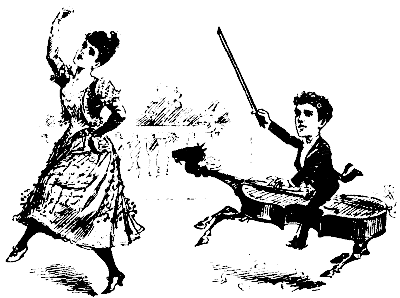
Zerlina Patti accompanied by her Squire on the violoncello.
Another two "turns" and Patti is off. Delightful to see and hear her as Zerlina in immortal Opera Don Giovanni. "Patti Patti" with "Batti Batti," "La ci darem," and all old friends admirably given and heartily encored. After one of the encores Maggie Macintyre walks off suddenly as if in search of lost pocket-handkerchief. In most serious moments ever a twinkle in Maggie's eye, and twitch at the corners of Maggie's mouth, as if giving audience clearly to understand that she is "only purtendin'."
Second Act. Enter Patti; sings, pauses; wonders; sings note, like nightingale summoning mate; pauses; again wonders. "Some one had blundered!" Bevignani beaming but bothered. "He cometh not," they said. Exit Patti, shrugging shoulders. Curtain drops. Very short Act. Audience, amused, applaud. Curtain up again. Bevignani brightens. Re-enter Patti with merry Masetto, who privately explains that for a few moments he had lost his voice and had been looking for it. Fortunately, voice found; in chest; quite safe. Surely a little modern dramatic polish might be used to furbish up utterly idiotic old-fashioned stage-business of this ancient Italian Opera? Eh, Signor Druriolanus?
In the trio at end of Act II. somebody got off the line, and audience, determined that they would be better for a little more practice, called Ma'am Adini, Miss Maggie, and Master Brozel before the curtain, and then made them go through their exercise once more. Nothing like practice, to make perfect.
The Statuesque Commendatore to be highly commended as represented by aristocratic Manners. New Italian Opera proverb "Manners makes the Commendatore." Patti at premium. Royalty Restored to Box. Brilliant night. Crammed, jammed house.
In Lobby.—Much agitation among ancient Opera-goers on hearing report that Mario is to sing here on Saturday afternoon. "Mario!" they exclaim; "impossible!" Not at all: it turns out that this "Mario" is a character in a new Opera by "Alick Maclean" (pretty name, but nicer if it were "A Wash Meclean"), entitled Petruccio (not Shakspear's Petruchio), in which one Mario is "Elvira's little brother;" and so, possibly, he was quite an infant when sister Elvira was cruelly treated by Don Giovanni. Also in this new Opera appears "Elvira's mother." In fact, it is rather lucky for Don that he has gone below with Stony Commendatore to Stony Stratford, or elsewhere, as the talented Elvira family, with whom is associated Rubino, a gentleman "formerly betrothed to Elvira," would make it rather too hot for him.
Tuesday.—Glück's Orfeo. "Gen'lm'n," if overtaken with wine, as was David Copperfield on a notable occasion, would say, "G'luck t' you," that is, could any gentleman in such state be possibly admitted to Covent Garden, and could dare to address Julia Ravogli, admirable as Orfeo, Cavalleria to follow.
Thursday.—Madame Sembrich nice as Violetta Traviata, "were t'other dear charmer away!" Very hot night. Mancinelli must for once have wished himself a non-conductor? Result, Mancinelli Melted.
Friday.—Adelina Zerlina Patti-cake and the Im-Maurel Don G. Why not in such hot weather give opera with ice in it; Patti in skates "en Patti-neuse."
Saturday.—Welcome to Madame Albani, our Valentine in what Wagstaff calls "Lay Hug-me-nots." "Not bad title," he explains; "after crowd of ecclesiastics in swearing scene, pleasing to find two principal characters are 'lay': not 'lay-figures' but lovers not permitted by hard Fate either to embrace each other or any opportunity of eloping together; so 'Hug-me-not' curiously applicable." So far, Wagstaff. Strong cast this with Giulia Ravogli as Urbano the page of music, Melba as Margherita the Queen with the top-notes in her air; Jupiter-Plançon as Marcel, Tam Agno as Hug-me-not Raoul, and Ancona as Conte de Nevers-say-die. Conducting orchestral army to victory, Marshal Mancinelli is Merry and Meritorious.
THE BOY AND THE BAT.
["Who may describe a small boy's passion for his bat?"—Daily News.]
Jemmy Bilkins, aged Thirteen-and-a-half, loquitur:—
I've won it, Bill, I've won it! And it's pooty nigh full size! Leastways, anyhow, it looks it. O, I tell yer, it's a prize. Yaller-backed, Bill, and cane-'andled, and its got a sort o' feel, As yer swing it wot reminds yer of a Stoddart or a Steel. Last Saturday as ever wos I turned out afore six, And practised in our back yard, wiv three lumps o' deal for "sticks." Young Polly she bowled to me, and I drove 'er, and I cut, And "swiped over the Pervilion"—which I mean our water-butt. Poll can do a fair round-armer for a girl and no mistake, And she'll 'ave you, middle-stumpo, if yer don't look wide awake. 'Twos the day of our School Match, Bill, and our gaffer, Mister Blore, 'Ad promised a cane-'andler to the boy as made top score. Oh I tell yer I meant 'aving it, if practisin' would do, But my bat 'ad split a lump off, and it seemed to 'it askew. 'Ow can yer "keep a straight bat" when your bat itself aint straight? But we did our level best, Bill, me an' Polly. At our fate Out at Petersham I tell you as we done the thing to rights, None o' yer 'at-an'-coat piles for the wickets, as is sights A cricketer cocks snooks at, when 'e knows the real game. No penny injy-rubber and a club! Though, all the same, Wiv a second-'and stripped tennis-ball, a little on the lop, Or even a ha'penny woodeny, an' the chump end of a mop, And my jacket on a stick for stump, I've 'ad a lot of fun, And wiv such on Gosling Green, Bill, I fust larned to 'it an' run. But to-day we did it different. Real stumps was pitched O. K., We'd a scoring-sheet, and umpire! We'd a red new ball to play, As it seemed a sin to slog at, 'cos it took the pooty out; But I tell yer we forgot that wiv the fust good 'it and shout. Lanky Steve 'e made that 'it, 'e did. It scooted past long slip, At forty mile a hour or so. That Steve can make 'em skip. He tops me by a 'ed, too, and I feared he'd cop the bun. Yus, I thought the Bat was his'n when he'd piled up twenty-one! I wanted fanning, Billy, when I ups and takes my block, And the ball came thunderin' at me like a little earthquake shock. Seemed heverywhere, yet nowhere, if you understand me, Billy. And pitched just in that orkud spot as always knocks yer silly. Coming off the pitch like pickles, as though aiming at yer heye; But I pulls myself together for a volley, an' let fly. And fust thing I knowed I heard it busting 'ard agin the fence; And I felt I'd scored a boundary, and the cheering wos emense. Then Billy I lammed into 'em! They came as easy then As little Polly's easiest lobs. Billy, they called hus "Men!" "The next man in wos Bilkins" the reporter sez—that's me!— "An' e's a young phernomenon, a infant W. G. Who piled his quarter-century in fair Doctorial form!"— Just fancy! But them scribbling chaps can pile it thick and warm. I won that Bat 'owever with a score of twenty-five, And Polly—in the Press-tent!—wos the 'appiest girl alive While as for me! O Billy, when I drawed it from the baize, Caught the whiff of the fresh willow!—well the world looked all a haze. If "the Doctor" feels much 'appier when his Testimonial comes— Well, though 'e's the pet of England, me a urchin from the slums, I jist guess he'll hunderstand me! Ony wish I'd got a bob To send the Telygraft, Bill. I should soon be on the job. Ain't Grace a 'Oly Stunner; and the Pride o' the Pervilion? Well I 'ope 'is Testymonial will run up to a Million!!! And when he makes his next "Century" may I be there to see!— Wich the Master says he'll take me, now I'm called "Young W. G."
How to fix the Happy Day.—Q. When's the best day for a wedding? A. Why, of course, "A Weddin's day."
UNLUCKY SPEECHES.
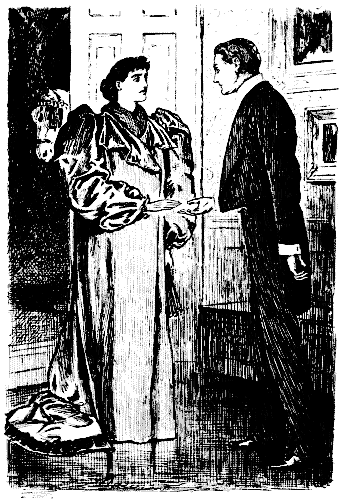
Host. "You'll have a nice drive home!"
Guest. "Yes; that's the best of it!"
DRESS À LA PREMIÈRE MODE.
(A Dialogue Pastoral and Sartorial.)
Scene—A Boudoir. Present—A Lady and her Modiste. Time—The passing hour.
Modiste. No, Madame, it is utterly impossible for you to wear silks and satins. They have quite gone out.
Lady. But hasn't alpaca come in a little?
Modiste. Scarcely. It may be used for divided skirts at Battersea Park, but it is not really recognised.
Lady. Then what am I to wear?
Modiste. Flowers, Madame, flowers. Of course they should be fixed on foundations, but they are the only materials used at the present time.
Lady. Are they not rather expensive?
Modiste. Well, no. I shall not charge more for them than velvet or brocade. And, of course, if you choose to wear your dresses more than once, your maid can get them renovated with new flowers at an almost fabulous reduction.
Lady. I do not think a gown ever looks well when worn a second time.
Modiste. Quite so, Madame; quite so. Well, would you like a charming dress of pink hyacinths, with bishop's sleeves of Gloire de Dijon roses? The skirt would be of variegated lilac.
Lady. But could you get the material for the floral combination?
Modiste. Oh dear yes, Madame! Since the fashion for real flowers has come in we are supplied daily from all parts of the world, and have a large stock always at hand on the premises. Why, our greenhouses are the finest in London. Will you want any other costume to-day?
Lady. Only one for a small dance to-morrow. I want something cool and quiet.
Modiste. You can scarcely do better than wear a costume d'Eden, or as it is facetiously termed in England, "a dress for Eve." It is an arrangement in oak leaves and apples à la mode de la première femme du monde.
Lady. Very well. Let me have it home by eleven.
Modiste. You can depend upon my punctuality, Madame. If you are careful not to dance too much it will last until 2 A.M., and permit of your partaking of supper. I would not say this with confidence of all the gowns I turn out, but in this instance you will find leaves stronger than flowers. And now, Madame, permit me to take your measure.
[Scene closes in upon mysteries of the toilet.
AFTER THE CONGRESS WAS OVER.
(A Strange Fragment dealing with a Mystery.)
Every important question that could be considered had been thoroughly examined and decided. The delegates, who had come from North, South, East and West, had expressed their satisfaction with everything they had seen in London. As for the British Empire generally, their admiration knew no bounds. "It was magnificent." "It was beautiful." "It was grand." And yet when they prepared to take their departure there was a shade of disappointment upon their expressive countenances.
"I wish I could have understood it," said one.
"It would have been a triumph of ingenuity to have comprehended it," observed another.
"The queries of the Egyptian Sphinx were the easiest of conundrums in comparison," added a third.
And others chimed in to the same effect. But to the very last the delegates tried their best to solve the problem. At length the company departed. The hall in which the great assembly had been held was empty. There was one striking object in the deserted apartment. It was a book—a yellow-covered book. Evidently it had been much read. But, in spite of the fingering, there was no distinct evidence that the full meaning of its contents had been grasped by anyone.
In the quiet of the night the moonbeams illuminated the title-page.
The volume that rested so securely with its knowledge carefully concealed between its paper covers was Bradshaw's Railway Guide.
Who Wouldn't be an Alderman?—I have often wished to be an Alderman, and, after reading the following extract from the Birmingham Daily Gazette, I have fixed upon West Bromwich as the scene of my aldermanic labours. It must be glorious to joke with such ease:—
"A West Bromwich Alderman's Joke.—Yesterday morning when the West Bromwich guardians entered the Board Room at the West Bromwich Workhouse, the blinds were all drawn, and as a consequence the room presented a very gloomy appearance. The business was about to be commenced, when Alderman R. Williams objected to the blinds being lowered. He inquired whether their lowering had a political significance, and whether the house was in mourning for the death of the Radical Government. If his assumption was true he considered they should not commence the business until the blinds were raised (Laughter.) Two of the largest blinds were then raised, but six others were allowed to remain down."