BLIND ALLEY-GORIES.
Reading edition
By Dunno Währiar.
(Translated from the original Lappish by Mr. Punch's own Hyperborean Enthusiast.)
No. III.—A Socratic Experiment.
The other day I went out for a walk. My thoughts circled round my head like bees in a bonnet, and detached themselves slowly from the loose white honeycomb of my brain to mirror themselves in my soul, as is usual with me on such occasions. And, somewhere round the corner, a voice lurked calling out remarks—what I knew not, only that they were of a highly personal character. The people I met stared at me, and I stared at them, for I had a presentiment that they were talking about me, but I took no notice of them—beyond informing them that they were cowards and blowflies, and requesting to be informed why they enclosed their dirty interiors in glass. For I am Young Garnaway, and when I take a walk, I generally exchange amenities of this kind with any persons I happen to meet.
At the Market Place, my friend the Tallow-chandler sat inside his shop, dozing under a pale canopy of farthing dips.
"Answer me a question," I begged of him. "Why does one yearn for the top brick off the chimney when one is a child, and yet feel dissatisfied when, as a man, one receives it on the top of one's Sunday tile? Why does the sea bird fly inland in winter to get food from the towns—only to turn up its beak when presented with a ticket for soup? Why do we——?"
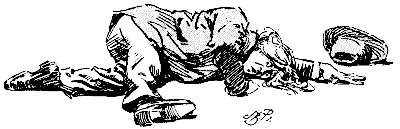
"A clear and practical illustration."
My friend the Tallow-chandler answered never a word, but chuckled foolishly to himself and retired behind a barrier of mottled soap.
When I had gone a piece further I reached a back street, where I found my friend the Bird-stuffer sitting on his doorstep, playing the mouth-organ.
"Answer me a question," I besought him. "Suppose you found out that those who hold the reins of government in our town were educating large blue-bottle flies to make apricot jam out of your and your neighbours' pig-wash, would you write to the local paper about it, even if you knew that the editor would decline to insert your letter?"
My friend answered never a word; he only giggled in embarrassment, struck up a mazurka on his mouth-organ, and began to dance sheepishly.
But, down in Mud Alley, my friend the Dustcart-man sat at his open window—a family idyll, wife and six small children, all eating onions and fried fish.
"Answer me a question," I prayed him. "If a person came to you and said rudely, 'Better anything else than sitting here with your head in the domestic halter among the potsherds and puffballs of the old ideals; rather a jolly good row that ends in a fortnight's "hard" than fat-headed, elephant-footed dulness here with your buzzing brood around you!' If a person came to you and said that, what reply would you give him?"
My friend answered never a word; he was out of the window before I had time to walk away; and in a very few moments I received a clear and practical illustration of the sort of reply he would give to such a question.
As for me, I limped home as well as I could, and, when evening fell, and I was done up in brown paper and vinegar, both my eyes gleamed in the evening sun with the iridescent glitter of peacocks' tails.
"FOR THIS RELIEF, MUCH THANKS!"
["Fort Chitral, April 20.—Colonel Kelly's force from Gilghit arrived to-day.... Much sickness from bad food, excessive work, and exposure. Conduct of troops admirable.... The discipline, devotion, and fortitude displayed by all ranks under circumstances which required all those qualities are beyond all praise."—Dr. Robertson's Summary of the Siege of Chitral.]
"Small time, but, in that small, most greatly liv'd This star of England." Chorus: King Henry the Fifth, Act V., Scene 2.
Only one more "little war,"—of course, Precipitate pluck, and inadequate force— Such wars as our England wages At terrible cost in British lives, And orphan children and widowed wives, Whereat, though greatly our glory thrives, Our conscience sometimes rages. But such little wars may need great hearts, And the wandering heroes who play their parts For England, the wide world over; Fight as well though they fight—and fall— In a leagured hut, by a shattered wall, As though the purple of Wellington's pall Each death-cold breast should cover. Devotion, fortitude, discipline? Yes! They always shine in the perilous press, Where British soldiers rally. Shine as bright in the hopeless dark Of the mad mêlée, though there's none to mark The scattered wreckage ruddy and stark Of the last brave stand or sally. We rejoice to hear, though we knew we should, Chitral's defenders again made good The glorious old tradition Of loyalty to the flying flag. Cynics may dub it the torn red rag, But our tongues shall laud, whilst those tongues can wag, That splendid "superstition." The men who stood, and the men who came O'er ice-bound ridges with hearts aflame, To relieve their leagured brothers, Have all done well; and the tawny skin Of those who helped us to war and win,— Well, your little Englander's less akin To England than those others! "For this relief, much thanks!" And thanks To dead, and living, and of all ranks. Forget their service? Never! "Small time," indeed, but as brightly shone "This star of England," as it had done On that stricken field when the lurid sun Of the Corsican sank for ever.