A FIRST STEP TOWARDS HISTRIONICS.
Reading edition
(Under the guidance of Herr Goethemann.)
Question. Have you witnessed the performance of the Actor-manager?
Answer. No, but I have perused the tragedy of the Author-publisher.
Q. Is it a curtain-raiser?
A. No, but it is a hair-lifter, in three acts.
Q. How many are the persons of the drama?
A. Four.
Q. Of these, how many are objectionable?
A. Five.
Q. Kindly resolve this paradox.
A. All are objectionable that come on the stage, and one that doesn't.
Q. You speak of the stage; where has the play been given?
A. Nowhere. It has not received a license.
Q. Is it the close season?
A. No, but so much private license was taken by the Author-publisher that the public censor did not see his way to adding to the amount.
Q. Then we shall not see it interpreted by intelligent actors?
A. No, for even if license were granted, the Author-publisher would take all the parts himself.
Q. I do not follow this scheme of plurality.
A. I quote from his own printed advertisement, "The right of performing in public this play (sic) is reserved by the author."
Q. Did you state that it is a tragedy?
A. Yes, but inclining to farce.
Q. Does it move the reader to pity and terror?
A. Yes, both. Pity for himself, and terror of the next thing of the kind that he may have to read.
Q. Has it any other of the high qualities of the Greek Tragedy?
A. It says it has the unities.
Q. A severe attack?
A. No, the Norwegian kind; a form of Teutonic measles, painful but transitory.
Q. Is it heroic?
A. No, but it is suburban.
Q. Is the conclusion worthy of a great tragedy? Does it end in a lurid light of whole-souled passion and death?
A. It ends about 4 A.M. the next day, with a cock crowing. The protagonist has come home intoxicated, and remains so. I regret to add that he pushes the heroine, she having displaced his beverage by breaking the glass. She slaps him upon the face, and eventually loses animation. I do not know how the other two end, because they were not home in time for the curtain. As it was, the Author-publisher nearly spoilt one of the unities through waiting for them.
Q. All must be well that ends so well. Is there a problem or enigma?
A. There is always the insoluble riddle—why did he write it?
Q. Is it full of situations?
A. Not inconveniently so; but there is a dramatic moment.
Q. Which?
A. I do not know.
Q. Then why do you say there is one?
A. Because the Author-publisher says so.
Q. But is it not wasteful to have three acts, and only one dramatic moment?
A. I should have thought so; but the Author-publisher says he has shown economy.
Q. Could you give me an idea of the manner? Select a striking incident or a passage where there is subtle characterisation.
A. One situation impressed me very much. I think it must have been the dramatic moment. I reserve it for my next.
(To be continued.)
FILIA PULCHRA, MATER PULCHRIOR.
I loved a girl, divinely sweet, An unsophisticated creature; I did not scruple to repeat She was divine, you could not meet More charms displayed in form and feature. I loved her youthful grace, her slight And dainty form, an angel's seeming. Crowned by sweet hair, as dark as night, Her face would charm an artist's sight, A poet's thoughts, a lover's dreaming. I loved her dark and lustrous eyes, Which love might light with glowing passion, Her lips, her neck—you will surmise I wrote her rhymes, all tears and sighs In lovesick versifier's fashion. I loved her like a childish pet, I felt I could not love another, Until the day when first I met Her widowed mother, charming yet, And now, instead, I love her mother. I love the woman, for the rose, Full blown, excels the rosebud's beauty, Nor think of girlish charms since those No more inspire my Muse, which shows My Muse is fit for any duty. I love her, stately as a queen Whom Veronese might have painted, Blue-eyed, with hair of golden sheen— That's just the one thing which has been A trouble since we've been acquainted. I love not charms I loved before, Dark as the night, or, say a hearse is. Now auburn beauty pleases more, My wasted hours I deplore— I've had to alter all those verses.
Epping and Overstepping.—At a meeting of forest borderers, Wanstead, it was asserted that since the Corporation had had control of the forest, upwards of 100,000 trees had been felled. If true, the members of the Corporation-Epping-Forest-Committee will henceforth be known as "those fellers!"
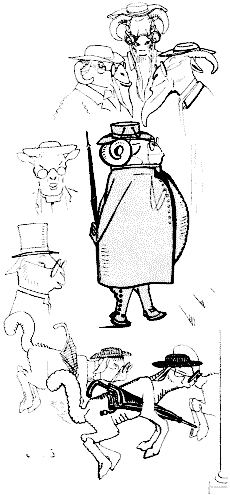
"ANIMAL SPIRITS."
No. XII.—Outside Exeter Hall.
TO CIRCE.
"If doughty deeds my lady please," Though somewhat old and gouty, The first occasion I will seize Of doing something "doughty"; "If gay attire delights your eye, I'll dight me in array" Which every casual passer-by Will think extremely gay. "If sweetest sounds can win your ear," I'll cheerfully begin (Though somewhat late in life, I fear), To learn the violin; In fact, whatever task you set, You'll speedily discover That in the writer you have met A most submissive lover. I could exemplify the fact Through several extra verses, How I would please, by every act, My kindliest of Circe's; And yet by destiny malign You've happened just to choose The single task which, though divine The bidder, I refuse. The single task—and pardon, pray, If, not without compunction, Reluctantly I disobey Your positive injunction: Ask what you will, I'll undertake The deed, however big, But do not——blind my eyes and make Me try to draw a pig!
TO A PICTURE.
You pretty face, upon my wall, Enshrined in glass and oak and gold, Most charming deaf-mute—and withal My confidante—whate'er befall, My trust in you will rest untold, You pretty face! What do they call you? Is it "Spring"? Or "Blossoms"? or "The Coming Race"?— It matters not in any case, Your name may be just anything For all I care, you pretty face. You bring me back old scenes anew, You've something of my lady's grace, Of her sweet features just a trace, And so I have re-christened you— I won't say what—you pretty face! I have no portrait to recall The sweetest of all maids to me, Nor have I need of one at all, Yet, seeing you upon my wall, By pleasing "make-believe" I see Her pretty face!