ESSENCE OF PARLIAMENT.
Reading edition
Extracted from the Diary of Toby, M.P.
House of Commons, Monday Night, April 8.—House to-night presented that appearance seen only on big occasions. Long unfamiliar in slough of despond in which present House been steeped since Session opened. Every seat on either side occupied. Members sitting on Gangway steps, flooding the side galleries, blocking the Bar, peopling even the steps of the Chair. Arthur Peel is leaving historic stage graced through eleven years in fashion that has added fresh fame to an illustrious name. On ordinary occasions when Speaker rises to address House on current topics of business, Members who chance to have their hats on keep them there. Now, when the stately figure is discovered standing under the canopy of the Chair, Members without concert, but with one accord, bare their heads. Throughout a moving scene, which crammed much into fifteen minutes, nothing more striking than this simultaneous, swift uncovering of the head, and the transformation that followed when the rare sunlight, streaming in from western windows, fell upon five hundred unshaded faces all turned towards the tall, gowned figure standing by the Chair.
The speech will be read to-morrow by millions, who will find it word for word and sentence by sentence in the newspapers. But the reader will gain but faint idea of the impression the delivery produced. The historic place, the animated scene, the electric current of such a gathering, were much. The effect was perfected by the elocution of the Speaker, perhaps the most perfect development of an attractive but dangerous art possessed by living man.
What possibilities underlie its possession were wonderingly recognised in the last days of the late Parliament, when the directors of the Cambrian Railway Company were brought to the Bar of the House in connection with the dismissal of a station-master who had given unwelcome evidence before a Select Committee. House in the ludicrous pickle which invariably follows on Privilege proceedings. Directors summoned to attend were somewhere in the lobby. If it had been permissible to follow Dogberry's example in similar circumstances—to take no note of directors, but let them go and presently call the rest of the watch together, and thank God they were rid of the knaves—it would have been well. But, directors being solemnly summoned, must needs be adequately dealt with. Finally resolved that Speaker should admonish them. Amid much giggling on part of hysterically uneasy House, conscious of its own ludicrous position, directors brought in and ranged at Bar. Then Speaker stood up and "most seriously admonished" them.
No one present will forget the awesome mien, the terrible voice, with which the task was performed. At a touch farce was transformed into tragedy. Dignity of House, sorely imperilled, triumphantly vindicated. To-night the Speaker's phrasing was perfect. Its setting in the delivery is untranslateable in speech or written word.
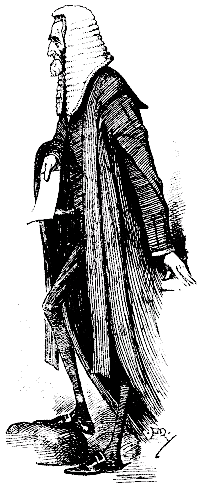
Farewell to Mr. Speaker Peel.
Business done.—Speaker announces resignation. Squire of Malwood brings in Local Veto Bill.
Tuesday.—"Poof!" said Sark, mopping his brow; "glad that's over. No knowing where it might have ended. Danger of last scene in Speaker's leave-taking closing amid burst of irritated laughter. When I was first returned, we thought two leaders enough for one House. There was the Government man on the Treasury Bench, the Leader of Opposition on bench opposite. When ceremonial business to be done, these two spoke and the whole House agreed that its opinions had found expression. House rapidly growing into position akin to home forces of Prince of Monaco. Nearly as many captains as privates."
These remarks wrung from troubled breast by long, at one anxious moment apparently interminable, procession of orators in support of resolution thanking retiring Speaker for services in Chair. Squire of Malwood said right thing in admirable way. Prince Arthur, less ornate in phrase, supplied a perfect second. These speeches voiced feeling of Ministerialists and Opposition. Some reasonableness in Justin McCarthy's interposition, he being leader of distinct party which, as he hinted, had in earlier days done battle with Speaker. But really, when it came to Joseph saying a few words for his merry men, and John Redmond tuning afresh the Irish harp on behalf of his, prospect grew alarming. If these leaders of sections within a division felt called upon to make speeches on such occasion, why not John Burns as a Labour Leader, with Keir Hardie to follow as captain of the Independent Labour Party; Osborne Morgan, purged of profligacy, speaking for Wales, followed by Lloyd-George from below the Gangway; Wilfrid Lawson for the Temperance party; Private Hanbury as representing the land forces of the Busy B's; Cap'en Tommy Bowles the naval; Jacob Bright returning thanks for the ladies, Walter M'Laren speaking specially for the section who desire to marry their deceased husband's brother? Domesticity thus trenched upon, Baron de Worms, with wistful "Long-Lost-Dear-Father" look on his face, might close the list by a few words spoken on behalf of the family circle.
To-day stopped a little short of this; but shall doubtless go the whole way next time opportunity presents itself. Business done.—Thanks of House voted to Speaker.
Wednesday.—By contrast with ordered speech-making of yesterday afternoon scene that took place in earliest moments of the new day's birth prettier by far. For upwards of an hour Members passing out homewards stopped to shake the Speaker's hand and bid him farewell. Just before quarter of hour chimed after midnight, Arthur Peel spoke his last words in House of Commons.
"The question is," he said, "that this House do now adjourn."
As he turned to leave the Chair, Members present sprang to feet, cheering continuously till Arthur Peel, for the last time robed in Speaker's wig and gown, passed out of sight.
For Lochaber no more, Lochaber no more. We'll maybe return to Lochaber no more.
Le roi est mort. Vive le roi. William Court Gully elected Speaker by majority of 11 in House of 559 Members.
Business done.—Elect new Speaker, and immediately give him ten days' holiday. Adjourn till Monday 22nd.
A STUDY IN ETHNOLOGY.
Upon my luck I still reflect, That led us to the same Museum: I greeted you with staid respect, But my heart sang its own Te Deum, And blessed your Uncle, ere I wist, For being an ethnologist! On old Assyrian spoils intent, Our very presence he forgot, While we o'er strings of wampum bent— We saw them and we saw them not. He lived within a past long dead, We, in the seconds as they sped. Within a carven mirror old, Suddenly, as we wandered by, You looked upon your hair of gold And flushing face, and so did I. Then on we passed: a vault we found, And Pharaoh's coffin, underground. Oh, if his phantom ever stood Beside the coffin made for him, And saw you in your joyous mood, With your bright eyes and figure slim, King Pharaoh might have envied us Beside his old sarcophagus! But, Pharaoh, we, remembering The ancient creed that souls of men May see the summer and the spring, May live again, and love again, A moment wished the tale were true, Because—it seemed so hard on you!
Wanted in the World of "Art."—A Spring Clean!
TO A YOUNG ACTRESS.
You regret that all you do Is to be a lady who Just walks on—a smile or two, Then you're gone; For you think that any gawk Would be good enough to walk, You undoubtedly should talk When you're "on." You are but a sort of show. Silence for a girl is slow, Speech is woman's right, I know That is true, And although your pretty face Charms beholders by its grace, You would like a higher place, Wouldn't you? But we cannot all have "leads," Nicely suited to our needs, To excel in words and deeds, Don't you see? So, if you desire to speak, I am not so far to seek, I would listen for a week— Talk to me.

Something Yet!—"Mr. G." is a proficient in several languages. In Italian, as well as in Latin, in ancient and modern Greek, he can, we believe, converse fluently, when anyone gives him a chance. With Russian he may be acquainted, for, as this is "caviare to the general," it may be equally so to an ex-prime-minister. With Spanish Mr. G. is, probably, not on speaking terms, though, no doubt he is well up in the niceties of the language; and there are many spoken languages of which he possesses more than a smattering. But the accomplished scholar has yet something to learn from one Richard Cumberland, a bishop in the last century, not the playwright, of whom it is on record that, being a proficient in most ancient and modern languages, he "began to learn Coptic at the age of eighty-three!" Although Mr. G. has gone very far north, yet has he not at present got up to Cumberland.
A Suggestion.—There are two excellent waters, Apollinaris and Johannis, known to everyone as "'Polly" and "Jo." Might not the two companies amalgamate, and reproduce the success of "My 'Pol' and my Partner 'Jo.'"
Latest Equivalent for "the East Wind," as Replenishment for Hungry Stomachs.—The Royal Commission on the Aged Poor.