A MISMANAGED ACCIDENT.
Reading edition
Have just discovered that the pretty girl I met at the dance the other night is a lady nurse at Charing Cross Hospital. Such a nice girl! What a charming nurse she must be! Almost wish I was laid up at the hospital. In fact, quite wish it. But I can't be. Another outrage on the miserable, downtrodden, middle class. If I were one of the fortunate, pampered masses, a Working Man, I should be nursed by her, if I were ill, and by others, perhaps, like her. Stay! There is a chance. If I could be damaged in an accident—not too much damaged—and carried to the hospital, they must look after me, and nurse me. They couldn't help themselves. Northumberland Avenue—the very place! Never cross it without being nearly run over.
Go straight there and look eagerly for the usual rushing hansoms. Here's one. Stroll in front of it. Driver pulls aside, shouts and swears at me, and goes on. Reflect that some caution is necessary. If the wheel went over my neck, even her ministrations would be useless. Must be run over judiciously. Better only be knocked down. Stroll across road again. Here comes one. Shouts from driver. A large splash of mud in my eye. And that's all. These cabmen drive so absurdly well. They pull up, or pull aside, or pull somewhere instantly. Wipe my eye, and then see something better. Old lady's brougham, from the suburbs, driven by the sort of coachman who also works in the garden. He won't be able to pull aside quickly. Stroll in front of horse. Shouts from gardening coachman. Horse nearly on me. Suddenly pulled back by fussy policeman, who says I had a narrow escape. Hang the fellow, of course I did! Am obliged to give him ten shillings for his prompt action. Begin to despair of this accident. Stroll on nearly to Embankment. Immense van coming along at a trot. Much too heavy. I should be smashed flat. And this driver seems to want to run over me. Escape with difficulty by jumping aside. At that moment something hits my legs, I am thrown down, and a wheel passes over my foot. It is a costermonger's donkey-cart which was racing the van. How ignominious! To be knocked down by a donkey and run over by a truck! Very painful too. Feel as if I should faint. Picked up by sympathetic people who rush to me. Say feebly to them, "Take me to the hospital." Then faint.
After a short time open my eyes. Am being carried in somewhere. At last! I shall forget the pain. I am in the hospital. She will nurse me! She—oh, heavens! Though I have planned it all, suppose I ought to murmur, "Where am I?" Do so. "In St. Thomas's Hospital," says somebody.
A fortnight later.—And I am in it still.
According to a paragraph last week in the Westminster Gazette, quoting from the Australian Review of Reviews, it appears that the Earl of Yarmouth has been making a sensation in the Colonies as a "Skirt-dancer." Queer fish this nobleman! belongs to the Bloater Aristocracy.
A Noble Plunger.—One day last week in the Times appeared an article headed "Lord Rayleigh on Waves." Rather early for sea-bathing, eh? Evidently so, such prominence having been given to the fact by the leading journal.
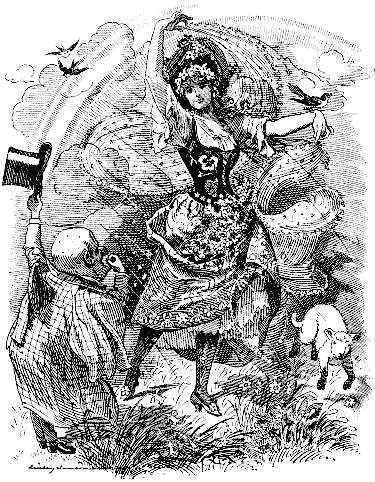
"BETTER LATE THAN NEVER.
Mr. Punch (welcoming Miss Spring-time). 'Glad to see you, my dear! Began to think you were never coming!'"
"ANIMAL SPIRITS."
No. XI.—After Bank Holiday.
"BETTER LATE THAN NEVER."
Mr. Punch to Miss Spring:—
Well, here you are at last, dear! Are the biting blizzards past, dear? And will you guarantee us from subjection to the plumber? Will no casual icy splinter from the serried spears of Winter Put a chill upon your smile, and spoil the promise of the Summer? We've been waiting worn and weary, till e'en cuckoo-songs sound cheery, And belated almond-blossoms show like roses of Cashmere: And the cockney chaunt now flowing, "All-a-blowing and a-growing!" Falls far sweeter than Mascagni upon London's longing ear. Where on earth have you been hiding? We are in no mood for chiding, But mid-April's rather late, dear, for what should have come in March! What malignant hocus-pocus has kept back the plucky crocus, Whose gold is scarce yet bursting from the beds the winds still parch? After that six weeks cold snap, dear, of fast frozen pipe and tap, dear, When back to barbarism and to bathlessness fate drove us, And we sicklier grew, and surlier, if you'd come a leetle earlier,— Well, let bygones now be bygones! But O Spring sweet! an you love us, Come—at last, dear—à la Herrick, with such influence atmospheric As will slay the Influenza; with such fragrance from your flowers, As will knock Malaria silly; let your dear daffydown-dilly From our bodies drive bacilli, and the blight from out our bowers. Slay our Microbes, Spring, and bless us! Like a clinging Shirt of Nessus Morbid sickliness surrounds us in our lives, our books, our art. Oh, if sunshine and your breezes might but slay our soul-diseases, Oust the pestilent miasma that pervades the home, the mart; Neutralise the nauseous virus whose developments so tire us; Disinfect the New Parnassus, purge the New Pierian Spring, Bring us honesty and health, dear, why for all our wit and wealth, dear, We might love like Nature's lovers, and like Nature's poets sing. Ah! we need Spring's prophylactic!—But I'm getting too didactic For a sunny April morning, and a sweet young thing like you. My dear, the London Season, wrapped and furred out of all reason, Has been waiting, decked like Winter, with a nose-tip nearly blue; Waiting, waiting for your coming. Sweet as bees in clover humming Is the first sound of your footfall. Most spontaneous of passions Is the love for you, you darling. You will bring the thrush and starling, And the young leaves and the young lambs, and, what's better— the Spring Fashions!!! So no wonder that she greets you with effusion when she meets you. Ah, Spring! 'tis not your lilacs, and your daffodils and stocks, Or the tender leaves the trees on, that most moves Miss London Season, 'Tis the hope of "rippin'" frolics and the thought of "trotty" frocks. But an old man's heart, my treasure, beats to quite another measure, Still my sympathies, dear Spring, are with the youngsters and with you. They are looking for love's playtime, and the merry, merry May-time, And the popular R.A. time, and the whole tohu-bohu! Bring the girls delights as dowry, may their social paths be flowery, And your silver drops the only tears they need to look upon. So they're wholesome, may they flourish; and may all Spring influence nourish True manhood and pure womanhood, and—there, my preaching's done! We need a true Spring Clean, sweet. Give us parks and gardens green, sweet. And laughter, like your bird-songs pure, un-satyr-like, though clever, Bless our boys, our girls, our babies, yes—and bring us back our Jabez, And we'll pardon your delay, and say 'tis better late than never!
Opportunity lost by Mr. Justice Hawkins during a recent Case when His Lordship might have put it to the Jury.—"Gentlemen, what is the difference, or, as there has been no quarrel, let us say what is the distinction between a costumier and a butcher anxious to arrange his shop-front to the best advantage? Gentlemen, I will not detain you, it is this: The costumier meets out the dresses; the butcher 'dresses out' the meats. Gentlemen, you are discharged."
To Charitable Chess-Players.—A good move at Easter time is—"cheque to his Bishop."
BLIND ALLEY-GORIES.
By Dunno Währiar.
(Translated from the original Lappish by Mr. Punch's own Hyperborean Enthusiast.)
Introductory Note.
IT affords me no ordinary gratification to be the humble instrument in rendering these exquisitely obscure prose-poems—reeking as they are with the self-consciousness of so magnificently triumphant an Ego—into the English tongue, though I am fully aware of the difficulty of preserving all the mystical unintelligibility of the original.
Dunno Währiar is perhaps the most remarkable personality that his native Lapland has yet produced. He first saw the light on April 1, 1879, at Kandalax, so that he may still be called comparatively young. His impressionable, sensitive soul broke out in early revolt against the train-oil and tallow which formed the traditionary nutriment of his family circle, and in 1883 we find him casting off the shackles of conventionality and escaping to Sweden in his sledge-perambulator. There he has lived ever since, and has already secured a foremost place among the greatest physiological psychologists of Scandinavia. As a morbid pathologist, he surpasses Strindberg; while in neurotic sensitivism, he has hustled Hansson into a back seat; easily beaten Björnson in diagnosis of the elusive emotions; and taken the indigestible cake of slack-baked symbolism from the master hand of Ibsen himself! Small wonder, then, that the commonest penwiper containing issues from his pen is eagerly sought after by admirers of such effusions.
He belongs ('tis true) to the Literary Upper Crust, and is for the few rather than the many; while so absolute has been his fidelity to the principles of his art, that he has published every one of his works at a considerable pecuniary loss.
Need I say more to ensure for him that respectful admiration which the public is ever ready to lavish upon anything they fail to understand?
Let me rather efface myself and leave Dunno Währiar—or "Young Garnaway," as is his self-adopted pseudonym—to unfold the rhythmic charm of his own inimitable incomprehensibility.
BLIND ALLEY-GORY THE FIRST.
THE LOST BACKBONE.
One summer evening, when the moon was at the full, and cloud-shadows glided imperceptibly over the chimney-pots, as curses that have found no utterance and come dejectedly home to roost, I wandered into my back-garden, and caught the God of the Period napping in the moonshine on one of my celery-beds.
He rose up suddenly and reposed awhile in space, with his head resting on the back of the Great Bear, and one foot on the arm of Cassiopeia's Chair, while with the other he skimmed the cream off the Milky Way. And he seemed to be everywhere and yet nowhere in particular, and he said nothing, and I was afraid to make a remark—and there was no sound, save that of the boundless, inconceivable silence which was rumbling round the corner.
Presently he came down to the celery-bed once more.
"What are you seeking for so late?" asked he; "your face looks so long and solemn, and your eyes are hollow and full of woe. Have you been having anything indigestible for supper?"
"I am in trouble about Humanity," I replied; "for, though I loathe and despise them individually, collectively I love them dearly."
"What's the matter with Humanity?" asked the God, as he squatted amid the celery.
"They are growing so deadly dull," I answered. "I am Young Garnaway, the Pessimistic Prose Poet, and it pains me to see how utterly they have lost their perception of the ridiculous, which is the backbone of real enjoyment. So I came out to see if by any chance the backbone was hidden under one of the flower-pots."
"I saw many myriads of spectral kitten forms and unsubstantial egg-shapes."
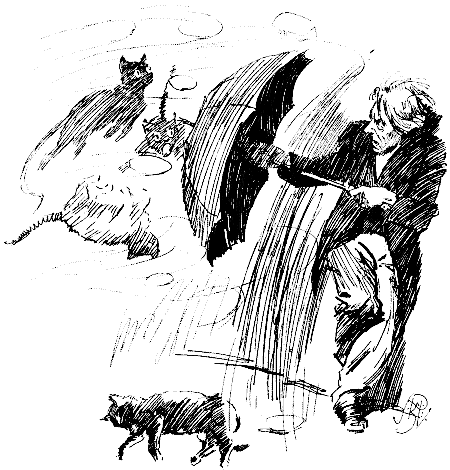
The Period-God once more pervaded the endless space that glittered in darkling infinitude round about and right ahead of him. It seemed to me, when he returned, that he had been laughing; but suddenly I saw him pull himself together, and frown.
And from afar a gurgling rose through the gloom, and darkness fell upon my back-garden, knocking a basilisk off the waterbutt, and above the garden-walls there appeared a crowd of rude persons, in pot hats, with red lolling tongues and wide grinning mouths, holding their sides with inextinguishable mirth. All at once the giggles turned into the booing of Philistines, and there was a fantastic shadowy horseplay, which rolled nearer and nearer.
I saw many myriads of spectral kitten forms, and unsubstantial egg shapes rushing towards me through the air. Instinctively I ran indoors and gripped the umbrella from its corner, and stood on guard.
Then I heard someone chuckling quite close to me, chuckling softly, but unmistakably. And the booing hushed, and the gloom lightened, and the garden-roller glimmered faintly in the moonlit summer night, and inside the lawn-mower lay the God of the Period crying with uncontrollable laughter.
"When the time comes," he said, "when mankind gets weary of Paraded Pessimism, and the Big Scandinavian Boom has burst, then I will conjure forth the Great Guffaw; and then it will be time for all Dyspeptic Decadents to get under their umbrellas—just as you did awhile ago, for mankind will have recovered its sense of humour, and will decline to take them seriously. But you had much better leave off bothering your head about that lost backbone, for you won't be happy when they get it!"
And while I was taking off my goloshes indoors, I heard again the sound of snapping celery sticks, as the Period-God rolled on the bed in ecstasies of stifled merriment, and I wondered at intervals what it was all about.
For Outward Application.—"'A man may change his skies,' as the Roman poet puts it," quoth the Daily Telegraph, "but he does not so easily change his habits." The Academy is about to open. The pictures will soon be hung. Varnishing day comes, with last chance for alteration. Then comes in Latin poetic proverb, "A man may change his skies, but, do what he will, he cannot alter that peculiar style that marks the work as his, and nobody else's."
New Proverb.—All "problem" and no "play" makes drama a dull joy.
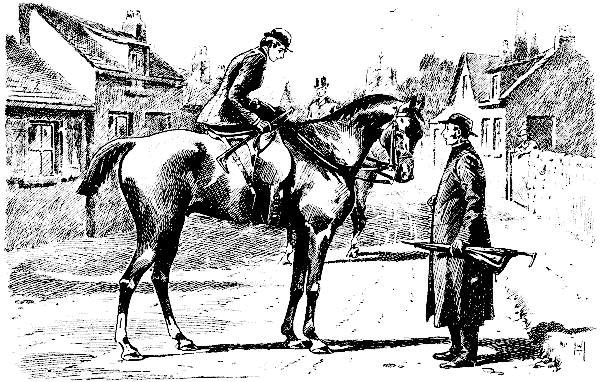
SHOCKING HEATHENISM.
Rector. "So you go up to Town next month, Miss Mary. How I envy you! And of course you'll attend the May Meetings."
Miss Mary. "May Meetings? Oh dear no! Though I adore Horses, I quite disapprove of Racing, don't you know!"