OUR BOOKING-OFFICE.
Reading edition
General Adye has added to our national war story Recollections of a Military Life (Smith, Elder & Co.). Sir John has not been in a hurry. He began fighting more than forty years ago, and has since filled up opportunity as it presented itself. These particular recollections are chiefly occupied with the Crimean War and the Indian Mutiny, though the old soldier has something to say about the Afghan War of 1878-9, and the Egyptian War of 1882. My Baronite finds most interesting the chapters about the Crimean War, certain incidents and episodes of which are narrated with soldierlike directness and simplicity. The story of the Balaclava Charge has been told in verse and prose innumerable times. General Adye did not actually see it, "a ridge of intervening hills intercepting the view" as he rode back to the camp from Balaclava. But he manages in a sentence or two vividly to impress the scene on the mind of the reader. Among many good stories is one about General Harry Jones. Pelissier, with a Frenchman's scorn of any language but his own, got as near as he could to ordinary pronunciation when he called him "General Hairy-Joze." He did better when the gallant General was knighted, and was alluded to respectfully by the French Commander-in-Chief as "Sairey-Joze" (Sir Harry Jones).
The Baron de Book-Worms.
A Quip.
Mr. Arthur Toller has been appointed to the Recordership of Leicester. He is an able man. "Argal," as the Shakspearian Clown would say, "the appointment is just Toller-able."
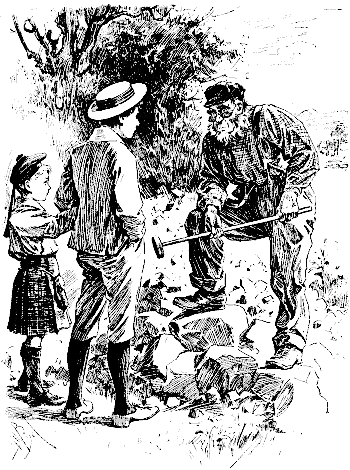
MAGNIFYING HIS CALLING.
Peter. "Na, Laddie, this is ane o' thae things a Body can never Learn. There's no nae use in a Man takin' tae this job unless he has a naiteral born Aptitude for 'd!"
THREE MODES OF SPENDING A BANK HOLIDAY.
(By a Confirmed Pessimist.)
Plan the First.—Take to Volunteering. Be up at daybreak. Leave your home after snatching a hasty breakfast of lukewarm tea and stale bread-and-butter. Crowd into a railway-carriage, and travel a hundred miles or so in the greatest discomfort. Fall in with your company. March, counter-march, and stand at ease for ten hours or so in sunshine, rain, fog, or snow. Stave off starvation with a packet of sandwiches and a bottle of ginger ale. Dead beat, enter crowded train a second time, and again travel a hundred miles or so in the greatest discomfort. More dead than alive, stagger home, and wearily roll into bed.
Plan the Second.—Try a trip to the sea-side. Share a first-class compartment with a dozen third-class passengers. Travel to Shrimpington with the accompaniment of rank tobacco-smoke, comic songs, and solos on the concertina. Get to your destination with a splitting headache. Find that all the shops are shut, and all the taverns open. Learn that Shrimpington, as represented by its respectable inhabitants, goes away en masse on a bank holiday. Discover that there is but one hotel in the place. Ascertain that at the solitary hostelry the rooms are filled with noisy excursionists, greedily devouring "the shilling tea." Search for nourishment, and fail in your search. Fall back upon stale buns at a third-rate sweet-stuff shop. Catch your train back, and endure the torture of the morning. Travel amongst the same company, under the like conditions. Reach home hours later than you proposed on starting, and consider whether the holiday has been a triumphant success or a dismal failure.
Plan the Third (highly recommended).—Although desiring change, remain at home, choosing the lesser of two evils.
Mr. Gully.—"William Court Gully, M.P."—certainly "Caught Gully" at last. Now the question is, "Will Gully" be acceptable to all parties "E-gully"?
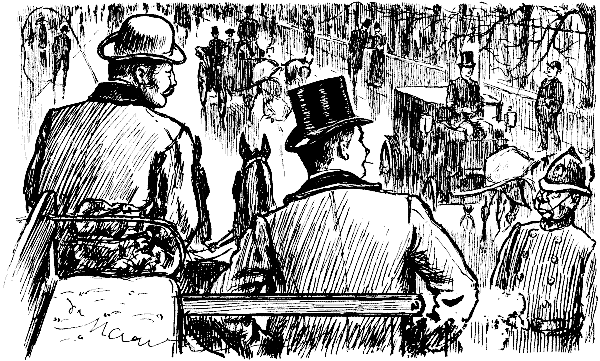
GENTLE IRONY.
'Bus Driver (to ill-favoured Policeman, who has stopped him at a crossing). "When are yer goin' to let me 'ave that Photo?"
NOT DONE YET.
A Song of St. Stephen's School.
(To the Air of the Harrow Song, "Fairies.")
When in the Springtime cold and bleak, In spite of wind and weather, The Blues and Buffs, the strong and weak Throng out of school together; Off to their homes alert and gay From long sederunts risen, Majors and minors rush to play, Live lags let loose from prison. There you behold "Big Bill," the bold! Hear how his heart rejoices— "Ho ho! ha ha! Tra-la-la-la!"— Booms his most bass of voices. He cocks a snook at slate and book. He's had his work this term, boys, But has contrived, by hook or crook, To keep his footing firm, boys. He's had to fight, like Dibdin's tar, 'Gainst many a would-be boarder. It needed wit as well as war To keep the school in order. But he has shown both wit and grit, And patience linked about it. "Ho ho! ha ha! Tra-la-la-la!"— Young Arty hears him shout it. Arty had hoped he could have coped With Bill, and licked him hollow; That Jack had kicked, and Sandy moped, And Pat refused to follow. But Bill has proved a dodgy one, As well as a hard hitter; And that has somewhat marred the fun, And disappointment's bitter. What wonder then Bill's Tra-la-la Sets Arty shouting shrilly, "Boohoo and pah! Yah-boo-yah-bah! You wait a bit, Big Billy! "With spur and rein, whip-stroke and strain, Jehu plus artful jockey, You've kept your team in tow again, And you look blessed cocky. Wait till the way shows sludge and clay, And you the pace would quicken! Over you'll roll long ere the goal, And then the fun will thicken!"— Bill cocks his chins, and skips and grins Like any Jumping-Jingle. His loud Ha, ha! Tra-la-la-la! Sets Arty's blood a-tingle. "Bah! You've done fairly well this half: Think you'll survive another As the school's 'Cock,' you great fat calf? Look out for my Big Brother! When he gets hold of you,—my eye!— You won't look quite so jolly. Think you've licked me! Wait till you try A round or two with Solly! He's waiting for a turn at you! You think you're a smart smiter? 'Tra-la-la-la'? Yah! bully! yah! He'll show you who's cock fighter!"
To Tara, My (Un-)Fair Neighbour.
("Moore"—where this comes from.)
"The harp that once through Tara's walls" Poor me disturbed in bed, Is nightly twang'd to feline squalls That wrack my aching head. I sleep not as in former days, Her voice cries "Sleep no more!" Ah, would she hadn't got this craze, And did not live next door!
A New Literary Venture.—In distinct opposition to the "Key-note series" will be started a "Wed-lock-and-Key note series."
"PRIDE AND PREJUDICE."
["Canada, unlike the mother-country, has the sense to be proud of its minor poets."—Mr. Le Gallienne in "The Realm."]
Really this bitter and bold accusation of Conduct so culpable cannot be borne; Are we indeed but a barbarous nation of Philistines treating our poets with scorn? Are we contemptuous, then, in reality, Of the effusions our lyricists write— Singing sweet songs of the Modern Morality, Praising each other from morning to night? Modesty, clearly, is somehow availing to Burke them of glory which should be their own, Modesty, morbid, excessive—a failing to Which, it's notorious, poets are prone. Only, he tells us, in Canada's latitude Honour to singers is duly allowed: Nay, how can Britons be backward in gratitude, Having Le Gallienne, are they not proud? Yes, when we Englishmen boast of our national Glories and deeds, though the scoffers deride, This is the greatest and really most rational Source of supreme and legitimate pride— Not in the struggles or deeds of iniquity Wrought by our sires in desperate fray, Still less in Shakspeare, or bards of antiquity, But in the poets amongst us to-day! Might we suggest, though, if, in the opinion of Mr. Le Gallienne, England's to blame, He and his comrades should seek the Dominion of Canada, where they'll be certain of fame?