End of Scene XVIII.
Reading edition
THE TYRANNY OF THE UNSUITABLE.
(A Fragmentary Christmas Tragedy.)
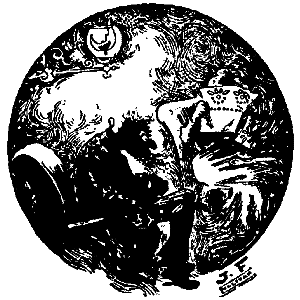
The atmosphere of the chamber is heavy with a portentous sense of paralysing dread; the fire cowers in the grate, cold at its very heart; the gas-flame shudders with a shuddering not caused by water in the pipes. Mr. Dredferley Cornerd, seated in his arm-chair, glares at his newspaper with preoccupied and unreceptive eye; while ever and again his hand passes nervously over his care-lined brow. Mrs. Dredferley Cornerd glances furtively at him through the perforations of her fancy-work, held between tremulous fingers; her eye is dilated, while her pale brow is puckered by the lines that whisper of prescience of impending calamity. Mr. Dredferley Cornerd feels that his wife's eye is upon him; he strives to avoid her gaze; but, fascinated, yields; and their eyes meet.
(enlarge)
Mrs. Dredferley Cornerd (huskily). James——
[Thrice he raised his outspread hands in wild, unvoiced deprecation; he clutches at his throat, as if suffocating; then buries his face in his trembling hands, and, in a hollow, far-off gurgle, says "Go on!" She goes to him, and smoothes his throbbing brow.
Mrs. D. C. James, let us nerve ourselves to it once more! Let us remember Duty! Come; we will plunge at once into the thick of it. What is Jane to have?
Mr. Dredferley Cornerd (hurling himself from his chair, his eye ablaze with unspeakable hate). Nothing—a bottle of poison—a dynamite bomb—the cat-o'-nine tails! Hear me, Mary-Ann. One year ago, at this very season that brings this haunting, maddening torture of the selection of Christmas presents, my sister Jane sent us that ormolu clock which at this very moment glares upon us from that mantel-piece! I loathe ormolu. Had we not laboured and struggled, you and I, to furnish this, our dining-room, in perfect taste, all in old oak and Flemish pottery. Then, in the very moment of our triumph, arrived that loathsome clock of ormolu, and crushed our whole design! It had to go there, lest we gave offence. I hate my sister Jane!
Mrs. D. C. Well, let us, for the moment, then, dismiss your sister Jane. Now what are we to give to Joseph?
Mr. D. C. Mary-Ann, I loathe that man! Well knowing how I hated summer-houses—abominations filled with creeping horrors—he gave me one just seven years ago. It makes our garden hideous to this day; I will not speak of him——
Mrs. D. C. Well, then, the Joneses. They gave us——
Mr. D. C. Mary-Ann, I know they did. We have to eat them still whenever they drop in to meals. A lamprey makes me—(shudders) ugh! They give us seven barrels twice a year! No, Mary-Ann; I will not threaten you, but breathe their name no more.
Mrs. D. C. Well, put them off. But now there's Mrs. Blenkinsop.
Mr. D. C. The cat! She gave us six outrageous oleographs, all green and yellow, framed in blazing gold, and said we ought to hang them in the hall. Our hall is Japanese; we'd left six spaces for kakemonos of subdued design, and there we had to hang those oleographs. I loathe our hall—I never enter it—I come round always by the garden door! Woman, you madden me! You'll mention next the hated name of Cousin Ichabod——!
Mrs. D. C. I was about to.
Mr. D. C. Cousin Ichabod presented to me, fifteen years ago, a pair of silver brushes. At the time I had but little hair; that very year I lost the rest. Still those accursed brushes mockingly gibber on my dressing-table. They must be there, for Cousin Ichabod drops in at unexpected moments! Once I hurled them from the window. One of them caught Ichabod, approaching up the path, over the eye, and raised a livid bump. I writhe with detestation of his name. Would that that brush—— Unhand me, Mary-Ann; see, I am calm. For years have thoughtless friends encumbered us with Christmas presents quite unsuited to our tastes and our requirements. What do we want with seven berceaunettes (our children being two), with fifteen inkstands, with twenty biscuit boxes, and thirty-five illuminated hanging almanacks? For years we've played the shameless hypocrite, pretending to adore these gruesome gifts; and now I bid you mark me, Mary-Ann; I mean Revenge. Yes, let us to the council, and plan what gifts to such and such; the most unsuitable that we can hit on. Here's Parker's list, and Porringe's, and Spriteley's. Come, here are wedding dresses; sister Jane is sixty and a spinster; I will send her a wedding gown—(hysterically) a dozen wedding gowns! Write, Mary-Ann, to Parker for a dozen. Then Joseph. Joseph, ha! I have it; Joseph goes mad with fright on passing near a dog. To-morrow I will seek the Lost Dogs' Home, and pick out fifty of the savagest—all bloodhounds, mark you! I will drag the pack to Joseph's door, and leave them with the maid. And now the Joneses. Silence, Mary-Ann! I do not need cold water on my temples! You shall not stroke my head, and murmur "Shish!" You shall not scream for cook, and Blenkinsop, and George, and Jane. I'm calm. The Joneses—hurr! Let me get at them! Back—unhand me! Ha!——
[He swoons. Curtain.
TRIOLET.
(Written whilst you wait.)
A woman who's late Is, of course, in the fashion. She's quite up-to-date, The woman who's late. The man has to wait, And swears in his passion. A woman who's late, Is, of course, in the fashion.
WEATHER WISDOM.
"Hark! I hear the Asses bray, We shall have some rain to-day." So the nursery jingle goes, Is it truthful? Goodness knows! But if vocal donkey's strain Brings indeed the daily rain 'Tis no marvel altogether We are worried with wet weather.
A "Wonder-Kid."
[A licence was recently applied for to enable Nellie Wick, aged eight years, to shave in public. Mr. De Rutzen, in granting the application, remarked that "the child was not likely to suffer any injury from the performance." Let us hope no one else will, either.]
The latest infant-prodigy is literally a shaver, A little lady-Figaro, who'll raze you like the wind! Though brave may be this barber-child, her victims will be braver— A kind of wounder, possibly, might prove this "wunderkind!"
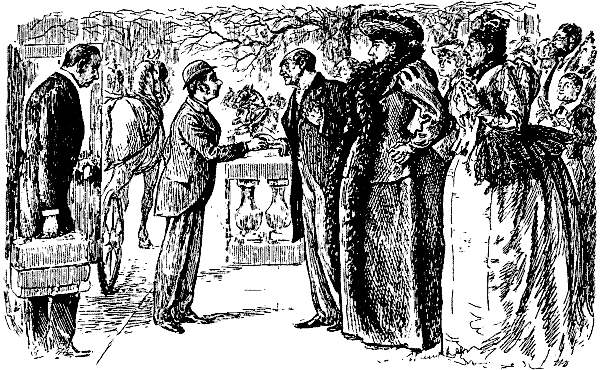
LEAVING THE PARENTAL NEST.
The Bride's Father (to Bridegroom). "Oh, John, you'll take care of her, won't you!"
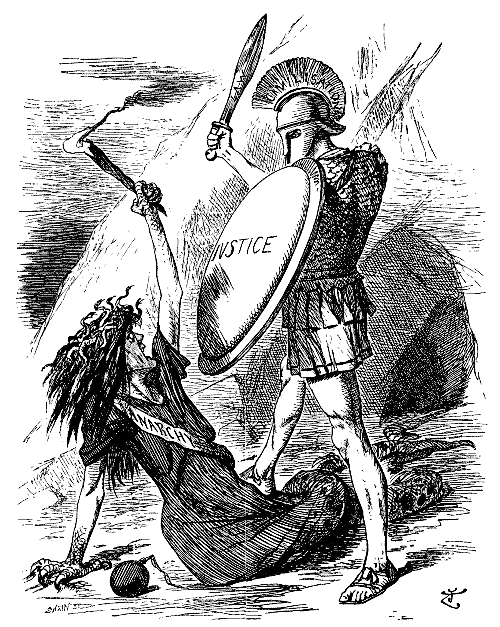
THE MODERN MEDUSA.
["The views and objects of the 'Commonweal' group of Anarchists are published in a journal called the Commonweal ... and by reference to which it appears that they applaud and justify the wholesale massacre of innocent persons as a legitimate method for the attainment of their ends."—Mr. Asquith.]
Gorgon Medusa of the snaky locks, Whose loathly lair was 'midst the wave-washed rocks, Thou wert less hideous than our monstrous, mad Belated birth of Nemesis and Nox.
Gendered of vengeful hatred and blind wrath, Crawling malign in Civilisation's path! Venomous vermin, of relentless fang, Foul spawn of wrong, oppression's aftermath.
Dark is the monstrous mystery of thy birth, Sinister scourge of a time-wearied earth; But all men's hands against thee must be raised, Foe of all love and murderer of all mirth.
Negation of all progress, hope's chill blight,
Black bringer-back of Chaos and Old Night;
Which all that's human to the death, must fight.
With thee weak tenderness must make no truce, Parley with thee were pity's mere abuse. The hand that halts, the sword that shrinks or spares, But lets the Gorgon's snaky offspring loose.
Yet dread of thee were but disastrous shame.
Fear is thy hope, and, fronting thee, to fear,
Is but to court disaster and disfame.
Thou crawling horror of the coward soul! Thy snaking convolutions furtive roll. To track thy trail, to face thy stony glare, And smite and slay is general duty's goal.
Civilisation armed with trenchant Law Must play the Perseus with thy monster maw, And all mankind be banded in the quest Of the worst enemy mankind e'er saw.
The massacre of innocents, the blind Blasting of the best hopes of humankind; Hate's indiscriminate earthquake, letting loose Of all the fiends of blood, and fire, and wind:
Sheer wreck of hearth and altar, home and State, Rending of reverenced ties, love desolate, Order submerged; these are the Gorgon's hopes, Which Law must frustrate ere 'tis all too late.
Smite Perseus! Wield the unhesitating brand With steadfast heart and with unfaltering hand; And from the grosser Gorgon of our day Free, in Humanity's cause, each harried land!
AN ADVERTISER'S APPEAL.
["Mr. Caine (who advocates prohibiting open-air advertisements in rural places) forgets that a good many people are unable to see that an advertisement of soap and pills mars the beauty of a landscape."—Illustrated News.]
Oh, Mister Caine—not Sugar-Caine, but bitter 'Gainst alcohol and opium and field-signs— Why put poor Advertisers in a twitter By laying thus hard legislative lines In the defence of merely pastoral Beauty, By levying on Field-Signs a fine or duty? Good gracious! what are meadows, rocks and trees Compared with the necessity—absolute, Sir!— Of advertising Silks and Soaps and Teas, Popkins's Pickles, Boodle's Bottled Fruit, Sir? Or how should he King Mammon's heavy hand 'scape Who'd sacrifice great £ s. d. to—Landscape? A Nuisance? Nonsense!!! Posters and Placards, In field or forest, serve the Public better Than all the blatant bosh of bleating bards. The Advertising Art would you thus fetter? What is the worth of rivers, rooks, and hills Compared with Smugson's Soaps and Podger's Pills? Soap, Sir, means Cleanliness, and Pills mean Health; And Sanitation's surely more than Scenery! Subordinate the claims of Health—and Wealth— To sentimental love of rural greenery? No, Mister Caine. I wonder you're not wiser, Pan is at present the great Advertiser!
THE MODERN MEDUSA.
NEW LIGHTS FOR OLD.
On religious instruction being entirely omitted from the School Board curriculum, the following suggestions towards the formation of a moral and physical catechism may possibly be of use:—
Question. There was at one time much debating about a so-called "Conscience Clause." Now I will ask you what are we to understand by the word "conscience"?
Answer. It is only a name for the action of the liver in its various states.
Q. What is a "troubled conscience"?
A. It may arise from indigestion, or from an east wind, or from many other causes which affect different persons, with differing livers, in a variety of ways.
Q. In what sense do you recognise "conscience" as "an inward monitor"?
A. Its recognition as such depends on the extent of each individual's acquaintance with his own particular physical organisation as differentiated from that of others. In some cases the "voice of the inward monitor" may point to blue pill, and in others it may indicate moderated remedies.
Q. What is the moral law?
A. The so-called moral law is purely hygienic. Perfect health is perfect morality. Mens sana in corpore sano. "Law," so-called, is for the protection of the "good livers," and for the punishment of the "evil livers." Voilà tout!
The only Profession where there isn't "the 'Devil' to Pay."—The Legal.
EUROPEAN CRISIS AVERTED!!
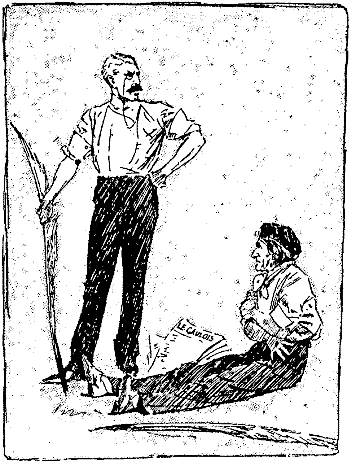
"Touché!" Victorious Bancroft and Victorien Sardou.
Latest Intelligence.—We are glad to be able to assure our readers that, in spite of relations between the two parties being somewhat strained, it is not apprehended that serious international complications will arise out of "L'affaire Bancroft-Sardou;" though it is now pretty generally known that so grave a catastrophe has only been averted by the sudden change in the French Ministry.
DEPTFORD HATH ITS DARLING.
A Lay of Loyalty.
["Mr. Darling, of Deptford, considers it his mission to chastise the Home Secretary."—Illustrated News.]
Air—"Charlie is my Darling."
Deptford hath its Darling, its Darling, its Darling! O! Deptford hath its Darling, the great Cav-il-ler! If Asquith needs stern warning, Or Morley wants the spur, They'll find it in our Darling, The great Ca-vil-ler! O! Deptford hath its Darling, &c. As he comes striding up the House, Gladstone shrinks like a cur; He knows his fluency must fail To foil the Ca-vil-ler! O! Deptford hath its Darling, &c. "With Liberty Caps upon their heads Shall Anarchists confer On treason in Trafalgar Square?" Demands the Ca-vil-ler! O! Deptford hath its Darling, &c. "Now stand aside, you Liberal loon! I'm going to raise a stir; I'll harry you—at Question time!" Quoth the great Ca-vil-ler! O! Deptford hath its Darling, &c. And it's by the Square's damp fountains, And it's in their Press, with pen, Tr-r-raitors daren't sputter treason, For Darling, best of men! Deptford hath its Darling, its Darling, its Darling! O! Deptford hath its Darling, the great Cav-il-ler!
ANACREONTICS FOR ALL.
(Being Bacchanalian Ballads for the use of all Professions, Trades, Crafts and Callings, and Convivial Carols for the Classes, the Masses, and the Lasses. By Tom Moore, Junior.)
THE DOCTOR'S DITTY.
Air—"Here's to the Maiden of bashful fifteen!"
Here's to the patient of hectic fifteen! Here's to asthmatical fifty! Here's to the port-soaked dyspeptic old dean! And here's to the slop-swigger thrifty! Chorus— Let the dose pass,— Drink, lad or lass! I'll warrant ye'll soon love the (medicine) glass! Here's to the charmer whom wrinkles surprise! Now to the maid who has none, Sir! Here's to the girl with two lungs of full size, And here's to the nymph with but one, Sir! Chorus— Whoe'er they be, Send 'em to me! I warrant they'll prove an excuse for a fee! Here's to "Old Purple," with port in his toe! Now to him who's gone saffron on sherry! Here's to the masher whose mind's on the go Through making nocturnally merry! Chorus— Let the dose pass! Drink, lad or lass. I warrant I'll prove there's some use in my glass. For let 'em be gamesome or let 'em be grim, Ill or hearty, I care not a feather; Fill 'em—with physic—bang up to the brim, And let us all dose 'em together! Chorus— Howe'er they be, Send 'em to me! I warrant I'll find some excuse for a fee!
A Fine Old Girl and Uncommonly Well Preserved is The Bohemian Girl by the Balfe and Bunn family, whose Jubilee, November 27th, was celebrated by the chivalrous Sir Druriolanus at the Good Old House from which he takes his Latinised title, conferred upon him some years since as a reward of merit (not Paul Merritt, dramatist, and once upon a time collaborateur with Pettitt) by Mr. Punch. The fair Bohemian seemed "going strong," and as lively as ever. Ad multos annos!
New Version.—An amendment has been proposed in our National Anthem. It is suggested that instead of "Knavish," we should substitute "Navy-ish," when the line in question would read "Frustrate their Navy-ish tricks," which may be applied to a Home Governmental policy or to that of our Continental possible foes, just as circumstances may require.
TO MARJORIE.
(An Imaginary Name of a Child Friend.)
Dear little maid, who in the Circle train Sat so demurely, daintily arrayed In sweet old-fashioned garment of delane— Dear little maid. Your merry smile, your laugh all unafraid Made me forget the daily stress and strain. To earth your childish prattle quickly laid The phantoms that to middle age bring pain, And life seemed more attractive, not so staid. Oh! some day soon ride with me once again, Dear little maid.
"How are you off for ——?"—Messrs. A. and F. P-rs, a name which rhymes to the first and final word of the line, "Tears, idle Tears" (by the way, what a delightful song for a Radical to sing, "Peers, idle Peers!"), write to Mr. Punch, informing him of the supreme excellence of the P-rs' Christmas Number, asking him to notice it, as he probably would do, in his pages, and adding that "it is already out of print." Then what is the use of drawing attention to it? Of course, if being out of print makes it the more valuable, then lucky are the possessors of original specimens, and well indeed are they off for the material for which the Upper House or House of P-rs is famed.
The Silk Industry (not from the Board of Trade Returns).—Mr. J. F. Leese, Q.C., M.P., appointed Recorder of Manchester. Mr. Punch wishes this capital cricketer a long innings, and may Manchester have a Leese that will run for any number of years without expiring.
A CHANCE FOR THE BRIEFLESS.
Dear Mr. Punch,—I am a briefless barrister, and I wish to throw myself upon your generosity by asking you to allow me to make a suggestion which will be of great public interest, and incidentally help me to make my fortune. All London to-day is placarded with a thrilling picture of the Law-Court Scene in A Woman's Revenge. My suggestion is—Why not have real barristers? The theatre to-day is nothing if not realistic. Drury Lane has its race-horses, Ibsenity its ghosts—why should not the Adelphi take the town by storm with its barristers? The actor may, no doubt does, act the part admirably, but who can contend that he can possibly do so as well as could a real, actual barrister, who would know that he was striving not merely for the applause of the moment, but for the guinead briefs of the future? If Messrs. Gatti will undertake to accept the plan, I will undertake to provide the barristers. The programme would then run:—
Sir John Blacklock, Q.C. (Counsel for the Crown) . . . Mr. A. B., 102, Temple Gardens, Temple, E.C.
What we briefless barristers want in these hard times is merely the chance. I look to Messrs. Gatti to give it to us. I ought to add that the above address, though, in point of fact, it is my own, is given purely by way of illustration, and in no way to advertise myself, though should anyone wish to consult—again, of course, purely with reference to this suggestion—the way to my chambers from the Strand is down Middle Temple Lane, whilst the Temple Station is just three minutes' walk. I am, Sir, your obliged servant.
L. Erned Counsel.
November 30th, 1893.
No second editions for Mrs. R. She says "she'll see the First Mrs. Tanqueray, or none at all!"
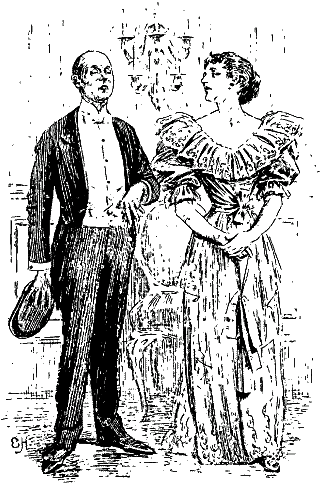
THE SAFE SIDE.
(Problem set:—To flatter a Poet's vanity and do no violence to your conscience.)
Pownceby (a minor poet). "Es, have you seen my last volume, Lady Vera—Throbs and Throes?"
Lady Vera. "Oh, yes, I have."
Pownceby. "And what did you think?"
Lady Vera. "Oh, I thought—that you had never done anything better."
THE LOST SMELL.
[The Queen's Hall is at present free from the smell of cooking hitherto "the inseparable accompaniment of orchestral music."—Times, Nov. 27.]
Seated to-day at a concert, I am weary and ill at ease, Though Lloyd and Albani are singing, Or anyone else you please; I know not what they are doing, For something is wanting there— That old-fashioned concert-hall odour Which throbbed in the scented air. It flooded the place, like one of Beethoven's sonatas might, And it lay on my fevered spirit With a touch of wild delight; It quieted pain and sorrow, It thrilled the enraptured sense, A song without words—or music— That travelled one knew not whence; It linked all delightful odours Into one perfect peace, And trembled away into soup-plates As if it were loth to cease. I have sought—but I seek it vainly— That one lost smell sublime, Which came from adjacent kitchens At dinner or supper time. It may be that Chopin is severed From scents which with music we group, It may be that Schubert is parted For ever from odours of soup.
The Belfry of Bruges Overlooked.
["A more silent city than Bruges does not exist."—Standard.]
What? Bruges a silent city! Now, nay a thousand times! If deaf, accept our pity; If not,—oh dear! those chimes!
New Legal Work. (By the author of "In Silk Attire.") —"The Briefless Junior; or, Plenty of Stuff to Spare."