"THE DEVIL'S ADVOCATE."
Reading edition
Old Parliamentary Pictor soliloquiseth:—
"As when a painter, poring on a face, Divinely thro' all hindrance finds the man Behind it, and so paints him that his face, The shape and colour of a mind and life, Lives for his children, ever at its best And fullest."
Aye, my Alfred, there you hit The portrait-painter's function to a hair; And here I hit the essential inner Joe. And so he'll live. But "ever at his best, And fullest?" Humph! His Brummagem retinue Will scarce acknowledge that. Some call him "Judas," But that is rude, and leads to shameful rows. Chaff is one thing and insolence another; E'en caricature may pass, so that its impulse Be humorous not malevolent; but coarse spleen, Taking crude shape in truthless graphic slander, Is boyish work,—bad manners and bad art! And so Tay Pay transgressed the bounds of taste, And led to shameful shindy. Herod? Humph! That flout "lacked finish," as great Dizzy said, He pricked, not stabbed, was fencer, not brute-bruiser, But he of Brummagem hath much to learn In gentlemanly sword-play. "Devil's Advocate!" That hits him off, I think! Not Devil,—no! (Though angry blunderheads will twist it that way) But ruthless slater of the pseudo-saint! The pseudo-saint, I own, looks limp and floppy, Half-fledged and awkward at the cherub rôle. Poor saint! He's had much mauling, must have more, Ere he assumes the nimbus, and I would That he looked less lop-sided. Yes, my Joe! You'll spot some "human failings" I've no doubt. To exercise your "double million magnifyin' Gas microscopes of hextra power" upon. Your "wision" is not "limited" by "deal doors" Or "flights o' stairs," or friends, or facts, or fairness, You hardly need suggestions diabolic From that hook-nosed attorney at your elbow To urge you to the attack; erect, alert, Orchid-adorned, and eye-glass-armed, you stand The sharpest, shrewdest, most acidulous, Dapper and dauntless "Devil's Advocate" That ever blackened a poor "saint" all over Othello-wise, or robbed a postulant For canonisation of a hopeful chance Of full apotheosis, and the right Of putting on the nimbus. There, 'tis finished: And—on the whole—'twere well I had not limned it! 'Twas tempting, yes, and pleasant in the painting, But—well, I've paid for it, and much misdoubt If it was worth the price. Followers applaud, I—suffer. Oh, that mob of scuffling men, Clawing and cursing, while the gallery hissed! Hissed—not a pothouse outpour in full fight, Not clamorous larrikins, or rowdy roughs By prize-ring or on race-course fired with drink, But England's Commons settling—with their fists A Constitutional Contest! Shame, O shame! And much I fear my Art must somewhat share the blame! [Left lamenting.
FASHIONABLE INTELLIGENCE.
"Mrs. Tanqueray has left town."
They talk of Alexander And Mrs. Tanque-ray, Now who would raise my dander Will just abuse that play. For few there are That can compare— Well,—if so, give their names,— With Mrs. Tanque-ray Who has just gone away From the Theatre of St. James.
Mrs. R. says that of all Shakspeare's plays produced at the Lyceum, she liked Henry the Eighth the best, because of the character of Cardinal Bullseye, which Mr. Irving played so sweetly.
Statues of the two New Parliamentary Giants to be Erected as Guarding the House of Commons.—Gag and Maygag.
Theatrical Pedestrian Match.—Match between two "Walking Gentlemen." Date not yet fixed. Stake-holder "Walker, London."
A VISIT TO BORDERLAND.
I called on Mr. Stead last week, at least I seemed to call, For in this "visionary" world one can't be sure at all; And when I reached the great man's house he shook me by the hand, And talked, as only Stead can talk, of Spooks and Borderland, I own that I was tired of men who live upon the earth, They hadn't recognised, I felt, my full and proper worth; "They'll judge me much more fairly," I reflected, "when they're dead,— So I'll go and seek an interview with William Thomas Stead." The reason why I went to Stead is this: the great and good Has lately found that English ghosts are much misunderstood; Substantial man may swagger free, but, spite of all his boasts, STEAD holds there is a future, and a splendid one, for ghosts. And so he has an office, a sort of ghostly Cook's, Where tours may be contracted for to Borderland and Spooks; And those who yearn to mix with ghosts have only got to go And talk, as I conversed, with Stead for half an hour or so.
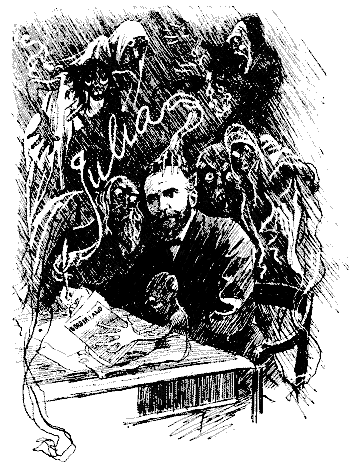
The ghosts have got a paper too, the Borderland I spoke of, Where raps and taps are registered that scoffers make a joke of: A medium's magazine it is, a ghostly gazetteer Produced by William Thomas Stead, the Julianic seer. And everything that dead men do to help the men who live, The chains they clank, the sighs they heave, the warnings that they give, The coffin-lids they lift at night when folk are tucked in bed, Are all set down in black and white by William Thomas Stead. While wide-awake he sees such shapes as others merely dream on; For instance there is Julia, a sort of female dæmon; Like some tame hawk she stoops to him, she perches on his wrist— In life she was a promising, a lady journalist; And now that death has cut her off she leaves the ghostly strand And turns her weekly copy out by guiding William's hand. Yet, oh, it makes me writhe like one who sits him down on tin tacks To note that happy ghost's contempt for grammar and for syntax. Well, well, I called on Stead, you know; a doctor's talk of diet is, And Stead's was of his psychic food as cure for my anxieties. I thought I'd take a chair to sit (it looked to me quite common) on, "You can't sit there," observed the Sage; "that's merely a phenomenon." Two ladies, as I entered, seemed expressing of their gratitudes For help received to Mr. Stead in sentimental attitudes; They saw me, pirouetted twice, then vanished with a high kick. "It's nothing," said the Editor; "they are not real, but psychic." These things, I own, surprised me much; I fidgetted uneasily; "Why, bless the man, he's had a shock!" said Mr. Stead, quite breezily. "We do these things the whole year round, it's merely knack to do them; A man who does them every day gets quite accustomed to them. This room of mine is full of ghosts,"—it sounded most funereal— "I've only got to say the word to make them all material. I'll say it promptly, if you wish; they cannot well refuse me." But my eagerness had vanished, and I begged him to excuse me. "Now Julia," he continued, "is in many ways a rum one, But, whatever else they say of her, they can't say she's a dumb one. She speaks—she's speaking now," he said. "I wonder what she'll tell us. What's that? She says she likes your looks; she wants to make me jealous." That gave me pause, and made me think 'twas fully time I went; it is A fearful thing to fascinate these bodiless non-entities. Of course when people go to Rome they act like folk at Rome, you know, But flirting didn't suit my book—I've got a wife at home, you know. Well, next I felt a gust of wind, "That's Colonel Bones," my host said; "He's dropped his helmet" (think of that, a helmet on a ghost's head). "I don't much care," he whispered this, "in fact, I can't endure him; Dragoons do use such awful words; I've tried in vain to cure him." I ventured to suggest to Stead that rather than be bluffed I Would make this cursing soldier-ghost turn out in psychic mufti; He couldn't drop his helmet then, nor threaten with his sabre. "I've tried to," said the Editor, "it's only wasted labour. "I've sought advice," continued Stead, "from Cantuar and Ebor, They hinted that they couldn't stand a she-ghost and a he-bore. I tried to get a word or two from men of arts and letters, They said they drew the line at Spooks who made a noise with fetters. And when I talked of bringing men and ghostly shapes together The Bishops tapped their foreheads and conversed about the weather. In fact"—he grew quite petulant—"in all this world's immensity I'd back the Bench of Bishops to beat the rest in density." And so he talked, till suddenly—(perhaps he's talking still; In talking of his own affairs, he has a wondrous skill)— There came a noise, as if Old Bones had let off all his blanks at once, As if a thousand theorists were turning all their cranks at once; It seemed to lift me off my legs, and seize me by the hair, And sweep me mute but terrified through all the spook-filled air. And, when I got my senses back, I vowed no more to tread The paths that lead to Borderland, nor ask advice of Stead.
OUR BOOKING-OFFICE.
Pietro Ghisleri is another success for that charming writer Marion Crawford. The style is everything. The story is not of so thrilling a nature as to be absorbing, but it is sufficiently interesting—for the Baron, at least, with whom M.C.—"Master of his Craft"—is a great favourite. "Odd, though," murmurs the Baron to himself, and he seldom murmurs about anything; "odd that a writer like our Marion should, in Vol. II., p. 35, pen such a sentence as this: "There are plenty of others whom you may care for more than I." Of course the author intends Maddalena del' Armi, who utters these words, to convey to her listener and to the reader that "There are plenty of others for whom you may care more than (you care) for me." How does "than I" get into this sentence, unless it is to mean "There are plenty of others for whom you may care more than I care for them"—quod est absurdum." It is unfortunate that the pivot on which the plot turns is so highly improbable as to be almost impossible, for is it not most unlikely that any Catholic, educated or uneducated, should ever write her confession to her confessor, and send it by post, instead of going to him, and making it by word of mouth? She must have known that, in so doing, she was making no confession at all, i.e., in the restrictedly religious sense of the word. While she was about it, she might as well have inclosed a stamped and addressed envelope for the absolution to be sent by return. This is the hinge of the story; and it is a very weak one. Mr. Crawford recognises this when his other characters casually discuss the probability of Adèle's having done such a thing. However, grant this, which is almost as easily done as granting superhuman strength to a Ouidaesque hero, and the book—in three of Macmillan's blue volumes—is fascinating. Such is the candid opinion of The Baron de Book-worms.
THE SPIRIT LEVEL.
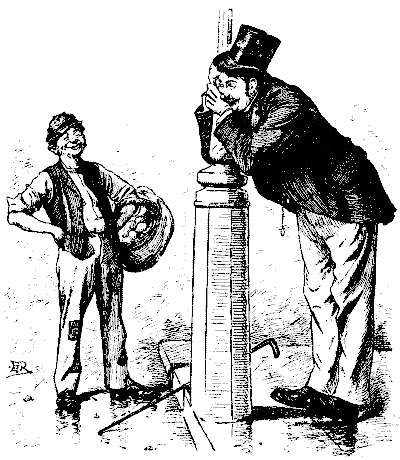
Relentless Youth. "'Ullo 'ere, Guv'nor, What 'yer up to naow? Tykin' a Hordnance Surwey o' the District, I suppose!!"