ESSENCE OF PARLIAMENT.
Reading edition
EXTRACTED FROM THE DIARY OF TOBY, M.P.
House of Commons, Monday, August 14.—Quite shocked to see Asher to-day. Strong constitution and a happy disposition united to make him a picture of buoyant health. Observing him walk up floor of House just now, hardly knew him. Shoulders bowed; arms hanging limp; cheeks sallow; an unspeakable sorrow in his dimmed eyes.
"What's the matter, Mr. Solicitor?" I asked, instinctively falling into the whispering tone proper in sick rooms. "Is it the state of Scotch business that weighs upon your mind? or is it true, as whispered, that necessity has been discovered for bringing in Bill amending the Borough Police and Health Act, 1892, with its 435 clauses?"
"No," said Asher; "I'm thinking of neither. My thoughts tend in quite another direction. My heart is at Deeside, my heart is not here. I have a moor there; you understand me—not a person of dark complexion, who, after much conversation, disposes of his wife with the assistance of a pillow. But a stretch of moorland, gorse-scented, grouse-haunted. I awoke early on Saturday morning hearing the popping of the guns in far-off Aboyne. Mere fancy, of course. You remember Charles Lamb's story about supping with some Scotchmen, and incidentally observing he only wished, to make the joy complete, that Burns were there? One by one the Scotchmen got up and explained to him that Burns had been dead for ever so many years, and that it was practically impossible, in view of the circumstances, that he could have been present; even, one of them added, supposing they knew Burns, and it had occurred to them to invite him. So you will say that Deeside, being hundreds of miles away, I could not hear the birds on the wing, or the pottering of the guns. In a sense, that is true; but I heard them all the same; worse still, heard them when I was in church yesterday, and should have been hearing something else. I wouldn't mind missing a day, a week, or, in the service of my Queen and country, a fortnight. What I see, and what gars me greet, is the endless vista of nights and days we shall spend here. If we get any shooting at all we shall begin with the pheasants.
"O my Bartley, shallow-pated! O my Tommy, such a bore! O, my dear belovèd moorland, shall I see thee evermore?"
Asher's case representative of many; only his despair is the more eloquent.
Business done.—Marking time in Home-Rule debate.
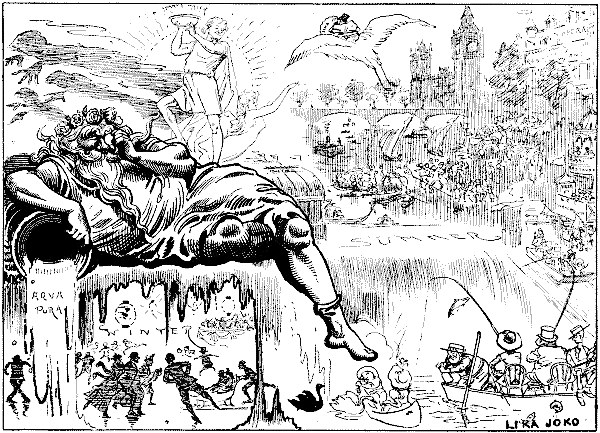
FATHER THAMES PURIFIED AND GLORIFIED, AS PROMISED BY L. C. C.
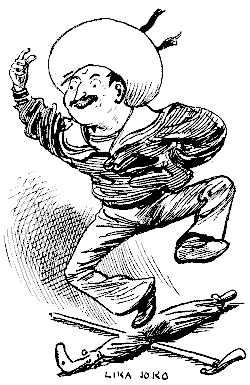
Admiral Field as the honest British Sailor.
Tuesday.—Just before eight bells, when all hands were piped below, Admiral Field turned up in favourite character as the honest British sailor. Rather modelled on transpontine style; a little unnecessarily noisy; too humorously aggressive; hopelessly obvious. But in present circumstances House grateful for anything; gleefully laughed whilst the Admiral shivered his timbers, talked about losing his soundings in a fog, declared against all shams, referred to himself as "honest and modest sailor who believed in straightforward action, and refused to have his eyes blinded by abstract proposals."
That last phrase didn't sound seafaring, but, as another honest sailor was accustomed to say, its bearings lay in the application of it. Motion before House was to eliminate Second Chamber from Home-Rule scheme; brought forward by Radicals; situation difficult for Opposition. If they voted against the Government they would be declaring against principle of House of Lords. If they voted with them they would be approving a proposition of the hated Bill. Joseph judiciously got out of difficulty by declining to vote at all. Prince Arthur elaborately explained that in going into Lobby with the Radicals he was voting against a concrete proposal and in favour of an abstract principle. This too subtle for Courtney, who announced his intention of voting with Government who happened to agree with him in approving principle of Second Chamber. It was amid these cross blades that the Admiral, hitching up his trousers, danced a hornpipe. Tomlinson attempting to bring House back to more serious views, Members with one accord rushed into Lobby, and Government came out with majority of 83.
Business done.—Seventh night in Report Stage Home-Rule Bill.
Thursday.—"Whew!" said the Member for Sark. "I don't know what will become of us if things go on much longer like this. With a Premier over eighty, and the thermometer over 90, the situation is at least unusual. Even Joseph not able to maintain his favourite attitude, grafted on the iced cucumber. Just now Mr. G. made a passing remark, quite mild compared with Joey's own sly hits. J. C. up on instant, with boding brow and angry plaint that Mr. G. had attempted to slay him with a sneer."
"Yes," said Plunket, "times are hot. I don't know what we should do without Tommy Bowles. The spectacle of his white ducks is to me as the shadow of a great rock in a weary land. They talk about an army of men in the basement working machinery that keeps the temperature ten degrees below what it is marked on the Terrace. Also there is, it seems, a ton and a half of ice melting in ventilating chambers at the taxpayers' expense for our comfort. But I don't think ice is in it with Tommy's ducks. Even if they were stationary it would be something. But observe how, coming and going, Tommy's brain an argosy of great thoughts, the ducks seem to skim over our prosaic floor, calling up even to the unimaginative mind a vision of deep, tree-shaded, quietly-rippling Broad, over which the wild duck swiftly moves, waving white wings."
Only Plunket, I fancy, could evolve poesy out of to-night's scene; hot above precedent, dull beyond endurance.
"Plunket's duck picture cool and refreshing. But," said Edward of Armagh, drawing on his military experiences, "what we're doing just now may be much more accurately described as the goose step."
Quite so. We sit all afternoon and far into the night, always talking, sometimes dividing; every appearance of motion, no advance; feet lifted with due sign of walking, but when midnight strikes and parade dismissed we are found posted exactly at the same spot as that on which we took our stand at half-past three in the afternoon.
If Mr. G. means business the sooner he gets about it the better.
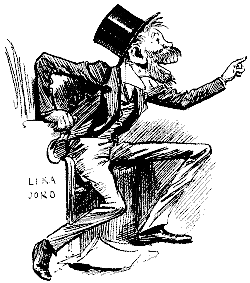
Swift MacNeill refuses to be named.
Business done.—None.
Friday.—Mr. G. does mean business. Commences on Monday, when Motion will be made to close Report Stage of Home-Rule Bill. Mere reference to it set House bubbling with excitement. Mr. G.'s proposed Resolution not yet drafted. "You know how it is," he said, smiling blandly at Prince Arthur; "you've had a good deal of experience in drawing Resolutions of this nature." But if Ministers not ready with their Resolution, Joseph prepared with Amendment. Read it out amid lively interruption.
Conversation later conducted with much vigour across the Gangway, where, a fortnight ago, Gunter received an Irish Member (not iced) full in pit of stomach. Once the Blameless Bartley signalled out Member for South Donegal, mentioning him by name as responsible for particular exclamations. "Don't presume to mention my name," said MacNeill, leaning across gangway.
"Look here, Bartley," said Tommy Bowles, "if you're going on that tack, you must come and sit at this side. When I saw MacNeill open his mouth to speak, I confess I thought I was going to be swallowed whole. You sit here; there's more of you."
Business done.—Notice given that business is about to commence.
Transcriber's Note: Sundry damaged or missing punctuation has been repaired.