THE SCHOPENHAUER BALLADS.
Reading edition
No. II.—THE MOSQUITO.
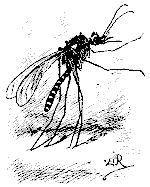
I am a restless Mosquito, Well hated by the world, I know, For faults that are not mine; I bite to live (some live to bite), I sting from sheer necessity, not spite,— I would my lot were thine.
I'd take thy bites, you'd love my sting, And bear the petty pains they bring Just like a Hindoo Saint; I would not blame you, 'bottle fly, You have to live the same as I— A beauty without paint.
We cannot all be butterflies, Or larks that carol in the skies,— Take life for what it's worth; We've all our wretched aches and pains, Our losses now—and now our gains— A little while on earth.
And when we get our final call— Mosquito, pole-cat, skunk, and all The vermin meek or bold— We shall not for the verdict quake, We've lived our lives for Nature's sake, And done what we were told.
CONNECTED WITH THE PRESS.
My dear Mr. Punch,—I see that some of your contemporaries have got up a "Press Band" which plays on the Thames Embankment between one and two o'clock every day (save Saturday) for the benefit of compositors out for their dinner-hour. I must confess that I think the idea excellent, but could it not be extended? A newspaper consists of more than "setters up at case." Could not some entertainment be contrived for the amusement of editors, theatrical critics, and city correspondents?
For instance, there are generally a number of ladies and gentlemen hanging about Fleet Street in the vain hope of obtaining interviews with the powers that are in the world journalistic. A really talented would-be contributor (especially if a lady) might "get at" an editor when he was most at his ease and least on his guard.
I will suppose that the Rédacteur en chef of the Imperial Universe is seated beside the Fountain in the Temple, quietly smoking his cigar. The authoress of "Tiger Songs" (adapted from the original Norwegian) may see the Editor from afar off, and come dancing towards him with the airy gaiety of a Morgiana. She executes a pas de fascination, and, when he is completely captivated by the exquisite grace of her movements, causes him to seize a bundle of MS. When she has retired, and the Editor gradually resumes his normal composure, he discovers that the authoress of "Tiger Songs" has left him an article upon "Voyages to the North Pole." Subjugated by the poetry of motion, and further moved (almost to tears) by the soft, sweet strains of the Press Band, he reads the contribution, and accepts it.
Then recreation, combined with instruction, might be found for special correspondents by erecting steam roundabouts on the Thames Embankment. The "special" might mount his wooden steed, and career round and round until he has done a good twenty miles. Then he would be prepared to give his experiences, which should (if written in the proper spirit) be of exceptional value as "copy."
A thousand details will occur to those who take an interest in the matter, and may be filled in at leisure. I merely throw out the idea, leaving its development to others more worthy of the task than one who signs himself, in all humility, A Pen Plus a Lyre.
THE WALKING ENGLISHWOMAN ON THE ALPS.
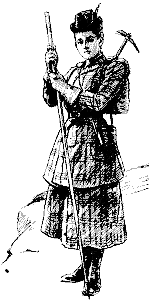
You who look, at home, so charming— Angel, goddess, nothing less— Do you know you're quite alarming In that dress? Such a garb should be forbidden; Where's the grace an artist loves? Think of dainty fingers hidden In those gloves! Gloves! A housemaid would not wear them, Shapeless, brown and rough as sacks, Thick! And yet you often tear them With that axe! Worst of all, unblacked, unshiny— Greet them with derisive boots— Clumsy, huge! For feet so tiny! Oh, those boots!
THE ENGLISHMAN IN PARIS.
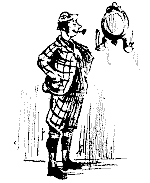
O "Englishman in Paris," do not think That I refer to your amusing book; I write of those who do not care "a tinker's cuss" for look!
Not you who dress in Paris as at home, Because the Frenchman is as good as you, Top-hat, frock-coat—in fact do all in Rome As Rome would do.
But you, attired in such eccentric ways, Who travelled here with tickets which you took Perhaps from enterprising Mr. Gaze, Or Mr. Cook.
And from some stupid, slow, suburban spot, Or prim provincial parish, come arrayed In clothes which your own gardener would not Wear for his trade.
Oh why offend the Frenchman's cultured sight With such a 'Arry's outin' sort of air? Do you consider knickerbockers quite The thing to wear?
The Frenchman, just as sensible as we, Calls "toppers" hateful, horrid, heavy, hot; In Paris, as in London, still you see The chimney-pot.
A linen collar hygiene abhors. And yet he wears it. You don't care a rap; You sport your flannel-shirt, and, out of doors, Your tourist cap.
Magnificent contempt for foreign lands! "Frog-eating Frenchy dress!" you say, and smile, "He imitates, but never understands True London style."
Unconquered Briton, you are right no doubt! Descendant of the woad-clad ones, that's true! And yet he never imitates a lout, A cad, like you.
Her Parliamentary Knowledge.—Mrs. R. is an intelligent student of the Parliamentary Reports in the Times. On Tuesday, in last week, her niece read this aloud—"8.30. On the return of the Speaker, after the usual interval"—— "That," observed the worthy lady, interrupting, explaining it to her niece, "is the interval allowed for refreshment—ten minutes I believe,—go on, my dear." Then her niece continued—"Sir T. Lea, who was interrupted by a count"—— "Stop, my dear!" exclaimed our old friend, indignantly. "What I want to know is, how did that Count come there? Was he in the Strangers' Gallery? And if he interrupted why wasn't he at once turned out of the House? On second thoughts," she added, "he must have been a foreigner, and so they made some excuse for him."
SPEECHES TO BE LIVED DOWN.
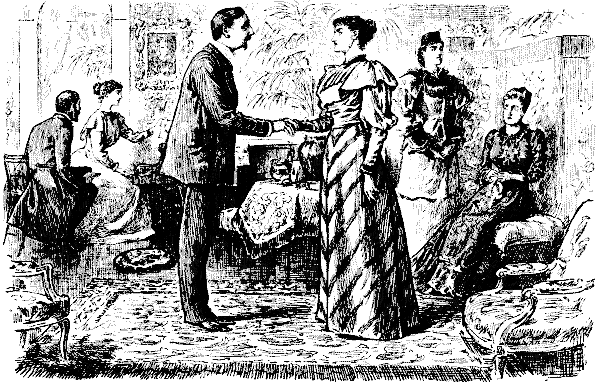
Country House Hostess. "So glad you could come, Mr. Vandyke! I'm afraid you'll find us rather Dull. We're quite a Small Party!" Mr. Vandyke. "Oh no. I shall be Out nearly all day, you know!"