SHOOTING THE CHUTES.
Reading edition
(After Southey.)
A Vision of Earl's Court.
Here they go hurrying, Up the steps scurrying, Pushing and jostling, Elbowing, hustling, Squeezing and wheezing they rush to the top. Puffing and panting, Tearing and ranting, (First-rate for Banting,) onward they climb. Up on the landing, Scarce room for standing, Man is commanding, "There you must stop! Don't cross the railing, Keep to the paling; Place for two more, Sirs, Go on before, Sirs; List to the roar, Sirs—ain't it sublime! Tuck in the mackintosh, Hold tight, Sir!" "Oh, what bosh!" Side by side seated, Breathless and heated, Freezing and sneezing, Down the Chute shooting, Yelling and hooting, 'Arry and 'Arriet, Princess and Peer, White man and black man and Injun to steer. "You're sure there's no danger?" "There's nothing to fear." "Are babies admitted?" "O no, mum, not 'ere." And waving and raving, And beaming and steaming, And laughing and chaffing, And thumping and bumping, And plumping and jumping, And spinning and grinning, And chattering and clattering, And blushing and gushing and rushing and flushing, And bawling and sprawling and hauling and calling, And foaming, bemoaning a bonnet dropped off, Not hearing the jeering of people who scoff, The peril of spilling delightfully thrilling, Tho' incivil devil's instilling cavilling; And screaming, not dreaming of being upset, And splashing and dashing and dripping with wet, And screeching and reaching for hat blown away, Excited, affrighted, delighted, benighted, And calling and bawling Hurrah and Hurray! "And so never ending but always descending Sounds and motions for ever and ever are blending;" All at once all is o'er, with a mighty uproar, And drenched and bedraggled they land on the shore.
"Lethe had passed her Lips."—Mrs. R. had often come across the name of this classic stream in the course of her reading. She pronounced it as one syllable, and said that "as this celebrated river was in Scotland—she knew the name quite well—what she wanted to know was, why weren't these waters bottled by a Company?"
AT THE SEASIDE CHURCH PARADE.
(A Conversation à la Mode.)
He. So very glad to see you. (Aside.) Hope she won't shut me up, she's so sharp!
She. Quite pleased to have met. (Aside.) Can't stand much of him, he's so stupid!
He. I suppose when you were in town you went to the Academy?
She. Yes, and saw all the pictures—and didn't like them.
He. And went to the Opera?
She. Yes, every night—and am tired of talking about it.
He. And of course you went to Henley?
She. Yes, and to the Eton and Harrow Match, and to Ascot, and to Wimbledon to see the Lawn Tennis finals.
He. But perhaps you never went to the House of Commons?
She. Oh, yes, I did—on the Terrace, and also to the Ladies' Gallery. The rows were most amusing—saw them all.
He. And did you go to many parties?
She. To every party of any consequence, and all the really nice dinners.
He. Were you at the Royal Wedding?
She. Oh, don't talk of that. The subject is quite exhausted. (After a pause.) Pray, have you no conversation?
He. Well, I don't know. I suppose you went to church this morning, and heard the Dean preach?
She. Oh, I really must beg your pardon. If you can't find anything better to talk about on a Sunday than the points of a sermon you had far better say nothing at all.
[Scene closes in upon an unbroken silence.
NEW KING COAL.
(A new Mining-Capitalist Version of an old Nursery Rhyme, dedicated and commended to the thoughtful consideration of the colliers on strike in Northumberland and Durham.)
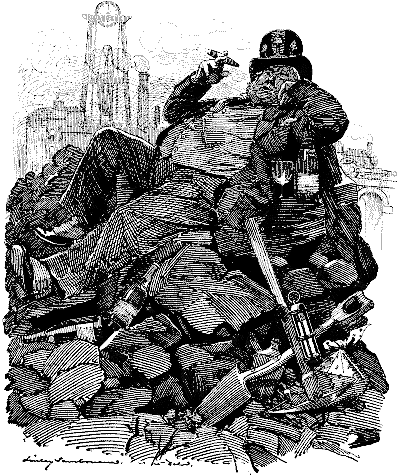
[Putting it in the form of a conundrum, Mr. Punch would ask the Colliers who may read this rhyme the following question, the answer to which may throw a light upon the meaning of New King Coal's jubilant doggerel ditty:—
"When prices rise—even in the midst of the Dog Days—and the output of first-class coal falls, who reaps the advantage of the enhanced value and readier sale of accumulated stocks of small and slaggy 'rubbish'?"]
O our New King Coal Is an artful old soul, And an artful old soul is he; And a jolly good Strike Is a game he must like— When it pulls in the £ s. d. He calls for his "weed" and he calls for his "fizz," And he calls for his—Fiddle-de-dee! Every fiddler has his own little fiddle, And a very fine fiddle has he. "£ s. d., £ s. d.," sings King Coal, "Fiddle-de-dee! Oh! an opportune Strike is the thing for me!" O, there's none so rare As can compare With King Coal and his Fiddle-de-dee!