Volume 104 — ESSENCE OF PARLIAMENT.
Reading edition
EXTRACTED FROM THE DIARY OF TOBY, M.P.
House of Commons, Monday Night, February 6.—"Did you ever destroy your offspring, Toby?" Rather curious question to ask any fellow. To me particularly startling. There are family traditions that, in accordance with sort of Malthusian doctrine, some of my young relations, my contemporaries in fact, were put out of the way even before their innocent eyes had grown accustomed to the light of a beneficent heaven. Thought at first George Wyndham meant something personal; was really thinking of his own woes.
"That's my speech," he said, showing me with melancholy smile quite a bundle of manuscript. "Worked at it all yesterday, instead of going to church. Read every Blue Book about Uganda; studied the map, and could pass an examination in the matter of its rivers and valleys, its hills and lakes, its various tribes, who are always murdering each other. Prince Arthur, you know, asked me to resume Debate at to-night's Sitting. Great opportunity; meant to make most of it; then, when I'm in my place conning my manuscript, Prince Arthur gives me up. Mr. G. reads text of Portal's instructions, and shows we've nothing to complain about or to criticise. Rather hard on a young fellow not unduly given to speech-making. Tell you what, Toby, if you've got three-quarters of an hour to spare, and will come with me into the Lobby, I'll read you my speech."
Much touched at this kindness. Unfortunately had an engagement which prevented my availing myself of it.
Kennaway and Alphabet Coutts in same box as Wyndham; get out of it in different fashion. They, also, had prepared speeches, unknowing what turn affairs would take. Weren't going to waste them, so delivered them at length. They had everything but an audience. House could not prevent them reeling off their speeches, but wouldn't stay to listen. Everybody happy all round, and evening agreeably wasted.
Business done.—More talk round Address.
Tuesday.—Pretty to see Don't-Keir Hardie just now escorted into House arm-in-arm with Charles Edward Howard Vincent, C.B., formerly of the Royal Welsh Fusiliers, now Colonel of the Queen's Westminster Volunteers. Some talk of the two Members temporarily changing coats whilst they addressed the House. This was Howard Vincent's suggestion.
"I fancy, Brother Hardie," he said, "it would picturesquely emphasise the situation, don't you know, if we thus made community of at least our coats. That's rather a remarkable garment you wear. If I put it on, and you wore mine, then House would see how thoroughly one we are. Do you mind?"
"Well," said Hardie, dubiously, "there's a good many things in the pockets, and they might get loose if you went mauling round with the coat. So I think, if you don't mind, we'll go in our own duds."
"Oh, as you please," said the Colonel, coldly, a little hurt at this evidence of lack of confidence on part of his new pal.
So Don't-Keir Hardie, moving Amendment to Address, orated in his own clothes, whilst Howard Vincent sat above Gangway near him, and punctuated his speech with persistent cry of "Hear! hear!" A notable figure his friend made. Evidently in the ranks of the Unemployed in the Don't-Keir Hardie household are the comb and brush. Through a mass of black hair, matted on head and chin, Don't-Keir looked on House of Commons. The coat Howard Vincent hankered after was rather a jacket, cut short, so as to hide little of the effulgence of his murky mustard-hued trowsers. Pockets alike of trowsers and jacket were bulging with letters and papers. You could see when he stood up to speak that he had just posted a letter to himself, sticking it in his waistcoat pocket, which only half concealed its surface.
"I don't exactly know how it is," said Gorst, curiously regarding Don't-Keir Hardie, and his eruption of correspondence, "but our friend, for whom I shall certainly vote, somehow reminds me of Mrs. Jellaby. The same earnestness of vague purpose, the same self-devotion to public questions, and the same large correspondence. I wouldn't be surprised, if you had the opportunity of examining our friend's hands, if you found them rather inked than horny. Still, I shall vote for him, and say something, if not exactly in his favour, at least a few words that will puzzle our fellows and rile the Bench opposite."
Business done.—Don't-Keir Hardie moved Amendment to Address, calling upon Parliament to provide for Unemployed; negatived by 276 votes against 109.
Wednesday.—"It was a good thing to win the Inverness Burghs," said the Squire of Malwood just now, reflectively stroking his chin. "But it was not all gain. Finlay worth a good deal to us. In moments of profoundest depression he acted upon Mr. G. with remarkable tonic effect. Often when we sat on other side, things going bad, and Mr. G. has seemed a little dull, he has accidentally turned round, and caught sight of Finlay, sitting, as you will remember he did, just behind us. In a moment our revered Chief was another man. His eye flashed, colour came back to his face, every nerve vibrated: Mr. G. was himself again. On the whole, I fancy Finlay was worth more to us than the two votes on a Division, for which we have bartered him."
Much in what the Squire says. It turned out this afternoon he did not mourn as one who has no hope, Finlay gone, but Jesse Collings remains. Has in degree, the same physical and mental effect on Mr. G. that Finlay had. This afternoon Mr. G. sitting on Treasury Bench, apparently waiting for Division. Debate on Jesse Collings's Amendment to Address flickering out. Henry Fowler, in vigorous speech, had replied for Government. Edward Stanhope said a few words; nothing to be done but to take Division. Whilst Stanhope speaking, Mr. G. turned round to see how forces were mustered. Accidentally his eye fell on benevolent visage of Jesse Collings, just then lit up with smile of genial satisfaction at compliment paid him by personal reference in Stanhope's speech. In an instant Mr. G.'s visage and attitude altered. The spell had worked, and to surprise of House he followed Stanhope, falling straightway upon the unsuspecting Jesse, treating him, as Grandolph, an amused and interested spectator of the scene, observed, "with all the vigorous familiarity Pantaloon is accustomed to meet with at Christmastide."
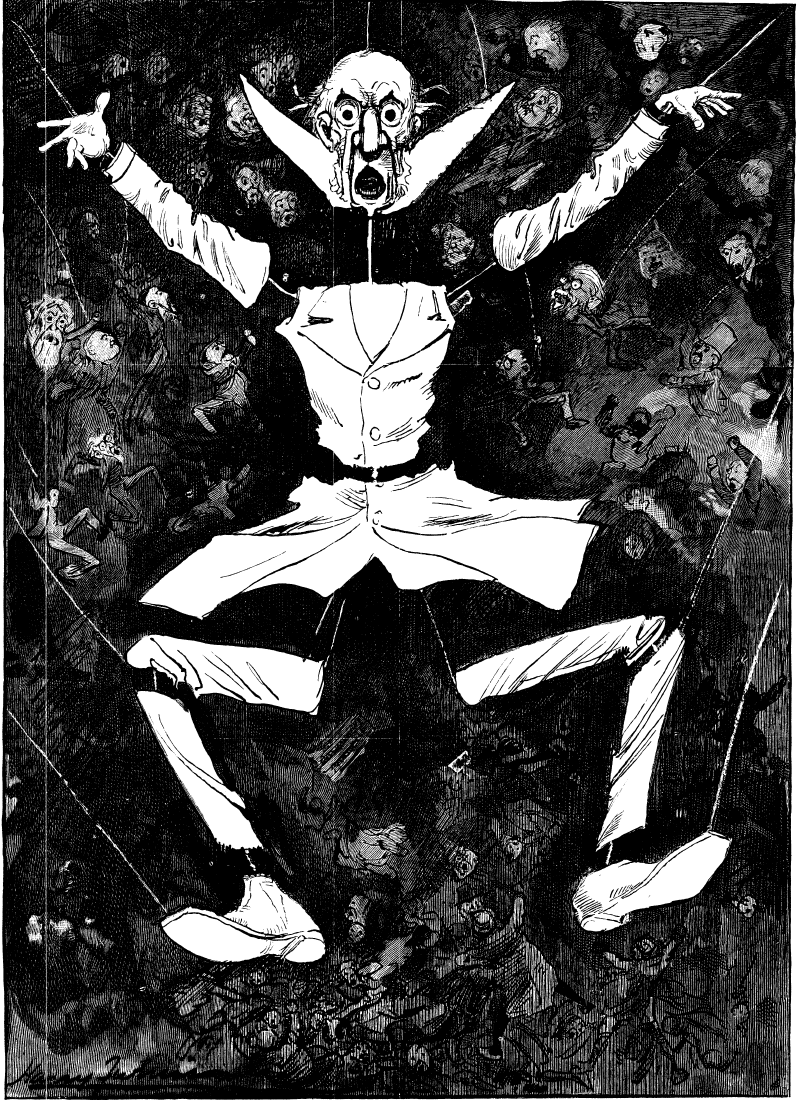
THE GRAND OLD MARIONETTE; OR, THE HOME-RULE DANCE.
Business done.—Mr. G. "goes for" Jesse Collings.
Friday, 2 a.m.—Long time since I saw Liberals in such fighting trim as at this moment. Been at it all night discussing Redmond's motion for release of Dynamitards. Asquith made speech that has confirmed and improved his Parliamentary position. At quarter to one this morning Division taken, giving thumping majority, 316, to Government. When figures announced, Ulster Member moved Adjournment of Debate. Wants to talk about release of Gweedore prisoners.
"Right you are," said Squire of Malwood; "Twelve o'Clock Rule suspended; we can sit all night. Fire away!"
Prince Arthur, forgetful of many cheerful nights he has sat up hearing the chimes in company with Tim Healy, protested against this as tyrannical proceeding. Irish Members massed below Gangway howled with delight. Their turn come now. Long they groaned under Prince Arthur's iron heel. Now they've got him down, and dance round him with shouts of exultation and Homeric bursts of laughter. Hardly can his voice be heard above the din; but he pegs along, finally turning his back on jubilant mob below Gangway; addresses himself to Speaker, edging in a sentence amid comparative pauses in uproar. Prince Arthur protests he will not yield to force; Liberals opposite, cheered by news from Walsall, following fast on heels of triumph at Halifax, laugh and scoff. Mr. G. safely packed off to bed; the Squire and his brother officers on Front Bench evidently ready to make a night of it. Tim Healy, radiant with this rare and rosy reflection of the good old times, observes it is "an excellent hour of the evening to begin fresh work."
More hubbub; House divides, showing Government in possession of majority of 80. Renewed tumult when they come back from the Lobby. Jesse Collings rising, with intent to implore House to remember its dignity, is met with such swift, sudden, rampant roar of "Rat! Rat!" that after ineffectual contest, he subsides. Another Division; Government majority gone up one. Fresh Motion made for Adjournment; Members tightening their belts for all-night sitting, when Squire of Malwood unexpectedly gives in. "Go on! go on!" excited Liberals cry.
"No," said the dignified Old Roman, throwing an imaginary toga over substantial shoulder. "No? they have done enough to make their position clear before the country. Let them go to bed." So at 2:20 a.m. they went.
Business done.—Blowing great guns.
Friday Night.—A flash in the pan at the opening of the Sitting, when Prince Arthur, meaning to smite at the unoffending figure of the Squire of Malwood, hit Mr. G. He explained, and apologised; thereafter, a long, dull night.
Davitt took his seat, amid loud cheers from both sides. A curious episode in his history, honourable both to him and House. A real good man Davitt, with all the modesty of sterling merit. Still, inclined to be argumentative. Had scarcely taken his seat, when he came up to me, and said, "It's very well for you, Toby, to be M.P. for Barks; but I'm M.P. for Tenpence. Yes, that's the precise sum it cost me to win my seat."
New Members come, and old ones depart. Everybody sorry to hear of the death of Louis Jennings, a fine-natured, high-souled man, of brilliant intellect and wide culture. In later Sessions has been handicapped by the cruel illness that carried him off whilst in his prime. But he made his mark at Westminster as he had done in New York, India, and Printing House Square.
Business done.—Still talking round Address.
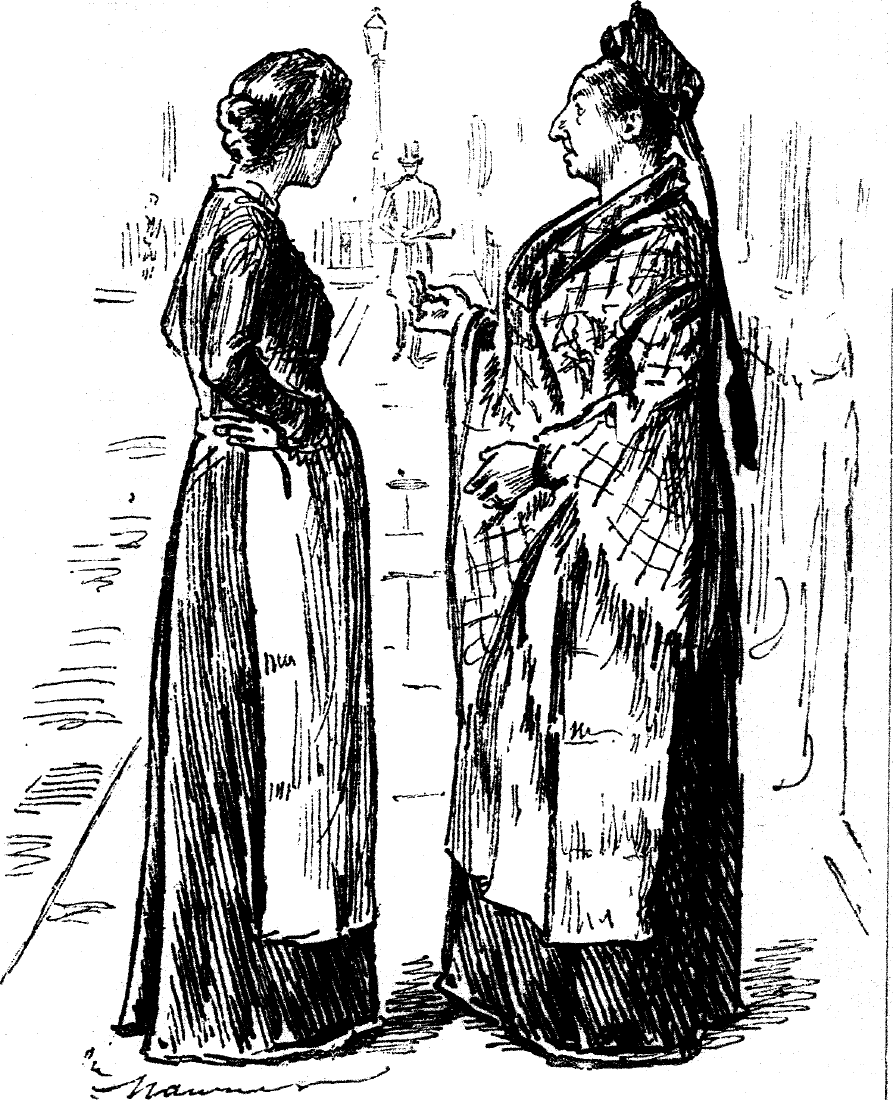
THE NEW DOCTOR.
"The hidear of a Young Man like that a-telling o' Me 'ow poor people's Children houghter be Fed and looked after! Why, I've buried Fourteen o' my own!"