MIXED NOTIONS.
Reading edition
No. IX.—PARISH COUNCILS.
(Scene and Persons as usual.)
Inquirer (to himself, as he reads his paper). Well, I'm dashed! What the blue blazes does all this stuff mean?
First Well-informed Man (to Second W. I. M., in a tone of pitying good-humour, mixed with conscious superiority). He's got started on his usual morning puzzle.
Inquirer (with asperity). Oh, it's all very well for you two chaps to sneer. You're both older than I am, and, as you've been about more, you ought to know more. Anyhow, I like to find out about things, and, when I don't know, I ask those who do.
First W. I. M. (not unkindly). Well, well, never mind all that. You know I don't mind telling you anything. I really didn't mean to sneer. What's your difficulty?
Inquirer. It's all about this Parish Councils Bill.
First W. I. M. What about it?
Inquirer (hopelessly). What does it mean? What is a Parish Councils Bill?
First W. I. M. Oh, well, you know, a Parish Councils Bill is——well, it's a Bill for giving Parish Councils.
Inquirer. Yes—but whom are they going to give them to?
First W. I. M. Why, to the Parishes, of course.
Inquirer. Ah! (Continues reading. A puzzled frown settles on his face.) But why can't the Parishes make their own Councils, without all this fuss in Parliament? Couldn't every Parish simply say, "I'm going to have a Council," and just start it straight away?
First W. I. M. My dear fellow, you know nothing can be done without an Act of Parliament.
Inquirer. But they call this a Bill, not an Act.
First W. I. M. It's only another way of saying the same thing. A Bill or an Act—it's all one.
Second W. I. M. No, it isn't.
First W. I. M. I'll lay you a couter it is.
Second W. I. M. Done!
First W. I. M. Well, what do you (withering emphasis) say is the difference?
Second W. I. M. When the House of Commons brings anything in, it's a Bill, and when the House of Lords does it, it's an Act. Pay up!
First W. I. M. Not I. That's precisely what I meant, only you wouldn't give me time to say it. Why, that's the A B C of politics.
Second W. I. M. Seems to take a lot of learning, anyway.
[A pause.
Inquirer (returning to his point). But look here. What have they brought the Parish Councils Bill in for? I thought we'd all got County Councils all over the place.
First W. I. M. (slapping him warmly on the back). My dear chap, you've just hit the nail plumb on the right head. That's what I've said all along. The whole country's being simply ruined with all these blessed Councils. Every man will have to be his own Council before long, if they go on making Councils at this rate.
Second W. I. M. Well, anyhow, your beautiful Conservative Government, that you were so dashed proud of, started the business.
First W. I. M. (indignantly). I deny it.
Second W. I. M. Deny away. Perhaps you'll tell me that Lord Beaconsfield didn't set the County Councils going?
First W. I. M. Ah, but those were quite different County Councils. Why, they weren't even called Councils; they were called Boards.
Second W. I. M. They may have been called Boards, but they're called Councils now, and that's enough for me. Anyhow, don't you see (furtively consults newspaper and quotes) that "Parish Councils are the logical and necessary development of the scheme of County Government left imperfect by the Conservatives"?
First W. I. M. No. I don't see it at all.
Second W. I. M. Well, then, how do you propose to root the agricultural population in the soil? You must admit——
First W. I. M. I don't admit anything—at least, I won't until you tell me how a Parish Council is going to root anybody, let alone an agricultural labourer, in anything. There's too much mollycoddling of these agricultural labourers, that's what I say.
Second W. I. M. (doggedly). You're always talking about agricultural depression and hard times for those that live on the land, and you won't lift a finger to help them when you get the chance. If we give these chaps Parish Councils, they can all get allotments, and then of course (quotes again) "we shall multiply the productive power of the land tenfold."
First W. I. M. What have allotments got to do with Parish Councils?
Second W. I. M. Everything.
First W. I. M. (triumphant). Then how do you account for my Uncle's coachman having an allotment at this very moment? He's had it for years, long before anybody even heard of Parish Councils.
Second W. I. M. That exactly proves my point. It's just because he isn't an agricultural labourer that he's been able to get it. What we want to do is to level up.
Inquirer. But there aren't any agricultural labourers in my parish; at least, I never heard of any. How are they going to manage about that?
Second W. I. M. They'll send you some from somewhere else. That's what they call migration.
[Terminus.
Inquirer. I thought birds did that.
BEFORE THE PRIVATE VIEW.
(A Modern Dialogue.)
Scene—Lady Hay's Boudoir. Lady Hay and Miss Bee discovered sipping five o'clock tea.
Miss Bee (sympathetically). I am so sorry, dearest, that you have sprained your ankle. And is it quite out of the question to come on Friday to Burlington House?
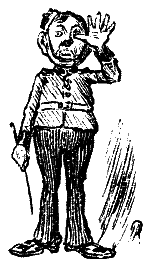
Private View.
Lady Hay. Quite, dearest. Dr. Keeley Dodge says I shall be laid up the whole Season if I move a step before Monday. So you will tell me all about the Royal Academy Private View, now won't you?
Miss Bee. Of course I will do my best; but you know my forte is not description. What do you want to know?
Lady Hay. Why, of course, who were there, and what they said, and (most important of all) what they wore. I hope, dear, you will notice if they are wearing any of the new-fashioned bonnets, and if hats are going out.
Miss Bee. You may rely upon me, darling.
Lady Hay. And mind you get at the last bit of scandal. There ought to be plenty about, now that people have come back from the Riviera. But, my dear, you know exactly what I should like, so it is useless to prompt you. I leave everything to your discretion.
Miss Bee. Quite so, darling. (After a pause.) I thought I had forgotten something—how about the paintings?
Lady Hay. Oh, never mind them! They will keep until another occasion!
[And as they will, Scene closes in on the Pictures.
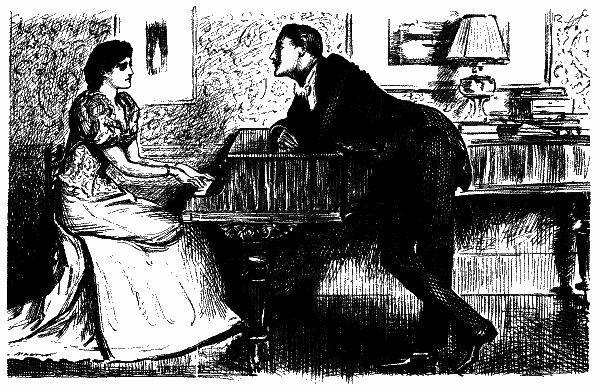
GROVES OF BLARNEY.
"And it's a perfect Miracle the Sounds ye manage to extract from that old Tin Kettle Miss Cecilia; sure we don't hear the Dumb Notes at all!"
LIBERTY LOQUITUR.
["I am persuaded that the true interests of the entire working-classes of this country are bound up with respect for individual freedom, and that to overlook it, or to bring the smallest interference in restriction of it, unless under absolute necessity, would be a sad mistake upon the part of the working-classes."—Mr. Gladstone to the Deputation of Miners from Durham and Northumberland.]
I stand between you—Capital and Labour,— And each of you invokes my "sacred name." Sacred! Were love of freedom and one's neighbour Coöperant, claim would not conflict with claim. But heed my words, outspoken yet meant kindly; I suffer whilst ye stone each other blindly. Solicitous—in speech—of my intactness, Ye damage and deface me in your strife. Your aims, expressed with full and fair exactness. Mean fratricidal strife, war to the knife. Encounter hot, and fierce retaliation Must vainly prate about conciliation. Union is strength; but banded for oppression Toilers are tyrants, and employers—knaves. Plain speech! Monopolist wealth in high possession Treated its scattered thralls as serfs and slaves. And now the lesson of the scourge and fetter Emancipated toil would learn—and better. Divide and govern! That, beneath all glosing About Free Labour, is Wealth's motto still; Ingenious fudge on shallow wits imposing, On banded Labour to impose its will, Capital needs (and lauds) Labour unbanded. The Many-headed dreads the Many-handed! But set one half his hands against the other, And e'en Briareus may be safely tackled. Whilst "Unionist" is foiled by "Blackleg" brother, Labour fights Capital with limbs half shackled. Hence Federations chant, in sweet communion, Hymns to the blessed Liberty of non-Union! And Labour, which loves Liberty—of striking, Hates "Blackleg" freedom with a furious hate. "Make all men do according to my liking!" Seems now the cry all round us in the State. Monopolist, Miner, Temperance fanatic, All crave compulsion with a force emphatic. But Legal Eight Hours Day, or Local Veto, "Blackleg" suppression, Anti-Union law, Mean "make the others to myself say ditto!" "Restriction" is the newest ass's-jaw For slaying all our foes, from Wealth to Drink, Hailed with applause, save by the few who think. If from proved ill to legal prohibition Were step as plain and proper as some deem, To diagnose (and cure) the State's condition Were easy as some Socialistic dream. But Looking Backward—or e'en forward—'s found Poor substitute for wisdom's look all round. Labour, you would be free to fix your wages; Capital, you'd be free to pick your men: Love of free Union the one's tongue engages, Love of free "Knobsticks" fires the other's pen; But love of Freedom for her own fair self,— How much of it moves Poverty or Pelf? Eight hours in the dark coal-seam, good friend Labour, Humanity admits more than enough. But fix it so, whilst neighbour wars' with neighbour, And mine with mine about it? Task too tough, Too desperate dilemma, for a Statesman, Why you can't settle it with your own mates, man! Capital, does your passion for Toil's Freedom Mean much more than desire to smash Toil's Union? He sells his birthright for the mess of Edom, The "Blackleg" Esau selling Work's communion Into the bonds of Wealth, well knit and strong, His comrades say. Are they entirely wrong? Thus Individual Freedom suffers scath On all sides. Can you plead Necessity's fiat? For me you boast your love, proclaim your faith, But, battered by the missiles you let fly at Each other, I with Roland, cry in shame, What tyrannous things are done in Freedom's name!
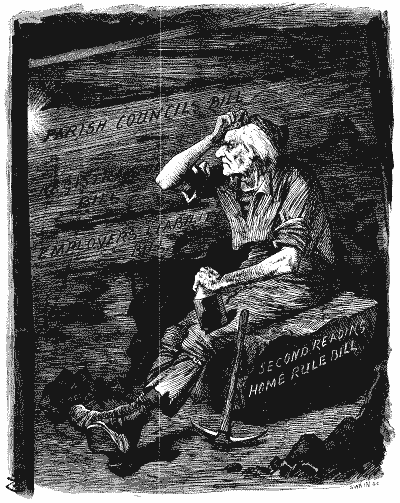
TAKING A "BREATHER."
Grand Old Miner. "DON'T KNOW HOW I SHOULD GET THROUGH WITH MY WORK, IF I WERE TIED DOWN TO EIGHT HOURS A DAY!"
FALBULOUS!
Dr. Falb, of Vienna, knows when earthquakes and eruptions are going to occur. Mr. Morley said, the other day, in the House of Commons, that the best way of treating a prophet was not to believe him; but this is rather difficult when the prophet happens to be right, as Dr. Falb generally is. For example, he predicted the last terrible earthquake at Zante, which only came one day before it was due. Dr. Falb has been interviewed about how he does it,—or perhaps it would be more appropriate to say, that he has been subjected to some mild "Heckling"—and he appears to hold that it is the action of the Moon on the tides which is responsible. In support of his theory it has been noticed that it is quite a custom of the people at Zante, after their houses have fallen in on their heads, to observe—"That was a tidy shock!" These predictions should help them to tide over the periods of danger.
COURT OUT!
What is an "Original Farcical Romance"? The immediate reply is that The Amazons, by Mr. Pinero, is a specimen of the genus. To see The Amazons ought to supply the terms of the required definition. I have seen it, and yet the definition does not satisfy me. "Original"! Well—more or less; but to use old materials in a novel manner is quite enough for originality. The girl brought up as a boy is not absolutely new or original, vide Tom Noddy's Secret, and multiply the heroine of that farce by three. The three men hunting after the three girls and obtaining access to them at school—substituting, in this case, home for school, and a mother for a school-mistress—is not absolutely new or original; but, again, what matters this to anyone, so long as the new shape given to the old material is genuinely amusing? So "farcical" goes with "original." But now, as to its being a "Romance?" Would not the term "burlesque" be a better term than "Farcical Romance?"
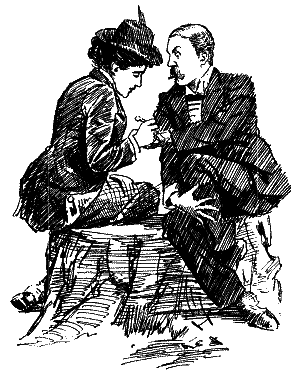
One of the Points of the Piece. The Queen of the Amazons gets the Needle.
The characters of the three adventurous lovers are not less burlesque than were those of the three Knights in Albert Smith's romantic Extravaganza, The Alhambra, played then by Alfred Wigan, and Mr. and Mrs. Keeley. So if I may take it that "Farcical Romance" is only a way out of describing the piece as "burlesque," then I know how to class it, and what to expect. Now I must own that my puzzlement is due to my own fault, for it so chanced that I did not look at the author's description of his play until after leaving the theatre. I thought I was seeing something that was intended to be as broad a farce as Bébé, alias Betsy, but I soon found that, whatever it might be, it wasn't this. It is capitally acted by all, but especially, on "the Spear Side," by Mr. Weedon Grossmith and F. Kerr, the former as an effeminate Earl, and the latter as a manly Viscount. But, even from a burlesque point of view, Mr. Elliot overdoes the Frenchman, a part which belongs to a stage-family of Frenchmen, of which, in former times, Alfred Wigan was the best representative; and, later, Mons. Marius, who, as the French sporting nobleman, in Family Ties, in love with an English "Mees," and so proud of his English slang, was simply the character to the life, without any more exaggeration than was artistically necessary. On "the Spindle Side," Miss Lily Hanbury looks handsome, and is generally fairly well-suited; Miss Pattie Browne has the most difficult part of the three, and it is not to be wondered at if she a bit out-tommies Tommy. Miss Ellaline Terris looks, acts, and sings charmingly as Lady Wilhelmina, and Miss Caldwell gives a good touch of low comedy to "the Sergeant."
The places where the fun comes in, as it does occasionally, and is therefore the more precious, are chiefly with Weedon Grossmith, and in the scenes between Mr. F. Kerr and Miss Hanbury. The piece is not up to the former "screamers," such as Dandy Dick, The Magistrate, and My Aunt, or whatever was the title of the farce in which Mr. Weedon Grossmith played the part of Mrs. John Wood's solicitor. The scenery by Mr. Hall is Hall good, specially the woodland scene in Overcote Park.
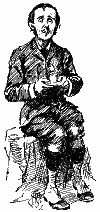
"We loathe Music."
"Much Ado About Nil."—Were the Temporal Power in existence, the Lord Mayor, in proposing the toast of the Pope before that of the Queen, would have been guilty of a blunder, and we all know, on Talleyrand's authority, how far worse is a blunder than a crime. But the Pope, being no longer "two single gentlemen rolled into one," but simply, as it might be set down in a Play-bill of Dramatis Personæ, "First Bishop," and also by his own style and title, "Servus Servorum," the health of His Holiness (which is uncommonly good) might, in British Dominions, be introduced after that of the Queen and Royal Family, and could be fitted into Church and State as neatly as possible, that is, where such a toast is a necessity of the entertainment. But the stupidity of the incident has been surpassed by the idiocy of the notice taken of it, and, for the sake of the common sense of the Common Council, it is to be hoped that a large majority will be on the side of Alderman and Sheriff Renals, and refuse to toast the Lord Mayor on the Gridiron of Lawrence.
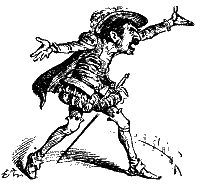
Drury Lane Opera Record.—Bohemian Girl going strong, Cavalleria Rusticana still the attraction. "Happy Thought" (vide Druriolanus's Diary)—"Revive La Juive." Done it! and done it well. Giannini, as Eleazaro, excellent. Rachele not up to Rachel in acting (for those who may remember that tragédienne), but Mlle. Gherlsen, representing the Jew's daughter, does what the great Rachel could not do, that is, sing. La Juive will be given during the Covent Garden season; so these performances may be considered as very superior rehearsals. Carmen on Thursday, instead of Il Trovatore.—the Trovatore being Il, couldn't appear. With all due sympathy and respect for Trovatore, Carmen was gratefully received. Signor Pignalosa, as the Toréador, very good, and obtained his encore; so this Toréador was "contento." Mlle. Guercia was a fascinating Carmen, and what is any Carmen if not fascinating?
TAKEN IN, BUT NOT DONE FOR.
(Overflow Letters, probably originally intended for a Contemporary.)
SIR,—No doubt you have seen in the papers recently a number of letters, giving accounts of the stoppage of cabs by well-dressed young men, who, after heartily greeting the occupants, have asked for the loan of a sovereign. The other day something of the same sort occurred to me. I got into an omnibus, when a man, purporting to be a Conductor, asked me for my fare. I replied that I would pay him later on. He then proceeded to mount to the roof, apparently to collect other money, when I quickly descended. I firmly believe that, had I not acted promptly, I should have been defrauded of three-pence. Believe me, yours, &c.,
Vigilant.
SIR,—I think you should know the last dodge. I was walking home from a rather heavy dinner the other evening, when I came across a man exactly like myself. He might have been my twin brother. He didn't say anything, but put out his hand towards me as if asking for alms. Of course I refused, as I could see that the man was drunk. A little later I was escorted home by a policeman. The next morning, when I got to the spot where I had been accosted by this silently-begging stranger, I found a looking-glass. The police say they have the matter in hand, but they do not see much prospect of finding the original.
—T. O'Baccus.
SIR,—As a warning to the less wary, I beg to send you the following particulars:—A short time ago I met at a Charity Banquet an Alderman who was apparently a most excellent gentleman; and I lay a stress upon this fact to show how deceptive are appearances. After the speeches, my City friend said he would like to subscribe to the benefaction. He asked me if I had change for a five-pound note. I replied I had only four pounds. He said that that would do, and that I could forward him the additional sovereign at my leisure. I then handed over the quartette of golden coins in exchange for his bank-note. Immediately afterwards I quitted the apartment to ascertain if the note was genuine. I have not seen the Alderman since. I may add that although I believe the draft a forgery, I have received its full alleged value from the Bank of England.
Caution.
THE TWO HENRIES.—Congratulations to Sir Henry Isaacs. The other Sir Henry, which his name is Hawkins, the Judge, observed that he had "a conviction that the case against Sir H. Isaacs ought not to go to a jury." So one Henry had a conviction, and the other hadn't.
(H)ART-TEACHING IN A NUTSHELL.
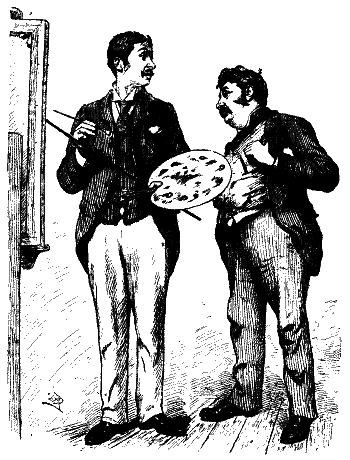
Cockney Art-Teacher (to ambitious Amateur, who rather fancies himself, but has come for a few "Finishing" Lessons). "Now, yer know, what I say is, if you're going to be a Artist, yer should try to mike it something like!"
ESSENCE OF PARLIAMENT.
EXTRACTED FROM THE DIARY OF TOBY, M.P.
House of Commons, Monday, April 11.—Lord Mayor of Dublin dropped in to pass time of day with Speaker. Accompanied by a score of his merry Councilmen, arrayed in scarlet cloaks trimmed with costly furs. Made ordinary Members in black coats feel very small. T. D. Sullivan, the Bard of Erin, long known at Westminster, is also Member of Dublin Corporation. Brought over his scarlet robes; took his seat within the Bar; other Members of Corporation, of course, kept outside sacred precincts. Some little disturbance at door when Lord Mayor arrived in procession, preceded by Mace, and accompanied by Sword-Bearer. These wanted to enter House, and support his Lordship as he stood at Bar in alien assembly.
"You enter only across my body," said the Serjeant-at-Arms, lightly, but firmly, touching the hilt of his terrible brand.
A moment's awful pause. The sword brought over from Ireland would, in weight and cubic capacity, have made ten of the rapier to which Erskine of Cardross had significantly called attention. When, later, it peacefully rested behind doorkeeper's chair, its mighty hilt rose above topmost height like the cross on a cathedral spire. Sword-Bearer looked at Lord Mayor; Mace-Bearer grasped with both hands shaft of his ponderous weapon. Both warriors accustomed to public meetings in Dublin; knew what was expected of them by way of argument. Lord Mayor happily in placable mood. Readjusting around his neck the collar of gold (the very one "Malachi won from the proud Invader"), he bowed his head; Mace and Sword were deposited behind doorkeeper's chair, and his Lordship strode in, escorted by the crimson-gowned, fur-betrimmed City Fathers.
Lord Mayor, supported on either side by a stately Alderman, stood at Bar holding what at first sight looked like a shillelagh.
"What have you there, my Lord Mayor of Dublin?" asked the Speaker, in tones so stern they made the sword rattle in the scabbard on the other side of the closed door.
Nothing escapes Speaker's Eye when he pleases to bring it to bear on a particular focus. Had seen the implement in Lord Mayor's hand; insisted upon knowing all about it before proceedings went further. Turned out to be nothing more dangerous than petition from Corporation of Dublin in favour of Home-Rule Bill. Speaker, instantly mollified, allowed it to be read; after which Lord Mayor, bowing, retired; Mace and Sword found all right, and possession resumed. As the thin red streak filed out of doorway, T. D. S. still lingering in seat by Cross Benches, said, as he looked admiringly upon the befurred crimson robes. "Reminds me, Toby, of a line from Goldsmith. You remember it in The Deserted Village?
'With blossom'd furze, unprofitably gay.'"
Business done.—Eighth Night Debate on Home-Rule Bill.
Tuesday.—Found Vicary Gibbs (well-known firm, Sons And Antony Gibbs, of the City and the Universe) rather in dumps to-night. Been a burglar at family mansion in Regent's Park; the Firm at dinner; Sons standing a little meal for Antony; burglar took opportunity of entering by bedroom window, first observing precaution of screwing up doors, and other entrances and exits, so that he might pursue his vocation with that certainty of non-disturbance upon which all well-bred burglars insist. Loot considerable, Providence blessing the burglar with tea-pots and spoons to extent that would have excited envy in heart of Hans Breitmann.
"Well, cheer up," I said to young Vicary; "awkward, of course, to lose this property; some of it, probably, heirlooms; at least, there was no bloodshed. You should be thankful for that."
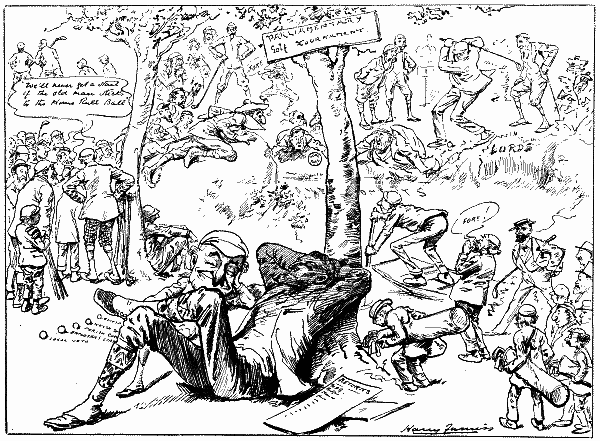
THE PARLIAMENTARY GOLF HANDICAP.
"Not at all," said Vicary, the light of Ulster battle ditches flaming in his eyes. "I should like to have shed some myself. But it isn't that, nor is it the material jewels whose disappearance I lament. They are things that are bought and sold; they may be replaced. Fact is, old friend" (hate to see a strong young man sobbing), "there was more than that."
"I didn't see anything else mentioned in the papers," I remarked.
"No; we resolved to bear our burden among ourselves. I don't mind telling you, that beside the brooches, bracelets, chains, rings, and other things of that sort, the fellows stole the notes I had made for speech on Home-Rule Bill. Been here night after night since debate opened, sitting patiently waiting to catch Speaker's eye. Have given up my dinner and other evening delights; night after night Speaker has passed me over. I waited on; everything has its compensation; the enforced delay proved invaluable, as supplying opportunity for improving original draft of speech. As I sat and listened, great thoughts surged through my mind; happy illustrations flashed upon me; irresistible arguments were slowly moulded. Jotted 'em all down. Notes getting, perhaps, a little long; couldn't have managed to work them off in less than two hours; but House would, I know, have suffered gladly for that time, or even longer. An audience that has survived two hours of Asmead Bartlett (Knight) is not disposed to mince matters. Last night resolved to get it over: told Prince Arthur to tell Akers-Douglas to arrange with Speaker to call me as near ten o'clock as possible. Went home for slight repast; placed notes of speech on dressing-table; thought with passing pleasure of the policeman we have kept these thirty years perambulating St. Dunstan's in view of possible burglar, and went to dinner. When I tripped upstairs, meaning to go down to House, found notes gone, and, incidentally, £2000 worth of jewellery. I won't disguise from you, Toby old man, my private conviction that the whole thing was a plant. Mr. Gladstone's at the bottom of it!"
Business done.—Ninth Night Debate on Home-Rule Bill.
Thursday.—Sexton made five speeches to-night, each sufficient of itself to lay foundation of parliamentary reputation. Had he spread them over the Session, or even distributed them throughout a month, would have scored great success. Unhappily worked them all off at single sitting, without other interval than succession of long pauses, arbitrarily introduced. Fancy he felt he must do something to maintain ancient reputation. Grandolph and John Morley spoke for two hours each, whilst few, having caught Speaker's eye, let go under ninety minutes. Sexton must needs beat record; did it, talking for two hours and half by Westminster clock! Had an hour and a half served, speech would have been worthy to rank with those of Asquith, John Redmond, and Davitt. As it is, case one of oratorial suicide. Carson followed; quite moderate in comparison. Spoke for little over an hour. When he sat down, it was after eight o'clock; more that one-half of possible length of sitting exhausted; only two Members taken part in Debate.
"Debate d'ye call it," said Lord Morris, looking on from the Peer's Gallery. "It's preaching rather—pragmatical prosing, the death of useful Parliamentary discussion."
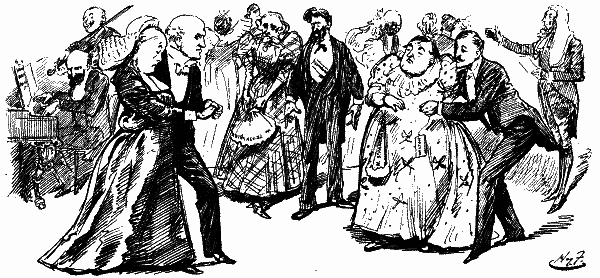
THE PARLIAMENTARY POLKA. "PAIRS PLEASE!"
House left in almost comatose state. Someone faintly moved Count; Marjoriebanks, who had not suffered the four hours' talk, and who, by comparison with rest, seemed supernaturally active, managed to bring in what was left of forty Members, and conversation drowsily proceeded to appointed hour of closing. Business done.—Eleventh Night.
Scheherazade. "And so, my Lord, he drew his scimitar, and was about to—— But excuse me, Sultan, I observe, through the oriel window, something that looks remarkably like the streak of dawn, and, if you don't mind, I'll continue the story to-morrow night."
Schahriah, Sultan of Persia. "Thank you, no my dear, I have some dim recollection that, in a former state, this sort of thing went on for a Thousand and One Nights, ending in the most agreeable manner to the principal personages concerned. But that, you will admit, was in other circumstances. The world, and we, were younger then. Eleven nights of this is enough for me, and, if you would be so good as to step into the next room, I will give instructions for your being—excuse this yawn—bowstrung."
(Extracted from "The Newest Arabian Nights.")
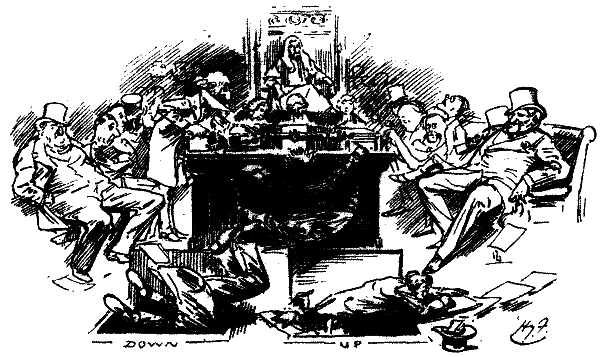
Demon-Trap for Reporters.
Saturday, 1.15 a.m.—Members streaming back from Division Lobby; Mr. G. down on stroke of One o'clock: splendid speech—a mental and physical miracle; for little over an hour he entranced an audience still suffering from two hours of Henry James, throughout which the eminent jurist sank below lowest level hitherto known of his Parliamentary capacity. Prince Arthur at his best; in brisk fighting mood, hitting out right and left; stirring Tim Healy's soul with surging desire to get up and reply. No opportunity so Tim snapped at him across Gangway, Prince Arthur cutting back with ever-smiling face. When, just now Mr. G. walked in from Division Lobby, Liberals and Irish Members leaped to their feet, welcoming him with waving hats, and strident cheers. A moving scene, introducing announcement that, in House of 651 Members, every absentee accounted for, Ministerial majority ran up to 43. Business done.—Home-Rule Bill read Second Time.