CREDIT WITHOUT CASH.
Reading edition
The Hon. Crœsus Cash was greatly annoyed that so many people should have been admitted to his library. He bitterly reproached his valet for this dereliction of duty.
"Beg your pardon, Sir," said his servant, "but they would come in. They said they must see you—that their lives depended on it."
"What have I to do with their lives?" growled the Hon. Crœsus. And then he added, as he entered his sanctum, "Now, Ladies and Gentlemen, what do you want? My time's precious, and I can't waste it upon strangers."
"My dear Sir, my very dear Sir," cried in trembling accents an old parson in a thread-bare coat, "I have a wife and family, and we are really starving."
"Ditto, Sir, ditto!" observed an elderly soldier who had evidently been an officer.
"And I am a widow, and must bring my poor children home from school, as I can no longer afford the expense of their education," so said an elderly dame in shabby mourning.
"But how can I help you?" asked the Hon. Crœsus. "What has brought you to this pass?"
"Why, you, Sir," returned the ex-officer. "You, Sir!"
"Come," said the Hon. Crœsus, waxing angry, "I advise you to be careful of the provisions of the Libel and Slander Act. You accuse me of bringing you to poverty! Why, I have never seen any of you in my life—never even heard of you!"
"But we have heard of you," they cried. "Yes, we have."
"We are all shareholders in the Bubble Babble Syndicate, Limited," explained the parson, tearfully, "and we have consequently lost every thing we had in the world."
"But what have I to do with it?" again asked the Hon. Crœsus. "Very sorry to hear of your misfortunes, but I don't see how I come in."
"Why you, Sir," exclaimed the ex-officer; "you, Sir, were one of the officials!"
"Pardon me, Sir, I was nothing of the sort. I have nothing whatever to do with the Syndicate. I was merely a Director."
And when the defrauded shareholders found out that he was only that, they went away complaining, but convinced they would be afforded by him no relief. And they were right, for the Hon. Crœsus (who was old-fashioned in his ways) acted strictly according to precedent.
THE PRIVATE VIEW.
(By a Visitor, Small but not Early.)
Irony about this View Is, I fear, more true than new, Still the crowd's a great 'un; Heads and bodies hide from me Pictures that I wish to see; Smooth, fair maids by Leighton; If I seek a work by Wells, Can I see through beaux and belles? I can but survey 'em. Hid the masterpiece of Brock By some girl's wide-shouldered frock, So the bulls of Graham. If my eyes seek breezy Hooks, Hooks and eyes obstruct my looks; Pity me, dear reader! Cobalt Cornish seas by Brett Hid by chignons in a net, Likewise views by Leader! See, instead of groups by Crowe, Coats, black like him, in a row; Also, quite as thick, see Backs, not sculptured ones by Bates, Hide the pretty pinkish pates Done to death by Dicksee! If I strive to see a Sant, My large neighbours make me pant, For they push so coarsely; Or the evergreens of Stone, Then they nip my funnybone; And I lose what Horsley Drapes so decently—the Marks Are on me; these tall young sparks Squeeze enough to kill a Little man, who sees no Watts Past their lofty chimney-pots, Nor a single Millais.
Good Start For The Academical Year.—Mr. Stanhope Forbes, A.R.A., is a clever Painter, as everyone knows, but he is cleverer than was thought, as he has sold his Academy Picture to the Manchester Corporation for 1,200 guineas. Stanhope Forbes will change his name to Stan'up-for-your-Price Forbes, A.R.A.
From One of the Wise Men in the East.—A traveller, doing a walking tour in Egypt, from Cairo and back again, describes himself as a "Cairopedist," and adds that it's just the place for Members of that profession to prosper, as "Corn in Egypt" is proverbial.
The Premier at the Haymarket Last Wednesday.—This does not mean that Mr. Gladstone visited this theatre, but simply that Mr. Tree produced a new piece, written by the O'Wilde. "Whatever be its merit or want of merit," says Joseph Miller, Q.C., "Wilde can't be tame."
A LIEN ON THE LEA.
AIR—"The Bells of Shandon."
["Mr. Pember, Q.C., before the Committee of the County Council General Powers Bill, put in a claim, on behalf of the New River and other Companies, that the water of the River Lea is the absolute property of the Companies!"
Daily Chronicle.]
Is it, by thunder? With solemn wonder I'll often think of That sounding claim; And oft remember How Mister Pember (He's a "hot member"!) Put in the same. On this I ponder: Where'er I wander, "From here to yonder," I'm sure to see, Whate'er I stand on, Wealth lays its hand on, As on the water Of the River Lea. I've had one mouthful. But, though of drouth full, I trust I'll never Another swallow. I've tried the tide Of Thames, Medway, Clyde, But unstrained Lea-water, It licks 'em hollow. I know that river Set me a-shiver, Upset my liver, And made me ill, When, on it punting, Some cads, sport-hunting, Driving into me, Gave me a spill. My memory, dwelling On that ill-smelling And muddy throatful Revolts. Ah me! That awful vision! That dread collision With the rowdy boatful On the River Lea! But, goodness gracious! If river spacious By Co.'s owdacious, Can thus be claimed, I have a notion The wide blue ocean As "absolute property" May soon be named. Who need be caring For the Sea of Behring? We shall have them sharing The broad Atlantic. Whilst the Bay of Biscay (Like a keg of whiskey) Will be shared and lotted By financiers frantic! O sublime monopolist, You're truly top o' list! Where will you stop? Oh, list, One word from me! Too big claims abandon. You may lay your hand on The unpleasant waters Of the muddy Lea, But in every quarter Of Earth, Air, Water, If too strong you "come it" (As you seem inclined), There will be a shindy; And you'll find it—windy Upon "Proputty's" summit, If you do not mind. On that peak you'd plant 'em, Your claws, bold Bantam, But I spy a phantom Which you may not see, Which may scare you slightly, Should you grip too tightly The unpleasant waters Of the River Lea!
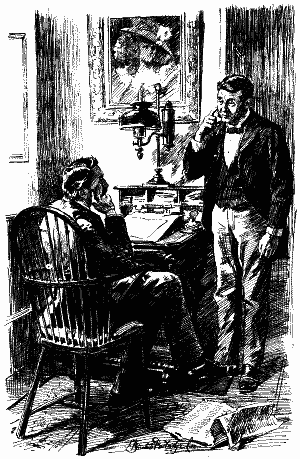
James. "You'll excuse me, Sir, but I wished to hask you if you could spare me for a Hour Or Two to-morrer mornin'?"
Employer. "What's it for, James?"
James. "Well, Sir, I wish to consult a Dentis', I 'ave a 'ollow Tooth 'ere, which gives me hawful pain; an' it's only with great heffort that I can manage to Domesticate my Food!"
TOO BAD TO BE TRUE.
At a meeting of the London Diocesan Conference, a Reverend gentleman is reported to have declared his belief that, "for one man drawn from the Public-house by the opening of the Museums on Sunday, there were ten persons drawn from their attendance at Church!" Mr. Punch fancies these are rather supposititious statistics. Does the Reverend gentleman quite see what his hasty statement involves? How slight must be the attractions of Church—his Church at least—to a large proportion even of those who do now attend? Rivalry between Museum and Gin-palace one can contemplate hopefully. But if the real rivalry is to be between Museum and Church, with such results as this rather pessimistic parson predicts, the look-out seems rather dismal—for the Church! Surely this is the highest compliment to secular attractions ever paid by a cleric! Mr. Punch hopes—and believes—it is as ill-deserved as high.
SPORTING ANSWERS.
Poultry.
Quack.—The game of Ducks and Drakes was played originally by Noah, after the subsidence of the Flood. We hear of it again in the Chronicles of Cornelius Longibovus Mendax, who relates that it solaced the last hours of Artaxerxes when he lay on his death-bed in the desert of Sahara, and called in vain for his third wife, Psammetica, who was at that moment gathering mushrooms in the garden of the Royal Palace at Persepolis.
Chaff-cutter.—To make Dodo's eggs, take a solution of ext. turp. rutifolia, and boil for two hours. Then simmer on a slow fire, add two pinches of salt, and the hard part of a bullock's hide. Pass through a common sieve, and hatch out under a tame Pterodactyl.
GARDEN.—Venditus Iterum.—The bark of the dog-rose is naturally worse than the Bight of Benin. The one you sent us had no dew-claws. Quite right; it has had its day. So has Martin.
"ECCLESIASTICAL INTELLIGENCE."
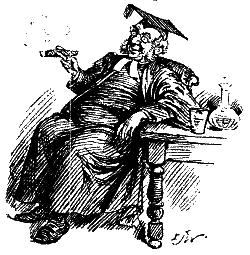
Under this heading the Times, some days ago, informed us that a certain set of Oxford Dons had met together in order to make arrangements for the establishment in the University of a couple of first-class Evangelical Clergymen, possessing "special gifts," to whom such Undergraduates as might be piously inclined could go for instruction and good counsel. It was stated, in their sketch of a prospectus of this scheme, that these two grave and reverend Gentlemen are to be "accessible at all times." This is excellent. Also, "they will be given to hospitality," which is still more excellent, and let us hope that, in return, hospitality will be given to them. But it is difficult to combine "accessibility at all times" with perpetual festivities. For how would it suit either of these well-intentioned Clergymen, after the hospitalities of an ordinary day, commencing with University Breakfast, going on to University Lunch, thence to University Tea, then dinner, wine, and, finally, supper, to be accessible to anyone who chose to ring them up during the small hours to ask for "counsel and advice so judicious and so sound"? Very "special" indeed would have to be the "gifts" of the two always-hospitable and ever-accessible Clergymen, who would undertake the mission; and, among their most essential special qualifications, would have to be, first, the capacity for taking any amount of everything without being in the least the worse for it, and, secondly, the capacity of perpetual wakefulness and clear-headedness, without the extraneous and artificial application of wet towels round the head. Men with such special gifts are, indeed, rare; nay, they are demi-gods. But, if such men are to be found, no matter at what cost, we sincerely wish they (the originators of this scheme) may get them.