OUR BOOKING-OFFICE.
Reading edition
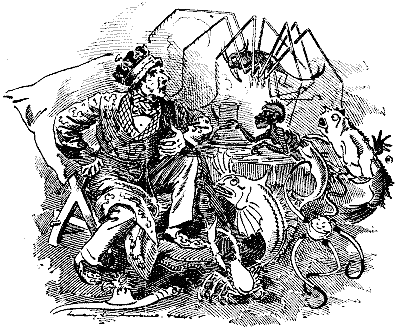
"The strange sea-creatures which made their appearance."
Two gentlemen of artistic and literary attainments, having studied the romances of Victor Hugo for the sake of being inspired by that Grand Old Master's style, determined to essay a "thriller" of most tragic type. These two single authors, Messrs. Wyatt and Ross, being rolled into one, wanted, like the Pickwickian Fat Boy, "to make our flesh creep." In their one-volume Hugoesque romance, The Earth Girl, bound in pale grass-green, with blood-red title, they have most unequivocally succeeded. The heroine, The Earth Girl, who, at the last, is sent back whence she came, and so ends by being the "Earth-to-Earth" Girl, is named Terra; she commences by being Terra Incognita, she is never Terra Firma, but her existence, in its consequences to all who come within her influence, is quite a reign of Terra. The authors are to be congratulated on not having yielded to a great temptation by styling their story The Earth Girl; or, Terra-ra-ra-Boom! The scene is laid chiefly in the Island of Breke—but to give too many details would spoil the intending-reader's pleasure. So, as Hamlet observes, "Breke, Breke my heart, for I must hold my tongue!" The Earth Girl first sees the light, such as it is, in a cavern, and is brought up on raw eggs fresh from the sea-bird's nest, uncooked herbs, and raw fish. No tea, coffee, milk, or liquors of any description, were within reach of this unhappy family of three, consisting of Pa, Ma, and the Infant Phenomenon. How they slaked their thirst is not clearly stated, unless a sort of aquarium, in which some amiable sharks reposed, was a fresh-water tank. This wild girl was elegantly brought up, as far as their somewhat straitened circumstances would permit, for she learned songs and ballads, French, English, and the Norman patois of the Channel Islands. In these peculiar troglodytian surroundings she had never learned the use of parasol or umbrella, and was entirely ignorant of harp, piano, and the "use of the globes." Coming up out of the caves and breathing once more the upper air, we naturally find ourselves in higher society, and are introduced to a handsome old Peer, Lord Netherdale, who has two sons, the half-brothers Royallet, one of whom gaily addresses his respected parent as "The Paladin of Paters," and is not at once locked up in Colney Hatch. The old Peer is as eccentric as he is handsome, and he takes up his residence on the Island of Breke, where "the fruit, the vegetables, the strange sea-creatures" (odd fish?), "which made their appearance on his table," (this sounds as if the strange sea-creatures walked in unasked. Queer place this Breke for a Breke-fast party!) "pleased him." He was easily pleased. Then "he began to think the island cider preferable to Pommery. In short, the eccentric Peer fell in love with Breke." Well! he must have been an eccentric Peer to prefer Channel Island cider, even from the best orchards, to the '84, '80, and '74—the last still existing in some exceptionally favoured spots—from the vinevards of Pommery. This eccentric nobleman on seeing the Island of Breke, observed the absence of a landing-stage, and jocosely remarked to himself, "They're in want of a pier; I will fix myself there." And so he did. But of all that happened to him there and elsewhere, and to the Earth-to-Earth Girl, and to the two sons, is it not to be read by the purchaser in the book itself, which, the Baron is pleased to add, will well repay perusal, and will hold the reader's attention to the very last line. At least, this was its effect on the not always easily pleased.
Baron de Book-Worms.
A NEW "ARNOLD'S EXERCISE."
My Dear Mr. Dacre,
I have seen your Play, and, since then, I have not seen any other like it. "When will I come again?" To see it twice within a week would be too ecstatic a joy for a dweller—may I say a Liver—in London, who is more at home as one of the Lights of Asia. So, for the present—to paraphrase what I believe were the words of a popular poet whose name has passed from my memory—such, alas! is popularity—I will say to you, "Not to-day. Dacre"—(I fancy the last word was "Baker" in the original Syriac)—but, some other day, when, as one of the Lights aforementioned, I shall, at a Matinée be day-lighted to re-witness your admirable performance.
Yours ever most sincerely sincere,
Edwin Tails-lose, C.B.
P.S.—"C.B." is not "Commander of the Bath," but stands for "Cox and Box," in which piece (have you ever played it? I forget—but how perfect you would be as Sergeant or Corporal Bouncer!) you will find the immortal quotation which precedes these descriptive initial letters.
MY DOCTOR.
When Influenza pangs attack My tortured head and limbs and back, You soothe me, stretched upon the rack, My Doctor. When, convalescent, I'm too weak To stand, or sit, or see, or speak, Your tonics make me tough as teak, My Doctor. No symptoms seem to cause surprise; Though I turn green or blue, your eyes Are still impenetrably wise, My Doctor. If grave or slight the case, you still Awe folks with look of learned skill; You cure them, whether well or ill, My Doctor. One needs trepanning of the head, Another just one pill—of bread, And neither, thanks to you, is dead, My Doctor. Long may you live to see the tongue, To listen to the wheezy lung, To feel the pulse of old and young, My Doctor!
A Button-hole for Mr. Chamberlain.—At the sale of the Quorn House Orchids, Mr. G. Hardy purchased a Cattleyn Mendelli for 220 guas. Perhaps Mr. Chamberlain wouldn't bid, having mistaken "Mendelli" for "Mundella." But to have entered the house in a careless fashion, with a "glass (with care)" in his eye, and a two-hundred-and-twenty-guinea Orchid in his button-hole, would have been a great sight for "Joey B"-irmingham.
Early and Late.—A telegram in the Times, Wednesday 12, was headed—"Japan: Yokohama, March 30 (viâ Victoria, B.C., April 11)." This met the eye of our old friend, Mrs. R., who forthwith exclaimed, "'April 11, B.C.!' and only arrived here now—April 12, A.D.!"
Change of Name.—All congratulations to the Duke and Duchess of Fife. Great alterations and improvements are, it is said, being made at Mar Lodge. The name also is to be altered, and henceforth it is to be known as "Mar and Pa' Lodge."