PART I.—THE START.
Reading edition
Notes from the Travel Diary of Toby, M.P.
The Cottage, Burrow-in-the-Corner, Devon.
Went out for a walk just now; nothing remarkable in that; the wonder came in when I got back. Present postal address given at head of this note. The Cottage is there all right, but where the township, hamlet, village, or whatever Burrow-in-the-Corner may be, is situated, haven't the least idea, and I've tramped pretty well round the country. The Cottage stands at four cross roads, on the top of a hill. Specks in the distance, in the valley and on the hillsides, understood to be farm-houses. Three miles off is Tipperton; it is approached from this point by a steep hill: most convenient way of getting to bottom is to lie down on top and roll; some people said to have become adepts in practise; can even enjoy quiet sleep on the way, and pull up at the very shop in High Street where they have business. So it is said; but I rarely see any people about Burrow-in-the-Corner; so how can they approach Tipperton in this or other way? The only persons that pass The Cottage palings are men who stop to ask their way. The population is sparse, and seems to fill up its time by losing itself. This should have been a warning to me, but it wasn't.
The Cottage been standing here for at least two hundred years. Began life as a smithy; only recently retired from business. The initials of one of its tenants are "R. B." He has carved the letters on the front door, with the date, 1813, following it. Fancy he must have been pretty old then, for, two years later, he cuts his initials again with date 1815; the writing quite shakey; possibly he had heard of Waterloo, and his hand was tremulous with patriotic joy. On second thought, that improbable. News of Waterloo not likely to have reached Burrow-in-the-Corner within limit of twelve months.
The smithy still stands as "R. B." left it when his bellows blew their last gasp. The Cottage itself transformed. The thatched roof remains; also the whitewashed walls, the porch, the little windows embayed in thick walls, which quite naturally form window-seats, where, if you take care not to bang your head, you may sit at ease, and look out over the swelling upland—rich red where it has just been ploughed; for the most part green pastures trending down to the Exe, a silver stream, rippling on to the sea, reckless of all it will pass through before it joins it. We have a parlour, but prefer to sit in the kitchen, a dainty room with gleaming dark-red sideboard; a kitchener, polished to distraction, so that looking-glasses are superfluities; a piano in recess by fireplace; a chimney-piece, on which gleam copper pans, brass candlesticks, and pewter plates, with their initials and ancient birth-dates polished almost out of sight; white-curtained windows, bright with begonias and cyclamen; a low ceiling, supported by a pragmatical beam, strictly conforming to the regulation that forbids a straight line in the room.
Have discovered that kitchen is best place in house to dine in; only drawback is that everything served so unexpectedly hot, new-comers scald themselves. Soon grow used to it, and to get grilled mushrooms served really hot is compensation for inconvenience. As for pancakes (made with freshly-laid eggs), begin to think I never tasted the real delicacy before. Your true pancake, as Brillat-Savarin omitted to say in his well-known treatise, should be eaten to the music of the one in the pan preparing to follow. When we go back to town, mean to ask servants to sit in dining-room whilst we dine in kitchen.
When I speak of going back to town, of course I imply the certainty of being able to find our way out of Burrow-in-the-Corner to nearest railway station.
Seems a good deal to have four cross roads all to yourself at your front door. The Cottage scarcely of sufficient importance to justify such lavish accommodation. But in these parts the amount of arable land wasted in roads and lanes is almost criminal. It was a Saturday evening when I went out to find the post-office. Nothing seemed plainer than instructions.
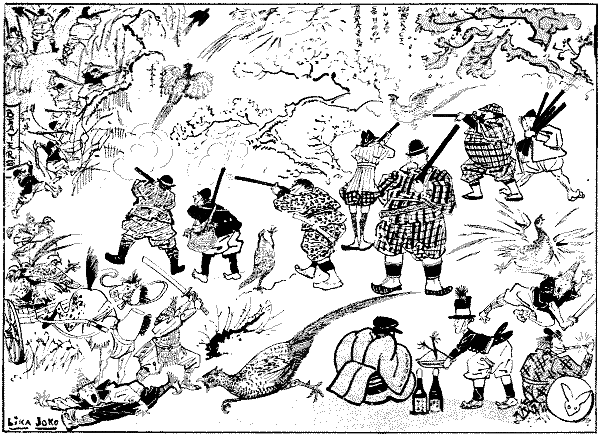
LIKA JOKO'S JOTTINGS.—No. 2. PHEASANT SHOOTING.
"Go straight down the road facing you, and you'll come to a church. Close by it is a house; letter-box inserted in side of house; box painted red, you know."
Of course I knew; set off with a light heart and handful of letters. A little way down high road, on right-hand side, lane suddenly opened and delved downwards, its sinuous course embowered in trees; where they failed, barricaded with hedges. High road seemed originally bent upon taking this direction; changed its mind; turned abruptly to left. Suppose a few traps driven down hill must occasionally have taken this dip; feeble attempt to avoid too frequent recurrence of accident made by setting posts on line of high road, and painting tops white. If, after this, anyone on pitch-dark night mistakes road, only themselves to blame. Other roads and lanes perplexingly branching out to right and left at short intervals; kept on steadily till church came in view; found the house; not difficult, as there was only one; also discovered letter-box painted red. Twenty minutes to five was hour for clearing box; barely that; posted letters. Turning away when observed remark on letter-box, "Next collection Monday."
Pretty go, this; postman evidently been before his time; no sign of him on wide expanse. Looking round perceived Elderly Gentleman sitting in garden behind house; doubtless this was the householder; apparently had anticipated Sunday by putting on best clothes; black frock coat, getting brown about the seams; high collar, nearly covering black stock; black waistcoat, which seemed to belong to other suit than the coat; (was buttoned close up over stock, whilst coat, with generous lapels folded back, buttoned low down); brown trousers, a little short in leg; stout green umbrella under left arm. Elderly Gentleman was sitting on rustic bench, with cup of cider at hand, and expression of serene content on his wrinkled face. A quaintly-coloured cup, with two handles close together, presumably with view to taking a good pull at contents. "Bin my grandfather's," he said, looking at it with affection, and incidentally half emptying it. There was a motto roughly scrawled by the potter; Elderly Gentleman read it to me:
Erth I am et es most trew, Disdain me not for so be yew.
Thus it was spelled, but no one born out of Devon could convey the tremendous sound of the u in the rhyming words. This peculiar to the soil; even barndoor fowls have it; notice that gamecock at The Cottage when it wakes me early in the morning, always shrilly pipes "cock-a-doodle-dew!" Asked Elderly Gentleman if he lived here? Born in the house, he said. Was he going for a walk? No, only sitting about. Then why the umbrella? Ah! he always took it out of drawer with his Sunday clothes, and put it under his arm, if he was only sitting in the garden.
But that's another story, told me after we had caught the postman.