THE CITY HORSE.
Reading edition
(A Legend of the "Coming Ninth.")
"You must let me have him on the day I have specified," said the military-looking man, with an air of determination.
"And you order this, Sir, after learning his history?" replied the well-educated cabman. "You know that he has been in a circus?"
"I do; it is one of his greatest qualifications. A circus, I think you said, where there was a brass band?"
"Not only a brass band, but a very brassy band indeed; a brass band all drum, trombone, and cymbal! A brass band that could be heard for miles!"
"And he bore it well?" asked the ex-soldier. "He did not mind the noise?"
"Not he," was the reply. "Why should he mind it? For remember he was accustomed to insults from the clown. When a horse regards insults from the clown with equanimity, you may be sure he will object to nothing."
"And what were the nature of these insults?" queried the veteran warrior, with renewed interest. "Did the clown push him about? Did he tell him to gee-up?"
"Why, certainly. Had he been an unruly crowd at Blackheath on a Bank Holiday, the clown could not have behaved worse. And Rufus, poor beast! bore it all—six nights a week, with a matinée thrown in on a Saturday—without complaining."
"And you do not think he would mind being called 'cat's-meat?' Not even by a rude boy?"
"Bless you, Sir, it is what I often call him myself. Rufus is his name, but cat's-meat is his nature. But don't you want him for more than a day? Won't you buy him?"
"No," returned the veteran soldier, sternly. "I only require him for the Ninth."
"He is getting too old for cabwork," argued the well-read driver. "He would make a splendid charger for the adjutant of a Yeomanry corps, and out of training might be put in the harness of a bathing-machine. No, pray don't interrupt me, Sir. You are going to urge that he would be useless in the winter. But no, Sir, you are wrong. He might take round coal (in small quantities), when the nights draw in. Can I not tempt you, Sir? You shall have him a bargain. Shall we say a penny a pound?"
"I have already told you," replied the warrior, "that I have need of him only on the 9th. You understand, the 9th of next month."
The well-read cab-driver nodded, and the two men parted. It was a bargain. Rufus (alias "Cat's-meat") was to be ready for hire on the 9th of November.
"What does he want to do with the brute?" the well-read cabman asked himself again and again. "Surely he cannot mean to ride it? And yet he desired to learn if Rufus were up to his weight; and when I answered Yes, his eyes brightened, and he regarded the animal with renewed interest."
And all through the day the mystery puzzled him. He could not solve the problem, try as he would. Suddenly, as he was discussing a cup of tea in a shelter, a ray of light flooded his perplexed mind.
"Eureka!" he exclaimed; "the warrior must have been the City Marshal; and he wanted Rufus ('Cat's-meat'), of course, for the Lord Mayor's Show!" And perhaps the cabman had guessed rightly. Only the future can tell.
A Question for Scotchmen.—The Duke of Athole announces that he is in future to be described as the Duke of Atholl. Why has he changed his name? Because he canna thole it.
A Duke cannot add to his stature a cubit, Like the frog in the fable in vain he may swell; And in vain does he alter his name with a new bit, Its length is the same, though he tacks on an "l."
M. Zola is a Son of France. Around him are many literary planets and stars, and imitators, shining with reflected light—the French Zolar System. This is the Theory of Mr. Punch.
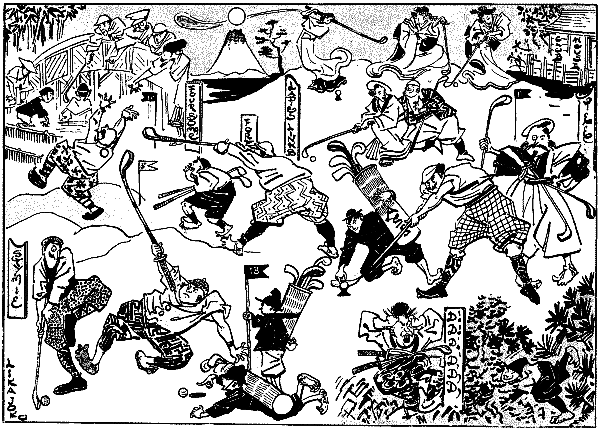
LIKA JOKO'S JOTTINGS. A GOLF MEETING.
A "FANTASTIC" ACTION.
["A young lady of Newark while dancing a few nights ago fell and broke her leg, and she has now commenced an action for damages against her partner, to whom she attributes the cause of the accident."—Daily Telegraph.]
"Oh, bother!" girls will sigh; "a fresh excuse For men not fond of dancing to forsake us! We fancy we can hear them say 'the deuce! We can't dance now; to drop a girl might break us!'
Now e'en 'the better sort,' who used to beg To see our cards, will—or our wits deceive us— Reflect that they may break a partner's leg, And, choose, alas, to 'make a leg,' and leave us."
DRAMA COLLEGE.
Establishment for Young Ladies, and Preparatory School for Little Boys,
Conducted by
THE MISSES MELPOMENE AND THALIA.
The Curriculum includes thorough grounding in Knowledge of Life, and in High-class Virtue and Honesty. The Pupils are carefully restrained from the practice of "unlovely middle-class virtue." Severe morality constantly inculcated. Mere amusement strictly excluded. Aristocratic Deportment and Etiquette taught by experienced Assistants.
For further particulars apply to Mr. Enry Hauthur Jones.
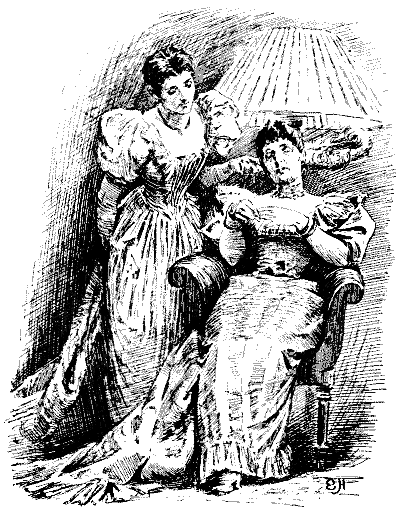
A PRICELESS POSSESSION.
Mrs. Golightly. "Oh, I hope you won't think it rude, but would you mind telling me what that wonderful Black Stone you're wearing is?"
Mrs. Luxor. "Oh, certainly. I find most People envy me that. It's a piece of real English Coal!"
Mrs. Golightly. "How wonderful! Ah, I Wish my Husband was A Millionaire!"
AWFUL RESULT OF THE COAL FAMINE.
(Upon an Ordinarily Innocent and Non-punning Fire-worshipper).
Oh! what a period! Strikes might puzzle Solon! I love, in winter—having shut up shop— My snug back-parlour fire to semi-colon, Now there's no colon, fuel's at a full-stop! I have burned coke, wood, turf, aye, even slate, But to no fire myself cannot a-comma-date!
"Practical John."—Mr. Hollingshead's advertisement, headed "Plain Words to the Public," is eminently characteristic of the author. Says he, "The prices I start with I shall stand or fall by." Certainly, as the prices are moderate, the public will stand them, so he needn't trouble himself on that score. If he be riding for a fall, and if the public won't come down heavily, let us hope, if he fall at all, he will come down lightly. Then he adds, in his own independent way, "If it is thought necessary to tamper with these prices in an upward direction" ["tampering upward" is pretty], "I shall give up this, my final effort in theatrical management" [Oh, no, don't!—please don't!!], "and walk out of the building." Why "walk"? By his own free admission he will be driven out (which sounds like a contradiction in terms), so why make a virtue of walking out. Never walk when you can ride. But J. H. walk out!! "J. H. y suis et J. H. y reste."
THE BRIGHT AND BEAUTIFUL WORKING-MAN.
(As described by Sir E. Arnold at Birmingham.)
A wonderful joy our eyes to bless, In his magnificent happiness, Is the working-man of whom I sing, Who fares more royally than a king. Seeing his "board" Sir Edwin's floored— Hors d'œuvres, soup, fish, entrée, joint, game, ices. Ab ovo nothing has been ignored Usque ad malum, not minding prices. Augustus might have have his sight Reading with only a lamp or taper; The working-man's electric light Glows on immaculate daily paper. Go search in Mommsen's history, Then come you home and sing with me— No life of emperor could, or can, Be bright as that of the working-man!
"Machinery turns his toil to art." Burne-Jones and Morris at this would start. Though the "Arts and Crafts" be with horror dumb, A Birmingham Parthenon yet may come! The School Board's pains mature his brains, Masses beat classes—he'll soon annul us. Never went—as he goes—in trains Heliogabalus or Lucullus. He, should he care, can daily stare At statues draped by dear Mrs. Grundy, And ride in trams for a halfpenny fare, And "wire" for sixpence, except on Sunday.
His letters traverse the ocean wave. Note.—If a penny you fail to save, To Henniker-Heaton please apply, And he will discover the reason why. Rich in the things contentment brings, In every pure enjoyment wealthy, But is he as gay as the poet sings, In body and mind as hale and healthy? In silence adept, he has certainly kept So extremely quiet we should not know it. Yet he "as authorities mayn't accept" Such blooming blokes as an Eastern poet.
Oh What a Sir Pryce!—Sir Pryce Pryce-Jones, M.P. for the Montgomery Boroughs, has received a testimonial from his constituents. That is to say, because he has been a nice-Pryce-Jones they have made him a prize-Pryce-Jones. Bravo, Sir Twice-Pryce-Jones!
Suggestion to Provincial Lawn-Tennis Club.—Why not give Lawn-Tennis Balls in Costume during the winter?
QUOTH DUNRAVEN, NEVERMORE!
There's many a slip 'twixt "cup" and lip! Is there not, good Dunraven? You'll take your Transatlantic trip Like sportsman, not like craven. The "centre-board" against the keel Has won. On woe we sup, Sir! As in old nursery rhyme we feel "The 'dish' ran away with the—cup," Sir! The Valkyries, those valiant dames, Success might sure have wished us; But the Vigilant, our yacht-builders shames. The "Yankee Dish" has—dished us!
TO "HANS BREITMANN."
[Mr. C. G. Leland, in his recently-published Memoirs, informs us of his very early appreciation of the formula, "I am I—I am myself—I myself I."]
You, from mirth to logic turning, Doubly proved yourself the right man, By your wondrous breadth of learning, For the title of "der Breitmann." Yes, the lore and fun within you Show us yearly greater reasons Why we wish you to continue Quite yourself for farther seasons.
Transcriber's Note: Sundry damaged or missing punctuation has been repaired. Page 192: Extra 'have' removed. "AUGUSTUS might have (have) hurt his sight".