CARR-ACTORS AT "THE COMEDY."
Reading edition
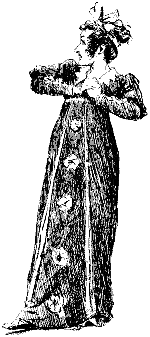
A Portrait from M-Emery. Emery Powder and polish'd performance.
When we have two original plays like Pinero's Second Mrs. Tanqueray and Grundy's Sowing the Wind, we may congratulate ourselves that they do not "do these things better in France." Mrs. Tanqueray is a life-like tragedy, and Sowing the Wind a life-like comedy. It was a pleasure to congratulate Mr. Alexander at the St. James's on his choice of a piece, and of the company to suit it, especially on the engagement of Mrs. Patrick Campbell for the heroine; and now it is equally pleasant to congratulate a confrère in literature, Mr. Comyns Carr, on having made so eminently successful a début in theatrical management, as he has done in choice of the piece and of the company to play it.
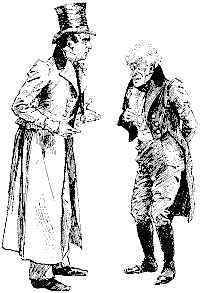
Brandon and Monkey Brand-on.
Mr. Brandon Thomas Brabazon (to Cyril Maude Watkin). "I know that face. I've seen it on the hoardings."
Watkin (faintly). "It won't wash!"
[Collapses.]
It is a canon of comedy-construction that from the first, the audience should be let into the secret of the dénouement, but that they should be puzzled as to the means by which that end is to be achieved. This play is an excellent example of the rule. Everybody knows who the heroine is from the moment of her appearance; but as to how she, the illegitimate daughter, is to be recognised and acknowledged by her father, this is the problem that no one except the dramatist, in the course of four acts, can solve. It is a very clever piece of workmanship. In these modern matter-of-fact realistic days, fancy the awful danger to any play in which a father has to discover his long-lost child! The strawberry mark on the left arm, the amulet, the duplicate miniature of the mother—these ways and means, and many others, must occur to the playgoer, and must have presented themselves at the outset to the author, flattering himself on his originality, as difficulties almost insuperable because so stagey, so worn threadbare, so out of date.
Over these difficulties Mr. Grundy has triumphed, and with him triumph the actors and the stage-manager; as, for the most part, except when there is a needless conventional "taking the centre" for supposed effect, the stage management is as admirable as the acting and the dialogue, which is saying a great deal, but not a bit too much.
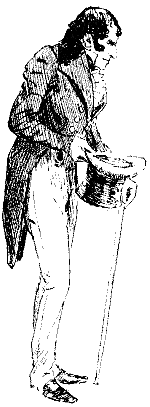
Portrait of the Great Duke of Wellington, when Marquis of Douro, by Mr. Ian Robertson.
Mr. Brandon Thomas and Miss Emery have never done anything better. The former with his peculiar north-country "burr," and with his collars and general make up reminding many of the G. O. M., whilst Mr. Ian Robertson as the wicked old Lord is not unlike the pictures of the Iron Duke when Lord Douro. Mr. Edmund Maurice, as representing the slangy, sporting, about-town Baronet of the Tom-and-Jerry day, is a kind of Goldfinch in The Road to Ruin, with a similar kind of catchword, which I suppose, on Mr. Grundy's authority [though I do not remember the expression nor the use of the word "chuck" in Tom and Jerry—the authority for Georgian era slang] was one of the slang phrases of that period. For my part (a very small part), I am inclined to credit Mr. Grundy with the invention of "smash my topper," and of the introduction of "chuck it" into eighteenth century London slang.
Admirable are the quaint sketches of character given by Miss Rose Leclercq and Miss Annie Hughes. Manly and lover-like is Mr. Sydney Brough. In the dramatic unfolding of the plot, faultlessly acted as it is, the audience from first to last are thoroughly interested. Here and there, speeches and scenes would be all the better for some judicious excision. When you are convinced, further argument weakens the case, and I confess I should like to hear that ten minutes' worth of dialogue had been taken out of the parts played by Mr. Brandon Thomas and Miss Winifred Emery. But this is a small matter—a very small matter. To sum up, it is good work and good play, and so the new manager and lessee is at this present moment a Triumphal Carr.
Q. Why was there at one time a chance of the Times, which has always been up to date, ever being behind time? —A. Because formerly there was so much Delayin!!
Motto for Ladies who "Grub Short" to Avoid Obesity.—Grace before Meat!
Nulli Secundus.
(By a Lover of the Links.)
Lyttleton asks—great cricketer, for shame!— If Golf—Great Scot!!!—is quite "a first-class game." Well, if first-class it cannot quite be reckoned, 'Tis that it stands alone, and hath no second!
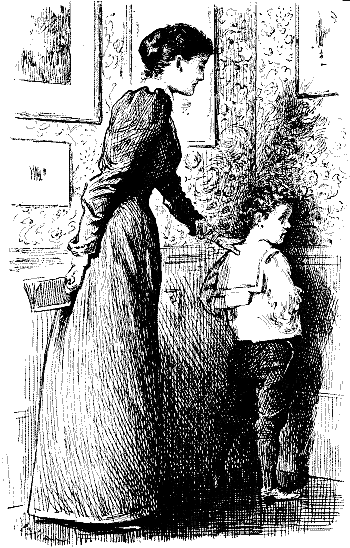
A PROTEST.
"And Pray, am I never to be Naughty, Miss Grimm?"
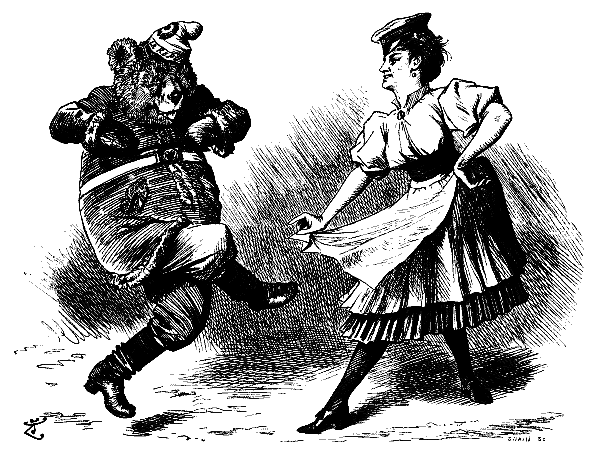
"L'UNION FAIT LA—FARCE!"
["France turns from her abandoned friends afresh And soothes the Bear that prowls for patriot flesh."
—Campbell.]
Yes, history here doth repeat itself verily! Fancy fair France, in Republican rig, "Soothing the Bear" again; footing it merrily In—well now, what is the name of this jig? Cancan, or Carmagnole? Blend of the two? Anyhow, 'tis a most strange "Pas de Deux"!
Policy makes pride and principles plastic, And 'tis most true that extremes often meet; Yet as a sample of joint "Light Fantastic" This dual dance must be baddish to beat. Beauty and Beast vis-à-vis in the dance, Were scarce funnier partners than Russia and France.
Autocrat Bruin, can he really relish The larkish high-kick, the tempestuous twirl, That risky Republican dances embellish? And she—a political "Wallflower," poor girl!— Can she truly like the strange partner that fate Apportions her, lumpish, unlovely, and late?
Like 'Arry and 'Arriet out for a frolic, They've interchanged head-gear, by curious hap! Of what is this strange substitution symbolic? The Autocrat crown and the Phrygian cap They've "swopped," but they both most uneasily sit, And each for the other appears a poor fit.
That Liberty cap upon Bruin's brown noddle! That crown—much awry—on the Beauty's fair head! Absurd! And the Bear's heavy lumbering waddle Sorts oddly enough with the lady's light tread. He won't get her step! Will she try to catch his? As soon shall small beer take the sparkle of fizz.
Is she "soothing the Bear"—with a show of lip-honey? Is he flattering the Bee—with an eye on the hive? Sting hidden, claws sheathed—for how long? Well, 'tis funny, This queer little game, whilst they keep it alive! Dance-partnership is not "for better for worse," And "union of hearts" sometimes smacks of—the purse.
"Twos and Threes" is a game to the playground familiar! "Two's Company!" Yes, so, in this case, are Three! Alliances frequently made willy-nilly are Dual or Triple. The Eagles we see Foregather; so may they not meet—in the dance— The Big Northern Beast and the Beauty of France?
ANGELS.
I wonder if you give your mind At all to angels. "Which?" you say? Why, angels of the hymn-book kind, Not imitation ones in clay. I often do. They fascinate My fancy to a strange degree; And meditating much of late There came two serious points to me. You notice in the Holy Writ Angels are never feminine; But, wheresoever they may flit, He came, he spake, he gave the sign. The men who wrote of them were sage, And knew their subject out and out; But we live in a wicked age, That twists the angels' sex about. And painters paint them girls. And then The question sets one's brains afire— Why choristers on earth are men, If women form the heavenly choir? And if they do paint here or there A man among the cherubim, I claim to know why not a hair May grow upon the face of him? I know the Roman Church decreed "A priest shall wear a shaven face." But what of angels? There indeed Razor and strop seem out of place. Then why this hairless cheek and chin? I ask, and Echo answers Why? Have angel-cheeks no roots within? —Here comes my keeper. So, good-bye!
Reckless.—"Mr. Allen, Senator of Albraska, a prominent silverite, spoke for fifteen hours." "Speech is silver. Silence golden." If all silverites go on at this length, there'll be no silence, ergo, no gold. Q. E. D.