Part 2 — CHAPTER VII THE DUAL MOTHER RÔLE (continued 2)
Beatrice M. Hinkle translation
“An encoiled granite snake, with arched neck, was found. In the middle of the coil is seen a narrow slit, polished by usage, just large enough to allow a coin of four centimeters diameter at most to fall through. At the side are holes for handles to lift the heavy pieces, the under half of which is used as a cover.”—Herzog, Ibid., p. 212.
The serpent, as protector of the hoard, now lies on the treasure house. The fear of the maternal womb of death has become the guardian of the treasure of life. That the snake in this connection is really a symbol of death, that is to say, of the dead libido, results from the fact that the souls of the dead, like the chthonic gods, appear as serpents, as dwellers in the kingdom of the mother of death.[744] This development of symbol allows us to recognize easily the transition of the originally very primitive significance of the crevice in the earth as mother to the 409meaning of treasure house, and can, therefore, support the etymology of Hort, “hoard, treasure,” as suggested by Kluge, κεύθω, belonging to κὲῦθος, means the innermost womb of the earth (Hades); κύσθος, that Kluge adds, is of similar meaning, cavity or womb. Prellwitz does not mention this connection. Fick,[745] however, compares New High German hort, Gothic huzd, to Armenian kust, “abdomen”; Church Slavonian čista, Vedic kostha = abdomen, from the Indo-Germanic root koustho -s = viscera, lower abdomen, room, store-room. Prellwitz compares κύσθος κύστις = urinary bladder, bag, purse; Sanskrit kustha-s = cavity of the loins; then κύτος = cavity, vault; κύτις = little chest, from κυέω = I am pregnant. Here, from κύτος = cave, κύυαρ = hole, κύαθος = cup, κύλα - depression under the eye, κῦμα = swelling, wave, billow, κῦρος = power, force, κύριος = lord, Old Iranian caur, cur = hero; Sanskrit çura -s = strong, hero. The fundamental Indo-Germanic roots[746] are kevo = to swell, to be strong. From that the above-mentioned κυέω, κύαρ, κῦρος and Latin cavus = hollow, vaulted, cavity, hole; cavea = cavity, enclosure, cage, scene and assembly; caulæ = cavity, opening, enclosure, stall[747]; kuéyô = swell; participle, kueyonts = swelling; en-kueyonts = pregnant, ἐγηυέων = Latin inciens = pregnant; compare Sanskrit vi-çvá-yan = swelling; kûro -s (kevaro -s), strong, powerful hero.
The treasure which the hero fetches from the dark cavern is swelling life; it is himself, the hero, new-born from the anxiety of pregnancy and the birth throes. 410Thus the Hindoo fire-bringer is called Mâtariçvan, meaning the one swelling in the mother. The hero striving towards the mother is the dragon, and when he separates from the mother he becomes the conqueror of the dragon.[748] This train of thought, which we have already hinted at previously in Christ and Antichrist, may be traced even into the details of Christian phantasy. There is a series of mediæval pictures[749] in which the communion cup contains a dragon, a snake or some sort of small animal.[750]
The cup is the receptacle, the maternal womb, of the god resurrected in the wine; the cup is the cavern where the serpent dwells, the god who sheds his skin, in the state of metamorphosis; for Christ is also the serpent. These symbolisms are used in an obscure connection in I Corinthians, verse 10: Paul writes of the Jews who “were all baptized unto Moses in the cloud and in the sea” (also reborn) and “did all drink the same spiritual drink; for they drank of that spiritual rock that followed them, and that rock was Christ.” They drank from the mother (the generative rock, birth from the rock) the milk of rejuvenation, the mead of immortality, and this Rock was Christ, here identified with the mother, because he is the symbolic representative of the mother libido. When we drink from the cup, then we drink from the mother’s breast immortality and everlasting salvation. Paul wrote of the Jews that they ate and then rose up to dance and to indulge in fornication, and then twenty-three thousand of them were swept off by the plague of serpents. The remedy for the survivors, however, was the sight of a serpent hanging on a pole. From it was derived the cure.
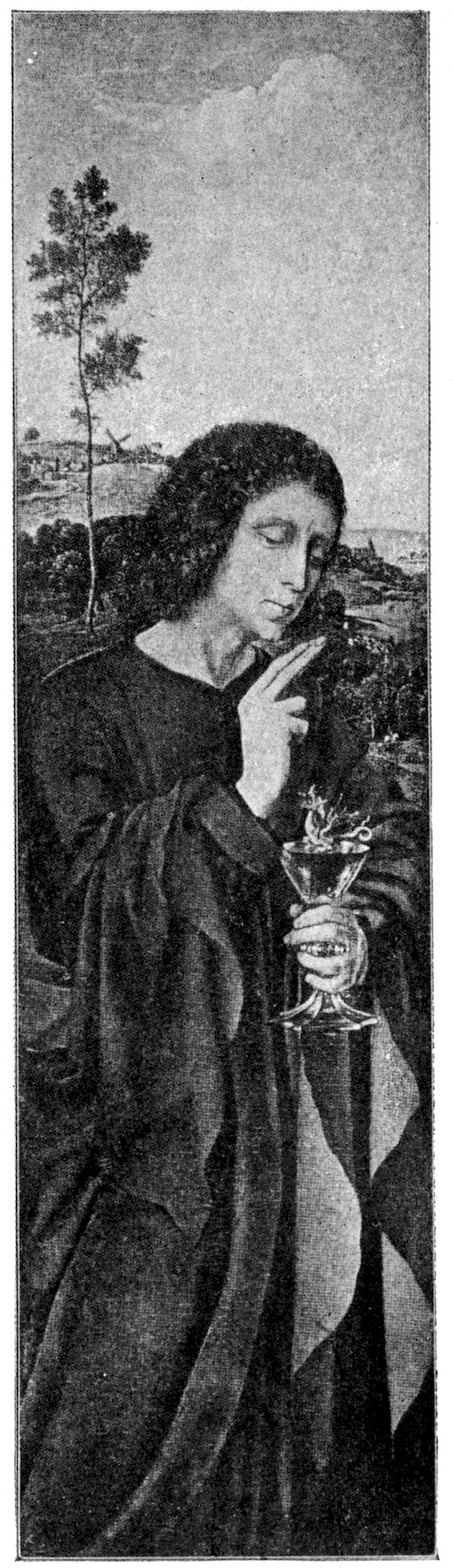
THE DRAGON IN THE GOBLET
411“The cup of blessing which we bless, is it not the communion of the blood of Christ? The bread which we break, is it not the communion of the body of Christ? For we being many are one bread, and one body; for we are all partakers of one bread.”—I Corinthians x: 16, 17.
Bread and wine are the body and the blood of Christ; the food of the immortals who are brothers with Christ, ἀδελφοί, those who come from the same womb. We who are reborn again from the mother are all heroes together with Christ, and enjoy immortal food. As with the Jews, so too with the Christians, there is imminent danger of unworthy partaking, for this mystery, which is very closely related psychologically with the subterranean Hierosgamos of Eleusis, involves a mysterious union of man in a spiritual sense,[751] which was constantly misunderstood by the profane and was retranslated into his language, where mystery is equivalent to orgy and secrecy to vice.[752] A very interesting blasphemer and sectarian of the beginning of the nineteenth century named Unternährer has made the following comment on the last supper:
“The communion of the devil is in this brothel. All they sacrifice here, they sacrifice to the devil and not to God. There they have the devil’s cup and the devil’s dish; there they have sucked the head of the snake,[753] there they have fed upon the iniquitous bread and drunken the wine of wickedness.”[754]
Unternährer is an adherent or a forerunner of the “theory of living one’s own nature.” He dreams of himself as a sort of priapic divinity; he says of himself:
412“Black-haired, very charming and handsome in countenance, and every one enjoys listening to thee on account of the amiable speeches which come from thy mouth; therefore the maids love thee.”
He preaches “the cult of nakedness.”
“Ye fools and blind men, behold God has created man in his image, as male and female, and has blessed them and said, ‘Be fruitful and multiply and fill the earth, and make it subject to thee.’ Therefore, he has given the greatest honor to these poor members and has placed them naked in the garden,” etc.
“Now are the fig leaves and the covering removed, because thou hast turned to the Lord, for the Lord is the Spirit, and where the spirit of the Lord is, there is freedom,[755] there the clearness of the Lord is mirrored with uncovered countenance. This is precious before God, and this is the glory of the Lord, and the adornment of our God, when you stand in the image and honor of your God, as God created you, naked and not ashamed.
“Who can ever praise sufficiently in the sons and daughters of the living God those parts of the body which are destined to procreate?
“In the lap of the daughters of Jerusalem is the gate of the Lord, and the Just will go into the temple there, to the altar.[756] And in the lap of the sons of the living God is the water-pipe of the upper part, which is a tube, like a rod, to measure the temple and altar. And under the water-tube the sacred stones are placed, as a sign and testimony of the Lord, who has taken to himself the seed of Abraham.
“Out of the seeds in the chamber of the mother, God creates a man with his hands, as an image of himself. Then the mother house and the mother chamber is opened in the daughters of the Living God, and God himself brings forth a child through them. Thus God creates children from the stones, for the seed comes from the stones.”[757]
History teaches in manifold examples how the religious mysteries are liable to change suddenly into sexual orgies 413because they have originated from an overvaluation of the orgy. It is characteristic that this priapic divinity[758] returns again to the old symbol of the snake, which in the mystery enters into the faithful, fertilizing and spiritualizing them, although it originally possessed a phallic significance. In the mysteries of the Ophites, the festival was really celebrated with serpents, in which the animals were even kissed. (Compare the caressing of the snake of Demeter in the Eleusinian mysteries.) In the sexual orgies of the modern Christian sects the phallic kiss plays a very important rôle. Unternährer was an uncultivated, crazy peasant, and it is unlikely that the Ophitic religious ceremonies were known to him.
The phallic significance is expressed negatively or mysteriously through the serpent, which always points to a secret related thought. This related thought connects with the mother; thus, in a dream a patient found the following imagery: “A serpent shot out from a moist cave and bit the dreamer in the region of the genitals.” This dream took place at the instant when the patient was convinced of the truth of the analysis, and began to free himself from the bond of his mother complex. The meaning is: I am convinced that I am inspired and poisoned by the mother. The contrary manner of expression is characteristic of the dream. At the moment when he felt the impulse to go forwards he perceived the attachment to the mother. Another patient had the following dream during a relapse, in which the libido was again wholly introverted for a time: “She was entirely filled within by a great snake; only one end of the tail 414peeped out from her arm. She wanted to seize it, but it escaped her.” A patient with a very strong introversion (catatonic state) complained to me that a snake was stuck in her throat.[759] This symbolism is also used by Nietzsche in the “vision” of the shepherd and the snake:[760]
“And verily, what I saw was like nothing I ever saw before. I saw a young shepherd, writhing, choking, twitching with a convulsed face, from whose mouth hung a black, heavy serpent.
“Did I ever see so much disgust and pallid fear upon a countenance?[761] Might he have been sleeping, and the snake crept into his mouth—there it bit him fast?
“My hand tore at the serpent and tore—in vain!—I failed to tear the serpent out of his mouth. Then there cried out of me: ‘Bite! Bite! Its head off! Bite!’ I exclaimed; all my horror, my hate, my disgust, my compassion, all the good and bad cried out from me in one voice.
“Ye intrepid ones around me! solve for me the riddle which I saw, make clear to me the vision of the lonesomest one.
“For it was a vision and a prophecy; what did then I behold in parable? And who is it who is still to come?
“Who is the shepherd into whose mouth crept the snake? Who is the man into whose throat all the heaviness and the blackest would creep?[762]
“But the shepherd bit, as my cry had told him; he bit with a huge bite! Far away did he spit the head of the serpent—and sprang up.
“No longer shepherd, no longer man, a transfigured being, an illuminated being, who laughed! Never yet on earth did a man laugh as he laughed!
“O my brethren, I heard a laugh which was no human laughter—and now a thirst consumeth me, a longing that is never allayed.
“My longing for this laugh eats into me. Oh, how can I suffer still to live! And how now can I bear to die!”[763]
415The snake represents the introverting libido. Through introversion one is fertilized, inspired, regenerated and reborn from the God. In Hindoo philosophy this idea of creative, intellectual activity has even cosmogenic significance. The unknown original creator of all things is, according to Rigveda 10, 121, Prajâpati, the “Lord of Creation.” In the various Brahmas, his cosmogenic activity was depicted in the following manner
“Prajâpati desired: ‘I will procreate myself, I will be manifold.’ He performed Tapas; after he had performed Tapas he created these worlds.”
The strange conception of Tapas is to be translated, according to Deussen,[764] as “he heated himself with his own heat,[765] with the sense of ‘he brooded, he hatched.’” Here the hatcher and the hatched are not two, but one and the same identical being. As Hiranyagarbha, Prajâpati is the egg produced from himself, the world-egg, from which he hatches himself. He creeps into himself, he becomes his own uterus, becomes pregnant with himself, in order to give birth to the world of multiplicity. Thus Prajâpati through the way of introversion changed into something new, the multiplicity of the world. It is of especial interest to note how the most remote things come into contact. Deussen observes:
“In the degree that the conception of Tapas (heat) becomes in hot India the symbol of exertion and distress, the ‘tapo atapyata’ began to assume the meaning of self-castigation and became related to the idea that creation is an act of self-renunciation on the part of the Creator.”
416Self-incubation and self-castigation and introversion are very closely connected ideas.[766] The Zosimos vision mentioned above betrays the same train of thought, where it is said of the place of transformation: ὁ τόπος τῆς ἀσκήσεως.[767] We have already observed that the place of transformation is really the uterus. Absorption in one’s self (introversion) is an entrance into one’s own uterus, and also at the same time asceticism. In the philosophy of the Brahmans the world arose from this activity; among the post-Christian Gnostics it produced the revival and spiritual rebirth of the individual, who was born into a new spiritual world. The Hindoo philosophy is considerably more daring and logical, and assumes that creation results from introversion in general, as in the wonderful hymn of Rigveda, 10, 29, it is said:
“What was hidden in the shell,
Was born through the power of fiery torments.
From this first arose love,
As the germ of knowledge,
The wise found the roots of existence in non-existence,
By investigating the hearts impulses.”[768]
This philosophical view interprets the world as an emanation of the libido, and this must be widely accepted from the theoretic as well as the psychologic standpoint, for the function of reality is an instinctive function, having the character of biological adaptation. When the insane Schreber brought about the end of the world through his libido-introversion, he expressed an entirely rational psychologic view, just as Schopenhauer wished to abolish 417through negation (holiness, asceticism) the error of the primal will, through which the world was created. Does not Goethe say:
“You follow a false trail;
Do not think that we are not serious;
Is not the kernel of nature
In the hearts of men?”
The hero, who is to accomplish the rejuvenation of the world and the conquest of death, is the libido, which, brooding upon itself in introversion, coiling as a snake around its own egg, apparently threatens life with a poisonous bite, in order to lead it to death, and from that darkness, conquering itself, gives birth to itself again. Nietzsche knows this conception:[769]
“How long have you sat already upon your misfortune.
Give heed! lest you hatch an egg,
A basilisk egg
Of your long travail.”
The hero is himself a serpent, himself a sacrificer and a sacrificed. The hero himself is of serpent nature; therefore, Christ compares himself with the serpent; therefore, the redeeming principle of the world of that Gnostic sect which styled itself the Ophite was the serpent. The serpent is the Agatho and Kako demon. It is, indeed, intelligible, when, in the Germanic saga, they say that the heroes had serpents’ eyes.[770] I recall the parallel previously drawn between the eyes of the Son of man and those of the Tarpeian dragon. In the already mentioned mediæval pictures, the dragon, instead of the 418Lord, appeared in the cup; the dragon who with changeful, serpent glances[771] guarded the divine mystery of renewed rebirth in the maternal womb. In Nietzsche the old, apparently long extinct idea is again revived:[772]
“Ailing with tenderness, just as the thawing wind,
Zarathustra sits waiting, waiting on his hill,
Sweetened and cooked in his own juice,
Beneath his summits,
Beneath his ice he sits,
Weary and happy,
A Creator on his seventh day.
Silence!
It is my truth!
From hesitating eyes—
From velvety shadows
Her glance meets mine,
Lovely, mischievous, the glance of a girl.
She divines the reason of my happiness,
She divines me—ha! what is she plotting?
A purple dragon lurks
In the abyss of her maiden glance.[773]
Woe to thee, Zarathustra,
Thou seemest like some one
Who has swallowed gold,
Thy belly will be slit open.”[774]
In this poem nearly all the symbolism is collected which we have elaborated previously from other connections. Distinct traces of the primitive identity of serpent and hero are still extant in the myth of Cecrops. Cecrops is himself half-snake, half-man. Originally, he probably was the Athenian snake of the citadel itself. As a buried god, he is like Erechtheus, a chthonic snake god. Above his subterranean dwelling rises the Parthenon, the temple 419of the virgin goddess (compare the analogous idea of the Christian church). The casting of the skin of the god, which we have already mentioned in passing, stands in the closest relation to the nature of the hero. We have spoken already of the Mexican god who casts his skin. It is also told of Mani, the founder of the Manichaean sect, that he was killed, skinned, stuffed and hung up.[775] That is the death of Christ, merely in another mythological form.[776]
Marsyas, who seems to be a substitute for Attis, the son-lover of Cybele, was also skinned.[777] Whenever a Scythian king died, slaves and horses were slaughtered, skinned and stuffed, and then set up again.[778] In Phrygia, the representatives of the father-god were killed and skinned. The same was done in Athens with an ox, who was skinned and stuffed and again hitched to the plough.
In this manner the revival of the fertility of the earth was celebrated.[779]
This readily explains the fragment from the Sabazios mysteries, transmitted to us by Firmicus:[780] Ταῦρος δράκοντος καὶ πατὴρ ταύρου δράκων[781].
The active fructifying (upward striving) form of the libido is changed into the negative force striving downwards towards death. The hero as zodion of spring (ram, bull) conquers the depths of winter; and beyond the summer solstice is attacked by the unconscious longing for death, and is bitten by the snake. However, he himself is the snake. But he is at war with himself, and, therefore, the descent and the end appear to him as the 420malicious inventions of the mother of death, who in this way wishes to draw him to herself. The mysteries, however, consolingly promise that there is no contradiction[782] or disharmony when life is changed into death: ταῦρος δράκοντος καὶ πατήρ ταύρου δράκων.
Nietzsche, too, gives expression to this mystery:[783]
“Here do I sit now,
That is, I’m swallowed down
By this the smallest oasis—
—It opened up just yawning,
Its loveliest maw agape.
Hail! hail! to that whalefish,
When he for his guests’ welfare
Provided thus!
· · · · ·
Hail to his belly
If he had also
Such a lovely oasis belly—
The desert grows, woe to him
Who hides the desert!
Stone grinds on stone, the desert
Gulps and strangles.
The monstrous death gazes, glowing brown,
And chews—his life is his chewing ...
Forget not, O man, burnt out by lust,
Thou art the stone, the desert,
Thou art death!”
The serpent symbolism of the Last Supper is explained by the identification of the hero with the serpent: The god is buried in the mother: as fruit of the field, as food coming from the mother and at the same time as drink of immortality he is received by the mystic, or as a serpent he unites with the mystic. All these symbols represent 421the liberation of the libido from the incestuous fixation through which new life is attained. The liberation is accomplished under symbols, which represent the activity of the incest wish.
It might be justifiable at this place to cast a glance upon psychoanalysis as a method of treatment. In practical analysis it is important, first of all, to discover the libido lost from the control of consciousness. (It often happens to the libido as with the fish of Moses in the Mohammedan legend; it sometimes “takes its course in a marvellous manner into the sea.”) Freud says in his important article, “Zur Dynamik der Übertragung”:[784]
“The libido has retreated into regression and again revives the infantile images.”
This means, mythologically, that the sun is devoured by the serpent of the night, the treasure is concealed and guarded by the dragon: substitution of a present mode of adaptation by an infantile mode, which is represented by the corresponding neurotic symptoms. Freud continues:
“Thither the analytic treatment follows it and endeavors to seek out the libido again, to render it accessible to consciousness, and finally to make it serviceable to reality. Whenever the analytic investigation touches upon the libido, withdrawn into its hiding-place, a struggle must break out; all the forces, which have caused the regression of the libido, will rise up as resistance against the work, in order to preserve this new condition.”
Mythologically this means: the hero seeks the lost sun, the fire, the virgin sacrifice, or the treasure, and fights the 422typical fight with the dragon, with the libido in resistance. As these parallels show, psychoanalysis mobiles a part of the life processes, the fundamental importance of which properly illustrates the significance of this process.
After Siegfried has slain the dragon, he meets the father, Wotan, plagued by gloomy cares, for the primitive mother, Erda, has placed in his path the snake, in order to enfeeble his sun. He says to Erda:
Wanderer:
All-wise one,
Care’s piercing sting by thee was planted
In Wotan’s dauntless heart
With fear of shameful ruin and downfall.
Filled was his spirit by tidings
Thou didst foretell.
Art thou the world’s wisest of women?
Tell to me now
How a god may conquer his care.
Erda:
Thou art not
What thou hast said.
It is the same primitive motive which we meet Wagner: the mother has robbed her son, the sun-god, of the joy of life, through a poisonous thorn, and deprives him of his power, which is connected with the name. Isis demands the name of the god; Erda says, “Thou art not what thou hast said.” But the “Wanderer” has found the way to conquer the fatal charm of the mother, the fear of death:
“The eternals’ downfall
No more dismays me,
Since their doom I willed.
423“I leave to thee, loveliest Wälsung,
Gladly my heritage now.
To the ever-young
In gladness yieldeth the god!”
These wise words contain, in fact, the saving thought. It is not the mother who has placed the poisonous worm in our path, but our libido itself wills to complete the course of the sun to mount from morn to noon, and, passing beyond noon, to hasten towards evening, not at war with itself, but willing the descent and the end.[785]
Nietzsche’s Zarathustra teaches:
“I praise thee, my death, the free death, which comes to me because I want it.
“And when shall I want it?
“He who has a goal and an heir wants death at the proper time for his goal and his heir.
“And this is the great noonday, when man in the middle of his course stands between man and superman, and celebrates his path towards evening as his highest hope: because it is the path to a new morning.
“He who is setting will bless his own going down because it is a transition: and the sun of his knowledge will be at high noon.”
Siegfried conquers the father Wotan and takes possession of Brunhilde. The first object that he sees is her horse; then he believes that he beholds a mail-clad man. He cuts to pieces the protecting coat of mail of the sleeper. (Overpowering.) When he sees it is a woman, terror seizes him:
“My heart doth falter and faint;
On whom shall I call
That he may help me?
424Mother! Mother!
Remember me!
“Can this be fearing?
Oh, mother! Mother!
Thy dauntless child!
A woman lieth asleep:—
And she now has taught him to fear!
“Awaken! Awaken!
Holiest maid!
Then life from the sweetness of lips
Will I win me—
E’en tho’ I die in a kiss.”
In the duet which follows the mother is invoked:
“O mother, hail!
Who gave thee thy birth!”
The confession of Brunhilde is especially characteristic:
“O knewest thou—joy of the world,
How I have ever loved thee!
Thou wert my gladness,
My care wert thou!
Thy life I sheltered;
Or ere it was thine,
Or ere thou wert born,
My shield was thy guard.”[786]
The pre-existence of the hero and the pre-existence of Brunhilde as his wife-mother are clearly indicated from this passage.
Siegfried says in confirmation:
“Then death took not my mother?
Bound in sleep did she lie?”
425The mother-imago, which is the symbol of the dying and resurrected libido, is explained by Brunhilde to the hero, as his own will:
“Thyself am I
If blest I be in thy love.”
The great mystery of the Logos entering into the mother for rebirth is proclaimed with the following words by Brunhilde:
“O Siegfried, Siegfried,
Conquering light!
I loved thee ever,
For I divined
The thought that Wotan had hidden—
The thought that I dared
Not to whisper—[787]
That all unclearly
Glowed in my bosom
Suffered and strove;
For which I flouted
Him, who conceived it:[787]
For which in penance
Prisoned I lay,
While thinking it not
And feeling only,
For, in my thought,
Oh, should you guess it?
Was only my love for thee.”
The erotic similes which now follow distinctly reveal the motive of rebirth:
Siegfried:
“A glorious flood
Before me rolls.
426With all my senses
I only see
Its buoyant, gladdening billows.
Though in the deep
I find not my face,
Burning, I long
For the water’s balm;
And now as I am,
Spring in the stream.[788]
O might its billows
Engulf me in bliss.”
The motive of plunging into the maternal water of rebirth (baptism) is here fully developed. An allusion to the “terrible mother” imago, the mother of heroes, who teaches them fear, is to be found in Brunhilde’s words (the horse-woman, who guides the dead to the other side):
“Fearest thou, Siegfried?
Fearest thou not
The wild, furious woman?”
The orgiastic “Occide moriturus” resounds in Brunhilde’s words:
“Laughing let us be lost—
Laughing go down to death!”
And in the words
“Light-giving love,
Laughing death!”
is to be found the same significant contrast.
The further destinies of Siegfried are those of the Invictus: 427the spear of the gloomy, one-eyed Hagen strikes Siegfried’s vulnerable spot. The old sun, who has become the god of death, the one-eyed Wotan, smites his offspring, and once again ascends in eternal rejuvenation. The course of the invincible sun has supplied the mystery of human life with beautiful and imperishable symbols; it became a comforting fulfilment of all the yearning for immortality, of all desire of mortals for eternal life.
Man leaves the mother, the source of libido, and is driven by the eternal thirst to find her again, and to drink renewal from her; thus he completes his cycle, and returns again into the mother’s womb. Every obstacle which obstructs his life’s path, and threatens his ascent, wears the shadowy features of the “terrible mother,” who paralyzes his energy with the consuming poison of the stealthy, retrospective longing. In each conquest he wins again the smiling love and life-giving mother—images which belong to the intuitive depths of human feeling, the features of which have become mutilated and irrecognizable through the progressive development of the surface of the human mind. The stern necessity of adaptation works ceaselessly to obliterate the last traces of these primitive landmarks of the period of the origin of the human mind, and to replace them along lines which are to denote more and more clearly the nature of real objects.
428