Part 2 — CHAPTER V SYMBOLISM OF THE MOTHER AND OF REBIRTH (continued 2)
Beatrice M. Hinkle translation
The symbol of the tree encoiled by the serpent may also be translated as the mother defended from incest 293by resistance. This symbol is by no means rare upon Mithraic monuments. The rock encircled by a snake is to be comprehended similarly, because Mithra is one born from a rock. The menace of the new-born by the snake (Mithra, Hercules) is made clear through the legend of Lilith and Lamia. Python, the dragon of Leto, and Poine, who devastates the land of Crotopus, are sent by the father of the new-born. This idea indicates the localization, well known in psychoanalysis, of the incest anxiety in the father. The father represents the active repulse of the incest wish of the son. The crime, unconsciously wished for by the son, is imputed to the father under the guise of a pretended murderous purpose, this being the cause of the mortal fear of the son for the father, a frequent neurotic symptom. In conformity with this idea, the monster to be overcome by the young hero is frequently a giant, the guardian of the treasure or the woman. A striking example is the giant Chumbaba in the Gilgamesh epic, who protected the garden of Ishtar;[545] he is overcome by Gilgamesh, whereby Ishtar is won. Thereupon she makes erotic advances towards Gilgamesh.[546] This data should be sufficient to render intelligible the rôle of Horus in Plutarch, especially the violent usage of Isis. Through overpowering the mother the hero becomes equal to the sun; he reproduces himself. He wins the strength of the invincible sun, the power of eternal rejuvenation. We thus understand a series of representations from the Mithraic myth on the Heddernheim relief. There we see, first of all, the birth of Mithra from the top of the tree; the next representation 294shows him carrying the conquered bull (comparable to the monstrous bull overcome by Gilgamesh). This bull signifies the concentrated significance of the monster, the father, who as giant and dangerous animal embodies the incest prohibition, and agrees with the individual libido of the sun-hero, which he overcomes by self-sacrifice. The third picture represents Mithra, when he grasps the head ornament of the sun, the nimbus. This act recalls to us, first of all, the violence of Horus towards Isis; secondly, the Christian basic thought, that those who have overcome attain the crown of eternal life. On the fourth picture Sol kneels before Mithra. These last two representations show plainly that Mithra has taken to himself the strength of the sun, so that he becomes the lord of the sun as well. He has conquered “his animal nature,” the bull. The animal knows no incest prohibition; man is, therefore, man because he conquers the incest wish, that is, the animal nature. Thus Mithra has sacrificed his animal nature, the incest wish, and with that has overcome the mother, that is to say, “the terrible death-bringing mother.” A solution is already anticipated in the Gilgamesh epic through the formal renunciation of the horrible Ishtar by the hero. The overcoming of the mother in the Mithraic sacrifice, which had almost an ascetic character, took place no longer by the archaic overpowering, but through the renunciation, the sacrifice of the wish. The primitive thought of incestuous reproduction through entrance into the mother’s womb had already been displaced, because man was so far advanced in domestication that he believed that the eternal life of the sun is reached, not through the perpetration of incest, but through the sacrifice of the incest wish. This important change expressed in the Mithraic mystery finds its full expression for the first time in the symbol of the crucified God. A bleeding human sacrifice was hung on the tree of life for Adam’s sins.[547] The first-born sacrifices its life to the mother when he suffers, hanging on the branch, a disgraceful and painful death, a mode of death which belongs to the most ignominious forms of execution, which Roman antiquity had reserved for only the lowest criminal. Thus the hero dies, as if he had committed the most shameful crime; he does this by returning into the birth-giving branch of the tree of life, at the same time paying for his guilt with the pangs of death. The animal nature is repressed most powerfully in this deed of the highest courage and the greatest renunciation; therefore, a greater salvation is to be expected for humanity, because such a deed alone seems appropriate to expiate Adam’s guilt.
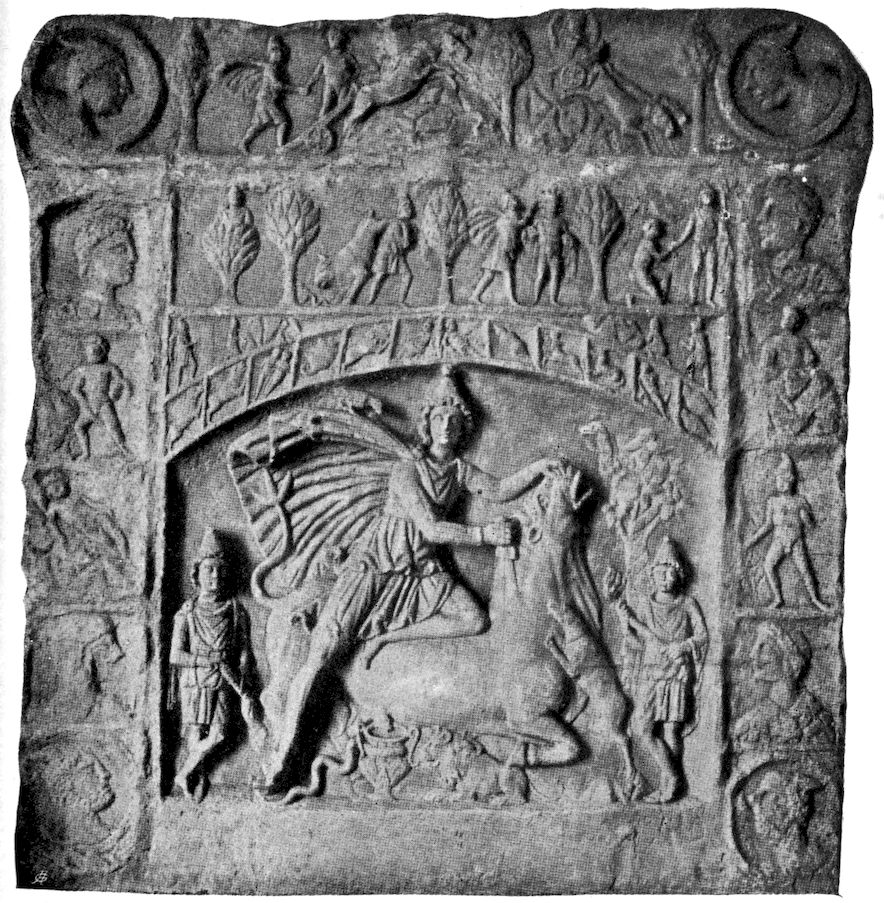
BULL-SACRIFICE OF MITHRA
295As has already been mentioned, the hanging of the sacrifice on the tree is a generally widespread ritual custom, Germanic examples being especially abundant. The ritual consists in the sacrifice being pierced by a spear.[548] Thus it is said of Odin (Edda, Havamal):
“I know that I hung on the windswept tree
Nine nights through,
Wounded by a spear, dedicated to Odin
I myself to myself.”
The hanging of the sacrifice to the cross also occurred in America prior to its discovery. Müller[549] mentions the 296Fejervaryian manuscript (a Mexican hieroglyphic kodex), at the conclusion of which there is a colossal cross, in the middle of which there hangs a bleeding divinity. Equally interesting is the cross of Palenque;[550] up above is a bird, on either side two human figures, who look at the cross and hold a child against it either for sacrifice or baptism. The old Mexicans are said to have invoked the favor of Centeotls, “the daughter of heaven and the goddess of wheat,” every spring by nailing upon the cross a youth or a maiden and by shooting the sacrifice with arrows.[551] The name of the Mexican cross signifies “tree of our life or flesh.”[552]
An effigy from the Island of Philae represents Osiris in the form of a crucified god, wept over by Isis and Nephthys, the sister consort.[553]
The meaning of the cross is certainly not limited to the tree of life, as has already been shown. Just as the tree of life has also a phallic sub-meaning (as libido symbol), so there is a further significance to the cross than life and immortality.[554] Müller uses it as a sign of rain and of fertility, because it appears among the Indians distinctly as a magic charm of fertility. It goes without saying, therefore, that it plays a rôle in the sun cult. It is also noteworthy that the sign of the cross is an important sign for the keeping away of all evil, like the ancient gesture of Manofica. The phallic amulets also serve the same purpose. Zöckler appears to have overlooked the fact that the phallic Crux Ansata is the same cross which has flourished in countless examples in the soil of antiquity. Copies of this Crux Ansata are found in many 297places, and almost every collection of antiquities possesses one or more specimens.[555]
Finally, it must be mentioned that the form of the human body is imitated in the cross as of a man with arms outspread. It is remarkable that in early Christian representations Christ is not nailed to the cross, but stands before it with arms outstretched.[556] Maurice[557] gives a striking basis for this interpretation when he says:
“It is a fact not less remarkable than well attested, that the Druids in their groves were accustomed to select the most stately and beautiful tree as an emblem of the deity they adored, and cutting off the side branches, they affixed two of the largest of them to the highest part of the trunk, in such a manner that those branches extended on each side like the arms of a man, and together with the body presented the appearance of a huge cross; and in the bark in several places was also inscribed the letter Τ (tau).”[558]
“The tree of knowledge” of the Hindoo Dschaina sect assumes human form; it was represented as a mighty, thick trunk in the form of a human head, from the top of which grew out two longer branches hanging down at the sides and one short, vertical, uprising branch crowned by a bud or blossom-like thickening.[559] Robertson in his “Evangelical Myths” mentions that in the Assyrian system there exists the representation of the divinity in the form of a cross, in which the vertical beam corresponds to a human form and the horizontal beam to a pair of conventionalized wings. Old Grecian idols such, for example, as were found in large numbers in Aegina have a similar character, an immoderately long head and 298arms slightly raised, wing-shaped, and in front distinct breasts.[560]
I must leave it an open question as to whether the symbol of the cross has any relation to the two pieces of wood in the religious fire production, as is frequently claimed. It does appear, however, as if the cross symbol actually still possessed the significance of “union,” for this idea belongs to the fertility charm, and especially to the thought of eternal rebirth, which is most intimately bound up with the cross. The thought of “union,” expressed by the symbol of the cross, is met with in “Timaios” of Plato, where the world soul is conceived as stretched out between heaven and earth in the form of an X (Chi); hence in the form of a “St. Andrew’s cross.” When we now learn, furthermore, that the world soul contains in itself the world as a body, then this picture inevitably reminds us of the mother.
(Dialogues of Plato. Jowett, Vol. II, page 528.)
“And in the center he put the soul, which he diffused through the whole, and also spread over all the body round about, and he made one solitary and only heaven, a circle moving in a circle, having such excellence as to be able to hold converse with itself, and needing no other friendship or acquaintance. Having these purposes in view he created the world to be a blessed god.”
This highest degree of inactivity and freedom from desire, symbolized by the being enclosed within itself, signifies divine blessedness. The only human prototype of this conception is the child in the mother’s womb, or rather more, the adult man in the continuous embrace of the mother, from whom he originates. Corresponding to 299this mythologic-philosophic conception, the enviable Diogenes inhabited a tub, thus giving mythologic expression to the blessedness and resemblance to the Divine in his freedom from desire. Plato says as follows of the bond of the world soul to the world body:
“Now God did not make the soul after the body, although we have spoken of them in this order; for when he put them together he would never have allowed that the elder should serve the younger, but this is what we say at random, because we ourselves too are very largely affected by chance. Whereas he made the soul in origin and excellence prior to and older than the body, to be the ruler and mistress, of whom the body was to be the subject.”
It seems conceivable from other indications that the conception of the soul in general is a derivative of the mother-imago, that is to say, a symbolic designation for the amount of libido remaining in the mother-imago. (Compare the Christian representation of the soul as the bride of Christ.) The further development of the world soul in “Timaios” takes place in an obscure fashion in mystic numerals. When the mixture was completed the following occurred:
“This entire compound he divided lengthways into two parts, which he joined to one another at the center like the figure of an X.”
This passage approaches very closely the division and union of Atman, who, after the division, is compared to a man and a woman who hold each other in an embrace. Another passage is worth mentioning:
300“After the entire union of the soul had taken place, according to the master’s mind, he formed all that is corporeal within this, and joined it together so as to penetrate it throughout.”
Moreover, I refer to my remarks about the maternal meaning of the world soul in Plotinus, in Chapter II.
A similar detachment of the symbol of the cross from a concrete figure we find among the Muskhogean Indians, who stretch above the surface of the water (pond or stream) two ropes crosswise and at the point of intersection throw into the water fruits, oil and precious stones as a sacrifice.[561] Here the divinity is evidently the water, not the cross, which designates the place of sacrifice only, through the point of intersection. The sacrifice at the place of union indicates why this symbol was a primitive charm of fertility,[562] why we meet it so frequently in the prechristian era among the goddesses of love (mother goddesses), especially among the Egyptians in Isis and the sun-god. We have already discussed the continuous union of these two divinities. As the cross (Tau [Τ], Crux Ansata) always recurs in the hand of Tum, the supreme God, the hegemon of the Ennead, it may not be superfluous to say something more of the destination of Tum. The Tum of On-Heliopolis bears the name “the father of his mother”; what that means needs no explanation; Jusas or Nebit-Hotpet, the goddess joined to him, was called sometimes the mother, sometimes the daughter, sometimes the wife of the god. The day of the beginning of autumn is designated in the Heliopolitan inscriptions as the “festival of the goddess Jusasit,” as “the arrival of the sister for the purpose of uniting with 301her father.” It is the day in which “the goddess Mehnit completes her work, so that the god Osiris may enter into the left eye.” (By which the moon is meant.[563]) The day is also called the filling up of the sacred eye with its needs. The heavenly cow with the moon eye, the cow-headed Isis, takes to herself in the autumn equinox the seed which procreates Horus. (Moon as keeper of the seed.) The “eye” evidently represents the genitals, as in the myth of Indra, who had to bear spread over his whole body the likeness of Yoni (vulva), on account of a Bathsheba outrage, but was so far pardoned by the gods that the disgraceful likeness of Yoni was changed into eyes.[564] The “pupil” in the eye is a child. The great god becomes a child again; he enters the mother’s womb in order to renew himself.[565] In a hymn it is said:
“Thy mother, the heavens, stretches forth her arms to thee.”
In another place it is said:
“Thou shinest, oh father of the gods, upon the back of thy mother, daily thy mother takes thee in her arms. When thou illuminatest the dwelling of night, thou unitest with thy mother, the heavens.”[566]
The Tum of Pitum-Heliopolis not only bears the Crux Ansata as a symbol, but also has this sign as his most frequent surname, that is, ānχ or ānχi, which means “life” or “the living.” He is chiefly honored as the demon serpent, Agatho, of whom it is said, “The holy demon serpent Agatho goes forth from the city Nezi.” The snake, on account of casting its skin, is the symbol 302of renewal, as is the scarabæus, a symbol of the sun, of whom it is said that he, being of masculine sex only, reproduces himself.
The name Chnum (another name for Tum, always meaning “the sun-god”) comes from the verb χnum, which means “to bind together, to unite.”[567] Chnum appears chiefly as the potter, the moulder of his egg. The cross seems, therefore, to be an extraordinarily condensed symbol; its supreme meaning is that of the tree of life, and, therefore, is a symbol of the mother. The symbolization in a human form is, therefore, intelligible. The phallic forms of the Crux Ansata belong to the abstract meaning of “life” and “fertility,” as well as to the meaning of “union,” which we can now very properly interpret as cohabitation with the mother for the purpose of renewal.[568] It is, therefore, not only a very touching but also a very significant naïve symbolism when Mary, in an Old English lament of the Virgin,[569] accuses the cross of being a false tree, which unjustly and without reason destroyed “the pure fruit of her body, her gentle birdling,” with a poisonous draught, the draught of death, which is destined only for the guilty descendants of the sinner Adam. Her son was not a sharer in that guilt. (Compare with this the cunning of Isis with the fatal draught of love.) Mary laments:
“Cross, thou art the evil stepmother of my son, so high hast thou hung him that I cannot even kiss his feet! Cross, thou art my mortal enemy, thou hast slain my little blue bird!”
The holy cross answers:
303“Woman, I thank thee for my honor: thy splendid fruit, which now I bear, shines as a red blossom.[570] Not alone to save thee but to save the whole world this precious flower blooms in thee.”[571]
Santa Crux says of the relation to each other of the two mothers (Isis in the morning and Isis in the evening):
“Thou hast been crowned as Queen of Heaven on account of the child, which thou hast borne. But I shall appear as the shining relic to the whole world, at the day of judgment. I shall then raise my lament for thy divine son innocently slain upon me.”
Thus the murderous mother of death unites with the mother of life in bringing forth a child. In their lament for the dying God, and as outward token of their union, Mary kisses the cross, and is reconciled to it.[572] The naïve Egyptian antiquity has preserved for us the union of the contrasting tendencies in the mother idea of Isis. Naturally this imago is merely a symbol of the libido of the son for the mother, and describes the conflict between love and incest resistance. The criminal incestuous purpose of the son appears projected as criminal cunning in the mother-imago. The separation of the son from the mother signifies the separation of man from the generic consciousness of animals, from that infantile archaic thought characterized by the absence of individual consciousness.
It was only the power of the incest prohibition which created the self-conscious individual, who formerly had been thoughtlessly one with the tribe, and in this way alone did the idea of individual and final death become 304possible. Thus through the sin of Adam death came into the world. This, as is evident, is expressed figuratively, that is, in contrast form. The mother’s defence against the incest appears to the son as a malicious act, which delivers him over to the fear of death. This conflict faces us in the Gilgamesh epic in its original freshness and passion, where also the incest wish is projected onto the mother.
The neurotic who cannot leave the mother has good reasons; the fear of death holds him there. It seems as if no idea and no word were strong enough to express the meaning of this. Entire religions were constructed in order to give words to the immensity of this conflict. This struggle for expression which continued down through the centuries certainly cannot have its source in the restricted realm of the vulgar conception of incest. Rather one must understand the law which is ultimately expressed as “Incest prohibition” as coercion to domestication, and consider the religious systems as institutions which first receive, then organize and gradually sublimate, the motor forces of the animal nature not immediately available for cultural purposes.
We will now return to the visions of Miss Miller. Those now following need no further detailed discussion. The next vision is the image of a “purple bay.” The symbolism of the sea connects smoothly with that which precedes. One might think here in addition of the reminiscences of the Bay of Naples, which we came across in Part I. In the sequence of the whole, however, we must not overlook the significance of the “bay.” In 305French it is called une baie, which probably corresponds to a bay in the English text. It might be worth while here to glance at the etymological side of this idea. Bay is generally used for something which is open, just as the Catalonian word badia (bai) comes from badar, “to open.” In French bayer means “to have the mouth open, to gape.” Another word for the same is Meerbusen, “bay or gulf”; Latin sinus, and a third word is golf (gulf), which in French stands in closest relation to gouffre = abyss. Golf is derived from “κόλπος,”[573] which also means “bosom” and “womb,” “mother-womb,” also “vagina.” It can also mean a fold of a dress or pocket; it may also mean a deep valley between high mountains. These expressions clearly show what primitive ideas lie at their base. They render intelligible Goethe’s choice of words at that place where Faust wishes to follow the sun with winged desire in order in the everlasting day “to drink its eternal light”:
“The mountain chain with all its gorges deep,
Would then no more impede my godlike motion;
And now before mine eyes expands the ocean,
With all its bays, in shining sleep!”
Faust’s desire, like that of every hero, inclines towards the mysteries of rebirth, of immortality; therefore, his course leads to the sea, and down into the monstrous jaws of death, the horror and narrowness of which at the same time signify the new day.
“Out on the open ocean speeds my dreaming:
The glassy flood before my feet is gleaming,
A new day beckons to a newer shore!
306A fiery chariot borne on buoyant pinions,
Sweeps near me now! I soon shall ready be
To pierce the ether’s high, unknown dominions,
To reach new spheres of pure activity!
This Godlike rapture, this supreme existence....
· · · · ·
“Yes, let me dare those gates to fling asunder,
Which every man would fain go slinking by!
’Tis time, through deeds this word of truth to thunder;
That with the height of God’s Man’s dignity may vie!
Nor from that gloomy gulf to shrink affrighted,
Where fancy doth herself to self-born pangs compel,—
To struggle toward that pass benighted,
Around whose narrow mouth flame all the fires of Hell:—
To take this step with cheerful resolution,
Though Nothingness should be the certain swift conclusion!”
It sounds like a confirmation, when the succeeding vision of Miss Miller’s is une falaise à pic, “a steep, precipitous cliff.” (Compare gouffre.) The entire series of individual visions is completed, as the author observes, by a confusion of sounds, somewhat resembling “wa-ma, wa-ma.” This has a very primitive, barbaric sound. Since we learn from the author nothing of the subjective roots of this sound, nothing is left us but the suspicion that this sound might be considered, taken in connection with the whole, as a slight mutilation of the well-known call ma-ma.
307