Chapter III · COMPLICATIONS OF MENTAL LIFE (continued 2)
Max F. (Max Friedrich) Meyer translation
QUESTIONS
179. Illustrate the independence of form feeling and content feeling.
180. Explain the pleasantness of unity in variety.
181. Give examples of unity in variety.
182. Illustrate feeling based on association of ideas.
183. What examples are given in the text of transference of feeling?
184. What are the two relations between the I and the rest of our thought, important for our feeling?
185. What is irradiation of feeling?
§ 20. Emotions
Our preceding discussion shows that an exhaustive description of all our complicated feelings is an enormous task. We cannot enter upon it here. But certain classes of feelings may be described in more detail; namely, emotions and moods.
Those feelings which are based on associated ideas, and which rise at once to great intensity, are called emotions. This definition is somewhat deficient in so far as it is difficult to draw the line which exactly separates great from small intensity and a quick from a slow rise of intensity. Nevertheless, the stormy character of certain feelings not directly attached to sensory stimulation is so conspicuous that a special name is desirable. Anger, fright, distress, and hilarity are such feelings: hilarity distinctly pleasant, fright and distress equally unpleasant; anger also unpleasant, yet mixed sometimes with a certain amount of pleasure. The feeling and the consciousness of its cause are usually so intense in an emotion that there is little room for coherent thought. The judgment of a person in a state of emotion is narrow; his actions may be called shortsighted.
Those feelings which become separated from their original perceptual or ideational substratum and attach themselves to any other kind of perception or ideation—no matter what feelings properly belong to these—are called moods. They are usually, probably because of the separation mentioned, of small intensity. But their duration is often very extended. As typical examples may be mentioned grudge, worry, dejection, and cheerfulness.
Like all feelings, emotions and moods are in some way related to motor activity. Of particular interest here are not the purposive movements, which are by no means absent, but a large number of muscular activities seemingly of little or no usefulness, resulting from inherited nervous connections. In so far as these muscular activities become outwardly noticeable they are called the expressions of the emotions or moods. The angry man instinctively clinches his fist, the hilarious fellow dances about. Laughing, weeping, wrinkling of the forehead, and blushing are further expressions of this class. Contraction of the muscle fibers in the skin causes goose flesh, or the hair to stand on end. Breathing undergoes changes, becoming quicker or slower than normal. The blood vessels expand or diminish in size through the activity of the muscle fibers in their walls, causing the subject to look red or pale, to feel warm or cold, and in the latter case to shiver. Secretion of saliva, perspiration, and secretion of the lachrymal glands may result from the changes in the circulation of the blood. Fatigue, nausea, lack of appetite, and other symptoms of internal processes may occur.
These phenomena were almost entirely neglected by the older psychology, although their significance was understood by physicians. More recently their psychological import has been recognized and even overestimated. It has been said that these phenomena not only occur in emotions, but are the emotions; that the emotions consist in the organic sensations resulting from these reflex muscular activities (theory of James and Lange). We do not weep because we are sorry, but we are sorry because we weep. We do not tremble because we fear a pistol held up before us, but we are frightened because we tremble. Two arguments favor this view. Let all bodily symptoms be gone, and the strongest emotion is gone too. Anger without clinching the hand is no anger. While I am sitting calmly on a chair, smiling, I cannot be angry. And further, when the bodily symptoms are exactly imitated or produced by drugs or by nervous disease, the emotion is there. Alcohol makes a person hilarious and courageous without any perception of the kind which usually produces this effect. Certain poisons or mania cause rage very much like that produced by an insult.
However, these facts do not prove that an emotion contains nothing else than organic sensations. It is obvious that, according to the laws of association, the contents of an emotion must be reproduced by those organic sensations which were present innumerable times when that emotion was present. The organic sensations resulting from poisons or mania perhaps call up an idea of an insult, and the complete emotion of anger naturally follows. Because of the firmly established associations, it is also to be expected that the voluntary substitution of a different set of organic sensations interferes with a present emotion. Introspection makes it clear that an emotion contains much more than a mere group of organic sensations.
The instinctive motor activities characteristic of the various emotions may be classified under two headings: excitation and depression. The difference is especially noticeable in unpleasant emotions: anger is an emotion of excitement; fear, as a rule, of depression. But this distinction is not entirely absent in pleasant emotions. The joy of a grateful memory is characterized, not indeed by depression, but by a restfulness very distinct from the excited joy of expectation or the delight at a present experience, although the pleasantness felt may be of exactly the same degree of intensity. A careful analysis of these motor activities must distinguish, not only excitement and depression, but also their occurrence in either the skeletal or the involuntary muscles, the muscles of the vascular system. Thus one may distinguish four classes of emotions, as characterized chiefly by heightened activity of the skeletal or of the vascular muscles, or by weakened activity of the skeletal or of the vascular muscles. Symptoms resulting from abnormal contraction or relaxation of the vascular muscles are, for example, a person’s growing pallid, or blushing, and the corresponding sensations of cold and warmth.
Two other concepts relating to the emotional life deserve to be mentioned, temperament and passion. Temperaments are inherited tendencies of the life of feeling in special directions. Since ancient times four have been distinguished: the sanguine, bilious (choleric), melancholic (atrabilious), phlegmatic (lymphatic). The ancients held that temperament is conditioned on the predominance of one of the four humors, the blood, lymph, yellow bile, and black bile. This is of course pure speculation of a prescientific period. But the distinction of the four classes agrees well with common observation, although mixed forms of temperament are more common than the pure types. People are either optimistically or pessimistically inclined. The sanguine and the phlegmatic are the optimists, the bilious and the melancholic the pessimists. On the other hand, some people are excitable, impetuous, others are not easily aroused. The sanguine and the bilious are quickly excited, the melancholic and the phlegmatic are calm and sluggish.
Passions are acquired dispositions toward special kinds of pleasant experiences. We might say that they are foreseeing, voluntary emotions. We speak of the passion of the gambler, the smoker, the collector, the lover. One may also compare an emotion with an acute disease, a passion with a chronic disease. Animals, too, possess emotions, as joy, fear, and rage. But it seems that they are not sufficiently capable of anticipating emotions to be said to possess passions.
QUESTIONS
186. How are emotions defined?
187. How does an emotion influence coherent thought?
188. How are moods defined?
189. Mention a number of moods and an equal number of emotions, each comparable to one of the moods.
190. What four classes of motor activities characteristic of emotions are distinguished in the text?
191. What motor activities are called expressions?
192. Give examples of expressions of emotion.
193. Give examples of motor activities which are not expressions of emotion, but nevertheless of much significance for the subject’s experience of an emotion.
194. What is temperament?
195. What is a passion?
§ 21. Complications of Willing
We have shown in an earlier chapter how voluntary—that is, foreseeing—actions develop out of instincts. Sensations result from the instinctive action, are associated with those other impressions which called forth the instinctive response, can then be reproduced by them, and can themselves produce the action. When an action is thus foreseen, it is called voluntary. Such simple voluntary actions are then combined into complicated groups and chain-like progressions. The conscious result of the first movement calls up the idea of a further movement, its execution that of a third movement, and so on. Serial activities of this kind often go on for a long time; for example, walking, eating, dressing, writing, sewing, rowing. As experience of the relations between the external things and practice in the performance advance, such serial actions become more and more perfect in several respects. Their conscious anticipation is more and more extended, so that they may be adapted to very remote consequences, the occurrence of which is not expected until days or weeks afterward. They are more and more refined in that they adjust themselves accurately in direction, speed, and force to the special circumstances of each case. They are performed in less time and more economically; all detail movements which are either wrong or merely superfluous come to be entirely omitted.
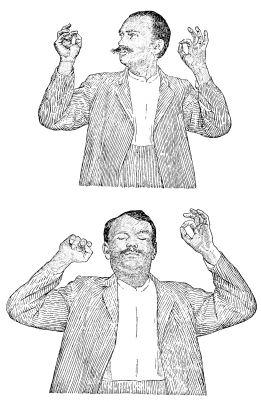
That the conscious processes in voluntary movements tend toward simplification has been mentioned in § 10. A whole series of movements, which was originally performed by each movement being consciously anticipated in order, is now performed without further consciousness as soon as the series has once begun. One fact, however, is highly interesting in this connection because it shows how the several movements of the series are actually caused. Although consciousness of all those anticipations of the movements is no longer required, the physiological sensory functions must run their course in the normal order or disturbances occur in the movement. This may be demonstrated in an animal by cutting all the sensory nerves of a limb, but carefully leaving all the motor nerves intact. The limb nevertheless appears paralyzed. A similar case in man has been described by Strümpell. A workman received a knife wound in the spinal cord. Complete recovery occurred, with the exception that the right hand and lower arm remained perfectly anesthetic: no kind of cutaneous or organic sensation was any longer perceived. The muscles of the hand and arm functioned almost normally. But movements, even very moderately complicated, could no longer be performed unless the man saw his hand and its movement. The illustration (figure 18) shows his behavior when requested to form a ring with his thumb and index finger. He could do this fairly well when permitted to look at his hand. Otherwise it was impossible, in spite of his will and the muscular capacity to perform this action. We see, then, that the peripheral impressions are necessary to bring about the several partial movements in this case of acquired serial activity, although these impressions have long ceased to become conscious whenever the act is done.
Fig. 18.—Visual and Kinesthetic Control of Voluntary Action: the Former Intact, the Latter Lost.
When we anticipate a final result of an extended series of movements, it frequently happens that the movement which directly leads to that result is, for one cause or other, not immediately possible. Imagine that a person for the first time sees some one pulling a cork from a bottle, pouring some of the contents into a glass, and inviting him to drink. Seeing the bottle again calls up in his mind the idea of a delicious beverage and the movement of drinking. But drinking is impossible, for there is no glass, and the bottle is corked. In such a case the idea of the result, which because of its importance is being kept constantly in mind, unrolls the total series of ideas in the reverse order. It calls up first the thoughts directly preceding the final result, then the thoughts preceding these, and so on, until an idea is reached which can be realized by a movement. In our example the person becomes conscious of the idea of pulling the cork, of the corkscrew used for this purpose, the place where the corkscrew was found hanging, the movements of preparing it for the task, and a similar set of ideas for the glass; and he thus becomes able to carry out the whole series of movements which result in the taste of the beverage.
QUESTIONS
196. Give examples of serial activities of the foreseeing kind.
197. In what ways are activities of the kind just mentioned perfected?
198. What is the relation of sensory activity, consciousness, and performance in perfected serial movements?
199. Illustrate by a pathological case the relation just spoken of.
200. What rule is illustrated by the example in the text of pulling a cork from a bottle?
§ 22. Freedom of Conduct
As experience of the connections, complications, and consequences of things advances, the ideas called up by any impression must clearly become very numerous. Ideas of near and remote, probable and improbable, desirable and undesirable, consequences,—ideas of fit and unfit, direct and indirect means of bringing about or preventing those consequences,—ideas of difficulties and obstacles, facilities and openings must tend to appear, to compete with each other, to disappear and reappear in rapid succession, or merely to approach consciousness ready to appear when their services should be needed. We refer to these various mental states, according as they appear in one or another form of connection, by such terms as reflecting, considering, choosing, desiring, rejecting, intending, deciding, and many others, all having in common the foreseeing of something to be experienced in the future as the result of our action.
What action occurs in each possible case depends on the relative force of the factors coming into play. The actual sensory impression is as a rule a rather insignificant factor. It sets free the ideas derived from innumerable previous sensory impressions. The resulting action is then nearly always extremely different from the instinctive reaction belonging to the sensory stimulation. Such actions, resulting essentially from factors within the mind, not from external factors which happen to impress the mind at the moment, are called free actions. Their freedom does not mean that they have no causation, that they are free of causes, but they are free of the compulsion exerted by the external stimuli of the moment. They are free actions as opposed to instinctive actions, which are not free of these stimuli of the moment, but on the contrary, completely determined by them.
Scholastic philosophy—and popular thought, which is still largely under the influence of that philosophy—recognizes still another kind of freedom of the mind. It assumes that mind, under the impression of perfectly definite external conditions and with perfectly definite internal motives of thought and action, possesses the faculty of deciding in favor of the action opposed to its own motives and of enforcing this action. This faculty of an absolutely causeless willing is assumed to be added to all the other external and internal factors determining action or, as the case may be, suppressing action. Such a faculty we cannot accept, since according to our most fundamental conceptions mind is not a being added to its experiences, but the totality of its experiences, in so far as it knows itself; whereas it is called brain in so far as it is known by other minds. The arguments brought forward in favor of a freedom of the will in the sense of a possibility of causeless action are inacceptable to the psychologist because they would make a psychological science impossible. Nevertheless, it is worth while to discuss the more important ones briefly.
Three arguments are most commonly offered. First, immediate experience tells us that, whenever we decide in favor of one action, we could have decided differently. We were conscious of the possibility of acting otherwise. The second and third arguments are of a practical nature. According to the second, the idea of a uniformly effective causation of our actions paralyzes our activity. If everything takes place by necessity, the idea of influencing the physical world or human society becomes meaningless. No one can believe in determination of our action and at the same time make an effort to instruct and educate people to act differently. Thirdly, no one can be held responsible for his actions if he could not help performing them. If all actions are causally determined, punishment becomes mere cruelty.
The first argument fails because our immediate experience under no conditions informs us exactly as to what caused and what did not cause our actions. We have just seen that a serial movement cannot be carried out unless constant sensory impressions are received from the progress of the partial movements. Immediate experience gives us no information about this necessity, which was entirely unsuspected until physiological experiment and pathological observation revealed the fact. Immediate experience tells a person who in his boarding house praises a very ordinary dinner in exaggerated terms, that he might have kept silent as he usually does—he does not remember that the evening before when he was in a state of hypnosis a suggestion was given to him to praise his dinner the following day. Everybody else knows that he will, that he must, do it. He alone thinks, on the basis of his immediate experience, that it was an act of free will without causation. It was free, uncaused, in the same sense in which the issue of a disease, the outcome of a war, the weather, the crops, are free and uncaused; that is, he was ignorant of the cause.
Paralysis of activity is said to be the consequence of a belief in universal causation. But surely the energetic and ambitious man is not paralyzed by this belief. He feels that he is the tool used by nature to shape the destinies of the world. How could a consciousness of his importance in the causal connections of events paralyze his activity? The idle and indolent may excuse his lack of activity by saying that it is his nature to love inactivity, that he cannot help it. But who would have any more respect for him on that account? Of course it is not his belief in universal causation that makes him indolent. The lesson from history is very significant in this respect, but it must not be read one-sidedly. It is all right to point out that the fatalistic Islam is losing piece after piece of its dominion. But the same fatalistic Islam also conquered a world and for centuries kept all Europe in terror. Thus it cannot be its fatalism that determined both its rise and its downfall. In recent years, did the belief in predestination make the Boers less energetic than the belief in freedom the orthodox Spaniards?
We must say, then, that in general neither belief is of much practical significance. But as a guide in special cases the belief in universal causation is by far preferable. What can give more encouragement to the educator than the conviction that his efforts will bear fruit in one way or other because they must help to shape and direct his pupil’s activities in later life? What can be more discouraging than the belief that, whatever may be his efforts, they are just as likely to be lost on his pupil as to be effective, since the latter has the faculty of causelessly acting either in one way or in the opposite way?
The third argument asserts that universal causation is incompatible with responsibility. But what do we mean by responsibility? Nothing but the fact that society, if it can do so, will punish its members for certain deeds. Why should a belief in universal causation prevent society from punishing its members? Bismarck writes in a letter to his sister: “It is not the wolf’s fault that God has created him as he is. That does not prevent us from killing him whenever we can.” Holding a person responsible, punishing or rewarding him, does not lose its meaning if we regard his actions as being determined by causes. We do not then hold him responsible for the single act, but for his being so natured that under such circumstances he cannot help committing such a deed. The question becomes this: What is the more plausible reason for punishing a person, his abnormal deed or his abnormal, unsocial nature which made this deed possible?
It is true that punishment dealt out by an individual or a small group is often merely an instinctive act of revenge for a single deed. If a person beats me, do I have less pain if I beat him and cause him pain too? Should a gambler beat the roulette because it makes him lose and the other man gain? Would the roulette act differently for having been beaten? Am I sure that the person whose beating me was undetermined by causes will treat me better the next time? If his actions are caused, he probably will treat me better because the memory of the blows received from me will act as a cause. The instinct of returning blows would be incomprehensible if human action were independent of causes.
But the legal punishment dealt out by the officers of a nation has lost the significance of an instinctive act of revenge. Does this fact make it compatible with the doctrine of causeless activity? Would not punishment, under this doctrine, be cruelty pure and simple? Punishment can be justified only if it can act as a cause determining human behavior. Society introduces fear of threatened punishment and memory of suffered punishment as motives into the mental life of its members, in order to inhibit criminal actions in those who are so natured that they will commit acts inimical to society when occasion offers, or when they are tempted. The degree of the penalty is adapted to the effectiveness of the temptation under different circumstances. Children and intoxicated and insane persons are treated in a different manner because the fundamental condition of punishment—the existence of an idea of punishment capable of serving as a motive of action—is not fulfilled in them. All this becomes entirely purposeless, meaningless, if we accept the doctrine that human actions are not completely determined by causes. Responsibility, social order, and law, far from being called in question by determinism, are, on the contrary, dependent on it for their justification.
Indeterminism, the doctrine of causeless activity of the mind, of freedom of a will which is regarded as an entity added to the contents of the mind, is no better supported by these special arguments than by general considerations. More than a hundred years ago Priestley said of this doctrine: “There is no absurdity more glaring to my understanding.”
QUESTIONS
201. Give at least a dozen words all meaning the foreseeing of a future experience resulting from action.
202. How are free actions defined?
203. What other name is mentioned in the text for unfree, compulsory action, a name which has already been much used in a previous chapter?
204. What are the three arguments mentioned in favor of the assumption that causeless action is possible?
205. What do we learn from a post-hypnotic suggestion with respect to the question of free will?
206. Give examples from history showing that both energy and indolence are independent of theories about the will.
207. Can the belief in causeless activity be expected to contribute to educational endeavor? Give reasons for your answer.
208. What is the aim of legal punishment? How is this aim related to the doctrine of causeless activity?
209. Why are children not made subject to legal punishment?