Chapter II · THE SPECIAL FACTS OF CONSCIOUSNESS (continued 2)
Max F. (Max Friedrich) Meyer translation
But none of these methods solve the chief problem, namely, the determination of the point at which fatigue begins to be permanently harmful. There is no doubt that in moderate degrees fatigue is a perfectly normal phenomenon, involving no detriment to our future efficiency. Otherwise most people would be wrecked before they are fully grown. The experience of athletes and soldiers shows that even rather high degrees of fatigue are compatible with the normal growth of bodily strength. The same may be true for mental life. The assertions of great damage done to children by school work are—so far as normal children are concerned—certainly greatly exaggerated.
QUESTIONS
106. What are the effects of fatigue?
107. Into what complication does fatigue enter with practice?
108. What attempts have been made at measuring fatigue?
109. What is the chief problem in connection with fatigue?
110. Is the fatigue of school work harmful?
C.THE EXPRESSIONS OF MENTAL LIFE
§ 12. Perception and Movement
The impression upon the mind is not the ultimate end of the nervous processes originating in the sense organs. The end is rather activity of the motor organs of the body, which we may here, accepting the naïve conception of matter and mind, regard as effects or expressions of mind. The complications of the mental life of a grown person tend to make this connection between mind and motor activity often obscure and doubtful. It seems that often we receive impressions quite passively. Nevertheless the connection exists. Every impression made upon the mind by the external world is in some way responded to by movement. The movement may occur in the stimulated sense organ itself, in the arms, the hands, the fingers, the legs, the feet, the head, the vocal organs, also in the internal organs, the heart, the blood vessels, the alimentary canal, the lungs. The significance of many of these movements is but insufficiently understood, for example, laughing, weeping, blushing, trembling. But those movements which directly affect the organism’s surroundings are easily understood. They may be classed under two headings, self-preservation and play. Another way of classifying them is to distinguish movement toward the object perceived and movement away from the object, without taking these terms in too literal a sense.
Innumerable illustrations for these classes of movements suggest themselves. A piece of bread put on the back of the tongue is moved down the esophagus by the proper muscular contractions. A particle moving into the wrong passage is thrown out again by coughing. If the palm of an infant is gently stroked, the hand closes and takes hold of the stroking finger. If the palm is scratched, the hand quickly recedes. A mild and steady light attracts the child’s eye, which follows the movements of the light. From an intense and flickering light the eye turns away. A piece of sugar is kept in the child’s mouth and moved about by the tongue until it is dissolved. A bitter root causes the lips to recede and the tongue to make a pushing movement. If the child is hungry, he cries, kicks, and strikes out with his arms until he is fed. After being fed he lies still so that digestion is not interfered with by the blood being drawn into the peripheral parts of the body.
Movements which do not serve self-preservation so directly are called play. When a cat perceives a mouse, she jumps at it and catches it. But before eating it, she usually lets it loose and catches it again, and so on several times. When she finds a ball of yarn, she treats it similarly, although she must know that it is not edible. A dog gnaws a bone because this contributes to his nutrition. But he also gnaws table legs and rugs, although these have no nutritive value. He chases rabbits and other small animals which he can eat. But he chases no less eagerly other dogs, wagons, cyclists, horses, none of which serve as articles of food for him. The same is true for man. The infant’s kicking, the small child’s breaking of his toys, do not have any immediate value. Men and animals respond to things not only by fighting, but also by play. The significance of playful movements is to be found in the exercise, the development, and the conservation of the abilities given to them by nature. As in the movements of self-preservation, so in play pleasantness and unpleasantness make their appearance. Extensive exercise of natural abilities is highly pleasant, enforced inactivity equally unpleasant.
But play is more than a general exercise of the bodily organs. It is a preparation for the specialized activities of the serious part of life. The animal meets in play things which behave very much like those things which it has to obtain for food. So it learns to obtain food at a time when food is not yet needed. It learns to defend itself when no one yet attacks it. The biological significance of the play movements obviously consists in this preparation for the special activities of life. Those animals which do not possess a strong tendency to play are thus at a disadvantage in the struggle for life, because they miss the opportunity for preparation. Serious activity and play accompany man and animal all through life; but the proportion changes. The young are taken care of by their parents, and play may therefore prevail. With maturity this changes, and less time is left for play.
All these movements of self-preservation and of play are natural inherited responses of the organism to its environment. Many of them do not appear at the very entrance into life, but at different stages of age and growth. They are the raw material from which all conduct is derived and built up. Their nervous conditions are the nervous processes in the reflex arches of the subcortical nerve centers. From the points of sensory stimulation, the nervous processes are carried into definite muscle groups so that definite movements occur. These movements are called reflexes or instincts according as they are rather simple or more complex. Both reflexes and instincts are inherited movements following in direct response upon sensory stimulation.
QUESTIONS
111. What is the ultimate end of every nervous process?
112. What are typical movements of self-preservation?
113. What are typical movements of play?
114. Is play more than a general exercise of the body?
115. Are all inherited movements possible immediately after birth?
116. What is the difference between reflexes and instincts?
§ 13. Thought and Movement
Consciousness is not a factor in reflex or instinctive movements. But these movements soon enter into a twofold connection with consciousness. (1) When such movements occur, they often result in consciousness. They are either seen, or perceived through the sense of touch or through the kinesthetic sense. These images of the movement become associated with the images originating from the sensory stimulations which give rise to the movement. (2) In consequence of this association the visual, touch, and kinesthetic images of the movement, particularly the most common, the kinesthetic, may themselves produce this movement to which they owe their existence. The mere thought of how one feels when performing a movement brings about, if it is vivid enough, the movement itself. The hearing of dance music awakens the kinesthetic ideas of dancing, and these become real movements, although perhaps only swaying movements of the body or the head. Vivid thinking similarly brings about whispering of words. Even vivid imagination of the movement of a foreign body has such powers. A passionate and excited billiard player thinks of the hoped-for movement of the running ball. This leads to imagery of a similar movement of his own body, and the result is the actual movement, rather ridiculous to the onlooker because it is entirely purposeless.
Through this connection with consciousness instinctive movements become voluntary movements. The term voluntary means just this connection with consciousness; it has no other meaning.
Suppose a child sees something white and glittering and puts it instinctively into his mouth. It happens to be a lump of sugar. Its taste is pleasant. It is retained, dissolved, and swallowed. All the impressions, occurring at about the same time, become associated: the sight of the thing, the movements of the arm and hand, the taste, the movements of the tongue and the lips. The more frequently this thing happens, the more firmly established are the associations. Later the sight of sugar reproduces at once its taste, the visual and kinesthetic images of the movements, and the movements themselves—the arm is stretched out, the tongue and lips making sucking movements—although the sugar may be lying so far away that it cannot be touched. The child’s consciousness then contains what we have previously called will, and what may also be called desire: a vivid impression accompanied by pleasantness, sensations of restlessness, and an image of a pleasant conclusion of the whole experience. We say then that the child wills, desires, to have the sugar.
We can will to do only that which in its elements we have previously done by instinct. If we do not know how a movement feels when we perform it, of course we cannot bring it about by way of our consciousness, that is, by our will. Children have as much command of speech as they have acquired by instinctively producing speech sounds in response to accidental stimulations. This instinctive production occurs usually rather late in the case of certain sounds, as k, r, sh; and accordingly, in spite of all special efforts on the part of the parents, children learn to produce those sounds only at that late time. We presuppose, of course, that they are not deaf. For in deaf children the speech sounds instinctively produced do not enter into an association with the kinesthetic sensations and therefore cannot be voluntarily reproduced; that is, the children remain dumb. Many a grown person remembers that all his attempts at learning the pronunciation of a certain sound in foreign speech (take for example the gutteral German r, or the German ch, or the French nasal sounds) were in vain until by a mere accident, instinctively, he pronounced that very sound. After that he had command of it.
This interweaving of the instinctive reactions of the body with conscious life is of the greatest practical significance. However well adapted the inherited reflexes may be to the purpose of keeping the young animal alive, they are very insufficient in meeting the ever growing complications of life. And they are not perfect even in the beginning. A reflex is the response to a present and direct impression upon the organism; but very similar impressions may come from things of different properties. Poisonous substances often look and taste like articles of food. The enemy assumes the attitude of a friend welcoming you. Reflex action is powerless to give the organism the protection needed in such cases. Instinct is easily deceived. But as soon as the harmful consequences impress themselves upon the organism, the instinct is modified, and in the future these consequences will be avoided. The instincts are ready-made institutions intended to be applied to average conditions. Their readiness and completeness is in so far of inestimable advantage to the organism. If it had to learn everything necessary for life, it could not survive. But for the manifold deviations of the external world from the average no provision can be made in this manner.
The variation of the organism’s response is made possible by the existence of higher nerve centers, that is, of connecting neurons of a higher order, more remote from the sensory and motor points of the body. Let us imagine the proverbial reaction of a child to the sight of a flame, and discuss the successive stages of development by the help of figure 15. (1) The visual stimulation starts a nervous process from s1, which passes through the bulb and spinal cord into the muscles of the arm at m1. A small part of the current may branch off at a and, instead of passing down towards b, take the direction of v. But the resistance in this direction is for the present so high that only an insignificant part of the process can take this way, and so no corresponding motor response is noticeable.
Fig. 15.—“A Burnt Child fears the Fire.”
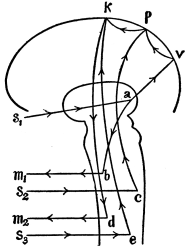
(2) While all this is still going on and the child’s arm is still moving forward, the heat of the flame acts as a pain stimulus at s2. The nervous process produced passes over c and d to the muscles at m2, whose contraction results in the arm’s being pulled back. This results in a third stimulation at s3, which we need not trace farther here. But not the whole of the nervous process passes from c down to d. A part of it, of considerable absolute magnitude because of the intensity of stimulation, passes from c up to p and thence over k down to d and finally also into m2. This process going from p to k, according to a general law of nervous activity, tends to attract other, weaker nervous processes, if the neuron connections make this possible. Consequently the nervous process from s1 to a is now turned mostly into the path a-v-p and only an insignificant part of it continues to go from a towards b. The consequence is that the resistance of the path a-v-p-k-d is soon reduced to less than the resistance of the path a-b. The great significance of this fact becomes clear in the third stage of development.
(3) At some later time the flame again acts as a visual stimulus. But now, because of the change of resistance just explained, the nervous process takes for the most part the path over a-v-p-k-d, and the reaction follows at m2 instead of at m1. The child has learned to avoid the flame. The child, when seeing the flame, is conscious of the pain, as imagery, without having to receive the actual stimulation at s2.
Thus the inflexible regularity of reaction gives place to another type of reaction, an adaptation, not only to those conditions which at the time make their impression upon the organism, but also to those conditions which are mere future possibilities. The experience of the past guides the organism into the future.
QUESTIONS
117. What is the twofold connection into which instinctive movement enters with consciousness?
118. Why is the movement of a billiard ball often accompanied by movements of the players or spectators?
119. What is a voluntary movement?
120. In what manner is will dependent on instinct?
121. Why do deaf children not acquire speech? Can they be taught to speak?
122. Why is the acquisition of foreign speech sounds by grown people often so slow?
123. What is the advantage to the organism of voluntary over instinctive action?
124. Can you describe the three stages of nervous development illustrating the proverb “A burnt child fears the fire”?