RELATION OF THE PROPER USE OF THE VOICE TO THE VITAL ORGANS.
Reading edition
EFFECT OF THE VOICE UPON THE LUNGS.
Great wisdom is exhibited in the construction of the human lungs. In the arrangement of the air cells, the greatest possible amount of surface is presented in order that the air may freely enter the blood. The lungs are largely made up of blood vessels, bronchial tubes, and air cells. When a person breathes, the oxygen, entering the lungs through the trachea and the bronchial tubes, penetrates the thin walls of these cells and passes at once into the blood. When the blood enters the lungs it is dark in color, but when it leaves the lungs it is of a light vermilion hue. The oxygen which has been taken into the lungs has wrought this change. So wonderful is this element of nature that some have called it life. If there is an elixir of life in the material world surely it is oxygen, for it has to do minutely and intimately with every power of the human body. The more a person breathes this oxygen as it is mixed in the common air, the more life and power he possesses.
It is essential to perfect health that every avenue to the lungs should be kept open and free, and that the air cells should be kept clear, for if the walls of the cells thicken, oxygen cannot penetrate them. If these cells are not properly filled during respiration, the walls thicken, and substances collect in the cells. If any trouble occurs in the air cells, except for traumatic reasons, it will first be found in the apexes of the lungs. In the production of tone, whether on a low, high, or medium pitch, the vocal cords are drawn so closely together that the air cannot immediately escape from the lungs; therefore, unable to get out readily, it is pressed up into the apexes of the lungs by the expiratory muscles, filling the air cells to the utmost, thus keeping them clear and their walls thin and healthy. In correct singing or speaking, the apexes of the lungs are filled with air. Tubercule seeks devitalized tissue for its development. Therefore tuberculosis usually begins in the apexes of the lungs because they are not kept clear and healthy through proper respiration and vocal exercise. Voice was given to man to make him strong and expressive, to give him life and power.
THE EFFECT OF THE VOICE UPON THE STOMACH.
The stomach is the principal organ of digestion. Out of the nutriment taken into it all the tissues of the body are renewed. It lies under the diaphragm, and is held in place by the abdominal muscles. The stomach is moved during respiration, descending with every inspiration, and rising with every expiration.
In addition to this exercise during the production of tone, the stomach is held firmly between the diaphragm and abdominal muscles. At the close of the tone the muscles which thus hold the stomach relax.
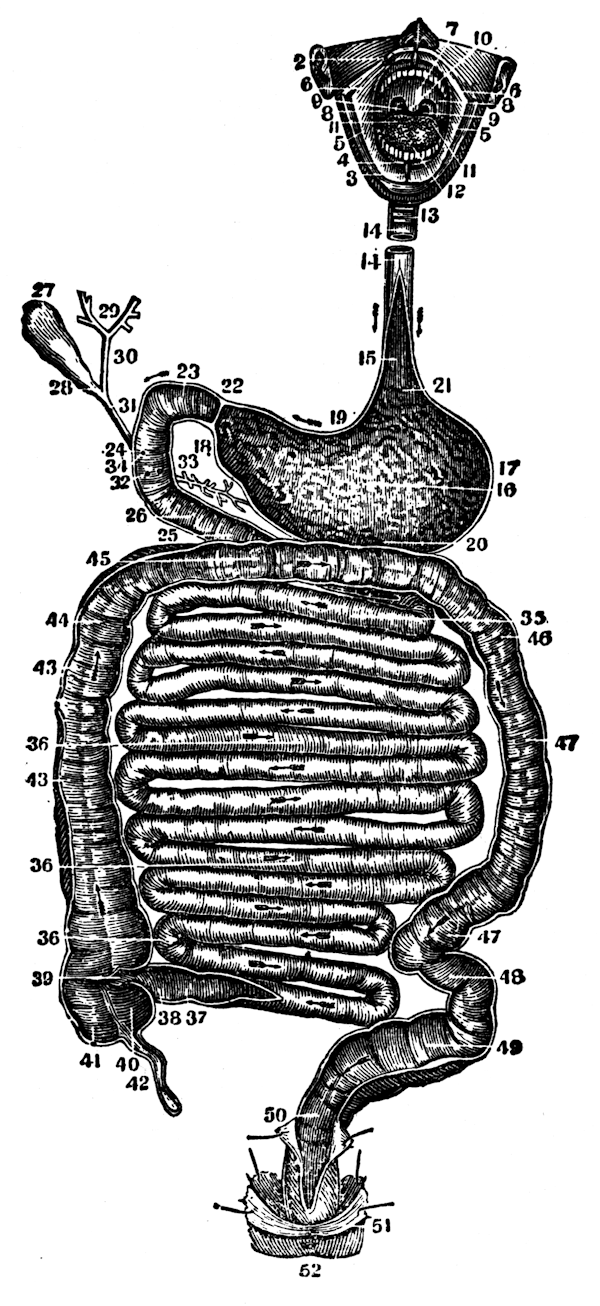
A view of the Organs of Digestion, opened in nearly their whole length; a portion of the œsophagus has been removed on account of want of space in the figure; the arrows indicate the course of substances along the canal: 1, the upper lip, turned off the mouth; 2, its frænum; 3, the lower lip, turned down; 4, its frænum; 5, 5, inside of the cheeks, covered by the lining membrane of the mouth; 6, points to the opening of the duct of Steno; 7, roof of the mouth; 8, lateral half-arches; 9, points to the tonsil; 10, velum pendulum palati; 11, surface of the tongue; 12, papillæ near its point; 13, a portion of the trachea; 14, the œsophagus; 15, its internal surface; 16, inside of the stomach; 17, its greater extremity or great cul-de-sac; 18, its lesser extremity or smaller cul-de-sac; 19, its lesser curvature; 20, its greater curvature; 21, the cardiac orifice; 22, the pyloric orifice; 23, upper portion of duodenum; 24, 25, the remainder of the duodenum; 26, its valvulæ conniventes; 27, the gall-bladder; 28, the cystic duct; 29, division of hepatic ducts in the liver; 30, hepatic duct; 31, ductus communis choledochus; 32, its opening into the duodenum; 33, ductus Wirsungii, or pancreatic duct; 34, its opening into the duodenum; 35, upper part of jejunum; 36, the ileum; 37, some of the valvulæ conniventes; 38, lower extremity of the ileum; 39, ileo-colic valve; 40, 41, cœcum, or caput coli; 42, appendicula vermiformis; 43, 44, ascending colon; 45, transverse colon; 46, 47, descending colon; 48, sigmoid flexure of the colon; 49, upper portion of the rectum; 50, its lower extremity; 51, portion of the levator-ani muscle; 52, the anus.
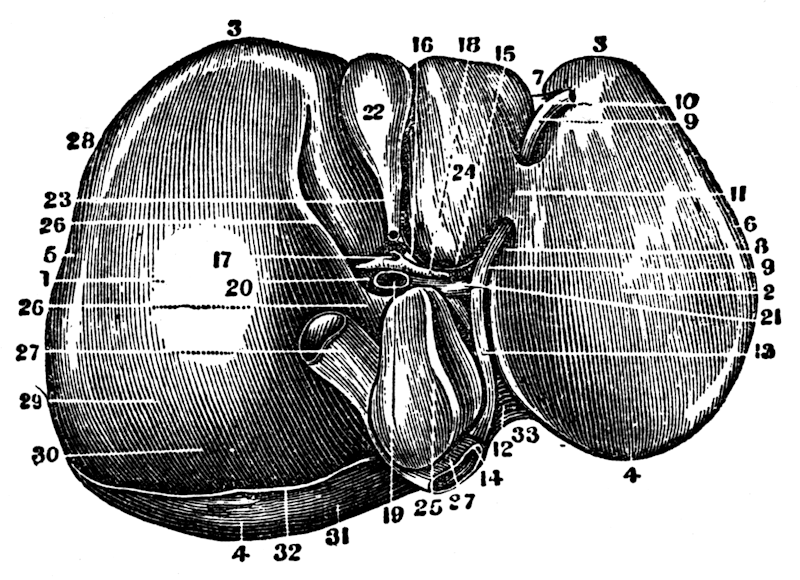
LIVER. The inferior or concave surface of the liver, showing its subdivisions into lobes: 1, center of the right lobe; 2, center of the left lobe; 3, its anterior, inferior, or thin margin; 4, its posterior, thick, or diaphragmatic portion; 5, the right extremity; 6, the left extremity; 7, the notch in the anterior margin; 8, the umbilical or longitudinal fissure; 9, the round ligament or remains of the umbilical vein; 10, the portion of the suspensory ligament in connection with the round ligament; 11, pons hepatis, or band of liver across the umbilical fissure; 12, posterior end of longitudinal fissure; 13, 14, attachment of the obliterated ductus venosus to the ascending vena cava; 15, transverse fissure; 16, section of the hepatic duct; 17, hepatic artery; 18, its branches; 19, vena portarum; 20, its sinus, or division into right and left branches; 21, fibrous remains of the ductus venosus; 22, gall-bladder; 23, its neck; 24, lobulus quartus; 25, lobulus Spigelii; 26, lobulus caudatus; 27, inferior vena cava; 28, curvature of liver to fit the ascending colon; 29, depression to fit the right kidney; 30, upper portion of its right concave surface over the renal capsule; 31, portion of liver uncovered by the peritoneum; 32, inferior edge of the coronary ligament in the liver; 33, depression made by the vertebral column.
EFFECT OF VOICE UPON THE LIVER.
The liver is a glandular organ, intended for the secretion of bile from the blood. It is situated under the diaphragm and partially over the stomach; therefore the exercises which produce pressure and relief upon the stomach, exert the same effect upon the liver. That the liver may properly perform its function it is necessary for it to be thus exercised. One cannot speak or sing well without moving the diaphragm, and when this is moved it moves nearly all the organs contained in the trunk of the body, and especially promotes the healthy activity of the lungs, stomach, liver, and intestines.
EFFECT OF THE IMPROPER USE OF THE VOICE UPON THE MUCOUS MEMBRANE.
Mucous membrane lines all those passages by which the internal parts communicate with the exterior, and is continuous with the skin at the various orifices of the surface of the body. The mucous membrane, beginning with the lips, lines the mouth, throat, œsophagus, stomach, and in short, the entire alimentary canal. It also lines the nares, larynx, bronchial tubes, and air cells. It is one because unbroken. Its function is to secrete mucous for the purpose of preventing dryness.
Sympathetic relations exist throughout the whole human system, and especially between different parts of the same organ; if one part of the mucous membrane is injured, another part is as liable to suffer as that immediately injured. If congestion takes place in any part of this mucous membrane, it may cause congestion in some remote part of the membrane, without affecting the intervening parts. There is a certain common misuse of the voice which creates in the pharynx an irritation called “clergyman’s sore throat.” By the law of sympathy, this congestion is likely to be communicated from the pharynx to the mucous membrane of the stomach. It may also attack the mucous membrane of the bronchial tubes and through them affect the lungs.
Although this disease caused by the misuse of the voice is called “clergyman’s sore throat,” it is not confined to clergymen; it prevails to a considerable extent among school teachers, lawyers, and auctioneers. It is dangerous for one to enter upon any form of public speaking without having a sufficient knowledge of the voice to use his own correctly. This is true not merely because it gives power to speak more effectively, but because it enables one to preserve his own health, and thereby prolong his usefulness. “Clergyman’s sore throat” is caused by making too close a chamber of resonance in the pharynx while speaking. This is a confirmed habit with a very large number of persons; in fact, it might almost be said to be a prevailing difficulty, but it does not always cause a sore throat until the voice is more constantly used than it ordinarily is in private life.
A clergyman or others may for years have practised this habit without feeling the effect upon the throat; but as soon as they come to speak steadily for a half hour or more, and that, too, for the purpose of being heard in a large room, begin to realize a huskiness which soon develops into an irritation of the throat.
This finally develops into a congestion, and sooner or later into a cough, which results in the breaking down of the powers of the individual, and if it does not receive immediate and proper attention consumption may be the result. No medicine, however good, can give more than a temporary relief. So long as the cause (which is the misuse of the voice), remains, the difficulty must return. Sometimes “clergyman’s sore throat” is not introduced by huskiness; the first symptom observed is that of dryness or irritation. This is especially true if the voice is characterized by a metallic element. All these evils can be cured by proper vocal education, providing the patient does not wait too long.
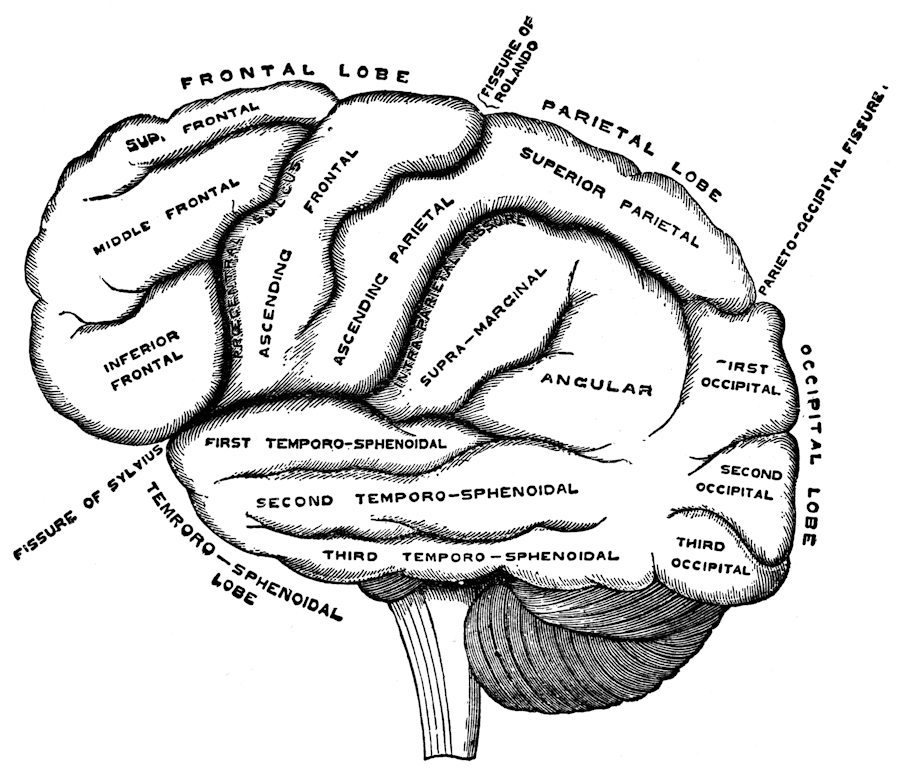
CONVOLUTIONS AND FISSURES OF THE OUTER SURFACE OF THE CEREBRAL HEMISPHERE.