MUSCLES OF RESPIRATION.
Reading edition
Inasmuch as voice is vocalized breath, it is important to give attention to respiration.
The principal muscles used in the ordinary movements of inspiration are:—
I.Diaphragm.
II.Levatores costarum.
III.External intercostals.
The principal muscles used in expiration are:—
I.Internal intercostals
with the infracostals.
II.Triangularis sterni.
{ Transversalis.
III.Abdominal muscles{ Rectus.
{ Internal oblique.
{ External oblique.
There are many accessory muscles which aid in violent respiratory movements, both inspiratory and expiratory. All the muscles which elevate the scapula may act through it upon the ribs; the three scalene muscles act directly upon the first rib.
The principal muscles of inspiration may be assisted by the
I.Serratus posticus superior.
II.Serratus magnus.
III.Pectoralis major.
IV.Pectoralis minor.
The principal muscles of expiration may be aided by the following muscles:—
I.Serratus posticus inferior,
II.Longissimus dorsi,
III.Sacro lumbalis,
and all the muscles which tend to depress the ribs.
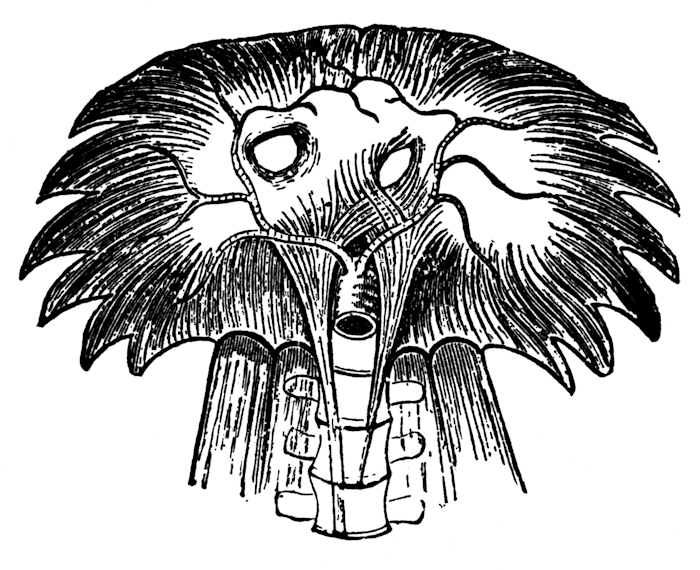
THE DIAPHRAGM.
DIAPHRAGM.
The diaphragm separates the cavity of the thorax from the cavity of the abdomen, and constitutes the floor for the heart and lungs to rest upon, and also a close-fitting cover for the contents of the abdomen. Therefore it is evident that the moving of the diaphragm moves the organs which are immediately above and those below it. In reposeful breathing the enlargement of the cavity of the chest is chiefly accomplished by the contraction of the diaphragm. As it contracts it presses upon the abdominal viscera. The abdominal muscles antagonize the diaphragm by pressing back the abdominal viscera, thus causing its ascent as soon as the diaphragm has become relaxed.
As the diaphragm contracts, the air rushes through the nostrils or mouth to fill the lungs. By lifting the ribs the thorax can be sufficiently enlarged to meet ordinary demands for breath; therefore the lungs would not immediately suffer if the diaphragm was not contracted. The principal sufferers in such a case would be the stomach, liver, and intestines, for without this exercise which the contraction of the diaphragm gives them they would not as vigorously perform their functions.
It is taught in many works on physiology that men inhale by means of the contraction of the diaphragm chiefly, while in adult women the diaphragm is exercised little, if any, during respiration. This statement was first given in early physiologies without due warrant from close observation. This idea, having once found its way into a standard work, has continued in successive works until now. This theory is of such vital interest to all that the authority for it should be carefully examined. It is a fact that more women than men breathe wholly by means of elevating and lowering the ribs; it is also a well-observed fact that the healthiest women and the healthiest men breathe alike, with no movement of the upper part of the chest during reposeful respiration. It is only when an unusual amount of air is required that the healthiest men and women ever move the upper part of the chest during respiration; then the diaphragm is exercised vigorously, and the movements of the ribs take place only for the purpose of enlarging the cavity of the thorax beyond what it is possible for the diaphragm alone to accomplish. During the last twenty-five years I have cured hundreds of people, both men and women, of dyspepsia and its attendant weaknesses by teaching them how to exercise the diaphragm in respiration, and in the production of tone. To say nothing of the incorrect way in which women breathe, I find that a majority of men breathe improperly.
The shape of the diaphragm, when it is relaxed, resembles an open umbrella. When the diaphragm is flattened by contraction it no longer retains its dome-like shape, and thus gives greater depth to the thorax.
DIFFERENCE IN THE ACTION OF THE DIAPHRAGM DURING EXPIRATION OF THE BREATH AND DURING THE PRODUCTION OF TONE.
During expiration of breath the diaphragm is fully relaxed, while during the production of tone it should be somewhat contracted. In the proper adjustment of the diaphragm and abdominal muscles during voice production, the diaphragm by its contraction resists, to some extent, the pressure caused by the contraction of the abdominal muscles, and thus only gradually yields to the force brought against it by the contraction of these muscles, in consequence of which a firm and steady support is given to the voice.
BREATHING THROUGH THE NOSE.
The question is often asked, “Should one breathe through the nose or through the mouth?” Nature has so constructed the organs of respiration and determined their action that a person in health breathes through the nose, while a person in ill health often breathes through the mouth. By “breathing through the nose,” of course, is meant reposeful breathing. In extraordinary breathing some persons are obliged to breathe through the mouth, but this is always an indication of exhaustion or weakness. Every person should, if possible, maintain the habit of breathing through the nose.
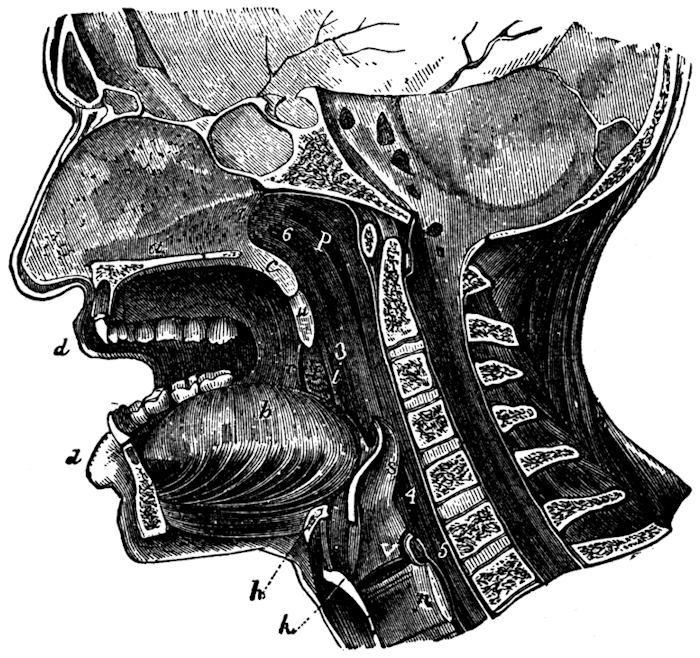
Median Section of Mouth, Nose, Pharynx, and Larynx:—a, septum of nose; below it, section of hard palate; b, tongue; c, section of velum pendulum palati; d, d, lips; u, uvula; r, anterior arch or pillar of fauces; i, posterior arch; t, tonsil; p, pharynx; h, hyoid bone; k, thyroid cartilage; n, crycoid cartilage; s, epiglottis; v, glottis; 1, posterior opening of nares; 3, isthmus faucium; 4, superior opening of larynx; 5, passage into œsophagus; 6, mouth of right Eustachian tube.