Chapter XI
Reading edition
The Rainy Season sets in at Bengazi towards the middle of January, and continues with little interruption till the beginning of March — Miserable Condition of the Town during that period — Construction of the Houses — Improvidence of the Arabs — Dirty state of the Streets — Swarms of insects which infest them — Position of Bengazi — Description of its Harbour — Castle of the Bey — Visit to Bey Halīl — Friendly Reception of our Party by his Excellency — Occupations and arrangements during the Rainy Season — The Shekh el Belad Mahommed — Jews of Bengazi — Trade of the Town — Produce of the Environs — Wretched state of the Bullock Vessels — Mahometan Inhabitants of Bengazi — Alarm of the Lower Classes during our residence there — Confusion resulting from it — Mob collected at our door on this occasion — Narrow Escape of Mr. Giacomo Rossoni — Friendly Conduct of our Mahometan Acquaintance — Parley with the Arabs — Dispersion of the Mob — Prejudices of the Arabs respecting the Treatment of Diseases — Fatal Effects of this species of Folly at Bengazi — Prevalent Diseases in Bengazi and its vicinity — Singular cause of Alarm among a Party of Arab Shekhs — Arab notions of decorum and propriety contrasted with those of European Nations — Bengazi supposed to occupy the Site of Berenice and Hesperis — Existing Remains there — Little regard manifested by Turks and Arabs for the relics of Antiquity — Probable Limits of Berenice — Quarries, and singular Chasms in its Neighbourhood — Gardens of Hesperides — Position of the Gardens according to Scylax, Pliny, and Ptolemy — Conjectures of Gosselin and others respecting them — Circumstances which appear to favour our position of the Gardens — Lakes and Subterranean Caverns in the Neighbourhood of Bengazi, (or Berenice) — Concealed Body of Water observed in one of the latter — Examination of the Caverns — Remarks of the Bey respecting it — The Subterranean Stream in question considered as the River Lathon, or Lethe — Testimonies of the Ancients on this point — Supposed Communication of the Subterranean Stream with the Lake adjoining the Harbour of Bengazi — Signification of the term Lathon alluded to — Further Remarks in confirmation of our suggested Position of the River, and of its probable Communication with the Lake above mentioned — Remarks of Strabo and Cellarius on the subject — Temple of Venus, and Lake Tritonis of Strabo — Remarks on the name Berenice — Total ignorance of the Arabs of Bengazi with respect to the former celebrity of their City — Pleasing little Fable of Kazwini, on the changes which take place in the Nature and Appearance of Places, and the little knowledge which remains, after a lapse of time, of their former Condition, even on the spots where they existed.
On the 12th of January our whole party arrived at Bengazi, having employed on the journey two months and seven days from the time of our departure from Tripoly. Shortly after our arrival, the heavy rains commenced, and continued with little interruption, until the beginning of March, accompanied with constant gales of wind from the north-east and north-west. The state of the town during this period may truly be said to have been miserable; the houses being chiefly put together with mud, were continually giving way, and falling in; and we were frequently apprized of occurrences of this nature, in our own immediate neighbourhood, by the shrieks and cries of women, whose families had been sufferers on some of these occasions.
The streets during part of the time were literally converted into rivers; the market was without supplies, owing to the impossibility of driving cattle into the town; and the number of sheep and goats which perished in the neighbourhood of Bengazi, from the extreme inclemency of the weather, amounted (we were informed) to several thousands. For ourselves, we were fortunate in having one room in our house which was capable of resisting the rain, the terrace on its roof having been cemented by one of the Beys, who had occupied it a short time before; and this, we really believe, was the only room in the town which could be fairly considered weather-proof. The court-yard round which our apartments were built (if they may be dignified with so imposing an appellation) assumed for a long time the appearance of a pond, and a narrow space was only left here and there on its borders, by which we could pass from one room to another.
From the state of our own house, which we have already said might be considered as the best in the town, the condition of other parts of Bengazi, during the rains, may be in some measure imagined; although it will scarcely be possible for the inhabitants of civilized countries, unacquainted with the nature of Arab towns, to conceive half the wretchedness and the utter want of comfort which they present on similar occasions.
The houses of Bengazi are built after the usual manner of Arab buildings, that is to say, with rough and unequally-shaped stones, put together with mud instead of mortar; they generally consist of a ground floor only, built round a square court-yard, which is exposed to the weather, and into which the doors of the chambers open, which seldom communicate with each other: the court is not paved, and in houses of more than ordinary consequence, there is sometimes a well in the centre. The roofs are flat, and are formed of rafters (chiefly of young pine-trees from the neighbouring forests) over which are laid mats, and on these there is generally a quantity of sea-weed, or other vegetable rubbish; over the whole is spread a thick stratum of mud, which is beat down as hard as Arab laziness will admit of at the time when the terrace is made[1].
They who can afford it (and there are very few so fortunate) spread a preparation of lime over the mud; which, as the cement is usually well made, forms a surface impervious to the weather, while the coating remains in good condition.
The rain which falls is in these cases highly beneficial, since it is carried off by spouts into some general reservoir, or is collected in large earthern jars for the daily consumption of the house. By far the greater number of houses are, however, unprovided with any defence of this nature; and if the precaution of beating down the mud which forms the terrace, sufficiently hard to make the water run off, be not adopted at the commencement of the rains, it is more than probable, that the whole of the building so neglected will disappear before the season is over. As the religion and the laziness of an Arab equally prompt him to depend more upon the interference of Providence, than upon any exertions of his own, this precaution is often neglected; and after having borne, with exemplary patience, all the dirt and inconvenience occasioned by the passage of the rain through the mud over his head, he is roused from his lethargy by the screams of his wife and children, alarmed, or badly wounded by the fall of the roof, or by some serious accident from a similar cause, by which he is a sufferer himself. Many persons were severely wounded at Bengazi in the winter during which we were confined there; and it is probable, that there are accidents in the town every year, occasioned by similar neglect.
When a house falls, it is generally left in a state of rubbish and ruin, and the survivors of the family remove to another spot without troubling themselves further about it: the consequence is, that the streets are often nearly blocked up by mounds of this nature disposed in various parts of them; which form in the winter-time heaps of mud and mire, and, in the dry weather, scatter thick clouds of light dust in the faces and eyes of the passengers.
As these masses of rubbish also serve at the same time as general receptacles for the superfluities of the city, groups of half-famished dogs and myriads of flies are invariably collected about them; in the midst of which are seen lying very contentedly, or rolling about for diversion, swarms of little naked children, regardless of either, which one might almost fancy were actually produced by the fertilizing qualities of these heaps of putrid matter, as the monsters of old are asserted to have been from the slime and the mud of the Nile. There is, however, nothing singular or peculiar to Bengazi in the scene which we have just described; for every Arab town and village will be found, more or less, to present to us a similar spectacle. Filth and dust, and swarms of insects of every description, must inevitably be the consequences of this continued neglect; and we accordingly find that these several annoyances, together with the scattered groups of lean dogs and naked children, form the principal characteristics (in the estimation of their European visitors) of these enviable places of abode. We say, in the opinion of the natives of Europe, because an Arab or a Moor sees nothing remarkable in any of the objects here alluded to, and would consider it a mark of affectation or effeminacy to be annoyed at any similar objects or inconveniences.
In addition to the nuisances already enumerated, the open spaces in Bengazi are usually ornamented by pools of stagnant, putrid water; and that which is in the market-place is rendered more particularly offensive, from the circumstance of its being the common receptacle of the offal and blood of the animals which are killed there, and which may truly be said to realize the words of the poet in “making the green one red.” It may readily be imagined, that in the heat of the summer these places are not very wholesome, and they are probably often the causes of fevers, especially during the prevalence of southerly winds. That these sinks of corruption should ever be bathing-places will not perhaps be so easily conceived; but they are nevertheless often used for such purpose; and the children of the town will very frequently adjourn from the dust-heaps already described, to cool themselves (we cannot in conscience say to clean themselves) in the green and red pools here alluded to. With so many objects to attract and encourage them, it is not to be wondered at, that Bengazi is proverbial for flies; and every part of the town, both within and without the houses, may truly be said to swarm with them. Among the various annoyances with which the place abounds, these are, perhaps, the most serious of any; or, at all events, they are those from which it is least possible to escape; there is, in fact, no chance of avoiding them; they follow you everywhere from place to place, settle on every part of the arms, legs, and body, which the heat of the weather obliges you to leave uncovered; creep obstinately into the corners of the eyes, and up the nostrils, into the hollows of the ears, and the corners of the mouth when it is closed, and often fly down the throat, nearly choking you, when it is open; at meals every part of the dishes and their contents are covered as soon as they are produced, and every fluid becomes a trap for as many of these insects as can crowd themselves over its surface. In short, there is literally no riding or walking, no reading or writing, or eating or resting one’s-self, in any part of Bengazi in comfort for them; and if at night they take up their accustomed position on the ceiling, and give place to the fleas and mosquitos, the first dawn of morning finds them on the wing, and all alive to recommence their operations. They are at the same time so watchful, and so quick in their motions, that it is difficult to succeed in killing any of them; we often caught thirty or forty fleas in a morning on turning down the bed-clothes with a little attention, and as many during the day on different parts of our dress, particularly about the legs and ancles; but the whole collection of flies which we could kill in a week would scarcely amount to this number; unless we except those which were caught in the traps which we were usually in the habit of setting for them. All hot climates are more or less subject to these nuisances; but it is probable that no place on earth will be found to abound more in flies than Bengazi; we might perhaps say, that few places could be mentioned where so many of them will at any time be observed.
The situation of Bengazi is, however, much better than so filthy a town may be said to deserve. It is built on the coast, close to the sea, at the extremity of a beautiful fertile plain, extending itself to the foot of a long chain of mountains about fourteen miles distant (in this part) to the south-eastward. Plentiful crops of corn and vegetables are afforded to the town by the cultivated lands in the neighbourhood, and the supplies of beef and mutton are in general very regular and abundant. The harbour of Bengazi appears to have been formerly capable of containing good-sized vessels, and, even in the recollection of some of the present inhabitants, the Bashaw’s ships were accustomed to lay, where now only boats can be accommodated.
At present it can only be entered by small vessels, drawing seven or eight feet water, and that merely in moderate weather. It is well protected from the sea by reefs of rocks, between which the entrance is so narrow as to render a pilot necessary.
There seems to be little doubt that the harbour originally communicated at all times with the lake to the southward of the town, as it does at the present day in the rainy season; but owing to the accumulation of sand from the sea, and of alluvial deposite from the lake, the communication is now, during the summer months, wholly interrupted. At the entrance of the port is the castle of the Bey of Bengazi, constructed on the ruins of an ancient building, part of which is still visible at the base of the castle next the sea. The existing structure is built with small stones and mud, so slightly, that when the Adventure made its appearance before it, the Bey requested Captain Smyth would dispense with the usual salute, as he feared the concussion would otherwise bring down a part of the walls. Its form is square, with a round tower at each of three angles; the fourth, which fronts the entrance of the harbour, being occupied by a pile of building, appropriated to the harem of his excellency.
If the gallantry of Mahometans has been doubted or denied, here is surely a proof of its existence; for the angle given up to the service of the ladies is almost the only one which could prove of any annoyance to vessels entering the harbour; and, while the three turrets mentioned are provided with guns, this angle is left without any. The fair inhabitants of the harem are in consequence favoured with a view of the “dark blue main,” and the grated windows of their apartments command at the same time a view of the entrance to the harbour.
The cool sea-breeze enters freely, and the ladies may sit with the lattice spread open to enjoy it, without incurring the danger of meeting the gaze of any vulgar or sacrilegious eye. The dashing of the waters against the base of the castle may also serve to lull them to sleep; but candour, at the same time, obliges us to state, that it may also serve to waken them rather too abruptly on no very distant occasion. Were it not that the lower part of the structure is (as we have before mentioned) ancient, and consequently strongly built, the interruption to which we allude would have happened long before now; and Neptune, as if encouraged by the daily glances of so many soft dark eyes, would have washed away the barrier which so cruelly interposed itself, and carried off the lovely inhabitants of the harem to enliven his submarine soirées.
Besides the harem of the Bey, the castle contains the officers and chaouses of his household, and a numerous body of troops might be lodged within the limits of its walls. In time of trouble, it is the only place to which he could retreat with any safety, and it forms the only ornament and the only protection which the town of Bengazi possesses.
The Bey, whose name is Halīl, was once fortunate enough to possess a daughter of the Bashaw as his wife, a circumstance which secured for him a good deal of influence (or at least a great portion of the royal favour) during the life of his consort. He was not, however, destined to enjoy his good fortune long, for the princess died a short time before our arrival at Tripoly, and with her highness departed that portion of influence which Bey Halīl through her means had obtained. The profits arising from the government of Bengazi would have been sufficient to enrich its possessor, had he been allowed to enjoy them; but the demands which were continually made upon him by the Bashaw became so heavy after the death of his wife, that the surplus was very inconsiderable. Besides this, the collection of the tribute from the Bedouin tribes in the neighbourhood was often attended with difficulty, and must have made the receipts uncertain; but no allowance is made in Mahometan countries for casualties of this description; the will of a superior is a law, and his demands must be punctually complied with, (whatever may be the means of satisfying them,) if the office, and often the life of the person upon whom they may be made, are valued by him. The consequence is, that extortion in the heads of departments is the cause of extortion in subalterns; and he who has no power to avail himself of tyranny, is generally doomed to be the sufferer himself, for not being able to do more than his resources will allow him to accomplish. Many a well-meaning man who would have acted with propriety, had the alternative been less severe, is thus obliged to commit acts of cruelty and injustice which his nature would not have inclined him to; the force of habit and example at length subdues his better feelings, and necessity is so often made the excuse for tyrannical conduct, that it not only becomes a plea where it actually obtains, but is urged as such eventually on occasions where no necessity really exists, to justify private acts of caprice and oppression, which have themselves only resulted from the long-indulged habit of executing similar outrages for others.
The Bey having been officially apprized of our arrival, and that we were desirous of paying our respects to him, appointed a day to receive us; and when the time arrived we proceeded to the castle, accompanied by Signor Rossoni, the British vice-consul at Bengazi, and his brother, Mr. Giacomo Rossoni. We found the Bey in a plain whitewashed room of unimposing dimensions, but cool and tolerably clean, seated upon cushions spread round a niche which had been formed in the wall for the purpose. On each side of this recess, or alcove, were ranged the principal officers of the household, the chaouses, and several shekhs; other parts of the room were occupied by slaves and persons of inferior condition. There was much less ceremony in the court of Bey Halīl than in that of the Bashaw at Tripoly, and the conversation appeared to have been pretty general before we entered the apartment in which he received us.
The hum of voices subsided all at once as we made our appearance, and every person’s eyes seemed determined to exert themselves in proportion as his tongue was laid under restraint; for the steady gaze of all present was fixed upon our party as we took up our stations near the Bey. We found his excellency a good-looking, well-formed man, who, apparently from inactivity and good living, had attained to that state of dignified embonpoint at which persons of inferior consideration in Mahometan countries are very seldom destined to arrive. A Georgian by birth, Bey Halīl possessed strongly the Asiatic cast of countenance and features, and an expression of unassumed and unreserved goodnature gave a pleasing character to his sharp, black eyes. His reception of our party was in unison with his appearance; and the formal inclination of the head, usually made by Mahometans to strangers whom they honour with their notice, gave place to a hearty English shake of the hand; while a cordial Bon giorno! Ti sta bono? was substituted for the grave and ceremonious salam, which, whenever it is offered by the faithful to unbelievers, is almost invariably dictated by politeness or policy merely.
Near the Bey stood his secretary, Hashi (whose pale and thin countenance, and weak, inflamed eyes, appeared to testify that his place was no sinecure); and two of his head chaouses, one a native of Constantinople, a short, corpulent, sleepy-looking personage; the other a tall, raw-boned, hard-featured Arab, who had shewn great bravery and activity in petty wars with the Bedouin tribes, and whose shattered hand bore testimony to his exploits.
Several persons came in from time to time, and having kissed his excellency’s hand, and made the appropriate salams, squatted themselves down in different parts of the room, according to their rank and station, and began with great attention their survey of our party.
The objects of the expedition had in all probability been made known to the Bey before our arrival; but we thought it proper to state them in general terms to his excellency, through the medium of Mr. Giacomo Rossoni, in his official character of interpreter.
This was no sooner done than the eyes of the spectators, which had hitherto been actively employed, were relieved for a short time by their organs of speech, exerted in ill-suppressed whispers. From their gestures, and a word or two which we caught en passant, we could perceive that very few of the Arabs assembled believed a single word of our statement, (so far, at least, as the motives for the expedition were concerned;) for they could not at all imagine why persons should be commissioned to make researches of such a nature as those which they had just heard proposed, where money was not in fact the real object of inquiry.
His excellency the Bey, though he received the statement graciously, and offered his assistance very freely in facilitating the operations of the mission, was scarcely himself convinced of the sanity of a government which could concern itself with science and research, particularly if no considerable pecuniary equivalent was likely to result to His Majesty’s treasury for the expenses incurred by its expeditions[2].
We had brought with us several papers for Bey Halīl from the Bashaw, all of which, when presented (with the exception of one), he put into the hands of his secretary Hashi, his excellency not being himself quite au fait at deciphering the contents of his letters. The paper retained was the teskeré from the Bashaw (already mentioned) for five hundred dollars; and it is probable that the frequent arrival of similar orders had rendered their appearance so familiar to Bey Halil, that he was able to distinguish them without the assistance of his secretary, though he could not read a word of other matter.
A slight change of countenance, when he first cast his eyes upon the teskeré, was, however, the only visible effect which it produced on the exterior of the Bey of Bengazi; and his good breeding did not allow him to manifest in any other way that our visit was not in all respects perfectly agreeable to him. We may add, that the sum was punctually paid to us, after some little (possibly unavoidable) delay, by the hands of secretary Hashi; and the credit of his excellency was in no other way diminished, than by the discharge of the five hundred dollars at several times, instead of being made at one payment. Had we known at Tripoly so much of the Bey’s private history, as we have already stated above, this teskeré might have been spared him; for we should certainly not have been induced to accept any order upon him, however trifling, could we have supposed that its payment might be inconvenient.
Soon after we left the coast of Africa, Bey Halil was removed from the government of Bengazi, and it is probable that he had reason to rejoice at his dismissal; for had he remained there much longer than he did, the continued demands for money and cargoes, so unmercifully made upon him by his Highness, could scarcely have failed to ruin him. In addition to these, he had sustained a considerable loss in the capture of one of the vessels which he had freighted, by the Greeks, as we were informed, at Bengazi; and also in the destruction of the jewels and wardrobe of his wife, which the Bashaw had ordered to be burnt (it was said) after the death of that unfortunate princess.
In compliance, we presume, with the practice of the court of Tripoly, tea was served to us with the sherbet, instead of coffee, at the interviews we had with Bey Halil; as we have already mentioned it to have been in that with the Shekh of Mesurata.
In the course of our first visit, we took occasion to mention to his excellency the careless manner in which Shekh Mahommed el Dúbbah had fulfilled the injunctions of the Bashaw; and to enumerate a few of the impositions, the unnecessary delays, and privations, to which we had in consequence been subjected; acquainting him at the same with the loss of property which we had sustained, from the thievish disposition of the Dúbbah’s people. We hoped by this complaint to get back a pocket compass, and some other articles which we could ill spare, which had been stolen from our tents on the journey across the Syrtis. Bey Halil was, however, either unwilling or unable to assist us in the matter; and after shrugging up his shoulders in dignified silence (as if he had expected nothing less), he summed up the whole of his displeasure in the single exclamation of—Arab! By which he seemed to imply, that, as one of that race, the Shekh could not be other than a rogue[3].
Unsatisfactory as this administration of justice may appear, it did not seem probable that we should obtain any other; and having one means of punishment, at least, in our own hands (that of mulcting the Shekh, whom we had not fully paid, to the amount of the property stolen), we did not press the subject any further with his excellency; and after having made known to him our intention of remaining during the rainy season in Bengazi, and of proceeding afterwards to the eastward, we concluded by requesting his assistance and protection, in furtherance of the remaining objects of the mission, and took our leave under the most decided and friendly assurances of having everything arranged as we could wish.
As soon as this visit of ceremony was over, we began to employ our time, which, on account of the heavy rains, was necessarily passed in doors, in putting together the materials which we had collected on our route, in making some arrangements for improving the condition of our horses, of which they stood much in need, and in preparing provisions and other necessaries which were required for our journey to the eastward. In these pursuits we were materially assisted by the vice-consul and his brother, Mr. Giacomo Rossoni, to both of whom our thanks are particularly due, as well on these as on many other occasions. Our time, though we passed it as agreeably as we could, nevertheless often hung very heavy on our hands; and we soon found that Bengazi was a residence which we should quit with very little regret. There is not a single place of public resort or amusement in any part of this gloomy abode: its inhabitants idle or sleep away the greater part of their time, without appearing to entertain the slightest desire of improving their comfortless and miserable condition, or of enlivening the monotony of their pursuits. Turkish towns are not in general remarkable for gaiety, and we did not expect to find theatres or assembly-rooms; but there is usually a good deal of amusement to be derived from occasional visits to the coffee-shops and bazaars, and not unfrequently some useful information. These resources, however, were not afforded us at Bengazi; for there is nothing of the kind there that we felt an inclination to visit a second time. Strangers who arrive there may indeed find a shelter from the weather, in a place well known to Mahometans as the Fundook, a temporary place of reception and partial accommodation. We once, and once only, took occasion to visit this place; and on entering it through the aperture of a broken door, we found ourselves in a long arched room, in which there was scarcely sufficient light to show us where to place our feet, a precaution which was nevertheless highly essential. Here we perceived the remains of a charcoal fire, which had been kindled on the well-smoked capital of a marble column, and a greasy Arab stretched close to it on the ground, snoring amid the folds of his barracan. The building itself was of some antiquity, though not apparently older than the worst time of the lower empire, the roof being supported upon small columns of execrable taste, and the other parts of the building in no better style. The exterior had undergone some repair from time to time, but no attention whatever had been paid to the chamber within, not even that of removing the dirt and filth which was collected there; and the consequence was, that the level of the floor reached two-thirds of the way up the columns. We need scarcely add, that whatever attractions this place may have had for an Arab, it had little allurement for us; and we should have laid ourselves down, without the least hesitation, to pass a rainy night in the street, rather than subject ourselves to the punishment of taking shelter for an hour under its roof.
The house in which we had taken up our abode was the property of the Shekh el Belad, a very worthy person, much respected by all who knew him: he soon made us acquainted with the principal people of the town, from whom we collected what little information they could afford us, respecting the country, and the several objects of our mission[4]. We were informed that Bengazi contained about two thousand inhabitants, a large proportion of which were Jews and negro slaves; but the number of persons residing in the town is continually varying, owing to the circumstance of many persons removing to the country, whenever the weather permits, where they establish themselves in tents, or in huts made of palm-branches and dhurra-stalks[5]. The Jews of Bengazi are a persecuted race, but uniformly steady in their pursuit after riches: as is usually the case in Mahometan countries, they are (with the few exceptions we shall presently mention) the principal merchants and tradesmen of the place; and their well-directed and unremitted industry alone enables them to meet the heavy exactions which are made upon their purses and property by the adherents to the religion of the Prophet. Their houses are generally cleaner and better furnished than those of most of the Mahometans, and we never entered any of them without finding the whole family employed in some useful occupation.
We found them invariably civil and obliging, and apparently contented with their condition; which proves how much habit will reconcile us to evils, which, to those not inured to them, would be intolerable. The “fierce impatience” which formerly characterized the Jews of the Cyrenaica has disappeared with the probability of its being successfully exerted; and poverty is now almost the only evil to which they will not quietly submit[6]. The trade of Bengazi is not, however, wholly confined to the Jews; for, besides the Bey himself, who may be considered as the first merchant, there are several other very respectable Mahometan traders[7]; the Bazaar, notwithstanding, presents little more than the articles in greatest request among the Bedouins; amongst which may be seen bundles of rusty nails, horse-shoes, musket-balls, and large flints, which form the chief objects of their visits, and are exposed for sale, on boards, at the doors of a few of the most industrious Arab inhabitants of the town, and bargained for with as much seriousness and vehemence, as if they were the most costly goods. The produce of the interior consists chiefly in corn, wool, and manteca, with which the merchants freight the different foreign vessels which purposely touch at Bengazi. This is done in preference to employing the small vessels of the country; first, because the foreign vessels are much better navigated, and secondly, because in sailing under European colours they are less liable to molestation from the Greeks. Besides these articles, oxen are well known to constitute a great portion of the trade of Bengazi, and many vessels are kept constantly employed in transporting them to Malta and other places during the summer months. If the wind prove favourable, and the passage be quickly made, the profits to all parties are great; but it sometimes happens that, from violent or contrary winds, or from the vessel being ill calculated for the cargo, and more frequently from there being too great a number of these poor animals crowded inconsiderately together, that so many oxen die from thirst and suffocation, from bruises, and occasionally from drowning, as to render the profits of the voyage very trifling.
The cattle are chiefly driven from the neighbourhood of Cyrene, where their original cost is from six to eight dollars a head; some expenses, of course, are incurred on the road, but these are amply covered by the price of ten and thirteen dollars, at which sum the oxen are furnished to the captains of the bullock-vessels: the master, again, being fully compensated by a contract of about eighteen dollars a head at Malta.
The prospect of fine weather very often induces the captain to take on board as many as there is standing-room for in his vessel, on both upper and lower deck, in both of which the poor animals are jammed as close as they can possibly be stowed. The sufferings of the oxen in hot and oppressive weather, taken at once from the invigorating atmosphere of their native mountains, and exposed to the thick and almost suffocating steam (proceeding from their own bodies) which they must necessarily breathe in the place of their confinement, will be more easily deplored than described. So oppressive is the heat, on many occasions, in the lower deck of the bullock-vessels, that the men employed to look after the unfortunate animals can scarcely stay more than ten minutes there, except immediately under the hatchways; and such of the oxen as chance, from their situation, or other causes, to be more affected by the closeness of the atmosphere than the rest, are obliged to be dragged up continually to the deck above, to prevent them from dying of suffocation.
We are sorry to say that our own experience enables us to speak decidedly on these points; for as there was no other vessel in the harbour of Bengazi, when we left the coast, than a bullock-vessel, and no other expected to arrive, we were obliged to take a passage in the only one of them then remaining. As we experienced, nearly the whole voyage, the most provoking calms, our passage was an unusually long one; and independently of the extreme inconvenience (to use the mildest term) which we experienced ourselves, we had to witness a scene of suffering which we shall never forget, and which we would willingly have gone through much more than we experienced to have avoided. It is indeed scarcely possible to conceive that human nature could be really so degraded from its rank in creation, as it appears to be in the persons of those who form the crew of a bullock-vessel.
And yet many of them are not, on other occasions, cruel men—but the constant habit of witnessing and inflicting sufferings, which they seem to think matters of course, has so blunted their kinder feelings in the discharge of this particular duty, that one might almost blush (on witnessing their conduct) at being classed in the same species with them[8]. The horrors of slave-ships are happily for the most part abolished, through the humanity and the influence of Englishmen; and if the government of Malta were acquainted with the horrors of bullock-vessels, they would surely take means to prevent the recurrence of them. Let us hope that some Martin may arise in the Mediterranean who will exert himself in bringing this about; we will answer for it, he will never sit down to a piece of beef without feelings of more than usual satisfaction.
Among the persons to whom we were introduced by Shekh Mahommed, there were several whose good sense and good feeling would have done credit to a more civilized people; and the time which we spent in their society was often very agreeably passed. They were able to afford us a good deal of information respecting the country to the eastward, and in the interior, which we afterwards found very useful; but they were generally shy in giving an opinion upon affairs of a political nature. They would, however, talk freely of the exploits of Mahommed Bey, who was so instrumental in reducing the country to its present state of tranquillity; and whose sanguinary measures alone procured for Bengazi the security which it now enjoys[9]. We often conversed on the subject of the existing war with the Greeks, and they manifested at all times extreme curiosity to know what part we should take, in the event of the arrival of any Greek vessel off their port. Our answers were always satisfactory to them; and a report of the English being favorably inclined towards the Porte having by some means reached them, we were in subsequent interviews addressed as Sahab, or ally.
This confidence in our intentions was not, however, so strongly felt among the lower classes of people; at least it did not appear to have been so on the occasion which we are about to mention.
Some vague reports of the successes of the Greeks, and their merciless treatment of the prisoners which they had taken, having reached the people of Bengazi, they became, on a sudden, uncommonly nervous, and were in momentary apprehension of an invasion, and of an indiscriminate slaughter of themselves and their families. The appearance of the Adventure, about this time, on their coast, which had not been visited by a man-of-war for a long time before, together with the arrival, soon after, of our party, whose real objects were for the most part unintelligible to them, added to the circumstance of their having seen us employed in making plans and drawings of their fort and harbour, all contributed to strengthen their suspicions and their fears; and they soon began to consider our residence among them as, in some way, connected with the Greeks. While their minds were thus prepared, it unluckily happened one evening just before sunset, that some hard clouds had formed themselves on the horizon, into shapes which they conceived to resemble ships under sail; the appearance soon excited the greatest alarm, and many an eager eye was fixed upon the formidable armada which imagination had suggested to the terrified Arabs[10]. Before they could be satisfied that there was no foundation for their fears, it was too dark to distinguish anything more; and the greatest confusion very shortly prevailed in every part of Bengazi. The men now began to prepare their fire-arms, and the signal to assemble was everywhere repeated; the women and children running about in the greatest terror, calling out that the Christians were coming to murder them!
The disturbance was not long unknown to our party, for our door shortly became the centre of confusion; a mob of Arabs was very soon collected about it, who manifested the most hostile feeling, and the street rang with invectives against the Nasáras[11]. It would have gone hard with any Christian who had been found unarmed in the streets at this moment; for even Giacomo Rossoni (the brother of the Consul), who was a great favorite with the Arabs, and who chanced to be out just before, very narrowly escaped with his life in making his way to take refuge in our house. We had every desire to act as conciliatory a part as possible, but finding our doors assailed in the manner described, we armed ourselves, with the intention of defending the house to the last, should the Arabs proceed to extremities. At this difficult moment Shekh Mahommed and his brothers, accompanied by some of our other Arab friends, made their way through the mob and arrived just in time to prevent an immediate attack upon our quarters; and we afterwards learnt that one of the Shekh’s brothers had been felled to the ground, for his remonstrances in our favour, before he could reach our door. A parley was now begun with great vehemence on both sides; but before any measures could be determined upon, an alarm was excited that the Greeks might be landing while this discussion was pending, and the whole party of rioters hurried down to the beach, leaving none but the women and children in the town. Muskets were now discharged in various directions, without any person knowing what they were firing at, and the whole strength of the place was drawn up on the beach in momentary expectation of being attacked by the invaders. At length, after a lapse of several hours, they conceived that sufficient time had been given for the approach of the vessels, if Bengazi had been really their object; and after inquiring of one another what grounds there had been for all the disturbance they had been making, without any one being able to give a satisfactory answer, the whole party retired very quietly to their houses, and nothing more was ever heard of the formidable invasion which had excited such alarm and confusion. In the mean time Signor Giacomo, who had been some time in our house, became anxious to relieve his family from the apprehensions which they could not but have entertained for his safety; but his European dress being likely to attract attention, and expose him to danger or insult, we offered our services to accompany him; and on reaching his house in safety, he learnt that the Consul had been obliged to shut himself up with his family, and that they had been in the greatest alarm for him. Thus ended a panic which arose from the most trifling circumstance, threw the whole town into serious confusion, and threatened the lives of all the Christians in the place, without having the slightest foundation.
It was singular to observe, during the whole of this affair, the total want of system and discipline which prevailed; each person hurrying he hardly knew where, because he saw others in motion, and leaving his home, with his family and property, at the mercy of any one who might invade it. A handful of men might have taken the whole town, which was left for several hours without any defence, and carried off their plunder beyond the reach of pursuit before the inhabitants knew they had been there. This was the only molestation we ever met with from the people of Bengazi; and, to do them justice, we must allow that it proceeded rather from their ignorance and their fears, than from any decided hostility or ill-will towards ourselves. On all other occasions we found them civil and obliging, and usually inclined to be of service to us when they could. With regard to the manners and customs of the people of Bengazi, we saw nothing in which they differed materially from those of Arabs in general; and it would merely be repeating what has been often observed by others, were we to give any detailed description of them. It is well known what reliance is placed by the Arab on the efficacy, we may say, the infallibility of charms and family nostrums, and how much they are averse to calling in medical aid till they have repeatedly tried their own remedies without success. We saw a lamentable instance of this adherence to popular prejudice and superstition, in the case of an interesting girl of Bengazi, the daughter of one of the Arabs of the town. As Mr. Campbell was standing at the door of our house, in company with some others of our party, an old woman hurried towards him, and eagerly seizing both his hands, conjured him to come and visit her daughter, who she said was very ill with a swelling in the throat. Mr. Campbell immediately complied with her request, and accompanied her, together with one or two of the other officers, to the house where the patient was lying. On entering they found the poor girl we have mentioned, extended upon the floor, in a state of delirium, while her sister, on her knees by her side, was endeavouring by means of a fan to keep away the myriads of flies from her face, with which the room as usual abounded. Her throat was soon found to be so much ulcerated and swelled, as almost to prevent respiration; and it seemed but too evident that the hand of death was already lying heavily upon her. She had been ill for nine days with a typhus fever, and the usual charms and remedies had been employed by her parents, who only came to Mr. Campbell for advice when all their own prescriptions had failed. The violence of the fever had now subsided, leaving the unhappy girl in a state of exhaustion, and a mortification appeared to have taken place. Every means were of course resorted to which our medicine-chest afforded, and every possible attention was paid to the comfort of the patient; but all our care was unavailing; the disease was too far advanced to be subdued by medical skill, and the poor girl shortly expired, a victim rather to ignorance and superstition, than to any fatal symptoms in the disease itself, had the proper remedies been applied in time.
Through a similar infatuation, the son of our worthy landlord, Shekh Mahommed, who was in other respects a very sensible man, had nearly fallen a victim to the prejudices of his father. He had, unknown to us, been for many days dangerously ill of a fever; during which time his father kept him shut up in a dark, close room, and almost smothered him with blankets. When we heard of the circumstance, Mr. Campbell immediately offered his advice and assistance; but both were civilly declined, the good Shekh observing, at the same time, that if it were the will of God that his favourite son should die, no exertions of any one could save him, and he himself had only to submit, without repining, to the visitation which heaven had been pleased to bring upon him. We, however, at last succeeded in prevailing upon him to accept of Mr. Campbell’s mediation, and, in the course of a few weeks, we are happy to state, the boy completely recovered. Some other cures which Mr. Campbell was enabled to make at length gained him a great reputation, and some of the operations to which he had recourse at once delighted and astonished the Arabs.
A man much emaciated, who had been long afflicted with the dropsy, was persuaded to submit to the operation of tapping; and when his numerous Arab friends, who had assembled to witness the ceremony, saw the water streaming out from the abdomen, they were unable to restrain the loud expression of their surprise at the sight; and lifting up their hands and eyes to Heaven, called Allah to witness that the tibeeb[12] was a most extraordinary man[13]!
Dysentery and liver complaints were very common in Bengazi, but we did not observe so many cases of ophthalmia as we had found at Tripoly and Mesurata. Cutaneous diseases of the most virulent kind were very prevalent, as well among the people of the town, as among the Bedouin tribes in the neighbourhood; indeed, we found that these disorders prevailed more or less in every part of the northern coast of Africa which we visited. The inhabitants of the Cyrenaica suppose them to be chiefly occasioned by handling their cattle, but it is probable that unwholesome food and water, to which they may be occasionally subjected, and the little use which they make of the latter for external purposes, contribute more effectually to engender and encourage these diseases, than the circumstances to which they attribute them.
Among the numerous instances, which we observed during our stay at Bengazi, illustrative of Arab character and prejudices, we may notice one which occurred in the skeefa (or entrance-hall) of our house, where a select party of the inhabitants of the town usually assembled themselves when the weather permitted. On this occasion, the women of England formed the principal subject of conversation, and the reports of their beauty, which had reached some of our visitors, appeared to have made a great impression in their favour. One of our party then produced a miniature from his pocket, which chanced to be the resemblance of a very pretty girl; and he roundly asserted, as he handed it to the company, that every woman in England was as handsome. We have already observed, that the subject was a very pretty girl; and they who are unacquainted with the force of custom and prejudice, will hardly conceive that an object so pleasing could be the cause of a moment’s alarm. But truth obliges us to add, that the first Arab of our party, who was favoured with a sight of the lady in question, started back in dismay and confusion; and all his worthy countrymen who cast their eyes upon the picture, withdrew them, on the instant, in the greatest alarm, exhibiting the strongest symptoms of astonishment and shame. The fact was, that the young lady who had caused so much confusion, was unluckily painted in a low evening dress; and her face was only shaded by the luxuriant auburn curls, which fell in ringlets over her forehead and temples.
There was nothing, it will be thought, so extremely alarming in this partial exhibition of female beauty; and the favoured inhabitants of less decorous, and more civilized countries, would scarcely dream of being shocked at a similar spectacle. But to men who inhabit those regions of delicacy, where even one eye of a female must never be seen stealing out from the sanctuary of her veil, the sudden apparition of a sparkling pair of those luminaries is not a vision of ordinary occurrence. At the same time, the alarm of the worthy Shekhs assembled, which the bright eyes and naked face (as they termed it) of our fair young countrywoman had so suddenly excited, was in no way diminished by the heinous exposure of a snowy neck and a well-turned pair of shoulders; and had they been placed in the situation of Yusuf, when the lovely Zuleika presented herself in all her charms as a suitor for the young Hebrew’s love[14], or in the more embarrassing dilemma of the Phrygian shepherd-prince, when three immortal beauties stood revealed before his sight, they could scarcely have felt or expressed more confusion. Every Arab, who saw the picture, actually blushed and hid his face with his hands; exclaming—w’Allah harám—(by Heaven ’tis a sin) to look upon such an exposure of female charms!
It is, no doubt, very gratifying, in these ages of assurance, to witness so unequivocal a display of genuine modesty; and we confess that we ought not to have laughed so heartily as we did at this laudable expression of it in our guests: but it certainly did appear to us somewhat ridiculous to see men, with long beards, who had each of them two or three wives, so completely discomfited at the sight of a rosy-faced girl. At the same time, we must allow that we have also our prejudices; and it is probable, that the appearance of a young Arab damsel, with her veiled face and naked legs and feet, in the midst of a party of Englishmen, might occasion no trifling confusion; scarcely less, perhaps, than that which was occasioned by the display of the fair face and neck above mentioned. It was some time before our worthy Arab friends recovered from the serious shock which their modesty had sustained; but as modesty (for what reason we will not pretend to determine) is by no means an unconquerable feeling, we prevailed upon the blushing Shekhs, when the first impression had subsided, to take a second look at the picture; declaring, that there was nothing in so innocent a display at which the most correct of true believers need be shocked. We will not venture to say that they were quite of our opinion; but it is certain that their curiosity (at least we suppose it to have been that) very soon got the better of their scruples; and we even think, that some of them might actually have been persuaded to trust themselves in those sinful regions where a pretty face and figure may be looked at and admired without any very serious breach of decorum. As for Shekh Mahommed, he had so far recovered himself as to put the object of his former confusion into his pocket, though merely to show it (as he said) to his wives; and was hardy enough to keep it three or four days, before he returned it to its owner.
With respect to the Arab women, we will venture to say (though we do not think that modesty is their predominant quality) that no consideration could induce them to dress themselves in the manner which caused such astonishment to our acquaintance: and they would certainly not believe that the ladies of Europe, to whom such costume is familiar, would object to appear in the presence of the other sex without their shoes and stockings. As for dancing with men, and taking them by the hand, it would be looked upon as the last stage of effrontery and indelicacy; yet their own familiar dance is at the same time of such a nature that no modest women of Europe could look at it. It would be a curious experiment in natural history to see which of the ladies would require most persuasion; the Arab to appear in public without any veil, or the Englishwoman without shoes and stockings. There can be no question which of the two is most civilized; yet, we own, we cannot see that it is at all more indecent to appear in public with the legs and feet uncovered, than it is to expose the face, arms, and neck; or that it is really more modest to cover the face than to leave it in its natural state. Of the two, we should certainly think it more modest to cover the face than the feet; yet we know that the practice of going without a veil is adopted by the most refined nations of the globe, and that the habit of wearing it is by no means inconsistent with levity and want of proper feeling.
To return to our description of the town; we have already stated, that Bengazi may be considered as occupying the site of the Berenice of the Ptolemies, and of the Hesperis of earlier times; but very few remains now appear above ground to interest the sculptor, the architect, or the antiquary. Berenice has, in fact, disappeared from the beautiful plain on which it stood, and a miserable, dirty, Arab town has reared itself on its ruins, or rather on the soil which covers its ruins, for all its interest is now under ground.
The erection of Bengazi on the site of the ancient town, rather than the effects of time, or of hostile violence, appears to have been chiefly the cause of the total disappearance of the latter; for the stones of which the buildings were originally composed being too large for the purposes of the Arabs, are broken up into small pieces before they are used in modern structures, and generally before they are removed from the places in which they are dug up. Many a noble frieze and cornice, and many a well-proportioned capital has been crushed under the hammer of these barbarians; so that, even were there not a single house in Bengazi which has not been composed of ancient materials, yet there is nothing of architecture in any of them at present to fix, and scarcely to arrest, the attention. We were ourselves just too late to save from the hammer several portions of a large and well-executed Ionic entablature, which a worthy Arab Shekh had caused to be excavated and brought into his court-yard, to form part of a house which he was building without the town, and which was carefully beat to pieces by his servants and slaves before it was bedded in the mud which received it. Very extensive remains of building are still found about Bengazi, at the depth of a foot or two from the surface of the plain; and whenever a house is intended to be erected, the projector of it has nothing more to do, in order to obtain materials for building it, than to send a few men to excavate in the neighbourhood, and with them a camel, or two or three asses, to transport what is dug up to the spot which has been fixed upon for the house. If the fragments which are found should prove too large for removal (which is generally the case) they are broken into smaller pieces, without the least hesitation or concern, till they are reduced to a convenient size for loading, and are afterwards broken again into still smaller pieces, as occasion may require, on the place where the house is built. Many valuable remains of antiquity must have disappeared in this way, but it is probable, at the same time, that many still exist to reward the expense of excavation; and we have little doubt, that statues and inscriptions, numerous fragments of architecture, and good collections of coins and gems, might still be obtained within the distance of half a mile round Bengazi. On the beach to the northward and to the north-eastward of the town, where a bank of twenty and thirty feet (more or less) is formed of the rubbish of one of the ancient cities, coins and gems are continually washed down in rainy weather; and the inhabitants of Bengazi repair in crowds to the beach, after storms, and sift the earth which falls away from the cliff, disposing of whatever they may find to the few Europeans of the place[15].
When we reflect that Berenice flourished under Justinian, and that its walls underwent a thorough repair in the reign of that Emperor, it will be thought somewhat singular, that both the town and its walls should have disappeared so completely as they have done. We have already mentioned the disappearance of the city, and it may here be observed, that scarcely a vestige of its walls now remains above the surface of the plain, and that it would not be possible to decide its precise limits, without a great deal of previous excavation. It is probable, however, that Berenice did not extend beyond the actual limits of Bengazi; for the salt-water lake to the southward of the town would prevent its going farther in that direction, and the ground to the eastward is in most parts so low as to be frequently overflowed by the sea, which oozes through the sand heaped upon the beach in that direction.
From the circumstance of the water in Bengazi being brackish, it is probable that the ancient town was furnished with an aqueduct from some springs of sweet water, about half a mile distant from it to the eastward; and the existence of remains of ancient reservoirs, or cisterns, with troughs, constructed of stone, leading into them, still observable on the beach where the coins and gems are collected, would seem, in some degree, to favour this supposition[16].
On first discovering the quarries from which the city of Berenice, and probably that of Hesperis also, have been constructed, we flattered ourselves that we should have found them full of excavated tombs, which are usually formed in similar situations, when the quarries are not far from the town: but two or three chambers only appeared, which did not seem to us to have been intended for places of burial, and the tombs of both cities must be looked for in the plain, under the soil or the sand which now conceals them[17].
The trees and shrubs which are growing in the quarries we allude to, and have rooted themselves, at the same time, in the sides of the rocks which they are formed in, give these places a very wild and picturesque appearance, not unworthy of the pencil of Salvator; and, had not our time been fully occupied in research, when the weather allowed us to ramble, we should have been glad to have made some sketches of them. The caper plant is found there in great abundance, and spreads itself, like ivy, over the steep sides of the rocks, hanging down in the most luxuriant and beautiful clusters.
In speaking of the steep rocks in which these quarries are formed, we must state, that they do not rise above the surface of the plain, but are sunk down, perpendicularly, to a considerable depth, so as not to be visible till they are closely approached. Besides the quarries here mentioned, some very singular pits or chasms, of natural formation, are found in the neighbourhood of Bengazi: they consist of a level surface of excellent soil, of several hundred feet in extent, inclosed within steep, and for the most part perpendicular, sides of solid rock, rising sometimes to a height of sixty or seventy feet, or more, before they reach the level of the plain in which they are situated. The soil at the bottom of these chasms appears to have been washed down from the plain above by the heavy winter rains, and is frequently cultivated by the Arabs; so that a person, in walking over the country where they exist, comes suddenly upon a beautiful orchard or garden, blooming in secret, and in the greatest luxuriance, at a considerable depth beneath his feet, and defended on all sides by walls of solid rocks, so as to be at first sight apparently inaccessible. The effect of these secluded little spots, protected, as it were, from the intrusion of mankind by the steepness and the depth of the barriers which inclose them, is singular and pleasing in the extreme: they reminded us of some of those secluded retreats which we read of in fairy legends and tales, and we could almost fancy ourselves, as we looked down upon them, in the situation of some of those favoured knights and princes, the heroes of our earlier days, who have been permitted to wander over the boundaries of reality into regions shut out from the rest of mankind.
It was impossible to walk round the edge of these precipices, looking everywhere for some part less abrupt than the rest, by which we might descend into the gardens beneath, without calling to mind the description given by Scylax of the far-famed garden of the Hesperides.
This celebrated retreat is stated by Scylax to have been an inclosed spot of about one-fifth of a British mile[18] across, each way, filled with thickly-planted fruit-trees of various kinds, and inaccessible on all sides. It was situated (on the authority of the same writer) at six hundred and twenty stadia (or fifty geographical miles) from the Port of Barce; and this distance agrees precisely with that of the places here alluded to from Ptolemeta, the port intended by Scylax, as will be seen by a reference to the chart. The testimony of Pliny is also very decided in fixing the site of the Hesperides in the neighbourhood of Berenice. “Not far” (he says) “from the city” (Berenice is here meant) “is the river Lethon, and the sacred grove where the gardens of the Hesperides are said to be situated[19].” Ptolemy also may be supposed to intend the same position, when he informs us, that the garden was to the westward of the people of Barca; or, what is the same thing, that the Barcitæ were to the eastward of the garden of Hesperides[20].
The name, indeed, itself of Hesperides would induce us to place the Garden, so called, in the vicinity of Bengazi; for the Hesperides were the early inhabitants of that part of the Cyrenaica, and Hesperis, as we have already stated, was the ancient name of the city of Berenice, on the site of which Bengazi is built,[21] and which was probably so called by the Greeks, from the circumstance of its being the most western city of the district.
It has been supposed by Gosselin[22] and others, that those celebrated gardens of early times (for they are frequently mentioned in the plural) were nothing more than some of those Oases, or verdant islands, “which reared their heads amid the sandy desert;” and, in the absence of positive local information, the conjecture was sufficiently reasonable.
The accounts which have come down to us of the desert of Barca, from the pens of the Arab Historians, would lead us to suppose that the country so called (which included not only the territory in question, with the whole of the Pentapolis and Cyrenaica, but also the whole tract of coast between Tripoly and Alexandria) was little more than a barren tract of sand, scarcely capable of cultivation. Under such an impression, we can readily imagine that modern writers might be easily deceived; and when it was necessary to fix the site of groves and gardens in the country so erroneously described, we may certainly justify them in looking for such places in the only parts of a sandy desert where luxuriant vegetation is found, the Oases, or verdant islands alluded to. “Objects here presented themselves” (says the learned and ingenious Author of the Discoveries and Travels in Africa, in speaking of the western coast of that country, where the Hesperides have by some writers been placed) “which acted powerfully on the exalted and poetical imaginations of the ancients. They were particularly struck by those Oases, or verdant islands, which reared their heads amid the sandy desert. Hence, doubtless, were drawn those brilliant pictures of the Hesperian gardens, the Fortunate Islands, the Islands of the Blest, which are painted in such glowing colours, and form the gayest part of ancient mythology. The precise position of these celebrated spots has been a subject of eager and doubtful inquiry. The chief difficulty is, that there are different points of the continent in which they seem to be fixed with almost equal precision. In fact, it seems clearly shewn, by some learned writers[23], that this variety of position is referrible, not to any precise geographical data, but to the operation of certain secret propensities that are deeply lodged in the human breast.”
“There arises involuntarily in the heart of man a longing after forms of being, fairer and happier than any presented by the world before him—bright scenes which he seeks and never finds, in the circuit of real existence. But imagination easily creates them in that dim boundary which separates the known from the unknown world. In the first discoverers of any such region, novelty usually produces an exalted state of the imagination and passions; under the influence of which every object is painted in higher colours than those of nature. Nor does the illusion cease, when a fuller examination proves that, in the place thus assigned, no such beings or objects exist. The human heart, while it remains possible, still clings to its fond chimeras: it quickly transfers them to the yet unknown region beyond; and, when driven from thence, discovers still another more remote in which they can take refuge. Thus we find these fairy spots successively retreating before the progress of discovery; yet finding still, in the farthest advance which ancient knowledge ever made, some remoter extremity to which they can fly.”
“The first position of the Hesperian gardens” (continues our author) “appears to have been at the western extremity of Libya, then the farthest boundary, upon that side, of ancient knowledge. The spectacle which it often presented, a circuit of blooming verdure amid the desert, was calculated to make a powerful impression on Grecian fancy, and to suggest the idea of quite a terrestrial paradise. It excited also the image of islands, which ever after adhered to these visionary creations. As the first spot became frequented, it was soon stripped of its fabled beauty. So pleasing an idea, however, was not to be easily relinquished. Another place was quickly found for it; and every traveller, as he discovered a new portion of that fertile and beautiful coast, fondly imagined that he had at length arrived at the long-sought-for Islands of the Blest. At length, when the continent had been sought in vain, they were transferred to the ocean beyond, which the original idea of islands rendered an easy step. Those of the Canaries having never been passed, nor even fully explored, continued always to be the Fortunate Islands, not from any peculiar felicity of soil and climate, but merely because distance and imperfect knowledge left full scope to poetical fancy[24]. Hence we find Horace painting their felicity in the most glowing colours, and viewing them as a refuge still left for mortals, from that troubled and imperfect enjoyment which they were doomed to experience in every other portion of the globe.” (Murray’s Account of Africa, vol. i. chap. 1.)
Nothing is more just than the picture of human nature here presented to us by the intelligent writer just quoted; and it must be confessed that the position of the Hesperian gardens has been fixed by different authors in so many parts of the coast of Africa, that we may scarcely hope to reconcile statements so opposite.
The legends connected with these celebrated places are at the same time so wild and extravagant, as well as so discordant with each other, that we might often be tempted to consider the gardens themselves as fabulous and imaginary spots, existing only in the creative brain of the poet and the mythologist, and nowhere to be found in reality.
We should not, however, say, from our view of the subject, that “the variety of position” assigned to the gardens of the Hesperides “is referrible to no precise geographical data:” the details which we have already quoted from Scylax are too minute to be wholly rejected; and the position of the gardens, as laid down by Ptolemy and Pliny, coincides with that assigned to them by Scylax.
We have shewn, at the same time, that the nature of the ground in the neighbourhood of Berenice (or Bengazi) is consistent with the account of Scylax; and that places like those which he has so minutely described are actually to be found in the territory where he has laid down the gardens. This singular formation, so far as we have seen, is also peculiar to the country in question; and we know of no other part of the coast of northern Africa where the same peculiarities of soil are observable. We do not mean to point out any one of these subterranean gardens as that which is described in the passage above quoted from Scylax; for we know of no one which will correspond in point of extent to the garden which this author has mentioned: all those which we saw were considerably less than the fifth of a mile in diameter (the measurement given by Scylax); and the places of this nature which would best agree with the dimensions in question, are now filled with water sufficiently fresh to be drinkable, and take the form of romantic little lakes.
Scarcely any two of the gardens we met with were, however, of the same depth or extent; and we have no reason to conclude that because we saw none which were large enough to be fixed upon for the garden of the Hesperides, as it is described in the statement of Scylax, there is therefore no place of the dimensions required among those which escaped our notice—particularly as the singular formation we allude to continues to the foot of the Cyrenaic chain, which is fourteen miles distant, in the nearest part, from Bengazi. When we consider that the places in question are all of them sunk below the surface of the soil, and that the face of the country in which they are found is overspread with brushwood, and nowhere perfectly level, it will not be thought extraordinary if some of them should have escaped us in a diligent and frequently-repeated search. At any rate, under the circumstances which are already before the reader, it will not be thought a visionary or hastily formed assumption, if we say that the position of these celebrated spots, “long the subject of eager and doubtful inquiry,” may be laid down with some probability in the neighbourhood of the town of Bengazi. The remarkable peculiarities of this part of northern Africa correspond (in our opinion) sufficiently well with the authorities already quoted, to authorize the conclusion we have drawn from an inspection of the place; and to induce us to place the gardens of the Hesperides in some one, or more, of the places described, rather than in any of the Oases of the desert, as suggested by Monsieur Gosselin and others[25]. It seems probable that there were more than one garden of this name; but they could scarcely have been all of them so large as that mentioned by Scylax; and the greater number of those which we were able to discover were considerably smaller in all their dimensions, as we have already stated above.
It has been mentioned that some of the chasms above described have assumed the form of lakes; the sides of which are perpendicular, like those of the gardens, and the water in most of them appears to be very deep. In some of these lakes the water rises nearly to the edge of the precipice which incloses them, and in others is as much as twenty feet below it. They are no doubt much fuller after the rainy season than at other times of the year, and the water is then sweeter than ordinary. Besides these, there are also several subterranean caves in the neighbourhood of Bengazi. One of these, at the depth of about eighty feet from the surface of the plain, contains a large body of fresh water, which is said to run very far into the bowels of the earth, or rather of the rock which overshadows it. On descending into this cave, we found that it widened out into a spacious chamber, the sides of which had evidently been, in many places, shaped with the chisel, and rose perpendicularly to a considerable height. Our progress was soon stopped, as we were advancing into the cave, by the body of water we have mentioned; which, notwithstanding the lights we procured, was scarcely visible through the thick gloom which surrounded us. We found the water shallow at the edge, but it soon became gradually too deep to be practicable; we were also unable to discover any end to it, and a stone thrown as far as we could send it, fell into the water without striking. We had, however, seen enough to excite our curiosity very strongly, and we determined to return, at some early opportunity, with a boat and a good store of torches, intending to go as far along this subterranean stream as the height of the rock would allow us.
On mentioning our visit and our intentions to Bey Halil, he informed us that he had himself paid a visit to the place, in company with a chaous of his suite; and that he had carried with him a small boat in which he embarked with the chaous, and proceeded a considerable distance. They became, at length, afraid of not finding their way back, and put about to return as they came, having found (as he said) on sounding, that the depth of the water was in some parts as much as thirty feet. This account naturally made us more anxious than ever to put our intentions in execution; but no boat could then be found in the harbour sufficiently small for our purpose, and we were obliged to defer our subterranean voyage; determining, however, that if we could not find a portable boat on our return from Cyrene, we would contrive to put together some pieces of timber, and prosecute our researches on a raft, after the example of Sindbad the sailor.
But, alas! who can say that to-morrow is his own?—and who is there who makes the most of to-day? If we had constructed our raft before we moved farther eastward, instead of waiting for the chance of a boat when we came back, we should in all probability have been able to ascertain the extent of this mysterious river. As it was, we were obliged, by circumstances which we could neither control nor foresee, to leave the coast of Africa before we had completed our researches in the city and neighbourhood of Cyrene; and the short time which we had at our command on returning to Bengazi was insufficient (under the pressure of other occupations) for accomplishing this object of our wishes.
The disappointment here alluded to was only one among many others which we experienced, in consequence of our hasty and unexpected return; but it was one which we regretted more, perhaps, than it deserved; for mystery will always add a charm to inquiry, which further investigation might probably remove, but which will continue to preserve its powers of fascination while the uncertainty remains which created it.
We are too well acquainted with the talent of amplification so generally possessed by Turks and Arabs of all classes, to rely implicitly upon the truth of every part of the above-mentioned narrative related to us by the Bey of Bengazi: there is, however, no reason, of which we are aware, connected with the nature of the place, which militates against its probability; and we submit it accordingly, as we received it, to our readers, in the absence of more decided information.
We have already wandered into the regions of fable in speaking of the Gardens of the Hesperides; and before we retrace our steps, we must be permitted to linger for a while on the borders of the mysterious, hidden stream above-mentioned.
The Lethe, or Lathon, (for it is no less a stream to which we are going to call the attention of our readers,) is laid down by geographers in the neighbourhood of the gardens, and close to the city of the Hesperides.
Strabo makes the Lathon flow into the harbour of the Hesperides, and Ptolemy also lays down the same river between Berenice and Arsinoe; Pliny describes the Lathon as situated in the neighbourhood of Berenice, and Scylax places a river (which he calls Ecceus, Εκκειος) in a similar situation. The river Lethe is supposed to have lost itself underground, and to re-appear (like the Niger) in another place[26]; and the point to which we would call the attention of the reader is—whether the subterranean stream above-mentioned, which certainly may be said to lose itself underground, be the source of the Lethe, or Lathon, in question? and whether a small spring, which runs into the lake near the town of Bengazi, may be supposed to be the re-appearance of the same river, in the place so decidedly assigned to it by Strabo—the port of the Hesperides, or, which is the same, of Berenice.
The circumstance of finding a subterranean stream in this neighbourhood, between the mountains and the lake which joins the Harbour of Bengazi, would certainly appear to favour the conclusion, that the course of the stream was towards the lake, that is to say, from the higher ground to the lower. And although the mere discovery of a small stream of fresh water emptying itself into the lake here alluded to, does not by any means tend to confirm the existence of a communication between it and the subterranean stream in question; yet there is no proof (at least, not that we are aware of) that one of these is not connected with the other. At the same time we may add, that if it were really ascertained that no connexion existed between the two, such a circumstance would not be considered as proving that the ancients did not suppose that they communicated. It was believed by the Greeks (or, at any rate, it was asserted by them) that the Alpheus communicated with the fountain of Arethusa, and that anything thrown into the former at Elis would re-appear on the waters of the latter in Sicily.
Other instances might be mentioned of similar extravagancies, which are considered by the moderns as poetical inventions, and never received as historical facts. The disappearance of the Lathon, and its subsequent rise, might have been equally a poetical fiction; but when we find, in the country in which it was placed, a large body of water which actually loses itself, we are naturally led to believe one part of the assertion, and to seek to identify the actual subterranean stream with that which is said to have existed. On a reference to the authority of geographers and historians, we find a river called Lathon laid down very clearly in the place where this body of water is found, and we remark that the name which they apply to the river signifies hidden or concealed. So far there is a probability that the Lathon of the ancients and the subterranean stream in the neighbourhood of Bengazi may be one and the same river.
Again, we are told, on the authority of Strabo, that the Lathon discharged itself into the Harbour of the Hesperides; and we find a small spring actually running into the lake which is connected with the harbour in question; and which might, from the position of the subterranean spring between it and the mountains to the southward of it, have received at least a portion of the waters, which lose themselves in a place where the level is higher. When we find that the Lathon (or hidden stream) of Bengazi is directly between the mountains and the harbour, it becomes the more probable that such a communication may have existed; and whether the little spring which runs into the lake be a continuation of the Lathon or not, there appears to be quite sufficient reason for believing that the ancients might have imagined it was. If we consider how trifling are the existing remains of the Ilissus, the Simois, the Scamander, and other rivers, to which we have been in the habit of attaching importance, we must not be surprised to find a celebrated stream dwindled down into a very insignificant one. The changes which a lapse of nearly two thousand years may be supposed to have occasioned on the northern coast of Africa, are fully sufficient to have reduced the river Lathon to the spring which now flows into the Lake of Bengazi.
The lake itself is salt, and in the summer is nearly dry; while the small stream in question takes its rise within a few yards of the lake, and running along a channel of inconsiderable breadth, bordered with reeds and rushes, might be mistaken by a common observer for an inroad of the lake into the sandy soil which bounds it.
On tasting it, however, we found its waters to be fresh, and the current which is formed by its passage into the lake is very evident on the slightest examination.
If we may suppose this little stream to be all that now remains of the celebrated River of Oblivion, we shall be enabled to throw light upon a passage in Strabo which has hitherto been the subject of much discussion.
It has been questioned by commentators, whether Strabo intended to make the river Lathon discharge itself into the lake, or into the port of the Hesperides; and the near resemblance which the words λιμην (limen) and λιμνη (limne), the former of which means a port, and the latter a lake, do certainly bear to each other, will allow of their being confounded in transcribing, by the mere transposition of a single letter[27]. Without reference to the authority of the most approved manuscripts, we may observe, on that only of local inspection, that either of these words would be correct. It has already been stated that the Harbour of Bengazi communicates with a salt-water lake, and it is probable that in Strabo’s time the vessels of the ancients might have passed from one into the other. The harbour and the lake might in that event be considered without any impropriety as the same. It is into this lake that the small stream discharges itself which we have alluded to above, and if we can suppose it to be the remains of the Lathon, the statement of Strabo may be considered as confirmed by the actual appearance of the place. If, however, we are disposed to be sceptical on this point, we must give up the river altogether, or, at least, we must give up the re-appearance of it in the lake and in the Harbour of Hesperis, or Berenice; for no other spring, that we are aware of, flows either into one or the other. It is probable that λιμην was the word used by Strabo, and it seems also probable that he intended to imply, that the harbour and the lake he calls Tritonis, on which stood the temple of Venus, were the same; at least, in reading the whole of the passage together, we can scarcely divest ourselves of this idea[28].
It may be, however, that the nature of the place, rather than the construction of the passage in question, has in fact suggested this reading to us: for on the borders of the lake, which still communicates with the Harbour of Bengazi, is a spot of rising ground, nearly insulated in winter, on which are the remains of ancient building; and which, at the time when the harbour was deeper, and the lake itself practicable for vessels[29], must have been (occasionally, at least) completely surrounded with water. Here then might have stood the temple of Venus mentioned in the passage above, and the introduction of the word μαλιστα by Strabo (taken in the sense of mostly, or generally), in speaking of the island in question, would seem to confirm this position.
Berenice (he tells us) is placed on the Point of Pseudopenias, near a certain lake called Tritonis, in which there is mostly an island (εν ἡ μαλιστα νησιον εστι), with a temple upon it dedicated to Venus. We may remark, in support of this supposition, that it is probable, from the position of the rising ground alluded to, that it was not at all times surrounded by water; and that it was only in the winter season, or at times when the sea advanced farther than ordinary, that it was completely an island.
We may suppose, in receiving this island as the one mentioned by Strabo, that the circumstance just stated was alluded to by the geographer, when he informs us that there was usually an island in the lake; but we do not mean to insist upon this reading of the passage in question, and will confess, that it would probably never have suggested itself to us had we never visited Bengazi; it must therefore be left to the discretion of our readers, to adopt it or not, as it may seem to deserve, on a reference to the local peculiarities we have mentioned.
With regard to the name of Tritonis, bestowed upon the lake in this passage, it is difficult to say whether the lake which Strabo mentions was actually called by that name; or whether the geographer has confounded it with the Tritonis Palus (the Lake Lowdeah of Shaw), situated in the Lesser Syrtis, and which also contained an island, according to Herodotus.
But whatever may have been the proper name of the lake at Berenice which we seek to identify with the Tritonis of Strabo, it appears to us to answer remarkably well to the lake of that name which he mentions. We will therefore suggest, that the Tritonis in question and the lake which now communicates with the Harbour of Bengazi, are one and the same lake: that it was originally deep enough to admit the vessels of the ancients, and to have formed occasionally the island containing the temple of Venus, on the spot of rising ground already pointed out, where remains of ancient building are still observable: that a small spring of fresh water runs into the same lake which may possibly be the remains of the Lathon of Strabo, at its point of re-appearance and communication with the Harbour of the Hesperides; and that the subterranean stream in the cavern between the lake and the mountains, which we have mentioned above, may also be the source of this river. When we add, that the gardens upon which we have remarked, are probably some of those called the Gardens of the Hesperides, we have pointed out all that now occurs to us of any interest in the neighbourhood of the town of Bengazi; and we submit these suggestions to the judgment of others better qualified than ourselves to decide the points in question.
It appears to have been from Berenice, the daughter of Magas, who was married to Ptolemy Philadelphus, that the city of Hesperis changed its ancient name into that which afterwards distinguished it[30]. But the name of Berenicidæ, which seems to have been conferred upon the inhabitants of this part of the Cyrenaica, was not by any means generally adopted; for we find that these people continued notwithstanding to be called by their former appellation of Hesperides. It is, however, somewhat singular that Pomponius Mela, who flourished towards the middle of the first century, and nearly a hundred years after the extinction of the dynasty of the Lagides, should have mentioned this city under its ancient name of Hesperis only; while he gives its Ptolemaic name, Arsinoe, to Teuchira, and distinguishes the port of Barca by its appellation of Ptolemais[31]. Yet the name of Berenice continued to be used by other writers long after the age of Mela; and Pliny, who flourished nearly at the same time with this geographer, mentions the city of the Hesperides by that title. It is probable that a name of such poetical celebrity as that which gave place to Berenice was not easily laid aside by the lovers of literature; and we find that Ptolemy thought it necessary, an hundred years after Mela, to add, when he speaks of the city of Berenice, that it was the same with that of Hesperis, or, as he writes it, Hesperides[32]; from which we may infer that the ancient name of the place still continued to be better known than the modern one. But alas for the glories of Hesperis and Berenice! both names have passed away from the scene of their renown; and the present inhabitants of the miserable dirty village, (for we can scarcely call it a town,) which has reared itself on the ruins of these cities, have no idea that Bengazi did not always occupy the place which it has usurped on the soil of the Hesperides[33].
The Arab who now gathers his corn, or his fruit, in some one, perhaps, of those gardens so celebrated in the annals of antiquity, dreams of nothing whatever connected with it beyond the profits which he hopes from its produce. He knows nothing of the stream or the properties of the Lethe; and the powerful influence of the River of Oblivion seems to have been so often, and so successfully exerted, as to have drowned at length even the recollection of itself[34].
FOOTNOTES:
Plan of the REMAINS of TAUCRA, Or TEUCHIRA; BY Captn. F. W. Beechey R.N. J. & C. Walker Sculpt. Published as the act directs, April 1827, by J. Murray, Albemarle St. London. (Large-size)
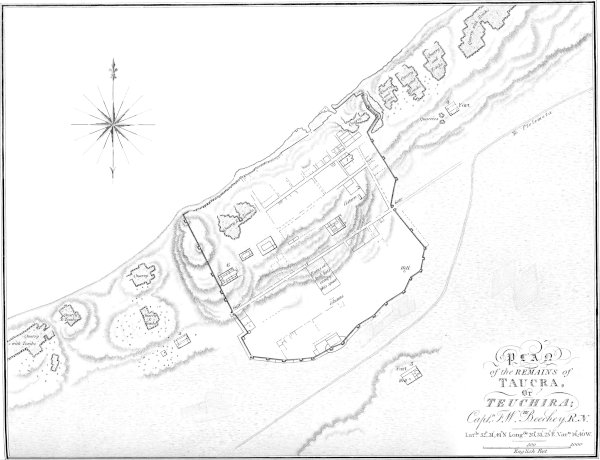
Plan of the RUINS and ENVIRONS of PTOLEMETA, now called DOLMEITA. BY Captn. F. W. Beechey R.N. J. & C. Walker Sculpt. Published as the act directs, April 1827, by J. Murray, Albemarle St. London. (Large-size)
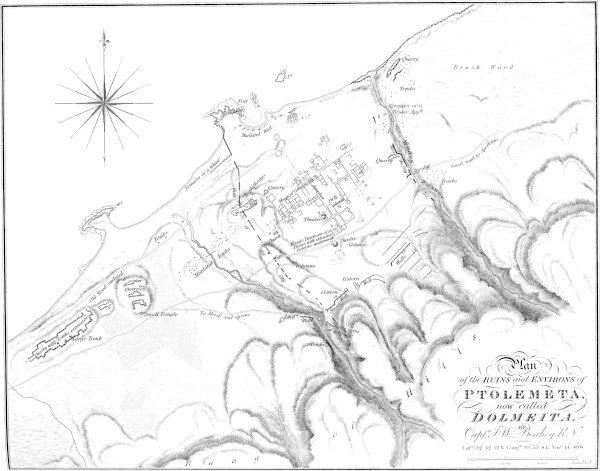
Engraved from a Drawing taken on the spot by H. Beechey. REMAINS OF AN ANCIENT BRIDGE AT PTOLEMETA. THROWN ACROSS THE BED OF A TORRENT. Published March 1827, by John Murray, London.
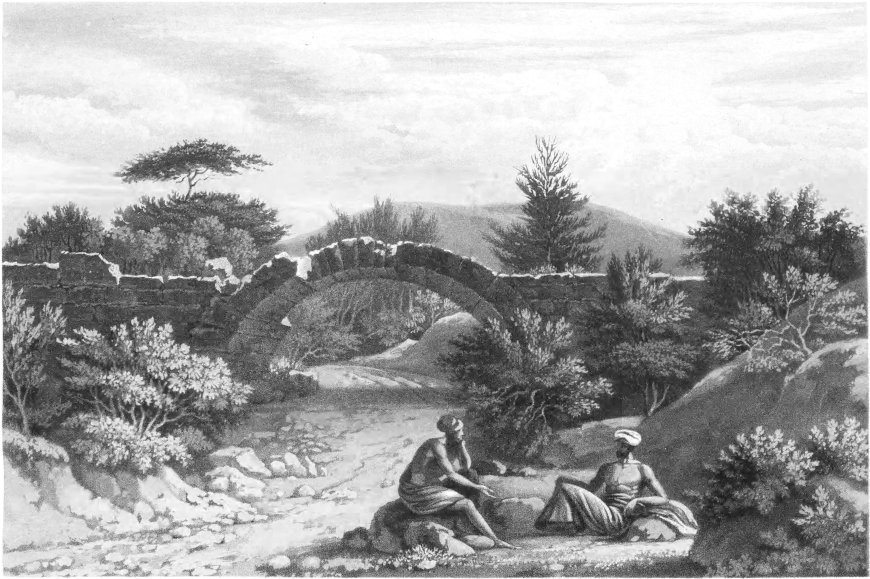
Engraved from a Drawing taken on the spot by H. Beechey. REMAINS OF AN ANCIENT MAUSOLEUM AT PTOLEMETA. Published March 1827, by John Murray, London.
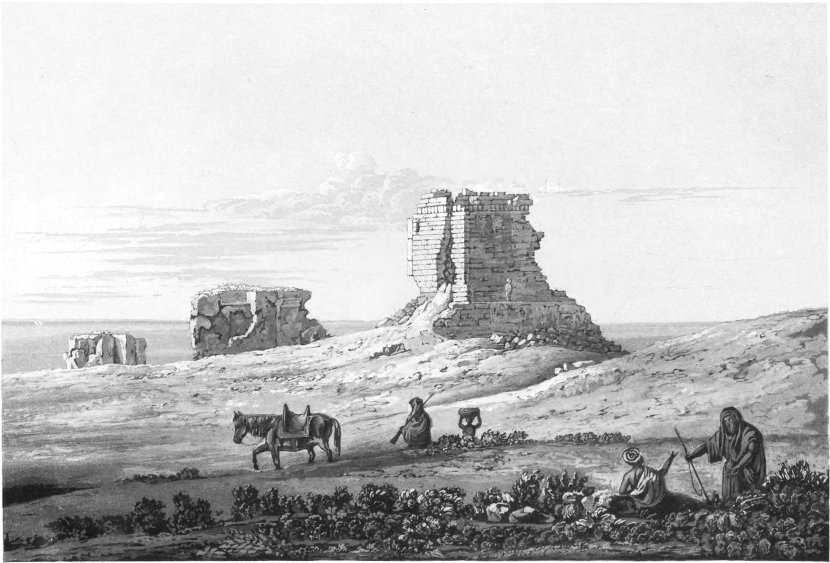
Drawn by H. Beechey. Engraved by E. Pinden. REMAINS OF AN IONIC BUILDING AT PTOLEMETA. Published March 1827, by John Murray, London.
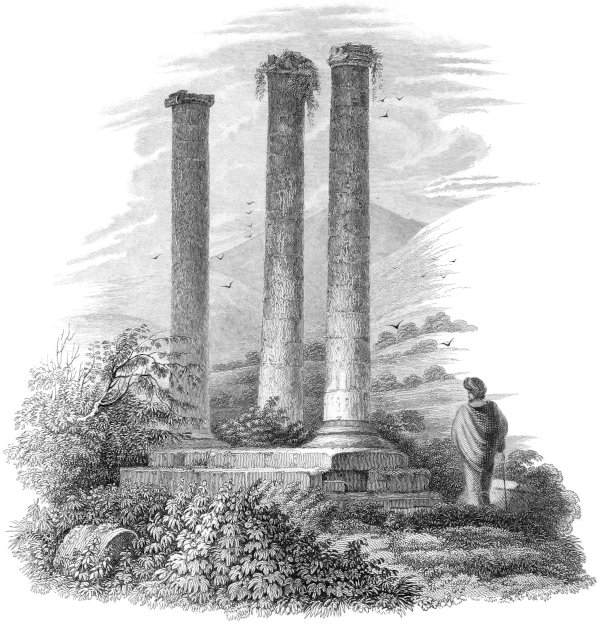
Engraved from a Drawing taken on the spot by H. Beechey. REMAINS OF A CHRISTIAN CHURCH AT PTOLEMETA. Published March 1827, by John Murray, London.