JOURNAL. RECEIVED ORDERS TO PROCEED TO KANDAHAR. (continued 2)
Reading edition
April 19th.
—The next morning I was reinforced by some of the 7th Fusiliers, my own escort with my baggage coming in at the same time. I had been 48 hours without anything but the clothes I stood in, and I must say I really felt very little inconvenience from the want of my luxuries. The ground does not make half a bad bed, especially if one has been riding in a hot sun for 12 or 14 hours, and as to eating and drinking there is no sauce like hunger and thirst, and under such circumstances it is wonderful how extremely nice, things, that really are very nasty, seem. I have discovered that a saddle is a first-class pillow, and that with it and a couple of blankets and a fairly soft piece of ground, a most excellent bed is quite possible. The truth was, I was really done when evening came, and any place where one could stretch oneself was delightful. On the afternoon of the 19th I rode back to Dubbrai to try to telegraph to Kandahar, taking a telegraph signaller with his instrument with me. The enemy had again (after all my trouble of the previous day) cut the wire, and we had a lot more work to do so very unwillingly, as it was getting dark, and I had only 2 native cavalry soldiers with me and no officer, I was obliged to start back to Gatai without succeeding in sending my telegram. It was rather a risky ride back in the dark (I did not get back into camp till near 9 o'clock), but I kept a good look out, and always took care to be going rather hard in any confined place where the enemy could have concealed themselves. We saw not a soul, except on one occasion in an open piece of ground, I thought I made out 4 or 5 fellows about a quarter of a mile off, who, the very instant they saw I was coming towards them with my 2 soldiers, bolted, and I thought, under the circumstances, that I had no business to go skying after them, so pursued my road quietly without an accident or incident of any kind.
April 20th.
—This morning the wire was restored, and General Primrose telegraphed to me that it was not thought necessary to keep troops, as I suggested, at Gatai and thereabouts, and that he wanted me at Kandahar. I then thought this wrong, and still think so, and the events of the last few days have amply supported my views. However, I had nothing to do but to obey, which I did, stating, however, my views of the position very plainly in my report. The 7th Fusiliers (Head Quarters) joined me this morning full of indignation because one of their native servants, who had strayed away from the road, had been attacked by Afghans and most seriously wounded. They had sent a couple of cavalry soldiers out, who had evidently seized the first two Afghans they had met and declared them to be the culprits. There was a great demand for immediate
justice?
and I fancy the lives of the 2 poor wretches would not have been worth much had I not been in camp and positively prohibited anything but an enquiry, leaving the punishment of the men to the Civil authorities. I was the more determined on this point, as the evidence against them seemed to me to be very weak.
|
March to Mel Kharez.
|
I marched for Mel Kharez at 4 o'clock with my usual escort and party, and stopping to dine at Dubbrai, arrived at the end of our journey (the distance is 21 miles) about half-past 11. The last 2 hours we had a bright moon and clear cold air, and the ride was very enjoyable.
Wednesday, 21st April.
—Mel Kharez has a Fort like the other places, and it was also looted, but no English officer being there, the native Commissariat Establishment had very wisely bolted to safety, and so no one was killed. I should say that this station was, of course, more favorably situated than Dubbrai, as it was within 12 miles of a military post of ours, while Dubbrai was at least 25 miles away from any help. I forgot to mention an amusing little incident at Gatai. There also the Commissariat agent, a Parsee, had run away when the place was attacked. When he returned and came to me to report his arrival, I said to him in chaff, "oh, you are the gentleman who ran away!" to which he replied quite as if he was much pleased with himself, "yes, sir, I ran away, and thereby I have saved my life," which was certainly true. At Gatai I had much trouble in getting water, the neighbouring chiefs having cut off the stream which supplied the Fort. After exhausting all gentle means to bring them to reason, I tried the
moral
force of some cavalry who I sent with orders to bring the chief man before me. The officer did his work capitally, bringing back a leading native chief, whose seizure had the best effect, as the water flowed into our camp sharp enough as soon as they knew I had their head man in my power. I kept my friend as a kind of a state prisoner till the next morning, when, with the usual formalities of Eastern life, I gave him an interview. He was a singularly handsome fine old man, with (like all true Afghans) a very Jewish type of countenance and a good manner. He was humble enough, and tried to make all sorts of excuses, none of which I informed him I thought at all good, but as the water had been turned on, and he had apologised for the delay, I dismissed him with a warning for the future. Several of the other chiefs came in to make their salaam to me, and to promise all sorts of things for the future. An Afghan is, however, so natural a liar that no one thinks of believing them, and among themselves they are never weak enough to put any trust one in the other, and in this they are quite wise, as a more treacherous lying set of beings do not, I suppose, exist on the face of the
|
March to Abdool Rahmon.
|
world. We marched from Mel Kharez at 2 p.m., a beautiful afternoon, to Abdool Rahmon, which is 12½ miles off. The road lay through an undulating valley, on the edges of which there were some signs of cultivation. Four miles from Mel Kharez is a range of hills called the Ghlo Kotal, at which we had hoped and expected the enemy would have made a stand, but they had bolted on the first sign of our troops approaching. After crossing the Kotal we descended into the Takt-i-Pul plain, and reached Abdool Rahmon about 6 o'clock. There is the usual Fort at this place, and it is well and sufficiently garrisoned, and its defences are quite good enough for the requirements. Abdool Rahmon is 26 miles from Kandahar, so I determined I would ride in there ahead of my party next morning, leaving them with the baggage to do the distance in the usual 2 marches. I got the native chief of the place, a certain Gholām Jan, to lend me a trotting camel on which to send my bag and bedding into Kandahar, and arranged to ride Rufus the first stage and a cavalry horse the last one into Kandahar. An order from Kandahar prohibits officers attempting to go alone, so I took an escort of a non-commissioned officer and 4 cavalry soldiers with me, the escort being relieved at the next stage.
Thursday, 22nd April.
—Left Abdool Rahmon at 6.30 a.m., with an escort of 5 sowars (native cavalry), and cantered to Mandi Hissar, the next and last stage on the road to Kandahar. The country is a dead plain, with some little cultivation, and intersected by watercourses. There are numerous fortified villages dotted about, from which the passers by are very often fired upon. At Mandi Hissar I was to change my horse for a trooper from the cavalry detachment there, and also to relieve my escort. While the horse and escort were being prepared I had a talk with the old Soubadar (native captain) commanding the detachment of the 19th Native infantry quartered there, who, with all his men, were most anxious to hear all I could tell them about Major Waudby, who was beloved by all in the regiment. The old Soubadar told me that they all knew what a
big heart
(
i.e.
, how brave) he had, and he added "if we can only meet the Afghan scoundrels, we will avenge Waudby Sahib's death right well;" and so I feel sure they will. To show the feeling of this regiment I may mention that when the news of Major Waudby's death was received, a detachment of 150 men were ordered to march at once to join me. The men were told off in the usual manner, but when the detachment paraded it was found that 170 were present, 20 men having fallen in in the hopes that they would not be discovered, and would succeed in getting to the front. After leaving Mandi Hissar, the country is the usual stony, dusty desert for 3 or 4 miles, when a low range of hills are crossed,
|
First glimpse of Kandahar.
|
and the road descends into the valley in which Kandahar lies, which was green with corn fields and orchards, and was the pleasantest sight I had seen since I left Bombay. In the distance the grey mud walls of the city of Kandahar were visible, but making no imposing appearance, and differing really in no way from the villages we had passed, except the extent was greater, and that in many places the line of the walls was hidden by the orchards which lie all round the city. Unlike most Mahomedan cities, no domes or minarets of mosques were visible, and I believe there is in the whole place but one mosque of any importance, and it would be hardly noticed in any Mahomedan town in India. Passing round the wall of the city I was conducted by an orderly who had been sent out to meet me to the charming house in which General Primrose and his staff live, where I found a very friendly welcome, and a very good breakfast ready for me. Including a quarter of an hour's halt at Mandi Hissar, I had accomplished my ride of 25 miles in 3½ hours, which was sufficiently fast, as I did not want to over-ride my horses. The house occupied by the General is a regular native building, composed of small and oddly shaped rooms, very thick walls, and a flat roof. Many of the rooms are highly ornamented with painting and gilding, and it is a quaint and cool place to live in, especially as it stands in a delightful garden full of roses, mulberries, peach, pear, plum trees, and vines, through which flow narrow canals of water with a rapid stream, and forms altogether a most delightfully quiet and refreshing sight after the wretched deserts we had been passing through. In this garden, but in another house, also lives the chief political officer, Colonel St. John, and his assistant. The garden has a wall 12 feet high round it, and the entrances are guarded by English native troops, as it is, of course, important to avoid any risks to the chief military officer. Outside the garden lie the very regiments of the force, for the greater number of whom a certain degree of shelter from the sun is provided in the shape of mud huts or buildings of Afghan pattern. Some of the regiments are quartered in regular Afghan villages, out of which the inhabitants have been turned, but some of the buildings now occupied by troops are actually those which we built ourselves for our men when we occupied Kandahar in 1839, and which were found in fairly good condition when we returned here
|
Description of quarters.
|
forty years later, in 1879. Quarters of a not very luxurious description are provided for the officers, that is to say, they are given a room without doors or windows, and with a mud floor, and any improvements they wish to make they are required to do themselves. There is, of course, no furniture, and any luxuries one wants in that way we have to get for ourselves. The room I have got is at one end of a long low line of mud huts, the whole of which, except the 4 rooms at one end, which are allotted to me and my staff, and the four rooms at the other end which will be given to General Burrows and his staff, are occupied by artillery officers. My set of quarters are in this shape,
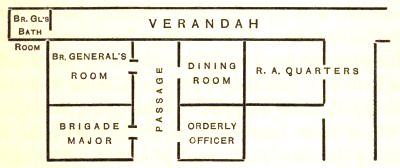
so I have one room to sleep, sit, and write in, and a room where we dine and breakfast, and which is, of course, public property. I have, as a special indulgence, a bath-room all to myself, but no one else has one. The room when I came into it was horrid; the floor was six inches deep in dust; there were no doors or windows, and altogether it was most unpromising. I have, however, had a floor made for it, the passage and dining-room, of a wonderful kind of stuff like Plaster of Paris which abounds here, and which hardens in the most wonderful way. I have had windows put in, and hope to have a door soon; and having bought a few pieces of a rough native carpeting in the city, and a couple of tables and chairs, my room begins to look very fair indeed. The mud walls are appropriately covered with yards of maps, which look very business-like, and in the small recesses I have had a few wooden shelves put up which quite do to hold my very scanty wardrobe. I find my room very hot and close at night, so I have pitched my little tent outside my door and sleep in it, watched over by a sentry whose sole duty is to guard his sleeping General, who can, therefore, slumber in the most perfect security. It would be rather monotonous to live with my Brigade Major and orderly officer only, as I am afraid we should get very tired of each other during the hot weather, so I am trying to get up a sort of mess between General Burrows and me, taking in our staff, and a couple of outsiders who have no special place to go to—viz., our Chaplain, Mr. Cane, and the Judge Advocate, Colonel Beville. The latter has agreed to manage the affair, so I have nothing to do with housekeeping, which is a blessing, and as Colonel Beville quite understands management and likes good things, I hope the affair will be a success, and that General Burrows will agree to join. The parson begged me to take him in, and I did not like to refuse, though I cannot say I care much about him (though perhaps he will improve on acquaintance), as he has the reputation of being rather inclined to quarrel and be difficult to manage. We will hope he is maligned and will prove not to have so unclerical a failing. A mess on service is a very rough affair, as we have no plate, crockery or linen, and live what is called camp fashion, that is, all the mess provides is tables and food, and each person's servant brings his plates, knives, forks, and spoons, and chairs, and when dinner or breakfast is over removes them. We shall, I daresay, in time get a few luxuries such as chairs, dishes, and perhaps a few table-cloths (I have 2 of my own for great occasions), and we have already made our dining-room look fairly comfortable (I am writing on 4th May), by putting down some carpets, and I have no doubt between Colonel Beville and me that we will get rid of as much unnecessary |Annoyances from flies and sand-flies.| roughness as we can. The great drawback of the whole place is the flies, which are most exasperating and pertinaceous. I am preparing a complete set of fortifications against them for my own room, by having net (which I have been fortunate to get in the city), such as musquito curtains are made of, nailed over the windows, and a door covered with net for the one entrance, so that I hope in time to be fairly free from them. They retire for the night, I am glad to say, about 7 o'clock, but as soon as they leave the sand-flies begin, and I think they are almost as bad, as they buzz and bite just like musquitos. They are a kind of very small gnat, and their bite is most irritating to some people, but they don't hurt me. The regiments are necessarily scattered over a large extent of ground, and the work is consequently very heavy on the men, as we have to post sentries very closely together to prevent the Afghans coming within our lines. The great proportion of the force is outside the city where I am living, but we hold the citadel, which is inside the city, where also we keep our arsenal and commissariat stores. A native infantry regiment and a detachment of a British infantry regiment hold the citadel, and the quarters occupied by both the officers and men there are much preferable to ours in the cantonments, as they are all regular native houses, many of which have gardens, and all some trees near and about them, and in this desert land a bit of green or a little shade have a value which no one who has not seen the country can understand. There is nothing striking about the actual city of Kandahar to anyone who has visited or seen an ordinary Indian town of the 5th or 6th rank. There are the usual bazaars with the occupants of the shops at work at their various trades in the front of their shops, and in many shops coarse English earthenware and cheap Birmingham and Manchester goods are exposed for sale, as is the case in even small villages in India. Raisins of all sorts and description, from the little sultanas up to dark purple ones, are sold in quantities, and seem to be a regular portion of the food of the poorest people. So far I have seen nothing curious or unusual which I would be tempted to buy, but then we cannot here wander about and go into the shops and ransack them for curiosities, as the people have a nasty trick of watching till a person is busy looking at things in a shop, and then coming up quietly and stabbing one in the back. It is consequently necessary, when we go shopping, to go in parties of 2 or 3, or take an escort, so as to always have some one on the watch against treachery, and as long as one takes this precaution they are too cowardly to attack in the open. The people in the streets are very picturesque, and most of them fine handsome men. No women are ever seen except very old ones, and even they generally wear the Turkish yashmak or veil which covers |Kandaharis—the Charsoo.| them from head to foot. In the centre of the city the 4 main streets meet under a curious large-domed building, around which are shops, and which is always crowded with a very mixed gathering of villains of all sorts. This place is called the Charsoo (or four waters), and it was in it that Lieutenant Willis, of the artillery, was murdered in broad day light by a Ghazi (N.B.—Next week I will explain who and what Ghazis are), who, however, was himself immediately killed. Any native attempting the life of any officer or soldier is now always hung in the Charsoo, which has had a very good effect.
Thursday, 22nd April, continued.
—The newspapers have had a good deal of late about Ghazis, both here and at Cabul, and I dare say it will be well to explain who and what they are, as even here people have an idea that every Afghan who fights against us is a Ghazi, and there is some reason for this idea, as the primary meaning of the Persian word is "a warrior." The Ghazis, however, with whom we have had to deal, are fanatical Mahomedans who bind themselves by vows to kill one or more of the infidels (that is of us), and thereby earn a positive certainty of going straight to heaven. So convinced are they that if they can only kill an infidel their future happiness is secured, that they are perfectly indifferent as to whether they lose their own life in the attempt or not, in fact I believe they rather desire to be killed, and so enter at once on all the delights of a Mahomedan Paradise, the principal charm of which is, that they are there to have as many wives as ever they like, all, we will hope, warranted free from vice or temper, and requiring no management, but living as a happy family, without any jealousy or inclination to scratch out each others' eyes, as I fear would be the case in a similar establishment on earth. It will be easily understood that a gentleman with these ideas in his head is a very awkward customer, as, caring absolutely nothing as to what happens to himself, he has a very great pull over the man he attacks, who is extremely unwilling to be either wounded or killed.
|
Murderous assaults by Ghazis.
|
Moreover, although the Ghazis are undoubtedly brave to fool-hardiness, they don't at all disdain stratagem or treachery, and much prefer to stab their first victim quietly in the back, as the more men they kill before they are themselves killed, by so much the more is their position in Paradise improved. They, however (that is the real Ghazis), never use fire-arms, only swords or long Afghan knives, and always try for a personal hand-to-hand encounter. There have been many cases of attacks by Ghazis here, and though in every case the Ghazi was immediately himself killed, nothing seemed to stop the practice. There has, however, been no attempt of the kind for a month, but of course none of the necessary precautions are relaxed. The last case was that of a lad, who was a sworn Ghazi, attacking an officer with no other weapon than a shoemaker's awl, with which, however, he inflicted a couple of disagreeable wounds in the back before he was seen and seized. On Christmas day 5 men walked out of the city, and came into the barracks of the 59th, and (in open day) produced long knives from under their clothes, called out that they were Ghazis, and had come to kill anyone they could get at. Of course they were shot down, but so wild was the shooting that 4 of the men of the regiment were killed by the bullets from their comrades' rifles! The incident, however, shows what plucky fellows they are, as of course when they entered the barracks of the 59th, and openly declared their purpose, they must have known their lives were forfeited. In consequence of the number of Ghazis here, and the generally hostile feelings of the people to us, we are all required to go armed at all times, even when riding out or walking for exercise. It is a great worry, and I hate it, being a little sceptical as to the necessity for the extreme measure of precaution required, and am disposed to think a neat little bludgeon of a walking stick I possess would prove a much more serviceable defence to me than my regulation sword. Everyone carries loaded revolvers, especially when in the city, and I dare say the fact that we all do so being known, prevents many attempted attacks being made. The soldiers have to carry their rifles, and when they go into the town have to fix their bayonets, and altogether we live in a regular state of siege, which I would myself like to see ended by the application of some good strong remedies, and immediate and severe punishment for murderous attacks. Still, even then I fear we could not hope to change the nature of an Afghan, who is born a treacherous, lying, murdering scoundrel. Strong words, I know, but nothing more than they deserve, as even their admirers can say nothing in favor of their moral qualities.
Friday, 23rd April.
—Being, for the present, the next senior officer to General Primrose, I exercise the command of all the troops at Kandahar, and all local arrangements and details are in my hands, as General Primrose commands the whole force, the senior officer at each place having the local command. When General Burrows arrives the command here devolves, by virtue of his seniority, on him, and I fall back on my brigade command, which I hold now in conjunction with the large command. The troops here form a nice little force, and consist of—
3Batteries of artillery.
2Native cavalry regiments.
2British infantry regiments.
3Native infantry regiments.
And sappers and miners.
And though the command entails plenty of work and responsibility, I like it, and wish I could keep it while I am here. The first thing, of course, was to ascertain the positions held by various regiments, their weak points, &c., and so I spent the afternoon in riding round and making myself acquainted with everything as far as I could, so that in case of a row at night, I should be ready to decide on what might be necessary to do. I moved into my quarters in the cantonments, and obtained permission for Capt. Law, of the artillery, to act as my Brigade-Major, as the officer who is to hold the appointment permanently has not yet arrived. Capt. Law is a smart good officer, and I am very glad to have him as my staff officer.
Force ordered into the Arghesan valley.
Saturday, 24th April.
—This afternoon I was greatly delighted to receive orders to hold in readiness a small force to proceed into the Arghesan valley, to disperse a considerable gathering of the enemy who were reported to be there. I was to go in command, so I had a double interest in the matter, and lost no time in seeing that everything was prepared, and that we should be fully supplied with all the necessary appliances for entrenching, road and bridge making, blowing up the enemy's forts, &c. We were not to start till Monday, and then only if the enemy did not agree to disperse and submit to the Governor of Kandahar, which they had been called on to do. I am sorry to say that hearing of our preparations they gave in at once, and eventually my little expedition was countermanded, which was a great disappointment to everyone. During the evening we had a little excitement, as an Afghan tried to steal and run away with the rifle of one of the native soldiers, which he had put down on the ground for a minute. The soldier gave the alarm, and 4 men of the nearest guard turned out and, after an exciting chase of about 3 miles, they came up within 400 yards of the thief, who immediately fired at them, but they returned his fire with good effect, and killed him at the 2nd shot, recovering the rifle and the remainder of the ammunition.
Sunday, 25th April.
—We had (as we have each Sunday) service for the troops in the open. The men are formed up on 3 sides of a square, and a pile of drums on the fourth side acts as reading desk and pulpit. Of course the men come with their rifles, and everyone is fully armed, ready for business at a moment's notice. There is a room in one of the barracks where evening service is held, but it is too small for the whole of the men in the morning, and there is also a temporary church in the citadel, where there is service morning and evening performed by a missionary.
Inspected quarters of various regiments.
April 26th to 30th.
—I was engaged morning and afternoon visiting all the regiments, camps and hospitals, and making myself thoroughly acquainted with the various positions, and carrying out such changes and alterations as seemed to me necessary, first, for the safety of the place, and next for the comfort of the men. I also managed to take a few gallops out along the main roads which lead to Herat and Ghuzni, so as to have some idea of the country, in case of necessity. I hope shortly to know every inch of the country for 10 or 15 miles round, but this will take a little time. I am required by General Primrose never to move about with less than 2 native cavalry soldiers, and of course if I go more than 4 or 5 miles from camp I would take 4. Sometimes I take my Brigade-Major or Orderly Officer, or both, but I like best wandering about alone, as then I feel more independent (that is without any other officer). Frequently, however, parties of 6 or 7 officers are got up, and we have a scamper across country, earnestly hoping we may meet some one who would like to try conclusions with us.
Saturday, May 1.
—Received letters from home, dated 1st April, a most welcome arrival and a great pleasure. People who get letters every day in the week cannot understand what the pleasure of getting letters is when you can only hear once a week, and then only provided the Afghans have been behaving themselves along the road.
Sunday, May 2.
—I had just settled myself down to a quiet day after service and breakfast when a report was brought to me that there had been a row in the city between the Afghans and some soldiers of the Artillery, and that 2 soldiers had been shot and one wounded. There was a good deal of excitement, as every one at once made up their minds that it was the beginning of an organized attack. The accounts which I succeeded in getting out of the soldiers who had rushed up out of the city were most conflicting, excepting in one remarkable point on which all agreed, and that was that only
one
shot had been heard, although it was acknowledged that one of our men fired off his carbine down the street. This was curious, and made me doubtful about the whole affair, so I sent the Brigade-Major off to the city at once to discover the facts for me, and went over to General Primrose, who sent the Political Officer also into the city to make enquiries, and eventually we ascertained, almost without a doubt, that the men had been killed by the accidental discharge of a carbine by one of their comrades who had been fiddling with his loaded carbine, which had gone off, and the bullet passing through 2 men killed them instantaneously. Since then the man has confessed and explained the whole matter, and there is now no doubt that there was no shot fired by the Afghans at all. The affair caused some excitement, and might have led to very serious results.
Inspections—Ride into Argandab River valley.
May 3rd, 4th, & 5th.
—More inspections and visits to the troops morning and evening which fully occupied my time.
May 6.
—A party of officers, among whom was William French, accompanied me to visit the valley of the Argandab River, which lies N.E. and N.W., and about 4 miles from Kandahar. To get to this valley a range of hills rising to 4,500 feet (that is 1,000 feet higher than our camp) has to be crossed, there being only 2 practicable passes, and these very rough, steep, and bad. The change from the dusty stone plain round Kandahar to the valley, which lies on the other side of these hills, is extraordinary, as nothing can be more wretched than the one and nothing more charming than the other. The whole valley is a series of fields of the most magnificent crops of wheat and barley, meadows full of clover, and orchards of every imaginable description of fruit. (To be continued).
May 6th.
—It would not be possible to give an idea of the luxuriance of the crops and the extraordinary abundance and variety of the fruits in the Argandab valley. Every field has rows of mulberry trees round, which were covered with fruit, of which the passers by (we among them) eat apparently as much as they like without payment. The other fruits were not ripe, but the apricots were just beginning to get soft, as were the plums, especially one very like the greengage in appearance and taste. Besides these there were vines everywhere, climbing over the walls and up the mulberry and other trees, all covered with a magnificent promise of grapes. There were also in abundance—peaches, nectarines, figs, pears, apples, quinces, and pomegranates, the latter being only in flower, but in that way adding greatly to the general appearance of the orchards, as they bear a very dark red flower which is most effective among the dark green of their leaves. Each field or orchard has a rapidly flowing stream of clear cool water running through it, which is the cause of the extreme luxuriance of everything, and very grateful to us who have been so long in a very "dry and thirsty land." (The remarkable fitness of these Bible descriptions are very clearly seen in these eastern lands). After halting in a mulberry grove resting our horses and having a good feed of mulberries, we struck out across country to get home, and had a delicious ride along the banks of a big canal shaded with trees, and felt very sorry when we emerged once again into the dust and glare of Kandahar. The apricots are now (May 12th) just being brought into the market, and we buy them (paying, no doubt, an extravagant price) for 1½d. for 2lbs.!! The difficulty is to avoid eating too many. Peaches, plums, and figs, will follow, and we shall, I believe, have grapes in June. The people are now cutting their corn which is rapidly ripening, which we are sorry for, as we shall miss the beautiful green they now are, and have only fields of yellow stubble. The primitive reaping hook, almost exactly similar to that used at home, is in use here, and the Afghan spade is almost similar to our shovel in shape, with the exception that on the
handle
of the shovel a cross piece of wood is fixed as a foot piece for the digger. I am told, but this I can hardly believe, that from the same root of wheat, barley, and oats (that is from one sowing), they get in this country 2 distinct crops, and certainly they appear systematically to cut down the first crop when it is green, but after it has eared, and in a few weeks afterwards a second crop is in ear without any fresh sowing.
Visit to old city of Kandahar.
May 7th.
—Rode out to visit the old city of Kandahar, which has been in ruins since 1737 when it was besieged by the Persian King, Nadir Shah, and after a long siege taken and destroyed. It is a curious sight to see it now, as the walls of the city and many of the fortifications, which must have been for those days very strong, still remain in wonderful preservation, as do the walls of the houses covering a considerable extent of ground, but not a living soul is to be seen, and the whole place is a picture of desolation and loneliness. After Nadir Shah had destroyed this city, he caused another one, also fortified, to be built about four miles off, but this also has been deserted, and is even more ruined than the older city. The present city of Kandahar is the third which has been built within the last 150 years.
May 8th.
—I made an excursion to one of the Passes over the hills near this, but the distance was longer than I had calculated on, and as it was getting dark I had to turn home without accomplishing my object.
May 9th.
—I started for a ride at half-past 5 p.m., accompanied by my usual escort of 2 native cavalry soldiers, and proposed to myself to ride to a place called Kokeran, about 7 miles off. When I got out about two miles on the road I saw that there were threatenings of a dust-storm from that direction, and, not caring to ride for pleasure into a cloud of dust, I turned off to the left and took a canter for 3 or 4 miles through the fields, coming out eventually on the Kokeran road, about 4 miles from our camp. The weather had cleared then, and I thought I might still have time to explore a little way along this road, but on looking at my watch I found it was 7 o'clock, and that (as there is no twilight here) it would be quite dark before I could get home, so I turned round and cantered back to camp. Just as I got close to the camp of the 19th Native Infantry, I saw a party of officers and 2 cavalry soldiers going along very slowly in front of me, and on riding up to them and enquiring what was the matter, I found that they, while returning along the Kokeran road from
|
Officers fired at by Afghans near Kokeran.
|
a ride, had been fired on by a party of Afghans concealed behind a wall, and that one officer (Captain Garrett) and one Sowar were badly wounded. Captain Garrett was nearly fainting and falling off his horse, as he had to ride about 5 miles after being wounded, so I got him off on to the ground, and supported him till a doctor and a litter to carry him in was brought, and at the same time sent off one of the officers to report the occurrence to General Primrose. The attack had taken place about a mile nearer to Kokeran than the spot at which I had come out on the road, so, had I been half an hour or even less earlier arriving there, I should certainly have gone down the road, and had a chance of a scrimmage on my own account, and had I carried out my original intention I should have got to the spot where the ambuscade was before the other party, or possibly just about the same time, which would have been more convenient altogether. My first inclination when I heard the account was to gallop back to the place with my own 2 Sowars and the one unwounded man of the party which had been attacked, but on reflection for an instant I felt this would not be correct, first, because I was bound to take General Primrose's orders, next because the chances were, that long before I could get back the 5 miles the attacking party would have run away, and lastly that it would certainly be considered not the place of a General to be scampering with 3 men over the country, like a cavalry subaltern, and so I galloped off to General Primrose in the hopes he would give me the cavalry Brigade and let me go off to scour the whole country. At first he was very well inclined to do this, but eventually less forward councils prevailed and a hundred
good?
reasons were discovered for doing nothing till morning. On further enquiring from the officers who were fired at, we found that they had been out to Kokeran, and were riding quietly back, the three officers abreast and the 2 Sowars behind, when suddenly a volley was fired at them, and thinking there was a large body of men concealed, they galloped off. As it turned out there were only 10 or 12 men, and after seeing the ground as I did next morning, I had no difficulty in coming to the conclusion that they might, with good effect, have halted some 2 or 300 yards off, and returned the fire with good success.
May 10.
—I went out very early with some cavalry and the Political Officer, and scoured the country round, but of course found no traces of the party who had fired on the officers, and all the surrounding villages absolutely denied any complicity in the affair, so we had to return to camp, having been unable to accomplish anything. In the afternoon I went out again with an escort of cavalry, and accompanied by 5 or 6 officers, and we went to Kokeran and hunted the hills all round, but saw no one. No doubt we threw away our only chance in deferring till to-day what ought to have been done yesterday.
Installation of Shere Ali Khan as Wāli.
May 11th.
—I attended a great durbar (or court) at the palace of the Governor, in the city, at which the letter appointing Shere Ali Khan, Governor of the Province of Kandahar, on behalf of the Queen, was to be read. Although it was very like what all such affairs in India are, it was quite worth seeing, and I should have enjoyed it very much if I had not been obliged to eat and drink so many nasty things as Persian etiquette on such occasions absolutely requires one to swallow. The proceedings commenced with small cups of tea, without milk or cream, being handed round, then there were speeches and the presentation of the Viceroy's letter, and of the presents sent by the Queen, and the affair wound up by trays of Afghan sweet-meats and iced sherbet being brought in, of which all, even the soldiers on the guard of honor, were required to partake. Iced sherbet sounds nice, but when it is flavoured with musk, it is apt (at least as far as I am concerned) to act very like an emetic. The sweet-meats I dare say I should have appreciated better about 30 or 40 years ago, and my Orderly Officer certainly seemed to find them very much to his taste. I send a capital account of the whole affair which appeared in the
Kandahar News
, and which can be read by those curious in such matters at this point....
On the 13th of May
the new Governor, or as he is called here, the Wāli, which is the Persian word for
Governor
of a province, announced his intention of coming to pay a return visit of ceremony to General Primrose, and as Government wished us to show him all possible honor we had the whole garrison out (about 5,000 men) and lined the streets of the town and the roads between his palace and General Primrose's house. The troops turned out wonderfully well and smartly, and we hear the Governor and his people were much impressed by their appearance. After seeing all right along the line of the procession I returned to General Primrose's house, where all the staff were collected to assist General Primrose in receiving his guest. The Wāli (or Governor) arrived about ¼ to 6 o'clock, accompanied by a very ragged looking lot of followers. He sat between General Primrose and me, and we had to carry on the usual uninteresting exchange of compliments through an interpreter, as none of us could speak Persian, and none of the Afghans could speak Hindustani. After a short time tea was handed round, and to our relief the visit, which was necessarily a very stupid affair, ended. According to Eastern etiquette, the Governor ought to have brought return presents with him, and each of us who were there should have had some present, but our Government do not allow us to accept anything of value, so nothing was offered. Since then, however, the Governor has sent us each, as a memento of the occasion, one of the new gold coins which he has struck for general issue. It is rather a pretty coin, of quite pure gold, and will do very well as an ornament for a watch chain.
Ride to an old gold mine—now deserted.
May 14th to 19th.
—Nothing of any interest occurred, except that I daily take long rides and increase my knowledge of the country, nearly every yard of which, for 10 or 12 miles round, I have now ridden over. To the north and east of Kandahar there are very pleasant rides indeed, through green fields and shady lanes, along watercourses, but on the other two sides it is all sandy and stony deserts, with high rocky hills, which only a sense of duty has induced me to visit at all. Among other places I have been to is a gold mine which has been worked for centuries, and is situated about 5 miles from Kandahar. It is now, however, deserted, as the upper earth fell in two or three years ago, and has choked up the place where they say the vein of gold was. The new Governor of Kandahar is most anxious to re-open the works, but despite the wonderful stories of the richness of the mine which the natives tell, he has not been able to get much encouragement out of our professional Geologist, who, after a careful examination, has come to the conclusion that the mine will never again pay its working expenses. The morning I rode over to see the place I found the Wāli (governor) down in the bottom of the mine, with half a dozen natives, carefully examining the place and collecting specimens, &c. He had evidently come out to have a quiet look at his new property, and did not seem particularly pleased at being caught, although he was very friendly and civil, of course. In my wanderings through the country I never fail to investigate the quality of the fruit, and have made a discovery, in two places, of a very superior kind of mulberry, of which there appears to be only half a dozen trees in the whole valley. They are so different from the common kinds that the natives call them Shah-toot, which means, the King mulberry, and the trees they grow on are considered quite curiosities. It certainly is a very delicious fruit, and I have only revealed my discoveries to a chosen few. I am a much earlier riser than most of my friends, and therefore seldom or never have any companion in my morning rides, except the two native cavalry soldiers who are my escort. I generally start when I have no parades or inspections, about half-past five in the morning, when the air is deliciously cool, and seldom get home till 9 o'clock, by which time the sun is very hot. The country is intersected with water channels for irrigation purposes, and mud walls divide the fields of corn and wheat, so there is lots of jumping, and some of the obstacles are very awkward. The orchards and vineyards are surrounded with very high walls, but there is also lots of fruit of all kinds growing along the paths which anyone may eat. In this country, from one end of it to another, there is no such thing as what we would call a road, as there being not a single wheeled vehicle in the whole length and breadth of the land, roads are not at all necessary. Everything is carried on camels, ponies, bullocks and donkeys, a regular stream of which flow into Kandahar every morning, loaded with fruit, grain and grass. The people here must be making fortunes, and certainly ought to like us, as we pay anything they ask for everything, and the prices, though not very exorbitant, are at least double what
|
Dust-storms of almost daily occurrence.
|
they used to be. It is getting very hot now in the day-time, and we have constant dust-storms, which are, of all things, the most horrid and the greatest trial to one's temper. Imagine the delights of an immense cloud of dust a mile square, or more, driven along by a red hot wind, and forcing its way into every hole and corner. While it is passing it is quite dark, even in mid-day, and when it is gone everything one possesses, every table, chair and book is covered with an inch of dust, and one's hair and beard turned into a whitey brown color, and stiff with dirt. Here we sometimes have a dust-storm which is continuous for an hour, but generally they come up in regular succession, each lasting 3 or 4 minutes, and a shorter or longer interval between each. Towards 8 o'clock in the evening the wind goes down and it becomes quite cool, and we generally have our dinner table placed outside our quarters, and so brilliant has the moon been, that for the last four days we have dined quite comfortably by the light of it without any candles or lamps at all. Our mess now consists of General Burrows and his Brigade-Major, Captain Heath; General Brooke, his Brigade-Major, Captain Leckie, and his Orderly Officer, Lieut. Fox; Colonel Beville, Deputy Judge Advocate, who manages the mess for us, Captain Harris, the Deputy Assistant Quarter Master General, and Mr. Cane, the Chaplain. The mess is managed on what is called the "camp fashion" principles—that is, every one has to provide their own plates, cups, knives, forks, and spoons, and chair; then wine, beer, and tea at breakfast are supplied by each person for himself, according to his own taste, the mess merely providing the eatables. It is a very good plan, as then no large supplies of crockery, glass, stores, or wine are necessary, and each one is able at a moment's notice to go off on a march, with all his things complete, without interfering with the comfort of the remainder of the party.
Cases of Ghaziism—Ghazis killed.
May 20th.
—A Ghazi attempted to kill a soldier of the 66th Foot to-day, but only succeeded in wounding him, and was himself instantly killed by the soldiers who happened to be near, who bayonetted him promptly. It seems that the man who was wounded was walking with a comrade down one of the streets of Kandahar, looking at the things in the shops, when an Afghan armed with a bayonet rushed out of a side street, shouted out he was a Ghazi, and made straight at the two men, and succeeded in inflicting two wounds (not serious) on the man nearest to him before his comrade fully realized what was happening, when he immediately bayonetted the Ghazi. When I first arrived here the men used to go into the city with loose ammunition, and often, I make no doubt, with loaded rifles, and when attacked by Ghazis used to fire wildly and, as a rule, missed the Ghazi, and killed unoffending passers by. I took the loose ammunition from them (leaving them, of course, ammunition in the usual bundles in their pouches), and told them in such cases to use their bayonets first, and then, if pressed, they might open ammunition and use it. The change was not altogether liked, but this affair (the first in which a Ghazi has had prompt justice meted to him) has satisfactorily proved the propriety of the arrangement.
May 21st to 25th.
—Nothing new has occurred. We had lots of dust-storms, but, alas, there is nothing new about them, as they come with a painful degree of regularity every afternoon.
May 26th.
—There was another attempt by a Ghazi to day to earn martyrdom, but this time it was one of the Hindustani camp followers who was attacked. He, however, had a sort of sickle in his hand, with which he was cutting some grass, and when attacked by the Ghazi, who had a sword, he returned the compliment so smartly that the capture of the Ghazi by a couple of native soldiers who came up at the moment was very easy. He was brought in a prisoner, and when his case was being investigated, and he was asked for his defence, he said simply "that he was a Ghazi, that he had sold his cow to buy a sword, and he was very sorry he had not killed the infidel." He was handed over to the Provost Marshal for immediate execution, and he accepted his fate with the most perfect coolness and indifference.
May 26th, 27th, and 28th.
—Nothing of interest occurred.
May 29th.
—We had a great parade for the Queen's birthday, all the troops at Kandahar being on the ground, making a very effective show, as we had
Three Batteries of Artillery, Three Regiments of Cavalry, Five Regiments of Infantry,
and the line was of good extent. General Primrose commanded the parade, and General Burrows and I |Feu de joie—"Akhbar" admired.| had each our own Brigades. One of the performances on the Queen's birthday parade is firing a feu de joie with blank ammunition, when the fire is run down the whole of the front rank, and then back up the rear rank, and this is done three times, and is, as may be imagined, most trying to horses, especially those who have to stand with their backs to the line as those of the Generals and Staff have to do on this occasion. Prudence suggested to me to ride my old and tried charger Rufus, but vanity got the better of prudence, and being anxious to show off Akhbar, and also to make the best turn-out on my own account that I could, I made up my mind to ride the Arab, who is really a picture when got up for parade. He is young and inexperienced, and had never been on parade before, or never heard a shot fired, but Arabs very often don't mind anything of that kind, and I hoped for the best and thought it all right when he stood like a post while the Artillery were firing their salute. The feu de joie, and the consternation it produced among all the other horses, was too much for his nerves, and he gave me all I knew to sit on him, though I don't blame him a bit, as this particular kind of firing is most trying to all horses. On this occasion not one of them really stood it steadily, and General Burrows' horse was so objectionable as to succeed in throwing him, although he is a first-rate rider. I was, however, quite repaid for the little bother I had by the admiration Mr. Akhbar's appearance called forth as he went past the saluting flag at the head of the Brigade.
May 30th and 31st.
—Nothing new.
June 1st and 2nd.
—Do. do.
June 3rd.
—I had been for some time meditating an exploring trip up a valley which had not been previously visited, and about which I wanted to know something, but had put it off from day to day on account of the heat, as the distance made it necessary to be out all the forenoon. Tired, however, of the monotony of the previous week, I determined to carry out my intention and have an outing and a good ride. I made up a party, but at the last moment all, except Captain Law and Captain Slade of the Artillery, both of whom are enterprising fellows, and always ready for anything, cried off on one excuse or other, the real truth, however, being that they were too lazy and did not like the idea of a 35-mile ride. At the last moment a young subaltern of the Artillery asked me to let him go also, so we started a party of 4 officers and my 2 Native Cavalry soldiers. We took a feed for our horses and materials for a pic-nic breakfast with us, as we intended to halt for a couple of hours or so about 8 o'clock. We left our quarters at 4 a.m., and it was really quite chilly when we started, and continued so till ¼ past 6 o'clock, when the sun got up and quickly made himself felt. Our road lay through a narrow valley, with high hills on either side, and very stony rough going it was, as, in accordance with the customs of this country, there was nothing that one could call a road or even a pathway, and consequently we had to go slowly except when now and then we got out on a bit of grassy ground where we could have a canter. We saw a good number of deer who seemed much astonished to see a white face, and moved away from us very leisurely, making us wish we had brought a gun or rifle with us. We thought of trying our pistols on them, but did not care to throw away our ammunition unnecessarily. We also saw, though at some little distance from us, the finest eagle I have ever seen. Indeed I have never seen such an enormous bird anywhere. Our destination was a fortified village called Mansurabad, which is about 15 miles in a straight line from Kandahar, but the turnings of the road added at least a couple of miles to that. We hit it off all right, and went all through it, the people seeming civil enough, but very anxious for us to move on. The most of the inhabitants were out in their fields cutting a most magnificent crop of barley, wheat, and oats, and they were evidently a well-to-do lot, as there were great flocks of cattle and sheep grazing all round, and the orchards were stocked with fruit
|
Into the Argandab river valley.
|
of all kinds. At this village we came on the Argandab River, from which the water, which turns the country along its banks and round Kandahar into a garden, is brought by a wonderful system of canals which carry it in all directions. These canals leave the river just below Mansurabad, and the way they are planned and engineered show great cleverness on the part of the people who made them many hundred years ago. Leaving Mansurabad behind, we struck down the valley of the Argandab, and set to work to find a good place for our halt for breakfast. This was not quite so easy to do, as we wanted such a lot of things. First and foremost, remembering the Prince Imperial's fate (though I don't
think
we had a Captain Carey in our party), we wanted a place which could not be approached suddenly by the wiley Afghan, and a place that if attacked we could have defended ourselves in. Then we wanted shade for ourselves and horses, and water at hand for the horses and for drinking and cooking. Eventually we got rather a good spot though we had to sacrifice shade somewhat to the other more material points. Having set our horses to work at their corn, we turned out the contents of our wallets (my campaigning saddle carries 2 side bags and a pair of holster wallets) and found we had the makings of a capital breakfast. My contribution was first and most important, a small kettle to boil water in, a tin of chocolate and milk, 2 tins of potted beef and ham, a loaf of bread, 6 hard-boiled eggs, salt, pepper, &c. Among the others there were more eggs and more bread, a Bologna sausage, and a heap of sandwiches. We soon collected some sticks and had a fire burning (I had brought matches and some old newspapers), and quickly had hot water ready and chocolate made, and made an excellent breakfast, finished off by a heap of apricots brought to us by a friendly Afghan. His idea of our powers of disposing of apricots was magnificent, as, after we and our two soldiers had eaten all we possibly could (and we did our best), we fed our horses on them, and still left a good pile behind us. In this part of the world apricots are in millions, and our friend brought us a
few for breakfast
in a sack thrown over his shoulder. The reason why apricots are cultivated up here is that there is great demand for them in India in a dried state, and tons of them are dried in the sun and sent down to India, and can be purchased in the smallest and most remote village in that country, and you (the children) used to eat them stewed very often when you were in India, and, if I don't mistake, liked them very much. They are often called in India
Alubokaras
, which, however, is not their proper name. We lounged about for a couple of hours, and then continued our ride down the Argandab Valley, and for ten miles rode along a charming rapidly flowing stream of clear water, well
|
Various fruits of Kandahar.
|
shaded on both sides by trees covered with apricots, plums, and mulberries, a most enjoyable ride, as, though the sun was hot, there was a very cool breeze, and the trees kept the great power of the sun from us. We saw many vineyards with a great promise of grapes, but none are ripe yet, and also lots of figs, apples, pears and pomegranates, all, however, some weeks from being eatable. The people we met, though not actually glad to see us, were not uncivil, and many of them offered us fruit as we rode along. No doubt our being well armed helped to make them civil. We got home at ¼ past 1 o'clock, having been 9¼ hours away, and having had a most enjoyable excursion. The distance was, I think, between 33 and 35 miles, and my old friend Rufus carried me like a bird, although with my saddle bags, big saddle and all, I am afraid I made up a good 15 stone for him to carry.
June 4th, 5th, 6th, 7th.
—Nothing important occurred on the 4th, but on each of the next three days there were attempts by Ghazis to kill some of our people. In the two first cases the men attacked were native servants, in the third case it was a soldier of the 66th. Both the natives were seriously wounded, but the soldier having some suspicions was on his guard, and escaped with a slight scratch, and bayonetted his assailant. The last idea the Ghazis have taken up, which is rather a mean one, is to send quite young boys to make the attack, as naturally people neither notice the approach of, nor try to avoid a small boy, and besides men hesitate to deal out summary justice, even in self defence, on a child. One boy who tried to stab one of our native servants is really quite a child, but as savage untamed a little viper as I ever saw. It is very hard to know how to deal with the young rascal, but I think a good whipping in a public place every other day for a month would be the best punishment. The first well authenticated account of a Ghazi that I know of will be found in the 3rd chapter of Judges, verses 14-22, as the motives and actions there described are exactly those of the Ghazis of to-day. However, this last device of sending children to do the work of men is so mean, that any little respect one might have for the motives which make men Ghazis is entirely destroyed.
Serious loss of warm clothing.
June 8th.
—Shortly after I left Bombay I found I should want some clothes I had left packed up, ready to follow, so I telegraphed to Alfred Christopher, and asked him to send my portmanteau to me, and I took all sorts of precautions by writing to the various transport officers along the road, and asking them to expedite its movements. It left Bombay on the 8th April, and exactly 2 months later it made its appearance here, so it had travelled very leisurely, and worse still, had been cut open and nearly everything in it abstracted. All the things I most wanted were stolen, and nothing was left except my Ulster and a few pair of old drawers. When the weather gets cold I shall be very glad to have the Ulster, of course, but the loss of a first-class pair of corduroy breeches and all my warm clothing is very tiresome. This misfortune, and the destruction of my things in the Bolan River leaves me rather short of clothes, and I shall not find it easy to keep up a very respectable appearance much longer.
June 9th, 10th, 11th.
—Nothing new. The heat is very much greater the last few days, and even the nights now begin to be hot.
June 11th to 18th.
—Nothing of any interest occurred, except that day by day the weather became hotter, and we lost our cool nights which had, up to this time, quite compensated for the heat of the days. A careful record of the heat during the month of June showed that the thermometer on one occasion rose in the shade to 124°, but that the average maximum for the month was 114°, and the average minimum 65°. Although the heat has, no doubt, been very great, it has not equalled in oppressiveness and debilitating effect the heat one gets at Cawnpore and Allahabad, and stations in the Punjab. Daily the grapes and fruit have been getting riper, and we have had a sort of compensation for the heat in the variety and goodness of the fruit. A great number of officers have been ailing more or less, the result, I am sure, of the sedentary lazy lives they lead. Great heat is, of course, enervating, and it takes some determination after a long hot night to start off for a good ride, and it is even worse in the evening. I am glad to say I have steadily stuck to my exercise, and have frequently, in the morning before breakfast, done 20 to 25 miles, and then 8 or 10 in the evening. Whatever has been the cause, I have certainly been wonderfully well, and, beyond the inconveniences of the heat, have not felt the slightest bad effects. I have now visited every inch of country within 12 to 15 miles of Kandahar, and know every part of it thoroughly.
March to Kelat-i-Ghilzi countermanded.
June 19th.
—It was decided to send the 30th Native Infantry to Kelat-i-Ghilzi to relieve the 29th N. I., and both regiments being in my Brigade, General Primrose allowed me to march up to Kelat-i-Ghilzi with one regiment and come back with the other, going up the Argandab Valley and returning by the valley of the Tarnak. As very little was known of the Argandab route, I was very glad to have the opportunity of seeing it and also visiting Kelat-i-Ghilzi. Captain Leckie, my Brigade Major, was to accompany me, and Major Leach, of the Engineers, on surveying duty, and Mr. Gordon, a Missionary who is here, also asked to join my party. The first there was no difficulty about, but the advisability of the latter going was more doubtful. However, as he wanted to make the trip only with the view to holding services, &c., for the English troops at Kelat-i-Ghilzi, he was allowed to come, and we all made our preparations for a start on the 25th, but between the 20th and that date the heat increased so greatly that it was considered unwise for us to move until a change in the weather set in, and so, to my great disgust, our trip was postponed.
25th, 26th, 27th, 28th.
—Heat very great.
29th.
—We got further, and apparently more certain information that Ayoub Khan with his army was actually on the march from Herat towards Kandahar, and preparations were at once put in hands to equip a force for despatch to Girishk to prevent his entrance into the Province of Kandahar. The distance from Herat to Girishk is 280 miles, and the road is, like all roads in this country, extremely bad, and very little water to be found along it once the Valley of the Helmund is left. About half way between Herat and Girishk is the town of Farrah, and to this place it was said Ayoub Khan's advance guard had arrived. The Wāli of Kandahar was at Girishk, with part of his forces across the Helmund in Zamindawur, and on hearing of Ayoub Khan's movements he wrote and asked us to come to his help. Reference, of course, had to be made to the Viceroy and Commander-in-Chief at Simla, and in the meantime our preparations for a move went on. The force to go out was a Brigade of Cavalry under General Nuttall, and a Brigade of Infantry under General Burrows, who, being senior, would command the force. A Battery of Horse Artillery was also ordered to be in readiness. Generals Burrows and Nuttall being senior to me, it was natural and right that they should have the commands, and indeed in any case, of course, the Cavalry General must have gone with his own Brigade, but, all the same, I cannot help being envious of their luck, though I shall have most responsible and interesting work here, as on me devolves the command of the Kandahar garrison, and the task of guarding, with a force reduced much below what is desirable, the whole position here. I shall only have for this purpose 2 of the Infantry regiments of my Brigade, one of which is weak, having detachments at the posts on the Quetta road, 2 Batteries of Artillery, and about 300 Cavalry. We expect two more Infantry regiments up in about a fortnight, but till then we are certainly much below our proper strength.
Force ordered from Kandahar to the Helmund.
June 30th.
—The very worst dust-storm I have yet been in occurred to-day, as it blew from 12 o'clock till 3 a.m. on the 1st July, when the wind changed, and a most perceptible difference in the temperature occurred. Nothing could be more disagreeable than these 15 hours were, but the change in the heat quite repaid us for the previous discomforts. Orders were received from Simla to send the proposed force to Girishk at once, so the Cavalry Brigade will march on the 4th, and the remainder of the force on the 5th, a junction being effected on arrival, near Girishk. Girishk is about 90 miles from Kandahar, and the road is, for the most part, through dry uncultivated country, and there would not have been sufficient water at all the halting places for the combined Cavalry and Infantry Brigades. Girishk is on the River Helmund, and General Burrows has positive orders not to cross that River, and I can hardly suppose it possible that Ayoub Khan will venture to force the passage of the River against our vastly superior (in arms and discipline) force. In numbers, of course, he has, it is said, about ten times a larger force than we have, but that is not of much consequence. Putting aside as unlikely his making an attempt to cross the Helmund at Girishk, three courses are open to him. The first, and it is thought by the Political people the most probable, is, that on arriving near Girishk he will endeavour to come to terms with us, and put in his claim for the Amir-ship, and say he does not want to fight. The next is, that instead of making for Girishk, he might cross the Helmund, at, or near, a place you will see on the map called
Kala Bust
, and giving General Burrows the slip, come down the Argandab to Kandahar. This, though the most unlikely, is what I should like. The third course is to pass along to the north of Girishk and cross the Helmund near
Garm-ab
(hot water), and bearing away northwards, pass along the Valley of the Tirin River, and eventually strike the Ghuzni road beyond Kelat-i-Ghilzi, and so get to Kabul without coming into collision with us at all. If Ayoub Khan does not want either to fight or make terms, or does not fall back on Herat, on finding us in force at Girishk, this last course seems a very likely one for him to take. These being the various alternatives, we ought, according to my idea, to have a small force in the Argandab Valley, near the junction of that River with the Helmund, and we should have a strong Brigade in the Tirin Valley, but both these moves are impossible, as we have no men, and it will take all we have to hold our own here. Of course, all is, at present, conjecture, and it might even be, so defective is our information, that Ayoub Khan is still at Herat, or, on the other hand, that he may reach Girishk before we do, and cross the river, and either fraternize with, or fight and lick the Wāli, and the outcome of the whole affair will be known at home long before this is received. Whatever happens, the move of the two forces I have mentioned (if men were available) would, I am clear, be the right thing to do, as precautions, at any rate. As the variety of names that are mentioned in connection with the Government of this country are very puzzling, it is well to mention
|
Mahomedan law of succession.
|
that Abdul Rahman, who stands first for the throne, according to the Mahomedan law of succession, is a first cousin of the deposed Amir; that Ayoub Khan is the late Amir Yakoob Khan's full brother, and that he comes 2nd, and that the third is the little boy, Musa Jan, who is Jakoob Khan's son. If Abdul Rahman has refused our offers, Ayoub Khan has a good chance, the Political officers seem to think, and so he may be coming down here in a friendly manner. However, time will soon show now. This is, I fear, a very dry bit of geography and history, but the first part will be clear enough if read with the map, as then you will see what the moves on the board might be, and, according to my idea, should be.
July 3rd.
—Took over command of the Kandahar garrison, and spent the morning in trying, with as much regard to safety as possible, to reduce the guards all over the position, but doing my best the men will be very hardly worked for the present, as will be understood when it is remembered that our Infantry are reduced by a whole Brigade of 2,000 men. In addition to the two Native Infantry regiments which will possibly be here within the next fortnight, we hear that the Viceroy has ordered up another complete Brigade from the Reserve, but it cannot be here for at least 6 weeks. I cannot myself think this addition necessary, as once we get the 4th and 28th Native Infantry from Quetta, we ought to be fit for anything.
July 4th.
—The Cavalry Brigade, with the Battery of Horse Artillery and company of Sappers, marched before daybreak, and starting about an hour after them, and taking a line across country on the excellent Akhbar, who carried me like a bird, I arrived at the first camping ground before the Brigade got in. It was a most lovely morning, as we have suddenly gone into quite cool weather, indeed it was quite cold when I started, and the ride was very enjoyable. This change in the weather is extremely pleasant, but of course no one expects it to last, and no doubt before the end of the week we shall have it as hot as ever. Still, every cool day is a gain. This sudden change in the aspect of affairs here is remarkable, as ten days ago the idea all over India was, that we should all be on our way back to India in a couple of months, and, instead of that, we are being heavily reinforced, and this would hardly be done if an early retirement was intended. Still so many foolish things have been, and are continually being done, in connection with our campaigns in Afghanistan, that the present moves may mean nothing important after all.
Cavalry & infantry brigades left Kandahar.
July 5th.
—The Infantry Brigade under General Burrows marched this morning, halting for the day at Kokaran. They did not get off quite so easily and well as the Cavalry Brigade, as they were hampered by having with them a large quantity of extra ammunition for both rifles and horse artillery guns, and as in this country there is no such thing as a road, and wheeled vehicles of any kind are impossible, everything has to be carried on pack animals, and the trouble and worry of loading and starting has to be seen to be understood. Here we use five animals for carrying packs—viz., camels, mules, ponies, bullocks, and donkeys, and I should be afraid to say the numbers of each which has accompanied this column. For the extra ammunition alone there were 250 ponies and bullocks, and as in that number there were a certain proportion of bad tempered brutes who at first refused to carry anything at all, delay was inevitable. However, the great comfort in marching is that the first march is always the most tiresome, as each day the men and animals fall more easily into the routine, and in a short time the machine works quite easily. I went out with the Brigade to their first halting ground, and having seen them all settled down, rode back to Kandahar, and spent the most of the day in perfecting my arrangements, as far as the means and force at my disposal would permit, for the safety and protection of our painfully straggling and badly laid out position at Kandahar. Certainly General Stewart has not left behind him any marks of a long-seeing and provident General. On the contrary, he seems to have trusted to good fortune, and fortune seems to have stuck to him in a remarkable manner. I consider the position here, from a military point of view, bad in all respects, and that even all the advantage which might have been taken of it has not been availed of. I have urged my view of the case, and can do more. As far as one can judge from the appearance of things, and the reports we get, it is extremely unlikely we should ever be attacked here, but I don't think that is any reason why we should not take every precaution. At the same time I must confess that the weakness of the position has one great advantage, and that is, we should operate in the open, a much better place for our soldiers than behind walls. I only wish the enemy would be so badly advised as to attack us, as, with all disadvantages, I have no doubt of the results.
Rode out to General Burrows' brigade.
July 6th.
—I was up at 4 a.m. and out at ½ past 4, and set off across country to catch up the Brigade and ride a few miles with them, and then come home. They, however, had started at 4 o'clock also, and so I did not come up with them till they were 12 miles from Kandahar, which was not to be wondered at, as they had 6 miles start of me, and got off half an hour earlier than I did. I could not, therefore (as I had to be back for breakfast and work), go very much further with them, so, after seeing them on their way a mile or so further, I struck off through new country and went straight for Camp, which I reached at nine o'clock. I rode Rufus, who did his 27 miles in first-class style, and could have done half as many more without any trouble. The morning was cool, almost cold, and a good deal of the country very pretty. The climate just now, and the excellent forage we get, suits the horses very well, and they are all, both public and private, in first-class order.
July 7th.
—Nothing of interest, except that we had news from Kelat-i-Ghilzi that they had a small skirmish there on the 1st July. The news made me more than ever disappointed that I did not get off to visit that place as was originally intended, as I should then have been in for this affair.
July 8th.
—Rode a long way up the Argandab Valley this morning in hopes of picking up some information, or ascertaining if there were any signs of movement or excitement. Everything seemed very quiet, and the people in the numerous villages I rode through were very busy thrashing their corn. An absurd accident happened to me as I was riding home, which at one time threatened, though quite free from any danger to myself, to effect the destruction of my one pair of long riding boots, which would have been an irreparable disaster. I had to ford a small water channel about 6 or 7 yards wide, the water of which was muddy, but looked quite shallow, so I rode in very carelessly, but had not gone 2 yards when Mr. Akhbar went right down over his saddle, plunging violently. He managed to get his chest on the bank, and I lost no time in springing on to hard ground and hauling him, with some difficulty, out of the hole, nothing the worse, I am glad to say. It appears that the people had dug a well about 10 feet deep in the bed of the water-course, and it was into this we had got. Of course I was wet through, and so was the saddle, but the sun was warm, and I was an hour and a half from home, and long before I arrived there everything was dry. I had to take my poor boots off most gingerly, and have been nursing them greatly, and I think they are nothing the worse. I was much more anxious about them than anything else, as nothing of the kind is to be got here, and parcels take 2 and 3 months coming up from Bombay. I am beginning to get rather short of clothes, as it was a great loss having all the contents of my portmanteau, which were principally strong warm clothes, looted on the way up here. The orchards of peaches and nectarines in the Argandab Valley are just now quite beautiful to look at. The trees are loaded with most splendid looking fruit, which, however, are rather disappointing when picked, as they don't seem to ripen thoroughly.
July 9th.
—We had an unofficial rumour that the advance guard of the Wāli's army had been met at Washir by the Cavalry of Ayoub Khan's army and defeated, but as no confirmation of the rumour has come from General Burrows, we are not inclined to credit it, though it is received as quite true by the people in the city, who are only too glad to believe anything to the detriment of the Wāli. Of course we must expect all sorts of rumours now, and I am, for curiosity, writing them all down as we get them to see how many eventually prove true, and how many are incorrect.
Chief of Kokaran deserted the Wāli.
July 10th.
—To-day it was reported that considerable disaffection exists among the Wāli's Chiefs and Officers, and that the most important man of the lot, the Chief of Kokaran, a place about 6 miles from this, has deserted, and this—July 11th—was so far confirmed that we received official news that he had, with 80 followers, withdrawn himself from the Wāli's force, although it does not appear, so far, that he has joined Ayoub Khan. In accordance with Afghan customs, the Wāli's representatives here at once took reprisals by seizing the son of the Chief of Kokaran (a small boy in a bad state of health) and putting him in prison, and taking possession of the house and property of the deserter at Kokaran.
July 12th.
—Employed during the morning in endeavouring to make arrangements for making the Citadel safer and more in accordance with the rules of war, but the task is hopeless, as the place is radically bad in a military point of view, and surrounded with houses on 3 sides. Strictly speaking these houses should have been knocked down for at least 300 yards all round the wall of the Citadel, but General Stewart appears to have set his face against any military precautions, insisting that they were quite unnecessary, "as the people were friendly to us." The consequence is that the whole position here is, strictly speaking, untenable—that is, if an enemy with either organization or means were to come against it. As, however, there is no possibility of any scientific attack being made on us, we feel that, bad as the position is, we can quite engage to hold it, and lick the enemy outside into the bargain. The City of Kandahar is a parallelogram about 1¼ miles long, and ¾ of a mile wide, something like this—
The Citadel is close to the north end, and the outer wall of the City forms then a sort of double wall to the Citadel.
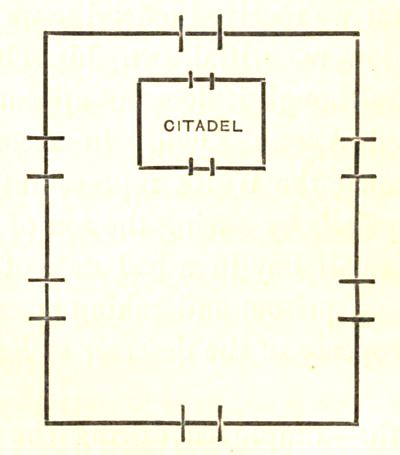
There are 6 gates in the wall of the City, which is fully 20 to 30 feet high, and very thick and strong. At each of the city gates there is a guard of Native Infantry, and we hold the keys of the gates which we lock every night at sunset, after which hour neither entrance nor exit is permitted to anyone. The guards are stationed on the ramparts, and their posts should, from the first, according to the most ordinary rules of war, have been put in a state of defence, but nothing was done to them, and General Primrose has been unwilling to make a change in the matter. Now, however, he has allowed me to take measures to make them safe in the event of any outbreak.
Rumoured advance of Ayoub Khan.
July 13.
—A welcome addition to our force reached us to-day, in the shape of the Head Qrs. Wing of the 4th N.I., which marched in from Quetta. The remainder of the regiment will follow shortly. There was a report that Ayoub Khan, with his army, had actually left Furrah, and that his advance guard was at Washir, but there is no confirmation of the collision between his and the Wāli's forces there, which has probably never occurred. There is much excitement in the city, and the merchants, jewellers, &c., are hiding and burying their property, which means, I assume, that they don't believe in our power to defend the city against Ayoub Khan. A gathering of the enemy is reported as being at Karkrez, about 30 miles off, and there is much excitement among the tribes in the Arghastan Valley. There is no doubt it is very desirable that our force at Girishk should have an opportunity of administering a lesson to some one, or we shall probably have to do something in that way ourselves here.
July 14th.
—Information received that one of the Wāli's regiments, composed of men from Kabul, is mutinous. They are in the fort of Girishk with the Wāli. Ayoub Khan is said to have with him 1,800 cavalry and 4,000 infantry, and 30 guns. So General Burrows' force of 2,500 men and 6 guns have not much to fear. I visited all the guards on the city gates in the evening, and walked round the whole city on the ramparts, and had a good view of the inhabitants preparing to go to bed on the roofs of their houses, which are flat, and always used as the sleeping apartments of the family. The ramparts are 20 to 25 feet high, and as the houses are all one-storied, the roofs were much below us, and we saw more of Afghan domestic life than usual, as the people did not anticipate that anyone would be passing round then, and the roofs were covered with ladies, who, however, very quickly let down their veils when they saw us in the distance.
Guns recovered from mutinous troops.
July 15.
—News from General Burrows received this morning states, that the whole of the Wāli's army was mutinous, and that the situation was so critical that he had decided it was necessary he should disregard the positive orders he had received not to cross the Helmund, and that he proposed to do so, and disarm the mutineers. I should explain that our force is, under orders from the Viceroy, halted on the Kandahar side of the Helmund, while the Wāli and his army are in the fort of Girishk, which is on the Herat side of the Helmund. Later in the day news arrived from the Wāli (which was apparently authentic), that early the previous morning (14th) the whole of his army left him, taking with them the Battery of guns our Government had been so idiotic as to give the Wāli. The letter, which was from the Wāli to his son, who is here, went on to say, that immediately General Burrows heard this, he had crossed the river with his cavalry and Horse artillery, and pursued the mutineers, and coming up with them had killed 200 and recovered the guns. This report seems authentic, though probably exaggerated, but as yet no confirmation has been received from General Burrows. True or not, the report has had a good effect in the city, and will help to show that the people are not likely to improve matters by trying conclusions with us. I had a deputation from the Parsee shopkeepers, who have followed the army from India, and have shops in our camp, where they sell us wine and provisions, &c., at most exorbitant rates, to beg me to give them a place in the fort for their stores, as they were in a dreadful fright for their lives and their property. Even if I had considered they were in danger, I would not have acceded to their request, as I would much prefer their running certain risks, to giving public confidence the shock of supposing I thought it necessary for our camp followers to take refuge in the fort, so I laughed at their fears, refused their petition, and comforted them by saying, that even if they now lost the whole contents of their shops, they would still be great gainers, as they have made their fortunes already by swindling us. They did not seem to see this in the light I did, but had to accept the inevitable, and take their share of the risks. As there is a large number of evilly-disposed men in the city, it was decided that it was desirable to show
|
40-pounder guns moved into fort.
|
them we were determined to put down any disturbances with a strong hand, so we moved down two of our 40 pounder guns into the fort, and placed them in position to shell the city, and at the same time established a system of strong patrols, which night and day visit the city, and go through all the main streets. There is no denying these patrols would be in an unpleasant position if attacked, as street fighting is, of all, the most disagreeable, but I have given clear and distinct orders for the guidance of the officers in command, from which they learn what they are expected to do, and which will cover their responsibility in resorting, if necessary, to strong measures. The great objection one feels to returning a fire in a street is, that in such cases it is always unfortunate children and women who suffer, and not the men who deserve it, and who take precious good care to remain under cover. I visited the city myself, and found all quiet, and went with the Wāli's chief man to arrange for certain improvement to the fortifications, and was quite civilly received everywhere. It was satisfactory to find that already the arrival of the guns in the fort was known and appreciated, and one Afghan said to me, "They" (the guns) "are very big: two discharges from them and the city would be destroyed." I answered in the language of the country, "I believe you, my boy."
July 16th.
—Rode out to Kokeran, and on arrival there, met a well armed caravan, the people composing which could give but an unsatisfactory account of themselves, so one of our native cavalry patrols coming up at the moment, I made the lot prisoners, and sent them into the city to be examined. They may only be peaceful traders armed for their own defence, as they were perfectly civil, but even in that case some information will be got out of them. No news yet from General Burrows, who possibly has gone on in hopes of meeting Ayoub Khan. We have decided to disarm every Afghan approaching Kandahar, and I have issued the necessary orders to ensure this being done.
July 16th.
—Rode out to Kokeran in the morning, returning by the Argandab, all seemed quiet. Visited the city in the evening, and found all quiet there also.
July 17th.
—Was woke at 2·30 a.m. by the Brigade-Major bringing the officer commanding the cavalry patrol (which is on duty round the camp all night), who reported that a considerable fire was burning in the direction of Kokeran. As these fires very often indicate a collection of men bent on mischief, I desired him to proceed cautiously with his patrol in the direction of the fire, and ascertain its cause, and bring me information, and at the same time I ordered a troop of cavalry to follow in support. The fire proved to be caused by some evilly-disposed persons having set a light to the corn and straw stacks of a peaceably-disposed native, living some 8 or 9 miles from camp, and the patrol found no signs of a gathering of men, so returned to camp. Confirmation was received from General Burrows of his successful fight at Girishk against our
supposed
friends, the troops of the Wāli, in which he had succeeded in recovering the Battery of artillery which our Government had given as a present to the Wāli, and the first time it was used was to fire upon us! General Burrows also recovered a great deal of stores and baggage belonging to the Wāli, and much ammunition, and on the whole made a very successful business, losing but very few men himself, the loss of the enemy being computed by themselves at 400, but was probably not more than half that number. There being a want of supplies at Girishk, General