ARTS AND CRAFTS
Reading edition
THE USE OF STONE
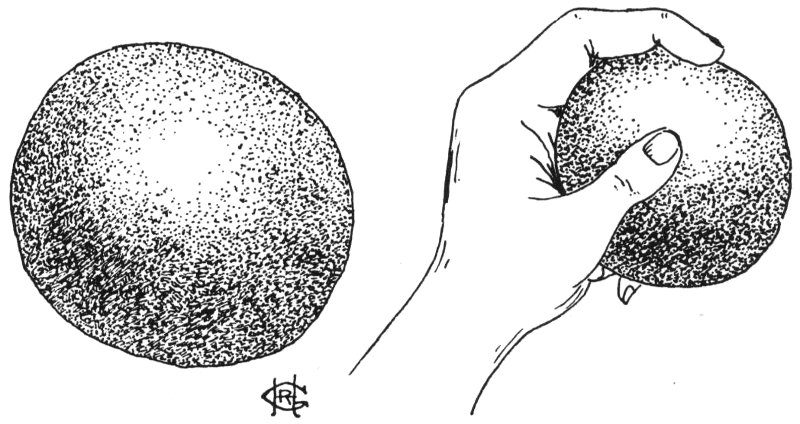
Fig. 11—Man’s First Tool, the Hammer Stone.
Away back in the days when all human beings were simple Stone Age peoples, just beginning the long climb toward civilization, their first tool was nothing more than a Stone or Pebble, picked up along the stream, and used as a Hammer Stone or Hand Hammer. They would want to crack a nut for its kernel, to break a bone for its marrow, or to frighten away a cave bear or hyena that threatened them; and the Hammer Stone served their needs. Later, when they learned that by breaking, pounding and pecking, they could change the shape and form of other stones, in making tools, the Hammer Stone was once more their servant. It was used by primitive peoples the world over, including of course the Mound-builders and the Indians. From the humble Hammer Stone, as a beginning, we may trace without a break all the inventions and progress that man has made, from the very earliest times up to the present. Therefore the Hammer Stone may be rightly called the father of civilization.
28
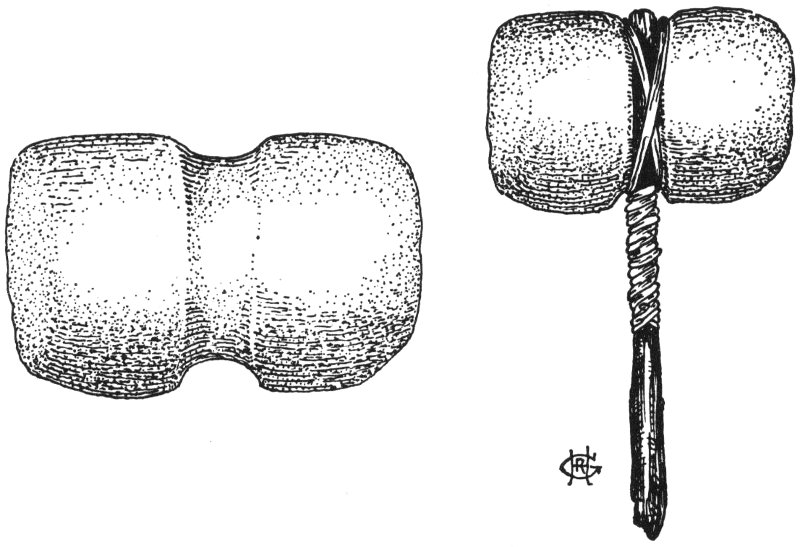
Fig. 12—Grooved Stone Hammer.
At first, the human arm was the handle of the Stone Hammer. Later, primitive man discovered that he could “work” stone by pecking and grinding it with another harder stone. He then supplied his Stone Hammer with a groove, and lashed it to a wooden handle by means of a rawhide thong. This handle not only gave him a longer reach, but added more power to his blow.
Putting a groove on a Stone Hammer was really a very important step in human development, for it made of the tool an actual piece of personal property, which the owner would want to carry around with him as he moved from place to place and which, perhaps, would be handed down from father to son.
In Ohio, the ancient Indian tribes used the Grooved Hammer quite freely, and while none have been found in Mounds, it is probable that the Mound-builders also made use of it.
29
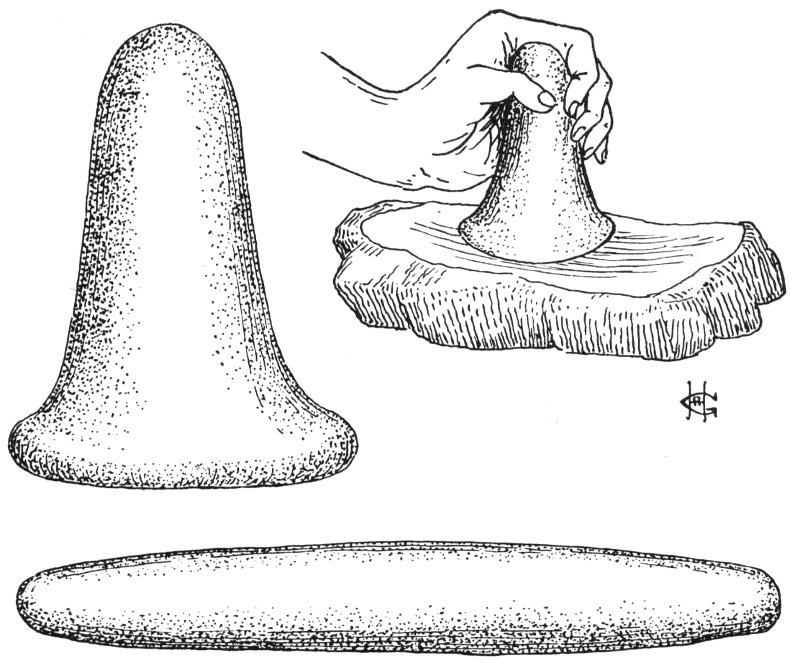
Fig. 13—Stone Pestles and Mortars.
For crushing and grinding corn and seeds into meal, primitive peoples used simple stone implements, several of which are shown above. The type of Pestle, shown at the upper left, known as the Bell-shaped Pestle, is found abundantly in Ohio and near-by states. They were used with wooden Mortars or flat stones, and sometimes with shallow stone mortars, like that shown at the upper right, and were suitable either for pounding or grinding.
The lower specimen in the picture, known as a Roller Pestle, was used like a modern rolling-pin.
Stone Pestles are rarely found in Mounds, but were used mostly by the primitive Indian tribes.
The stone Pestle and Mortar were man’s first grist-mill, out of which developed the water-driven grist-mills of pioneer days and, later on, the great electrically-driven flour mills of today.
30
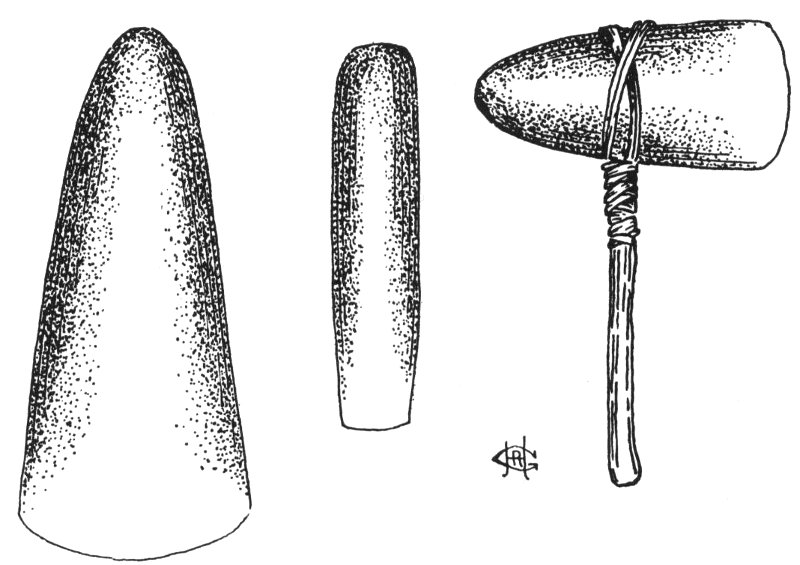
Fig. 14—Chisels and Celts, or Ungrooved Axes.
These, with the Grooved Axe illustrated on the following page, were the commoner types of implements used for chiseling and chopping. They could also be used as wedges. With the Celt, when used as a Chisel or Hand-hatchet, the human arm was the handle. If it served as a Hatchet, Tomahawk, or Axe, it was lashed to a wooden handle by means of rawhide thongs.
The Celt was used for a great variety of purposes. In Ohio and near-by states it is often called a “skinning stone,” and it would have been a very convenient tool for removing the hides of animals. Some Celts are very rough in appearance, with only the edges ground to a polish, while others are smooth and highly polished over their entire surfaces.
The Celt is a very ancient tool, and is found in large numbers on the surface of the ground in almost every part of the world where men have lived.
31
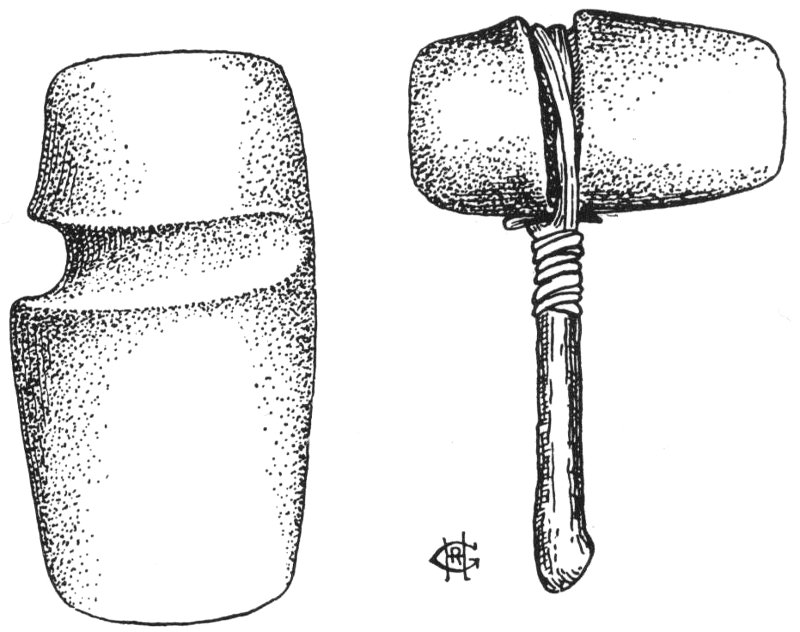
Fig. 15—Grooved Stone Axes.
It is interesting to compare the modern Steel Axe, Hatchet or other handled cutting tool, with the simple stone implements of prehistoric times and to note how, little by little, they have been improved and perfected. The present-day Axe or hatchet is comparatively light and thin and the handle is inserted through a hole or into a socket. Stone tools, no matter how the handle is attached, must be heavier and thicker, because stone will not stand the strain of hard use as will steel.
The Ohio Mound-building peoples simply lashed wooden handles to their ungrooved Axes or Celts, using rawhide thongs. These, when they dried, held very tightly and made a very useful tool. The ancient Indians also used this method, and in addition they pecked grooves around their Axes to supply a firmer fastening for the thong. The above drawings show the Grooved Axe, and how the handle was secured. This implement served as an Axe, a Hatchet or a Tomahawk, according to its size.
32
THE USE OF FLINT
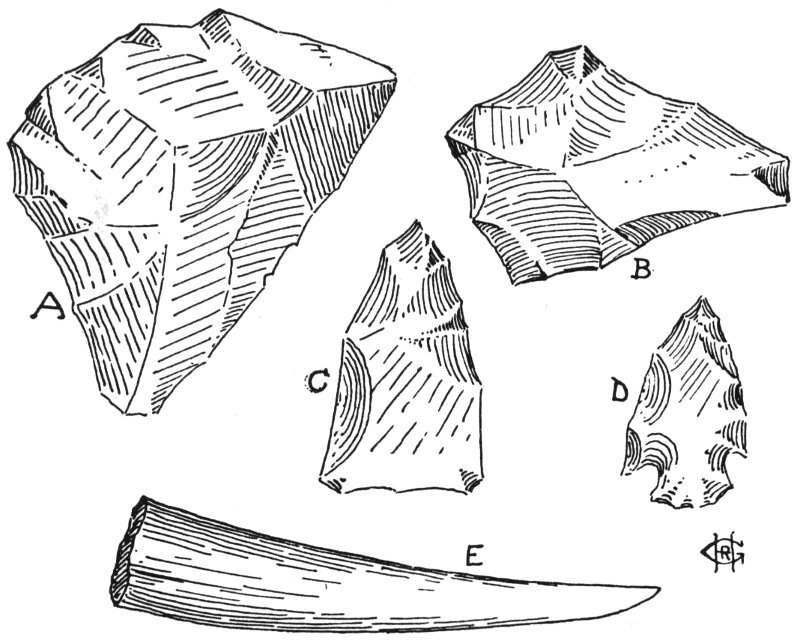
Fig. 16—An Arrowmaker’s Outfit.
Primitive man used Stone a long time before finding what proved to be a very superior variety, Flint, a rough block of which is shown on the left in the picture. Possibly he chanced upon a piece of Flint and in using it as a Hammer Stone noticed that it broke into thin flakes with sharp edges, and with this knowledge he soon learned to make Flint Knives, Scrapers, Arrow-points, Drills, and other cutting and piercing tools. For example, from the rough piece of Flint, “A,” the arrowmaker struck off a few flakes with his Stone Hammer, producing the piece marked “B,” which has something of the shape of the final point. Then by means of the chipping tool of deer antler, marked “E,” he pressed off thin flakes from the edges of “B,” and produced “C,” and finally the finished point, “D.”
33
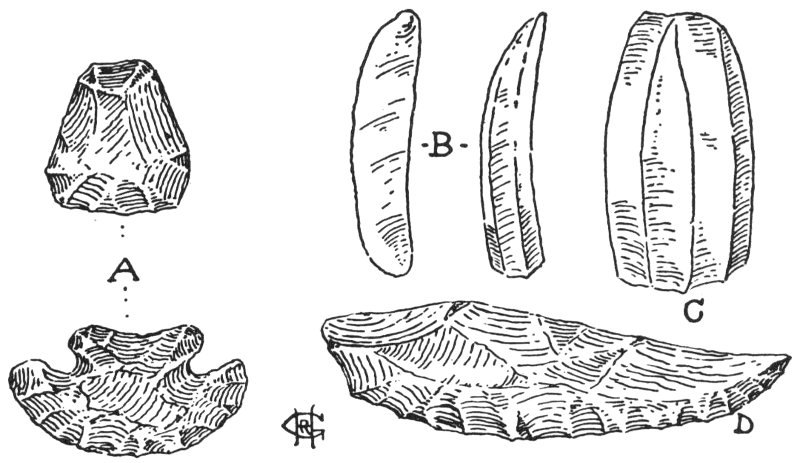
Fig. 17—Flint Cutting and Scraping Implements.
Perhaps the earliest tools made from Flint were simple flakes, struck from a block of flint by means of a hammerstone. “B,” in the picture, shows two of these flakes, which remind us, in shape, of a modern knife blade or a safety razor blade. At first they were simply held in the fingers, but later probably were mounted in wooden or bone handles. In “C” is shown the “core” of flint from which the flake or blade was struck off. In time primitive peoples, including the Mound-builders and the Indians, came to make more pretentious knife-blades, like that shown as “D.”
Scrapers of various sorts were made from flint, and served many purposes. The simplest form, a mere flake of flint, is the top specimen in “A,” while an improved type, with notches for securing it to a handle is shown below it. They were used for scraping wood, bone and stone, in making tools and ornaments, and for removing the fat from skins, before tanning.
34
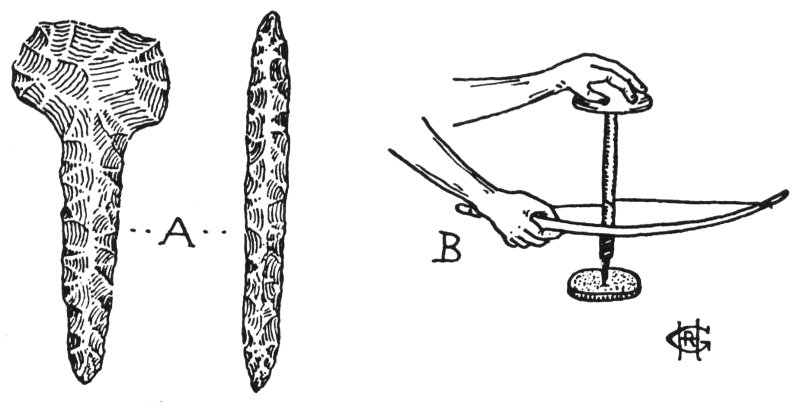
Fig. 18—Flint Drills and Perforators.
For drilling wood, stone, bone, and other materials, primitive man made and used Flint implements of the types shown in this picture. Flint Drills such as these are abundant in village sites and on the surface of the ground where their makers lived. Two different kinds of perforators are shown here. The one to the left is made with an expanded base so that when drilling a hole through hard material, such as wood or a thick piece of leather, the tool could be turned easily by the hand. The other specimen, to the right, “A,” was probably used like an ordinary punch of today, with a twisting motion. Flint is a very hard stone and with such Drills as the one on the left, holes were made in softer stones like granite and slate.
In “B” is shown the manner in which Flint points of this type were mounted on a shaft and made into a mechanical drill by twining a bow-string once around the shaft and drawing the bow back and forth.
35
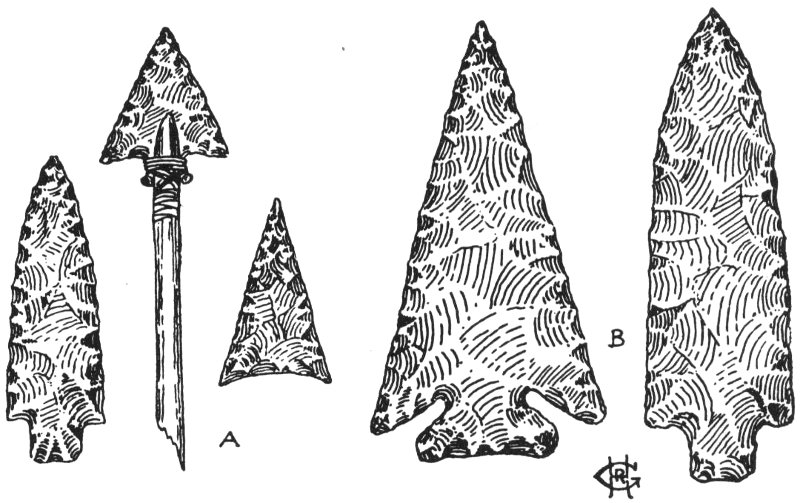
Fig. 19—Flint Arrow and Spear Points.
Most useful of all Flint implements were the “Points” or “Heads” of Flint, as shown above. The only difference between an Arrowhead (A) and a Spearhead (B) is that of size. Those more than three inches long are usually called Spearheads.
With Arrows and Spears tipped with Flint Points, the primitive hunter was able to “bag” an abundance of game. Flint Points like these are probably the most numerous of the relics left by the prehistoric inhabitants of America. They are found by the hundreds of thousands in all parts of the country, on the surface, in mounds and graves, and in places where the Indians had their villages.
Shot from strong bows, these Flint Points had great penetrating power. Arrowheads have been found imbedded in the bones of large animals and human beings in such positions as to show that they passed through almost the entire thickness of the body before being brought to a stop.
36
PREHISTORIC FARMING
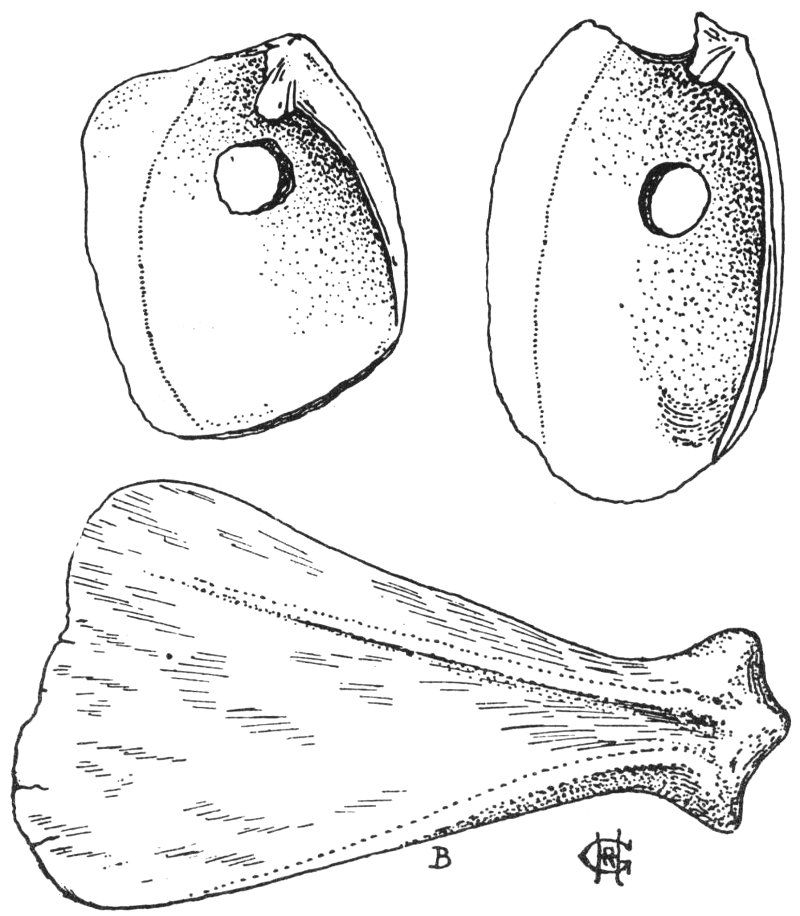
Fig. 20—Primitive Agricultural Implements.
Although the Mound-builders, like all primitive peoples, drew freely on nature’s bounty for food supplies, such as hunting, fishing and gathering wild nuts, fruits, and roots, they had developed agriculture to a considerable degree. Tending their crops with rude Hoes made from clam shells (A) and shoulder blades of the deer (B), they produced corn, beans, squash, tobacco, etc. It is probable also that some of the burial mounds were built with the aid of such Hoes, which were used for loosening the soil and scraping it into baskets and carrying bags.
37
THE USE OF BONE
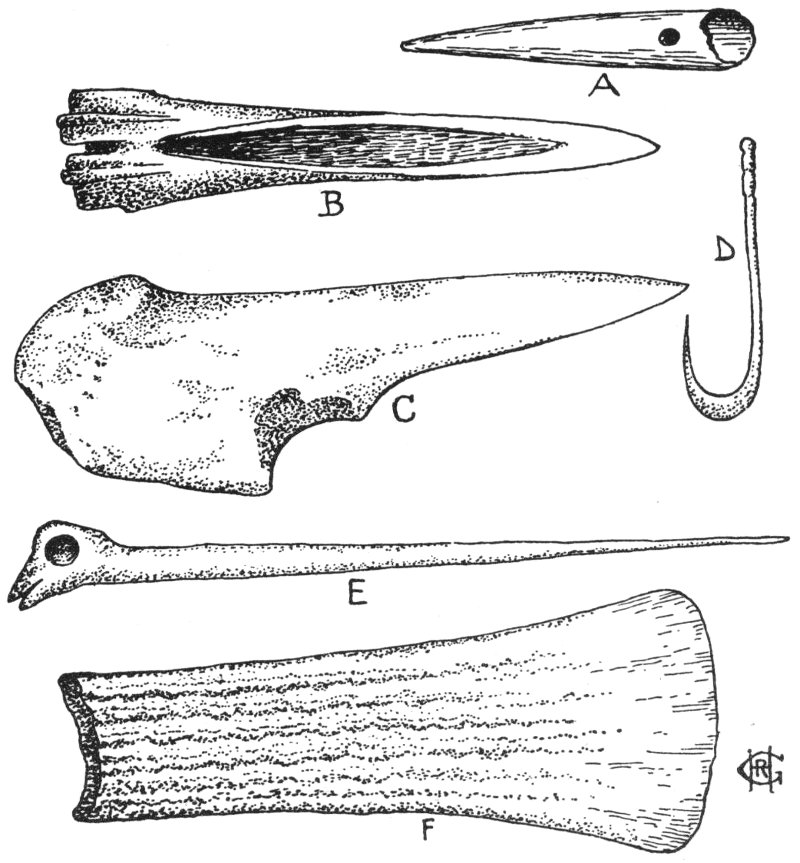
Fig. 21—Implements of Bone.
Next to Stone and Flint, the Mound-builders prized Bone for making implements and ornaments. Above (B, C) are shown two Bone Awls, which served for piercing leather and bark, and also as “tableware” in eating their meals. Other things made from bone were Harpoons and Arrowheads (A), Fish Hooks (D), Scrapers (F), Hoes, Needles (E), and Ornaments such as Beads and Pendants.
With some of the Ohio Mound-builders and prehistoric Indians, Bone was almost as important as Flint and Stone, and was used for many different purposes.
38
USE OF CLAY FOR POTTERY
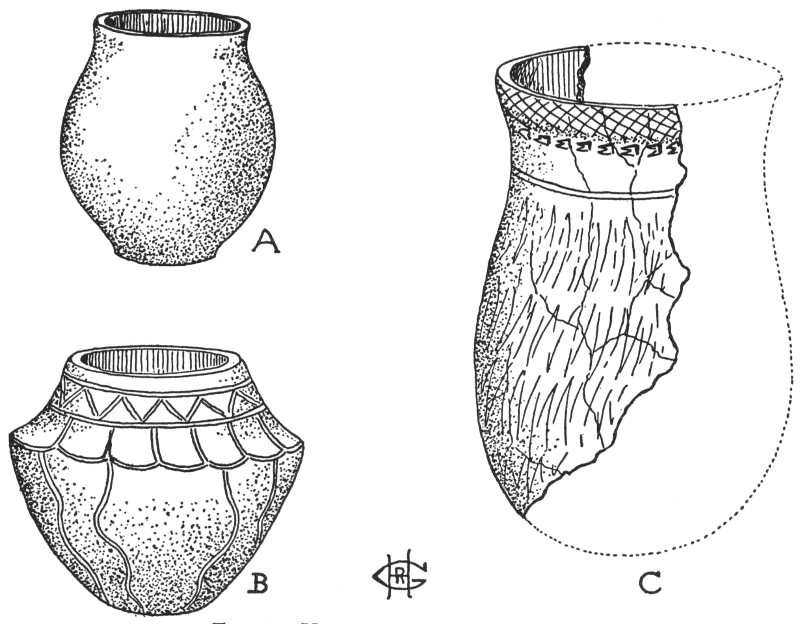
Fig. 22—Vessels of Burned Clay.
The Mound-builders and some of the Indians made their pots and pans out of clay, of which there is a great abundance in the river valleys of Ohio. They tempered or hardened the clay by mixing it with ground-up rock or shells, molded it into the desired shape, and baked the vessel in an open fire.
Many of these ancient pots have designs like “B” and “C,” which were made with small sticks, or perhaps with pieces of flint or bone, before burning.
In size, pottery vessels range all the way from that of a thimble to a bushel basket. They were used for the most part for cooking, storing and preserving food, but many of the highly decorated pots found in the mounds were probably made purposely as tributes to the dead.
39
SPINNING AND WEAVING
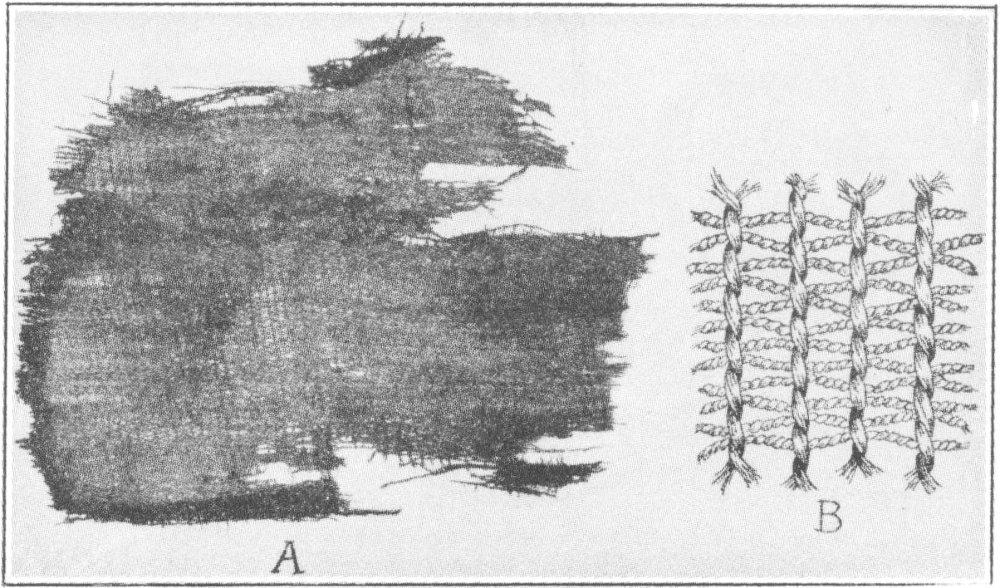
Fig. 23—Mound-builder Cloth.
The Mound-builders wove serviceable cloth from the tough fibers of plants and the inner bark of certain trees. The sample shown as “A” resembles the homespun linen of the days of our pioneer grandmothers, and in “B” a piece of the same sample is magnified to show the weave. Cloth, as well as the skins of animals, was used for clothing by the Mound-builders, and they probably knew how to weave thick blankets to protect them from the cold in winter. There are many samples of Mound-builder Cloth, as well as of woven bark matting, in the Ohio State Museum. These show half a dozen or more different weaving patterns, of which the weave shown in the above picture is but one. Copper implements found in the mounds were very often wrapped in Cloth, which was preserved throughout the centuries by the chemical action of the Copper.
Some of the prehistoric Indians also wove cloth, but none of them was as skilled as the Mound-builders.
40
THE USE OF METALS
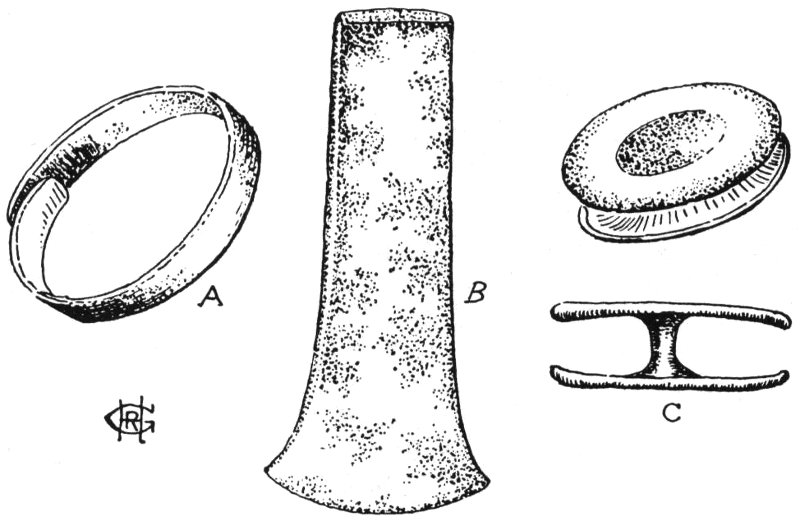
Fig. 24—Implements and Ornaments of Copper.
Although strictly a Stone Age people, the Mound-builders used Copper, Silver and other native metals. They had not learned to melt these, but pounded the metal into the desired shape, afterward polishing the objects by rubbing. The objects shown in the picture are all made of Copper. “A” is a Bracelet and “B” is a Celt, or ungrooved Axe. “C” shows two views of what are called Ear-spools. These were worn as ornaments in the ears, and probably signified some particular station in life. The Mound-builders obtained their copper from the shores of Lake Superior, where it is found near the surface of the ground. Many of the pits they dug there are still to be seen. Silver was also obtained by them in the same region.
Besides Copper and Silver, the Mound-builders used Galena, or Lead-ore, and Iron, which they probably obtained from fallen meteors. The non-Mound-building Indians used copper to a lesser extent.
41
PERSONAL ORNAMENTATION
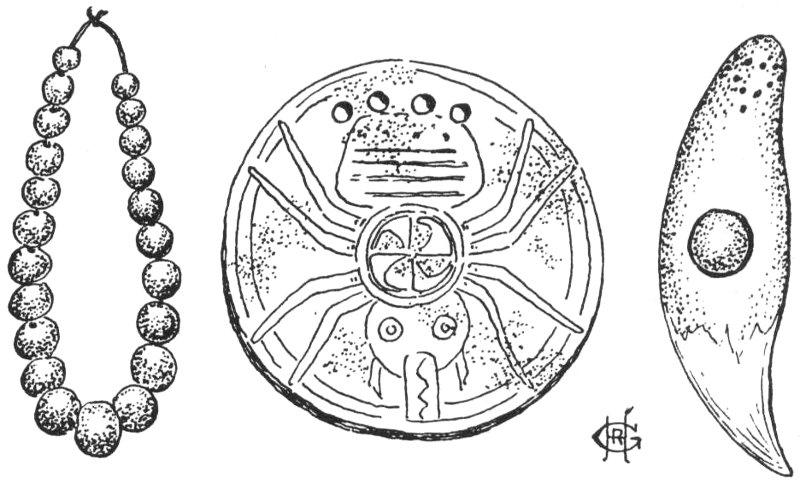
Fig. 25—Mound-builder Jewelry.
Beads always have been popular with human beings as articles of personal adornment. The Mound-builders and other Indians used them in great numbers, samples of which are shown in the picture. From left to right there are: Beads made of fresh-water pearls, which are found in the mounds by the thousands; a “breast-pin” of sea-shell decorated with the effigy of an insect, and a Bear Tusk with a Pearl set in it, used as a pendant for a necklace.
The Mound-builders made Pendants and Beads and other ornaments, some of which were sewed onto cloth, out of Copper, Mica, Tortoise-shell, Stone and Bone. Many Buttons about as large around as a dime, made of sandstone and covered with thin layers of copper or silver, have been found in the burial mounds. Some of the Mound-builders even wore rings of copper on their fingers.
42
THE ART OF THE MOUND-BUILDERS
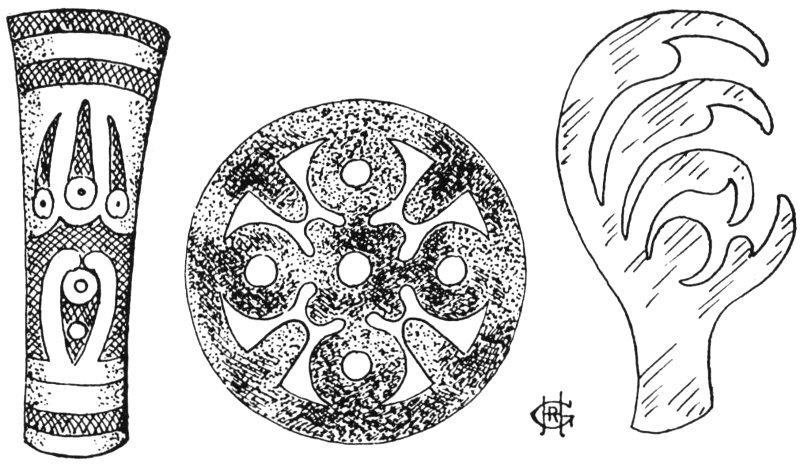
Fig. 26—Mound-builder Designs.
The Mound-builders were artists, carving and cutting a variety of patterns in Bone, Mica, Shell, Copper, Clay and Stone. Without doubt they worked in other materials too, such as Wood and Bark, but these, of course, have entirely disappeared along with other perishable materials. We have seen examples of their artistic ability in the great geometrical circles, squares and octagons which they built up of earth around some of their burial mounds.
At the left in the picture is a section of a human leg bone carved with an attractive design. This was no doubt a sort of family relic or a memento of some relative who had died. In the middle of the picture is a rare design, possibly representing the universe, cut from a thin sheet of copper. At the right is the foot of an eagle, cut out of a thin sheet of mica, as skillfully as anyone could do it today.
The finest examples of Mound-builder art are the many tobacco pipes taken from the Mounds.
43
TOBACCO AND TOBACCO PIPES
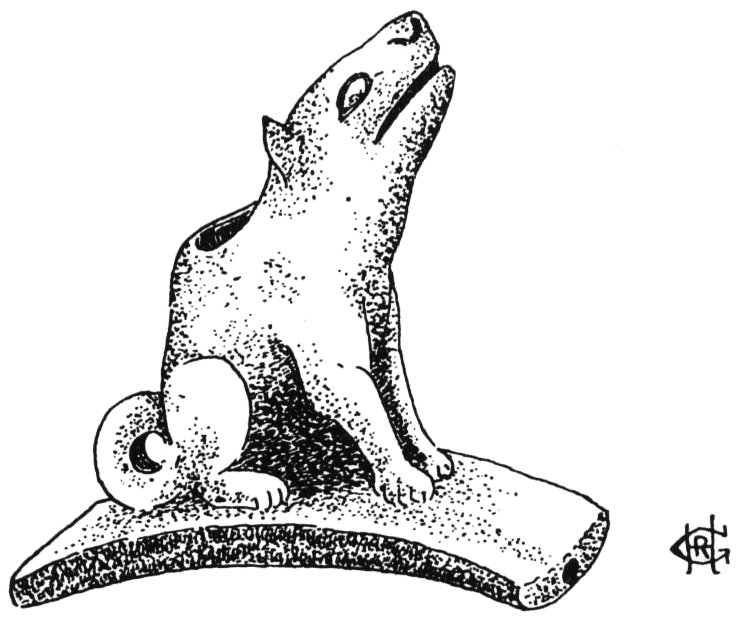
Fig. 27—The Mound-builder Tobacco Pipe.
The Mound-builders cultivated and smoked Tobacco long before civilized people knew of the plant. Above is a picture of one of their Tobacco Pipes, in which they have shown their artistic ability by carving it in the image of the Dog, their only domestic animal. Several hundred pipes like this one have been found in mounds in Ohio, representing many different animals and birds, and the human form has also been found. The American Indian not only taught the white man the use of tobacco, but it was probably from pipes very much like those of the Mound-builders, with stem and bowl, from which our modern tobacco-pipes are copied.
This Pipe is made of Ohio Pipestone, which is found in Scioto County. The Tobacco Pipes of the Mound-builders and prehistoric Indians are made not only of this material, but of several kinds of stone, including limestone, slate, steatite or soapstone, and granite.
44
“CEREMONIAL” OBJECTS
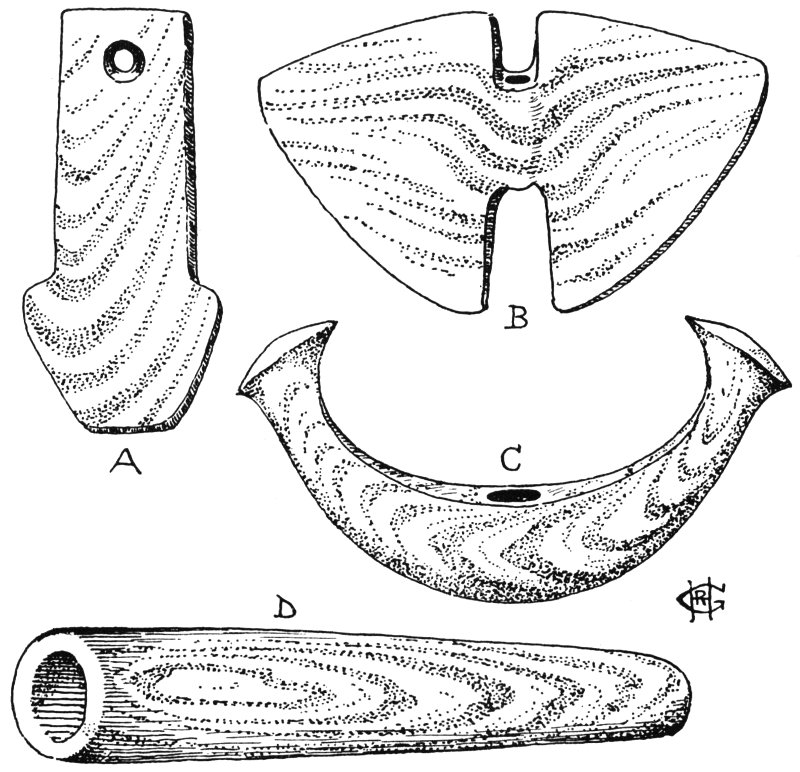
Fig. 28—Charms, Badges and Talismans.
Almost every collection of “Indian relics” contains one or more specimens, like those shown above, that are difficult to account for. They are called by the Archæologists “Ceremonial” objects, because they are believed to have been used in mysterious ceremonies of the Mound-builders and Indians. The specimen marked “A” is a pendant or Gorget, and was worn suspended from the neck. Specimen “B” is a Bannerstone, and “C” is a Crescent. They probably were mounted on wooden handles and served as badges of authority or rank. Other Ceremonial objects are tubes (D), Cones, Bars, Bird-shaped objects, called Bird-stones, and others.