The Apiary.
Reading edition

Corn-Silk Protection.
A correspondent of “Gleanings” writes: I winter on the summer stands, and pack them a little differently from most persons. I spread the combs so that eight or nine will fill same space occupied in summer by ten. Then placing sticks crosswise of the frames, to allow a passway for the bees, I spread a cloth above them, and pack on the top of this two or three inches of corn-silks. For packing, these are superior to anything I have yet seen or heard of. They are clean, and excellent non-conductors, and will more readily absorb the moisture than either chaff or saw-dust, and yet remain perfectly dry. They are easily collected by a boy when men are husking in the fields; and when taken off in the spring can be stored away for another winter. Knowing the value of them by experience, I hope that many of our brother bee-keepers will give them a fair trial.
Feeding Back.
The question of “feeding back” honey to bees was discussed at the Michigan State Convention at Flint. W. Z. Hutchinson had had a poor season; but as he had mentioned incidentally that he had practiced “feeding back,” it brought down upon him a shower of questions. In feeding back 1,000 pounds of extracted honey, he had received 800 pounds of comb honey. Had tiered up the cases of sections until they were three or four cases high. Had fed the honey as fast as they would take it. Looked the sections over about once a week, and removed the full ones. Some colonies did much better work than others. After the first trial, selected the best. No honey was coming in at the time of the feeding; did not weigh the hives; weighed only the sections and the amount. He had a friend who had fed back upon exactly the same plan, but his friend had not found it profitable. He thought that to know just how to feed back, at a profit, was not yet positively known.
D. A. Jones: The question of feeding back has but few advocates, for the reason that the majority have failed to make it profitable. To be successful in feeding back there must be no place in the hive in which the bees can store honey, except in the sections. Those hives must be selected that contain the most honey, or else those having but few combs. My plan of feeding is to elevate the hives in front and pour the feed in upon the bottom-board. The bees do not carry the honey out of the hives; they must store it somewhere. Bee-keepers fail to make it pay, because the bees had an empty brood-chamber. Section boxes filled with foundation had been given a colony at 9 A. M.; feeding commenced, and the next day, at evening, the bees had commenced capping some of the sections. Fifty-two pounds of honey was fed, and forty-four pounds of comb honey obtained. To get unfinished sections filled, and at the same time have the honey removed from some other unfinished sections, I put the sections that I wish emptied, over the hive, and the ones that I wish finished, in the main body of the hive, keeping the queen out of them by using perforated zinc.
W. Z. Hutchinson: Will not pouring in honey at the entrances excite robbing?
D. A. Jones: I do not pour it in at the entrance. I pour it down inside the hive at the back.
W. Z. Hutchinson: You speak of using perforated zinc. I should like to know something about that. Do the bees work through it freely? Is there any objection to its use, except its cost? And where is the expense? Is it in the material, or in the preparations?
D. A. Jones: It is in no way detrimental. The bees work through it freely. I see no objection to its use except its cost, and its cost is the preparations. Tin would be no cheaper, for the reason that it comes in smaller sheets, and the waste would be greater.
W. Z. Hutchinson: I have used honey boards the past season made of wood, the slats of which were 5-32 of an inch apart, and they answered every purpose; and are cheaper than zinc.
S. T. Pettitt: I can hardly think the wooden boards would be better than the zinc. It would take some time to make them, while the zinc is all ready, and so lasting.
W. Z. Hutchinson: The wood boards cost only a third as much as the zinc and I prefer them.
Bee Pasturage.
At the late Nebraska Bee-keepers’ Convention Mr. Ballard spoke very highly of dandelion and alsike clover, stating that he had seen four or five bees on one blossom of dandelion, and recommends alsike clover, as it will take root on the prairie.
G. M. Cooper, Beatrice, gave it as his opinion that white clover did not secrete any honey last spring, on account of the cool weather.
P. M. Aldrich said that his bees worked on rape long after frost. No one present had ever seen rape fail.
Mr. Colwell sowed the roadside twice last year, and had a continuous bloom all summer, and late in the fall; puts one peck to the acre on the roadside.
Mr. Hawley sows about six pounds of rape seed per acre.
Mr. Colwell’s bees have a great feast on box elder sap, early in spring.
Mr. Hawley has sown rape several times, but the bees only gathered fast enough to build up; he can tell when his bees are gathering rape honey, by the odor.
C. C. Turney, Ceresco, had seen bees work very extensively on the blackberry, both blossom and fruit, and also on parsley.
Wm. Sutton, Elk Creek, saw his bees on raspberry and alsike clover; they did a great deal to stimulate his bees, although the quantity is limited in his locality; they bloom about the middle of June.
The ancient Egyptians of the Nile had floating bee-houses, designed to take advantage of the honey harvest. They were warned when it was time to return home by the depth to which the boat sank in the water under the weight of the cargo of honey. That the bees might not be lost, they were obliged to journey during the night-time.
STANDARD BOOKS.
PRICE, ONLY FIVE DOLLARS.
American Roadsters —AND— TROTTING HORSES, BEING A SKETCH OF THE Trotting Stallions of the United States. AND A Treatise on the Breeding of the Same, WITH AN APPENDIX
Showing the Pedigrees and Breeding, so far as known of all Trotters that have a Record in 2:25 or better, and containing much Practical Matter relating to the Breaking Management, and Treatment of Trotting and Breeding Stock.
ILLUSTRATED WITH PORTRAITS OF
Hambletonian, Bellfounder, Administrator, Almont, Edward Everett, Florida, Thorndale, Byron, Voltaire, Lakeland Abdallah, Governor Sprague, Cuyler, Gimcrack, Vermont Blackhawk, Mambrino Patchen, and other great Stallions.
By H. T. HELM, Counselor at Law.
The most original, complete, instructive, and entertaining book on Trotting Horses ever published. Several Single Chapters are each worth the price of the book. The Illustrations are the finest ever included in any book on horses. Nearly six hundred pages.
PRICE, FIVE DOLLARS.
For sale by the PRAIRIE FARMER PUBLISHING CO.
150 Monroe St., CHICAGO, ILL.
Swine Husbandry.
A Practical Manual —FOR THE— BREEDING, REARING, AND MANAGEMENT OF SWINE. —AND THE— Prevention and Treatment of Their Diseases. BY F. D. COBURN, A Western Practical Farmer and Breeder ILLUSTRATED. CONTENTS:
Breeds of Swine, their Characteristics and Worth.
Raising and Fattening Swine.
Diseases of Swine, Practical Information as to their Causes, Symptoms, Prevention, and Cure.
Price, by mail, postpaid, $1.75.
PRAIRIE FARMER PUBLISHING CO., Chicago.
AGENTS WANTED, Male and Female, for Spence’s Blue Book, a most fascinating and salable novelty. Every family needs from one to a dozen. Immense profits and exclusive territory. Sample mailed for 25cts in postage stamps. Address J. H. CLARSON, P. O. Box 2296, Philadelphia, Pa.
RAILROADS.

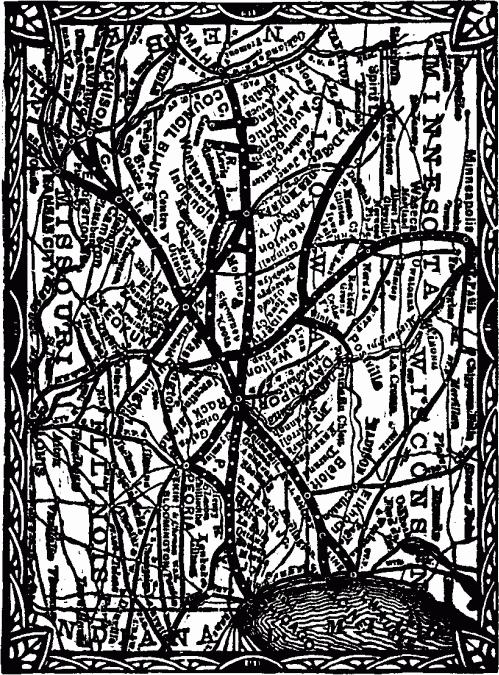
WHO IS UNACQUAINTED WITH THE GEOGRAPHY OF THIS COUNTRY WILL SEE BY EXAMINING THIS MAP THAT THE
CHICAGO, ROCK ISLAND & PACIFIC R’Y
By the central position of its line, connects the East and the West by the shortest route, and carries passengers, without change of cars, between Chicago and Kansas City, Council Bluffs, Leavenworth, Atchison, Minneapolis and St. Paul. It connects in Union Depots with all the principal lines of road between the Atlantic and the Pacific Oceans. Its equipment is unrivaled and magnificent, being composed of Most Comfortable and Beautiful Day Coaches, Magnificent Horton Reclining Chair Cars, Pullman’s Prettiest Palace Sleeping Cars, and the Best Line of Dining Cars in the World. Three Trains between Chicago and Missouri River Points. Two Trains between Chicago and Minneapolis and St. Paul, via the Famous
“ALBERT LEA ROUTE.”
A New and Direct Line, via Seneca and Kankakee, has recently been opened between Richmond, Norfolk, Newport News, Chattanooga, Atlanta, Augusta, Nashville, Louisville, Lexington, Cincinnati, Indianapolis and Lafayette, and Omaha, Minneapolis and St. Paul and intermediate points.
All Through Passengers Travel on Fast Express Trains.
Tickets for sale at all principal Ticket Offices in the United States and Canada.
Baggage checked through and rates of fare always as low as competitors that offer less advantages.
For detailed information, get the Maps and Folders of the
GREAT ROCK ISLAND ROUTE,
At your nearest Ticket Office, or address R. R. CABLE, Vice-Pres. & Gen’l M’g’r, E. ST. JOHN, Gen’l Tkt. & Pass. Agt.
CHICAGO.
MAPS.
RAND, McNALLY & CO.’S NEW RAILROAD —AND— COUNTY MAP —OF THE— UNITED STATES —AND— DOMINION OF CANADA.
Size, 4×2½ feet, mounted on rollers to hang on the wall. This is an
ENTIRELY NEW MAP,
Constructed from the most recent and authentic sources.
—IT SHOWS— ALL THE RAILROADS, —AND— Every County and Principal Town —IN THE— UNITED STATES AND CANADA.
A useful Map in every one’s home, and place of business. Price, $2.00.
Agents wanted, to whom liberal inducements will be given. Address
RAND, McNALLY & CO., Chicago, Ill.
By arrangements with the publishers of this Map we are enabled to make the following liberal offer: To each person who will remit us $2.25 we will send copy of The Prairie Farmer One Year and THIS MAP POSTPAID. Address
PRAIRIE FARMER PUBLISHING CO., CHICAGO, ILL.
DRAINAGE.
PRACTICAL FARM DRAINAGE.
WHY, WHEN, and HOW TO TILE-DRAIN —AND THE— MANUFACTURE OF DRAIN-TILE.
By C. G. ELLIOTT and J. J. W. BILLINGSLEY
PRICE, ONE DOLLAR.
For sale by
THE PRAIRIE FARMER PUBLISHING CO., 150 Monroe St., Chicago, Ill.
THE SHEPHERD’S MANUAL
A PRACTICAL TREATISE ON THE SHEEP. Designed Especially for American Shepherds BY HENRY STEWART. Finely Illustrated
Price, $1.50, by mail, postpaid. Address
PRAIRIE FARMER PUBLISHING CO., Chicago.
$2.00. FOR THIS AMOUNT WE WILL send a copy of THE PRAIRIE FARMER for one year, also a handsome Colored Map of the United States and Canada—size, 4×2½ feet.
Remember that $2.00 pays for The Prairie Farmer one year and, the subscriber gets a copy of The Prairie Farmer County Map of the United States, free! This is the most liberal offer ever made by any first-class weekly agricultural paper in this country.