OUR YOUNG FOLKS
Reading edition
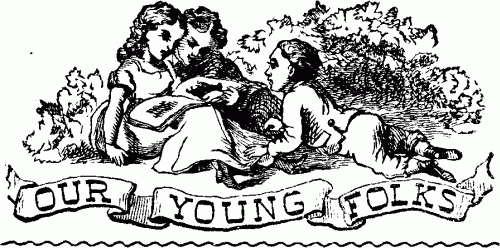
THE LEGEND OF THE STORKS AND THE BABIES.
Have you heard of the valley of Babyland, The realm where the dear little darlings stay, Till the kind storks go, as all men know, And oh, so tenderly bring them away? The paths are winding and past all finding By all save the storks, who understand The gates and the highways and the intricate byways That lead to Babyland. All over the valley of Babyland Sweet flowers bloom in the soft green moss. And under the blooms fair, and under the leaves there, Lie little heads like spools of floss. With a soothing number, the river of slumber Flows o’er a bed of silver sand, And angels are keeping watch o’er the sleeping Babes of Babyland. The path to the valley of Babyland Only the kingly, kind white storks know. If they fly over mountains or wade thro’ fountains— No man sees them come and go; But an angel, maybe, who guards some baby, Or a fairy, perhaps, with her magic wand, Brings them straightway to the wonderful gateway, That leads to Babyland. And there in the valley of Babyland Under the mosses and leaves and ferns, Like an unfledged starling they find the darling, For whom the heart of a mother yearns. And they lift him lightly and tuck him tightly In feathers as soft as a lady’s hand, And off with a rock-a-way step they walk away Out of Babyland. As they go from the valley of Babyland Forth into the world of great unrest, Sometimes weeping he wakes from sleeping Before he reaches his mother’s breast. Ah, how she blesses him now she caresses him:— Bonniest bird in the bright home band, That o’er land and water the kind stork bro’t her From far off Babyland. —Ella Wheeler.
A Chat About Halifax.
As I promised you I will try and tell you a little about Halifax.
Halifax is, as you all know, the capital of Nova Scotia, which is one of the provinces of British North America, and thus is under the dominion of the Queen. It is just what I should imagine a real old English city to be—very odd and antiquated, and yet picturesquely beautiful, and altogether a most charming place in which to spend a summer.
Never shall I forget the stroll I took alone the second morning after my arrival. The day was one of those rarely perfect ones in July. All nature seemed wrapped in a dreamy repose; the heat of the sun was tempered by the soft sea breezes blowing from the grand old ocean not many leagues away, whose roar sounded like the voice of many waters, soothing, restful, and sweet.
It happened that my wanderings led me in to some of the older portions of the city where the houses are many of them two hundred years old. And such funny, queer old houses. They seemed, somehow, to have a slanting look to them; it may have been, however, that it was because the streets were so hilly, and such a contrast to our flat, level prairies.
Right in the midst of the city, among the stores (shops they call them) and houses one comes suddenly upon the graveyards—some of them not now in use, but still left there. What interested me was the flat tombstones. When a little girl my father used to tell me of how the children would take their dolls to the cemetery and play upon and under the grave stones. Do I hear you exclaim, “What, play under a grave stone!” I do not wonder, for it seemed a funny thing to me, but it was quite clear when I saw how the marble slabs were placed. Instead of standing in an upright position, as you have always seen them, they were laid flat and raised some distance from the ground (high enough for a child to crawl under comfortably) by means of little marble posts. I used often to roam through these cemeteries with a dear old gentleman who would tell me stories of the brave young sailor boys buried there, far away from their own loved English homes.
Halifax is one of the most strongly fortified cities in America, and at every turn one meets the red coated soldiers in the streets—when they are not on duty. What would interest our boys would be to see a sham battle; the officers and soldiers all in uniform, eager and active as for a real encounter with the enemy.
One day I went to visit the strongest fort the city contains. It is called Citadel Hill, and overlooks and commands the harbor; which by the way, is considered one of the finest in the world. This Citadel is merely an immense hill, covering nearly half a mile of ground and situated in the very heart of the city. When you have climbed to the top you come upon a large opening, and looking down see a long flight of iron steps leading to the ground, many, many feet below. The hill is excavated and stored with arms and ammunition of all kinds, and great cannons, that look so cruel. All along the outer edge of this excavation were little rooms in which the married soldiers lived with their families. I pitied the little children that had to live in this way, without any home feeling—never knowing at what moment their father might be called away, for a soldier’s life is necessarily a roving one.
This hill would make a grand coasting place in the winter, and one which I have no doubt the little Blue Nose boys and girls often avail themselves of. In Halifax not only the boys and girls, but the men and women also, make much more of winter sports than we do. The large and elegant skating rink I hear has just been opened and, the regimental band have given a grand concert in honor of the occasion.
Snow-shoeing used to be indulged in largely, but in the city the custom is, I believe, somewhat falling off. I do not think you Western boys and girls could hardly imagine what odd, pretty suits the girls make to go skating and snow-shoeing in. The one I saw was made of two large white flannel bed-blankets, with a bright scarlet and blue border. The suit consisted of a skirt, circular-like cloak, and cap with a long side flap to it, which hung nearly to the shoulder. My cousin dressed herself all up in her pretty rig and then got down her wooden snow-shoes and buckled them on. She looked like a winter fairy all ready for an Arctic expedition.
I must confess I could hardly understand how she could manage to walk in the great unwieldy looking shoes, which were nearly five times as large as an ordinary shoe, but she assured me it was great fun and easily done.
I heard an amusing story there about a minister who wished to be married, but who lived a long distance from the neighboring minister, and the snow was very deep, and there was but one pair of snow-shoes. Not wishing to wait until spring he hit upon a novel plan which was this:
That his ladylove should stand upon the back of his snow-shoes, clasp her arms tightly around her future lord’s waist, and thus be carried safely to the neighboring kirk, which she accordingly did. You see this required no real effort on the lady’s part, only, I should judge, a great deal of pluck and nerve power, as well as love. However the story is that they accomplished the journey in safety and were duly married.
One of the prettiest drives in Halifax can be had in a place called the park (what we would call a park proper they call the gardens). This park, situated in the southern part of the city and overlooking an arm of the ocean, has twenty miles of smooth, beautiful roads winding around, and circling in and out among the trees. The roads were made by the soldiers, who received for their work twenty-five cents a day besides their regular army pay. There is also another strong fort in this park. There are, I think, nine forts, strongly garrisoned in and about the city.
I wonder if any of The Prairie Farmer boys and girls have the same desire that I had when living away out West, where I never saw water, much less a ship, to go through a large ocean steamship. If you have I hope that some day you may be able to have your wish gratified as I had mine.
One morning my friend said, “Will you go to a concert this afternoon or go and visit the ships?” “The ships of course,” I cried, and to the ships we went. The “Scotia” was just in on her way from Liverpool to New York, crowded with passengers. It was noon when we went on board, and the long tables were being laid out in the salon. Most of the cabin passengers were out “doing” the city so we saw only the steerage passengers. Now I had heard much of the steerage passengers, but really never imagined them to be such a poor, miserable looking set of beings. They sat around almost anywhere with a plate of soup or a dish full of other unpalatable appearing food and ate as though they did not care much whether they lived or died. I longed to speak to the children and the downcast looking mothers, but they were nearly all of foreign birth, and would not have understood me if I had.
Many of the better class of passengers were in the little side rooms at their private meals, but we only caught side glimpses of them passing through. It was a very pleasant sensation to sit in the handsome saloon and almost imagine yourself to be sailing, sailing away in the great noble ship to the land of your dreams and fancies.
There are many more things of interest about this pretty city I would like to touch upon, but I fear my space is already occupied, so will have to say good-by for this week.
Mary Howe.
The Little Legislatures.
Most of these are in session again over the land. I do not mean those law-making bodies which meet annually at the State capitols to undo what they had done before, or otherwise make work for the courts and lawyers. But I allude to those little assemblies of young folks—lads and lasses—that weekly meet in the winter season in all the thousand and one school-houses and rural halls throughout our country. Legislatures did I call them? Not quite legislatures; but training schools in which legislators are made; and it is in these that our rising youth are qualifying themselves to govern the country that is so soon to be theirs.
Little as we may think of it, these assemblies, under whatever name they may be known—lyceums, societies, clubs, or “legislatures,”—are a power in the land; they do far more than most people think in forming the characters and fixing the opinions of the great multitude of boys and girls who participate in them. They are to-day more numerous than ever before, though they have been abroad in the land for more than half a century. Many of the leading actors on the world’s stage at the present day owe their position to the influence of one or more of these little associations of which they formed a part in their boyhood days. The writer of this could not count on his fingers the number of his associates in boyhood, who have risen out of these schools to positions of honor and trust in the country.
But there is a marked feature belonging to them now that did not exist a half century ago, the result of a vast change that has been made in public sentiment within that period. Then they were confined only to the boys; now the girls participate in them almost, if not quite, as freely as their brothers; and it must be confessed that in a great majority of cases the result has been beneficial to both sexes. The fogyism of that day stoutly protested that hens should not be permitted to crow, yet they persisted in learning the art, and conservatism has been forced to acknowledge that they can crow vociferously and to good effect. And these institutions have proven to be good crowing schools to girls.
Let these associations be encouraged in every school district; but care should be taken by the elder class that they be properly organized and conducted in an orderly manner. Youthful zeal and ardor will be apt to break out into rudeness and disorder, unless held in check by the aged and experienced. Let the older, then, wherever these associations exist, see to it that they are prudently managed—else instead of blessings they will become evils in the community.
The points to which these efforts should be mainly directed, should be—first, plain rules for their government; second, a strict adherence to them when adopted; a diversity of exercises—not too much debate, and not too many essays; fourth, the avoidance of all personal matters; and fifth, a judicious selection of subjects. With these points held well in view, and with a serious desire for improvement, these institutions can not but be useful; otherwise they should be discontinued.
Farmers everywhere ought to encourage the formation of these institutions in their respective neighborhoods, and aid their sons and daughters in carrying them forward. Give them your countenance and your counsel.
T. G.
Walking Canes.
The material of which walking sticks are made is as various as can well-nigh be conceived of. Many are imported woods—some from the tropics, China and the East Indies. The celebrated Whongee canes are from China, where they are well known and celebrated for the regularity of their joints, which are the points from which the leaves are given off, and the stems of a species of phyllosiachys, a gigantic grass, closely allied to the bamboo. The orange and lemon are highly prized, and are imported chiefly from the West Indies, and perfect specimens command enormous prices. The orange stick is known by its beautiful green bark, with fine white longitudinal markings, and the lemon by the symmetry of its proportions, and both prominence and regularity of its knobs. Myrtle sticks also possess a value, since their appearance is so peculiar that their owner would seldom fail to recognize them. They are imported from Algeria. The rajah stick is an importation. It is the stem of a plant and a species of calamus. It is grown in Borneo, and takes its name from the fact that the Rajah will not allow any to go out of the country unless a heavy duty is paid. These canes, known as palm canes, are distinguished by an angular and more or less flat appearance. Their color is brownish, spotted, and they are quite straight, with neither knob nor curl. They are the petioles of leaf stalk of the date palm. Perhaps the most celebrated of the foreign canes are the Malacca, being the stems of the calamus sceptonum, a slender climbing palm, and not growing around Malacca, as the name would seem to indicate, but imported from Stak, on the opposite coast of Sumatra. Other foreign canes are ebony, rosewood, partridge or hairwood, and cactus, which, when the pith is cut out, presents a most novel appearance, hollow and full of holes.
Shortly after Miss Alcott’s “Little Women” was published a quiet-looking lady entered a Boston circulating library and asked a lady clerk to pick her out “a good book that would rest and amuse her.” Naturally “Little Women” was offered, and declined. “It’s very nice; you’d like it,” urged the clerk. “I should not care to read it,” said the other. “But at least look at it.” “No,” came the answer, firmly and with an odd smile; “it is not a book that I should care to read.” Then the clerk, pretty angry, walked away to the chief librarian and cried: “There’s a woman down there wants a book, and if you want her waited on somebody else must do it. I won’t.” “Why, why not?” “Why, she says ‘Little Women’ isn’t good enough for her to read.” “Do you know who that lady is?” “No, and I don’t care.” “Well, I’ll tell you. That is Louise M. Alcott. Now go and get her a book.”
A Michigan girl told her young man that she would never marry him until he was worth $100,000. So he started out with a brave heart to make it.
“How are you getting on George?” she asked at the expiration of a couple of months.
“Well,” George said hopefully, “I have saved up $22.”
The girl dropped her eyelashes and blushingly remarked: “I reckon that’s near enough, George.”
Illinois Central Railroad.
The elegant equipment of coaches and sleepers being added to its various through routes is gaining it many friends. Its patrons fear no accidents. Its perfect track of steel, and solid road-bed, are a guarantee against them.
MISCELLANEOUS.
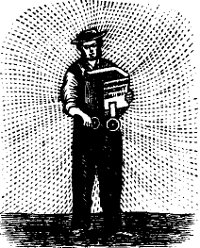
CAHOON’S PATENT
BROADCAST SEED SOWER
Sows perfectly all Grain and Grass Seeds. Hand Machine sows 4 acres while operator walks or rides a mile.
PRICE, $6.00. Every farmer should have it.
HIRAM SIBLEY & CO.,
SEEDSMEN, Rochester, N. Y., Chicago, Ill.
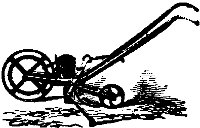
MATTHEWS’
SEED DRILL & CULTIVATOR
sows perfectly all Garden Seeds. Chicago Market Gardeners prefer it to all others, calling it Best in the World. Do not buy without investigating the Matthews. Beware of Worthless Imitations. Send for circular and prices. We are General Western Agents. SPECIAL PRICES TO THE TRADE.
HIRAM SIBLEY & CO., seedsmen, Rochester, N. Y., Chicago, Ill.
TOOLS and IMPLEMENTS. We carry a large and complete stock for the Lawn, Garden and Greenhouse.
Phila. Lawn Mowers.Hedge Shears.
Matthews’ Seed Drills.Border Shears.
Cahoon Seed Sowers.Pruning Knives.
Hand Cultivators.Budding Knives.
Lawn & Garden Rakes.Hand Weeders, etc.
Send for Illustrated Catalogue and Price List; free.
HIRAM SIBLEY & CO., Seedsmen. Rochester, N. Y., Chicago, Ill.
Philadelphia LAWN MOWERS Are used on all the celebrated Chicago Parks. They are light running, clean cutting, and are the BEST Lawn Mowers made. Write for descriptive catalogue and prices. We are the General Western Agents.
TRADE SUPPLIED. Rochester, N. Y.
HIRAM SIBLEY & CO., Seedsmen, Chicago, Ill.
CARDS 40 Satin Finish Cards, New Imported designs, name on and Present Free for 10c. Cut this out. CLINTON BROS. & Co., Clintonville, Ct.