GENERAL REMARKS.
Reading edition
The diseases known by the general term of syphilis or venereal disease, and arising from impure coition, appear generally in three forms, gonorrhœa, chancres, and bubo. These sometimes exist alone, and sometimes together. As they affect the genital organs and their appendages, a description of these organs is necessary to a full understanding of the subject.
Genital organs and appendages in the male.—This term embraces the penis, testicles, bladder, and kidneys. The form of the penis is familiar to every one. It commences at the bladder, is of a spongy nature, and is composed of three different parts; the two upper and larger are called the cavernous bodies, and the lower the spongy body; these bodies are covered by the skin which comes over the head of the penis, and forms the prepuce. When this skin is drawn back, the head of the penis, or the glans penis is seen, which is a development of the spongy body, and is extremely sensitive. A whitish secretion, with a peculiar odor, forms at the end of the glans, where the prepuce seems to join it. The object of this secretion is to preserve the sensitiveness of the glans, and to facilitate the withdrawal of the prepuce in coition and in urinating. This material sometimes collects, irritates, hardens, and causes much inconvenience. This can be done away with by circumcision, which is performed as follows:—draw an inked line on the skin of the prepuce, corresponding to the base of the glans penis; draw the prepuce forward, and have the inked part held firmly by an assistant with a pair of forceps. Then the surgeon takes that part of the prepuce projecting beyond the forceps with his left hand, and with a bistoury cuts the prepuce at the inked line with his right. When this is done, the lining skin of the prepuce, which cannot be drawn forward, remains entire, and covers the glans; this lining is divided by a single cut with the scissors: then the flaps are removed round to the frenum, and then the two flaps are held together and removed, with the frenum, at one cut. The mode of holding the prepuce, &c. is seen in the cut.
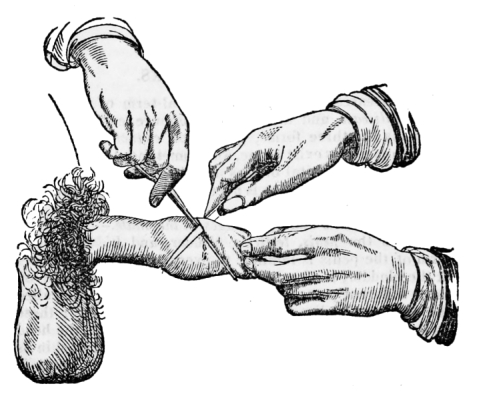
View larger image
On the under side of the glans, near the mouth of the water passage, or urethra, the prepuce is attached by a fold called the frenum, or bridle, or martingale of the penis. The use of this frenum is to confine the movements of the prepuce, and to draw down the mouth of the water passage to direct the flow of the urine. Sometimes the frenum is too short, and confines the prepuce too much; it may be slit down with a pair of scissors as far as is considered expedient. The frenum is frequently ruptured in a first coition. The frenum is very elastic, and protects the sensitive surface beneath it as the eyelid does the eye. Sometimes, however, it becomes permanently contracted;—the glans is then denuded, but soon loses its sensibility. The person is sometimes born with this formation.
The cavernous bodies form two tubes, united in most of the length of the penis, separated only by a thin partition, and enveloped in a firm sheath; they are composed of an immense number of cells, principally formed by dilated veins, which communicate with each other; these, when the penis is erected, become filled and even distended with blood. The cavernous bodies terminate abruptly and form rounded points under the glans penis. At the other extremity they separate, and form the crura or legs of the penis.
The spongy body forms the lower and under body of the penis, terminates at one end at the point in the glans, whilst it extends the whole length of the penis, again becomes enlarged, and forms the bulb. The urethra or water passage extends through the spongy body, and connects the penis with the bladder. This cut is a section of the penis showing the three bodies:
a. Corpora Cavernosa. b. The division or Septum. c. Corpus Spongiosum. d. Urethra. e. The great vein of the Penis. View larger image
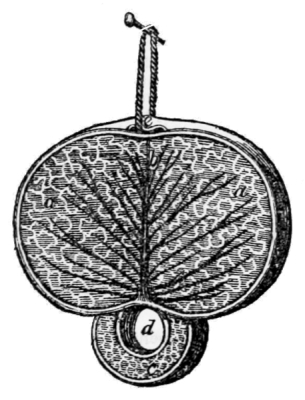
a. Corpora Cavernosa.
b. The division or Septum.
c. Corpus Spongiosum.
d. Urethra.
e. The great vein of the Penis.
The cut below shows a section of the cavernous body, showing the blood vessels that go to it and cause a distension or erection of the penis:
a. Urethric part. b. Glans. c. Dorsal Artery serving the Glans. d. Dorsal Artery serving the interior of the Corpus Cavernosum. e, f. Deep-seated Arteries. View larger image
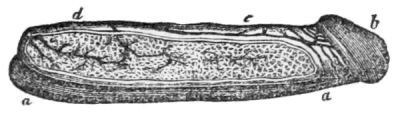
a. Urethric part.
b. Glans.
c. Dorsal Artery serving the Glans.
d. Dorsal Artery serving the interior of the Corpus Cavernosum.
e, f. Deep-seated Arteries.
a. Urethra. b. Glans. c. Dorsal Vein. d. Septum. e. Vessels. View larger image
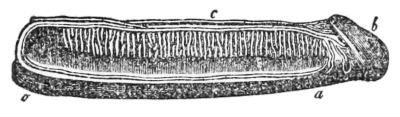
a. Urethra.
b. Glans.
c. Dorsal Vein.
d. Septum.
e. Vessels.
In the cut above we see the septum or division of the cavernous bodies, in which are seen the vessels by which, when the erection of the penis subsides, the blood passes into the dorsal vein of the penis.
The Urethra, or water passage, is the canal that passes through the spongy body to the bladder. The urine and semen pass through it. It is very elastic, and may be dilated so as to admit a large instrument to be passed into the bladder, and it contracts on the smallest. It is supported in its course by the spongy body and the prostate gland, between which is a portion unprotected, called the membranous portion. The passage varies in its size in different parts: thus it is rather contracted at the orifice, enlarges within, and for an inch again contracts, dilates nearer the bulb, diminishes at the membranous portion and near the prostate gland, and finally enlarges into the bladder. The cut opposite will show these parts.
a. Bladder, or receptacle of urine. b. Ureters, or passages through which the urine comes from the kidneys, where it is formed, to the bladder. c. Vas Deferens, through which the semen passes from the testicle, where it is formed, to the seminal vesicles, where it is matured. d, d. Openings of Ureters into the bladder. e. Prostate Gland. f. Orifices of excretory ducts. g. Openings of the seminal ducts. h. Ischio-cavernous muscles. i. Bulb of Urethra divided. k. Cowpers Glands. l. Wide part of Urethra. m. Narrow part. n. Fossa Navicularis, usually affected in gonorrhœa. o, p. Prepuce. View larger image
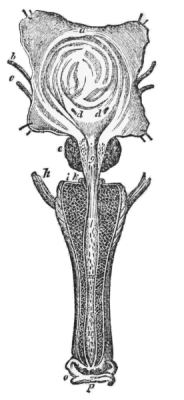
a. Bladder, or receptacle of urine.
b. Ureters, or passages through which the urine comes from the kidneys, where it is formed, to the bladder.
c. Vas Deferens, through which the semen passes from the testicle, where it is formed, to the seminal vesicles, where it is matured.
d, d. Openings of Ureters into the bladder.
e. Prostate Gland.
f. Orifices of excretory ducts.
g. Openings of the seminal ducts.
h. Ischio-cavernous muscles.
i. Bulb of Urethra divided.
k. Cowper’s Glands.
l. Wide part of Urethra.
m. Narrow part.
n. Fossa Navicularis, usually affected in gonorrhœa.
o, p. Prepuce.
The urethra is constantly moistened with a mucous secretion,—from the membrane itself, the glands, and the folds which yield to the pressure of the urine as it flows, or from other altered conditions of the urethra pour out their contents. The inner surface of the urethra is very vascular and sensitive, as is shown by the slightest laceration by the bougie or by chordee, when considerable bleeding often takes place. Its sensitiveness is well known in the first passing of the bougie, or in inflammation, when the pain of the former and the act of urinating in the latter, often causes fainting.
The bladder is the reservoir of the urine, which is formed in the kidneys, comes into the ureters, passages leading from the kidneys to the bladder, and thence flows, drop by drop, into the bladder. The bladder is shaped somewhat like a pear, but this shape is varied by its contents, and the relative condition of its adjacent parts. Thus, when the bladder is full, its upper part may be felt rising above the pubis, that portion of the lower part of the belly that is covered with hair. In very fat persons the bladder is flattened by the weight of the intestines, and obliged to find room where it can, as in pregnant women. Anatomists, when describing the bladder, speak of its body, base, or upper part, sides and neck, where the urethra or water passage begins, and which is surrounded by the prostate gland. These parts are seen in the first engraving on the opposite page.
The bladder is composed of several coats. There is a peculiar membrane investing the important structures in the abdomen called the peritonœum. The base and back part of the bladder is covered by a portion of this peritonœum, which in a measure supports the bladder in its position, and also exercises certain properties which may hereafter be alluded to.
a. The inner surface of the Bladder, showing the direction of the Muscular Fibres. b. The opening of the right Ureter into the Bladder, whence the urine issues. c, c. The Prostate Gland cut through, and its sides exhibited. d. The Urethra. e. Verumontanum. f, f. Orifices of the Seminal Ducts, marked by twigs inserted therein; the other points mark the orifices from the Prostate and other Glands. View larger image
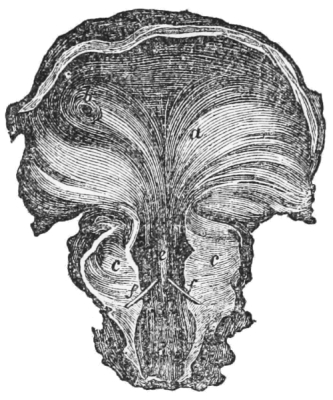
a. The inner surface of the Bladder, showing the direction of the Muscular Fibres.
b. The opening of the right Ureter into the Bladder, whence the urine issues.
c, c. The Prostate Gland cut through, and its sides exhibited.
d. The Urethra.
e. Verumontanum.
f, f. Orifices of the Seminal Ducts, marked by twigs inserted therein; the other points mark the orifices from the Prostate and other Glands.
The position of the perineum is seen in the following cuts in which the skin has been removed, disclosing—
1. The superficial fascia of the Perinœum. 2. The fascia lata, or shiny covering of the muscles of the thighs. 3. The tuberosity of the ischia, or part whereupon we sit. 4. The last portion of the spine, called the Coccyx, easily to be felt posteriorly to the rectum. a. The Sphincter muscle of the Anus. b. The inferior border of the great muscles of the buttock, called the Gluteal. c. The Levator Ani, or muscles which elevate the rectum. View larger image
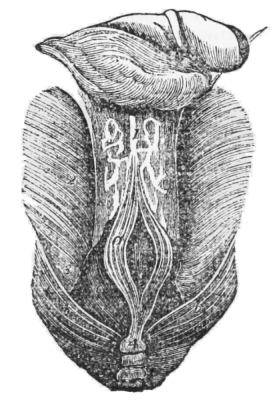
1. The superficial fascia of the Perinœum.
2. The fascia lata, or shiny covering of the muscles of the thighs.
3. The tuberosity of the ischia, or part whereupon we sit.
4. The last portion of the spine, called the Coccyx, easily to be felt posteriorly to the rectum.
a. The Sphincter muscle of the Anus.
b. The inferior border of the great muscles of the buttock, called the Gluteal.
c. The Levator Ani, or muscles which elevate the rectum.
The following cut represents the muscles of the perinœum exposed, the superficial fascia having been removed.
1. Point in the Perinœum where the principal muscles arise or meet. 2. Covering of the Thigh. 3. Seat. 4. Corpora Cavernosa of the Penis. 5. Corpus Spongiosum. 6. Coccyx. 7. Great Sacro Sciatic ligament. a, a. Erector Muscles of the Penis. b, b. Accelerator Urinæ Muscles. c. Line whence the above Muscles take their origin. d. Transverse Muscles of the Perinœum. e, e. Sphincter Muscle of the Anus, supposed to be distended with tow or wool. f, f. Levatores Ani. g, g. Great Gluteal Muscles. View larger image
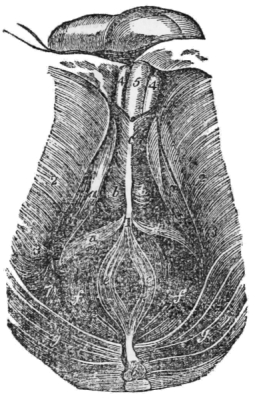
1. Point in the Perinœum where the principal muscles arise or meet.
2. Covering of the Thigh.
3. Seat.
4. Corpora Cavernosa of the Penis.
5. Corpus Spongiosum.
6. Coccyx.
7. Great Sacro Sciatic ligament.
a, a. Erector Muscles of the Penis.
b, b. Accelerator Urinæ Muscles.
c. Line whence the above Muscles take their origin.
d. Transverse Muscles of the Perinœum.
e, e. Sphincter Muscle of the Anus, supposed to be distended with tow or wool.
f, f. Levatores Ani.
g, g. Great Gluteal Muscles.
A brief description of the structures displayed in the two preceding and the following drawing (p. 14) will render this part of our subject perfect.
The Fasciæ means the coverings of muscles, such as is seen in cutting a domestic joint—a leg of mutton, for instance—a shiny surface; their use is to strengthen the action of the muscles, to bind them well together, and they mostly exist about the buttocks, back, &c.
The office of a Sphincter Muscle, of which we have several, as that of the bladder and anus, is to keep closed the aperture they surround. The sphincter ani closes the rectum, and pulls down the bulb of the urethra, by which it assists in ejecting the urine and semen.
The Levator Muscles lift up the part they are connected with. The levator ani muscles form the funnel appearance of the rectum, and help to draw it up after the fæces or stools are evacuated. They also assist in sustaining the contents of the pelvis, and help to eject the semen and urine, and contents of the rectum, and, perhaps, by pressing upon the veins, contribute to the erection of the penis.
1. Coccyx. 2. Semen. 3. Covering of the Thigh. 4. Great Sacro Sciatic Ligament. a. Bulb of the Urethra. b. Corpus Spongiosum. c. Crura of the Penis, being the conclusion of— d. Corpora Cavernosa Penis. e. Sphincter of the Anus. f. Levatores Ani, covered by a fascia or prolongation of the triangular ligament of the Urethra. g. Great Gluteal Muscles. h, h. Triangular Ligament of the Urethra. The artery of the bulb is seen on the left as it runs between the Crus Penis and bulb of the Urethra. View larger image
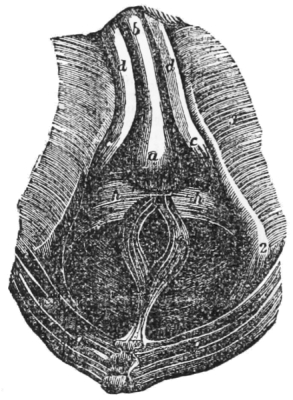
1. Coccyx.
2. Semen.
3. Covering of the Thigh.
4. Great Sacro Sciatic Ligament.
a. Bulb of the Urethra.
b. Corpus Spongiosum.
c. Crura of the Penis, being the conclusion of—
d. Corpora Cavernosa Penis.
e. Sphincter of the Anus.
f. Levatores Ani, covered by a fascia or prolongation of the triangular ligament of the Urethra.
g. Great Gluteal Muscles.
h, h. Triangular Ligament of the Urethra. The artery of the bulb is seen on the left as it runs between the Crus Penis and bulb of the Urethra.
The Gluteal Muscles help the rotatory motion of the thigh, and give support generally to the buttocks.
The Sacro-Sciatic Ligaments assist in the firm union of the bones of the pelvis.
The Erector Muscles of the penis propel the urine and semen forward; and, by grasping the bulb of the urethra, push the blood toward the corpus cavernosum and the glans, and thus distend them.
The Accelerator Urinæ Muscles, as their name implies, help to eject the urine and semen.
The Triangular Ligament of the urethra assists the preceding purposes.
———<>———
Testicles.—The testicles are two glandular oval bodies suspended in the scrotum. They furnish the male seed. They are supported by what is called the Spermatic Chord, which consists of the spermatic artery that supplies the testicle with arterial blood, whence the semen is concocted; the veins that return the superfluous blood, and the tube that conveys the semen to the urethra. The testicles are very liable to inflammation, and particularly to changes resulting from the wear and tear of human life—changes that not simply produce pain or inconvenience, but those whereby the power of the organs becomes partially if not wholly lost. A rather ample description of their complicated structure will show the necessity of attending to the earliest symptoms of disturbance. The testicles, in embryo, are lodged in the belly, but they gradually descend, and usually are found in the scrotum at birth. There are occasional exceptions, when one or even both testicles do not descend, but are retained in the groin. Mr. Hunter considered that their virility was thereby impaired, although such an opinion is negatived by numerous illustrations. The non-descent of the testicle, necessarily from its confined situation when in the groin, can not be so fully developed as where it is allowed to range in the scrotum. It is also exposed to accidents when retained, and cases have occurred where Hydrocele, a disease to be noticed hereafter, has ensued, producing much inconvenience, and occasionally the same has been mistaken for rupture. The testicles have several coats. The Scrotum should be considered as one, which is merely a continuation of the common integuments, exceedingly elastic, nearly destitute of fat, and possessing a peculiar contractile power of its own, whereby it can closely embrace the testicles, and at other times yield or become distended, as in hernia or hydrocele, to the size of a melon. The contractile powers of the scrotum have been assigned to the supposed presence of a muscle, which is merely a thickened cellular membrane, and called Dartos. It was stated that the testicles were suspended by their spermatic chords—their support is rendered more perfect by the presence of a muscle to each, that descends into the scrotum, and which is called the Cremaster—it is an expansion of one of the muscles of the abdomen, called the internal oblique, and it spreads itself umbrella fashion around the chord, over the upper part of the testicle, and its fibres extend ray-like over the other coats of the testicle—its office is to draw up the seminal organs during procreation.
The testicles, thus suspended, have two coats, one adhering closely, and the other loosely surrounding the former—between the two, a lubricating fluid is secreted, whereby the various movements of the body are permitted without injury; it is between these coats that water is secreted occasionally, constituting the disease known as hydrocele. The closely fitting coat is termed from its whiteness and density Tunica Albuginea—the other Tunica Vaginalis. These coverings are formed of that extensive membrane in the abdomen called the Peritonœum. The Tunica Albuginea which surrounds the testicle previous to its descent, accompanies it into the scrotum, propelling, as it were, the Tunica Vaginalis before it. On the descent of the testicles into the scrotum, the opening through which they passed becomes impermeably closed.
The annexed diagram will explain the coats and facilitate the understanding of subsequent descriptions.
1. Body of the Testicle. 2. Epididymis. 3. Vas Deferens. 4. Spermatic Artery. 5. Veins. 6. Cremaster Muscle 7. Tunica Albuginea. 8. Tunica Vaginalis. 9. Scrotum. 3, 4, 5, 6, and 8 constituting the Spermatic Chord. View larger image
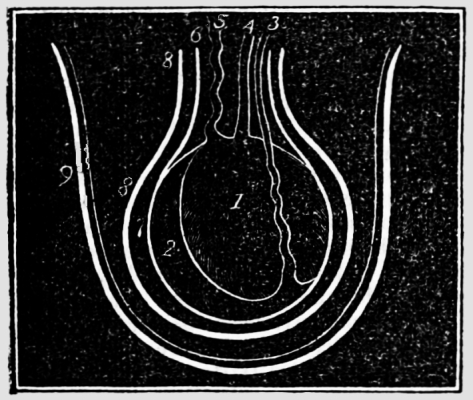
1. Body of the Testicle.
2. Epididymis.
3. Vas Deferens.
4. Spermatic Artery.
5. Veins.
6. Cremaster Muscle.
7. Tunica Albuginea.
8. Tunica Vaginalis.
9. Scrotum.
3, 4, 5, 6, and 8 constituting the Spermatic Chord.
When the coats of the testicle are taken off, it is found to consist of innumerable delicate white tubes, which when disengaged from the cellular membrane that connects them together, and steeped in water, exhibit a most astonishing length of convoluted vessels; they appear to consist of one continuous tube, convoluted in partitions of the cellular membrane. When the Tubuli come out from the body of the testicle, they run along the back of it and form a net work of vessels called Rete Testis; it is supposed that by the net work the semen is conveyed from the testicle. The continuations of this Rete Testis have been denominated Vasa Deferentia, which, ending in a number of Vascular Cones, constitute what is called the Epididymis. The Vasa Deferentia, after forming three conical convolutions, unite and form larger tubes, which ultimately end in one large excretory duct, called the Vas Deferens. The following description relates to the accompanying sketch.
a. Body of the Testicle. b. Tubuli Testis. c, c. Rete Testis. d. Vasa Deferentia. e. Vascular Cones. f. Epididymis. g. Vas Deferens. View larger image
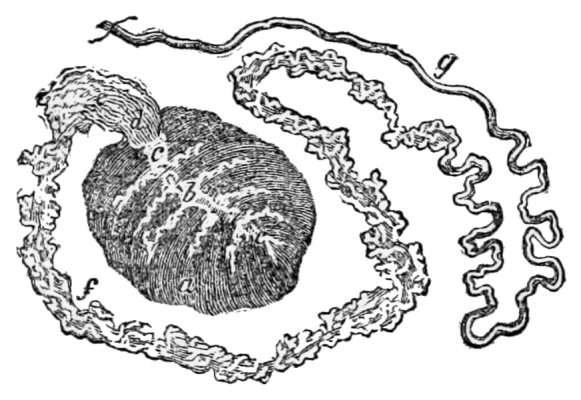
a. Body of the Testicle.
b. Tubuli Testis.
c, c. Rete Testis.
d. Vasa Deferentia.
e. Vascular Cones.
f. Epididymis.
g. Vas Deferens.
The preceding completes the anatomical description of the Testicle. The semen is supposed to be secreted by the arteries that ramify among the seminal tubes; the last drawing exhibits the testicle as from the hand of the dissector. In life and in health the epididymis is attached to the testicle—the vas deferens passes up the chord, enters the abdomen, and, passing down into the pelvis, terminates in the vesiculæ seminales as already, but to be again, alluded to. The two subjoined drawings illustrate the testicles in their natural situation.
a. Body of the Testicle. b. Commencement of the Epididymis. c. End of ditto. d. Vas Deferens. View larger image
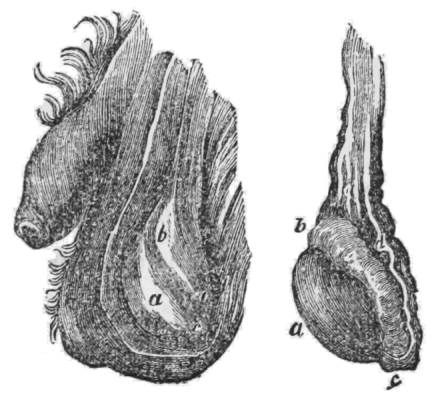
a. Body of the Testicle.
b. Commencement of the Epididymis.
c. End of ditto.
d. Vas Deferens.
In the larger figure the testicle is displayed as enveloped by its coverings, and in the lesser as stripped of them. The references serve for both.
We now come to speak of the Vesiculæ Seminales. It was just observed, that the Vasa Deferentia terminated in these structures. They are attached to the lowest and back part of the bladder, behind the Prostate Gland. The following drawing is the prelude to the description—It represents the Prostate Gland, the Vesiculæ Seminales and the Bladder.
a, a. Prostate Gland. b. Gland cut away to show the Ducts of the Vesiculæ. c. Ends of the Ducts. d, d. Cells of the Vesiculæ. e. Left Vas Deferens, also cut open to show its connexion with the Vesiculæ. f. Right Vas Deferens. g, g. Openings of the Vas Deferens and Vesiculæ into the Urethra. h. Bladder. i. Ureter. View larger image
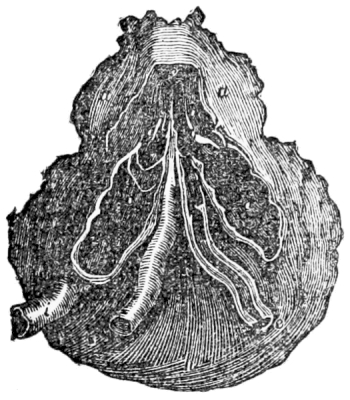
a, a. Prostate Gland.
b. Gland cut away to show the Ducts of the Vesiculæ.
c. Ends of the Ducts.
d, d. Cells of the Vesiculæ.
e. Left Vas Deferens, also cut open to show its connexion with the Vesiculæ.
f. Right Vas Deferens.
g, g. Openings of the Vas Deferens and Vesiculæ into the Urethra.
h. Bladder.
i. Ureter.
The Vesiculæ Seminales appear like two cellular bags. They have two coats, the one called nervous, and the inner the cellular, a membrane divided into folds or ridges. The use of the vesiculæ is supposed to be, to act as reservoirs for the semen; but there are different opinions upon the subject, some contending that they furnish a fluid, not spermatic, but merely as an addenda to the seminal secretion; whereas others, who have examined the vesiculæ of persons who have suddenly died, have discovered all the essential qualities of the male seed therein; and, in fact, physiologists, who direct researches in these matters, advise such examinations as the surest means of obtaining, in a state of purity, the seminal fluid.
The Male Semen is a fluid of a starch-ish consistency and of a whitish color. It has a peculiar odor, “like that of a bone while being filed—of a styptic and rather acrid taste,” (for physiologists use more senses than one in these researches), “and of greater specific gravity than any other fluid of the body.” Shortly after its escape, “it becomes liquid and translucent;” if suffered to evaporate, it dries into scurfy-looking substance. By being examined through a powerful microscope it is ascertained to be animated by an infinite number of animalcules; but they are only present in healthy semen, and consequently that fact is taken as a criterion of the virility of the secretion.
President Wagner thus describes the germe of future animal life: “The seminal granules are colorless bodies with dark outlines, round and somewhat flattened in shape, and measuring from 1-300 to 1-500th of a line in diameter.” “The animalcules exist in the semen of all animals capable of procreation. They are diversified in form in all animals according to their species, but in man they are extremely small, scarcely surpassing the 1-50th, or almost the 1-40th of a line in breadth. This transparent and flattened body seldom exceeds from the 1-6th to the 1-800th of a line in length.”
The annexed drawing exhibits the granules and animalcules of a human male being magnified from 900 to 1,000 times:—
1. Animalcules of a man, taken from the Vas Deferens, immediately after death. 2. Seminal Granules. 3. A bundle of Animalcules, as grouped together in the Testicle. 4. Seminal Globule. 5. Same surrounded by a cyst or bag. View larger image
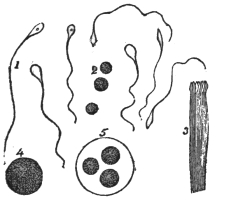
1. Animalcules of a man, taken from the Vas Deferens, immediately after death.
2. Seminal Granules.
3. A bundle of Animalcules, as grouped together in the Testicle.
4. Seminal Globule.
5. Same surrounded by a cyst or bag.
The semen is never discharged pure; it is always diluted with the secretion from the prostate and other glands, and also the mucus of the urethra. A chymical analysis is thus given of 100 parts:
Water 90
Mucilage 6
Phosphate of Lime 3
Soda 1
——
100
The semen may certainly be vitiated and diseased: the odor and color assume all the gradations of other secretions when in a morbid condition.
Semen not discharged is supposed to be absorbed, thereby adding to the strength and nutriment of the economy; but as it is furnished for a specific purpose, and its secretion depends much upon the play of our animal passions, and as they are rarely permanently idle, there is not only the inducement that the fluid be furnished, but also emitted, and hence we have nocturnal emissions. These, to a degree, are salutary; but they may happen so frequently that the function becomes disordered and perverted, and in some individuals the semen (unconsciously to them) escapes during sleep, or on the slightest local excitement of riding, walking, or on the action of the bladder or rectum.
The prostate gland, as has been stated, contributes much to the dilution of the semen; it may empty itself independently of it. The gland is composed of numerous cells, from which proceed some twenty or thirty pipes or passages that open in the urethra by the sides of the verumontanum, as shown in the drawing.
———<>———
Morbid Secretions and Irritability of the Urethra.—I have stated that clap or gonorrhœa is one of the first and most frequent complaints of the generative apparatus. There are many secretions common to the urethra, such as those afforded by the various glands for the purpose of lubrication, &c.; and the lining membrane of the passage yields a moisture for its own protection, like the membrane of many other organs, such as the eyes, nose, mouth, and so forth, and these secretions may become unhealthy or vitiated, and give rise to symptoms that lead on to confirmed disease; and, what is still more remarkable, may assume many of the characters and appearances of gonorrhœa, but they rarely induce such constitutional disturbances as clap. The symptoms, consequences, and duration of clap, form its distinguishing features from any other discharge of the urethra: it is very important that such distinction should be understood, for the treatment of the two affections differs most materially; the one is an affection of weakness, and the other of an inflammatory and pestilential nature. The symptoms of clap are as follow: there is usually first felt an uneasy sensation at the mouth of the passage or urethra. The patient is frequently called upon to arrange his person; that uneasy sensation sometimes amounts to an itching (occasionally of a pleasurable kind) the feeling extends a little way up the penis; there is oftentimes an erection and a desire for intercourse, which, if indulged in, the sooner develops the disease. The itching alone will not convey the disease from one person to another; but if intercourse be held, the action of the inflamed vessels is accelerated, and a purulent secretion which is infectious is urged forth and emitted with the semen: therefore the very symptom of the tingling or itching, for it rarely exists in healthy urethræ, should be noticed, and intercourse be avoided until it shall have ceased.
About this time is perceived a slight heat on passing water, or at the conclusion of the act; and shortly after, or may be before, a yellowish discharge is observed oozing from the mouth of the glans or nut of the penis; the symptoms then rapidly advance, unless timely and judicious means be adopted to palliate them or effect a cure; the scalding becomes intense, and the pain and smarting continue some time after each operation of passing water: the discharge becomes profuse and clots on the linen, and continues to ooze out with little intermission: the orifice of the urethra looks red and inflamed, and the glans itself swells and is occasionally extremely tender: the foreskin or prepuce sometimes, but fortunately not always, becomes swollen, and tightened over the nut of the penis, from which it can not be drawn back, constituting that form of the disease known by the name of phymosis. See drawing annexed.
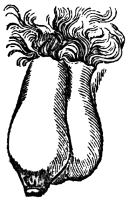
View larger image
When that is the case, other annoyances ensue; the purulent matter collects around the glans; excoriations, ulcerations, and sometimes warts, are the consequence; the whole symptoms become thereby much aggravated. It also happens that the prepuce from inflammation assumes a dropsical appearance, that is to say, the edges or point swell, and appear like a bladder filled with water; thus, the size which the penis then arrives at is enormous, and to the patient very alarming; it usually, however, subsides in a day or two, if rest and proper measures be employed.
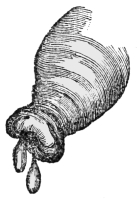
View larger image
The glans with some people, is always bare, and the foreskin drawn up around it. Such a state may be induced also by disease: in either case, it may become so inflamed as to resist any efforts to draw it over the glans and, from the swelling and consequent pressure on the penis, a kind of ligature is created; and instances have been known where the most disastrous results have ensued. The circulation of the blood in the glans is checked; the nut puts on a black appearance, and if the ligature be not removed or divided, mortification takes place, and the tip or more of the penis sloughs off or dies away. This state of the prepuce is called paraphymosis: it sometimes happens to young lads, who, having an indicated opening of the foreskin, endeavor to uncover the glans: they succeed, but are unable to pull the prepuce back again. They either take no further notice of it, or else become frightened, but conceal the accident they have committed: in a few hours, the parts become painful, swell, and all the phenomena above detailed ensue.
The annexed diagram exhibits the foreskin in a state of paraphymosis.
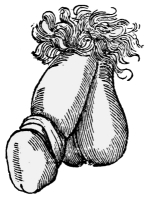
View larger image
The next proceeding which will probably be induced, will be an extension of the inflammation to the bladder: the symptoms are a frequent desire to make water, and occasionally ulceration of the membrane lining the bladder follows, when a quantity of muco-purulent matter is discharged, which, mingling with the urine gives it the appearance of whey. Now and then the bladder takes on another form of disordered function: the patient will be seized with retention of urine, that is, a total inability to discharge his water, except by the aid of the catheter. A new and most perplexing feature about this stage of the proceeding is perceived: it is what is called chordee. The existing irritation excites the penis to frequent erections, which are of the most painful nature. The penis is bent downward; the occasion is, the temporary agglutinization of some of the cells of the corpora cavernosa through inflammation, and the distension of the open ones by the arterial blood, thereby putting the adherent cells on the stretch, and so constituting the curve, and giving rise to the pain. This symptom is frequently a very long and troublesome attendant upon a severe clap; it is more annoying, however, than absolutely painful, as it prevents sleep, it being present chiefly at night-time when warm in bed.
Occasionally the glands in the groin enlarge and are somewhat painful; they sometimes, but very rarely swell and break; they more frequently sympathise with the adjacent irritation, and may be viewed as indications of the amount of general disturbance present; as the patient gets better the glands go down, leaving a slight or scarcely perceptible hardness as it were to mark where they had been. The most painful of all the attendant phenomenon of clap is swelled testicle, or, as in medical phraseology it is called, Hernia humoralis.
The first indication of the approach of the last-named affection is a slight sense of fulness in the testicle, generally the left first, although occasionally in the right, sometimes one after the other, but rarely both together: a smart twinge is now and then felt in the back upon making any particular movement: the testicle becomes sensibly larger and more painful, the chord swells also and feels like a hardened cord in the groin: the patient is soon incapacitated from walking, or walks very lame; if the inflammation be not subdued by some means, and if the patient be of a “burning temperament,” that is, of a very inflammatory constitution, fever is soon set up, and the patient is laid upon a “sick bed.” There is no form of the complaint so dangerous to neglect as swelled testicles; they have sometimes been known to burst or become permanently callous and hardened, and ever after wholly unfit for procreative purposes: in other instances, they have entirely disappeared by absorption: in fact, all diseases of the testicles interfere with the generative power. At the onset of inflammation there may be a brief increase of sexual appetite, but when the structure of the testicle becomes altered or impaired, that appetite is subdued or wholly lost; there is such a wonderful sympathy betwixt all parts of the generative economy of man, that if one portion only be injured, the ordinary end of sexual union is frustrated.
The gonorrhœal poison is capable of producing a similar discharge from other parts to which it may be applied besides the urethra. It has been conveyed by means of the finger or towel to the eyes and nose; and a purulent secretion (attended with much pain and inconvenience, indeed with great danger, when the eye becomes so attacked), has oozed plentifully therefrom. Gonorrhœa is an infectious disorder, and consequently is communicable by whatever means the virus be applied. It certainly is possible, and (if we are to believe the assertions of patients, who are often met with, declaring they have not held female intercourse, and yet have contracted the disease), it certainly is not improbable that it may be taken up from using a water-closet that has been visited by an infectious person just before. It may also be contracted by using a foul bougie.
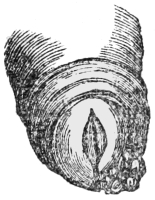
View larger image
If the gonorrhœal discharge be suffered to remain on particular parts of the person, such as around the glans of the penis, or on the outside of the foreskin, excoriations, chaps, and warts, spring up speedily and plentifully, and protrude before the prepuce, or sometimes become adherent to it, as here drawn: it therefore only shows how necessary cleanliness is in these disagreeable complaints, to escape the vexations alluded to. A species of insect also is apt to appear about the hairy part of the genital organs, and indeed extend all over the body, particularly in those parts where hair grows, such as under the armpits, chest, head, &c., if cleanliness be not observed. They are called crabs. The itching they give rise to is very harassing, and the patient, unable to withstand scratching, rubs the parts unto sores, which, in healing, exude little crusts that break off and bleed.
A. The Pubis studded with these insects. B. The Crabs, or Pediculi Pubis, as they are called, about their natural size, as picked from the skin. View larger image
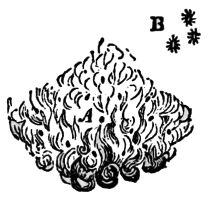
A. The Pubis studded with these insects.
B. The Crabs, or Pediculi Pubis, as they are called, about their natural size, as picked from the skin.
When the gonorrhœa has been severe and there has been much constitutional disturbance, there frequently hang about what are called flying rheumatic pains; and sometimes, if the patient’s health be much broken up, confirmed rheumatism seizes hold of him, and wearies him out of several months of his existence. I have seen many a fine constitution, by a tedious ill-treated or neglected gonorrhœa, much injured, that, had the sufferer consulted a medical man of even ordinary talent, in the first instance, instead of foolishly leaving the disease to wear itself out with the help of this recommended by one, and that by the other, he might have shaken off the hydra, and have averted the hundred vexations that follow.
I come now to add to the list of calamitous consequences, stricture, which, in my opinion, prevails to an enormous extent; however, its consideration will be reserved, as well as the affections of the bladder, and prostate gland, for their proper places. I will simply repeat my impression that a stricture, or narrowing of the urethra, or some organic changes, invariably ensue when the gonorrhœa has been mismanaged, or its cure unfortunately protracted.
It is the opinion of many medical men, and it can, no doubt, be borne out by many patients, that a gonorrhœa if unattended by any untoward circumstance, will wear itself out, and that the duration of such a proceeding is from one to two months; there is no disputing but such has been, and is now and then the case, but such rarely stand even so fair a chance of recovery as to be left entirely alone: even if medicine be not taken, rest, abstemiousness, and such like means, are seldom followed up; either the patient lives gloriously free, or else goes to the opposite extreme.
The cases of gleet which seek medical relief are more numerous, as most professional men must be aware, than those of gonorrhœa, for the reasons so frequently alluded to; the fair inference would be, that a gonorrhœa seldom escapes the terminus of a gleet.
The distinguishing feature of gleet from gonorrhœa is that it is not considered infectious: it consists of a discharge ever varying in color and consistence; it is the most troublesome of all urethric derangements, and doubtlessly helps more to disorganize the delicate mucous membrane lining the urinary passage than even the severest clap. Its action is constant though slow; and subject as we are to alternations of health, of which even the urinary apparatus partakes, it is not to be wondered at that a part of our system which is so frequently being employed, should become disturbed at last, and that stricture and all its horrors should form a finale; but as gleet and stricture form in themselves such important diseases, I shall devote a chapter to the consideration of each separately.
———<>———
The Surgical Treatment of Gonorrhœa.—The principal symptoms indicative of the outbreak of a gonorrhœa are a scalding burning sensation along the urethra as the urine passes through it, and also the pouring forth of a profuse discharge of yellow matter from the same passage. The urethra is lined with a very sensitive membrane, fashioned, however, to be insensible to the urine in its natural state; but if the character of the urine or the membrane itself be altered, the most exquisite misery is produced. Now in gonorrhœa, when it is a first attack, the initiatory sensation is invariably heat, itching, or pain in the urethra; the seat of this suffering is in the mucous membrane. On separating the lips of the orifice of the urethra, the passage appears highly vascular, very red, and looks, according to the popular notion, very sore. On examining it with a powerful glass, little streaks or surfaces of a yellow and tenacious matter are perceived, which, upon being removed, are soon replaced by others. When the patient attempts to urinate, this purulent exudation becomes washed off. By this time, the system is somewhat excited, and the urine is consequently more deeply impregnated with uric acid, which renders it more acrid and pungent to the delicate and now tender outlet through which it flows: the sensation is faint at first, but is rendered very acute by the combined worry inflicted upon the urethra, by its muscular contraction to eject every drop of urine, the denuded state of the membrane itself, and the irritating quality of the water. Such, however, is the habit of action, that the urethra in course of time becomes indifferent to the annoyance of the flow of urine. The nervous sensibility is much diminished, and the urethra is further protected by an abundance of the venereal secretion. There are numerous contingencies that prevent the changes ensuing in such order, and, consequently, the scalding, and the amount of discharge, are seldom two days alike. Were there to be no interruption, the inflammation, for such is the whole process in obedience to the animal law, would fulfil its intention and retire; but molested as it is by diet, exercise, the varied states of health, and numerous other fortuitous circumstances, as we well know, it exists indefinitely. It would be next to an impossibility to explain the process whereby the character of a secretion becomes altered, or to describe the exact changes which the structure or vessels undergo when furnishing the discharge; but we well know that some such changes do take place, and that a cause must precede an effect. In like manner we can ascertain the result of certain experiments, although the modus operandi may baffle our penetration. Gonorrhœa is originally a local complaint, but if not arrested, it involves not only the neighboring parts, but it compromises the general health. Now if the same ends can be brought about by artificial means in a few days, that it takes weeks to effect in the ordinary routine, all the intermediate suffering may be avoided, and all the inconvenience of confinement and physic-taking spared.
To cure this disease I find that in many cases, if the parties apply at the very onset of the disease, before the discharge and scalding have set in with anything like severity, and they themselves be not of a very inflammatory temperament, that a sharp stimulating injection will at once subdue the sensitiveness of the urethra and alter the action, and, at the cost of very little, and that only temporary suffering, effect a speedy cure: the mode, except it be by stimulating the relaxed vessels, or owing to the specific action of the injection, is, like all other medical operations, a mystery. A favorite prescription is the nitrate of silver, say one scruple of the nitrate to the ounce of water, but the disease must be thus treated at the very first symptom: the patient must be otherwise in comparatively good health, and his occupation must not expose him to much bodily fatigue. He must not be given to intemperance, nor should those instances be selected where the sufferer is of a very inflammatory constitution. Experience begets confidence, and confidence begets experience. In cautious hands I am satisfied of its usefulness; but there are cases that turn out failures. I have used the injection when the disease itself was a week old, and with like success; but I am ready to confess I have known cases, the cure of which were retarded by its employment. The inflammation has been temporarily aggravated, but they were cases where the treatment was not appropriate; the disease was far advanced, there was much heat and swelling, and the patient’s health was in most instances considerably affected; but yet beyond the few hours’ of suffering merely, no extraordinary symptoms were produced. The cure was very shortly after effected by means which I shall presently allude to.
In all cases of suspicious connexion I recommend copious ablution as soon as possible.[1] The syringes I would advise to be used should have their points conically shelved off pear fashion; they fill up the urethra like a wedge, and prevent the immediate escape of the injection: all injections should be retained a few seconds, and then be allowed to flow out. It is seldom worth while to repeat the operation more than twice on an occasion; but that occasion may be resorted to two or three times a day.
When the nitrate of silver is used, the syringe had better be made of glass. The nitrate of silver discolors the skin, linen, &c.; therefore gloves should be worn, and care taken that the fluid be not spilt over the person or dress, but should the skin be stained, it can be removed by a strong solution of hydriodate of potash.
The plan of injection, I must remind the reader, is only applicable in early and old cases. The recent cases, as I have before stated, are less frequently before the medical man than what we may call a “ripe” gonorrhœa. The old cases present also some difference as to the cause of their continuance, and require also some difference in their treatment, and they will be introduced under the chapter headed “Gleet.”
The symptoms of a clap, fully developed, are severe scalding, voluminous discharge, painful erections, local inflammation, probably phymosis or paraphymosis, glandular swellings, and possibly swelled testicle.
But all cases of gonorrhœa are not ushered in with such severity; nor do many, if common cleanliness and quiet only be maintained, experience even the various accompaniments just described, and still fewer would if the following precautions and measures were used.
The plan just laid down, may be called the surgical treatment of gonorrhœa; the following may be designated the Medical. This is divided into two methods—the one denominated the Antiphlogistic, the other Specific. The Antiphlogistic is a term applied to medicines, plans of diet, and other circumstances, that tend to oppose inflammation by a diminution of the activity of the vital powers, whereby the inflammation is subdued, and nature rights herself again of her own accord. The Specific implies a reliance upon a particular remedy, which is supposed at once to set about curing the disease, as, for instance, by giving Bark in Ague—Colchicum in Rheumatism—Cubebs or Copaiba in Gonorrhœa.
Now, both these plans are successful in curing gonorrhœa; but the majority of medical men adopt the former method, inasmuch as although it but quietly conducts the case to a successful termination, still it does so, whereas the specific, in unskilful hands, is often productive of many annoyances, much delay, and not always a cure.
Our plan, however, is as follows: in the first place, I take into consideration the appearance of the patient; if he be strong, robust, sanguine, or of full habit, and youthful—if it be his first attack, and if the symptoms be ushered in with any degree of severity, I invariably and rigidly (where I choose not the surgical) pursue the antiphlogistic course of treatment; if the case be in a person of phlegmatic temperament, of mature age, and the disease be but a repetition of the past, and there be no evidence of physical excitement, I fearlessly adopt the specific. Where, in the third place, I encounter a patient with no very prominent peculiarity, nor with symptoms demanding extraordinarily active measures, experience has taught me the propriety of cautiously combining the two methods—a mild aperient had best always a precede a tonic or a stimulant, in cases where there is a doubt of inflammation lurking in the system; and, recollecting the tendency our complicated organization has, when assailed by a distemper, to become irritable, it is always as important to know when to withhold a remedy as when to prescribe one.
The three following imaginary cases will serve as no inapt illustration of the principles laid down:—
A. B. A man twenty-six years of age, five feet six inches in height, weighing eleven stone six pounds, of a full rounded form—florid complexion, of what is termed a sanguine temperament, and harassed with the following symptoms: profuse discharge in large yellow clotted lumps of gonorrhœal virus—intolerable scalding on passing water—great pain at the rectum at the close of micturition—redness and swelling of the orifice of the glans penis, puffiness of the prepuce, a vicious chordee—inclination to headache—a bounding pulse—hot skin, and an anxious mind. Treatment: say first bleeding, then purging; warm bath, saline powders or mixtures, cold lotions to the part, rest, abstinence; the following eve, symptoms will be less severe. Continue the powders, temperance and quiet. In a few days, the discharge will be lessened, the scalding mitigated, the chordee gone, and the fever exchanged for the cool skin of health. The resuscitative powers of nature await only the fillip of some gentle stimulant, and the sick man throws off his mantle for the coronal of health.
B. C. At twenty-three, dark countenance, marked features, well developed muscular form, pulse 66, bilious temperament, accustomed to late hours, hard drinking, and seldom still, and subject to clap. Symptoms: plenteous discharge with but little scalding, and no inconvenience beyond the suspension of ordinary sensualities. Treatment: cleanliness, cubebs or copaiba, injections, a black draught, and half a dozen days’ rest, release him from his quarantine.
C. D. At nineteen, a timid bashful youth, for the first time infected with gonorrhœa, which he had enduringly borne for the last fortnight, having neglected until now to seek professional aid, although cajoled into the purchase and imbibing of some popular “never-failing antidote” for a “certain disease.” Symptoms: discharge cured? right testicle swollen, and treble the size of the other, and excruciatingly painful; frequent desire to pass water, pain in the groin and back, general lassitude, and a feeling of illness all over. Treatment: leeches, warm bath, bed, purging, fever medicines, cold lotions, hot fomentations, low diet and patience, a month’s imprisonment, and a slow recovery. Had the treatment of the first two cases been reversed, the results would have been very different: and had the last sought timely and efficient aid, he would have been spared much that he endured.
However, to particularize the treatment for each symptom; to commence, I will request the reader to remember that on the first appearance of gonorrhœa, attended with an unusual inflammatory aspect, I practise, where permissible, venesection; if the case demand it not, at least there should be administered an aperient; let, therefore, a dose of opening medicine be taken immediately (Form 1). This is the first step toward reducing inflammatory action—the next should be directed toward allaying the local symptoms, by diminishing the nervous irritability of the urethric passage.
With this view, no plan surpasses that of bathing the penis in warm water, or immersing the entire body in a warm bath. The former should be repeated several times in the day; the latter daily, or certainly on alternate days, so long as the severity lasts.
By these means, the parts will be preserved clean, and will derive benefit from the soothing influence of warmth; and, in many cases, this will be the means of averting chordee or swelled testicle.
Where, however, from peculiar circumstances, warm water and warm baths are not to be had, the penis should be bathed in cold water, or encircled with pledgets of rags or lint, moistened with cold goulard or rose-water. Warm, however, is to be preferred, although cold water seldom fails of affording relief.
To lessen the acrimony of the urine, which keeps up the irritability, and somewhat to lower the system, all strong drinks, such as ale, beer, wine, and spirits, should be avoided, and milk, tea, barley-water, toast and water, linseed tea, gum arabic in solution, and other such mucilaginous diluting liquors taken instead. The diet should be lowered: in fact, a spare regimen should be adopted, not wholly abstaining from animal food, but partaking of it only once in the day, and carefully excluding all salted meats, rich dishes, soups, gravies, &c. The usual employment should be suspended, and rest should be taken as much as possible in a recumbent posture.
Of course the preceding remarks apply only to cases of severity; I mean such cases as first attacks ordinarily prove; and which remarks, if attended to, will greatly mitigate the violence of the disease.
To assist the foregoing treatment, the aperient medicine, which should be repeated, at least, on alternate days, until the inflammation is ameliorated, should be followed by some saline or demulcent medicine to allay the general disturbance. Several formulæ are suggested for that purpose, suitable to various temperaments and conditions—[See Forms 2, 3, 4, 5 in Formulæ annex.]
By these means, the disease, if not aggravated by intemperance of living, or otherwise, will gradually subside, and in the course of a fortnight or three weeks, cease entirely, without the aid of any other remedy whatever.
But we need not rest satisfied with merely “showing” the disease through its stages; we can expedite it, and many of its steps we can skip over, and here it is we may call to our aid the specific method of treatment alluded to. This specific method consists of the suspension of a vitiated secretion, and a restoration of a healthy one. Now how this is effected we know not; we only know that it can be done—and experience has taught us that it may be done safer at one time than another. During the existence of a fevered state of the circulation, it would be highly impolitic suddenly to check a discharge from any surface, much less one situated like the mucous membrane of the urethra, in the immediate connexion, as it is, of important nerves and glandular structures—a metastasis of the inflammation will almost invariably ensue; and hence we account for swollen testicles, buboes, painful affections of the bladder, &c. Whereas, on the subsidence of inflammation, the revulsion is borne; and to our satisfaction, the disease disappears. A constitution in a state of excitement is like a fretted child—it will have its “will” out, and the rod is not always the safest corrective.
On the subsidence, therefore, of the scalding, and a lessening of the general fever, the specific plan of treatment may be commenced. Upon the same principle that the surgical treatment is selected according to the symptoms, so also are the just-named preliminaries in many cases dispensable, and hence, as hereafter detailed, it will be found that the antiphlogistic and specific do not go always hand in hand. However, to explain the latter:—
By specifics are meant those remedies that exert a positive curative effect on a particular disease; and the most prominent of those, in gonorrhœa, are copaiba and cubebs. See Formulæ annex for some useful recipes of both—Forms 6, 7, 8, 9, 10.
For instance, cubebs may be taken alone, in water, in doses of a tablespoonful twice or thrice daily. If cubebs produce no good effect in four or five days, it had better be discontinued, and other means sought after.
These proceedings usually carry the disease to a close, and, if no adventitious circumstances occur, successfully and speedily. It is well to deserve success, but it can not be always commanded.
The business engagements of young men render it almost impossible for them to devote that care and attention so importantly requisite; and few, consequently, will be found who will be fortunate enough to escape the usual concomitants of a gonorrhœa.
Where, therefore, the scalding or passing the urine is very severe, the pain may be mitigated by carefully injecting, previously to making water, either of the formulæ No. 11 or No. 12 (see Formulæ annex) into the urethra.
The inflammation extends in general not more than two inches down that passage, so that much force is not required to inject the intended fluid, nor should an unnecessary quantity be used.
When the inflammation reaches the bladder—which is indicated by pain in that viscus and the perinœum, with a constant desire to pass water—the taking of a warm bath at a temperature of 100°, and remaining therein for a quarter of an hour, will afford essential relief.
When a chordee is attendant on a gonorrhœa, and the patient can not sleep, the draught (Form 13) may be taken on going to bed, or the powder (Form 14) in some gruel. The embrocation (Form 15) rubbed on the parts affected, however, will instantly remove both the pain and the spasmodic contraction, and not unfrequently prevent their recurrence. Care must be taken that the embrocation be only used for its specific purpose, and not swallowed by mistake, as it is poisonous.
In the event of the patient being obliged to follow his ordinary occupation, or to go about, the use of a suspensory bandage will be found of great benefit; indeed it is indispensable, and the neglect of it has often brought on swelled testicle, or most excruciating chordee.
By way of recapitulation, the treatment of gonorrhœa thus far consists: in severe cases, of bleeding; in ordinary ones, and in both, of warm bathing, local or general—where impracticable, cold—attention to diet, the taking of aperient, soothing and astringent medicines, rest as much as possible, and the use of the suspensory bandage. These remarks are equally applicable, then, through every stage of this complaint that is accompanied by inflammation, and may be relied upon as the most effectual to avert all the consequences I now proceed to detail.
The consideration of the symptoms here following is not in the order in which they always occur; for swelled testicle may ensue without phymosis or paraphymosis preceding, or even being present; and the converse holds equally good with regard to every other.
The successful treatment of phymosis (that condition of the foreskin in which it can not be drawn back over the glans) depends very much upon local management. Bathing the part frequently in warm water, the daily use of the warm bath, and the frequent injection, by means of a syringe, of warm milk and water, are generally all that is required to reduce phymosis; but where it is attended with much inflammation, where the glans is excoriated, probably by the discharge from the urethra accumulating between it and the prepuce, and thereby inducing irritation, bleeding is even sometimes necessary, the strictest antiphlogistic regimen should be preserved, and the treatment advised in the early stages of gonorrhœa scrupulously followed.
Sometimes the prepuce becomes so swollen as to assume an œdematous or dropsical appearance; in which case it may be scarified with a lancet, or several leeches applied. With the exception of concealing the state of the glans, phymosis is less dangerous than paraphymosis, and is most usually produced by the patient worrying the part, by frequently uncovering the glans to observe its condition. Where a discharge is perceived oozing from beneath the prepuce, which is not urethral, and the glans does not feel sore or tender, the injection (Form 16) syringed up five or six times a day, will prove very efficacious in healing the ulceration.
Where there is an unnatural elongation of the prepuce, it will be constantly subject to phymosis, not only from gonorrhœal inflammation, but from the accumulation of the natural secretions of the part. In that case, cleanliness is the only remedy the patient can employ of himself. Occasionally it is necessary to have recourse to the surgeon’s knife.
Paraphymosis is the opposite to phymosis, and usually arises in this way: the orifice of the prepuce, being contracted by the inflammation, is drawn back for the purpose of washing or examination, and is allowed to remain, or, as frequently happens, it can not be redrawn. When this continues some time, considerable inflammation, both of the glans and prepuce, arises. The contracted orifice pressing more tightly, it will often happen that a sloughing of both it and the glans will take place; but this occurs only in consequence of neglect, or in constitutions injured by intemperance.
If seen and attended to early, this state may be removed very easily. The penis should be immersed in a basin of cold water, or sponged, so as to cool it as much as possible; or it may be well oiled. In either case there will not be much difficulty in pressing up the glans and drawing up the prepuce over it; but where adhesion has taken place, or ulceration exists, it will be harder to accomplish: the adhesions must be separated, or the stricture divided with the scalpel.
I need scarcely observe, that such an operation is out of the province of the non-professional person, who should lose no time in consulting his surgeon.
I omitted to mention, in the description of the symptoms of gonorrhœa, that occasionally, in very severe cases, a tumor forms in the perinœum, which, if neglected, proceeds to suppuration, and establishes a fistulous communication with the urethra. On the instant of such a swelling appearing, leeches, fomentations, and poultices, should be applied with a view to disperse it; but the management of such a case had better be intrusted to the surgeon.
Excoriation of the membrane of the glans or prepuce requires for its treatment frequent ablution with warm water until the redness and discharge somewhat diminish, when Form 16 may be resorted to, and applied, if practicable, by a moistened layer of lint; but if accompanied by phymosis, the syringe must be used.
Warts, if not large, are easily removed, by brushing them with the muriated tincture of iron, or the application of a lotion of lunar caustic (Form 17).
Where they are numerous and large, and resist the remedies just recommended, the nitric acid is an excellent escharotic; it gives little or no pain, and is rarely productive of inflammation. The glans, if not naturally denuded (in which instance, by the way, warts seldom accrue), should be kept so for a time; and the nitric acid, after a few moments, washed off with cold water. Notwithstanding, excision is sometimes necessary to their complete removal.
When the organs of generation are infested by pediculi, or crab-lice, the most efficacious and agreeable remedy is the sulphur-bath; one bath generally effecting an extinction of every one of them, even though they be all over the body.
Some recommend shaving the hair off the pubis, the locality in which the vermin are most usually engendered, and applying blue ointment or the black wash. Such a practice is seldom ineffectual, but the irritation attendant upon the reproduction of hair is absolutely intolerable. The hair need not be removed, as the above remedies will be all-sufficient without it. Rubbing the parts well with strong mercurial (or blue) ointment, or the black wash (Form 18), or even powdering them with calomel, will at once destroy the insects, and thereby remove the itching.
Swelled testicle, or hernia humoralis, more especially that proceeding from gonorrhœal irritation, is ushered in and discovered in the following manner: The patient, on some sudden movement of the body, experiences a pain, darting from one of the testes (both being rarely affected at the same time) to the loins—the left testicle is the one generally attacked. On examination, he finds that the testicle is rather swollen and full, and very painful on being handled; the swelling quickly increases and becomes hard, which hardness extends to the spermatic chord, presenting the feel of a rope, passing from the scrotum to the groin.
It is remarkable that when swelled testicle occurs, the discharge from the urethra, which, from previously being very profuse, and the scalding on making water, which was very severe, both suddenly diminish, or cease entirely, until the inflammation of the testis declines; hence, it has been supposed by some, that the disease is translated from the urethra to the testicle.
It is more probably however, derived from the sympathy between the two; the irritation of the one affecting the other, and the preponderance of inflammation in the testicle acting on the principle of counter-irritation to the urethra, and, for a time, thereby lessening the disease in it: for it is observed that, as soon as one improves, the disease returns in the other. The treatment of hernia humoralis must be strictly antiphlogistic. In no form of gonorrhœal disease is bleeding more absolutely necessary.
The timely and prompt loss of twelve or sixteen ounces of blood from the arm will often cut short the complaint, and render other remedies almost unnecessary; while the temporising delay, under the vain hope of the inflammation subsiding, will allow the disease to make rapid progress, and impose a necessity of several weeks’ rest and absence from business, before a cure can be effected.
Immediately, then, on the occurrence of swelled testicle, I would recommend the patient to be bled—to take some aperient medicine, and, if the inflammation continues, to apply from twelve to eighteen leeches, and afterward suffer the wounds to bleed for twenty minutes in a warm bath; to retire to bed or to the sofa, and to maintain a horizontal posture. If he be strong, young, and robust, an emetic (Form 19) may be given previous to the aperient, which has been known to remove the swelling almost instantaneously.
Iodine (Form 20) also possesses a similar specific property in reducing swelled testicle, and may be taken during the inflammatory stage after bleeding and aperients, as may likewise the chlorate or hydriodate of potass (Form 21).
With regard to local applications, the repeated employment of leeches, fomentations, and poultices, with the frequent use of the warm bath, and, above all, keeping the testicle constantly supported by means of a bag, truss, or suspensory bandage, will subdue the disease in a very short time, without impairing the functions of the important organ concerned.
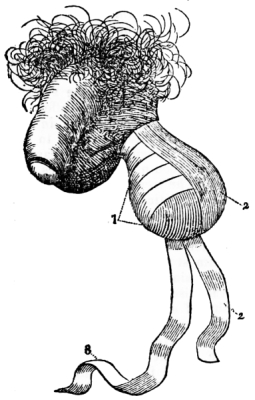
View larger image
A hardness, however, of the epididymis commonly remains and continues during life, but rarely gives rise to any inconvenience, although this may often be remedied by compressing the testicles with strips of adhesive plaster, as seen in the cut.
Almost every case of inflamed testicle will terminate favorably by strictly pursuing the plan proposed; but when, from any untoward circumstance, the inflammation proceeds to suppuration, the case must be treated like one of common abscess, in which event professional aid should be sought for without delay.
Other diseases of the testicle will be treated upon under a specific head.
To return to the treatment of Gonorrhœa:—On the abatement of all or any of the enumerated symptoms, such as the diminution of the scalding upon making water, the subsidence of chordee, the escape from, or cure of, swelled testicle, phymosis and paraphymosis, warts, crabs, excoriations, &c., the discharge may still continue, though thicker in consistence, and deeper in color: and it is at this period, which I will call chronic gonorrhœa, when all inflammatory symptoms have left, that stimulants may be judiciously given; but it must be borne in mind that relapses often occur from imprudence: and this chronic form requires as much attention as the acute or early stage. (See article Gleet.)
———<>———
Gleet.—Gleet is certainly, as its name implies, a discharge of thin ichor from a sore. Patients usually understand, and medical men usually allow, a gleet to be a discharge from the urethra, which has existed some time, of a whitish color, unattended with pain, and that is not infectious, by which is meant is incapable of producing gonorrhœa. There are several kinds of morbid secretions, the successful treatment of which depends upon a knowledge of their differences. They may be divided into two principal orders—those secreted from the mucous surface of the urethra or bladder, and those which proceed from the various glands-leading into one or the other. Gleet is a term popularly applied to both, but more strictly relates to that which proceeds from the membrane lining the urinary canal. There is great analogy in inflammatory affections between the mucous membrane of the digestive and pulmonary, as well as urinary passages. In inflammatory sore throat, the secretions assume various appearances; there is a discharge of viscid mucus, of purulent matter, or of a thin watery nature; these secretions are dependant upon the amount and duration of the inflammation present. Exactly in like manner may be explained those issuing from the urethra. They are consequently alike modified by treatment, by diet, by rest, and aggravated by a departure from constant care. It is the nature of all membranes, lining canals that have external outlets, to attempt the reparative process by pouring forth discharges, while those which line the structures that have not, effect their cure by union with the opposite surface. It is an admirable provision, else important passages might become closed, and so put a stop to vital processes; and in the other case, accumulations ensue that could not escape without occasioning serious mischief. When, however, disease has existed a long time, the operation of the two kinds of membranes is reversed. The serous,[2] through inflammation, take on the character of abscess, dropsy, or other secretions, and the mucous ulcerate or form adhesions, as evidenced in stricture, or ulceration of the throat or urethra. Gleet may be a spontaneous disease, that is to say, may arise from other causes than infection. It may exist independently of gonorrhœa, and be the result of cold, of intemperance, and of general or of local excess. Its long continuance and neglect, however, renders it infectious, and it also gives rise to ulceration, excrescences, and stricture: and when, from other causes, ulceration, or excrescences, or stricture, are set up, gleet is in return generally one of their consequences. Gleet, despite these various occasions, is, after all, most frequently a remnant of gonorrhœa; and it is very difficult to define the time or point where the one ends and the other commences. Pathologists draw this distinction between the two:—they say that gonorrhœal discharge consists of globules, mixed with a serous fluid, while gleet is merely a mucous secretion. I confess it difficult for a non-professional person to decide which is which, the resemblance, in fact, being so great—a gonorrhœal discharge being one day thick and yellow, a few days afterward thin and whitish, and at one time in quantity scanty, and the next profuse. Gleet assumes nearly the same changes. The best test for distinguishing them is, by regarding the accompanying symptoms. Where there is pain on passing water, bladder-irritability, tenderness in the perinœum or neighboring parts, and the discharge plentiful and offensive, staining the linen with a “foul spot,” it may, without much fear, be decided to be clap; but where the discharge is next to colorless, like gum-water, for instance, and where there is no other local uneasiness than a feeling of relaxation, and where it has existed for a long period, and was, or was not, preceded by a gonorrhœa, it may fairly be called a gleet. Now where does the discharge of gleet come from? Let us recapitulate its causes; first from clap, which is a specific inflammatory affection. It may therefore be a chronic inflammatory state of the lining membrane of the urethra, of greater or less extent; in which case we would call it chronic gonorrhœa, and which would be owing to a relaxed state of the secretive vessels. We know that when a disease exists for a long while, and is one not positively destructive to life, a habit of action is acquired that renders its continuation in that state as natural as its healthy condition. This is the state of the secretive vessels in gleet, arising from gonorrhœa; and hence the discharge is poured forth, instead of the secretion natural to the urethral passage in its healthy order. Secondly, such may have been the severity of a clap, that ulceration of some portion of the urethra may have taken place. The disease may have got well except in that identical spot which, owing to the constant irritation occasioned by the urine passing over it, struggles with the reparative intention and effort of nature, and exists even for years. Thirdly, when stricture is brewing, which will be explained in an appropriate chapter, the alteration going on gives forth a discharge, and, as I have stated in another part of this work, I here repeat, that a long and obstinate gleet, as the slightest examination would testify, rarely fails to indicate the presence of a stricture. Lastly, gleet may be produced by loss of tone in some or the whole portion of the secretive vessels, induced by one or many of the accidents of life, or the various kinds of physical intemperance when they not only weep forth various kinds of fluids, at irregular intervals, which impair the muscular and nervous energy of the generative organ, but render persons laboring under this description of weakness very susceptible of infection, if they hold sexual contact with those but slightly diseased. Hence persons laboring under this form of debility incur what others escape. An individual so circumstanced would receive a taint from a female having leucorrhœa. Very many inconveniences have arisen from this infirmity, giving birth occasionally to unjust suspicions, and creating alarms of the most distressing nature.
Thus, then, we may have gleet from gonorrhœa, gleet from ulceration, gleet from stricture, gleet from debility and discharges, popularly understood to be gleet, but in reality glandular secretions, which will be considered shortly and separately. Gleet is a tiresome and troublesome disorder. So difficult, occasionally, is its management, that oftentimes the more regularly a patient lives, and the more strictly he conforms to medical regimen, the more deceptive is his disorder. He will apparently be fast approaching to, as he conceives, a recovery, when, without “rhyme or reason,” the complaint recurs, and hints that his past forbearance has been thrown away. It would be dispiriting, indeed, were every case of gleet to realize this description; but it is well known that many do, either from neglect or mismanagement. Now it must be evident that the treatment of gleet depends upon what may happen to be the occasion of it. Where the membrane of the urethra is entire, internal remedies may, and do avail. Copaiba will achieve wonders; the use also of a mild injection, perseveringly employed (as a solution of iodide of iron, or citrate of iron, ten grains to the ounce of water), will give tone and stringency to the weakened vessels, and so correct the quantity, at least, of the secretion. In very obstinate cases, stronger injections, as of the nitrate of silver, twenty grains to the ounce of water, are serviceable; and we are not without many useful internal medical combinations, which, properly administered, conquer this troublesome complaint. In ulceration and stricture, these two causes must be removed, else all efforts are unavailing. In general and local debility, the attention must be devoted to the constitution. Common sense and common reading must give to persons, possessing both, every necessary information. The community are beginning to appreciate the advantages of temperance, air, and exercise, too highly, to need instructions how much of the one or either of the other two are essential to the preservation or recovery of health.
Morbid Irritability of the Urethra.—Of the varied symptomatic sensations, few are more provoking and fretting than some continued troublesome itching or pain that frequently attends the passing of water. There may be no discharge of any kind, but there is either a constant tingling, partially pleasurable sensation, drawing the attention perpetually to the urethra, or there is felt some particular heat or pain during the act of micturition. These feelings do not always indicate a venereal affection; they appear to depend upon local irritation, perhaps induced by a morbid condition of the urine. The treatment consists in temperate diet, moderatively laxative medicines, and now and then local applications. Some cases yield to sedatives topically applied, and alkalies given internally, while others need local stimulants and specific tonics. At all events, whenever there is an unhealthy feeling in those parts, it points out some altered action is going on, which, if not arrested, is likely to end in stricture or gleet, and therefore attention had better be bestowed upon it as soon as possible.
On Stricture of the Urethra.—Of all diseases of the genito-urinary system, stricture must be allowed to be the most formidable. It is not the most difficult to cure; but it involves, when neglected, more serious disturbances—disturbances which frequently compromise only with loss of life. Stricture is a disease unfortunately of extensive prevalence; and in nine cases out of ten is the sequence of a gonorrhœa; and, what is still more comforting, few persons who become the prey to the latter infliction escape scot-free from the former; not because a clap must necessarily be succeeded by a stricture, but simply because it is, and all owing to the carelessness and inattention manifested by most young men in the observances so necessary for the perfect cure of the primary disease. One very prevalent notion, and which explains a principal cause of the extension of the venereal disease, is entertained, that the way to give the finishing coup to an expiring clap, is to repeat the act that gave rise to it: the disease becomes temporarily aggravated, and the impatient invalid probably flies, from an unwillingness to confess his new error, from his own tried medical friend to some professional stranger. From a desire to earn fame as well as profit, the newly consulted prescribes some more powerful means; the discharge is arrested for a while, but returns after the next sexual intercourse; a strong injection subdues the recurrent symptom, which only awaits a fresh excitement for its reappearance. Thus a gleet is established. The patient finding little or no inconvenience from the slight oozing, which, as he observes, is sometimes better and occasionally worse, according to his mode of living, determines to let nature achieve her own cure, and for months he drags with him a distemper that, despite all his philosophy, he can not reflect on without an humiliating diminution of self-approval. So insidiously, however, does the complaint worm its progress, that the patient, considering his present state the worst that can befall him, resolves to endure it, since it appears his own constitutional powers are incapable of throwing it off.
In the midst of this contentment, the invalid finds that the process of urinating engages more time than formerly, the urine appears to flow in a smaller stream, and is accompanied by a sensation as though there were some pressure “behind it.” The act of making water is not performed so cleanly as it used to be; the stream differs in its flow, seldom coming out full and free, but generally split into three or four fountain-like spirts, as the annexed drawing displays.
At other times it twists into a spiral form, and then suddenly splits into two or more streams, while at the same moment the urine drops over the person or clothes, unless great care be observed, as witness diagram.
In advanced cases, the urethra becoming so narrow the bladder has not power to expel the urine forward, and it then falls upon the shoes or trowsers, or between them, as observe illustration.
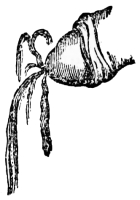
View larger image
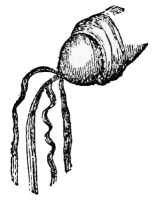
View larger image
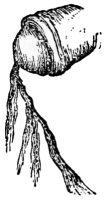
View larger image
Persons afflicted with stricture, and urinating in the streets, may almost be detected from the singular attitude they are obliged to assume to prevent the urine from inconveniencing them, and also from the time occupied in discharging it. Some few minutes after making water, when dressed and proceeding on his way, the patient finds his shirt become moist by some drops of urine that continue to ooze from the penis; and it is only as these annoyances accumulate, he begins to think he is laboring under some other disease than the gleet. The next symptom he will experience will be a positive but temporary difficulty in passing his water—perhaps a total inability to do so; it will, however, subside in a few minutes. This will lead him to reflect, and he will even appease his fears by inclining to think it may be the consequence of his last night’s excess: he resolves to be more careful for the future, and he gets better; his contemplated visit to his usual professional adviser, if he have one, is postponed, and a few more weeks go by without a return of the last symptom. The next attack, which it is very difficult to avert, and which is sure to accompany the succeeding debauch, or to follow a cold or fatigue, does not so speedily subside; the patient finds that he can not complete the act of making water without several interruptions, and each attended with a painful desire resembling that induced by too long a retention of that fluid. In that state he eagerly seeks medical assistance; the treatment generally adopted consisting of some sedative, immersion in a hot bath, or the passage of a bougie. Relief being thus easily obtained, professional advice is thus thrown up, and the symptoms are again soon forgotten. Before proceeding further with the more severe forms and consequences of stricture, which may now be fairly said to have commenced in earnest, a brief anatomical description of the urethra may enable the reader to understand how the constriction or narrowing of that canal takes place.
I have elsewhere stated the urethra to be a membranous canal, running from the orifice of the penis to the bladder, and situated in the lower groove formed by the corpus spongiosum.
The difference of opinion entertained by some of our first anatomists, on the structure of the urethra, is deserving of notice; for only in proportion to the correctness of our knowledge of it, can we arrive at a just definition of its diseases.
One party assert it to be an elastic canal—whether membranous or muscular they do not say—endowed with similar properties of elasticity to India rubber, or to a common spring. That it is elastic, is beyond doubt; but the mere assertion is no explanation of its mode of action.
Others, from microscopical observations, declare it to consist of two coats—a fine internal membrane, which, when the urethra is collapsed, lies in longitudinal folds—and an external muscular one, composed of very short fasciculi of longitudinal fibres, interwoven together, and connected by their origins and insertions with each other, and united by an elastic substance of the consistence of mucus. This is the more satisfactory of the two.
They account for the occurrence of stricture in this way. They say that “a permanent stricture is that contraction of the canal which takes place in consequence of coagulable lymph being exuded between the fasciculi of muscular fibres and the internal membrane, in different quantities, according to circumstances.”
A spasmodic stricture they define to be “a contraction of a small portion of longitudinal muscular fibres, while the rest are relaxed; and as this may take place, either all round, or upon any side, it explains what is met with in practice—the marked impression of a stricture sometimes a circular depression upon the bougie, at others only on one side.”
With respect to the change consequent upon permanent stricture, dissection enables us, in some degree, to arrive at the truth. Excrescences and tubercles have been found growing from the wall of the urethra; but in the majority of instances, the only perceptible change is a thickening of the canal here and there, of indefinite length; but whether it be occasioned by the exudation of coagulable lymph, or whether it be the adhesion of ulcerated surfaces, which I contend are more or less present in gleet, is not so easy to determine; at all events, it is undoubtedly the result of inflammation.
With regard to the action of spasm, all we know of it is theoretical; but experience every day furnishes instances of its occurrence.
Spasmodic stricture is generally seated at the neck of the bladder, and may occur to persons in good health, from exposure to wet or cold; from some digestive derangement; from long retention of the urine, particularly while walking, owing to the absence of public urinals; or to violent horse exercise; but more frequently does it happen to those young men who, when suffering from gleet or gonorrhœa, imperfectly or only partially cured, are tempted to commit an excess in wine, spirits, or other strong drinks. Surrounded by jovial society, glassful after glassful is swallowed, each one to be the last. The patient, with his bladder full to repletion, scarcely able to retain his water, yet probably “going” every moment, represses his desire until the party breaks up, when, on encountering the cold air, he finds himself unable to void even a drop, or if so, but with extreme difficulty. The greater the effort, and the more determined the straining, the greater is the impossibility, and unless relief should be afforded, the most alarming consequences may ensue.
The rationale is this: the patient, opposing the action of the muscles of the bladder, by contracting those of the urethra, they (the latter), from irritation, become spasmodically contracted.
The urine, by the powerful action of the muscles of the bladder, is forced against the contracted portion of the urethra; and by its irritation increases the mischief. Where neglected, or unless the spasms yield, extravasation will take place, mortification ensue, and death follow.
The urethra is situated at the under part of the penis, and is embraced by a substance called the corpus spongiosum; it (the urethra) consists of several different layers or coats—the inner, the one continuous with that lining the bladder, which possesses the power of secreting a mucous fluid, and the other made up of muscular fibres, which give to the urethra the power of contracting and dilating, that regulates the flowing or jetting of the fluid which has to pass through it. The mucous membrane of the urethra is of a highly sensitive nature, and more so in some parts than in others, as, for instance, in the membranous and bulbous portion of the canal; and hence it will be found, that those are the parts most liable to disease. The mucous membrane has several openings called lacunæ, for the furnishing a particular fluid to moisten and lubricate the urinary tube: these also are frequently the seat of disease. These are seen in the drawing on page 50.
In passing a bougie in contracted and irritable urethra, it sometimes enters the opening marked B, and if violence be used in propelling the instrument, false passages are made.
Independently of the function of the urethra being to discharge the urine, it has also to convey the semen to the orifice of the glans; and here in this act is to be observed the wonderful adaptation of means to an end. During the excitement attendant upon venereal commerce, the seminal fluid accumulates, prior to emission, in the bulbous portion, and when the fitting moment arrives for its ejection, the membranous portion spasmodically contracts, thereby preventing the regurgitation of the semen into the bladder, while the muscles surrounding the bulbous portion contract with energetic force, and so complete the transmission of the generative fluid. Such are the functions of the urethra in health.
A—Signifying the urethra cut open. B—The lacunæ and the cut end of bougie, to show the continuation of the urethra. View larger image
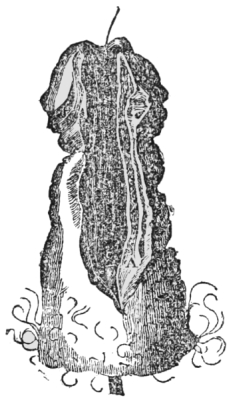
A—Signifying the urethra cut open.
B—The lacunæ and the cut end of bougie, to show the continuation of the urethra.
Now, this canal being extensively supplied with nerves, that have more extensive communication with others than any particular ones have in the whole body, and made up, as before stated, of surficial and muscular membranes, and exposed to the performance of several duties which are often unduly called into exercise, can not be supposed to be exempt from the consequences of such misappropriation; and therefore it is very liable to inflammation. From the sensitive nature of the tube, it is very obnoxious to spasm, which may be partial, general, temporary, or continuous: hence spasmodic stricture. This condition is of course dependent upon many causes, excess of diet, fatigue, cold, &c., irritating the general system; when from the local irritation previously set up in the urethra by the forenamed causes—a neglected gleet or clap—the urethra is not long in participating in it: the phenomena are the symptoms recently narrated. Highly restorative as the powers of nature may be to remove disease, she does not appear readily disposed to interfere with the processes set up in the machine she inhabits, for self-defence, to protect itself from the constant irritation produced by the daily flow of acrid urine, which in several cases often produces ulceration; coagulable lymph is thrown out in the cellular structure of the particular diseased part, thereby thickening the walls thereof, and constituting permanent stricture, it appearing preferable to impede a function which a narrowing of the urethric canal does, namely, that of urinating, than of allowing ulceration to ensue, whereby the urine would escape into the neighboring parts, and occasion great devastation, and probably death. Permanent stricture, as its name implies, outlives the patient; it never yields, unassisted by art. I have described the ordinary symptoms of stricture, especially that form induced by gonorrhœa. Stricture may arise from other causes. Inflammation, in whatever way set up, if allowed to go on or remain, will give rise to stricture, and the celerity or tardiness with which it takes place depends upon circumstance. An injury from falling astride any hard substance, blows, wounds, contusions occasioned by riding, the presence of foreign substances, the injudicious use of injections, and lastly, which is as frequent a cause as any one of those heretofore enumerated, masturbation. The violent manual efforts made by a young sensualist to procure the sexual orgasm for the third or fourth time continuously, I have known to be of that degree that irritation has been communicated to the whole length of the urethra, extending even to the bladder; and retention of urine, in the instance I allude to, ensued, and required much attention before it could be subdued. Excessive intercourse with females will give rise to the same effects; not so likely as in the case preceding, inasmuch as the former can be practised whenever desired, while the latter needs a participator. The act of masturbation repeated, as it is, by many youths and others, day after day, and frequently several times within each twenty-four hours, must necessarily establish a sensitiveness or irritability in the parts, and alteration of structure is sure to follow.
The positive changes which take place in stricture in the urethral passage are these: there ensues a thickening and condensation of the delicate membrane and the cellular tissue underneath, which may possibly unite it to the muscular coat. This thickening or condensation is the result of what we call effusion of coagulable lymph. It will be rather difficult to explain the process; but lymph is that fluid understood to be the nutritious portion of our sustenance or system, and which is here yielded up by the vessels which absorb it, and which vessels abound, with few exceptions, in every tissue of our body. However, it will suffice to say, that where inflammation takes place, there is an alteration of structure, and that alteration is generally an increase. In stricture, this increase or thickening takes place, as I observed before, in particular parts of the urethra, but where the inflammation is severe, no part is exempt, and whole lengths of the passage become occasionally involved. It is true, certain parts are more predisposed than others, as, for instance, the membranous, bulbous, and prostatic portions of the canal; but there are oftentimes cases to be met with where these parts are free, and the remainder blocked up. This effusion or thickening assumes various shapes, and selects various parts of the urethra. The subjoined diagram will convey a tolerably perfect idea of the malady in question; indeed it is a beautiful specimen of simple stricture.
A—The cut edges of the corpus spongiosum. B—The urethra. C—The stricture. View larger image
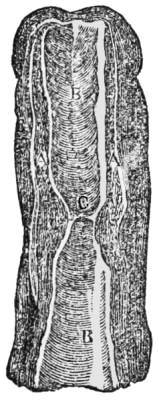
A—The cut edges of the corpus spongiosum.
B—The urethra.
C—The stricture.
To continue the description of the formidable consequences of neglected stricture.
In protracted and neglected cases, that part of the urethra between the stricture and bladder becomes dilated, from the frequent pressure of the urine upon it, induced by irritability of the bladder, which has an increasing desire to empty itself. In process of time, complete retention of urine will ensue, ulceration will take place at the irritable spot, and effusion of urine into the surrounding parts will follow; and the consequences will be, as in the instance of the spasmodic affection, fatal, unless controlled by the skilful interference of the surgeon.
The symptoms of permanent stricture are often as slow in their progress, and as insidious in their nature, as they are appalling in their results, and are seldom distinctly observed by the patient, until firmly established.
He is suffering from a long-continued gleet, and is first alarmed by a partial retention of urine—it passes by drops, or by great straining, or not at all. This usually occurs after intemperance, and is relieved by the warm bath, fomentations, and laxative medicines. This is the first stage, and is attributed to the debauch solely; whereas, at this time an alteration of structure is going on in the urethra. Its calibre is becoming diminished, which necessarily causes the urine to flow in a smaller stream. This is not observed at first; and it is only after a long period that the patient becomes aware of the fact.
The disease proceeds. In the morning, from the gluing together of the sides of the urethra, by the discharge from its diseased surface, the urine flows in a forked or double stream; and then, as this agglutinution is dissolved, it become natural.
There is a greater and more frequent desire to make water, disturbing sleep many times during the night, but unattended with pain, unless the neck of the bladder be affected.
There are also uneasy sensations in the perinœum, a sense of weight in the pelvis, with flying pains in the hips; and in the permanent stricture there is a remarkable symptom frequently prevailing—that is, a pain extending down the left thigh from the perinœum.
As the disease advances, the urine flows in only a very small stream, or forked, twisted, double, or broken, or in drops; and the patient solicits the flow by pressing with his finger on the perinœum, and elongating the canal, somewhat after the manner in which a dairy-maid milks a cow.
The dilatation of the urethra between the stricture and the bladder already alluded to, now takes place; and some urine remains in the dilated part, which oozes through the stricture, making the patient wet and uncomfortable.
There is great difficulty felt, and more time is occupied in getting rid of the last drop of water, than formerly. This sensation continues all along; and the cure is never accomplished until this is finally removed.
If the stricture is still neglected, more severe symptoms come on, and the neighboring parts become affected also.
The sphincter ani, or the muscles of the anus, are relaxed, from the excessive action of the abdominal muscles; and the fæces pass in small quantities involuntarily. There is a protrusion of the bowel, which adds to the distress, and, by its irritation, brings on a looseness or diarrhœa.
The prostate gland, which is seated near the neck of the bladder, suffers inflammation and enlarges, beginning at the orifice of the ducts, which open into the urethra.
The emission of semen, which often happens involuntarily, is attended with agonizing pain, producing cold shiverings, followed by heat; and fever soon becomes fairly established.
The liver and its secretions become diseased, discharging in the intestines large quantities of vitiated bile. The fever assumes the intermittent character. The discharge from the urethra is greatly increased in quantity, showing the formation and bursting of an abscess of the prostrate gland into it.