GENERAL REMARKS. (continued 2)
Reading edition
The bladder is much thickened and diminished in size, and acutely or chronically inflamed. The desire to make water is continual, allowing hardly a moment of rest; and the patient, in the agony of despair, prays to be relieved from his sufferings.
Soon succeeding the irritation of the prostate, the testicles become involved, the disease being propagated by means of their ducts, which open into the urethra. The testicles swell a little, become uneasy and painful, and a dropsical or hardened enlargement ensues.
When the stricture forms a nearly complete obstruction to the passage of urine, the violent efforts of the bladder to expel it bring on ulceration or rupture of the urethra, through which the urine is forced into the cellular membrane, with all the power of a spasmodically excited bladder.
The scrotum and neighboring parts become distended, erysipelas supervenes, black patches of mortification break out in different places, the febrile symptoms are augmented, and the patient at last irrecoverably sinks into a state of coma or muttering delirium, and death closes the scene. Such is the progress and termination of stricture when neglected.
The reader, if he be an afflicted one, will eagerly turn to the page wherein the treatment of this formidable and distressing malady is considered; and great will be his satisfaction and delight, on finding it remediable by such simple means, and entirely within his own control; more especially if he direct his attention to the disease in its earlier stages.
He must by no means, however, be too sanguine, from these remarks, or indulge in the idea that as stricture is remediable, it is unimportant when the cure be attempted; the longer the delay, the greater will be the cost to the patient; and, furthermore, the slightest deviation from the instructions laid down, will surely aggravate the disease, and increase the embarrassment of the sufferer.
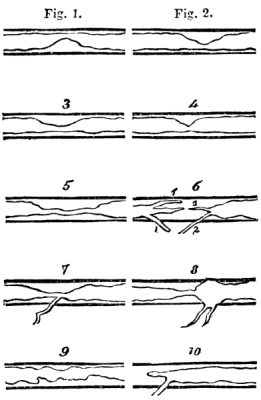
The following diagrams are further explanatory of the stricture in its amplified forms.
View larger image
The dark marginal line denote the calibre of the urethra, and the inner lines the actual diameter of the obstructed passage. Figure 1 shows the stricture to be on the lower part of the urethra. Figure 2 the upper part. Figure 3 exhibits a stricture of some length, and a somewhat contracted state of the whole canal. Figure 4 denotes a very common form of stricture, which resembles a flour-bag tied in the middle; it is the least difficult to cure of any, because it signifies that the seat of irritation is limited; but these cases are generally precursory to severer forms, if not promptly attended to. Figure 5 represents a stricture of considerable length, and of course very difficult of removal.
There are many provocatives to stricture, and when once mischief is progressing, it makes up for its slow initiation by giant strides. A patient may have a trifling stricture for years without experiencing much inconvenience. He takes cold, fatigues himself, commits some stomachic or other excess, may possibly have fever, all of which more or less disturb the general economy, alter the character of the urine, and in that manner doubly accelerate the disorganization going on in the urethra. A small abscess may spring up in the urethra, or below it among the cellular membranes and integuments. In either case, it chances now and then to burst an opening and create a communication externally with the urinary passage, constituting what is called fistula. A person laboring under stricture is always liable to these occurrences. As much mischief is done oftentimes by mismanagement as by neglect. The clumsy introduction of a bougie, or, in other instances, the unjustifiable introduction of one, is likely to, and very frequently does, lacerate the delicate and irritable membrane, and make a false passage. Figure 6 exhibits an instance at Nos. 1 and 2; the upper numerical shows a false passage made by a bougie, and an obliteration of the ordinary passage of the urethra, the result of inflammation, constituting an impassable stricture; the lower figure exhibits a false opening made, in the first instance, by a fruitless effort at passing an instrument, when inflammation completed the process. No urine escaped from it of course, because communication was cut off from the bladder by the impassable stricture; the outlet for the discharge of that fluid being through a sinuous opening marked No. 2, the No. 3 denoting the closed end of the urethra. The case happened to a man in very ill health, who was prone to ulceration, and he gradually sunk under exhaustion from debility and premature old age. Figure 7 exhibits a stricture where the posterior part was enlarged by the constant pressure of the urine to escape through the narrowed part of the urethra; ulceration ensued, and a fistulous opening was the consequence; the stricture was seated high up, and the fistulous canal was several inches long, terminating in the upper and posterior part of the thigh; the urine used to dribble through it as well as through the urethra. The patient had been a seafaring man; he was in exhausted health from hot climates and intemperate living, and he died at last of consumption. I have the parts showing the stricture and the fistulous opening by me, in a state of good preservation. In Figure 8 is presented an illustration of extensive ulceration producing two fistulous openings; the state of the urethra was only discovered after death, the patient having concealed his infirmity for many years; he died suddenly from apoplexy, being found dead in his bed by the people of the house where he lodged. Figure 9 portrays irregular and extensive ulceration. The patient died from syphilis, having gonorrhœa at the same time. I have the preparation. Figure 10 shows an impervious urethra, and a fistulous opening through which the urine flowed. The urinary passage was blocked up within two inches from the orifice, and the length of the obstruction was perhaps a quarter of an inch. It was perforated successfully by the lanceted stilette, and the passage thereby rendered continuous; the catheter was worn for several days, and the false opening soon healed after a slight application or two of nitric acid. Numerous other illustrations might have been given, but the preceding convey a passable notion of the simplest, and most confirmed, and most severe forms, of the malady in question.
It is melancholy, notwithstanding the resisting and reparative power of nature to avoid so saddening a disease as stricture, that it is so very prevalent, and that it is occasioned by so many causes. Where it is not destructive to life, it is very injurious. It involves, where it is severe, other important organs beside the seat of its abiding; the repeated calls upon the bladder, through sympathy of the irritation, created so near to that viscus, the efforts which at all times it is obliged to make, although assisted by the muscles of the abdomen and contiguous parts to void its contents, at last, and very frequently end in paralysis, and total inability to pass water ensues, except through the aid of the catheter. Independently of which, where so much disease exists as in the urethra, the urine also constantly pressing against ulcerating and irritable surfaces, extravasation of that secretion takes place, and the most formidable and alarming consequences ensue. In the simplest form of stricture, many important functions are disturbed. A very frequent consequence is permanent irritability of the bladder, so that the patient is obliged, ten or twelve times a day, to micturate, and is unable to pass through the night without suffering nearly the same inconvenience. Besides which, the natural sensitiveness of the genital organs becomes speedily and much impaired. I am satisfied that where disorganization of the testicles does not exist, and where the patient is young, or even middle-aged, if he be impotent, he will in nine cases out of ten be found to have stricture. There are exceptions, which shall be named when speaking on the infirmities of the genital system, but in nearly all cases of impuissance there will be found, if not stricture, at least some morbid irritability of the urethra. During the existence of stricture, there is generally a vitiated secretion from the seat of mischief, constituting a gleet; therefore a gleet at all times should be regarded, lest it be an indication of something more than a mere weeping from enfeebled vessels.
———<>———
On the Treatment of Stricture.—Having fully described the symptoms and progress of stricture, I proceed to the more pleasing part of treatment. Stricture, if early attended to, is a disease easy remediable: if neglected, its horrors accumulate, and sufferings the most acute close the scene. Such, however, is the progress of science, that it is almost possible to cure the most inveterate case, at all events to relieve it; but that is no reason why the initiatory notices should be disregarded. Stricture, as must be perceived, is of two kinds, spasmodic and permanent: the treatment of the first is chiefly medical, the treatment of the latter chiefly mechanical. The principal agents I rely upon in the cure of the former, are the warm bath, rest, sedatives, and certain dietetic restrictions; for the removal of the latter, I place unbounded confidence in the practice of dilatation; and I am of opinion that the other methods, namely, the application of caustic or the scalpel, might be dispensed with altogether, if the dilating method be not delayed too long.
Before commencing the cure of stricture, I need hardly observe, that we ought to be fully satisfied of its existence. Symptoms are not always unerring guides; and, therefore, our reliance should not wholly depend on them.
——“to be once in doubt Is once to be resolved.”
The only mode of ascertaining the precise condition of the urethra, is by an examination of it, which should not be delayed a moment after suspicion is entertained of the impending evil.
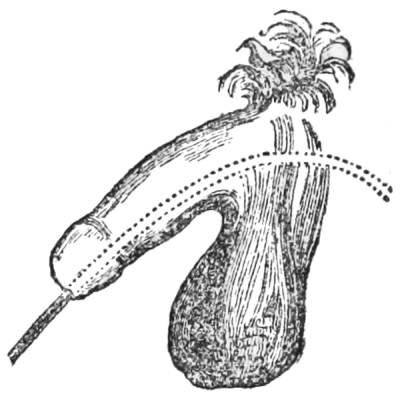
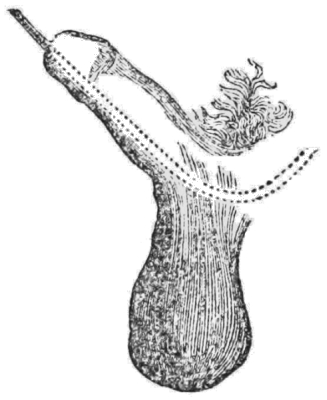
For this purpose, it is recommended that a solid silver sound should be used as the best instrument; because it will pass with much less pain or inconvenience. It should be made conical, that is, smaller at the point than at the shaft, and of a size to pass very readily into the orifice; the shaft or body of the sound should not exceed two thirds of the size of the canal. The sound should be warmed, and afterward it should be well oiled. The directions for examining the urethra pertain to the passage of a bougie or catheter; and as it often falls to the lot of a patient, that he is beyond medical assistance, it behooves him to learn how an instrument should be passed, in order that in emergencies he may officiate himself; besides, it often happens, in cases of diseased bladder, and in those cases where retention of urine frequently occurs, that an invalid can not command the necessary constant attendance of his professional man; and therefore such knowledge will well repay any little time or trouble bestowed in the acquisition. The two annexed drawings will render the commonest observer a proficient. The first shows the manner in which the bougie is to be introduced. Where the instrument can be passed thus far, without the assistance of the other hand than that which holds the bougie, it is better, as it keeps the penis and the muscles which influence it in a passive state. When the instrument has passed as far as it will, in the direction the dotted lines denote, it is to be turned gently round, raising the handle toward the abdomen. A slight pressure is then to be made downward, and the handle of the catheter or bougie at the same time to be borne away from the body. See diagram. The instrument will, if there be no impediment, gradually slip into the bladder. A trial or two will perfect and surprise the novice. The same directions apply to the introduction and use of all other instruments into the urethra. The sensation experienced on having a bougie passed, partakes more of a strange tickling feeling than absolute pain, except there exist stricture, and even then the urethra, on a subsequent trial, is almost insensible to it.
View larger image
View larger image
If soreness or pain is felt, on the sound passing over the affected part, we may presume there is chronic inflammation of the urethra, or that the surface is ulcerated, as in long standing gleet. If the sound meet with an impediment, but proceeds after a little pressure, it indicates a thickening of the mucous membrane, the forerunner of stricture.
I may here observe, that stricture is generally found to exist either within an inch of the orifice, or at about six inches and a half from it, or in the prostate part of the urethra.
If the sound passes, without hinderance, the last situation, but with increased pain, the membrane of that part is diseased, and may extend to the bladder; which will be indicated by the frequent desire to micturate during the night, owing to the irritable state of that organ.
If the instrument be arrested at about six inches and a half, the complaint, in all probability, is seated in the transverse portion of the prostate, and requires very cautious treatment.
When the obstruction is at the very entrance of the bladder, a resistance will be perceived, which, on yielding, will impart a peculiar sensation as the sound enters the bladder. When stricture is thus situated, there is a frequent desire, with almost total inability, to micturate; and when once formed, it is productive of the most serious mischief, unless relieved.
In cases of permanent stricture, the passing of the sound conveys the sensation of going over a ridge. Where it meets with a temporary stoppage, and then passes on, it has probably hitched to a fold of the urethra. Sometimes it will enter the orifice of a dilated follicle; and if much pressure is used, it will occasion considerable bleeding.
The nature and situation of the disease being ascertained, the cure may now be proceeded in, recollecting that no force is to be used, and that too much be not attempted at one essay. Now without entering into an inquiry as to the laws on which contraction and elasticity of certain animal structures depend, it is enough for our purpose to know, that the urethra possesses both properties; it may contract so as to oppose the exit or entrance of the smallest stream, and it may be dilated to admit the introduction of an instrument an inch in circumference. The urethra maintains these properties in disease as well as in health, and upon the strength of this fact, is the practice of dilatation in the cure of permanent stricture founded, permanent stricture, it will be recollected, is a positive narrowing of the urethric canal; and as it is the nature of all organic diseases to progress, unless prevented by art, it needs no stronger argument than necessity to show how imperative it is to set about their removal.
The cure by dilatation is as follows:—the seat and size of the stricture being ascertained (both of which can be easily done by the passing of the sound as directed, and the observance of the stream of urine), a bougie in circumference somewhat larger than the calibre of the urinary current, warmed and dipped in an oleaginous mixture combined with some sedative (Forms 22, 23, 24) or stimulant (Form 25) according to circumstances, is to be passed to the stricture, and the gentlest pressure is to be employed for the space of five, ten, or twelve minutes, according to the irritation it produces, removing it as soon as any uneasiness is felt.
Even in this very simple operation, a certain dexterity is requisite; for the direction of all urethræ is not alike, and the mere pushing a bougie against a contracted part is not the only likely method of effecting a free passage. Much also depends upon the nature of the bougie—the elastic ones, although assisted in their attempted passage to the bladder, by the smooth and well lubricated sides of the urethra, have a tendency to straighten; and unless considerable rotatory motion be observed, are apt to hitch in a fold of the urethra, especially if the case befall a person of relaxed fibre, and he be much worn down by suffering. The bougies that I employ are constructed upon an improved plan to those in general use, being prepared of a material that will preserve the shape I adapt them to, previously to introducing them, but at the same time sufficiently soft to yield to any accidental tortuosity of the tube they are intended to explore. The bougie then is to be pressed softly, but steadily, against the obstruction, now and then withholding for a minute the bearing, so as to allow a respite to the stretched membrane; then renewing by, what is better done than expressed, an “insinuating” pressure for the space of the time advised above. The patient should not be dispirited, even if the bougie do not perforate the stricture at the first trial; it would doubtless do so, if longer time were employed, but that is rarely advisable, except in cases where the urine can scarcely escape, or much expedition be requisite. Should the operation even be unsuccessful in this first attempt, the patient will find his ability to micturate much greater than before the introduction; but, save in long-standing and obstinate strictures, I rarely find myself foiled, nor do those who practise the same method, if they have patience and skill enough, in overcoming the difficulty at the first interview. A great advantage of the cure by dilatation, independently of its safety and efficacy, is the insignificant pain it occasions; the sensation produced being only like a pressing desire to make water, which immediately subsides on withdrawing the bougie.
Another method of dilating a stricture, where it happens to be of chronic existence, is the passing a plastic catheter into the bladder, and suffering it to remain all night, or even for several nights, stopping up the handle end with a cork or wooden peg, which the patient can remove when he desires to urinate. The urethra, by this means, becomes quickly dilated, and much beyond the size of the instrument. It necessarily confines the patient to his room and couch; but where an expeditious cure is the object, as much may be effected in this manner in six days, as by the ordinary method in as many weeks. Time, however, it must be remembered, is the working material of nine tenths of strictured invalids, and a week’s lay-up may cost a twelve-month’s salary—a purchase too dear to be generally incurred.
Several other plausible methods have been suggested for the cure of stricture—one by means of an instrument, that the operator could enlarge when it was passed into the urethra, through turning a screw; another, which was to introduce a tube made of some thin skin, and then to distend it with wind or water; a third, and oftentimes, in reality, a very useful and available one, is to compress the penis around the glans, and suffer the urine, as it accumulated, to distend the anterior part of the urethra before the bandage was removed and the urine suffered to escape. But they have their several disadvantages: the processes, with the exception of the last, are complicated and uncertain in their result; the instrument is not so manageable, or so useful, as an ordinary sound; and the gut, instead of distending the strictured part, enlarges the healthy portions of the urethra. The bougie, in proper hands, notwithstanding it is a simple instrument, is the most positive and effectual method of curing stricture as yet, or likely to be, discovered. An entrance, then, having by this means been gained, a bougie of a larger size is to be selected on the next occasion, and the same process repeated. It is never advisable to repeat the operation oftener than once in two days, and when the urethra is irritable, only every three or four days.
By continuing in this manner, the stricture gradually yields, and a bougie as large as the orifice will permit to enter will at last proceed through the whole passage without meeting any obstacle. The operation, notwithstanding this apparent success, should not be wholly laid aside, but continued until the disposition for contraction is entirely removed; and the patient should never rest without occasionally examining his urethra, say once a month (at least once a quarter), lest he encounter a relapse.
Having disposed of the treatment of stricture in its fortunately most usual—namely, the mildest—form, I proceed to consider the treatment of severe kinds—previously to which, a few remarks upon the various kinds of instruments, their structure, shape, and size, will render any subsequent allusion more intelligible.
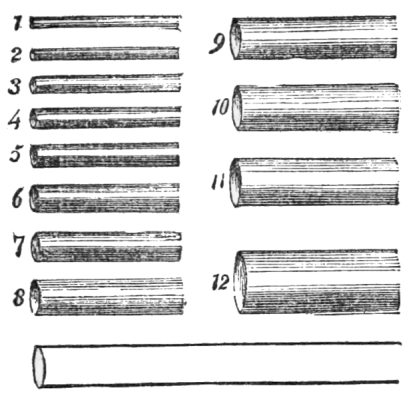
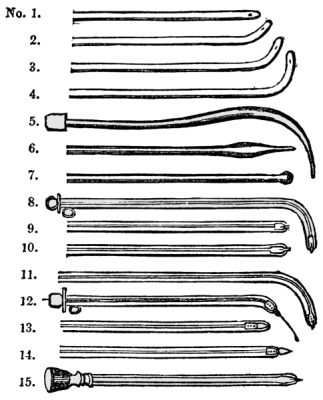
The diagram here introduced represents the calibre of the various bougies in general use, and the observer will perceive, that as they are made to accommodate themselves to the passage they have to pass, how varied must be the changes which the urethra undergoes. The last outline indicates the natural and healthy bore of the urethra. Bougies are manufactured of different materials: waxen cloth rolled together, elastic and yielding; flexible metal, silver, and gold. The bougies which I employ are constructed upon an improved plan to those in general use: the elastic, as they are termed, although assisted in their attempted passage to the bladder by the smooth and well-lubricated sides of the urethra, have a constant tendency to straighten, and consequently are liable to hitch in all the folds they may encounter, which, in relaxed habits, are very numerous in the membranous portion of the urethra. To obviate such a possibility, I prefer that the bougie should be of such a consistence and manufacture as will admit of its preserving the shape I adapt it to previously to introducing it; at the same time the material to be sufficiently soft to enable it to accommodate itself to any accidental tortuosity of the tube it is exploring.
View larger image
Catheters are instruments for the purposes of withdrawing the urine; they are consequently hollow, and are made of the same materials as bougies; but the most useful and to be depended upon are composed of silver. Surgeons, like other men, have their fancies: a catheter, when made of silver, has very little flexibility; accordingly it must be shaped beforehand. Some medical men prefer them quite straight, others with an immense curve. A surgeon should possess many forms, as the direction of the urethra differs almost in all men. The subjoined exhibits not the size, but the shape of the more useful and those most generally used. Figures 1, 2, and 3, suffice in most instances, whereas figure 4 is necessary in cases of enlargement of the prostate gland, which presses up the bladder, and renders the urethral passage consequently longer.
View larger image
The French employ not only variously curved instruments, but variously shaped. In peculiar cases they are doubtlessly useful; but they require to be used only by persons of skill and judgment. In the next three kinds are views of such; they are called conical bougies—the first curved, the second straight. They are made of silver, waxen cloth, or India-rubber. The third exhibits a sound, employed to ascertain the seat of the stricture.
I have already alluded to the improved method I employ on finding it necessary to use escharotics. I can not better explain the process than by submitting a sketch of the instruments, whereby the mode of application will be instantly perceived. The instruments are made of silver. The figures represent No. 8 a curved, No. 9 a straightened, No. 10 ditto, with enlarged head, which puts the areola of the stricture on the stretch, and secures the central part for the application of the caustic, or whatever substance may be employed.
The next kind of instruments are for the purposes of dividing or piercing hardened obstructions—one or two applications creating a passage which a hundred cauterizings would not effect. When any styptic is applied to a morbid growth, its tendency is to create a slough, or to destroy the part whereto it is applied. In some instances a styptic actually promotes increased action: it may temporarily destroy the part; but the moment the effect is over, a reaction follows, and the excrescence is increased. Such is the case in many long-standing, obstinate strictures; and their removal by perforation or division is rendered indispensable. The practice requires the most careful attention and anatomical knowledge; and no one but a professional man would attempt its employment.
No. 11 sketch exhibits a curved instrument, with the pointed lancet projecting as when applied. No. 12 exhibits ditto, but with a differently formed instrument, consisting of two portions separated, so as to allow a director, in the form of a thin silver wire with a silver knob, to pass for the purpose of exploring the passage which the instrument is to follow and enlarge. It is indispensable in strictures seated upon the soft and deep parts, lest a false passage should be made. No. 13 represents a straight instrument; No. 14 ditto, but with the lancet in reserve—the last a perforator.
The reader has now been made acquainted with the various resources the surgeon has at his command. A few words on their employment will complete the necessary amount of information to render the one as wise as the other. By way of recapitulation, the treatment of stricture is by dilatation, cauterization, and division. They are to be estimated in the order of their arrangement. By dilatation is meant the enlarging of the urethral passage through the frequent introduction of bougies of graduated sizes. It is an operation unattended with any considerable pain; its novelty sometimes renders a patient a little nervous, but a complaint is rarely made after a second or third introduction. Indeed, it is oftentimes courted more frequently than is desirable. The application also of caustic, or even the perforator, produces scarcely the least inconvenience. Hemorrhage, of most things to be dreaded, is less frequent, with cauterizing and cutting instruments (in skilful hands), than the incautious employment of blunt-pointed bougies.
———<>———
Diseases of the Testicles.—The testicles, from their office and connexion with other structures equally as important, are liable to many excitations. In gonorrhœa they are subject to sympathetic inflammation, as in hernia humoralis, which, if neglected or maltreated, gives rise to abscess or chronic hardness. Inflammation also occurs in them as in other structures. Accidents, such as blows or bruises, horse-riding, wearing very tight pantaloons, are all fertile sources of derangement. Scrofulous constitutions are predisposed to have their testicles, like the rest of the glands, diseased. The most frequent disturbance, however, of the testicles, is a dilatation of the veins, constituting what is called varicocele; and generally accompanied by a wasting away of the testicle itself. It is rare, indeed, to find perfectly healthy testicles in an individual who has been exposed to amatory pleasures and sensualities; and as, of course, even amative desire, as well as amative power, depends upon the absolute sound condition of the glands in question, the inference is, that in very numerous persons, the sexual instinct is considerably diminished, and not unfrequently wholly suppressed, before half the natural term of their existence has expired, at which time they ought in reality to be at the climax of their prime and capability.
It is not so much a painful complaint, as an unpleasant one. There are occasionally pains in the back and loins, and other feelings, creating a sensation of lassitude and weariness; and now and then some local uneasiness is felt.
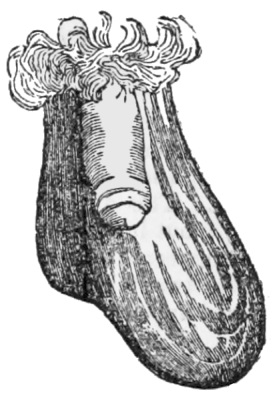
Varicocele gives to the examiner a sensation as though he were grasping a bundle of soft cords. It sometimes exists to such a degree as to resemble a rupture. In advanced stages of the disease, or disorganization, the epididymis becomes detached from the body of the testicle, and is plainly distinguishable by the finger. The result of all is, that a considerable diminution of sexual power takes place; and if means are not adopted to arrest a further break-up of the structure, the venereal appetite will subside altogether. The annexed drawing exhibits a tolerably faithful portrait of the disease; it represents the varicocele to be on the left side—the side most usually affected.
View larger image
The folds formed by the veins lapping over each other are clearly distinguishable, and the dependent state of the scrotum on the affected side exhibits very well the occasion of it. The treatment consists in giving support by means of a suspensory bandage, which may be worn during the day, and the use of local refrigerants night and morning. The state of health is sometimes mixed up with it; and tonics and generous diet are useful. The cold shower bath helps to brace the system. It is a complaint in which, if it be not of very great severity, nor very long continuance, much good may be done. In some instances the veins may be allowed to empty themselves, which they will do when the body is in a recumbent position, and a coated ivory ring, or a silken band, may be so placed around them as shall prevent their refilling. It is, however, a case fitter for the surgeon’s management.
Abscess in the Testicle.—The testicle is subject to inflammation and suppuration like any other structure. A case about three years ago fell under my notice, where a quantity of dark fœtid fluid was released on puncturing a testicle in which the sense of fluctuation was very evident; and the patient stated that it had been five or six years in arriving at that condition. He was wasted considerably from nocturnal perspirations and acute pain, and his sexual desire was much diminished. The case did well, and the latter function was restored without much loss.
Hydrocele.—Hydrocele is an accumulation of yellow serous fluid in the tunica vaginalis testis (refer to the engravings in next page), or peritoneal covering of the testicle. It is a disease incident to every period of life, but more commonly met with in grown persons. The ordinary formation of hydrocele is unattended with pain; and the patient accidentally discovers the existence of the swelling, but oftentimes not until it has attained a considerable magnitude. The tumor, when large, produces an unsightly appearance, and forms a hindrance to sexual intercourse, from the integuments of the penis being involved therein, and thereby preventing a perfect erection of that organ. The disease may appear to originate spontaneously; but it is usually traceable to some bruise, blow, or other external injury to the part.
The two following drawings exhibit the outward and inward appearance of the scrotum in hydrocele:—
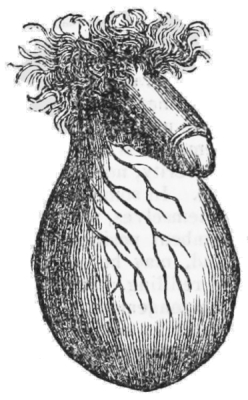
The Scrotum largely distended.
View larger image
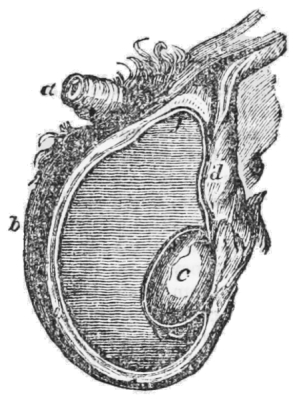
The Scrotum distended to its utmost extent, and the position of the fluid shown. The penis is almost always more or less drawn up, and in severe cases it appears drawn up so as scarcely to be perceptible.
View larger image
The notion that the cure of hydrocele depends on promoting adhesion to the sides of the tunica vaginalis with the testicle is somewhat upset by several preparations in the London hospitals, exhibiting the tunic taken from persons in whom a radical cure was effected by injection, and in whom no fluid was reproduced; nor were the sides of the said investment at all adherent with the testicle, but apart, as in the healthiest individual. Hitherto surgeons, acting on the aforesaid notion, with a view to obliterate the cavity, adopted various plans of treatment—such as, for instance, laying open the entire cavity, cutting away a portion of the tunica vaginalis, the application of caustic, and, lastly, the seton, as advised by Dr. Pott, which was suffered to liberate itself by ulceration. When, in any of these instances, suppuration was induced, the cavity became in time filled up by the granulating process. The plan of the present day is by perforating the sac with a trocar, suffering the effused fluid to escape, and injecting some stimulating liquid which is allowed to remain until a degree of inflammation is produced, that shall cause an obliteration of the cavity by adhesion, or, as it has also been proved, prevent a reproduction of the fluid, by closing the mouths or altering the diseased action of the exhalent arteries. Whichever be the effect produced thereby, the cure is almost certain, and the principles of the treatment consequently judicious. But, notwithstanding, the operation is not always immediately, nor ultimately successful; the degree of inflammation set up may be insufficient, and the effusion again take place, and the operation may require a second and third repetition; or an excessive degree of inflammation may ensue, that shall occasion serious constitutional disturbance, either by suffering the injected fluid to remain too long, or its being of too stimulative a character, or from its escaping into the cellular membrane of the scrotum, an accident not unfrequent, unless great care be used in the operation.
Radical Cure of Hydrocele.—The term radical is applied to the process narrated in the last case; but, as has been observed, the operation is occasionally required to be repeated several times. In the case I am adverting to, after tapping, several injections were thrown in between the tunics, and withdrawn; and on one occasion the morbid fluid was secreted to the greatest possible distension of the scrotum by the following morning. Its subsequent withdrawal, and the injection of a more active stimulant, effected, however, a permanent cure. In the country, surgeons frequently plunge a lancet in the scrotum, suffer the effused liquid to escape, and desire the patient merely to wrap the parts up in a handkerchief, to take no further heed, and to ride home: and these cases generally do well.
Hydrocele Cured by Acupuncturation.—A new method of treating hydrocele has of late years been introduced, namely, by the insertion of a needle into the sac or bladder of the testicle, which, upon its withdrawal, permits the fluid to escape into the cellular membrane, whence it is rapidly absorbed. A pint of fluid may be got rid of in that way in two or three hours; and, although the disease may not be radically cured, it will occupy several months before a reaccumulation of the fluid takes place. In recent cases, this treatment oftentimes proves permanently successful. Many nervous persons will not submit to anything approaching an operation, not even to the simple one of acupuncturation. In such cases, there is no alternative but counter-irritants, to be applied over the part, such as the tincture of iodine, or the following ointment (Form 26).
It is at all times best to attend early to any disease of the testicles; the progress is so rapid, the mischief so great, and the consequences so deplorable, of uncontrolled disease.
Eruptions incident to the Organs of Generation and the Rectum.—The structures included in the above heading are subject to a variety of eruptions, varying in character, intensity, and duration. Thus we have the papular, a chronic inflammation characterized by papules, or very minute pimples, of nearly the same color as the skin, accompanied by intense itching, and terminating, when broken by scratching, in small circular crusts: this is called, by dermoid pathologists, Prurigo. Another order of eruption is designated the vesicular and pustular, and consists of groups of small pimples of a very bright red color, and containing a serous fluid. They are accompanied by itching, which increases as the contained humor becomes turbid, and assumes the puriform aspect; they then incrustate, and at the end of about a fortnight drop off, leaving the skin healthy underneath. The name given to this variety is Herpes.
The last and most inveterate species is characterized by an itching of the skin, which, on inspection, appears of a diffused redness, and gives off, after a while, a number of thin scales: these reaccumulate, and the entire organs of generation becomes sometimes covered with similar patches: this is denominated Psoriasis. These affections, which are but various degrees of inflammation, modified by idiosyncrasy and habit, arise from local and constitutional causes. Among these are frequent excitation of the organs of generation, the contact of the fluids secreted during sexual intercourse, an unhealthy and relaxed condition of the genitals, and, lastly, a disordered state of the digestive organs. It is astonishing to what an extent these disorders prevail, and more so to find how long the individuals, probably from a sense of diffidence in seeking professional assistance, endure them. I have encountered many patients who have informed me that they have had the complaint upon them from five to ten years, purposing during the whole of that period to consult some medical friend, but postponing it until their interview with myself; and it is the more to be regretted, as the cure may always be effected in a week or two, with moderate attention and perseverance; but if the attempt be neglected, there is no limiting the extent to which the disease may proceed. Local diseases, especially of such a nature as those under consideration can not exist any great length of time without involving the digestive organs, which become sympathetically deranged; and in like manner do local diseases participate with dyspeptic disturbances—each, therefore, goes on aggravating the other.
———<>———
Diseases of the Bladder.—The anatomical description of the bladder will be found in the earlier pages of this work. It may simply be restated:
The bladder is a viscus somewhat similar in structure to the stomach. It is composed of several coats—muscular, nervous, and mucous. Each are liable to diseases peculiar to their several structures. The size of the bladder differs in most persons, and in the sexes.
The female bladder is generally the largest; but the largeness is observable more especially in females who have borne children. The proverbial ability of females to retain their urine longer than men is thus accounted for.
Much mischief is often done by both sexes disobeying the particular “call of nature” to urinate; and the younger branches should have that fact impressed upon them. I have known children acquire a severe and obstinate form of irritability of the bladder by retaining their urine too long. Diseases of the bladder are generally the consequences of other complaints, and those complaints have already been enumerated. They may be thus summed up:
Gonorrhœa extending to the bladder, and producing absolutely a clap of the bladder. If the inflammation is not subdued, or does not subside, probably some permanent mischief ensues; at all events, the inflammation extends, and involves other coats than the interior. Accordingly, we have inflammation of the muscular coat, the nervous coat, and, lastly, the peritoneal coat. These terminations, severally, have certain symptoms, and certain names.
There are others, and among them may be named colds, local injuries, hæmorrhoids, excess in drinking particular fluids, sensual indulgences, diseased condition of the kidneys, or long retention or vitiated states of the urine, nervousness, and, lastly, the formation of stone in the bladder. The most common form of bladder ailment is irritability, which is a milder term for inflammation. Then we have absolutely inflammation, and, lastly, loss of power, or paralysis.
Irritability of the Bladder.[3]—The chief indication of disease affecting the bladder is a frequent desire which the patient experiences to pass his water; but that symptom alone does not determine the nature of the complaint. It may be irritable from sympathy with surrounding irritation, and disappear on the subsidence of that irritation. It may constantly be fretting the patient by its contractions, through the urine (owing to some general derangement in the system, being altered in its chemical qualities) exciting the bladder the moment it is secreted therein; or it may be the result of nervous agitation, with or without any actual diseased state of the bladder. These causes should be understood to regulate the treatment, which of course must be qualified by the provocation, and which the patient, when in doubt, had better leave to the discrimination of his physician.
Paralysis of the Bladder.—The bladder may become, through loss of nervous stimulus, insensible to irritation, and consequently be disobedient to its natural functions. The urine, in these cases, accumulates in large quantities, distends the bladder to its utmost, which it does without pain; and the excess of secretion then dribbles away involuntarily. This state of the bladder is called paralysis, and is an aggravated form of disease, arising from the same causes that establish inflammation, or from some contiguous nervous injury. The treatment of paralysis of the bladder must be intrusted to experienced hands; it consists chiefly of purgatives, stimulative enemata up the rectum, the introduction of the catheter, the cold bath, rest, and general medicinal nervous excitants.
Inflammation of the Bladder.—Cases of acute inflammation of the bladder are of rare occurrence; but they do occur, occasionally prove fatal, and always are productive of much general disturbance, which yields not without vigorous and active treatment. Gonorrhœa is most usually the exciting cause. On the sudden suppression of the urethral discharge, an inflammation sympathetically seizes the testicle, the glands in the groin, or the bladder; and when the latter is the seat of the transference, it may be held as the ratio of the severity of the disease. In inflammation of the bladder, there is a constant desire to pass water, which, when made, is usually in very small quantities, and leaves a sediment. The patient often experiences an insupportable inclination to urinate, with a sensation as though the bladder were ready to burst—whereas there may be little or no urine in it. There is much pain at the root of the penis, and it extends along the perinœum to the rectum, which latter is assailed with almost constant spasms resembling straining. There is considerable thirst, fever, and anxiety; the pulse is full and quick, the tongue furred, and all those symptoms are present that prevail during severe constitutional excitement. The treatment consists of bleeding, leeching, or cupping; relieving the bowels by castor oil and injections; giving mucilaginous drinks, administering opiates, preserving rest, and total abstinence from stimulating diet. If these means fail in subduing the inflammation it runs on to ulceration, permitting extravasation of urine occasioning mortification and death; but where they are effectual, the patient is soon left free from complaint. It often happens that the inflammation is not so vigorously treated, or it may be wholly neglected, and yet it may happily resolve itself without proceeding to the extremity narrated; but, unfortunately, it may degenerate into a minor but not less troublesome form, denominated chronic, and which, in fact, is the disease christened “irritability,” and the one, for obvious reasons, as above stated, for which relief is most usually sought, the patient having in vain daily looked for the subsidence of his malady. Having stated that irritability of the bladder must be treated with reference to its cause, it is obvious that more than non-medical discrimination is required. Where it depends upon stricture, the stricture must be first cured; where upon stone in the bladder, the stone must be removed; where upon sympathetic inflammation, the source must be attacked, and so on.
However, it has been stated that other causes may exist—that it may even be a primary disease in itself; and as this treatise professes to be a private mentor to the invalid, I will detail such measures as may be safely adopted for the cure of a complaint as often borne from being trusted to unskilful hands, as from a morbid delicacy in seeking proper and legitimate relief. The ordinary symptoms are, first, an inordinate desire to make water; it flows in small quantities, with pain before, during, and after. The urine has an offensive ammoniacal odor; it deposites a thick, adhesive mucus, of a gray or brown color, sometimes streaked with blood, and of an alkaline character.
In this stage of affairs, rest is indispensable; sedatives and opiates may be given; but alkalies (rarely omitted in prescriptions for incontinence of urine) should not be indiscriminately given, for they only render the urine more alkaline, which occasions it to deposite calcareous flakes, that, if not passed off, accumulate, unite, and lay the foundation of that frightful disease, stone in the bladder. The extract of conium, or henbane, combined with mucilage, may be given in doses of three to five grains every six hours. The tincture of henbane, in doses of a fluid-drachm, or the tincture of opium, not exceeding ten or fifteen drops at a time, may be given in like manner, and continued for several days, keeping the bowels open with castor oil. The daily or alternate daily use of the hot, general, or hip bath, will afford immense relief. The various preparations of morphine, aconitine, and of hops, possess great power in small and frequent doses. The uva ursi is a remedy of ancient note, and is often prescribed with advantage; the dose is one scruple to a drachm in milk, or any bland fluid, three times a day, or it may be taken in infusion or decoction, one ounce to a pint of water—that quantity to be drank during the day. The pareira brava, exhibited in a decoction (by simmering three pints of water, containing half an ounce of the root, down to a pint), may be taken in divided doses of eight or twelve ounces during the day, or in the form of extract, in quantity of a scruple, which equals the above amount of decoction.
The achillæ millefoliæ is an excellent plant, and possesses astonishing astringent powers, often restoring the tone of the bladder to a healthy condition, when all other remedies have failed. A handful of the leaves are to be infused in a pint of boiling water, which, when cool, may be poured off, and given in doses of a cupful three times a day. Any of the preceding sedatives may be given in conjunction with these preparations.
Lime-water taken with milk, as an ordinary drink, is a useful corrective.
The buchu (the diosma crenata)—an ounce infused for several hours in a pint of boiling water, and a wineglassful of the cooled liquid administered three or four times a day—has justly obtained some notoriety.
Where all these means prove ineffectual, the injection of sedative and astringent applications often answers the most sanguine expectations; but they should be employed only by professional persons, and even then with great care; as when the disease has been at its height, and they have been used, much inconvenience, and even mischief, has been occasioned. A mild infusion of poppies, or weak gruel, may be thrown in, once or twice a day, in quantities not exceeding two or three ounces at a time, and withdrawn after being suffered to remain thirty or forty seconds. A catheter, with elastic bag, should be the instrument used.
In the more chronic forms, where the urine does not deposite much mucus, or is tinged with blood, the addition of ten drops (very gradually increasing the quantity) of the diluted nitric acid may be made to the fluid injected, repeating or declining the operation, as the effects are discovered to be advantageous or prejudicial.
In an irritable state of the bladder depending on some disease of the kidney, there is a frequent desire to void the urine without there being any, or but very little, urine in the bladder. There is also a severe cutting pain felt about the neck of the bladder, especially after each effort to make water, followed or attended by a “languid” pain in the loins. The urine is often the color of whey, at other times tinged with blood, and deposites, when suffered to remain a while, a purulent sediment. The severe symptoms should be allayed by the same remedies as prescribed in irritable bladder arising from other causes; but the original seat of the disease in this instance demands energetic attention. The various counter-irritants are in great requisition; leeches, blisters, setons, &c.
In addition to the tonics and astringents already advised, an infusion of the wild-carrot seed, made by macerating for a couple of hours one ounce of the seeds bruised in a pint of boiling water (drinking, when cool and strained, the whole of the liquid in divided doses during the day), may be taken with every chance of relief. As in the other infusions, the patient must persevere in the use of this for some time.