Front matter (continued 3)
Reading edition
Barbara turned up her pretty nose. "The Eyesore looks more revolting than ever!"
"Dreadful," assented Marjolaine, with a shudder. At this instant the Eyesore caught another fish! and Marjolaine gave a cry of surprise. Sempronius sat and watched.
"What's he doing now?" asked Barbara, in a whisper.
Marjolaine looked. Then she covered Barbara's eyes with her hand. "Don't look!" and in a tragic whisper, "He's putting on a worm!"
"Oh!" cried Barbara, with a shiver of disgust. They came down to the elm.
"It was impossible," said Marjolaine, "to talk in Ruth's presence, with Doctor Johnson screaming in the next room."
"Dearest," answered Barbara confidentially, "shall I confess that sometimes that bird—" she broke off—"but no! it were disloyal. Only, if Charles had given me a lock of his hair, perhaps it would have made less noise. Yet, now I think of it, that is a selfish wish, for he had been scalped."
"How dreadful!" cried Marjolaine. But she was full of her great idea, and went on at once. "Barbara, were you very much in love?"
Barbara's face grew very serious. "Dearest," she said reproachfully, "is that quite a delicate question?"
"Well," said Marjolaine, "I mean, are you still as much in love as ever?"
Barbara avoided her eyes. But she spoke with almost exaggerated feeling. "Dearest! Do you think love can change?"
Marjolaine thought a moment. I suppose she was consulting her own heart. Then she spoke very firmly. "No! I don't think so!"
"And do I not hear the sound of my darling's voice every time Doctor Johnson yells? Is not that enough to keep the flame of love alive even in the ashes of a heart however dead? Oh! if only that innocent fowl had been present when Charles used different language!"
"But did he?" asked Marjolaine innocently.
"I sometimes wonder," answered Barbara, deep in thought.
Marjolaine felt she had said a tactless thing. She must try to soften it. "Perhaps the loss of his hair—" she began.
"Yes," assented Barbara. "But he concealed the honourable scar under a lovely wig." She turned her eyes fondly to Basil's window from which the familiar passage from the slow movement of the Kreutzer Sonata came throbbing. "And—oh, dearest!—can any physical infirmity affect true love?" she cried rapturously.
At last she was coming to the point Marjolaine had been insidiously leading up to. Marjolaine watched her closely. "I suppose not."
"I am quite sure it cannot!" cried Barbara with a burst of enthusiasm.
Marjolaine took both Barbara's hands in hers and forced her to face her. She spoke very earnestly. "Barbara, why are you quite sure?"
Barbara instantly fell into a pretty state of confusion. "Dearest!—how searching you are!"
"Tell me!" insisted Marjolaine, "why are you quite sure?"
Barbara looked this way and that; toyed with the lace on Marjolaine's sleeve; and said quite irrelevantly, "Dearest—did your mother match those lovely silks?"
Marjolaine was not to be put off. "Mr. Basil plays the violin beautifully," she said.
Barbara fluttered exactly like a sparrow taking a sand-bath. She hopped all round Marjolaine. "Oh, dearest!" she chirped. "Oh, you wicked dearest! You have guessed my secret!" Then, if I may put it that way, she perched on Marjolaine's finger and pecked her on each cheek.
"I was sure before I guessed!" laughed Marjolaine.
The Eyesore caught another fish; and, what was equally astonishing, for the first time in his life, he moved from his accustomed place and came nearer the girls.
Barbara put on as solemn a face as she could contrive. "Promise you will never tell a living soul?"
"Look!" cried Marjolaine, "the Eyesore's caught another fish!"
"Poor darling!" exclaimed Barbara.
Marjolaine gave her a horrified look. "You are not in love with the Eyesore, too!"
"I meant the fish!" explained Barbara, "to be drawn out of the watery element."
"Ah," said Marjolaine, wisely, "that comes of a fondness for worms."
"Worms!" repeated Barbara, lugubriously. "Ah, worms!—I shall let the worm i' the bud feed on my damaged cheek."
The two were now sitting on the bench under the elm, and twittering together like little love-birds. The Eyesore came nearer.
"Barbara," said Marjolaine, with meaning, "suppose Mr. Basil's cheek is being fed on, too?"
"Dearest, that is impossible," said Barbara.
Marjolaine sat nearer and spoke more confidentially. "Suppose I know it is?"
Barbara pushed her away and looked at her. "You wonderful child!" Then she added, shortly, "Then why does n't he speak?"
"Suppose he 's too shy?"
Barbara appealed to the universe. "Oh! are n't men silly?"—She luxuriated in her sense of tragedy. "Then we must look and long."
Marjolaine breathed into her ear, "But suppose a third person spoke!"
"You!" exclaimed Barbara, with delight.
"No!" said Marjolaine, rather shocked. "That would not do at all. I could n't." The Eyesore was very near them. Marjolaine saw him. "Hush!" she whispered, and drew Barbara away. "Hush! The Eyesore!"
Barbara looked from her to the Eyesore and back again with bewilderment. "You don't mean he 's to be Cupid's messenger!"
Marjolaine laughed. "No, no. Listen." She sank her voice to a mysterious whisper. In spite of her own sorrow she was enjoying herself immensely. "Listen, and try not to scream." Barbara quivered with excitement. Marjolaine went on, "Doctor Johnson talks, does n't he?"
Barbara looked at her in amazement. "Doctor John—?"
"And he learns easily?"
"But what—?"
"Let Basil hear it from him!" said Marjolaine, triumphantly.
"Hear what?" almost screamed Barbara.
Marjolaine laughingly took her by the shoulders and shook her. "Oh, you little goose!" she cried. Then she added, very deliberately and clearly, "Teach the parrot to say—'Barbara loves you!'"
Barbara did, I assure you, leap into the air, and Marjolaine had her hand over her mouth only just in time to stifle a scream which would have brought the entire Walk to its doors and windows.
But Barbara was seized with instant remorse.
She put Marjolaine away from her with a gesture which would have done credit to Mrs. Siddons. She spoke in a tone of mingled heroism and reproach: "Charles's only gift, turned to such uses! Oh, Marjory!"
Marjolaine was quite unabashed. "Would n't Charles be pleased to know his gift had been the means of making you happy?"
"From what I can remember of him, I should say decidedly not," said Barbara, rather snappishly.
The Eyesore was now close to the Gazebo.
"Look!" cried Marjolaine. "The Eyesore's invading the whole Walk!"
But little Barbara cared. Also her momentary remorse had entirely vanished. If she had been on a tree she would have hopped from branch to branch. As it was she hopped all across the lawn, clapping her hands and twittering. "Oh! I can't bother about him!" she said. "Let him invade! Oh! it's such a splendid idea! Oh! you 're such a clever girl! Oh! my goodness, what shall I do?"
Marjolaine was anxious on the Eyesore's account. Were the Admiral to see him, there would be a terrible outburst of anger. "I'll speak to him," she said, summoning all her courage, "I 'll save him from Sir Peter's wrath!"
"No! no!" cried Barbara; "stick to business! Tell me more about the bird!"
"Stand by me!" entreated Marjolaine. "Hold my hand!"
"I daren't! I'm frightened!" cried Barbara, "and—and—and I want to begin teaching the bird!"
"Treacherous Barbara!" cried Marjolaine. But before the words were out of her mouth Barbara had scuttled into the house and slammed the door.
And before Marjolaine had recovered from that shock the Eyesore had hurled his hat and smock into the Gazebo, and she was in Jack's arms.
CHAPTER X
IN WHICH THE MYSTERIOUS LADY REAPPEARS AND HELPS JACK TO VANISH
Chapter X headpiece
Marjolaine was bewildered, overjoyed, indignant, and too breathless even to cry out. Jack swept her off her feet. "Come into the Gazebo!" he cried, and before she could remember where she was, she was on the seat in the summer-house and Jack had hold of both her hands and was saying impetuously, "Marjory, I love you!"
She sank into his arms, utterly overwhelmed. It was as if a cyclone had whirled her away. "I love you, I love you, little Marjory," he was murmuring into her ear. "I loved you the first moment I saw you under the elm!"
Under the elm! Her memory came rushing back. She broke away from him and her eyes flashed indignantly. "How dare you!" she cried. "Oh! how dare you! I didn't know what I was doing. Go away! You broke your word! You never came!"
"I come now!" he answered, with a fine air of injured innocence.
"In a horrible disguise!" said she, looking with disgust at the Eyesore's hat and smock lying disconsolately where Jack had thrown them, "and too late!" She broke into sobs. "I have promised not to love you!"
"Whom have you promised?"
"My dear, dear Mother."
She had stood up and was trying to look like a dutiful daughter. But he made that very difficult by seizing her hand and drawing her down to his side again.
"Don't you love me?" said he.
"If I did, I 've promised not to!" she replied firmly.
"What 's the use of that, if you do?" Jack did n't know it, but he had put a question which undermined all first principles.
"I keep my word!" she replied, with great dignity. It was no answer to his question, but it saved her for the moment. The implied reproach turned his position and forced him to be on the defensive.
"So do I!" he said, quite boldly and unabashed: so unabashed that she could only stare at him in amazement and cry "Oh!"
"Differently," he explained. "I told my father; and I promised I 'd stay away a week, to make sure. I 've made sure, and I 've come. Is n't that keeping my word?"
Marjolaine was shaken, and he had stated his case so cunningly that she could not, on the spur of the moment, put her finger on the weak point—the truth being, that she did not want to. "It seems so, when you tell it, but—"
"Do they want you to marry somebody else?" said he.
"No."
"Well, they want me to!" and he added with modest but conscious virtue, "but I refused."
"That's it!" cried Marjolaine, remembering all the Admiral had innocently let drop. "You 're a great man; by-and-by you 'll live in marble halls; and you never said a word about it!"
"Hang it all!" cried Jack, protesting with all his might, "I told you my name! I can't go about shouting I 'm a lord's son!"
But Marjolaine had not done. "And you 're going to marry a great lady who owns half a county and goes about doing good. The Hon—Hon—" what a nuisance it was that she could not keep her sobs down!—"the Honourable Caroline Thring!—Oh, does n't it sound horrid!"
"I 'm not going to marry her!" Jack almost shouted. "And she does n't want to marry me; and there 's only one girl in the world for me, and that's you—you—you!"
He tried to draw her down again, but she resisted. Caroline Thring was not the only obstacle. "Jack," she said, with tragic solemnity, "I 'm the one girl in the world you can never marry!"
Her manner was so intense, that even Jack was, for the moment, awed. "You speak as if you meant it!" he said, staring at her in astonishment.
"I do!" Her manner grew more and more solemn. She looked like the Tragic Muse, and I am not sure she did not rather enjoy the impression she was creating. Her voice rang deep and hollow. "We are fated to part."
"Why on earth—?" cried Jack, almost frightened.
"It is a terrible secret," she answered. Then she suddenly sat down beside him. "Sit close! Oh, closer!" Now she was a child again, revelling in a good story. "Listen. Your father loved my mother when they were both very young—"
"No!" cried Jack.
"'M. And he went on loving her for years and years and years! And then he left her for ever, just as you left me last Saturday; and went and married the Honourable Caroline Thring."
"What!" cried Jack, utterly bewildered.
"Oh, well—same thing—some other great lady."
Jack gave a low whistle.
"And Maman 's never forgotten it, just as I never should. And that's why she fainted when she heard your name."
Jack whistled again. Then a new idea occurred to him. "That accounts for my father's temper just now."
Marjolaine was puzzled. "Just now?" she asked.
"When I landed, he was here with your mother."
"Oh!" cried Marjolaine, astonished and frightened.
"Sir Peter told me," Jack went on. "It was a close shave. I had just time to borrow the fisherman's coat and hat. When my father came away he was perfectly furious. He did n't know me, but he swore at me horribly."
Marjolaine nodded wisely. "You see! Maman had been telling him exactly what she thought about him. Oh, Jack, they are enemies and we must part forever." She stood up and resumed her finest tragedy-queen manner. "It is what they call a blood-feud!"
Jack sprang to his feet. "Then we must marry to wipe it out!" he cried. "Marjory, we must fly!"
"Fly—?"
"Fly!—run away!—elope!"
"Leave Maman—!" cried Marjolaine, very properly shocked. "I could n't do it!"
"You 'd have to if we were married," he argued.
"Afterwards, perhaps," answered the ever-ready Marjolaine, "but not before."
Jack thought he would clinch the matter. "We'll be married at once. Then it'll be afterwards."
"No, no, no!!" cried Marjory. "It's no use." She turned to him with pretty appeal. "Don't ask me, will you?" Then she went on in a tone of middle-aged common-sense: "Besides, we can't be married at once. In your stupid England, the parson has to ask the congregation three times whether they have any objection. As if they could n't make up their minds the first time! and as if it was any of their business at all!"
"Banns—! Hang!" said Jack, scratching his head. That helped him. "I know!" he cried, "Licence!"
"Don't ask me!" She caressed his coat-collar coaxingly. "You won't ask me, will you? What is a licence?"
"Well," said Jack, with an air of profound knowledge and experience, "You go to a Bishop, and he gives you a document, and then you go to the nearest church—and—and—there you are!"
"I don't believe you're there at all," she said, pouting. She turned away in despair. "Oh, it's no use!" But she turned back with new hope. "Do you know any Bishops?"
"Not one," said Jack, ruefully.
Her head rested on his shoulder, and made a prop for his. "It's discouraging!" they both sighed, sinking on the seat in the Gazebo, and looking as woe-begone as the Babes in the Wood.
Down came the rain, pattering on the leaves of the elm. The Eyesore had come back, hatless and in his shirt sleeves, and had executed a brief dance of delight over the three fish Jack had caught for him. He had only got back just in time to avert disaster, for Sempronius, seeing the Walk deserted, had been on the very point of raiding the fish. The Eyesore sat on his box and resumed his melancholy sport, resigned to the loss of his outer garment, oblivious of the rain, but keeping a wary eye on the cat.
The Reverend Doctor Sternroyd emerged from his house. I say emerged, because it was a slow and difficult manoeuvre. He was loaded as usual. His green umbrella occupied his right arm, while his left encircled a number of ancient tomes; so he had to come through his door sideways and down his steps backwards, and the gate presented a new and complicated problem. Then he discovered it was raining, and, of course, he tried to open his umbrella while he was still under the arch of his gate. At the best of times the opening of that umbrella was a matter of diplomacy and patience. You did not open it just when you wanted to, but only when it was willing. In a wind it would open itself and turn itself inside out; but in a shower it needed coaxing. Its ribs all went in different directions and it required the greatest skill to induce anything approaching unanimity. The chances were that by the time you had got the umbrella open, the shower had ceased and the sun was shining; and as it was just as difficult to close it, you probably gave up, and resigned yourself to looking eccentric.
The Reverend Doctor got inextricably mixed up with his books, his half-open umbrella, and the gate. He felt he must use strong language. "Tut, tut!" said he.
Marjolaine heard him. "Hush!" she whispered, warningly.
"Why?" asked Jack.
She peeped round the edge of the Gazebo. "The Reverend Doctor Sternroyd coming out of his gate!"
"A parson?" Jack almost shouted.
"Yes."
"By George!" exclaimed Jack; and while she was gasping, "What are you going to do?" he had rushed across the lawn and slapped the Doctor on the back.
"Dear me!" cried the startled Doctor, as his books slid from under his arm and the umbrella opened with a report like a gun's. "Dear me! Tut, tut!"
"I beg your pardon, Doctor," Jack apologised, picking up the books and helping the parson through the gate. Then he seized him by the sleeve and dragged him bewildered and protesting to the Gazebo.
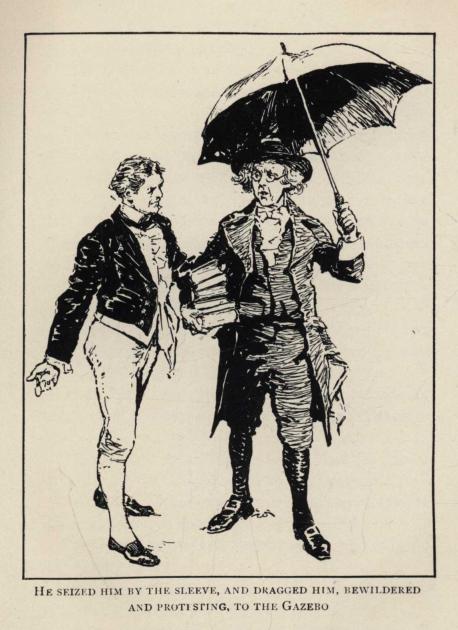
HE SEIZED HIM BY THE SLEEVE, AND DRAGGED HIM, BEWILDERED AND PROTESTING, TO THE GAZEBO
"Sempronius! Sempronius!" cried Mrs. Poskett, appearing at her window. "Come in, you bad cat, you 'll get wet through!"
But Sempronius was deeply engrossed, and Mrs. Poskett closed her window in despair.
Meanwhile Jack had forced the outraged Doctor down on to the seat, Marjolaine had relieved him of the umbrella, and Jack had tossed his books into a corner.
"Sit down, Doctor," said Jack, "here, between us."
"But, my dear young friends—" began the Doctor, protestingly.
"You'd get your feet wet, Sir, and catch cold. My name's Jack Sayle."
Marjolaine interrupted him. "His name is the Honourable John Sayle," she explained with great importance, "and he's the only son of Lord Otford."
She had touched a spring. If there was one thing the Doctor was more familiar with than another, it was heraldry. He started off like an alarm clock, and all the exclamations and gesticulations of the impatient lovers were incapable of stopping him.
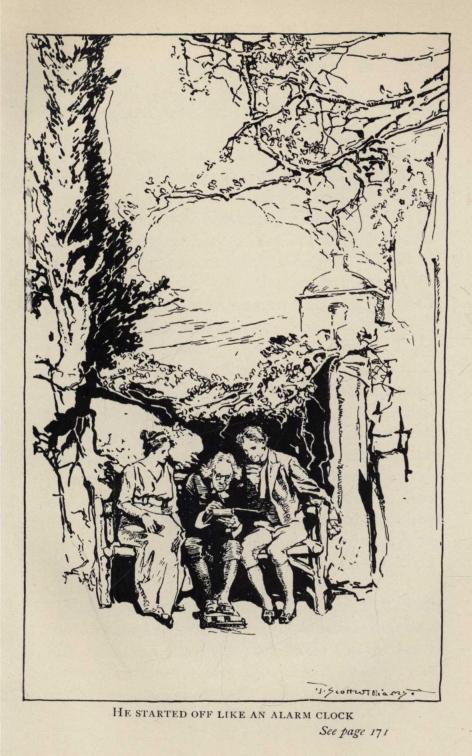
HE STARTED OFF LIKE AN ALARM CLOCK
"Otford: or, on a fesse azure between in chief, a sinister arm embowed and couped at the shoulder fessewise vested of the second, holding in the hand proper a martel gules, and in base a cerf regardant passant vert, three martlets of the first. Crest: out of a crest-coronet a blasted oak—"
"Oh!" cried Marjory, stopping her ears.
"—motto: Sayle and Return."
"Doctor!" shouted Jack, shaking him, "when you 've quite done, we want to get married; and you 've got to get a licence!"
The boy and girl were leaning excitedly across him. They spoke alternately and breathlessly.
"Because," said Marjolaine, "we 're in a dreadful hurry and Maman won't hear of it—"
"And my father wants me to marry Caroline Thring, which is wicked—"
"And of course I'll never do it, and it's no use asking me, but—"
"We're going to be married anyhow, and if you don't help we shall run away—"
"And you would n't like to be the cause of our doing that, would you?" She had slipped to her knees.
"And we love each other—" Jack also was on his knees, facing her.
"Very, very dearly!" they both concluded. And to the horror of the learned Doctor, their lips met.
He rose, indignant. "I am deeply shocked. Profoundly surprised. I shall make a point of informing Madame Lachesnais and his lordship."
Jack leapt to his feet. "Oh, I say, you can't, you know!" he protested, "because we took you into our confidence!"
The antiquary was as nearly angry as he had ever been in his life. "I did not ask for your confidence!" he exclaimed.
"Well—you've got it!" said Jack, conclusively.
Marjolaine laid her hand on the Doctor's arm and looked up at him with great pathetic eyes—the stricken deer. "And, Doctor, dear—think of when you were young!"
"Eh?" said the Doctor, startled. "How did you know?—And if I did run away with my blessed Araminta—"
"Ah!—there, you see!" cried Jack, delighted.
"—I had every excuse," protested the Doctor. "My blessed Araminta was deeply interested in flint arrowheads."
"And I 'm sure you were very, very happy," said Marjolaine, laying her hand on his shoulder.
The Doctor looked at her. The Doctor dug his snuff-box out of a remote waistcoat-pocket. The Doctor took snuff. The Doctor drew out a great, brown handkerchief. The Doctor blew his nose. His snuff was very strong, and had made his eyes water. Finally he said, "Ah, my child, she has been dead thirty years!"
"Dear Doctor Sternroyd!" murmured Marjolaine.
He pulled himself together. "But this is so harebrained! A special licence is not so easily had. His Grace, the Archbishop of Canterbury—"
"Oh, my goodness! an Archbishop!"—cried Marjolaine, deeply impressed.
"The Archbishop of Canterbury requires excellent reasons."
"I 've told you," cried Jack impatiently, "we love each other!"
The antiquary could not help smiling. "I fear that would hardly satisfy his Grace!"
"Wicked old gentleman!" pouted Marjolaine.
"We'll find a reason," said Jack, confidently; and after a moment's thought: "Here you are! My leave 's up in a month: only just time for the honeymoon!"
"H'm!" said the Antiquary. "Even that does not seem to me sufficiently convincing."
He had risen, and now turned and looked at them as they sat watching him eagerly and hopefully. They looked so charming, so young, so innocent, and so deeply in love with each other, that the Doctor was touched. For years he had been buried in his musty old books, and suddenly he was confronted with life, with youth starting out on its career. It would be good to make these children happy.
"I have an idea," he said, with a humorous twinkle. "The Archbishop, who is a very good friend of mine, is forming a collection of antiquities. Now—" he searched in all his pockets—"I found a rare Elizabethan tobacco-pipe here the other day." He produced it and polished it carefully on his sleeve. Marjolaine, I am sorry to say, hid her face in her handkerchief, and was attacked by a fit of coughing which shook her from head to foot. "Perhaps," continued the Doctor, eyeing the pipe with fond regret, "perhaps if I were to offer that to his Grace, it might oil the wheels." He sighed deeply. "Yes!—It will be a wrench, but I 'll take it to Lambeth to-morrow—Ah, no! To-morrow is Sunday!"
"Dash it!" cried Jack, petulantly. "What a way Sunday has of coming in the wrong part of the week!"
"Hush!" said Doctor Sternroyd, reprovingly, "Monday, then."
"And you'll marry us the same day?" asked Jack.
"No, no!" replied the Doctor. "The day after, perhaps."
Marjolaine ticked the days off on her fingers. "Saturday—Sunday—Monday—Tuesday—! Four whole days!—"
The lovers looked at each other disconsolately, and together sighed, "Oh, dear!"
"And what am I to do till then?" cried Jack. "I daren't go home. My father 's quite capable of having me kidnapped and sent to my ship!"
Marjolaine clung to him with a little cry. "Oh, Jack!"
He turned to Doctor Sternroyd with sudden decision. "Doctor! You must give me a bed."
The Doctor failed to understand. "Give you—?"
"A bed."
Doctor Sternroyd threw up his hands in protest. "And incur your noble father's displeasure?"
"On the contrary. He'd be deeply grateful to you for showing me hospitality."
"Ah," sighed the Antiquary, shaking his head, "you'll find me poor company, young gentleman."
"It's only for two days," said Jack lightly. "We can play chess." He turned to Marjolaine. "And every evening we'll meet in the Gazebo. I 'll whistle so:—" he executed a fragment which Marjolaine repeated, more or less—"and you 'll come out."
Doctor Sternroyd was troubled; but this young man had a way with him. "Ah, well!" he sighed, sitting down and motioning them to sit beside him. "Now you must give me full particulars: your names, ages, professions, if any—"
"How exciting!" cried Marjolaine, clapping her hands.
The Antiquary picked up one of the books. "'Epicteti quæ supersunt Dissertationes,'" he read, affectionately. "A pencil! Now, Mr. Sayle—" So they bent their heads together, and were very busy, giving the dates of birthdays, and all their histories, which Doctor Sternroyd meticulously entered on the fly-leaf of the tome.
The rain had ceased. The sun was again shining brightly, turning the rain-drops on the foliage of the elm into diamonds. The air sparkled, newly washed. The Eyesore in his corner had, for some time, been showing symptoms of discomfort. With appetites refreshed by the shower, the fish were displaying a lively interest in his bait. To be sure, they refused to swallow his hook; but they nibbled at his worm with great zest, and kept his float bobbing up and down in a manner which made it impossible for him to attend to anything else. Yet out of the corner of his eye he could see Sempronius, stretched at full length, creeping slowly, almost imperceptibly, but with deadly determination, towards the fish Jack had caught.
The Eyesore said "Hoo!" but Sempronius took no notice. The Eyesore kicked; but Sempronius was out of reach. The Eyesore shook his disengaged fist; but Sempronius only smiled.
As the sun came out, out came Mr. Jerome Brooke-Hoskyn, as resplendent as the sun. He was truly wonderful to behold: his magnificent beaver hat poised at an improbable angle, his buckles glittering, and his vast person imposing under the countless capes of his driving-coat. Just as he had swaggered to his gate he was evidently arrested by a voice from the upper chamber.
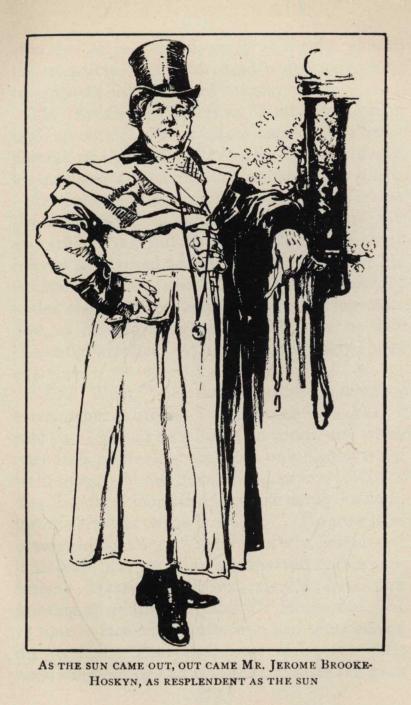
AS THE SUN CAME OUT, OUT CAME MR. JEROME BROOKE-HOSKYN, AS RESPLENDENT AS THE SUN
"Eh? What?" he asked peevishly, making an ear-trumpet of his hand. "Late home?—Yes; I told you I should be. Pitt is to speak, and when once he's on his legs the Lord only knows when he'll stop. But I have the doorkey. What? Yes, I did! I found the keyhole easily enough, but the key was twisted. What?" He grew purple with indignation. "Sober!—Reely, Selina!—" The Walk was astir, as he observed to his confusion. "Dammit, Ma'am, they'll hear you howling all round the Walk!" He turned just in time to face Miss Ruth, who had come sailing up to him. Everybody was either at their open windows, or had come out to taste the fresh air. The Admiral was fussing with his sweet peas; Jim was helping him; Mrs. Poskett was watching the Admiral; Basil Pringle was struggling with the Kreutzer Sonata; Barbara had left Doctor Johnson and was leaning out of the lower window; listening to Basil. Even the servants were out and about; only Madame was missing.
Miss Ruth addressed Mr. Brooke-Hoskyn. "Off to the whirl of fashion so early?"
Brooke-Hoskyn did his best to edge her away from the house while he nervously pulled on his buckskin gloves. "H'm, it is a long way to the City," he explained, "my good friends, the Goldsmiths' Company—a banquet to the Chinese Ambassador—my shay is waiting round the corner."
Miss Ruth tried to pass him. "I'll go and sit with your wife," she said, with the kindest intention.
"On no account!" he answered, not too politely, interposing his solid bulk between her and the gate. Seeing her bridle, he corrected himself. "Most kind of you, to be sure; but—ah—not just now. I left the dear soul asleep, and dreaming of the angels."
Miss Ruth turned away disappointed, and her attention was at once diverted by the Eyesore's extraordinary antics. Sempronius, that intelligent cat, clearly comprehending that the fisherman could not leave his rod, was preparing to spring at the fish.
"Oh! look at the Eyesore!" cried Miss Ruth.
"Haha!" laughed Brooke-Hoskyn. "Sempronius is about to snatch his fish! Observe his antics! Reely, most amusing!"
In the Gazebo the lovers and Doctor Sternroyd had finished, and the Doctor closed the book with a sigh of satisfaction. "There! I think that's all!" They prepared to leave their shelter, unconscious of the excitement in the Walk.
But at that moment the Eyesore, driven to desperation by the threatened loss of his fish, sprang at Sempronius with uncontrollable fury, seized the animal by the scruff of his neck, and—horresco referens—hurled him into the river. Then he picked up his fish, and bolted.
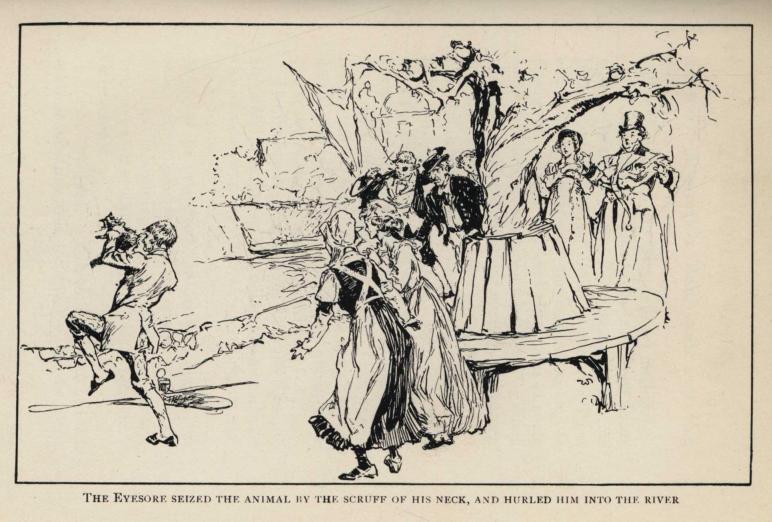
THE EYESORE SEIZED THE ANIMAL BY THE SCRUFF OF HIS NECK, AND HURLED HIM INTO THE RIVER
Ruth screamed; Barbara screamed; Nanette and Jane screamed; while Mrs. Poskett waved her arms and screamed louder than any of them: "Sempronius!—Save him!"
Ruth turned wildly to Mr. Brooke-Hoskyn. "Save him!"
"In these clothes!" cried he, much offended.
They had all forgotten the hero of the Battle of Copenhagen. To fling his coat to Jim; to seize the Eyesore's landing-net; to stumble down the steps to the river; and to capture the squirming cat, was the work of a moment.
Mrs. Poskett had rushed out of her house just in time to meet the Admiral bringing the drenched cat up the steps again. In his open window Basil struck up "See the Conquering Hero Comes," and, while Marjolaine, Jack and Doctor Sternroyd stood petrified in the Gazebo, all the rest of the Walk formed an admiring circle round the Admiral and Mrs. Poskett.
"Your cat, Ma'am," said Sir Peter with the simple dignity becoming to the doer of a great deed, as he handed her the struggling and yelling animal.
And what do you think she did? She tossed—tossed!—the cat to Jim, and, exclaiming, "My hero! My preserver!" flung her arms round the Admiral's neck and kissed him on both cheeks.
And at that precise moment, while the whole Walk had gone frenzied with excitement, while the Admiral was standing stupefied, only able to ejaculate "Gobblessmysoul!" a great many times in succession; at that precise moment the gaunt Mysterious Lady entered the Walk, followed by her gigantic footman. Mr. Brooke-Hoskyn fled.
"'Ware pirate, Admiral!" shouted Jim. All the women, except Mrs. Poskett, who was lying half unconscious in the Admiral's arms, rushed to their doors, where they stood, watching further developments.
The Mysterious Lady had her face-à-main up, and her disgusted stare wandered from the excited women to the dishevelled group formed by Mrs. Poskett and the Admiral. "What horrible people!" she exclaimed. She bore down on Sir Peter, who had managed to shake off his fair burden, and stood panting with suppressed fury.
"You dreadful old man—" she began.
"Eh?" cried the Admiral. "You, again! Don't you speak to me! I'm dangerous!"
The three conspirators in the Gazebo were listening with all their ears.
"You don't know whom you're addressing!" said the Lady, haughtily.
"I don't, and I don't want to," answered the Admiral, mopping his brow.
The Lady drew herself up to her full height. "I am Caroline Thring!"
"Caroline—!" ejaculated the Admiral, who had caught sight of Marjolaine and Jack. But the situation was too much for him, and he sank speechless on the seat under the elm.
"Caroline! Oh, my stars!" cried Jack.
Fortunately the Honourable Caroline Thring turned away from the Gazebo and examined the houses, where all the women were standing on guard, prepared to defend the doors with their lives. Marjolaine had time to gather her wits. She saw the Eyesore's smock and hat lying where Jack had thrown them. "Put those on! Quick!" she cried.
"Where is the girl with the curls?" asked Caroline, turning fiercely on Sir Peter.
"I—I—I—don't know," he stammered.
"In the summer-house, no doubt," said she, beginning to advance towards it.
"She 's coming!" whispered Jack, who was not nearly ready. Then, to Doctor Sternroyd, who was standing first on one leg and then on the other and alternately opening and shutting his umbrella in his helpless bewilderment, "Doctor! Lie! Lie, as you never lied before in your life!"
But Sir Peter had jumped up, and was barring Caroline's way. "You mustn't go there!—You can't go there!—You shan't go there!"
Caroline gave him a look and brushed him away with a contemptuous motion of her face-à-main. "Stand aside, intoxicated person!"
"Intoxicated!—Me!" screamed the Admiral, sinking back on the seat.
Caroline found herself face to face with Doctor Sternroyd, whom Marjolaine had thrust forward, just as you throw your wife or your child to the wolves when you are sleighing in Siberia. "A clergyman!" she cried, examining him with surprise.
"A humble clerk in holy orders, Ma'am," stammered the Antiquary.
Now Caroline saw Marjolaine with difficulty supporting a decrepit old man in a very bad hat and a very dirty smock. Really quite a touching picture.
"Who is this?" she asked, almost mollified.
"A poor man, your Ladyship," said Marjolaine, with a pretty curtsey. "I'm teaching him his letters, your Ladyship." Another curtsey. Then she had an inspiration. She pointed to Doctor Sternroyd. "And this kind clergyman is going to give him some soup, your ladyship." When she had completed her third curtsey, she turned to Jack. "Come, good man. Lean on me."
Caroline was much moved. "I'm glad my first visit bore such good fruit," she said patronisingly. Then seeing with what extreme difficulty the poor old man walked, and not to be outdone by a mere chit of a girl, she said to Jack, "Give me your other arm." And so Jack was slowly escorted towards Doctor Sternroyd's house, while the Walk looked on and admired.
The Walk was puzzled. Here was the Eyesore, suddenly grown very old, being led into one of their houses, and the Admiral uttered no protest! As a matter of fact the Admiral was too much occupied in mastering his desire to laugh, to move from his seat. The rest of the Walk felt that Caroline was the common enemy, and even the Eyesore sank into secondary importance.
For all but Basil. Basil, who had watched the entire adventure from his window, nearly spoilt the whole thing. He had seen the Eyesore run away—yet here was the Eyesore—!
"But the Eyesore ran away! Who's—?" he shouted.
Sir Peter recovered breath enough to gasp, "Hold your tongue!"
"Well, but, Doctor Sternroyd—" protested Basil.
"Hold your silly tongue, sir!" cried the Doctor to Basil's infinite amazement.
Jack disappeared into the Antiquary's house and the Antiquary himself stood at the door waving his umbrella like a sword. Caroline turned to Marjolaine. "You're a good little girl," she said, kindly. "Here's a six-penny bit." Marjolaine, quite equal to the occasion, received it with a fourth curtsey, and a modest "Thank you, my Lady."
I think Caroline had some idea of following into Doctor Sternroyd's house to see that her ancient protégé was well bestowed, but just as she got to the gate the Doctor slammed the door violently in her face; and the whole Walk took its cue from him, so that as Caroline passed along the Walk haughtily tossing her head, every window was closed with a bang, and every door was slammed with a bang, bang, bang, bang, bang!
And Marjolaine and the Admiral sat under the tree and shouted with laughter!
CHAPTER XI
POMANDER WALK TAKES A DISH OF TEA
Chapter XI headpiece
The Walk had got through Sunday as best it could. It had gone to church; it had read good books; the Admiral had carefully laid "Hervey's Meditations among the Tombs" open on his knees, and his bandana over his head, and had tried to sleep his Sunday sleep. But it was only a fitful slumber. Too many things had happened and were happening in the Walk. There was Jack, concealed in Doctor Sternroyd's house, for one. What did that mean? Sir Peter had called on Doctor Sternroyd, but the latter stood in his doorway with the door only ajar, and would not allow him to cross the threshold. He had kept a wary eye on the Walk and he was sure Jack and Marjolaine had not met. He himself had sat under the elm to an unconscionable hour, and had made it impossible for the lovers to meet. He would not betray them, but on the other hand there should be no underhand goings on. He had tried to intercept Marjolaine and talk to her like the Dutch uncle he had alluded to, but she laughed in his face, and ran away. But that was not all that troubled him. He had undoubtedly been embraced, in the presence of the whole Walk, by Mrs. Poskett. There was no blinking that fact; and he felt that his neighbours, with gross unfairness, put the blame on him. After the morning service, Miss Ruth Pennymint, who had gone to church alone, refused to walk home with him for the first time in his experience, and only gave a very lame excuse. Mr. Brooke-Hoskyn looked at him with a disapproving eye. Mrs. Poskett had not shown herself since the awful scene with the cat. He had instructed Jim to reconnoitre; I don't know how Jim carried out that delicate task, but he came back to his master with the report that Mrs. Poskett was mortal bad, to be sure. Even Basil Pringle had been very distant with him when they met after church.
The Admiral turned and twisted in his chair. Surely the flies were more troublesome than usual so early in the summer.
He was so put about that, contrary to his usual custom, he went to church again in the evening. Madame Lachesnais was there, and to his confusion asked him to escort her home. Marjolaine walked on in front with Mr. Pringle and Ruth.
Madame had noticed the curious discomfort that pervaded the Walk. She had seen and heard nothing of yesterday's occurrences, as she had been shut in her own little room at the back of the house, busy with her own troubles. She took the Admiral into her confidence. Did he know what was the matter with the Walk? It seemed as if some imp of mischief had set everybody by the ears. She had ventured to address Doctor Sternroyd that morning, and he had turned even paler than usual—positively green—and had run away from her. What was the matter with Mrs. Poskett? Why had not Barbara been to church all day? And he, himself, why was he so silent? Why did he seem to wish to avoid her?
The Admiral was greatly troubled. He could only stammer that he supposed it was the change in the weather. "Well," said Madame, "I cannot let our good friends go on like this. Why, we should be unable to live together in the Walk, if we were not all on excellent terms with each other." And so the next morning all the inhabitants of the Walk received a pretty little three-cornered note, asking them to an al fresco tea-party that evening, under the elm.
Jack had never spent such a Sunday, and privately registered a vow he would never spend such another. Doctor Sternroyd did all his own housekeeping; he said he would rather spend his money on a book than on a cook. He invariably rose at six. He routed Jack out at that hour. At half-past six he was at work in his study, even on Sundays. At nine he made his breakfast, a thin cup of tea and a very thin rasher of bacon. What Jack did between six and nine, I do not know. After breakfast the Doctor went back to his study and he gave Jack his great manuscript work on "Prehistoric Remains found in the Alluvial Deposit of the Estuary of the Thames, together with Observations on the Cave-dwellers of Ethiopia," to while away the time. When the Doctor went to church he locked Jack in his room. After church he went for a long walk and forgot all about Jack. And he had forgotten all about him when he came back, so that Jack was forced to raise a perfect riot before he could get released. By midday on Monday Jack had worked his way through every edible thing in the house, and on Monday afternoon the Doctor not only had to go and see the Archbishop of Canterbury on the subject of the licence, but had been strictly enjoined by Jack to bring home food.
Fortunately for Madame's tea-party, that Monday evening was an ideal one. June had come and the roses in the little gardens had taken the opportunity to burst into bloom. The elm was in its fresh summer garb. The setting sun shone level through its leaves and turned them all to burnished gold. It gilded the entire Walk, and set the panes in the windows flashing and flaming; even the dirty little oil lamps were glorified as they reflected the golden blaze. The river shimmered with opal and amethyst; and a great barge, drifting down with the tide, might have borne Cleopatra and all her retinue, so gorgeously was it transfigured.
Not all the Walk was present. The Doctor, as we have just seen, was engaged with the Archbishop, and with his own marketing. Miss Barbara had sent a polite excuse. Her actual words were "Miss Barbara Pennymint presents her Compliments to Madame Lachesnais and is much obliged for her kind invitation to tea. Miss Barbara Pennymint much regrets she cannot avail herself of Madame Lachesnais' proffered hospitality as I am engaged in an educational experiment."
Mrs. Brooke-Hoskyn, of course, was absent, as usual, for purely personal and private reasons.
But all the others were there. Mr. Brooke-Hoskyn was resplendent in a plum-coloured suit, of which the breeches fitted so tightly, and of which the waist was so narrow, that he scarcely dared breathe.
Mrs. Poskett and Ruth had put on their best gowns; the Admiral wore his gala uniform with all his medals, and his three-cornered hat. Madame herself was a vision of loveliness. She had discarded her half-mourning for the occasion; but what she wore I cannot tell you, except that it was a soft blue, and that there was graceful lace about her neck and wrists. If you wish to see what she looked like, you have only to examine a Book of the Modes of 1805, and you will find her there. Even Mr. Basil Pringle was brushed.
Nanette and Jim—Jim in his best clothes—waited on Madame's guests. The latter were all on their best behaviour. You never saw anything more elegant than the way Mr. Brooke-Hoskyn stuck out his little finger as he raised his cup to his lips; you never heard prettier protests than when Marjolaine offered Mrs. Poskett a third helping of cake. "I couldn't! I reely and truly couldn't!—Well, since you insist!"
But do what Madame would she could not put her guests quite at their ease. A sort of blight brooded over their spirits. This was particularly noticeable in their attitude towards Sir Peter. They treated him with unaccustomed aloofness; they kept him at arm's length; they did not respond to his sallies; with the result that his sallies became more forced as the evening wore on. As a contrast to this gentle gloom, Marjolaine's high spirits amazed her mother. This child, who only last Saturday was broken-hearted, to-day was laughing and blithe, rallying her guests, prettily playing the hostess, the only life in the party. Madame watched her with puzzled anxiety.
Mr. Brooke-Hoskyn, with the calf of his leg well displayed, and his little finger well at right angles to his cup, bowed elegantly. "Ah, Ladies, there is nothing so comforting as a dish of tea after dinner. It is prodigiously soothing!"
There seemed no appropriate rejoinder, but Mrs. Poskett exploded with "Nothing can soothe the broken heart." She spoke into her cup, but her eyes wandered towards the Admiral.
Sir Peter tried to change the conversation. Also he felt it was time to assert himself. Mr. Brooke-Hoskyn had been monopolising the notice of the ladies far too long.
"Hah!" he cried, "I 've always said Pomander Walk was a Haven of Content. Look at it!" You remember that the last time he made a similar remark everybody obediently turned at his command. Imagine his feelings, then, when on this occasion nobody paid the slightest attention. On the contrary, they ostentatiously turned to each other and began spirited conversations about nothing in particular. He repeated, "I say, look at it!" but only drew a glare from Brooke-Hoskyn.
Marjolaine came to the rescue. She tripped up to him and put her arm through his. "There 's something the matter with the Walk this evening, Sir Peter. I 'm the only merry one among you!"
Madame could not help exclaiming with grave remonstrance, "Marjolaine!"
Marjolaine came close to her mother. "Oh, let me laugh, Maman!" She proceeded in a whisper, "They are so droll! Sir Peter is afraid of Mrs. Poskett; Mrs. Poskett is almost in tears; Mr. Basil is gloomy; Ruth is in a bad temper; and Mr. Brooke-Hoskyn has n't got over Saturday's banquet."
"But you, Marjolaine—!" exclaimed Madame with quiet reproof.
"You told me to fight it, Maman," said Marjolaine, with a shy laugh. Then she ran across to Basil, who was watching the door through which Barbara might still come. He was wondering what demon had persuaded him to accept this invitation, which had brought him out of doors, when he might have stayed indoors where he would at least have been under the same roof as Barbara.
The Admiral had bravely recovered from his rebuff. He came up to Brooke-Hoskyn. "Well, Brooke, my boy! Did n't see you in church yesterday. Too much turtle on Saturday—what?" and down came the flat of his hand with a round thwack on Mr. Brooke-Hoskyn's broad back.
To be accused of having overeaten yourself when you are suffering from a bad headache is extremely annoying; to be slapped on the back when you are swallowing hot tea is infuriating. Mr. Brooke-Hoskyn turned on Sir Peter. "Nothing of the sort, sir!—I deprecate these unseemly familiarities. I was detained from divine service because I chose to sit at home and hold my dear Selina's hand!" And he turned his back on Sir Peter.
"Um," said the latter. His playful banter was certainly not being well received.
Mrs. Poskett looked up at Mr. Brooke-Hoskyn with melancholy eyes. "How is your wife?" she said, "that dear, innocent lamb."
"Gambolling, Ma'am," he answered, airily. "Figuratively speaking, Selina is gambolling."
"How wonderful!" exclaimed Mrs. Poskett, sympathetically.
Basil Pringle felt that something drastic must be done if they were to live through the evening. He addressed Marjolaine. "Miss Marjory, won't you cheer us with a song?"
Madame Lachesnais interposed quickly: this was putting her poor child's courage to too severe a test. "I am sure she would prefer not to sing this evening."
But Marjolaine exclaimed merrily, "Oh, yes, Maman, if they would like it!"
Madame could only admire her indomitable pluck. "Brave child!" she murmured.
"Sing that pretty little thing about the blue ribbon," cried the Admiral, and hummed the first bar.
"Ha!" mockingly cried Mr. Brooke-Hoskyn.
The Admiral faced him angrily: "Well, sir?"
Mr. Brooke-Hoskyn eyed him calmly through his quizzing glass, and said coldly, "What, sir?"
Madame interposed with her most amiable smile. "Sir Peter, Mrs. Poskett's cup is empty."
"Is it?" growled Sir Peter, without moving. But Madame's hand was stretched out to receive it, and he had to yield.
"Oh hang!—Your cup, Ma'am." He almost snatched it from her.
"How kind and gentle you are," almost sobbed Mrs. Poskett, with an adoring glance.
The Admiral answered her with a glare. "Kind be—" he was silenced by a stern "Hush!" from Basil, and had to relieve his feelings by inarticulate splutterings.
Marjolaine stood in the centre of the circle, with her hands folded in front of her, and sang very simply and unaffectedly:
"Oh, dear! What can the matter be?
Dear, dear! What can the matter be?
Oh, dear! What can the matter be?
Johnny 's so long at the fair.
He promised he 'd buy me a fairing should please me,
And then for a kiss, oh! he vowed he would tease me,
He promised he 'd buy me a bunch of blue ribbons
To tie up my bonny brown hair."
Mr. Brooke-Hoskyn applauded in the grand manner with the tips of his fingers, as if he had been at the Opera. "Brava! Brava!" he cried, with the discrimination of a connoisseur.
"Brava be hanged!" roared the Admiral. "Capital!" He turned to Miss Ruth. "Where's little Miss Barbara?"
To his consternation Miss Ruth hissed a fierce "Hsssh!" at him.
"Well, I 'm—!" he muttered to himself.
Marjolaine sang the second verse. You are to understand that she made a very pleasant picture as she stood warbling the quaint old ballad with unaffected simplicity. Jack evidently thought so, for, braving the danger of discovery, he stood, gaunt and hungry, watching her from behind the curtains in Doctor Sternroyd's window. Indeed, all the Walk was affected by her charm. Heads nodded to the tune; feet kept time to the rhythm; hearts melted—Mrs. Poskett's heart, especially. She gazed reproachfully at the Admiral. What, indeed, could the matter be? and why, indeed, was her Johnnie, whose name was Peter, so long at the fair? Jim and Nanette had come into the circle, fascinated by the song. Jim was trying to insinuate an arm round Nanette's ample waist, but only got pinched for his pains.
"He promised he'd buy me a basket of posies,
A garland of lilies, a garland of roses,
A little straw hat to set off the blue ribbons
That tie up my bonny brown hair.
And it's oh, dear! What can the matter be?
Dear, dear! What can the matter be?
Oh, dear! What can the matter be?
Johnny 's so long at the fair!"
Almost unconsciously the whole Walk drifted into the song, so that the last lines were being sung by everybody. The Admiral, indeed, who never knew when a song was over, went on long after everybody else had finished. In his enthusiasm he added weird shouts to the words:—"Oh! Damme! Ahoy! What can the matter be?"
Mrs. Poskett burst into loud sobs. "Oh, don't!—I can't bear it!"
Ruth turned fiercely on the Admiral. "Brute!" she cried.
Mr. Brooke-Hoskyn was stopping both ears with his hands. "Mong doo! Mong doo!" he drawled. And then in that curiously official manner he sometimes dropped into, "Pray silence for the Admiral's song!" It was a very irritating manner.
Sir Peter made furiously towards him. "By Jehoshaphat—!"
But Madame, ever alert, stopped him. She held out a full cup. "Sir Peter," she said, with her sweetest smile, indicating Mrs. Poskett, "take her another dish of tea."
"Me, Ma'am!" protested the outraged Admiral; but there was no resisting that smile, and he took it like a lamb—an angry lamb. "It's a confounded conspiracy," he growled. He thrust the tea under Mrs. Poskett's nose. "Your tea, Ma'am!"
"How sweet of you!" sobbed Mrs. Poskett.
The Admiral danced with rage. "Dash it and hang it, Ma'am, you're crying into it!"
Marjolaine had taken Miss Ruth aside. "Where is Barbara?" she asked.
"It's enough to make a saint swear," answered Ruth, snappishly. "She's been locked in with Doctor Johnson since Saturday. Locked in! Only comes out for meals." Marjolaine laughed quietly to herself.
Sir Peter had been moving restlessly round the Walk. He now found himself face to face with Basil. "Pringle," he said, "can you tell me what's come over the Walk?"
Basil drew himself up. "The Walk has lofty ideals, sir," he said sternly. "Perhaps you have fallen short of them." He turned away and stalked towards Barbara's house.
The Admiral was left speechless. He—he! Admiral Sir Peter Antrobus—had been snubbed by Mr. Brooke-Hoskyn, by Ruth, and now by this—this fiddler-fellow! He could only mutter, "Well!—blister my paint—!"
He was aroused by the booming of Mr. Brooke-Hoskyn's voice.
"Yes, Ladies," that great man was saying, "Sherry was in fine condition on Saturday!"
The Admiral was not going to hoist the white flag. Mr. Brooke-Hoskyn must be put in his proper place. "And port, too, eh, Brooke, my boy?"
Mr. Brooke-Hoskyn eyed him sternly and haughtily. "My name is Brooke-Hoskyn, sir, and I was referring to my Right Honourable friend, Richard Brinsley Sheridan!"
"Why couldn't you say so?" grumbled Sir Peter.
Mr. Brooke-Hoskyn continued. "As I was about to say when—" he looked contemptuously at the Admiral—"when I was interrupted—What wit! What brilliance!"
"Oh, do tell us!" cried Ruth. The ladies all hung on his lips. He tasted the full flavour of popularity. He let it linger on his palate. He was in no hurry. "In order to appreciate the point, you must remember how sultry the weather was on Saturday."
"Gave you a headache, what?" put in the irrepressible Admiral.
Mr. Brooke-Hoskyn did his best to wither him with a look. Then he resumed. "Brooke, says he—Brooke, my boy"—just like that—all craned forward: they must not miss the point—"it's a very warm night." His audience waited. Yes? The rest of the story? He looked from one to the other a little uncomfortably. When they found nothing more was coming they turned to each other, puzzled. Could this be all? Was their perspicacity at fault? or where was the joke? The Admiral, bolder than the rest, gave voice to the general feeling. "H'm. I don't see much in that."
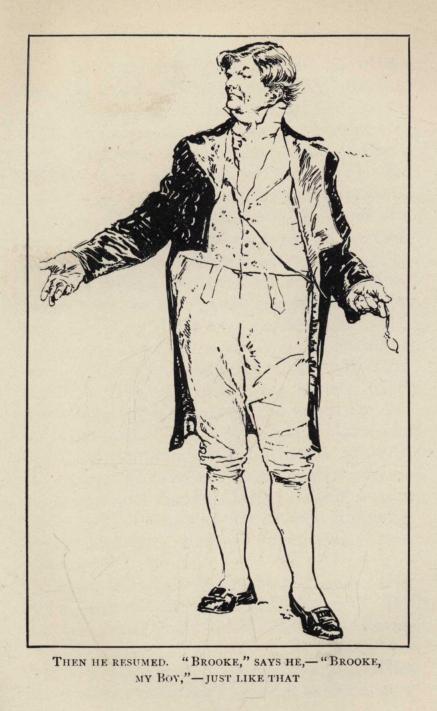
THEN HE RESUMED. "BROOKE," SAYS HE,—"BROOKE, MY BOY,"—JUST LIKE THAT
"Nobody ever suspected you of having a sense of humour," said Mr. Brooke-Hoskyn, severely. However, he felt that his first effort had not been the success he had hoped for, and he tried again. "Ah!"—said he, brightening up, "and my friend, H.R.H. the P. of W.!" He uttered the cabalistic letters with a mixture of mystery and airy familiarity. There was an awed "Oh-h!" from all his hearers except Sir Peter. The latter exclaimed impatiently, "Your friend who?"
The reply came with crushing weight. "His Royal Highness the Prince of Wales, sir!" The Admiral reeled under the shock of this broadside.
Mrs. Poskett leant forward eagerly. "What did the dear Prince say? My poor husband knew him well," she explained. "When Mr. Alderman Poskett was Sheriff, the dear Prince frequently dined with the Corporation, and many 's the time he said to Poskett, 'Mr. Sheriff, you must be knighted,' but Poskett went and died—"
Mr. Brooke-Hoskyn was annoyed. He was being interrupted, which is a thing intolerable, and his own anecdote was being supplanted. He held up a deprecatory hand. "It was not so much what he said," he explained, "as his manner of saying it. Just:—'Ah, Brooke!'—but oh! the elegance! Oh, the condescension!"
Sir Peter broke out with, "Well, of all the—!"
But Madame stopped him with a touch on his arm. "Do you ever make speeches, Mr. Brooke-Hoskyn?" she asked sweetly.
The great man looked at her with something like suspicion. For a moment he was undeniably flustered. But he mastered himself with an effort and replied with a fair assumption of carelessness, "Short ones, Ma'am. Frequent, but short. I have proposed the health of many gentlemen of distinction."
"How clever you must be!" cried Ruth, admiringly.
"Oh—!" protested Mr. Brooke-Hoskyn, with exquisite modesty.
Madame pointed to the river, now gleaming in the afterglow. "How strangely empty the Walk looks without our fisherman!"
"I was wondering what I missed," said Basil, "of course! The Eyesore!"
"He leaves a blank," added Ruth.
Marjolaine laughed. "He was a sort of statue."
Mrs. Poskett confided tearfully to her tea-cup. "The Walk is not the Walk without him."
Sir Peter was genuinely astonished. "Why, he tried to drown your cat, Ma'am!"
Madame playfully shook her finger at him, "Oh, Sir Peter! have you driven the poor man away?"
The Walk eyed him severely, and all cried as with one voice, "For shame, Sir Peter!" Mr. Brooke-Hoskyn went on booming, "Shame! Shame!" all by himself, long after the others were silent.
The Admiral's patience was nearly exhausted. Here was Madame turning against him now. The injustice of it infuriated him. He stamped with rage. "But, hang it and dash it, I haven't seen him!" he roared. But nobody believed him. All shook their heads gloomily, and said "Ah!"
CHAPTER XII
IN WHICH THE OLD CONSPIRACY IS TRIUMPHANT AND A NEW CONSPIRACY IS HATCHED
Chapter XII headpiece
Little Miss Barbara Pennymint came flying out of her house: a little more and she would have flown over the railings. Her cheeks were glowing with joy, her eyes glittering with excitement. She saw nothing of the tea-party, but dashed headlong into the midst of it as a sea-mew dashes at a lighthouse. "Marjory! Marjory!" she cried. Then she saw all the people staring at her, and stopped, abashed. "Oh! I had forgotten!" she exclaimed, and spread her wings to fly back again, but Madame stopped her.
"A dish of tea, Miss Barbara?"
"No!" cried Barbara, violently, but remembering her manners she corrected herself. "Oh, no, thank you!" She hopped and skipped to Marjolaine, who had come half-way to meet her. "Marjory," she said, overflowing with excitement, "can I speak to you?"
Before Marjolaine could answer, Sir Peter had borne down on them. Here, at last, was somebody who had not snubbed him yet. "Ah, Miss Barbara," he bellowed, with clumsy playfulness, "I didn't see you in church yesterday!"
As if Barbara wanted to be reminded of that!
"Wasn't I there?" she stammered, utterly taken aback. "I don't remember." She tried to get away, but the Admiral was inexorable. "Come, now! Come, now! What was the text?"
Unhappy little Barbara saw all the eyes of the Walk fixed on her. She had to say something. "Oh! I know!" she cried at last, and proceeded volubly, "'If any of you know of any cause or just impediment—'"
"Barbara!" screamed Miss Ruth, indignantly, while the others laughed at her confusion. Basil heaved a great sigh. Still thinking of the lost one! Marjolaine came to the rescue and drew Barbara away from her tormentor. "Come away, Babs!" She turned severely on poor Sir Peter, "Don't worry her, Sir Peter!"
"Try to put some sense in her, Miss Marjory," said Ruth, as the two girls ran away, with their arms, as usual, round each others' waists.
The Admiral was crushed. "Even Missie!" he groaned. But he saw Mr. Brooke-Hoskyn preparing to tell another anecdote. This gave him new courage. Putting on his courtliest manner, he exclaimed, "Well, Ladies! To-morrow is the Fourth of June!"
"As this is the Third," interrupted Mr. Brooke-Hoskyn, with fine sarcasm, "you might safely have left us to infer that, sir!"
He was standing close to Mrs. Poskett, who had not moved from her seat under the elm. Sir Peter came and faced him, so that the poor lady found herself, as she afterwards described it, between the upper and the nether millstone.
If Mr. Brooke-Hoskyn could wield sarcasm, so could Sir Peter when he was put to it. He spoke with dangerous politeness. "But it seems necessary to remind the bosom friend of H.R.H. the P. of W. that it is the birthday of His Most Gracious Majesty King George the Third!—" The shot told. For a moment Mr. Brooke-Hoskyn was silenced. Sir Peter went on, conscious of victory, "Ladies, I warn you not to be alarmed when you hear me fire the salute as usual!"
Mr. Brooke-Hoskyn leaped—positively leaped at his opportunity. "As usual!—Ha! That brass popgun of yours—"
"Popgun!—" roared the Admiral, leaning across Mrs. Poskett.
"I said popgun, sir!—has never gone off, yet!"
Mrs. Poskett was in a dreadful flutter. She held up her cup and saucer deprecatingly to each of the infuriated gentlemen in turn, and each automatically seized them and rattled them in the other's face. Jim—moved by his guilty conscience—was signalling frantically to Mr. Brooke-Hoskyn not to betray him.
The Admiral was purple in the face. "Because some infernal scoundrel has always tampered with the charge!" The accumulated grievances of the evening welled up within him. "But to-night," he went on, thrusting the cup and saucer roughly on Mrs. Poskett and spilling the tea over her beautiful silk gown, "to-night, I'll load it myself! and, damme! I'll take it to bed with me!" And with that he stumped off in a rage into his house, thrusting the innocent Basil and the terrified Jim out of his way with horrible objurgations.
"Now, Ladies!" said Mr. Brooke-Hoskyn, triumphantly, "you see the man's real nature!"
Poor Mrs. Poskett's nerves were completely shattered, and she was trying to drink tea out of her empty cup.
Ruth came and sat beside her. "We shall break the Admiral down, yet, my dear. His temper is all due to conscience."
"Alderman Poskett was just like that whenever he had sanded the sugar," said Mrs. Poskett, tearfully.
Mr. Brooke-Hoskyn was devoting himself to Madame. Jim and Nanette were removing the tea-things into Madame's house, and that rascally Jim, who was old enough to know better—but is anybody ever old enough to know better?—was making the most of his chances.
Marjolaine and Barbara had retired into the Gazebo. "Yes!" twittered Barbara, continuing their conversation, "he's learnt it! He does surround it with flowers of speech, but he says it quite clearly."
"Dear Doctor Johnson!" cried Marjolaine, laughing, and clapping her hands.
Barbara shuddered reminiscently. "But I cannot bear his eye on me! It's like Charles's. And he is moulting—which more than ever increases the resemblance. Oh, Marjory, he looked at me so coldly all the time I was teaching him!"
"Never mind how he looked, if he'll only talk!"
Barbara embraced her frantically. "How can I ever thank you?"
Basil was standing by the chains that separated the Walk from the river. The melancholy of the evening had entered his soul. Ruth came up to him. He was an idiot, to be sure, yet her heart went out to him in sympathy. Mr. Brooke-Hoskyn and Mrs. Poskett were thanking Madame for her hospitality. Jack could be seen peeping impatiently out of Doctor Sternroyd's window, or striding to and fro in the room like a caged tiger at feeding time.
Marjolaine whispered to Barbara. "If you are really and truly grateful, you may be able to help me! I'll tell you a great secret." She drew Barbara close to her. "I am to be married to-morrow!"
Barbara screamed aloud, and all the people in the Walk turned in alarm.
"Is anything the matter?" enquired Miss Ruth, anxiously.
"No, no!" said Marjolaine, laughing. "Yes," she went on, when the others had resumed their conversation, "married secretly to-morrow. Swear you won't tell anybody if you live to be ninety!"
"Yes! oh, yes!" cried Barbara, hopping from twig to twig. (I cannot help it: she really was exactly like a bird!) "I mean, No! oh, no!"
"And you must be bridesmaid!"
Barbara's face expressed rapture. "Marjory!" And then with eager curiosity, "Who is it?"
"Sh!" whispered Marjolaine. She pointed to Doctor Sternroyd's house. "There!"
Barbara was genuinely amazed. She had heard of May and December, but this was May of this year and December of the year-before-last. "Not Doctor Sternroyd?" she asked aghast.
Marjolaine burst out laughing. "No, no!" She pointed again where Jack was standing behind the curtain, the picture of misery. "There! At the window!"
Barbara gazed and understood. "Oh, how lovely!" she cried, alluding to the romance and secrecy.
But, of course Marjolaine accepted the epithet for Jack. "Yes, is n't he?" She drew Barbara to the elm. "We are to be married by special licence."
"What's that?" asked Barbara.
"I don't know. Doctor Sternroyd's getting it. It lets you go and be married anywhere, whenever you like."
"Heavenly!" cried Barbara. "If Doctor Johnson teaches Basil what I 've taught Doctor Johnson, Doctor Sternroyd shall get me a licence, too."
"Yes," said Marjolaine, "we'll keep him busy." Then she turned to where Basil was gloomily watching them, and called, "Mr. Basil!"
Basil hurried forward eagerly, "Yes, Miss Marjory?"
"Barbara is not feeling very well," said Marjolaine, sympathetically; and immediately Barbara looked languishing and pathetic.
"Heavens!" cried Basil in genuine alarm, "Shall I play to her?"
"Oh, no!" cried Marjolaine, innocently, "it's not so bad as that. But it's her evening hour with Doctor Johnson, and she does n't feel quite equal to it."
Ruth had overheard this last statement. "Why, bless her heart!" she interrupted tartly, "she 's been sitting with that bird all day!"
Barbara lifted great reproachful eyes at her. "Unkind Ruth! The lonely bird!"
Marjolaine went on rapidly, addressing Basil, "So she wondered whether you would take her place for once."
"Why, of course!" cried Basil. "With the greatest pleasure in life!"
Barbara glanced at him out of the corner of her eye, and said very demurely, "Oh, but you don't know what you may hear."
"Yes," exclaimed Ruth, sharply, "he swears horribly."
"I'll soothe his savage breast!" cried Basil, enthusiastically. "I 'll be Orpheus with his Lute! I 'll play the Kreutzer Sonata to him!"
Barbara turned anxiously to Marjolaine: this wouldn't do at all!
"No! no!" cried the latter, "just let him talk! Just let him talk!"
But Basil was already inside the house. Marjolaine and Barbara retired, giggling, into the Gazebo, where they sat and twittered mutual confidences. Ruth joined the other ladies, who were listening to Mr. Brooke-Hoskyn. The Admiral was leaning out of his upstair window to take in his thrush.
"Indeed, yes," continued Mr. Brooke-Hoskyn, "I have collected the witty sayings of my distinguished friends. I shall make a book of them. A small quarto. I shall call it, 'Pearls'"—he caught sight of the Admiral—"'Pearls before Swine.'" The Admiral disappeared. Mr. Brooke-Hoskyn proceeded, "Did I tell you my friend Sherry's bonn mott about the weather?"
"Yes! Oh, yes!" cried all three ladies, with alacrity, and fled from him, leaving him abashed and rather offended. He saw Barbara in the Gazebo, and brightened up. "Ah! but Miss Barbara was not there!" He crossed on tip-toe, and, much to her alarm, seized her by the arm and dragged her to the elm. "Imagine, then," he boomed, condescendingly, while Barbara signalled in vain to Marjolaine for help, "Imagine, then, that you are standing—ah—just where you are standing; and I am Sheridan." Barbara had no idea of what he was talking about. Had he suddenly gone mad? If so, was he harmless? "You remember how we perspired on Saturday evening?" "Oh!" cried Barbara, with disgust. "I come up to you—so." He suited the action to the word. "I place my hand familiarly on your shoulder—so—"
"Really!" cried Barbara, indignantly.
Mr. Brooke-Hoskyn explained. "You understand: you are Sheridan—no; I am Sheridan and you are me. And I—that is Sheridan—say to you—I mean, me—'Brooke, my boy—'"
Jane, Mr. Brooke-Hoskyn's pretty maid, came rushing out of the house. She was in a flutter of excitement; also she was in a dreadful hurry—and here was her master, talking to a lady!
"'Brooke, my boy'"—repeated Mr. Brooke-Hoskyn, leading up to his point.
"Master—! Master—!" whispered Jane, hoarsely.
Mr. Brooke-Hoskyn waved her away impatiently.
"'Brooke, my boy—'" he repeated for the third time. But Jane was tugging at his coat-tails.
"What is it?" cried Mr. Brooke-Hoskyn, peevishly. "What the devil is it? Go away!"
Jane clung to him like a limpet. "Master!" she cried again; and then, putting her lips close to his ear and covering them with one hand, while with the other she pointed frantically to the upstairs window, she whispered a piece of news which petrified him and made his eyes start out of his head. Then she ran back into the house as quickly as she had come.
"Eh? What?" he cried, in great perturbation. "There, now!—So like Selina! Spoilt the point of my story!" He turned to the utterly bewildered Barbara, with half a mind to continue his anecdote, but thought better of it, and with a brusque, "Excuse me!" dashed headlong into the house.
Madame, who had been quietly conversing with Mrs. Poskett and Ruth, came to Marjolaine. "I think I shall go in. Will you come, Marjolaine?"
"Oh, Maman," pleaded Marjolaine, "I have so much to say to Barbara!" She accompanied her mother to their gate.
"You are so feverish—so unlike yourself—! You are not going to be indisposed?"
Marjolaine caught sight of Jack in the Doctor's study. "Oh, Maman!" she cried, throwing her arms round her mother's neck and kissing her with quite unusual ardour, "I am so well, so well!—I never was so well!"
Madame looked at her searchingly. Could her daughter be heartless? To be sure, she herself had besought her to forget her girlish love, but Marjolaine had forgotten it too quickly. Madame went into her house with an uneasy mind and a troubled countenance.
Miss Ruth had been arguing with Mrs. Poskett. "Well," she said, evidently alluding to the Admiral, "That's what I should do! Bring him to his knees."
There was a dangerous glitter in Mrs. Poskett's eyes as she replied, "I brought Poskett to his: why should n't I bring Peter?"
"Strike while the iron's hot. He knows we're all disappointed with him, and he's ashamed of himself. Now's the time, when he ain't sure of himself. Come along in. Put on your prettiest cap. I'll help you."
Just as they were at Mrs. Poskett's gate they saw Doctor Sternroyd come shuffling round the corner. His manner was furtive, and he was burdened with a variety of small parcels.
"Dear me, Doctor! How you are loaded!" cried Miss Ruth.
The antiquary had evidently hoped to get home unnoticed. "Good evening, Ladies!" he stammered, in confusion. "Pray excuse me if I cannot remove my hat."
"And not books, this time?" said Mrs. Poskett.
"No, no, no!" cried the antiquary, looking as guilty as if he had been caught carrying stolen goods. "Not books. Not what you might call books. Just parcels. Simple necessaries, I assure you." He made a wide curve in order not to come into closer contact with Ruth and Mrs. Poskett, and they went laughing into the latter's house. But the wide curve brought him up against Marjolaine and Barbara, who had come out of the Gazebo. "More women!" groaned the Doctor; and before either of them had spoken he had added hastily, "Simple necessaries, I do assure you!"
Barbara hopped up to him eagerly. She touched all the parcels, which he vainly tried to keep out of her reach. "Doctor," she said, eagerly, "which is the licence?"
The Doctor was utterly taken aback. "Eh? Oh, dear! dear! Miss Marjory, you told her!"
"Of course," said Marjory. "She's my dearest friend!"
"Tut, tut!—Dear, dear!—What says the Swan of Avon? 'Who was't betrayed the Capitol?—A woman!'"
Jack had opened the window and now leant out and said in a ghastly whisper, "Doctor!—For Heaven's sake look sharp with the victuals!"
"There, there!" cried the flustered Doctor, as he shuffled on into the house, "the cuckoo in the nest!"
At the same instant Mr. Basil Pringle came bounding out of the Misses Pennymint's house, shouting, "Miss Barbara!"
Barbara leant half-swooning against Marjolaine. "Oh!—he's coming!"
"Oh, Miss Barbara!" repeated Basil, breathlessly.
"Has Doctor Johnson bitten you?" asked Marjolaine, mischievously.
"Oh, that gifted bird!" exclaimed Basil, rapturously.
"Did he speak?" asked Marjolaine, while Barbara panted expectant.
"Speak!—Ah!—" Basil had no words.
Doctor Sternroyd's window was violently thrown open by Jack. It was nearly dark in the Walk, and Jack was reckless. "Marjory!" he called. Marjory was very much startled. Anybody might come out at any moment.
"Oh! take care!" she cried, as she ran up to within whispering distance of him.
Barbara, with bent head and blushing cheeks was trying to keep Basil to the point. "What did he say, Mr. Basil?"
"Come closer!" whispered Jack to Marjolaine, and after assuring herself that no one was looking, she crept inside the little garden.
Basil came impulsively towards Barbara. "Shall I tell you? Dare I tell you?" he asked passionately, yet shyly.
"You know best," said Barbara, making an invisible pattern on the grass with her dainty foot.
Basil took his courage in both hands. "He said—it was all in one breath—He said, 'O-burn-your-lungs-and-liver-you-lubberly-son-of-a- lop-eared-weevil-tell-Barbara-you-love-her!'"
"Oh, Mr. Basil!" sighed Barbara, and threw herself headlong into his arms.
"But it's true!—It's true!" he cried enthusiastically. "Come! let me tell you my own way!" And without more ado, he picked her up and carried her bodily into the Gazebo.
"It's perfectly monstrous!" Jack was explaining angrily to Marjolaine, who was now under his window. "The old fossil's brought two eggs, a red herring, and a pot of currant jelly!"
"Poor Jack!" exclaimed Marjolaine sympathetically, yet with a note of laughter in her voice.
"Is that rations for a grown man?" asked Jack pathetically. "Says he'll make an omelette! Two eggs! An omelette! Ho!"
Here the Eyesore crept cautiously back to his post. He had not dared come in broad daylight, but now that it was nearly dark he hoped he would be unobserved.
From the Gazebo came the voices of the other lovers in long-drawn notes.
"My own!" said Basil, in a stupendous bass.
"My Basil!" echoed Barbara.
Rapture. Oblivion. An endless embrace.
"Can't you send that object for food?" said Jack, pointing to the Eyesore.
"I daren't speak to him," answered Marjolaine, with a little shiver of dislike. "He always turns out to be somebody else. Jack! if you 'll be good, I 'll get it myself!"
"Angel! But make haste! I'm starving!"
"If you hear me singing, look out of the window," whispered Marjolaine, kissing her hand to him. And with that she ran lightly into her own house, and Jack retired to wait with what patience he could muster.
"And now, what is the next thing to do?" asked Basil, rising and leading Barbara towards the house.
"We must tell Ruth," said Barbara, with a sound practical idea of clinching the matter. There should be no mistake this time.
"Yes! at once!" cried Basil, nobly. "Oh!" he exclaimed, with a burst of grateful sentiment, "I 'll buy Doctor Johnson a golden chain!"
Barbara's pretty head was reposing affectionately on his shoulder. "And I 'll wear it for him. The dear bird."
"The dear, dear bird!" they repeated in melodious unison.
Not otherwise did Romeo and Juliet breathe soft nothings in the gardens of Verona. Not otherwise did Paolo and Francesca talk exquisite nonsense when they had very injudiciously left off reading. Not otherwise—but why pursue the subject? You and I have been just as happy, and just as foolish.
Ruth brought Mrs. Poskett, resplendent in a new cap and various other seductive devices, out of the house. Barbara fluttered to her sister. "Dear Ruth! Come in quickly! Basil and I have such news for you!"
Ruth saw it at a glance. At last they had shed one form of idiocy to take on another. Now, perhaps, she would enjoy a little peace. "Very well," she said. Then she made a low curtsey to Mrs. Poskett, and said, meaningly, "Courage—Lady Antrobus!"
Alas, poor Admiral! The knell of thy freedom has sounded. Shut thyself in thy house as thou wilt: close thy shutters; make fast thy doors; yea, train the little brass cannon on the Walk: nothing will help. Thy fair enemy is cruising at the harbour's mouth, with pennons flaunting to the breeze, and all her deadly armoury of sighs, tears, threats, reproaches and languishing glances made ready for action; and nothing thou canst do will serve. Through long years thou hast sailed light-heartedly from many ports, leaving broken, or, at any rate, damaged hearts behind thee. Now the Hour of Retribution has struck, and the Avenger is here. Thy day of conquests is past, and it is thou who wilt be led captive in chains of roses. There is none to sympathise with thee. On the contrary, it is my firm conviction that the whole Walk will hang out banners to celebrate thy defeat.
CHAPTER XIII
IN WHICH ADMIRAL SIR PETER ANTROBUS IS MORE THAN EVER DETERMINED TO FIRE THE LITTLE BRASS GUN
Chapter XIII headpiece
Mrs. Poskett found herself—if you did not count the Eyesore: and nobody ever had counted him, yet—alone in the Walk. The sun had set, and the evening twilight itself had almost merged into night. The river gleamed a pale green, as if it were loath to surrender the last remnant of day. It was a propitious hour for amorous dalliance, but Mrs. Poskett felt she had much to do ere she could hope to be engaged in any such pleasant pastime. She sat some moments under the elm considering her position. She was face to face with a difficult problem. Here she was, under the elm, and there was Sir Peter, safely barricaded in his own house. That he was not in a good humour she knew. The house looked forbidding. The door was tightly closed. The windows were shut, and the blinds drawn. Somewhere behind those drawn blinds the Admiral was fuming. She yearned to hold his hand and comfort him and soothe his feelings, wounded, as well she knew, by the sneers and open mutiny of the Walk. But how to get at him? She could not go to his house. She could not call him. All the conventions and proprieties rose up like an impregnable wall against either of those courses. And even if she called him, he would not come. On the contrary, he would retire like Hamlet to some more remote part of his ramparts, and pretend he had n't heard her. She must employ some stratagem. But what stratagem? Pomander Walk was not a good nursery for stratagems, she thought, little knowing how many plots and schemes and conspiracies had been concocted and were still seething all around her.
She was on the point of giving up in despair when she caught sight of the Eyesore. She looked at his back—which was all she could see of him—and brooded a long time. At last she rose and stole over to him on tip-toe. She felt for a coin in the little bead-embroidered bag that hung from her wrist. Two or three times she opened her mouth as if about to speak, but each time she closed it again upon the unspoken word. Finally, however, she made up her mind.
"My good man," she said, rather condescendingly.
The Eyesore never stirred. She might as well have addressed one of the chain-posts. She tried again: this time a trifle more urbanely. "Mister!—"
A sort of wave of acknowledgment ran down the back of the Eyesore's coat, just as a horse shivers at the touch of a fly; but that was all. She made one more effort: now with a courteous appeal. "Sir!—You threw Sempronius into the river on Saturday—here's a crown for you."
I cannot explain what connection there was in her mind between the crime and the reward, except that in some confused way she considered the former as a sort of introduction entitling her to address him.
The Eyesore only put his hand behind his back with the open palm upward. When Mrs. Poskett had dropped the huge coin into it, he brought it slowly round, bit it, spat on it, and pocketed it. But he said no word. Mrs. Poskett proceeded hastily, indicating the Admiral's house. "Now I want you to knock at that door."
The Eyesore followed the direction of her finger with a bleary eye. What! He knock at the door of his enemy and persecutor! and be captured by him! That was her little game, was it? And she thought to lure him to his doom with a miserable bait of five shillings. But he'd show her! To Mrs. Poskett's amazement, alarm, and admiration, he picked up a stone, hurled it with unerring aim at the door, and incontinently bolted round the corner. Mrs. Poskett fled behind the elm and awaited the upshot with a beating heart.
Jim appeared, red-faced, at the door. He looked up and down the Walk, but seeing it empty, muttered, "Cuss them boys!" and was turning to go in again, when Mrs. Poskett called him.
"Good evening, Mr. Jim," she said, in her blandest tones.
"'Evening, mum!" answered Jim, touching his forelock. "Them boys ought to be drownded, is what I says; and I wish I had the doing of it."
"You have a responsible post, Mr. Jim."
"Ay, ay, mum. Bosun o' the Admiral's gig."
"Oh, more than that, Mr. Jim. Chief officer, and cook, and gardener—what lovely peas!" It was much too dark to see the peas, but she knew they grew all around Jim's heart.
"Ah," he assented, and added with meaning, "takes a oncommon lot o' moistenin', though."
"It is thirsty weather, Mr. Jim." Mrs. Poskett was searching in her bag again.
Jim's eyes gleamed. "And a truer word you never spoke, Lady."
"Mr. Bosun," said Mrs. Poskett, insidiously, "I want to see the Admiral."
Jim shook his head gloomily. "Ah! 'tis dirty weather he's makin' of it, sure 'nough. He've a-locked hisself in by hisself if you'll believe me; an' he's a-swearin' somethin' 'orrible for to 'ear!"
"Mr. Bosun," said Mrs. Poskett, holding up a beautiful, bright new crown-piece between her finger and thumb, "would five shillings quench your thirst?"
Jim wiped his mouth with the back of his hand. "Well, Lady, I can't say but 'twould take the edge off it."
To his disgust, Mrs. Poskett retreated a step. "But I must see Sir Peter."
Jim scratched his head—which was his way of expressing deep reflection. He caught sight of the Admiral's flag hanging motionless. "I've got it!" he cried. "Sheer off a cable's length, Lady."
Mrs. Poskett retired to the extreme end of the Walk. Jim made a speaking-trumpet of both hands and bellowed, "Admiral, ahoy!"
The Admiral's window went up so suddenly, the Admiral's head shot out so abruptly, and his voice was so fierce, that Mrs. Poskett could not suppress a little scream.
"D'ye want to wake the dead?" roared the Admiral.
"Axing your pardon, Admiral—sunset."
"What of it, you lubber?" The Admiral was quite unaware of Mrs. Poskett's presence, or I am sure he would not have used such an expression.
"Shall I haul the flag down, Admiral?" asked Jim, with well-feigned astonishment.
You may judge of what the Admiral had gone through from the fact that this was the first time in recorded history he had neglected to perform this ritual.
"On your life!" he cried, in great agitation. "I've hoisted it and struck it with my own hands, morning and night, any time these five years. D' ye think I'll have a lubberly son of a sea-cook like you do it now?"
He vanished from his window as abruptly as he had appeared. Jim hobbled towards Mrs. Poskett. "Got him, Lady!" he chuckled.
Mrs. Poskett handed him the coin. "Here, and thank you."
"Thank you, mum."
Sir Peter appeared at the door. Unfortunately he caught sight of Mrs. Poskett. He retreated, half-closed the door, and only showed his head through the opening.
"Jim!" he cried.
"Ay, ay, sir!"
"Haul it down yourself."
Mrs. Poskett gave a cry of disappointment. Had she spent ten shillings in vain?
But Jim was equal to the occasion. His voice was a beautiful blend of pathos and wounded dignity. "No, Admiral. Not after what passed your lips."
"Damme! I can't leave it hoisted all night!" roared the Admiral.
"That's as mebbe," said Jim, beginning to stump off. "Even the lubberly son of a sea-cook 'as 'is feelin's, same as them wot's 'igher placed." And he stumped round the corner.
"Here! Jim!" roared the Admiral, in distress and fury. "Come back! you mutinous scoundrel!" But Jim was gone.
What was the Admiral to do? Was he to leave the flag up, contrary to all precedent? That was unthinkable. On the other hand was he to offer himself as a target for Mrs. Poskett's sarcasms? Yet again, was he to show the white feather in the presence of the enemy? No! He'd be hanged if he would. He slapped himself on the chest to give himself courage, and came down the steps. "Cheer up, my hearty!" he cried; and then he hummed what he thought was the tune of "Oh! dear! what can the matter be?" and began hauling down the flag.
Meanwhile Mrs. Poskett had sidled casually along the railings, as if she were going nowhere in particular and didn't mind when she got there. But she timed herself carefully, so that she was close to Sir Peter just as he was entangled in the lines.
"Admiral!" she said, very gently.
"Ma'am?" growled he, continuing to extricate himself.
"Why do you force me to address you?" she asked reproachfully, and with great dignity.
Sir Peter was taken aback. "Me! Force you! Gobblessmysoul!" he exclaimed, "Well, I'm—"
"For your own good," said Mrs. Poskett, solemnly. "Oh, Sir Peter, you was King of the Walk on Friday. Now Mr. Brooke-Hoskyn will usurp that title."
This fetched him. He left the flag lying at the foot of the mast, and came out into the open. "Will he so, Ma'am!" he said, fiercely.
"So he will!" Having enticed him from behind the security of his railings, Mrs. Poskett knew he would follow wherever she led him. She led him at once towards the elm.
"The Walk says you have lowered the prestige of His Majesty's Navy."
The Admiral had indeed turned to go back; but this brought him to her side. "Dash it and hang it, Ma'am! what do you mean?"
"Well, you know what I mean," said Mrs. Poskett, with pretty confusion. "The entire Walk saw you press me to your heart!"
The Admiral was helpless. His own recollections of what had happened on Saturday were extremely vague. What with the rescue of the cat and the sudden appearance of Caroline Thring, together with the subsequent escape of Jack, he had lost all sense of actualities. Moreover, it was impossible for him to accuse Mrs. Poskett of having embraced him. A gentleman does not do such things. So he could only stammer weakly, "I didn't, did I?"
Mrs. Poskett flashed at him indignantly. "The entire Walk witnessed the outrage, and the entire Walk is indignant that nothing has come of it."
"Gobblessmysoul!" muttered the Admiral.
Mrs. Poskett followed up her advantage. "'Oh, how unsailor-like!'"—that is what the Walk says: "'How unsailor-like!'"
Imagine the stab. He, Admiral Sir Peter Antrobus, with more than forty years of service in His Majesty's Navy to his credit; the hero of Copenhagen; the friend of Nelson; he, who had given an eye for his country—unsailor-like!
He pushed his wig back and mopped his brow. "It doesn't say that!" he murmured, horrified.
But Mrs. Poskett was mercilessly emphatic. "It says that." Then she steered on another tack. "I 'm only a lone widow," she said, with an air of martyrdom. "If Alderman Poskett were alive, he 'd see you did the right thing by his wife. But I!—I must leave my once happy home!"
"But—dash it and hang it—!" protested Sir Peter, struggling in the web that was being woven around him.
"You cannot alter facts by swearing," said the widow. "Can I bear the sneers of a Pennymint? the arched eyebrows of a Brooke-Hoskyn? I cannot. I must let my beautiful house," with a side glance at him and considerable stress, "my freehold house. Let it to an undesirable tenant: a person with a mangle."
A mangle in Pomander Walk! "Gobblessmysoul!" said the Admiral. Also he had been set thinking. Freehold, eh?
"To be sure, the expense of moving is nothing," proceeded Mrs. Poskett, airily, "when one has Four-hundred a year in the Funds. But oh! my lovely furniture will be chipped! and, oh! how shall I part from my friends?"
The Admiral was moved. He was undeniably moved. A freehold house, Four-hundred a year in the Funds, and lovely furniture.—And, mind you, the widow was buxom; he himself had described her as a "Dam fine woman." As she stood there in tearful confusion, she looked distinctly agreeable; plump and comfortable. To be sure, the sun had gone down.
"But it's not so bad as that?" said the Admiral, with something approaching sympathy.
"It's worse!" cried Mrs. Poskett. "And that innocent cat, Sempronius!—What will he say? He took a chill on Saturday and he's lying before the kitchen fire wrapped up in a piece of flannel. When I move, the change will kill him. Oh, why did n't you leave him to drown?" she sobbed aloud.
The Admiral was much stirred. A woman's tears always bowled him over. He could stand anything but that.
"Dash it and hang it, Ma'am, don't cry!"
"It is n't as if I was older," sobbed Mrs. Poskett. "I could be much older! But I'm young enough to have a tender heart!" She mastered herself with an heroic effort; swallowed her sobs; drove back her tears; and stood before him, the picture of stoic calm, of noble resignation. "But never mind! I will be brave! You—you—shall—not—see—me—weep!" Then she howled.
Sir Peter was indescribably distressed. "But—Gobblessmysoul!—" he stammered—"what am I to do with Jim, and the flagstaff, and the brass gun, and the thrush, and the sweet peas?" and, pointing to his house, "What am I to do with Number One?"
Mrs. Poskett raised one tear-bedewed eye from her handkerchief. "Knock a door through and make one house of them!" she exclaimed, as if sweeping away an absurdity. "Oh, these paltry details!" Then she lifted her face to his with a smile. Thus does the sun look when it emerges from behind a rain-cloud. "Sweet peas? What could be more appropriate? Ain't I Pamela Poskett? and ain't you Peter?"
The tearful smile, so winsome, so appealing, was irresistible. "Damme, you 're right!" cried the Admiral, surrendering at discretion. "You've swept me fore and aft! You've blown me out of the sea! By George, Ma'am, I 'll marry you if you 'll have me!"
Once more, as when he saved her cat, Mrs. Poskett threw her comfortable arms round Sir Peter's neck. "I 'll have you, Peter," she cried joyfully; and she added in a tone which clinched the matter, "I've got you!"
There was an eloquent silence. The old elm shook its leaves with a ripple of laughter. It had seen many things in its long life, but never anything so epically grand as the widow's victory and the Admiral's surrender. Troy town was besieged in vain during ten long years, and was then only conquered by a horse. Five years Mrs. Poskett had besieged Sir Peter and her victory was due to a cat. You seize the analogy? When you remember, further, that Basil had been inveigled by a parrot, you will realise the danger—or utility, according to your point of view—of keeping domestic pets: the undoubted risk of having any commerce with other peoples' domestic pets—especially if they are Greeks or widows. I mean, the people.
The Admiral was conquered, and like a gentleman, he made the best of his defeat. That is the way to turn it into a moral victory. "I 'll haul out the brass gun and fire it to-night!" he cried, enthusiastically. "That'll tell the Walk!"
"I 'll tell the Walk!" said Mrs. Poskett, masking her quite legitimate triumph under renewed endearments.
They say drowning men see all their past lives in a flash. As the Admiral felt Mrs. Poskett's arms tighten round his neck, he had a similar experience. All the eyes he had ever looked into seemed to be gazing reproachfully at him out of the darkness; all the names he had ever whispered seemed now to be whispering in his ear. Dolores, Inez, Mariette, Suzette, Paquita, Frederike, Jette, Karen—I know not how many more—like a swarm of bees they buzzed around him. Then, too, he suddenly remembered that upstairs in his old sailor's chest; the chest that had accompanied him all over the world, there was a splendid and varied assortment of locks of hair: black, brown, golden, auburn, frankly red, straw-coloured, chestnut, and one off which the dye had faded and shown it uncompromisingly grey. He must remember to destroy them before—well, before the door was knocked through.
What escapes he had had! What a mercy he had not married that fiery Spaniard; that still more blazing Brazilian; that fickle Portuguese; that frivolous Mam'selle; that straw-coloured Dane. He began to realise that Mrs. Poskett was, like the Walk itself, a Harbour of Refuge. Here was no rhapsodical nonsense, but safe comfort, with a freehold house, solid furniture, and Four-hundred a year. Almost unconsciously his arms closed round her. She gave a great, contented sigh, as her head sank on his shoulder. To have drawn this response from him was, indeed, victory! I wonder what she would have done if she could have read his thoughts, if she could have seen the long procession of seductive females that was passing across his mental vision. I am convinced that the prospective title would have consoled her, and that she would have accepted his past for the sake of her future.
They were abruptly aroused from their happiness, however. Unperceived by them, Lord Otford had entered the Walk. He had come slowly along the crescent, examining each house in turn, evidently trying to make up his mind to knock at one of them. He retraced his steps and had his hand on the handle of the Admiral's gate, when his attention was attracted by the sound of murmuring voices. Evidently the voices of lovers. Quickly and angrily he came down, just in time to witness the Admiral implant a chaste but conclusive salute on Mrs. Poskett's ample brow.
"Peter!" he cried, scandalised.
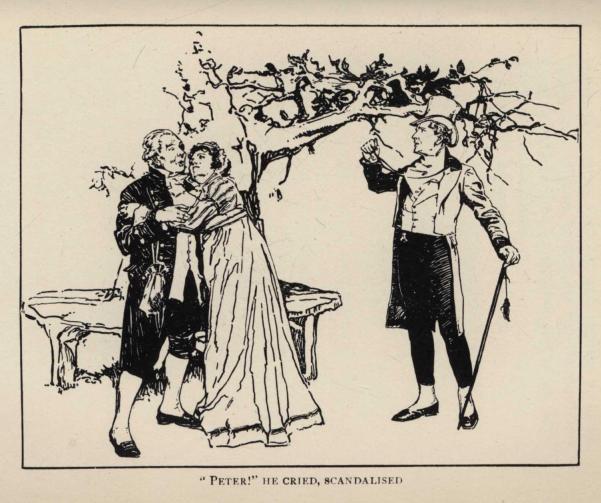
"PETER!" HE CRIED, SCANDALISED
CHAPTER XIV
IN WHICH MISS BARBARA PENNYMINT HEARS THE NIGHTINGALE, AND THE LAMPS ARE LIGHTED
Chapter XIV headpiece
The Admiral tried to start away from Mrs. Poskett, but though her hands slipped from his neck they clung to his arm. "Gobblessmysoul! Lord Otford!" he cried.
Mrs. Poskett had a delicious foretaste of future greatness. Here, at the very threshold of her betrothal, was a real, live lord. It was well worth all she had been through. "Present me, Peter," she whispered, "and tell him."
It is not so easy to tell an old friend you are going to be married, when you yourself are old enough to know better. The Admiral made a bad job of it. "Um—my neighbour—Mrs. Poskett—" he mumbled, weakly.
"Widow of Alderman Poskett," she broke in. "And if Poskett had n't died when he did—"
The Admiral cut her short. He presented his friend to her. "Um—Lord Otford—" then he tried bravely to explain the equivocal attitude in which they had been discovered. "Um—I am—she is—we are—" He broke down under Otford's eye.