Front matter (continued 2)
Reading edition
Jack protested, "Oh, my dear young lady!—It's not for me to say. Anything you offer me—anything!"
Ticking the items off on her pretty fingers, Marjolaine enumerated the various beverages stored in her mother's cupboard. "We have elderberry wine; cowslip wine; red-currant wine; and gooseberry wine."
Jack's face was a study. It had grown so long that Marjolaine exclaimed with genuine sympathy, "Why, you look quite ill! Which do you say?"
It was a choice between poison and discourtesy, but Jack was equal to it. "I 've been brought up very simply. I should never have the presumption to ask for any of those. Have n't you any ale?"
"Ale!" cried Marjolaine, "how low!"
"I said I 'd been brought up simply."
"We have no ale."
Before he could stop himself Jack had cried "And this is England!"
But Marjolaine had had an idea. "I know! There 's Maman's claret. She takes it for her health. What do you say to that?"
Jack had not tried it, and did n't know what he might be likely to say to it. He could only stammer, "Oh, it's better than—better than—" he was going to add elderberry, or cowslip, but caught himself up in time—"better than ale."
"Ah!—Now, will you wait a moment under the tree?"
"I'll wait hours, anywhere!"
Marjolaine caught sight of a figure moving about in Number Three. She came on tip-toe to Jack. You see, by this time there was quite a conspiracy between them.
"No! Better!" she whispered. "Go into the Gazebo."
Jack could only stare at her. "Into the what?"
She ran across to the summer-house, Jack following her.
"Here," she cried, "in the summer-house. And keep quite still."
For a moment a horrible suspicion crossed Jack's mind. "I say! You will come back? You 're not going to leave me here to perish of thirst?"
"That would be a good joke!" she laughed.
"I 'll carve your name while you 're gone!"
"No, you won't!"
"Why not?"
"Because you don't know it!—Voilà!"
And before he could stop her she had tripped into the house.
Jack sat for a moment in a sort of silent rapture.
Then all he said to himself was "By George!" three times repeated; and if you don't know what that exclamation meant, I 'm sure I can't tell you.
Marjolaine had left the "Adventures of Telemachus" on the seat in the Gazebo. Under ordinary circumstances Jack would have avoided picking up a book; but this was her book; it had been in her hands; her eyes had looked at it; it was not so much a book as a part of the little goddess; so he picked it up tenderly and tenderly opened it. There, on the fly-page, was a name.—"Lucy Pryor"—Of course! Her name! Lucy Pryor—just the sort of pretty, simple name she would have. Aha! but now he'd astonish her! She should find he had carved her name, after all! Out came his sailor's knife, and to work he went, and as he carved he sang a little song to himself, the words of which were, "Lucy, Lucy, Lucy Pryor." He was not a poet.
The Eyesore came slowly round the corner. Seeing the little lady was no longer on the seat, he drew his line out of the water—I need hardly record the fact that there was no fish on it. With a sigh he seated himself on his box, with his back to the Walk; patiently he placed a new worm on the empty hook, and in a moment he was immersed in his contemplative occupation. There was utter silence in the Walk.
Then the upstairs window of Number Five was thrust open and Mr. Jerome Brooke-Hoskyn, at his ease in his shirt-sleeves, and enjoying a church-warden pipe, leant out. He was evidently conversing with his wife, and was in his tenderest mood.
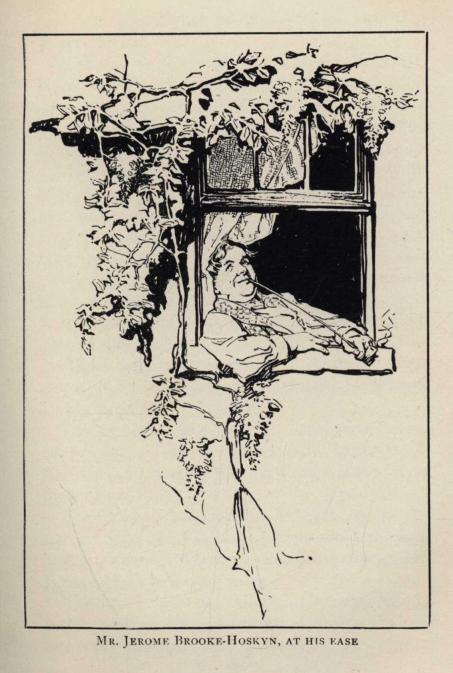
MR. JEROME BROOKE-HOSKYN, AT HIS EASE
"What a pity, my dearest Selina, you are temporarily deprived of the use of your limbs! The river is flowing by—What? Do I expect it to stop? No, of course I don't. Why check my musings? I say, the river is flowing by. Not a living thing is in sight except the Eyesore; and he enhances the beauty of his surroundings by sheer contrast. My smoke does not incommode you, my own?—You can bear it?—Dear soul! Am I the man to deprive you of an innocent pleasure?—"
He might have gone on all the afternoon in this strain, but at this moment Marjolaine came very cautiously out of her house carrying a tray on which was a bottle of claret, a tumbler, and a cake. Mr. Brooke-Hoskyn was immediately absorbed in this new and inexplicable phenomenon. What could it mean? He watched Marjolaine half-way across the lawn. Then in his softest and most caressing tones he exclaimed, "Why, Miss Marjory—!" Marjolaine gave a little cry and very nearly let all the things drop. She stood aghast.
Mr. Brooke-Hoskyn continued, "Is your mother in the Gazebo?"
Before Marjolaine could think of anything to say she had said "No."
"Indeed?—Then why this genteel refection?" Here Mr. Brooke-Hoskyn was forced to look over his shoulder into the room and answer the invisible Selina. "Yes, my own. I am speaking to Miss Marjory."
Meanwhile Jack was signalling frantically to Marjolaine, who, on her part, was as frantically motioning him to keep still. Mr. Brooke-Hoskyn again leant forward, and Jack vanished only just in time.
Marjolaine explained. "I—I always take a little refreshment at this hour."
It was quite obvious that Mr. Brooke-Hoskyn did not believe her.
"How singularly unobservant I am! I have never noticed it. Wait one moment. I 'll come and help you."
This would never do. "No, thank you," cried Marjolaine, "I am sure your wife wants you." And she added, as a parting shot, "She sees so little of you!"
Then taking her courage in both hands she hurried into the Gazebo, where she and Jack stood, pictures of horror, silently awaiting Mr. Brooke-Hoskyn's next move.
The latter leant far out of his window vainly endeavouring to peer round the corner. "Curious, very curious," he muttered.
"Did you hear him?" asked Marjory, in a tragic whisper.
"If he comes here I 'll punch his head," growled Jack.
"Be quiet!"—And again they both listened.
But Mr. Brooke-Hoskyn's attention was engaged by Selina, and it was clear from his remarks that the dear lady was not in her pleasantest humour. "No, my dear, of course I did n't mean to go.—Do you think her an ugly little thing?—Matter of taste.—Oh, come! Not jealous, my own one?—Hold your hand?—Oh, certainly, if you wish it!" And down came the window with a crash and what sounded very like a fine Saxon monosyllable.
Marjolaine and Jack, hearing the window close, uttered a sigh of relief.
"Thank goodness!" cried Marjolaine; and then, being a daughter of Eve, "Now you see what you 've done!"
"'Pon my honour, I 've done nothing. Just waited hours."
"Hours, indeed!" said the girl, scornfully.
"It seemed hours," answered Jack, insinuatingly. "It seemed hours—Miss—Lucy Pryor."
"Lucy Pryor? Oh! you got that out of the book! That was Maman's name before she married. My name's Lachesnais."
"Beg pardon?"
"La-ches-nais. Marjolaine Lachesnais. You don't pronounce the middle s."
"Are you French?"
"My father was." She had filled the tumbler with claret and was holding it out to Jack. "Never mind about all that. Make haste."
Jack rose to his feet, tumbler in hand.
"Marjolaine—? That means Marjoram, does n't it?"
"Do you know French?"
Jack bowed as he swallowed the claret. He swallowed unwisely. It was a lady's claret, and that and a lady's cigar are things to be avoided by the judicious. Indeed Jack was shaken from head to foot by a convulsive shudder. "Oh Lord!" said he involuntarily. But he pulled himself together like a man. "I beg pardon!—Know French? Very little. Marjoram—sweet Marjoram—how appropriate!"
Marjolaine was eyeing him with grave suspicion. "You are not drinking. It is Maman's claret!"
Jack gazed stonily at his half-empty tumbler. "Does she—does she take this for her health?"
"Yes. As medicine."
"As medicine—I understand."
"You said you were thirsty."
"It's a wonderful wine. Quenches your thirst at once." He put the glass away from him.
"Take some cake?" said Marjolaine.
She had forgotten to bring a knife, so Jack, sailorlike, broke the cake in two pieces.
"I say!" he cried, "you must have some too, or I shall feel greedy!" And there they sat, like two children, contentedly munching and swinging their legs.
"I shall call you Marjory," said Jack, between two bites.
"They all do," answered Marjolaine, with her mouth full.
"Do they?" asked Jack ferociously. "Who?"
Marjolaine waved her cake at the Walk in general. "Oh—the neighbours."
"Impudence!" growled Jack. But he recovered quickly. "I say! Isn't this delightful?"
"It's very strange. Do you know, you are the first young man I 've ever spoken to, in all my life?"
Jack's eyes expressed his joy. "No!—that's first-rate!"
Marjolaine stared at him with astonishment. "Why?"
"Oh, I don't know. I hate young men."
"Then you ought to live here. Here—everybody is—oh!—so old!"
"Poor little girl," said Jack, with deep sympathy.
"Why?"
"Must be so lonely."
"Oh, no! One cannot feel lonely where there 's a river. Twice every day it brings down news from the meadows, where the flowers are, and the cattle, standing knee-deep in its margin, and the demoiselles—how do you say?—dragonflies—and the willows, dipping their branches in it. And then, when the tide turns, it comes back from the great town, and sings of the ships and the crowded bridges, and the King and Queen taking their pleasure in great, golden barges. And the sea-gulls come with it, and it sings of the sea!"
Her eyes were flashing; her face was transfigured; Jack was leaning forward eagerly, and if there had been any loophole of escape for him before, there was certainly none now.
"Do you love the sea?"
"What do I know of it?" said she, coming to earth again. "I have only crossed from Dunkerque to Tilbury. But that was lovely! It was very rough; and I stood against the mast, and my hair blew all about, and I shouted for joy!—Oh! I should love to be a pirate!"
"Fine!" cried Jack, as excited as she. "Tell you what! We 'll charter a ship, and sweep the seas, and bang the enemy!"
"'We'?—Why, you're going away in a minute, and I shall never see you again."
There was a pause. Marjolaine's words had brought them both to a sense of reality. Finally Jack spoke, and his voice had a new ring of earnestness.
"Marjory—do you mean that?"
She turned wonderingly innocent eyes on him. "Why should you come again?"
"Think a moment. Let us both think. We are very young, and I know I 'm hasty. Let us sit quite still, and think hard whether we 'd like to meet again. Let us look at each other and not speak."
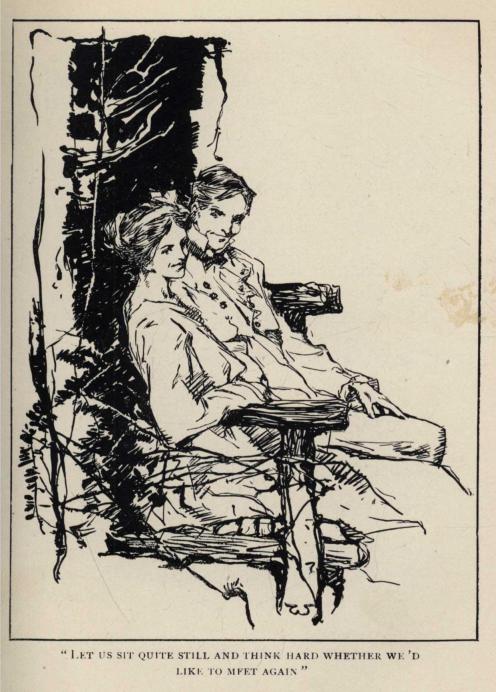
"LET US SIT QUITE STILL AND THINK HARD WHETHER WE'D LIKE TO MEET AGAIN"
She met his look quite frankly for a moment—but only for a moment. Slowly her head sank and her eyes half closed, and when she spoke, she spoke very shyly. "I do not see why you should not come again," she whispered.
"I see why I should! I must!—But it must be differently."
"Differently—?"
"I mustn't come on the sly. I'll get an introduction."
"But none of your friends are likely to know anybody in Pomander Walk!"
Jack leaped up. "Is this Pomander Walk?" he almost shouted. "Why, that 's what I Ve been looking for all the afternoon. That's where my friend lives—the Admiral!"
It was Marjolaine's turn to be astonished.
"Not Sir Peter Antrobus!"
"Yes!—Do you know him?"
"Why, he's the King of the Walk! He lives at Number One. If you 're quite quiet you can almost hear him snoring!"
"Why, there we are then! I'm introduced! I'm on a proper footing! The whole thing's ship-shape! O Marjory, what a relief!"
"But I don't understand—"
"Yes, you do. He 's my father's oldest friend. I served under him as a middy on board the Termagant. I 'm very fond of him. I 'll come and see him to-morrow!"
Marjolaine clapped her hands. "And then he can introduce you to Maman!"
"Don't you see? It's grand! I'll come and see him often—every day—twice a day. If he 's out, I can sit under the elm and wait for him—with you. Oh! are n't you glad?"
"I'm very glad you 've found your old friend," she answered demurely.
"What's to-day?"
"Quintidi. Fifth Prairial. Year Thirteen—" she replied without thinking.
Jack could only stare. "What are you talking about?"
"Oh," she laughed, "I had forgotten I was in England. Saturday."
Jack's face sank. "Then to-morrow 's Sunday. Hang. Well! I'll come on Monday. Shall you be here?"
"I am always here."
"Be under the elm." He thought a moment, and then added insidiously, "Shall you your mother about to-day?"
Marjolaine hesitated. Perhaps it would be better to wait until the proper formalities had been observed. "On Monday; when you've been introduced."
"That's it!" cried Jack. "And now I'll be off." He took both her hands in his. "Good-bye. Oh, but it's good to be alive! It's good to be young! The river is good that brought me here! The sun is good that made me thirsty!"
"And the claret was good?"
"The claret—! Nectar!—Oh, Jack!—Jack!—"
Marjolaine held up the glass, still half full.
"Finish it, then."
Jack started back in horror, but seeing the dawning surprise on her face, bravely seized the tumbler and dashed it off. Thus swiftly was his perjury avenged.
"Good-bye, little Marjory. Till Monday!"
She looked up at him wistfully. "You think you will come?"
"Think!" cried Jack; and every lover's vow was in the one word.
"Slip to your boat, quickly!" cried Marjolaine, peeping round the corner of the Gazebo. But before he could move she gave a startled cry and motioned him back. For the Muffin-man had entered the Walk ringing his bell.
"Dash it! What's that?" cried Jack.
"Keep still! It's the Muffin-man!"
"I'm off!"
"Wait!" Now she was peeping through an opening in the box-wood hedge. "Jack! The whole Walk's awake! Look!"
Jack's head was very close to hers. "I can't see; your hair's in the way. Don't move!" For a moment they stood watching.
And indeed the Walk was awake. The Muffin-man's bell had acted like magic. The Admiral and Jim were already bargaining with him. Mrs. Poskett was on her doorstep with a plate in her hand. So was Ruth Pennymint. Barbara was in the garden, and Basil was telling her just how many muffins he wanted from the upstairs window; Jane, Mr. Brooke-Hoskyn's maid, was waiting impatiently; and Dr. Sternroyd had come out of his house book in hand, and was making frantic signals so as not to be overlooked. And they were all talking, and gesticulating, and calling.
"By Jove!" cried Jack excitedly, "there's old Antrobus!"
"All of them! All of them!" wailed Marjolaine.
"They 're all buying muffins—greedy pigs!—They won't see me." He made as if to dash out.
Marjolaine held him back. "Yes, they will. Let me go first. I'll get them talking, and then you can slip away." But she started back with a suppressed scream.
"What now?" cried Jack.
"Maman and Nanette!"
Yes. As ill-luck would have it Madame Lachesnais and her old servant turned the corner at this moment, and with a friendly word to each of her neighbours Madame was coming slowly towards the Gazebo.
"They must not come here!" cried Marjolaine in distress. "I cannot explain you before the whole Walk!—Is my hair straight?"
"Lovely!—Monday?"
"Oh, I don't know. I'm frightened."
"Monday?" insisted Jack.
"Yes! Yes!"
But meanwhile Mr. Brooke-Hoskyn had come out of his house, and taking advantage of the hubbub in the Walk had crossed—shall I say like a sleuth-hound?—more like a sleuth-cat, if there be such an animal—to the Gazebo. So that when Marjolaine came forward to intercept her mother, she ran straight into his arms.
"All right, Miss Marjory," he whispered, with something very like a wink, "I'll fetch the things for you."
"No, no!" cried Marjolaine, in agony.
Her mother caught sight of her and called her.
For a moment Marjolaine stood irresolute. Then, with an almost hysterical laugh, she ran to her mother. "Me voilà, Maman chèrie!"
Jack was peering through the hole in the hedge, looking for a chance of escape. Mr. Brooke-Hoskyn put his head slily round the corner of the Gazebo—and, sure enough, just as he had suspected—there was a young man!
What with the Muffin-man, and Madame, and Marjolaine running to and fro and button-holing everybody who seemed to be inclined to drift towards the summer-house, the Walk's attention was fully occupied. Mr. Brooke-Hoskyn lifted his fat hand and brought it down with a sounding thwack on Jack's shoulder.
"What the devil—?" cried Jack, turning fiercely on his assailant. And then in amazement, "Hoskyn! By all that's improbable, old Hoskyn!"
If it were possible for a large man to shrivel, the great Mr. Jerome Brooke-Hoskyn seemed to shrivel as he recognised Jack. He could only stammer, "You, sir—you!—"
"Hoskyn!" repeated Jack. And then, suspiciously, "What the devil are you doing here?"
I hate to have to write the words, but Mr. Brooke-Hoskyn had all the obsequious manner of a well-trained servant. "I beg pardon, sir," he muttered, and turned to go.
But Jack caught him by the lapel of his coat. "No, no, Hoskyn; you don't get off so easily. What are you doing here?"
Mr. Brooke-Hoskyn turned sulky. "I'm living here, sir."
"The doose you are!—Well, you're in the nick of time. Be a good fellow and fetch my hat out of the boat."
"Certainly, sir," said Mr. Brooke-Hoskyn. But as he started to do so, he caught sight of the Admiral. He turned to Jack and said respectfully but firmly, "I'm very sorry, Master Jack; but I can't do it."
"Why not?"
"I'm looked up to here, sir. I should lose prestige."
Jack eyed him half with suspicion and half with mockery. "I say, Hoskyn, what's your little game?"
Mr. Brooke-Hoskyn was getting angry. "What's yours, sir?" he asked defiantly.
"What the devil do you mean?"
Mr. Brooke-Hoskyn pointed an accusing finger at the wine and the crumbs of cake. "I mean—this."
"What of it? What do you insinuate?" cried Jack fiercely.
But Mr. Brooke-Hoskyn's blood was up, and he was not to be intimidated. "It ain't right, sir. It ain't right for you to come here like a snake in the grass drinking claret and making love to our little Miss Marjory. I won't help you! I'll be damned if I do!"
"Do you mean I'm doing something underhand?"
Mr. Brooke-Hoskyn looked at him sternly. "Well—ain't you, sir?"
"I'll devilish soon show you!" shouted Jack, trying to pass him.
But now Mr. Brooke-Hoskyn fell into a sudden panic. "Don't betray me, sir! Don't, sir!" he entreated, trying to stop him.
Jack thrust him roughly aside with an angry, "Out of my way!" and poor Mr. Brooke-Hoskyn sank on the seat in the summer-house, gasping, "Good Lord! He'll tell the whole Walk!"
Jack had acted on the spur of the moment; but now that he was face to face with all the inhabitants of the Walk a sudden shyness took hold of him and he stood irresolute. Marjolaine had sat down exhausted on the seat under the elm, and Madame Lachesnais was coming towards her. Little Barbara Pennymint was the first to see Jack. She gave a demure little scream and ran to the Admiral. "Look! A stranger!" Sir Peter was on his dignity at once. He came straight at Jack. "Now, sir—may I ask—?"
"Admiral," cried Jack, saluting.
"Eh," said the Admiral, fixing his one eye on the young man, "Gobblessmysoul! what a coincidence!" He seized Jack's hand and nearly wrung it off, while the whole Walk watched with amazed curiosity, and Marjolaine looked on with delight. "I'm delighted to see you, my lad!—De-lighted!" He turned to Madame Lachesnais as the social leader of the Walk. "Madame Lachesnais!" he cried, holding Jack by the hand, "Let me have the honour of presenting my gallant young friend, the Honourable Jack Sayle, son of my old friend, Lord—"
He never got any further. At the words, "Jack Sayle," Madame, who had been standing smilingly to welcome the young man, gave a sharp cry, swayed, and sank swooning in Nanette's arms.
Then what a commotion there was, to be sure! Marjolaine ran to her mother, Mrs. Poskett, Ruth and Barbara crowded round her or rushed about vaguely, crying, "Salts! Quick!" The Admiral stood petrified a moment. Then he hurried Jack towards the boat. "Get away, Jack!" Jack resisted. "But—!"
"Away with you!" insisted the Admiral in a raucous whisper. "Discretion!—They'll have to unhook her!"
But the Eyesore went on fishing.
CHAPTER VI
IN WHICH POMANDER WALK IS NOT QUITE ITSELF
Chapter VI headpiece
The Admiral was much troubled. A week had elapsed since Madame fainted, and although the mysterious process of unhooking her, together with a dash of water on her face, and the salts, had brought her to very rapidly, a cloud had seemed to hang over the Walk since that moment. It was certainly not itself, and it had grown less like itself as the days passed. Madame was apparently quite well, yet she stayed within doors, or, if she came out, her face was more than usually sad, and she walked with slow steps, like one who bears a heavy burden of sorrow. She was not seen in church on Sunday. Marjolaine was there, bright and happy. She had assured everybody there was nothing really serious the matter with her mother: only a headache. On Monday morning Marjolaine was still her usual merry self, but as the morning wore into the afternoon and the afternoon into the evening she grew restless. The Admiral noticed that she kept on going to the river-bank and looking up and down stream as if she were expecting someone. On Tuesday she was out very early, still apparently watching. On Wednesday she grew silent, and refused to have her usual singing-lesson on the plea that she was not feeling very well. On Thursday she turned unnaturally gay, but there was a hard note in her laughter, and Sir Peter had caught her sobbing in the Gazebo. Fortunately she had not noticed him, and he was able to retire without disturbing her. But he himself was greatly disturbed. The more so as he had seen that Madame was watching her daughter intently, and that every change in Marjolaine was reflected on the elder lady's face.
Friday found Marjolaine pale and dejected; and here was midday on Saturday, and she had not yet appeared!
Could she be sickening for a serious illness? Sir Peter was nervous and anxious. He was also put out by the fact that although Jack Sayle had promised as he hurriedly rowed away, that he would come to see him on the Monday, the whole week had passed without a sign of the young lieutenant, and without any word of explanation.
But the entire Walk was nervous and anxious. It had grown so accustomed to Marjolaine's songs and merry laughter, that as she grew silent and grave, the Walk grew silent and grave with her. Mrs. Poskett's temper underwent a change for the worse, and she and Ruth Pennymint very nearly had words over a milk-can which the dairy-man had carelessly hung on the wrong railing. Ruth's ill-humour was aggravated by the behaviour of Barbara and Basil. They went about sighing and turning up the whites of their eyes; Barbara shut herself up two and three hours every day with the parrot, and Basil ground at the slow movement of the Kreutzer Sonata, repeating one particularly heart-rending passage so persistently that Ruth wanted to scream.
But the man who behaved most strangely of all was Mr. Brooke-Hoskyn. That magnificent creature showed all the symptoms of a guilty conscience. It is true he strutted about the Walk, dressed as faultlessly as ever, swung his tassled cane with much of his old elegance, and took snuff with all the airy grace imaginable. And yet—and yet—! Somehow, his clothes seemed to hang loosely on him. Somehow, his hat, though poised at a rakish angle, no longer conveyed the old devil-may-care impression. His face no longer beamed with unassailable self-satisfaction. There was a furtive look in his eyes, as though he were constantly on the watch. It is a low comparison to apply, but if you have ever seen a dog who knows he has just stolen a piece of meat, you have seen Mr. Brooke-Hoskyn. Once, when the Admiral, who was stubbornly resisting the universal depression, came up behind him unobserved and suddenly slapped him on the back, he screamed—he positively screamed. "Thought the Bow-street runners was after you?" roared the Admiral heartily. But the tone of fury with which he replied "Certainly not, sir! How dare you?" was so sincere that Sir Peter did not pursue the joke. Evidently he had indeed thought the runners were after him.
The Walk was like a drooping flower, and even the Eyesore felt the depressing influence; he fished less hopefully than ever, and it was noticed that he interrupted his fishing more frequently for excursions outside the bounds of Pomander Walk: excursions from which he returned wiping his mouth with the back of his hand, and returned each time perhaps a trifle less steadily.
Now, all these good people had lost their usual good spirits and their cheery outlook on life merely because one little girl had left off laughing; and she had left off laughing because one very young man had not kept his word.
The servants of the Walk were very busy this Saturday morning. Jane, Mr. Brooke-Hoskyn's nurse, was explaining to Abigail, Mrs. Poskett's little maid, that nothing should persuade her to continue wearing the Charity-School costume after she had risen to the dignity of domestic service. Jim was feverishly polishing the Admiral's little brass cannon. That brass cannon was the apple of the Admiral's remaining eye; and at the same time the plague of his life. On every state occasion, such as the King's birthday, or the anniversary of the Battle of Copenhagen, he would, to the great terror of the Walk, have it out, plant it pointing truculently to the opposite side of the river and, standing well away from it, apply a match. This was always an agonised moment of suspense for the Walk. But invariably the gun refused to go off. The Admiral's expletives, however, supplied an efficient substitute. I am sorry to say the failure to explode was always due to an act of treachery on Jim's part. The Walk subscribed five shillings towards that ancient mariner's liquid refreshment, and the ancient mariner withdrew the charge in the dead of night. To-day he was polishing the gun well in view of all the houses. The King's birthday was approaching, and the Walk needed a gentle reminder that unless it wished to be stunned and to have all its windows broken, now was the time to start the usual collection.
Nanette came out of Number Four, carrying a rug and a bamboo cane, evidently bent on beating the former on the lawn. Jane drew Jim's attention to her. Then began a battle of tongues. Jim tried to explain that this was not allowed. If she wanted to beat the rug, she must do so in the back garden. Words, none of which either could understand, grew high; Abigail and Jane joined in, and the place became a veritable Babel of screaming voices and of wildly waving arms.
Mr. Brooke-Hoskyn opened his window violently. "What's all this?" he cried; and he was such an amazing apparition that the voices sank to sudden silence and the servants rushed, helter-skelter, into their respective houses.
Mr. Brooke-Hoskyn was finishing his toilet. He was brushing his hair. It stood out on each side of his head like a sort of double mane, and his face looked exactly like the representations of a flaming sun on the cover of an almanac. He was carrying on a conversation with Selina, and both he and his wife were evidently in a bad humour.
"But, my own Selina," said he, "what was I to do? Be reasonable. I only wrote and told his lordship the boy was carrying on a clandestine love-affair.—No, of course I did n't sign the letter.—None of my business?—Now, Selina, if I had n't wrote he 'd have come again, and all would have been disclosed. We should have been obleeged to leave the Walk.—Drat the Walk?—Oh! fie! That is not how my ring-dove customarily coos.—What? soft words butter no parsnips?—Selina, Selina—! Does my Selina think she is in her kitchen?—Yes; I know I 've made Miss Marjory very unhappy; but we must make other people unhappy, if we 're to be happy ourselves. I 'm sorry for her, very sorry. She's a sweet creature." There was a sound of a broken tea-cup. "There you go again!—You scold me for making her unhappy, and you scold me for being sorry. There 's no pleasing you anyhow!"
In his perplexity he had brushed his hair over the top of his head, and now he looked like an angry cockatoo.
Marjolaine came slowly and dejectedly out of her house. She heard Mr. Brooke-Hoskyn's voice and glanced up at him, but even his wild and wonderful appearance failed to draw a smile from her. Mr. Brooke-Hoskyn could not retire, much as he would have liked to. He waved a conciliatory hair-brush at her, and cried with assumed cheerfulness, "Ah, Miss Marjory—! How do you do?" then in response to some remark from his wife, he turned and whispered peevishly, "I must speak to her; it's only polite. Don't snivel." He addressed Marjolaine again, deprecatorily, "You are looking a little pale."
Marjolaine drew herself up. It was intolerable that anybody should see she was in trouble.
"I never felt better in my life," she said defiantly.
"But more like the lily than the rose?" exclaimed Mr. Brooke-Hoskyn with a fine touch of lyricism; and then to Selina, "No; I am not talking nonsense! It was a quotation."
"How is Mrs. Brooke-Hoskyn this morning?" asked Marjolaine.
"In the highest spirits!" cried Mr. Brooke-Hoskyn. "My dear Selina," he explained, turning towards the room, "Miss Marjory is kind enough to ask after your health, and I am telling her you are in the highest spirits. Do—not—snivel—she 'll hear you!" To Marjolaine, with a ghastly smile, "Her gaiety is infectious; positively infectious!" Some hard object, thrown with unerring aim, caught him in the small of the back. "Oh, Lord!" he cried. "Excuse me, Miss Marjory; Selina has just remembered a joke she wishes to tell me. Thus the hours pass in innocent mirth and badinage. Excuse me!" He turned away. "You really are—!" he cried, almost viciously; and slammed the window, and disappeared.
But Marjolaine never smiled. She moved as one who had no particular object in life. She drifted instinctively towards the river-bank although she knew that strain her eyes as she might the little boat she had looked for all the week was now less likely than ever to appear. At one moment she seemed almost inclined to speak to the Eyesore; to ask him whether he had seen what she had so long been vainly looking for. But the Eyesore was at that instant impaling a worm, and was altogether too revolting. She stood a moment looking up and down the stream, and then turned away with a great sigh.
Mrs. Poskett's great yellow cat, Sempronius, was curled up in the sun just behind the Gazebo. Marjolaine looked at him. She and he were fast friends, and in happier times she would have had a friendly word for him and an affectionate caress. To-day, even that was too much of an effort. Fortunately Sempronius was asleep and did not notice her inattention.
Sir Peter Antrobus opened his upstair window and hung the osier cage with the thrush in it on its nail. He caught sight of the disconsolate little figure. "Missie, ahoy!" he roared, as though he were hailing a friendly craft in the offing. Marjolaine started.
"Oh, Sir Peter! You made me jump!"
"Sent a shot across your bows—what?" roared the Admiral.
"How's the thrush?" asked Marjolaine with an interest she did not feel.
"Peaky. Peaky. That confounded cat next door's been watching him. Seen him about anywhere?"
Marjolaine pointed to where Sempronius was lying wrapped in innocent slumber. "He's quite safe," she said. "There."
But the Eyesore was between him and Sir Peter, and the latter had to twist himself into what was for so portly a gentleman a very unnatural position in order to see him. "Eh? Where?"
"There," she answered, "there, behind the—" she was just going to say "Eyesore," but stopped herself in time. "Behind the Gazebo."
"Oh, there! Well, if he moves I'll kill him!"
Marjolaine wondered. Could Sir Peter tell her what she so much wanted to know? Could he, at least, be brought to talk about what her heart was full of?
"Sir Peter," she said, with as much of her old cheerfulness as she could summon, and with that pretty way of hers which no one could resist, "Are you very busy? Could you spare time for a little chat?"
"With you?" cried the Admiral, gallantly. "Hours!" He vanished from the window and was heard tumbling down his stairs two at a time. I believe if he had been only a few years younger he would have slid down the balustrade. Jim told Jane later in the day he had never seen anything like it.
Marjolaine waited for him under the elm, and pondered how she was to lead the conversation round to what she wanted to hear.
The Admiral burst out of his house. For once he took no notice of the Eyesore. The cat, however, did arrest his attention. Sempronius, scenting an enemy, was blinking at him out of one eye. Sempronius' attitude towards the Admiral was one of armed neutrality. He knew Sir Peter bore him no good-will, but he also knew Sir Peter dare not touch him. Wherefore, although he kept a wary look-out, even the Admiral's threatening gesture was not enough to make him stir from his sunny corner.
Sir Peter came to Marjolaine.
"He's sitting there, watching the Eyesore like a tiger. Shows cats have no sense. 'Pears to think the Eyesore's going to catch a fish! Ha! Never caught a fish in his born days!" He took both Marjolaine's hands in his. "Well, Missie; what can I do for you?"
"Talk to me," said Marjolaine.
Sir Peter was flattered and delighted. Their little Missie was coming to life again. "Ah!—tell ye what," he said, swinging her hands, "If we had that fiddler here, we might practise the hornpipe!" He whistled gaily and tried to force her into the step.
"No, no!" she cried, breaking away from him; and then, more gently, "No: not to-day!"
The Admiral looked at her anxiously out of his one eye. "Oh?" said he, sympathetically, "In the doldrums?"
"Sir Peter," she cried, impulsively, "was you ever broken-hearted?"
"Lord bless your pretty eyes, yes! Every time I left port."
"Ah! but did the world seem like an empty husk? and did you want to sit down and cry your eyes out?"
This was much worse than the Admiral had anticipated. He must try to make her laugh.
"Well, ye see, I could only have cried one out, was it ever-so!"
"Then what did you do? How did you cure yourself?"
"Why, with a jorum of rum, to be sure!"
Marjolaine was disappointed. "Oh!—I can't do that!"
Sir Peter came closer. "What? Are you broken-hearted?"
Good heavens! What had she been saying? Had she given away her precious secret?
"Certainly not!" she answered, with flaming cheeks. "Of course not. It's nothing. Only somebody—somebody has broken their word."
"Look-a-that, now!" cried the Admiral, puzzled. "But I'll cure you! I'll tell you a story. Something funny. How I lost my eye—what?" He drew her down beside him on the seat under the elm. "Ye see, it was on board o' the Termagant—"
"When you was with Nelson?" asked Marjolaine.
"Ay. Battle o' Copenhagen; year Eighteen-one."
Here was a possible opening. At any rate Marjolaine would try.
"I suppose you had many officers under you?" she insinuated.
"Hundreds!" cried Sir Peter, enthusiastically; and then, feeling he had conveyed an exaggerated impression, "well—when I say hundreds—!" his memory awoke. "Ah! I was somebody, then!—But this infernal government—!"
Marjolaine laid her hand soothingly on his arm. "I suppose some of them were quite young?" she said, with splendidly assumed indifference. Every woman is a born actress.
"Middies?" cried the Admiral, with magnificent contempt. "Lord love ye, I took no notice o' them! Passel o' powder-monkeys!" Then he added with a touch of tender recollection, "Not but what Jack Sayle—"
"Jack what?" said Marjolaine quickly, as if she had not heard.
"Sayle. Jack Sayle. You know. Young feller I presented to your lady-mother a week ago. Time she swooned—"
"Oh, yes."
"Gobblessmysoul! I was startled! I thought—"
The Admiral must not be allowed to wander from the only topic that mattered. Marjolaine interrupted him. "Was he on your ship?"
"What, Jack Sayle? Ay, was he. And a fine young feller, too. Of course you was much too agitated to notice him last Saturday. Gad! I wonder he has n't been to see me all the week. Promised he would. Said he 'd come last Monday."
"Did he?" cried Marjory. So he had broken his word in two places!
"He did. There! He's only on leave, and he has heavy social duties. Only son of Lord Otford, y' know."
"Lord Otford!" Marjolaine repeated, amazed. The name and the title somehow impressed her with a sense of vague fear.
"Ay, ay," the unconscious Admiral proceeded garrulously. "My old friend. Otford's selfish about him. Ye see, the boy 'll come into a great estate. Half a county. And the old man's anxious about his marriage."
"Whose marriage?" asked Marjory, almost voicelessly.
"Why, Jack's, to be sure!—Lord!—they marry 'em now before they 're out of their swaddling clothes. Otford's in a hurry to secure the succession—" He stopped abruptly. This was really not a subject to discuss with a young girl. "Hum!—what I was about to say—er—the Honourable Caroline Thring—!"
"Caroline Thring"—Marjolaine repeated the name to herself. It was a name to remember.
"Ay—daughter and sole heiress of Lord Wendover. Not my sort. Goes about doing good—like the party last Saturday. But the two estates 'll cover the county. It's an undoubted match—"
Marjolaine had heard all she wanted—and more. She felt she would break down if the Admiral went on. She looked all around the Walk for help; for some excuse to break off the conversation. There was only Sempronius. "I think—" she just gave herself time to make up her mind as to what she could think—"I think I saw Sempronius stirring!"
Sir Peter jumped up. "Damn that cat!" he cried—"Beg pardon!—I'll—" But the golden-haired Sempronius was sound asleep with his bushy tail over his nose.
Whether the Eyesore was shocked by the Admiral's bad language—which seems unlikely—or whether he was moved by his usual thirst, he dropped his fishing-rod, and vanished round the corner.
The Admiral hurried back.
"No. He 's quiet enough." He saw Marjolaine's sad face and added, "Gobblessmysoul! Here I 've been boring you about a young feller you don't know—" To his amazement Marjolaine turned her face away abruptly. The Admiral stopped short. Why did she turn away? Was it possible that—? How long had Jack been in the Walk when he met him a week ago? "Do you know him?" said he. Marjolaine was silent. Sir Peter gave a low whistle. He took her gently by the shoulder and turned her towards him. "Here, I say, young woman—You just look me in the eye." He pointed to his good one. "This eye." Marjolaine stood before him in confusion. It made her angry to feel confused. Why should she feel confused? "I—I have seen him once," she answered bravely.
"Have you, begad!—So that's what he was cruising about here for, was it?—But I'll teach him!"
Marjolaine was very angry indeed. "Sir Peter!" she flashed at him, "If you breathe it, I 'll never speak to you again!"
"D' ye think I 'll have him coming here—?"
"But he's not coming here!" cried Marjolaine; and with a meaning of her own: "Oh, don't you see he's not coming?—Swear you won't breathe a word to a living soul! Swear! Swear!"
"Damme!" cried the Admiral. "I must think that over. And as for you," he added, with humorous sternness, "you come and sit under the tree and I 'll talk to you like a Dutch uncle."
Marjolaine saw Mrs. Poskett at her window. It would not do for Sir Peter to talk to her like an uncle—Dutch or otherwise. "Sir Peter!" she cried, "Sempronius is going to jump!"
Sir Peter rushed to the cat again, and again found him sound asleep. He turned furiously towards Marjolaine, but Mrs. Poskett intercepted him. "Good morning, Sir Peter!"
Sir Peter looked up, where the widow was shaking the ribbons of her cap at him. "Morning, ma'am," he said, sulkily. "Your cat—"
"Hush!" interrupted Mrs. Poskett, craning forward to see her pet. "Dear Sempronius!—Don't disturb him! He's so happy!"
"But—!"
"I 'm sure it's going to rain," the widow explained. "He always sits there when he feels rain coming; because the fish rise, and he loves watching them."
"Confounded nonsense," growled Sir Peter.
Mrs. Poskett closed her window, and Sir Peter was on the point of returning to Marjolaine and having it out with her, when Madame Lachesnais came out of her house. Of course that made all conversation with the girl impossible, and as he did not feel he could meet the mother, knowing what he now knew, there was nothing left for him but to salute her and beat a hasty retreat into his own house and think things over.
CHAPTER VII
SHOWING HOW HISTORY REPEATS ITSELF
Chapter VII headpiece
Engrossed in her own gentle melancholy Madame crossed slowly towards the river. She was sincerely distressed about Marjolaine. What could be the matter with the child? This question had haunted her all the week; but whenever she had tried to speak to her daughter, the latter had evaded her on one pretext or another. In vain Madame racked her brains. Marjolaine was not ill; yet she had no appetite; the colour had faded from her cheeks; the spring had gone out of her step; and the laughter had died from her lips. Madame remembered the time—long ago: twenty years ago and more—when she herself had looked and spoken and moved, just as Marjolaine did now; but there had been a very good reason for that. In Marjolaine's case there could be no reason. No one had crossed her young life—or, was she mistaken? That young man who had so suddenly appeared: who had so suddenly revived the most poignant memories of her own youth!—Was it conceivable that he and Marjolaine had met? had perhaps met frequently? It was not conceivable. Marjolaine was the soul of truth. Marjolaine had been perfectly happy until a few days ago. Marjolaine had not shown any signs of recognition when the young man stood there. And yet? Was it wise to be too sure? In her own case there had been secrecy, and, now she remembered, she had borne the secrecy unflinchingly; had shown a perfectly calm and happy exterior. The secrets of the young seem to them quite innocent: merely possessions of their own which they keep to themselves, which they cannot understand they are in duty bound to disclose to their elders. And, to be sure, her own father—she had lost her mother in early youth—had never tried to win her confidence. A great entomologist cannot be expected to allow his attention to be distracted by a girl's sentimental nonsense. But she—had she paid enough attention to her daughter? Had she not allowed herself to be lulled into false security by the remoteness of Pomander Walk? But if the young man—Jack Sayle, of all people in the world!—had won Marjolaine's heart, why, here were the beginnings of a bitter tragedy: her own tragedy all over again. It must be nipped in the bud. Mercilessly. She must be cruel to be kind. Could she be cruel to Marjolaine? Motherhood had its duties, however, and, now that this great fear was on her, she saw her duty plainly, and would do it.
She was interrupted in her meditations by the sound of weeping, and for the first time, she saw poor Marjolaine sitting under the tree, bending low, with her face in her hands, shaken with great sobs. She hurried across to the weeping girl, placed her arm very tenderly over her shoulders and gently called her by her name.
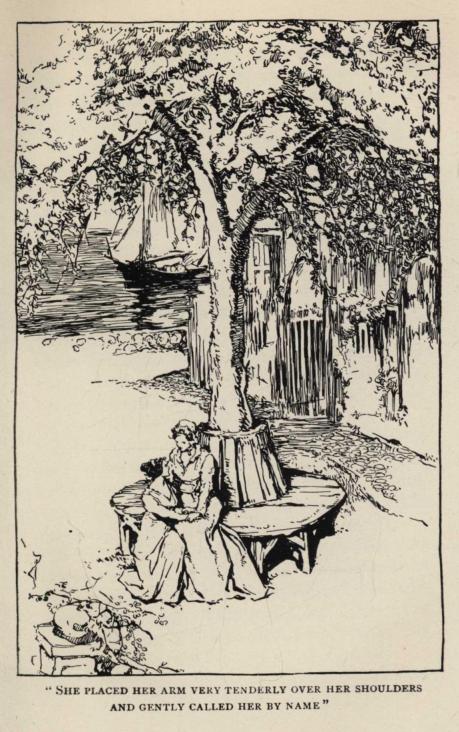
"SHE PLACED HER ARM VERY TENDERLY OVER HER SHOULDERS AND GENTLY CALLED HER BY NAME"
The touch of her mother's arm, the sound of her mother's voice let loose the floodgates. With a cry of "Oh, Maman!" Marjolaine threw her arms round her mother's waist and buried her face against her. Madame sat down beside her and drew her very close. "Chérie—my darling! What is the matter?"
Marjolaine tried to master herself; tried to put on a brave face; dashed the tears from her eyes, as she answered—"Nothing, Maman. I think—it is so beautiful here!—So peaceful! It made me cry. Let me cry a little on your heart."
There was a sad smile on Madame's face. As if you cried because the sun was shining and the Walk was quiet! "Cry, Marjolaine," she murmured soothingly. "Do you think I have not been watching you all this week? Cry, my darling, and tell me."
"There is nothing to tell, Maman," said the girl between her sobs. "Realty and truly there is nothing." She looked wistfully towards the river. "There was something; but—" and down went her head on her mother's breast—"there is nothing now."
Madame stroked the fair head lying on her bosom. "My dear, my dear!—I tried every day to speak to you, but you would not. For the first time in our lives you and I, who should be everything to each other, were parted."
"Oh, Maman!" cried Marjolaine, looking up into her mother's face, "that was because I was waiting to tell you a great secret. But the secret no longer exists. It has"—she made one of her quaint little gestures—"it has—evaporated!" And with a new outburst of tears she again hid her face.
Madame looked at her lovingly, and kept silence a moment. So, then, there was a secret? What secret? What but one secret is ever in a young girl's heart? "Ah, chérie," she murmured, "you see? The secret exists: it is gnawing at your heart. It will hurt you and hurt you, till you tell me."
Marjolaine looked up. Her mother was right. Speaking might bring her some relief. She would tell her. She tried to speak; but a look of puzzled amazement came into her eyes. Now that she was willing and anxious to speak, she had nothing to say.
"Tell me," repeated Madame.
"I can't, Maman."
"Why not?"
"I cannot begin alone: I don't know how."
"Shall I help you, Marjolaine?"
"Can you?"
Madame could only guess; but even if the guess were mistaken, it might lead to the truth. So she spoke tentatively.
"Let us say, you were sitting here, under the elm? And that stranger, that young man—"
There was no need to go on. Marjolaine had already risen to her feet. Her thoughts were let loose: all the thoughts she had locked in her breast during the past week, the memories that had been tormenting her, the problems she had been struggling with. She saw Jack Sayle as if he were standing before her. "He stood over there, in the sun"—she spoke quietly but intensely—"and he looked at me, and I looked at him; and—" her voice was hushed, and although she addressed her mother she did not turn to her, but kept her eyes on the spot where Jack had stood—"Mother! what happened to me? I felt as if he and I had always known each other, and as if we were alone in the world. No! As if he were alone, and I were a part of him. And we spoke. Nothings. Things that didn't matter. Silly things; about his being thirsty, and what I could give him. But it was only our voices speaking. I know it was only my voice: it was not I. I was thinking of sunshine and music and flowers. And then we went into the Gazebo; and the foolish talk ran on! And all the time my heart was singing!—He told me his name; and my heart took it and wove music around it, and sang it! and sang it!" Her voice sank to an awed whisper. "And—Mother!—I seemed to step out of childhood suddenly, into—into what, Mother?—What was it?"
"Alas!" sighed Madame. The child's words had carried her back, so far, so far! Back to her own early youth. Just so had the day been transfigured for her. Just so the sunshine had taken on a new glamour. Just so her own heart had sung its hymns of rapture. Just so she had stepped across the threshold of childhood.
But Marjolaine continued. "When he went, I felt as if he had taken me with him: my heart and my mind. He said he was coming again—but he never came; and every day I have wandered about; looking for what he had taken; looking for my life!" she sank on her knees at her mother's feet. "He will never come again! He will never bring back what he has carried away!—Oh, mother, what is it?"
Her tears flowed freely now, but silently: tears of relief at having unburdened her heart. Madame looked down at her with such pity as only a mother can feel. "My darling! Is it so serious as that? God help us, poor blind things!" She remembered what she must have been doing while this fateful meeting took place. "While my child was going through the fire, I was matching silks for my embroidery!"
Marjolaine looked up at her with great, innocent eyes. "But it would have been the same if you had been there!"
"I suppose so," said Madame, sadly. "There is no barrier against it: not even a mother's arms."
"But what is it?" asked Marjolaine, wistfully.
Her mother looked at her searchingly, and Marjolaine met her gaze steadfastly, with her clear, truthful eyes. It was patent she did not indeed know what caused this new pain at her heart. Madame looked long. Her daughter seemed, in a way, suddenly to have become a stranger to her. This child was a child no longer, and her mother no longer held the first place in her heart. Yes! and if Marjolaine had suddenly leapt out of childhood, then she, the mother, must begin to face old age: she was the mother of a marriageable girl. She would fight against this while she could; not for unworthy or small motives, but to keep her daughter's companionship. Who was this Jack Sayle that he should come like a thief in the night and steal Marjolaine's youth, her happiness and her peace of mind, and tear the girl out of her mother's arms? "No," she said, at last, "I will not tell you. If I told you it would grow stronger; and it must not. It shall not. You must win yourself back, as I did. Oh! but sooner, and more completely!"
Marjolaine was amazed. Had her mother gone through what she was going through now? "As you did—?" she cried, in a voice which betrayed her astonishment.
Madame smiled sadly. "My dearest dear, the young never realise they are not beginning the world. Your story is mine."
With a cry of "Oh, mother!" Marjolaine nestled closer.
"Yes; but mine was longer and therefore left more pain in its track. Chérie, chérie, I am not telling you this to make light of your sorrow, but to show you I know what your pain is: to show you how to fight now, now, with all your might, to win yourself back." She paused a moment, to gather her thoughts and to gather strength. Then she continued very softly, almost as if she were speaking to herself, "It was years and years ago, in my father's garden—in the old vicarage garden—that I felt the sun and the song enter my heart. He and I were very young and very happy." Madame paused. "And then he rode away; and I never saw him again."
"Maman!" whispered Marjolaine, stroking her mother's cheek.
"We had lived in our dream a whole year; so my love—"
Marjolaine started at the word. "Love!" Was this love?—
But her mother did not notice her, and went on; "So my love had time to grow. Its roots were twined round my heart; and when he left me, and tore the roots out of me, I thought he had torn my heart out with them."
"Like me," said Marjolaine, below her breath.
Madame drew her closer, and whispered, "Would you like to know his name?"
There was something in her mother's voice which told Marjolaine her mother had some special reason for asking her. "Yes; what was it?" she asked, hushed, and very tenderly.
Her mother looked straight into her eyes and answered slowly, "Jack—Sayle."
Marjolaine recoiled in amazement. "Mother!—I don't understand!"
"The father of the boy you have seen!"
"How wonderful!"
"Much more wonderful things happen every day. It's much more wonderful that I can tell you this now: that I ever grew out of my love. For I loved him—ah, how deeply!"
There was a long silence.
Here was a curious thing. If any profane eye had lighted on the group—the young girl kneeling at Madame's feet in the green coolness of the elm; that profane eye would have got the impression that here were a mother and daughter closely linked in some common sorrow, and clinging to each other for mutual consolation. In one sense that impression would have been the right one; but in one sense only. Their thoughts were worlds apart. Madame was remembering the days when she was Lucy Pryor, the daughter of the vicar of Otford. The great Lord Otford was Lord of the Manor, and his son, the Honourable John Sayle, being a delicate lad, was studying desultorily with the Vicar. The Vicar was more interested in butterflies than in Greek roots, and the boy and girl spent most of their time in the great vicarage garden. Thus the lad had grown strong and well set up. He was gazetted into the Army, and sent to America, where the war had just broken out. There he stayed five years. Lucy treasured the dearest memories of her playfellow, and when he came back, a splendid lieutenant, it is hardly necessary to say that they fell seriously in love. Their love was patent to everyone except the vicar and the old Lord. When the latter discovered it, his fury was indescribable. He drove the vicar out of his living, and had him transferred to a miserable parish in the East-end of London, where there was n't a single butterfly; and he sent his son, who had retired from the army, on the Grand Tour. The lovers parted, vowing to be faithful; but young Sayle very soon forgot his vows in the excitement of travel. At Rome he met the Honourable Mabel Scott, daughter of Lord Polhousie, and, to cut a long story short, he married her, without a thought for poor Lucy, whom the shock nearly killed. Nor did he ever know the blow he had inflicted, nor ever hear from her, or of her, again. She was lost in the wilderness of London. A few years later he had succeeded his father, and was sent as Ambassador to Vienna. In the same year his son John—our Jack—was born, and his birth was closely followed by the mother's death.
Marjolaine, too, was thinking hard. All sorts of new ideas, new conceptions, were looming on her horizon. They came as angels, certainly, but angels with flaming swords. It seemed that great happiness could be inextricably interwoven with great misery, so that a simple human being could not tell where the one began and the other ended. It seemed that a man could say one thing and mean another: that he could look like the Archangel Michael and yet not mean what he said. It seemed that you could be wounded in all your finest and most sensitive nerves just for looking at a man. It seemed also, that your pride was of no use to you whatever, but deserted you when it was most needed, or, rather, turned against you, and helped to hurt you. This must be enquired into.
"Mère, chérie," she whispered.
"What, my darling?" asked Madame, coming out of her dream.
Marjolaine pressed her hand to her heart. There was an actual physical pain there, as if an iron band were crushing it. "Is this—is what I feel—love?"
"Ah!" cried Madame, "I have betrayed myself. I did not mean you to know. I am afraid it was going to be—love."
"Going to be! But it is! Or else, this ache? What is it?"
"Crush it now!" Madame was distressed. She would not allow Marjolaine's young life to be blighted as her own had been. "Crush it now! Fiercely! ruthlessly! and it will be nothing. You have only seen him once—"
"Does that make any difference?"
What could one answer to such a question? One could only ignore it. "You must be very brave; very determined; and put the thought of him away."
Marjolaine shook her head sadly. How could she put the thought of him away? It was in her. It filled her. It was she herself. And did she want to put it away? Would she put it away if she could? It seemed to her that if the thought were withdrawn now, she would be left a hollow husk of a thing, with no thought at all.
Madame saw she had gone too far too quickly. "Dear, I know. It took me a long time, because I had been happy so long; but at last, when your father came, I was able to put my hand in his, and look straight into his eyes."
Here was a new mystery for Marjolaine. So good and beautiful a woman as her mother could love twice, then?
"Mother," said she, with grave enquiry, "did you love my father as much as you had loved Jack?"
However good and blameless we may be, it is a very uncomfortable experience to be cross-examined by utter, single-minded innocence.
"Listen," said Madame, "life is long, and nature merciful. I recovered very slowly; but I tried to be brave; I tried to take an interest in the life around me: the sordid, sunless life of the very poor, so much sadder than my own. Then Jules Lachesnais came to live with us—with my father and me—in order to study the English language and our political institutions. A great friendship sprang up between us. When my father died, Jules urged me to marry him. I was utterly alone in the world; I felt a deep affection for him; and I consented."
She waited for Marjolaine to say something; but Marjolaine was silent.
"He took me to France, where you were born. We went through the horrors of the Revolution side by side. He played an active part in those horrible days; always on the side of justice and moderation. The aim of his life was to see his country under a constitutional government, such as he had learnt to admire during his stay in England. The excesses he was forced to witness disgusted him, and he resisted them with all his might." Madame was lost in her reminiscences. "Ah, yes! You were too young to know; but we all ran grave risks of falling victims to the guillotine. Your father hailed Napoleon as a deliverer; but when Napoleon began to usurp power, he foresaw the dawning tyranny; still more when Napoleon was made consul for life. He retired more and more from public affairs, thereby incurring the tyrant's anger and again endangering his life. When Napoleon was proclaimed Emperor your father protested publicly—think of the courage! He was expelled, and he died disappointed and heartbroken. He was a brave, true man, faithful to his ideals. I was very proud of him; very happy and contented. And I am very happy and contented now," she added defiantly,—"or I shall be, when I see you have won the victory!"
But Marjolaine was merciless. This was all very well, as far as her mother was concerned. "But what became of poor Jack?" she asked.
"Poor Jack!" Madame laughed bitterly. "Poor Jack had married some great lady!"
At once poor Jack had lost all Marjolaine's sympathy. She muttered between her teeth, "Caroline Thring."
"I tell you," protested Madame—and perhaps she protested just a shade too strongly—"I ceased to think of him. I forgot him."
Marjolaine's brow was puckered in thought. Could one forget? "But, mother," she said, very simply, "if you had forgotten him, why did you swoon when you heard his name?"
Down went the cloak of self-deception Madame had so carefully wrapped round herself. She took her daughter's face in both her hands and looked at her sadly. "Ah! my little girl is become a woman indeed! The innocence of the dove, and the guile of the serpent!—Well! Think over what I have told you. Come, now, chérie, you promise to fight?"
"Yes," said Marjolaine, without conviction.
"You promise to conquer?"
"I promise to try."
"At least you see there can be nothing between Lord Otford's son and my daughter?"
"Yes." Oh, what a hesitating yes!
Madame folded her in her arms. "Try to lighten someone else's sorrow," she said, kissing her tenderly, "then you will forget your own, and the roses will bloom in your cheeks again."
The Walk was beginning to show signs of life. The Eyesore came slouching back, and resumed his fishing with a lack-lustre eye. The early housekeeping having got itself done, the ladies of the Walk were showing themselves at their windows, tending their flowers or dusting their ornaments. Miss Ruth Pennymint came bustling out of her door, with needlework. She looked up at the overcast sky and held up the back of her hand.
"Ah," said Madame, catching sight of her. "Coming into the fresh air to work, Miss Ruth?"
Miss Ruth was evidently not in the best of tempers. "Of course it's going to rain," she snapped.
"Oh, not yet," said Madame, conciliatorily.
"Do you mind if I sew here?" said Miss Ruth. "It's so lonesome in the house, when Barbara's locked up with that precious bird!"
What could be the matter? The word "precious" was uttered in a manner which conveyed an exactly opposite meaning. Madame said soothingly, "That is so touching!" And Ruth snorted. There is no other word. She snorted. Madame and Marjolaine glanced at each other, and both moved towards the house. But Miss Ruth had no intention of being left alone. "Marjory!" she called. Marjolaine came back; and Madame went into Number Four alone.
CHAPTER VIII
CONCERNING A GREAT CONSPIRACY
Chapter VIII headpiece
Now Marjolaine did not want to talk to Miss Ruth just at that moment, and it says much for her sweetness of character that she came back docilely. "Marjory," said Miss Ruth, looking at her searchingly, "you haven't had a singing-lesson this week."
Marjolaine was confused, and a little angry. She had just exhausted the subject with her mother, and it was too bad to be thrust into the midst of it again by this comparative stranger. So she answered rather coldly, "I have n't been quite myself."
"So I saw," said Miss Ruth, examining her over her spectacles. A hot flush rose to Marjolaine's cheeks. Had she really been wearing her heart on her sleeve, and showing the whole Walk the state of her feelings? She must be more careful in future.
"Anything the matter?" asked Miss Ruth.
Marjolaine answered hastily, "Oh, nothing. Nothing to speak of."
"H'm," said Miss Ruth, violently biting off a cotton-end. Then she added, "Barbara was quite upset."
"How sweet of her!" cried Marjolaine.—Dear, sympathetic little Barbara!
"Oh! Not so much about you," said Miss Ruth rather acidly. "But she looks forward to sitting with you and Mr. Pringle, when you are singing."
"Is she so fond of music?" asked Marjolaine, glad to turn the conversation into a less personal channel.
"Bless your dear heart, no!" exclaimed Miss Ruth sharply. "Now, would she sit and listen to you if she were? She does n't know one note from another."
It seemed to Marjolaine that the conversation was becoming rather personal, so she held her tongue.
But Miss Ruth evidently had something on her mind of which she was anxious to relieve herself.
"No, it is n't that," she said with a world of meaning which challenged enquiry.
Marjolaine obliged her, although she felt no interest. "What is it, then?"
Having succeeded in getting the question she wanted, Miss Ruth made a feint of retreating. "Pfft!" she said, with the action of blowing some annoying insect away, and then, cryptically, "Oh! grant me patience!"
"Ruth!" exclaimed Marjolaine, astonished at her violence.
"Well!" cried Ruth, still more sharply. "It seems to me the whole house is bewitched—that ever I should say such a thing."
Marjolaine grew more and more surprised. "Oh! I thought you were so happy!"
"I 'm happy enough," snapped Ruth, "because I 'm not a fool. But what with that feller upstairs, and Barbara down, a body has no peace of her life."
Now, what could she mean? Of course Mr. Pringle was upstairs, and of course Barbara was downstairs. How could that perfectly natural state of things affect the peace of Miss Ruth's life?
"Tell me," said Marjolaine.
"Ha' n't you noticed anything? No. I s'pose you 're too young. Don't know sheeps' eyes when you see 'em!"
What on earth had sheeps' eyes come into the story for?
"Sheeps' eyes?" Marjolaine asked, utterly puzzled.
"'T is n't for me to say anything," Miss Ruth continued, "but with him mooning about the house, like"—words failed her—"like I don't know what; and her moping, like a hen with the pip, it's enough to give a body the fantoddles—as my poor, dear mother used to say."
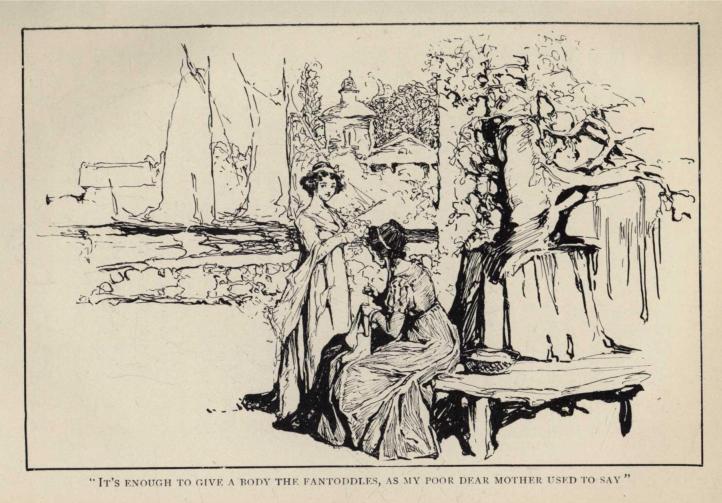
"IT'S ENOUGH TO GIVE A BODY THE FANTODDLES, AS MY POOR DEAR MOTHER USED TO SAY"
Marjolaine suddenly saw light. Here, under her very eyes, was another romance, like her own—only, of course, on an infinitely lower plane, because it held no thread of tragedy—and she had been blind to it. This was lovely! But she must make sure. She turned to Miss Ruth and asked eagerly—"Are they—are they fond of each other?"
Ruth quite unnecessarily bit off another cotton-end. "I don't know!" she cried crossly; but at once added, "Yes, of course they are!"
Marjolaine was more puzzled than ever. "Then, why don't they say so?" she asked, quite simply.
"That's what I want to know," said Miss Ruth.
Lovers who might be perfectly happy, kept apart for want of a word, thought Marjolaine. How wicked, and how silly! "You should speak to Mr. Basil," she said, with all the gravity of her nineteen years and of her bitter experience.
"Me!" cried Miss Ruth. "Bless your dear heart, he 'd up and run away. He 's that shy a body can't look at him but he wants to hide in a cupboard. He 's got it into his silly head he is n't good enough. As if anybody'd notice his shoulder!"
"Perhaps," said Marjolaine, pensively, "if Barbara showed him she liked him—Why don't you speak to her? Sympathetically."
"So I did, just now. Told her she was an idiot. What did she do? She burst out crying, and went and shut herself up with that parrot."
"Ah!" sighed Marjolaine, with a pathetic look at the Gazebo, where she had been so happy so short a time, so long ago, "Ah, yes! The old love!" How well she understood!
"Old frying-pan!" cried Ruth.
"Ruth!" exclaimed Marjolaine, deeply shocked. "The poor parrot."
"Oh, that bird!—Marjory!" said Ruth, firmly, as if the time had come to utter a bitter but necessary truth at all costs, "Marjory, there are times when I 'd give anybody a two-penny bit to wring that bird's neck!"
But Marjolaine had not been listening to her. The mention of the parrot had set her thoughts working; her face suddenly lighted up with the inspired look of one who has just conceived an epoch-making idea. "Ruth!" she cried, running up to her.
Ruth naturally thought she was shocked. "Well, I don't care! I mean it. If it was n't for that bird—"
But Marjolaine had snatched Ruth's needlework away and was trying to drag her from the seat by both hands. "I was n't thinking of the bird! Yes, I was thinking of the bird, but I was n't thinking what you thought I was thinking. Oh! what nonsense you make me talk!"
"Whatever's got into the child's head?" cried Miss Ruth, swept off her feet.
"Come!" insisted Marjolaine. "Quick! Come, and tell Barbara I want her."
"What do you want her for?" asked Miss Ruth, struggling.
"I must n't tell you yet, she may refuse."
"Bless us and save us!" cried Miss Ruth, now on her feet, and struck by the change in Marjolaine's appearance, "now your cheeks are glowing again!"
"Maman said they would!" laughed Marjolaine. Positively, for the moment she had forgotten her sorrows. "Come along!"
"Wait! My mouth 's full of pins!"
Seeing the two ladies under the tree, Sir Peter Antrobus had come out, anxious for a little conversation. He was much disappointed when he observed they were leaving the lawn.
"Going in, just as I'm coming out?" said he, reproachfully.
"Yes," laughed Marjolaine on the top step, and looking up at the threatening sky, "like the little people in the weather cottages: you come out for the rain; and I go in for the sunshine." Which, of course was extremely inaccurate, but the correct statement would have spoiled her meaning entirely.
"How are the peas coming on, Admiral?" asked Miss Ruth, for the sake of politeness.
Sir Peter's temper was already ruffled by the disappointment of his sociable intentions. Now he burst out, "How the doose can they come on, Ma'am, when that everlasting cat roots 'em up every night?"
I am sorry to say, Miss Ruth laughed as he disappeared into the house. The Admiral came towards Sempronius, who was now wide awake and watching the Eyesore's float with lively interest; he shook his fist at him—I mean the Admiral shook his fist at the cat—with comic fury, and found himself shaking his fist at Lord Otford, who had just turned the corner.
"Shaking your fist at me, Peter?" asked Lord Otford, with a grim laugh.
"Hulloa, Otford!" cried the Admiral, feeling rather foolish.
Moreover, he was not particularly pleased to see Otford at that precise moment. Only half-an-hour ago he had surprised Marjolaine's confidence. He had not had time to think the matter over and make up his mind, and now that he found himself without warning face to face with Jack's father, he was torn between two conflicting emotions. On the one hand he felt he ought to tell Otford about Jack and Marjolaine. That was his plain duty; but it was one of those forms of duty which everybody tries to find some plausible excuse for evading. He had surprised Marjolaine's confidence: she had not given it voluntarily. On the other hand he suspected that Jack's breach of faith in not coming near the Walk for a whole week was due to some interference on the part of his father, and he was so fond of Marjolaine, and so jealous of the status of the Walk, that he resented such interference even before he knew whether Otford had interfered. His keen eye saw, even while they were shaking hands, that there was something on his friend's mind.
"How are you?" asked Lord Otford, perfunctorily. "Have you a moment to spare?"
"All day; thanks to this confounded government," growled the Admiral.
Lord Otford plunged into the thick of his business at once. "I am in great trouble," he blurted out, in the tone of a man who expects sympathy.
He didn't get it. "Damme! you're in trouble once a week!" said the Admiral. "Here! Come into the Gazebo."
Lord Otford started at the word. "The Gazebo?—Ha! Very appropriate!"
"Eh? Why?" asked Sir Peter, sitting on the seat in the summer-house and making room for his friend beside him. Lord Otford produced a crumpled letter from his pocket. "Here! Read this!" said he, thrusting it under Sir Peter's nose.
"Can't," said the latter, curtly, "haven't my spy-glass on me!"
"Well, listen." Lord Otford read the letter aloud, with ill-suppressed fury.—"'My lord—It is my painful duty to inform your Lordship that your Lordship's son, the Hon. John Sayle, is carrying on a clandestine love-affair with Mademoiselle Marjolaine Lachesnais, of Pomander Walk—'"
The Admiral had grown purple in the face. "Belay, there!" he roared.
Lord Otford took no notice, but went on reading: "'Yesterday they were together for an hour in the Gazebo—'"
The Admiral would have no more of it. "When did you get that, and who sent it?" he roared. The fact that the information was true was quite outweighed by the implication that an inhabitant of the Walk could have been guilty of the lowest form of treachery.
"It's signed, 'Your true Friend and Well-wisher,'" said Lord Otford, "and I had it on Sunday."
The Admiral could hardly speak. "Do you mean to say that damned, anonymous, Sabbath-breaking rag came from Pomander Walk?"
"I presume so."
"Who sent it?" cried the Admiral, jumping up and walking to and fro in a towering rage. "Show me the white-livered scoundrel, and by Jehoshaphat! I 'll break every bone in his body!" He turned sharply towards Otford. "Is it a man's writing, or a woman's?"
"It's vague: might be anybody's."
The Admiral was passing the houses of the Walk in review. "Can't be Sternroyd—Brooke-Hoskyn—Pringle—We 're none of us anonymous slanderers." His eye fell on the Eyesore with momentary suspicion. "Was it the Eyesore?"
"The Eyesore?" repeated Lord Otford, not understanding.
"That scare-crow, fishing. No; of course not. He does n't know you, and I don't believe he can write.—But, what of it, Jack? You're not worried by that rubbish! Why, it's a pack o' lies!" (Oh, Admiral, Admiral!) Lord Otford tried to speak. "Don't interrupt!—I'm here all the time. Nothing happens in Pomander Walk that I don't know. Don't interrupt!—I was here when Jack came last Saturday. He went back in his boat before you could say 'Jack Robinson,' because Madame swooned!"
He wiped his brow, and had the grace to add "Lord, forgive me!" as a silent prayer. After all, he had told no lie. He had only omitted to say how long Jack had been there before he saw him. And as he did n't know, what could he have said?
Otford found his opportunity of speaking at last. "Now, perhaps you 'll allow me to say it's all true," he shouted.
The Admiral shouted louder. "Do you take this blackguard's word rather than mine?" he roared, pointing to the letter. It was intolerable he should be doubted, even if he were not telling the whole truth.
"You confounded old porcupine," Lord Otford roared back at him, "Jack 's owned up to the whole thing!"
"What!" yelled the Admiral. "Don't shout like that! D' ye want the whole Walk to hear?—Sit down. Tell me again: quietly!"
"When I 'd read this letter, I taxed him with it," said Lord Otford, "and he owned up. He came here last Saturday: met the damned little French gel—"
"Jack!" roared the Admiral, flaring up.
"I'll withdraw 'damned.' Sat an hour in this infernal what-d'-ye-call-it, and thinks he 's in love with her." Sir Peter was about to speak. "Don't interrupt!—You know the Sayles when their blood 's up. My blood was up. Jack's confounded blood was up. You can imagine the scene we had. He's as pig-headed and obstinate as—as—"
"As his father," put in Sir Peter.
"Don't interrupt!" roared Lord Otford. "He's thrown over Caroline Thring—won't hear of her." Sir Peter chuckled. "The utmost I could get out of him was that he 'd wait a week to make sure of what he calls his mind."
"Aha!" said Sir Peter, delighted.
"Mind! Puppy! All the week he's gone about like a bear with a sore head! Had the impudence to refuse to speak to me! This morning he had the impudence to speak! And what d' ye think he said?"
"Serves ye right, whatever it was!" cried Sir Peter.
Lord Otford didn't hear him. "He said, 'The week 's up, and I 'm going to Pomander Walk!'"
"Good lad!" roared Sir Peter, slapping his thigh, and breaking into a loud guffaw.
"What!" shouted Lord Otford, jumping up. "You're mad! Think of what's at stake! Ninety-thousand acres!—For the daughter of a Frenchwoman from the Lord knows where. Who was the gel's father?—Or, rather, who was n't?"
"Jack!" roared the Admiral, in a burst of fury, jumping up in his turn and facing Otford.
"I withdraw!" cried Otford. "But think of it!" He was looking at the Walk. In the grey light of the coming shower the houses were certainly not seen at their best. "Think of it!" he said with a sweep of his cane condemning the whole Walk to instant annihilation. "An Otford taking his wife from these—these—Almshouses!"
The Admiral was livid—apoplectic—hysterical. Words failed him. His voice failed him. He could only gasp, "Almshouses!—Pomander Walk!—Almshouses!"
Lord Otford was alarmed at the effect his words had produced. "There! there!" he cried, almost conciliatorily, "I withdraw 'Almshouses!'"
"Withdraw more, sir!" said the Admiral, and for all his almost grotesque rage, there was a ring in his voice which compelled respect. "How dare you come here, abusing the sweetest, brightest, most winsome—"
"I believe you 're in love with her yourself!" cried Otford.
"And, damme, why not?—Take care how you talk about innocent ladies you 've never set eyes on!"
"That's it!" cried Otford, glad to get on safer ground. "That's why I 'm here. You are to present me to this Madame—whatever her confounded name is."
"In your present temper?" roared Sir Peter, whose own temper was at boiling point. "I'll walk the plank first!" He pointed to Madame's house. "There's her house: the white paint. Go and pay your respects." He came close up to Otford, and spoke straight into his face. "Your respects, Jack! You 'll find you have to!"
"I can't force my way into the house, unaccompanied, and you know it!"
"Then stay away, and be hanged!"
Lord Otford was nonplussed. He caught sight of the Gazebo. "I 'll stay here," he said doggedly, sitting down like a man who means never to move again, "and if Jack shows his nose—!"
The Admiral had begun to stride towards his house. He came back and put his red face round the side of the Gazebo. "I shall be watching, sir!" this with blood-curdling calmness. "And if you dare raise a disturbance, I 'll—" he could not think of anything bad enough. "I 'll—damme! I 'll set the Eyesore at you!"
He stumped off towards his home again, while Lord Otford sank back in his seat, folded his arms, and said, "Ha!" with grim determination.
At that moment Jack came hurrying round the corner and ran straight into the Admiral's arms. At that fateful moment also Madame must needs come out of her house. Fortunately she was preoccupied and did not see the frantic pantomime with which Sir Peter tried to explain to Jack that his father was hidden in the Gazebo. Madame called, "Marjolaine! Marjolaine!" As we know, Marjolaine was with the Misses Pennymint, and Madame received no answer. Lord Otford heard her from his hiding-place. "Aha!" he said to himself, "the mother!" and he sat up at attention.
"Gobblessmysoul!" whispered the Admiral, hoarsely. "The father here, and the mother there! Jack! Get away!"
Madame had turned to her house and was calling her old servant. "Nanette!"
Jack refused to budge. What he said I do not know; but Sir Peter grew still more frantic. Nanette appeared at the upstairs window. "Quoi, Madame?"
"I 'll be hanged if I stir!" said Jack.
"Où est donc Mademoiselle?" said Madame.
"Je ne sais pas, Madame." Madame went back into her little garden, and looked into the ground-floor window.
"Come inside, then!" said Sir Peter to Jack. But Jack saw the Eyesore, who was placidly fishing, and a broad grin spread all over his face. "No! Better idea!" he chuckled. He imparted the idea to the horrified Admiral in a whisper.
Madame spoke to Nanette again. "Vite! Allez voir si son chapeau est dans sa chambre!"
Nanette disappeared from the window, and Madame stood impatiently looking up at it awaiting her return.
Whatever Jack had said to the Admiral was of such a nature as to fill that ancient salt with horror. He threw up his arms, cried, "I wash my hands of it!" and dashed into his house. Jack quickly said something to the Eyesore which caused the latter to fling his rod down with alacrity, and, amazing to relate, he and Jack hurried round the corner and out of sight together.
Nanette reappeared with a huge Leghorn straw hat. "Oui, Madame, voilà le chapeau de Mademoiselle." Then, pointing to the Gazebo, "Mademoiselle doit être au pavillon."
"Non," said Madame, "je viens de l'appeler." But a sudden suspicion flashed across her mind. Could Marjolaine be there with Jack, and afraid to show herself? "Serait-il possible?"—she cried, and came hurriedly towards the summer-house.
Lord Otford had heard her conversation with Nanette, and had risen; so that Madame found herself abruptly face to face with her faithless lover.
CHAPTER IX
IN WHICH OLD LOVERS MEET, AND THE CONSPIRACY COMES TO A HEAD

Chapter IX headpiece
Madame knew him at a glance. To some extent she had been prepared for his coming by Jack's previous visit. As Jack was acquainted with Sir Peter, it was quite likely Lord Otford was also, and nothing was more probable than that he should come to look up his old friend. Nevertheless this sudden confrontation startled her, and she could not suppress a little "Oh!" of surprise.
Lord Otford, on his part, was too much occupied with his own anger, his outraged dignity, to pay more than very superficial attention to her. Moreover she had changed a great deal more than he. He had left her, a mere strip of a girl, and now she was a dignified and very beautiful woman. He was not thinking of Lucy Pryor at all at the moment, while her thoughts, if the truth must be told, were full of the Jack Sayle of old days. So they began their little duel with unequal weapons. Madame was absolutely self-possessed: Otford could not suppress a certain amount of nervousness in the presence of this calm and stately lady who was so utterly different from anything he had expected. However, he pulled himself together and put on his grandest and most overwhelming manner.
"I am the trespasser," he said, with a condescending bow, in answer to her startled cry. She inclined her head very slightly, and turned to go.
"May I detain you a moment?" said he, quickly.
She stopped and half turned towards him. "I am at a loss—" she said coldly, with raised eyebrows.
He explained. "I heard you calling your daughter." Then, very stiffly, "I presume you are Madame—ah—" he made pretence to consult the anonymous letter; this haughty person should know she was not of sufficient importance for him even to remember her name, "Madame Lachesnais."
Madame bowed almost imperceptibly and something very like a mischievous smile lurked in the corners of her lips.
"I am Lord Otford—" he gave his name quite simply, as a gentleman should, yet he managed to convey that it was a great name and that he expected the announcement of it to make its effect.
Madame made a slight movement with her hand as if she were brushing away something of no moment whatever; as if she declined to receive a name which could have no importance for her; as if she did n't care whether his name were Otford or Snooks. This disconcerted him. It was a new experience, and it was unpleasant. For the sake of something to say he pointed to the seat under the tree. "Ah—pray be seated." Madame saw the advantage she had already gained. She spoke as she might have addressed a poor beetle: "What you have to say can be of so little consequence—"
Lord Otford flushed angrily. Here was he, a great nobleman with a grievance, and this totally insignificant woman was treating him like a child! He spoke with some warmth. "I beg your pardon! What I have to say is of the utmost consequence."
"I shall be surprised," said Madame—"and I am waiting."
Lord Otford was still fuming. Her manner was really most disconcerting. "You—you make it somewhat difficult, ma'am," he blustered.
Nothing could stir her calmness. "Then why give yourself the trouble?" she said; and again moved as if to go.
"Pray wait!" cried he, hastily. All the fine outworks of sarcasm and irony which he had elaborately prepared against this meeting had vanished before the icy blast of her imperturbable coolness. He was hot; he was uncomfortable. He could only stammer, "The fact is—my foolish son—"
Madame held up a delicate hand and stopped him. "Ah!" she said, with a well-bred rebuke of his excitement, "I can spare you any further discomfort. Your son forced his acquaintance on my daughter in my absence a week ago. Be assured we are willing to overlook his lack of manners. The circumstance need not be further alluded to."
Here was a nice thing! In those few words she had turned the tables on him. Instead of metaphorically grovelling in the dust at his feet and entreating his pardon, she had become the accuser, and he now found himself forced to speak on the defensive.
"It must be alluded to! I must explain!" he cried.
"No explanation or apology is required," she went on implacably, "since under no circumstances shall we allow the acquaintance to continue."
Was he on his head or his heels? These were practically the very words he had meant to use. This was the shell he had meant to hurl into the enemy's camp, and here it was, exploding under his own feet!
"But my son has pledged his word to come again, and—"
Again she interrupted him. "Make yourself easy on that score," she said; and now there was even a note of contempt in her voice. "He has broken his word."
"That was my doing!" cried Lord Otford, almost apologetically. "I persuaded him to wait a week. I regret to say he means to come to-day."
"Well," answered Madame, with the utmost indifference, "Pomander Walk is public, and we cannot prevent him."
"But he 'll see your daughter!"
"I think not. Unless he breaks into the house."
"Upon my soul, I believe he 'll go that length!" What Lord Otford had intended should be a menace, turned to an appeal. "That is where I ask for your co-operation."
Madame looked him up and down with indignant protest. Really, he might have been poor Snooks. "Pardon me," she said, "not co-operation." She drew herself up and her eyes flashed. "But I shall defend my own."
She laid a peculiar stress on the word "defend," which arrested his attention.
"'Defend'?" said he, with amazement. "What do you mean?"
She looked him straight in the face, and spoke with intense feeling. "I mean, that no member of your family is likely to cross my threshold."
There was something so threatening, so avenging in her voice, that he fell back a pace and said, hushed, "You speak as though you nursed a grudge against my family!"
Madame smiled scornfully. "Oh! no grudge whatever." Then she added slowly and very quietly, "But I remember!"
"Remember what?" cried he, more and more bewildered.
For a moment she did not answer. Then she turned to him and spoke. "Am I so changed—Jack Sayle?"
He stared. "Indeed, ma'am—" then suddenly he saw and remembered. He could only exclaim, "Good God!"
"Are you still puzzled?" she asked, with that mysterious smile of hers.
"Lucy!"
"Lucy Pryor," she assented. She bowed and turned away.
Lord Otford was stunned. "No—no," he stammered. "Stop!—this alters the case entirely!"
She turned on him with raised eyebrows. "How?"
He was entirely at a loss. He had spoken on the spur of the moment. All the past had suddenly risen up before him, all his youth had come flooding back. The birds sang in the old vicarage garden; his experiences, his worldly honours, sank from him, and he was a lad again, deeply in love; and here stood his first sweetheart—his only sweetheart—the woman who meant youth and spring-time and all the ideals of boyhood. He bowed his head. "I—I don't know. I am stunned!—After all these years!"
She was merciless. Also she was on her guard. She must not let herself be defeated by sentimentality. As she looked at him and saw him standing humbled before her, a still small voice in her heart cried out in pity. That would never do. He had blighted her youth; his son had hurt Marjolaine. She must remember. She must be firm. So she silenced the appealing voice and spoke with an admirable assumption of lightness.
"Why, what does it all amount to? After all these years Lord Otford meets Madame Lachesnais. These are not the Jack Sayle and the Lucy Pryor who loved, years ago. He does not meet a broken-hearted woman pining for her lost girlhood, but," she drew herself up and her voice grew firmer, "but one who has been a happy wife, and a happy mother—and a mother who will defend her daughter's happiness." Then the mockery returned, intensified. "So there is no cause for such a tragic countenance, my lord!"
Otford winced. He was humbled; he was angry with himself, and angry with her. "Madam," said he, "I am well rebuked. I wish you a very good day!" He made her a very low bow, and turned on his heel. Inwardly he was raging, and when, at the corner of the Walk, he ran right into the Eyesore who was innocently returning to his fishing, that unfortunate creature received the full force of his anger in a muttered but none the less hearty curse.
Madame stood where he had left her. Now that he was gone, she realised how the meeting had shaken her. Twenty years, and more, and he was scarcely changed! The same lithe figure; the same handsome face, with the bold eyes; the same appeal which had drawn her heart to him in the old days. The long interval which had elapsed, with all its varied adventures; her marriage, the Revolution, her husband's death, seemed merely an episode. She and Jack had parted yesterday, so it seemed, and to-day they had met again. She was dismayed at realising the sway he still held. The same sway as ever. It took the strength out of her limbs. She leaned against the summer-house in distress. This was unbearable. She must fight. The old pain must not be allowed to seize her in its grip. Jack Sayle was dead, buried and forgotten, and she would not let him come to life again.
Meanwhile Mrs. Poskett had opened her upstairs window and was leaning out. The sky was very threatening; there was going to be a thunder-storm; and there crouched that foolish cat of hers, oblivious of the weather, watching the Eyesore. "Sempronius!" she called. "Puss! Puss! Puss!"
But Sempronius had more urgent business than attending to his mistress's voice. A miracle had happened: the Eyesore had caught a fish! Sempronius looked on with eager interest as the Eyesore disengaged his prey from the hook and laid it on the grass. Yes; he would go in, said Sempronius to himself, making sure that the downstairs window of his mistress's house was open; he would go in presently, when he had safely stalked that fish. Not before.
The Admiral also had seen the skies darken. It was time to take in the thrush. So he leant out of his upstairs window to unhook the osier cage. His window and Mrs. Poskett's were so close together that—well—the Admiral and the widow could, at a pinch, have kissed if they had been so minded. But nothing was further from, the Admiral's thoughts.
"Sempronius!" screamed Mrs. Poskett.
"Ah!" chuckled the Admiral, "it's no use calling him, ma'am. He 's got his eye on the fish!"
"You don't mean to say the Eyesore's caught one!" cried Mrs. Poskett.
The Admiral laughed as he looked at the Eyesore. Laughed more than the occasion seemed to justify. "Ay, ay! he's wonderfully patient and persistent!"
The widow's face, as he leant out to see the fish, was very near the Admiral's.
"Astonishing what patience and persistence 'll do, Admiral," said she, coquettishly. She withdrew quickly and closed her window.
The Admiral was puzzled. What did she mean? But he shook off his forebodings. He turned to where the Eyesore, buried more than usual in his horrible old hat, was putting on new bait, and gave a low whistle. The Eyesore signalled to him to be quiet and at that moment he became aware of Madame, who was moving away from the Gazebo. "Gobblessmysoul! Madame!" he muttered to himself with inexplicable confusion, and hastily withdrew out of sight with his thrush.
Miss Barbara Pennymint came hopping down her steps, followed by Marjolaine. Madame had recovered her self-possession. "Ah!" she cried, seeing Marjolaine, "I was a little alarmed about you. Did you not hear me call?"
"No, Maman chérie."
Madame turned to Barbara. "Don't let her stay out if it rains." And with a pleasant nod to the two girls she moved into her house. She had need to be alone.
Marjolaine and Barbara locked their arms round each others' waists and came across the lawn.