No. XI.
Reading edition
Jan. 22, 1798.
We have said in another part of our paper of this day, “that though we shall never begin an attack, we shall always be prompt to repel it”.
On this principle, we could not pass over in silence the Epistle to the Editors of the Anti-Jacobin, which appeared in the Morning Chronicle of Wednesday, and from which we have fortunately been furnished with a motto for this day’s paper.
We assure the author of the epistle, that the answer which we have here the honour to address to him, contains our genuine and undisguised sentiments upon the merits of the poem.
Our conjectures respecting the authors and abettors of this performance may possibly be as vague and unfounded as theirs are with regard to the Editors of the Anti-Jacobin. We are sorry that we cannot satisfy their curiosity upon this subject—but we have little anxiety for the gratification of our own.
It is hardly to be expected, that the character of the epistle should be taken on trust from the editors of this volume; it is thought best, therefore, to subjoin the whole performance as it originally appeared—a mode of hostility obviously the most fair, and in respect to the combatants in the cause of Jacobinism, by much the most effectual. They are always best opposed by the arms which they themselves furnish. Jacobinism shines by its own light.
68To the respectable names which the author of the following address has thought proper to connect with the “Anti-Jacobin,” no apology is made for thus preserving this otherwise perishable specimen of dulness and defamation. He who has been reviled by the enemies of the “Anti-Jacobin,” must feel that principles are attributed to him, of which he need not be ashamed: and when the abuse is conveyed in such a strain of feebleness and folly, he must see that those principles excite animosity only in quarters of which he need not be afraid.
It is only necessary to add, what is most conscientiously the truth, that this production, such as it is, is by far the best of all the attacks that the combined wits of the cause have been able to muster against the “Anti-Jacobin”.
EPISTLE TO THE EDITORS OF THE ANTI-JACOBIN.[40]
Hic Niger est; hunc tu, Romane, caveto!
To tell what gen’rals did, or statesmen spoke,
To teach the world by truths, or please by joke;
To make mankind grow bold as they peruse,
Judge on existing things, and—weigh the news;
For this a PAPER first display’d its page,
Commanding tears and smiles through ev’ry age!
Hail, justly famous! who in modern days
With nobler flight aspire to higher praise;
Hail, justly famous! whose discerning eyes
At once detect MISTAKES, MIS-STATEMENTS, LIES;[41]
10
Hail, justly famous! who with fancy blest,
Use fiend-like virulence for sportive jest;
Who only bark to serve your private ends—
Patrons of Prejudice, Corruption’s friends!
Who hurl your venom’d darts at well-earned fame—
Virtue your hate, and Calumny your aim!
69Whoe’er ye are, all hail!—whether the skill
Of youthful Canning guides the ranc’rous quill;
With powers mechanic far above his age,
Adapts the paragraph and fills the page;
20
Measures the column, mends whate’er’s amiss,
Rejects THAT letter, and accepts of THIS;
Or Hammond,[42] leaving his official toil,
O’er this great work consume the midnight oil—
Bills, passports, letters, for the Muses quit,
And change dull business for amusing wit:—
His life of labour at one gasp is o’er,
His books forgot—his desk beloved no more!
Proceed to prop the Ministerial cause;
See consequential Morpeth[43] nods applause;
30
In ev’ry fair one’s ears at balls and plays
The gentle Granville Leveson[44] whispers praise:
Well-judging Patrons, whom such works can please;
Great works, well worthy Patrons such as these!
Who heard, not raptured, the poetic Sage
Who sung of Gallia in a headlong rage,
And blandly drew with no uncourtly grace
The simple manners of our English race—
Extoll’d great Duncan, and, supremely brave,
Whelm’d Buonaparte’s pride beneath the wave?
40
I swear by all the youths that Malmesbury[45] chose,
By Ellis’[46] sapient prominence of nose,
By Morpeth’s gait, important, proud, and big—
By Leveson Gower’s crop-imitating wig,
That, could the pow’rs which in those numbers shine,
Could that warm spirit animate my line,
Your glorious deeds which humbly I rehearse—
Your deeds should live immortal as my verse;
And, while they wonder’d whence I caught my flame,
Your sons should blush to read their fathers’ shame!
50
Proceed, great men!—your office is not done;
Proceed with what you have so well begun:
Load Fox (if you by Pitt would be preferr’d),
With ev’ry guilt that Kenyon ever heard—
Adult’rer, gamester, drunkard, cheat and knave,
A factious demagogue and pension’d slave!
70Loose, loose your cry—with ire satiric flash:
Let all the Opposition feel your lash;
And prove them to these hot and partial times,
A combination of the worst of crimes!
60
But softer numbers softer subjects fit:
In liquid phrases thrill the praise of Pitt;
Extol in eulogies of candid truth
The Virgin Minister—the Heav’n-born Youth;
The greatest gift that fate to England gave,
Created to support and born to save;
Prompt to supply whate’er his country lacks—
Skilful to GAG, and knowing how to TAX!
With him companions meet in order stand—
A firm, compact, and well-appointed band;
70
Skill’d to advance or to retreat, Dundas,[47]
And bear thick battle on his front of brass;
Grenville with pond’rous head, which match’d we find
By equal ponderosity behind.——
But hold, my Muse; nor farther these pursue!—
Great Editors, we have digress’d from you;
From you, to whom our trivial lays belong,
From you, the sole inspirers of our song!
Proceed:—urge on the same vindictive strain,
To gain the applauses of great Malmesbury’s train;
80
With jaundiced eyes the noblest patriot scan:
Proceed—be more opprobrious if you can;
Proceed—be more abusive ev’ry hour;
To be more stupid is beyond your power.
71
TO THE AUTHOR OF THE EPISTLE TO THE EDITORS OF THE ANTI-JACOBIN.
Nostrorum sermonum candide judex!
Bard of the borrow’d lyre! to whom belong
The shreds and remnants of each hackney’d song;
Whose verse thy friends in vain for wit explore,
And count but one good line in eighty-four!
Whoe’er thou art, all hail! Thy bitter smile
Gilds our dull page, and cheers our humble toil!
For yet—though firm and fearless in the cause
Of pure Religion, Liberty, and Laws,—
Though TRUTH approved, though fav’ring VIRTUE smiled,
Some doubts remained: WE yet were unreviled.
10
Thanks to thy zeal! those doubts at length are o’er!
Thy suffrage crowns our wish!—WE ask no more
To stamp with sterling worth each honest line,
Than Censure, cloth’d in vapid Verse like thine!
But say—in full blown honours dost thou sit
’Midst Brookes’s elders[48] on the BENCH OF WIT,
Where Hare,[49] chief-justice, frames the stern decree,
72While with their learned brother, sages three,
Or art thou One—THE PARTY’S flattered fool,[52]
20
Train’d in Debrett’s, or Ridgway’s civic school—
One, who with rant and fustian daily wears,
Well-natured Richardson![53] thy patient ears;—
Who sees nor Taste nor Genius in these times,
73Or is it he,—the youth,[59] whose daring soul
With half a mission sought the Frozen Pole;—
And then, returning from the unfinish’d work,
Wrote half a letter,—to demolish Burke?
Studied Burke’s manner,—aped his forms of speech;
30
74Though when he strives his metaphors to reach,
One luckless slip his meaning overstrains,
And loads the blunderbuss with Bedford’s brains.[60]
75Whoe’er thou art—ne’er may thy patriot fire,
Unfed by praise or patronage, expire!
Forbid it, Taste!—with Compensation large
Patrician hands thy labours shall o’ercharge![61]
Bedford and Whitbread shall vast sums advance,
The Land and Malt of Jacobin Finance!
Whoe’er thou art—before thy feet we lay,
40
With lowly suit, our Number of to-day!
Spurn not our offering with averted eyes!
Let thy pure breath revive the extinguished Lies!
Mistakes, Mis-statements, now so oft o’erthrown,
Rebuild, and prop with nonsense of thy own!
Pervert our meaning, and misquote our text—
And furnish us a motto for the next!
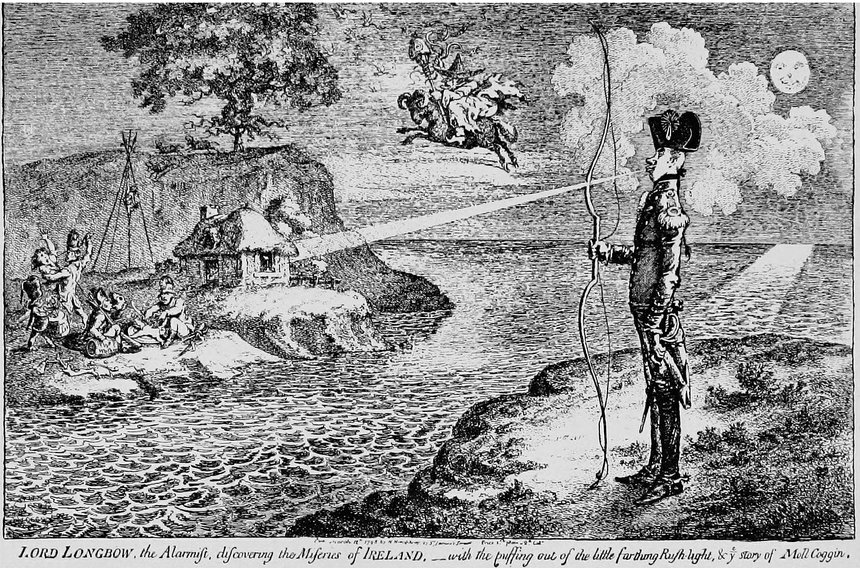
78
ODE TO LORD MOIRA.
I.
If on your head[62] some vengeance fell,
Moira, for every tale you tell,
The listening Lords to cozen;[63]
If but one whisker lost its hue,
Changed (like Moll Coggin’s tail) to blue,
I’d hear them by the dozen.
II.
But still, howe’er you draw your bow,[64]
Your charms improve, your triumphs grow,
New grace adorns your figure;
More stiff your boots, more black your stock,
10
Your hat assumes a prouder cock,
Like Pistol’s (if ’twere bigger).
III.
Tell then your stories, strange and new,[65]
Your Fathers fame[66] shall vouch them true;
So shall the Dublin Papers;
Swear by the stars[67] that saw the sight,
79That infant thousands die each night,[68]
While troops blow out their tapers.
IV.
Shuckburgh[69][70] shall cheer you with a smile,
20
And fierce Nicholl,[74] who wields at will
Th’ emphatic stick, or powerful quill,
To prove his country’s ruin.
V.
Each day new followers[75] crowd your board,
And lean expectants hail my Lord
With adoration fervent:
Old Thurlow,[76] though he swore by G—
No more to own a master’s nod,
Is still your humble servant.
30
VI.
Old Pulteney[77][78] too, your influence feels,
And asks from you th’ Exchequer Seals,
To tax and save the nation:
Tooke trembles,[79] lest your potent charms
Should lure Charles Fox from his fond arms,
To YOUR Administration.[81]
36
80[TRANSLATION OF HORACE, BOOK II., ODE VIII.
BY ARCHDEACON WRANGHAM.
Avenger of insulted truth,
Had Heaven, Barine, dimm’d one tooth;
Or bade, in justice bade, thee wail
A speck upon a single nail—
I’d trust thee: but ere well the vow
Has passed those treacherous lips, there glow
New beauties mantling o’er thy cheek;
And thee the youth, thee only seek.
It profits thee to be forsworn
By thy dead mother’s hallowed urn;
By heaven, and each mute nightly sign,
And every deathless power divine.
Yes: Venus laughs well-pleased, and lo!
The gentle Nymphs are laughing too;
And Cupid, who his burning darts
Whets with fresh blood from lovers’ hearts.
Boyhood is rising to thy sway,
Thy train of slaves augments: e’en they,
Who swore thy threshold to forsake,
Hug the fond chain they cannot break.
Thee for their sons pale mothers fear,
The frugal father for his heir:
And plighted maidens, lest thy charms
Keep the false truants from their arms.—Ed.]
NOTES TO THE ODE TO LORD MOIRA.
[This Ode, written by George Ellis, refers to the wish of a “Third Party” in the House of Commons, who were dissatisfied with the conduct of the war, the embarrassed state of the finances, and the alarming situation of the country, to have an interview with Lord Moira, with a view to effect a change of Ministry. The following extracts from a letter from his Lordship to Col. M‘Mahon, dated June 15, 1797, will throw some light on this negotiation. “They requested that I would endeavour, on the assurance of their support, to form an administration, on the principle of excluding persons, who had on either side made themselves obnoxious to the public. I strenuously recommended them to form an alliance with Mr. Fox’s party, that might be satisfactory to themselves, and reduce to strict engagement the extent of the measures, which Mr. Fox, when brought into office by themselves, would propose. Hitherto nobody has been designated to any particular office but Sir William Pulteney. The gentleman had said that he was the person whom they should be most gratified in seeing Chancellor of the Exchequer, and I had professed to them and to him that there was not any person with whom I could act more confidently. I added, the introduction of Lord Thurlow, Sir W. Pulteney, and myself, into the Cabinet, would not assure the public of a change of system.”—Ed.]
82

83