PLUM PUDDING (continued 4)
Reading edition
Coming down Fifth Avenue on top of a bus, we saw a man absorbed in a book. Ha, we thought, here is our chance to see how bus reading compares to subway reading! After some manœuvering, we managed to get the seat behind the victim. The volume was "Every Man a King," by Orison Swett Marden, and the uncrowned monarch reading it was busy with the thirteenth chapter, to wit: "Thoughts Radiate as Influence." We did a little radiating of our own, and it seemed to reach him, for presently he grew uneasy, put the volume carefully away in a brief-case, and (as far as we could see) struck out toward his kingdom, which apparently lay on the north shore of Forty-second Street.
We felt then that we would recuperate by glancing at a little literature. So we made our way toward the newly enlarged shrine of James F. Drake on Fortieth Street. Here we encountered our friends the two Messrs. Drake, junior, and complimented them on their thews and sinews, these two gentlemen having recently, unaided, succeeded in moving a half-ton safe, filled with the treasures of Elizabethan literature, into the new sanctum. Here, where formerly sped the nimble fingers of M. Tappe's young ladies, busy with the compilation of engaging bonnets for the fair, now stand upon wine-dark shelves the rich gold and amber of fine bindings. We were moved by this sight. We said in our heart, we will erect a small madrigal upon this theme, entitled: "Song Upon Certain Songbirds of the Elizabethan Age Now Garnishing the Chamber Erstwhile Bright With the Stuffed Plumage of the Milliner." To the Messrs. Drake we mentioned the interesting letter of Mr. J. Acton Lomax in yesterday's Tribune, which called attention to the fact that the poem at the end of "Through the Looking Glass" is an acrostic giving the name of the original Alice—viz., Alice Pleasance Liddell. In return for which we were shown a copy of the first edition of "Alice in Wonderland." Here, too, we dallied for some time over a first edition of Dr. Johnson's Dictionary, and were pleased to learn that the great doctor was no more infallible in proofreading than the rest of us, one of our hosts pointing out to us a curious error by which some words beginning in COV had slipped in ahead of words beginning in COU.
At noon to-day we climbed on a Riverside Drive bus at Seventy-ninth Street and rode in the mellow gold of autumn up to Broadway and 168th. Serene, gilded weather; sunshine as soft and tawny as candlelight, genial at midday as the glow of an open fire in spite of the sharpness of the early morning. Battleships lay in the river with rippling flags. Men in flannels were playing tennis on the courts below Grant's Tomb; everywhere was a convincing appearance of comfort and prosperity. The beauty of the children, the good clothing of everybody, canes swinging on the pavements, cheerful faces untroubled by thought, the warm benevolence of sunlight, bronzing trees along Riverside Park, a man reading a book on the summit of that rounded knoll of rock near Eighty-fourth Street which children call "Mount Tom"—everything was so bright in life and vigour that the sentence seems to need no verb. Joan of Arc, poised on horseback against her screen of dark cedars, held her sword clearly against the pale sky. Amazingly sure and strong and established seem the rich façades of Riverside Drive apartment houses, and the landlords were rolling in limousines up to Claremont to have lunch. One small apartment house, near Eighty-third or thereabouts, has been renamed the Château-Thierry.
After crossing the long bridge above Claremont and the deep ravine where ships and ferryboats and coal stations abound, the bus crosses on 135th Street to Broadway. At 153d, the beautiful cemetery of Trinity Parish, leafy paths lying peaceful in the strong glow. At 166th Street is an open area now called Mitchel Square, with an outcrop of rock polished by the rearward breeks of many sliding urchins. Some children were playing on that small summit with a toy parachute made of light paper and a pebble attached by threads. On 168th Street alongside the big armoury of the Twenty-second Engineers boys were playing baseball, with a rubber ball, pitching it so that the batter received it on the bounce and struck it with his fist. According to the score chalked on the pavement the "Bronx Browns" and the "Haven Athletics" were just finishing a rousing contest, in which the former were victors, 1–0. Haven Avenue, near by, is a happy little street perched high above the river. A small terraced garden with fading flowers looks across the Hudson to the woody Palisades. Modest apartment houses are built high on enormous buttresses, over the steep scarp of the hillside. Through cellar windows coal was visible, piled high in the bins; children were trooping home for dinner; a fine taint of frying onions hung in the shining air. Everywhere in that open, half-suburban, comfortable region was a feeling of sane, established life. An old man with a white beard was greeted by two urchins, who ran up and kissed him heartily as he beamed upon them. Grandpa, one supposes! Plenty of signs indicating small apartments to rent, four and five rooms. And down that upper slant of Broadway, as the bus bumbles past rows of neat prosperous-seeming shops, one feels the great tug and pulling current of life that flows down the channel, the strange energy of the huge city lying below. The tide was momentarily stilled, but soon to resume action. There was a magic touch apparent, like the stillness of a palace in a fairy tale, bewitched into waiting silence.
Sometimes on our way to the office in the morning we stop in front of a jeweller's window near Maiden Lane and watch a neat little elderly gentleman daintily setting out his employer's gauds and trinkets for the day. We like to see him brood cheerfully over the disposition of his small amber-coloured velvet mats, and the arrangement of the rings, vanity cases, necklaces, and precious stones. They twinkle in the morning light, and he leans downward in the window, innocently displaying the widening parting on his pink scalp. He purses his lips in a silent whistle as he cons his shining trifles and varies his plan of display every day.
Now a modern realist (we have a painful suspicion) if he were describing this pleasant man would deal rather roughly with him. You know exactly how it would be done. He would be a weary, saddened, shabby figure: his conscientious attention to the jewels in his care would be construed as the painful and creaking routine of a victim of commercial greed; a bitter irony would be distilled from the contrast of his own modest station in life and the huge value of the lucid crystals and carbons under his hands. His hands—ah, the realist would angrily see some brutal pathos or unconscious naughtiness in the crook of the old mottled fingers. How that widening parting in the gray head would be gloated upon. It would be very easy to do, and it would be (if we are any judge) wholly false.
For we have watched the little old gentleman many times, and we have quite an affection for him. We see him as one perfectly happy in the tidy and careful round of his tasks; and when his tenderly brushed gray poll leans above his treasures, and he gently devises new patterns by which the emeralds or the gold cigarette cases will catch the slant of 9 o'clock sunlight, we seem to see one who is enjoying his own placid conception of beauty, and who is not a figure of pity or reproach, but one of decent honour and excellent fidelity.
One of our colleagues, a lusty genial in respect of tobacco, has told us of a magnificent way to remove an evil and noisome taste from an old pipe that hath been smoked overlong. He says, clean the bowl carefully (not removing the cake) and wash tenderly in fair, warm water. Then, he says, take a teaspoonful of the finest vatted Scotch whiskey (or, if the pipe be of exceeding size, a tablespoonful of the same) and pour it delicately into the bowl. Apply a lighted match, and let the liquor burn itself out. It will do so, he avouches, with a gentle blue flame of great beauty and serenity. The action of this burning elixir, he maintains, operates to sizzle and purge away all impurity from the antique incrustation in the bowl. After letting the pipe cool, and then filling it with a favourite blend of mingled Virginia, Perique, and Latakia, our friend asserts that he is blessed with a cool, saporous, and enchanting fumigation which is so fragrant that even his wife has remarked upon it in terms complimentary. Our friend says (but we fear he draws the longbow nigh unto fracture) that the success of this method may be tested so: if one lives, as he does, in the upward stories of a tall apartment house, one should take the pipe so cleansed to the window-sill, and, smoking it heartily, lean outward over the sill. On a clear, still, blue evening, the air being not too gusty, the vapours will disperse and eddy over the street; and he maintains with great zeal that passersby ten tiers below will very soon look upward from the pavement, sniffingly, to discern the source of such admirable fumes. He has even known them, he announces, to hail him from the street, in tones of eager inquiry, to learn what kind of tobacco he is smoking.
All this we have duly meditated and find ourselves considerably stirred. Now there is only one thing that stands between ourself and such an experiment.
There are some who hold by the theory that on visiting a restaurant it is well to pick out a table that is already cleared rather than one still bearing the debris of a previous patron's meal. We offer convincing proof to the contrary.
Rambling, vacant of mind and guileless of intent, in a certain quiet portion of the city—and it is no use for you, O client, to ask where, for our secrecy is firm as granite—we came upon an eating house and turned inward. There were tables spread with snowy cloths, immaculate; there were also tables littered with dishes. We chose one of the latter, for a waiter was removing the plates, and we thought that by sitting there we would get prompter service. We sat down and our eye fell upon a large china cup that had been used by the preceding luncher. In the bottom of that cup was a little pool of dark dregs, a rich purple colour, most agreeable to gaze upon. Happy possibilities were opened to our mind. Like the fabled Captain X, we had a Big Idea. We made no outcry, nor did we show our emotion, but when the waiter asked for our order we said, calmly: "Sausages and some of the red wine." He was equally calm and uttered no comment.
Soon he came back (having conferred, as we could see out of the wing of our eye) with his boss. "What was it you ordered?" he said.
"Sausages," we replied, urbanely, "and some of the red wine."
"I don't remember having served you before," he said. "I can't give you anything like that."
We saw that we must win his confidence and we thought rapidly. "It's perfectly all right," we said. "Mr. Bennett" (we said, seizing the first name that came into our head), "who comes here every day, told me about it. You know Mr. Bennett; he works over on Forty-second Street and comes here right along."
Again he departed, but returned anon with smiling visage. "If you're a friend of Mr. Bennett's," he said, "it's all right. You know, we have to be careful."
"Quite right," we said; "be wary." And we laid hand firmly on the fine hemorrhage of the grape.
A little later in the adventure, when we were asked what dessert we would have, we found stewed rhubarb on the menu, and very fine stewed rhubarb it was; wherefore we say that our time was not ill-spent and we shall keep the secret to ourself.
But we can't help feeling grateful to Mr. Bennett, whoever he is.
Occasionally (but not often) in the exciting plexus of our affairs (conducted, as we try to persuade ourself, with so judicious a jointure of caution and hilarity) we find it necessary to remain in town for dinner. Then, and particularly in spring evenings, we are moved and exhilarated by that spectacle that never loses its enchantment, the golden beauty and glamour of downtown New York after the homeward ebb has left the streets quiet and lonely. By six o'clock in a May sunset the office is a cloister of delicious peace and solitude. Let us suppose (oh, a case merely hypothetic) that you have got to attend a dinner somewhere in the Forties, say at half-past seven; and it is requisite that evening clothes should be worn. You have brought them to the office, modestly hidden, in a bag; and in that almost unbelievable privacy, toward half-past six, you have an enjoyable half hour of luxurious amusement and contemplation. The office, one repeats, is completely stripped of tenants—save perhaps an occasional grumbling sortie by the veteran janitor. So all its resources are open for you to use as boudoir. Now, in an office situated like this there is, at sunset time, a variety of scenic richness to be contemplated. From the President's office (putting on one's hard-boiled shirt) one can look down upon St. Paul's churchyard, lying a pool of pale blue shadow in the rising dusk. From the City Room (inserting studs) one sees the river sheeted with light. From the office of the Literary Editor (lacing up one's shoes) one may study the wild pinnacle of Woolworth, faintly superfused with a brightness of gold and pink. From the office of one of our dramatic critics the view is negligible (being but a hardy brick wall), but the critic, debonair creature, has a small mirror of his own, so there one manages the ticklish business of the cravat. And from our own kennel, where are transacted the last touches (transfer of pipe, tobacco, matches, Long Island railroad timetable, commutation ticket, etc., to the other pockets) there is a heavenly purview of those tall cliffs of lower Broadway, nobly terraced into the soft, translucent sky. In that exquisite clarity and sharpness of New York's evening light are a loveliness and a gallantry hardly to be endured. At seven o'clock of a May evening it is poetry unspeakable. O magnificent city (one says), there will come a day when others will worship and celebrate your mystery; and when not one of them will know or care how much I loved you. But these words, obscure and perishable, I leave you as a testimony that I also understood.
She cannot be merely the cruel Babel they like to describe her: the sunset light would not gild her so tenderly.
It was a great relief to us yesterday evening to see a man reading a book in the subway. We have undergone so many embarrassments trying to make out the titles of the books the ladies read, without running afoul of the Traveller's Aid Society, that we heaved a sigh of relief and proceeded to stalk our quarry with a light heart. Let us explain that on a crowded train it is not such an easy task. You see your victim at the other end of the car. First you have to buffet your way until you get next to him. Then, just as you think you are in a position to do a little careful snooping, he innocently shifts the book to the other hand. This means you have got to navigate, somehow, toward the hang-handle on the other side of him. Very well. By the time the train gets to Bowling Green we have seen that it is a fattish book, bound in green cloth, and the author's name begins with FRAN. That doesn't help much. As the train roars under the river you manage, by leanings and twistings, to see the publisher's name—in this case, Longmans. At Borough Hall a number of passengers get out, and the hunted reader sits down. Ten to one he will hold the book in such a way that you cannot see the title. At Nevins Street you get a seat beside him. At Atlantic Avenue, as he is getting off, you propose your head over his shoulder in the jam on the stairs and see what you are after. "Lychgate Hall," by M.E. Francis. And in this case, success left us none the wiser.
Atlantic Avenue, by the way, always seems to us an ideal place for the beginning of a detective story. (Speaking of that, a very jolly article in this month's Bookman, called "How Old Is Sherlock Holmes?" has revived our old ambition to own a complete set of all the Sherlock Holmes tales, and we are going to set about scouring the town for them). Every time we pass through the Atlantic Avenue maelstrom, which is twelve times a week, we see, as plain as print, the beginning of two magazine tales.
One begins as the passengers are streaming through the gate toward the 5:27 train. There is a very beautiful damsel who always sits on the left-hand side of the next to last car, by an open window. On her plump and comely white hand, which holds the latest issue of a motion picture magazine, is a sparkling diamond ring. Suddenly all the lights in the train go out. Through the open window comes a brutal grasp which wrenches the bauble from her finger. There are screams, etc., etc. When the lights go on again, of course there is no sign of the criminal. Five minutes later, Mr. Geoffrey Dartmouth, enjoying a chocolate ice cream soda in the little soft-drink alcove at the corner of the station, is astonished to find a gold ring, the stone missing, at the bottom of his paper soda container.
The second story begins on the Atlantic Avenue platform of the Lexington Avenue subway. It is 9 a.m., and a crowded train is pulling out. Just before the train leaves a young man steps off one of the cars, leaving behind him (though not at once noticed) a rattan suitcase. This young man disappears in the usual fashion, viz., by mingling with the crowd. When the train gets to the end of the run the unclaimed suitcase is opened, and found to contain—continued on page 186.
Every now and then we take a stroll up Irving Place. It is changing slowly, but it still has much of the flavour that Arthur Maurice had in mind when he christened It "the heart of O. Henry land." Number 55, the solid, bleached brownstone house where O. Henry once lived, is still there: it seems to be some sort of ecclesiastical rendezvous, if one may judge by the letters C.H.A. on the screen and the pointed carving of the doorway. Number 53, next door, always interests us greatly: the windows give a glimpse of the most extraordinary number of cages of canaries.
The old German theatre seems to have changed its language: the boards speak now in Yiddish. The chiropractor and psycho-analyst has invaded the Place, as may be seen by a sign on the eastern side. O. Henry would surely have told a yarn about him if he had been there fifteen years ago. There are still quite a number of the old brown houses, with their iron railings and little patches of grass. The chocolate factory still diffuses its pleasant candied whiff. At noontime the street is full of the high-spirited pupils of the Washington Irving High School. As for the Irving house itself, it is getting a new coat of paint. The big corset works, we dare say, has come since O. Henry's time. We had quite an adventure there once. We can't remember how it came about, but for some reason or other we went to that building to see the chief engineer. All we can remember about it was that he had been at sea at one time, and we went to see him on some maritime errand. We found that he and his family lived in a comfortable apartment on the roof of the factory, and we remember making our way, with a good many blushes, through several hundred or thousand young ladies who were industriously working away at their employer's business and who seemed to us to be giggling more than necessary. After a good deal of hunting we found our way to a secret stair and reached our seafaring engineer of the corset factory in his eyrie, where (we remember) there were oil paintings of ships on the walls and his children played about on the roof as though on the deck of a vessel.
Irving Place is also very rich in interesting little shops—laundries, tailors, carpenters, stationers, and a pleasant bookshop. It is a haunt of hand-organ men. The cool tavern at the corner of Eighteenth, where Con Delaney tended the bar in the days when O. Henry visited it, is there still. All along the little byway is a calm, genteel, domestic mood, in spite of the encroachments of factories and apartment houses. There are window boxes with flowers, and a sort of dim suffusion of conscious literary feeling. One has a suspicion that in all those upper rooms are people writing short stories. "Want to see a freak?" asks the young man in the bookshop as we are looking over his counters. We do, of course, and follow his animated gesture. Across the street comes a plump young woman, in a very short skirt of a violent blue, with a thick mane of bobbed hair, carrying her hat in her hand. She looks rather comfortable and seemly to us, but something about her infuriates the bookseller. He is quite Freudian in his indignation that any young woman should habit herself so. We wonder what the psycho-analyst a few blocks below would say about it. And walking a few paces further, one comes upon the green twitter, the tended walks and pink geranium beds of Gramercy Park.
There is no time when we need spiritual support so much as when we are having our hair cut, for indeed it is the only time when we are ever thoroughly and entirely Bored. But having found a good-natured barber who said he would not mind our reading a book while he was shearing, we went through with it. The ideal book to read at such a time (we offer you this advice, brave friends) is the "Tao" of Lao-Tse, that ancient and admirable Chinese sage. (Dwight Goddard's translation is very agreeable.) "The Tao," as of course you know, is generally translated The Way, i.e., the Way of Life of the Reasonable Man.
Lao-Tse, we assert, is the ideal author to read while the barber is at his business. He answers every inquiry that will be made, and all you have to do is hold the book up and point to your favourite marked passages.
When the barber says, genially, "Well, have you done your Christmas shopping yet?" we raise the book and point to this maxim:
Taciturnity is natural to man.
When he says, "How about a nice little shampoo this morning?" we are prompt to indicate:
The wise man attends to the inner significance of things and does not concern himself with outward appearances.
When, as we sit in the chair, we see (in the mirror before us) the lovely reflection of the beautiful manicure lady, and she arches her eyebrows at us to convey the intimation that we ought to have our hands attended to, old Lao-Tse is ready with the answer. We reassure ourself with his remark:
Though he be surrounded with sights that are magnificent, the wise man will remain calm and unconcerned.
When the shine boy offers to burnish our shoes, we call his attention to:
He who closes his mouth and shuts his sense gates will be free from trouble to the end of life.
When the barber suggests that if we were now to have a liberal douche of bay rum sprayed over our poll it would be a glittering consummation of his task, we show him the words:
If one tries to improve a thing, he mars it.
And when (finally) the irritated tonsor suggests that if we don't wait so long next time before getting our hair cut we will not be humiliated by our condition, we exhibit Lao-Tse's aphorism:
The wise man is inaccessible to favour or hate; he cannot be reached by profit or injury; he cannot be honoured or humiliated.
"It's very easy," says the barber as we pay our check; "just drop in here once a month and we'll fix you up." And we point to:
The wise man lives in the world, but he lives cautiously, dealing with the world cautiously. Many things that appear easy are full of difficulties.
To a lot of people who are in a mortal scurry and excitement what is so maddening as the calm and unruffled serenity of a dignified philosopher who gazes unperturbed upon their pangs? So did we meditate when facing the deliberate and mild tranquillity of the priestly person presiding over the bulletin board announcing the arrival of trains at the Pennsylvania Station. It was in that desperate and curious limbo known as the "exit concourse," where baffled creatures wait to meet others arriving on trains and maledict the architect who so planned matters that the passengers arrive on two sides at once, so that one stands grievously in the middle slewing his eyes to one side and another in a kind of vertigo, attempting to con both exits. We cannot go into this matter in full (when, indeed, will we find enough white paper and enough energy to discuss anything in full, in the way, perhaps, Henry James would have blanketed it?), but we will explain that we were waiting to meet someone, someone we had never seen, someone of the opposite sex and colour, in short, that rare and desirable creature a cook, imported from another city, and she had missed her train, and all we knew was her first name and that she would wear a "brown turban." After prowling distraitly round the station (and a large station it is) and asking every likely person if her name was Amanda, and being frowned upon and suspected as a black slaver, and thinking we felt on our neck the heated breath and handcuffs of the Travellers' Aid Society, we decided that Amanda must have missed her train and concluded to wait for the next. Then it was, to return to our thesis, that we had occasion to observe and feel in our own person the wretched pangs of one in despair facing the gentle—shall we say hesychastic?—peace and benevolent quietness of the man at the bulletin board. Bombarded with questions by the impatient and anxious crowd, with what pacific good nature he answered our doubts and querulities. And yet how irritating was his calmness, his deliberation, the very placidity of his mien as he surveyed his clacking telautograph and leisurely took out his schoolroom eraser, rubbed off an inscription, then polished the board with a cloth, then looked for a piece of chalk and wrote in a fine curly hand some notation about a train from Cincinnati in which we were not at all interested. Ah, here we are at last! Train from Philadelphia! Arriving on track Number—; no, wrong again! He only change 5 minutes late to 10 minutes late. The crowd mutters and fumes. The telautograph begins to stutter and we gaze at it feverishly. It stops again and our dominie looks at it calmly. He taps it gently with his finger. We wonder, is it out of order? Perhaps that train is already coming in and he doesn't know it, and Amanda may be wandering lost somewhere in the vast vistas of the station looking for us. Shall we dash up to the waiting room and have another look? But Amanda does not know the station, and there are so many places where benches are put, and she might think one of those was the waiting room that had been mentioned. And then there is this Daylight Saving time mix-up. In a sudden panic we cannot figure out whether Philadelphia time is an hour ahead of New York time or an hour behind. We told Amanda to take the one o'clock from Philadelphia. Well, should she arrive here at two o'clock or at four? It being now 5:10 by our time, what are we to do? The telautograph clicks. The priestly person slowly and gravely writes down that the Philadelphia train is arriving on Track 6. There is a mad rush: everyone dashes to the gate. And here, coming up the stairs, is a coloured lady whose anxiously speculating eye must be the one we seek. In the mutuality of our worry we recognize each other at once. We seize her in triumph; in fact, we could have embraced her. All our anguish is past. Amanda is ours!
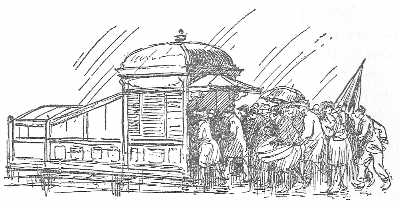
THOUGHTS IN THE SUBWAY
I
We hear people complain about the subway: its brutal competitive struggle, its roaring fury and madness. We think they have not sufficiently considered it.
Any experience shared daily and for a long time by a great many people comes to have a communal and social importance; it is desirable to fill it with meaning and see whether there may not be some beauty in it. The task of civilization is not to be always looking wistfully back at a Good Time long ago, or always panting for a doubtful millennium to come; but to see the significance and secret of that which is around us. And so we say, in full seriousness, that for one observer at any rate the subway is a great school of human study. We will not say that it is an easy school: it is no kindergarten; the curriculum is strenuous and wearying, and not always conducive to blithe cheer.
But what a tide of humanity, poured to and fro in great tides over which the units have little control. What a sharp and troubled awareness of our fellow-beings, drawn from study of those thousands of faces—the fresh living beauty of the girls, the faces of men empty of all but suffering and disillusion, a shabby errand boy asleep, goggling with weariness and adenoids—so they go crashing through the dark in a patient fellowship of hope and mysterious endurance. How can one pass through this quotidian immersion in humanity without being, in some small degree, enriched by that admiring pity which is the only emotion that can permanently endure under the eye of a questioning star?
Why, one wonders, should we cry out at the pangs and scuffles of the subway? Do we expect great things to come to pass without corresponding suffering? Some day a great poet will be born in the subway—spiritually speaking; one great enough to show us the terrific and savage beauty of this multitudinous miracle. As one watches each of those passengers, riding with some inscrutable purpose of his own (or an even more inscrutable lack of purpose) toward duty or liberation, he may be touched with anger and contempt toward individuals; but he must admit the majesty of the spectacle in the mass. One who loves his country for a certain candour and quick vigour of spirit will view the scene again and again in the hope of spying out some secrets of the national mind and destiny. Daily he bathes in America. He has that curious sense of mystical meaning in common things that a traveller feels coming home from abroad, when he finds even the most casual glimpses strangely pregnant with national identity. In the advertisements, despite all their absurdities; in voices humorous or sullen; even in the books that the girls are reading (for most girls read books in the subway) he will try to divine some authentic law of life.
He is but a poor and mean-spirited lover—whether of his city, his country, or anything else—who loves her only because he has known no other. We are shy of vociferating patriotism because it is callow and empty, sprung generally from mere ignorance. The true enthusiast, we would like to think, is he who can travel daily some dozen or score of miles in the subway, plunged in the warm wedlock of the rush hours; and can still gather some queer loyalty to that rough, drastic experience. Other than a sense of pity and affection toward those strangely sculptured faces, all busy upon the fatal tasks of men, it is hard to be precise as to just what he has learned. But as the crowd pours from the cars, and shrugs off the burden of the journey, you may see them looking upward to console themselves with perpendicular loveliness leaping into the clear sky. Ah, they are well trained. All are oppressed and shackled by things greater than themselves; yet within their own orbits of free movement they are masters of the event. They are patient and friendly, and endlessly brave.
II
The train roared through the subway, that warm typhoon whipping light summer dresses in a multitudinous flutter. All down the bright crowded aisle of patient humanity I could see their blowing colours.
My eyes were touched with Truth: I saw them as they are, beautiful and brave.
Is Time never sated with loveliness? How many million such he has devoured, and must he take these, too? They are so young, so slender, so untutored, such unconscious vessels of amazing life; so courageous in their simple finery, so unaware of the Enemy that waits for us all. With what strange cruelties will he trouble them, their very gayety a temptation to his hand? See them on Broadway at the lunch hour, pouring in their vivacious thousands onto the pavement. Is there no one who wonders about these merry little hostages? Can you look on them without marvelling at their gallant mien?
They are aware of their charms, but unconscious of their loveliness. Surely they are a new generation of their sex, cool, assured, even capable. They are happy, because they do not think too much; they are lovely, because they are so perishable, because (despite their naïve assumption of certainty) one knows them so delightfully only an innocent ornament of this business world of which they are so ignorant. They are the cheerful children of Down Town, and Down Town looks upon them with the affectionate compassion children merit. Their joys, their tragedies, are the emotions of children—all the more terrible for that reason.
And so you see them, day after day, blithely and gallantly faring onward in this Children's Crusade. Can you see that caravan of life without a pang? For many it is tragic to be young and beautiful and a woman. Luckily, they do not know it, and they never will. But in courage, and curiosity, and loveliness, how they put us all to shame. I see them, flashing by in a subway train, golden sphinxes, whose riddles (as Mr. Cabell said of Woman) are not worth solving. Yet they are all the more appealing for that fact. For surely to be a riddle which is not worth solving, and still is cherished as a riddle, is the greatest mystery of all. What strange journeys lie before them, and how triumphantly they walk the precipices as though they were mere meadow paths.
My eyes were touched with Truth, and I saw them as they are, beautiful and brave. And sometimes I think that even Time must be sated with loveliness; that he will not crumble them or mar their gallant childishness; that he will leave them, their bright dresses fluttering, as I have seem them in the subway many a summer day.
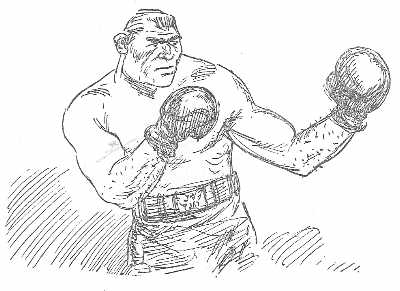
DEMPSEY vs. CARPENTIER
The race is not to the swift, nor the battle to the strong; but as Frank Adams once remarked, the betting is best that way. The event at Boyle's Thirty Acres in Jersey City was the conclusive triumph of Reality over Romance, of Prose over Poetry. To almost all the newspaper-reading world—except the canny fellows who study these matters with care and knowledge—Carpentier had taken on something of the lustre and divinity of myth. He was the white Greek god, he was Mercury and Apollo. The dope was against him; but there were many who felt, obscurely, that in some pregnant way a miracle would happen. His limbs were ivory, his eyes were fire; surely the gods would intervene! Perhaps they would have but for the definite pronouncement of the mystagogue G.B. Shaw. Even the gods could not resist the chance of catching Shaw off his base.
We are not a turncoat; we had hoped that Carpentier would win. It would have been pleasant if he had, quite like a fairy tale. But we must tell things as we see them. Dempsey, in a very difficult situation, bore himself as a champion, and (more than that) as a man of spirit puzzled and angered by the feeling that has been rumoured against him. Carpentier entered the ring smiling, perfectly at ease; but there was that same sunken, wistful, faintly weary look about his eyes that struck us when we first saw him, at Manhasset, three weeks ago. It was the look of a man who has had more put upon him than he can rightly bear. But with what a grace and aplomb he stood upon that scaffold! Dempsey, on the other hand, was sullen and sombre; when they spoke together he seemed embarrassed and kept his face averted. As the hands were bandaged and gloves put on, he sat with lowered head, his dark poll brooding over his fists, not unlike Rodin's Thinker. Carpentier, at the opposite corner, was apparently at ease; sat smilingly in his gray and black gown, watching the airplanes.
You have read the accounts of the fight to small purpose if you do not realize that Carpentier was utterly outclassed—not in skill or cunning, but in those qualities where the will has no part, in power and reach. From the first clinch, when Dempsey began that series of terrible body jabs that broke down the Frenchman's energy and speed, the goose was cooked. There was nothing poetic or glamorous about those jabs; they were not spectacular, not particularly swift; but they were terribly definite. Half a dozen of them altered the scene strangely. The smiling face became haggard and troubled.
Carpentier, too, must have been leaving something to the gods, for his tactics were wildly reckless. He was the aggressor at the start, leading fiercely for Dempsey's jaw, and landing, too, but not heavily enough to do damage. Again and again in that first round he fell into the fatal embrace in which Dempsey punished him busily, with those straight body strokes that slid in methodically, like pistons. Georges seemed to have no defence that could slacken those blows. After every clinch his strength plainly ebbed and withered. Away, he dodged nimbly, airily, easily more dramatic in arts of manœuvre. But Dempsey, tall, sullen, composed, followed him steadily. He seemed slow beside that flying white figure, but that wheeling amble was deadly sure. He was always on the inner arc, Carpentier on the outer; the long, swarthy arms were impenetrable in front of his vitals; again and again he followed up, seeking to corner his man; Carpentier would fling a shining arm at the dark jaw; a clinch would follow in which the two leaned together in that curious posture of apparent affection; and they hung upon each other's necks—Carpentier, from a distance, looking almost like a white girl languishing in the arms of some dark, solicitous lover. But Mr. Dempsey was the Fatal Bridegroom, for at each union he would rivet in several more of those steam punches.
There was something almost incredible in the scene—so we had been drilled in that Million-Dollar Myth, the unscathability of Carpentier. Was this Gorgeous Georges, this blood-smeared, wilting, hunted figure, flitting desperately from the grim, dark-jowled avenger? And then, in the latter part of the second round, Georges showed one flash of his true genius. Suddenly he sprang, leaping (so it seemed) clear from the canvas, and landed solidly (though not killingly) on Dempsey's jaw. There was a flicker of lightning blows, and for an instant Dempsey was retreating, defensive, even a little jarred. That was the high moment of the fight, and the crowd then showed its heart. Ninety thousand people had come there to see bloodshed; through several humid hours they had sat in a rising temperature, both inward and outward, with cumulating intensity like that of a kettle approaching the boil. Dempsey had had a bigger hand on entering the ring; but so far it had been too one-sided for much roaring. But now, for an instant, there was actual fighting. There were some who thought that if Georges could have followed up this advantage he still had a chance. We do not think so. Dempsey was not greatly shaken. He was too powerful and too hard to reach. They clinched and stalled for a moment, and the gong came shortly. But Carpentier had shown his tiger streak. Scotty Monteith, manager (so we were told) of Johnny Dundee, sat just in front of us in a pink skirt, and had been gathering up substantial wagers from the ill-starred French journalists near by. Scotty was not in any doubt as to the outcome, but even he was moved by Carpentier's gallant sally. "No one knew he was a fighter like that," he said.
The rest is but a few words. Carpentier's face had a wild, driven look. His hits seemed mere taps beside Dempsey's. In the fourth round he went down once, for eight or nine counts, and climbed up painfully. The second time he sprawled flat; Dempsey, still with that pensive lowered head, walked grimly in a semi-circle, waiting to see if that was the end. It was. Greek gods are no match for Tarzans in this game.
It was all over in a breathless flash. It was not one lucky blow that did it, but a sequence of business-like crushing strokes. We shall not soon forget that picture before the gong rang: Carpentier, still the White Knight of legend and glory, with his charming upward smile and easy unconcern; and Dempsey's dark cropped head, bent and glowering over his chest. There was in Dempsey's inscrutable, darkling mien a cold, simmering anger, as of a man unfairly hounded, he hardly knew why. And probably, we think, unjustly. You will say that we import a symbolism into a field where it scarcely thrives. But Carpentier's engaging merriment in the eye of oncoming downfall seemed to us almost a parable of those who have smiled too confidingly upon the dark faces of the gods.
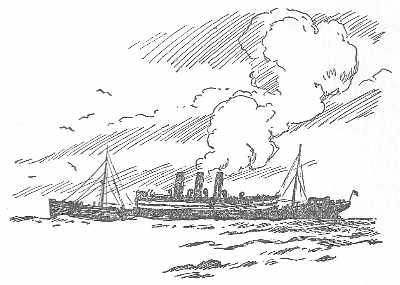
A LETTER TO A SEA CAPTAIN (To D.W.B.)
Dear Captain:
You are the most modest of men, but even at the risk of arousing your displeasure we have it on our mind to say something about you. We shall try not to be offensively personal, for indeed we are thinking not merely of yourself but also of the many others of your seafaring art who have always been such steadfast servants of the public, the greatness of whose service has not always been well enough understood. But perhaps it is only fair that the sea captain, so unquestionable an autocrat in his own world, should be called upon to submit to that purging and erratic discipline which is so notable a feature of our American life—publicity!
It is not enough understood, we repeat, how valuable and charming the sea captain is as an agent and private ambassador of international friendship. Perhaps we do not know you until we have seen you at sea (may the opportunity serve anon!). We have only known you with your majesty laid aside, your severity relaxed. But who else so completely and humorously understands both sides of the water, and in his regular movements from side to side acts so shrewd a commentator on Anglo-American affairs? Who takes more keen delight in our American ways, in the beauty of this New York of which we are so proud, who has done so much to endear each nation to the other? Yours, true to your blood (for you are Scot Scotorum), is the humorist's way: how many passengers you have warmed and tickled with your genial chaff, hiding constant kindness under a jocose word, perhaps teasing us Americans on our curious conduct of knives and forks, or (for a change) taking the cisatlantic side of the jape, esteeming no less highly a sound poke at British foibles.
All this is your personal gift: it is no necessary part of the master's equipment to be so gracefully conversable. Of the graver side of the sea captain's life, though you say little, we see it unconsciously written in your bearing. Some of us, who know just a little about it, can guess something of its burdens, its vigils, and its courages. There is something significant in the obscure instinct that some of your friends have to seize what opportunity they can of seeing you in your own quarters when you are in port. For though a ship in dock is a ship fettered and broken of much of her life and meaning, yet in the captain's cabin the landsman feels something of that fine, faithful, and rigorous way of life. It is a hard life, he knows; a life of stringent seriousness, of heavy responsibilities: and yet it is a life for which we are fool enough to speak the fool's word of envy. It is a life spared the million frittering interruptions and cheerful distractions that devil the journalist; it is a life cut down to the essentials of discipline, simplicity, and service; a life where you must, at necessity, be not merely navigator but magistrate, employer, and priest. Birth, death, and all the troubles that lie between, fall under your sway, and must find you unperturbed. But, when you go out of that snug cabin for your turn of duty, at any rate you have the dark happiness of knowing that you go to a struggle worthy your powers, the struggle with that old, immortal, unconquerable, and yet daily conquered enemy, the Sea.
And so you go and come, you go and come, and we learn to count on your regular appearance every four weeks as we would on any stated gesture of the zodiac. You come eager to pick up the threads of what has been happening in this our town, what books people are talking about, what is the latest jape, and what (your tastes being so catholic!) "Percy and Ferdie" are up to. And you, in turn, bring news of what they are saying in Sauchiehall Street or Fleet Street, and what books are making a stir on the other side. You take copies of American books that catch your fancy and pass them on to British reviewers, always at your quixotic task of trying to make each side appreciate the other's humours. For, though we promised not to give you away too personally, you are not only the sea captain but the man of letters, too, eminent in that field in your own right.
There must be some valid reason why so many good writers, and several who have some claim on the word "great," have been bred of the sea. Great writing comes from great stress of mind—which even a journalist may suffer—but it also requires strictness of seclusion and isolation. Surely, on the small and decently regimented island of a ship a man's mind must turn inward. Surrounded by all that barren beauty of sky and sea, so lovely, and yet so meaningless to the mind, the doomed business of humanity must seem all the more precious and deserving of tenderness. Perhaps that is what old George Herbert meant when he said, He that will learn to pray, let him go to sea.
THE END
This and the following are advertisements of Mr. Morley's books.