PLUM PUDDING (continued 3)
Reading edition
Not far from our house, in that desirable but not very residential region which we have erst described as the Forest of Arden, there is a pond. It is a very romantic spot, it is not unlike the pond by which a man smoking a Trichinopoly cigar was murdered in one of the Sherlock Holmes stories. (The Boscombe Valley Mystery!) It is a shallow little pond, but the water is very clear; last winter when it was frozen it always reminded us of the cheerful advertising of one of the ice companies, it was so delightfully transparent. This pond is a kind of Union League Club for the frogs at this time of year; all night long you can hear them reclining in their armchairs of congenial mud and uttering their opinions, which vary very little from generation to generation. Most of those frogs are Republicans, we feel sure, but we love them no less.
In this pond Gissing had his first swim one warm Sunday recently. The party set out soon after breakfast. Gissing was in the van, his topaz eyes wild with ambition. Followed a little red express-wagon, in which sat the Urchiness, wearing her best furry hat which has, in front, a small imitation mouse-head with glass eyes. The Urchin, wearing a small Scotch bonnet with ribbons, assisted in hauling the wagon. Gissing had not yet been tested in the matter of swimming: this was a sober moment. Would he take gladly to the ocean? (So the Urchin innocently calls our small sheet of water, having by a harmless ratiocination concluded that this term applies to any body of water not surrounded by domestic porcelain.)
Now Gissing is passionate in the matter of chasing sticks hurled abroad. On seeing a billet seized and held aloft with that sibilant sound which stirs his ingenuous spirit to prodigies of pursuit, his eyes were flame, his heart was apoplexy. The stick flew aloft and curved into the pond, and he rushed to the water's edge. But there, like the recreant knight in the Arthurian idyl, he paused and doubted. There was Excalibur, floating ten feet from shore. This was a new experience. Was it written that sticks should be pursued in this strange and alien element? He barked querulously, and returned, his intellect clouded with hesitation. What was this etiquette? He was embarrassed.
Another stick was flung into the trembling mere. This time there was no question. When the gods give the same sign twice, the only answer is obey. A tawny streak crossed the small meadow, and leaped unquestioningly into the pond. There was a plunging and a spattery scuffle, and borne up by a million years of heredity he pursued the floating enemy. It was seized, and a large gulp of water also, but backward he came bearing it merrily. Then, also unknowing that he was fulfilling old tradition, he came as near as possible to the little group of presbyters and dehydrated himself upon them. Thus was a new experience added to this young creature. The frogs grew more and more pensive as he spent the rest of the morning churning the pond hither and thither.
That will be all about Gissing for the present.
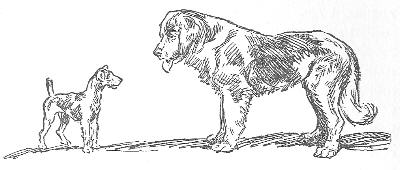
A DIALOGUE
It was our good fortune to overhear a dialogue between Gissing (our dog) and Mike, the dog who lives next door. Mike, or Crowgill Mike II, to give him his full entitles, is a very sagacious old person, in the fifteenth year of his disillusionment, and of excellent family. If our humble Gissing is to have a three-barrelled name, it can only be Haphazard Gissing I, for his ancestry is plainly miscellaneous and impromptu. He is, we like to say, a synthetic dog. He is young: six months; we fear that some of the errors now frequently urged against the rising generation are plainly discernible in him. And Mike, who is grizzled and grown somewhat dour, shows toward our Gissing much the attitude of Dr. Eliot toward the younger litter of humans.
In public, and when any one is watching, Mike, who is the Dog Emeritus of the Salamis Estates, pays no heed to Gissing at all: ignores him, and prowls austerely about his elderly business. But secretly spying from a window, we have seen him, unaware of notice, stroll (a little heavily and stiffly, for an old dog's legs grow gouty) over to Gissing's kennel. With his tail slightly vibrant, he conducts a dignified causerie. Unhappily, these talks are always concluded by some breach of manners on Gissing's part. At first he is respectful; but presently his enthusiasm grows too much for him; he begins to leap and frolic and utter uncouth praises of things in general. Then Mike turns soberly and moves away.
On such an occasion, the chat went like this:
Gissing: Do you believe in God?
Mike: I acknowledge Him. I don't believe in Him.
Gissing: Oh, I think He's splendid. Hurrah! Hullabaloo! When He puts on those old khaki trousers and smokes that curve-stem pipe I always know there's a good time coming.
Mike: You have made a mistake. That is not God. God is a tall, placid, slender man, who wears puttees when He works in the garden and smokes only cigarettes.
Gissing: Not at all. God is quite stout, and of uncertain temper, but I adore Him.
Mike: No one knows God at your age. There is but one God, and I have described Him. There is no doubt about it, because He sometimes stays away from the office on Saturdays. Only God can do that.
Gissing: What a glorious day this is. What ho! Halleluiah! I don't suppose you know what fun it is to run round in circles. How ignorant of life the older generation is.
Mike: Humph.
Gissing: Do you believe in Right and Wrong? I mean, are they absolute, or only relative?
Mike: When I was in my prime Right was Right, and Wrong was Wrong. A bone, buried on someone else's ground, was sacred. I would not have dreamed of digging it up——
Gissing (hastily): But I am genuinely puzzled. Suppose a motor truck goes down the road. My instinct tells me that I ought to chase it and bark loudly. But if God is around He calls me back and rebukes me, sometimes painfully. Yet I am convinced that there is nothing essentially wrong in my action.
Mike: The question of morals is not involved. If you were not so young and foolish you would know that your God (if you so call Him, though He is not a patch on mine) knows what is good for you better than you do yourself. He forbids your chasing cars because you might get hurt.
Gissing: Then instinct is not to be obeyed?
Mike: Not when God is around.
Gissing: Yet He encourages me to chase sticks, which my instinct strongly impels me to do. Prosit! Waes hael! Excuse my enthusiasm, but you really know very little of the world or you would not take things so calmly.
Mike: My dear boy, rheumatism is a great sedative. You will learn by and by. What are you making such a racket about?
Gissing: I have just learned that there is no such thing as free will. I don't suppose you ever meditated on these things, you are such an old stick-in-the-mud. But in my generation we scrutinize everything.
Mike: There is plenty of free will when you have learned to will the right things. But there's no use willing yourself to destroy a motor truck, because it can't be done. I have been young, and now am old, but never have I seen an honest dog homeless, nor his pups begging their bones. You will go to the devil if you don't learn to restrain yourself.
Gissing: Last night there was a white cat in the sky. Yoicks, yoicks! I ran thirty times round the house, yelling.
Mike: Only the moon, nothing to bark about.
Gissing: You are very old, and I do not think you have ever really felt the excitement of life. Excuse me, but have you seen me jump up and pull the baby's clothes from the line? It is glorious fun.
Mike: My good lad, I think life will deal hardly with you.
(Exit, shaking his head.)
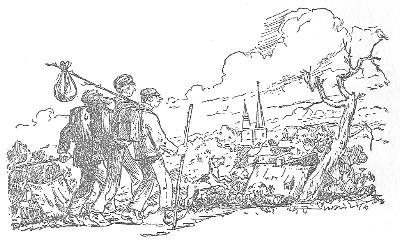
AT THE GASTHOF ZUM OCHSEN
Looking over some several-days-old papers we observe that the truant Mr. Bergdoll was discovered at Eberbach in Baden. Well, well, we meditate, Herr Bergdoll is not wholly devoid of sense, if he is rambling about that delicious valley of the Neckar. And if we were a foreign correspondent, anxious to send home to the papers a complete story of Herr Bergdoll's doings in those parts, we would know exactly what to do. We would go straight to the excellent Herr Leutz, proprietor of the Gasthof zum Ochsen in Eberbach, and listen to his prattle. Herr Leutz, whom we have never forgotten (since we once spent a night in his inn, companioned by another vagabond who is now Prof. W.L.G. Williams of Cornell University, so our clients in Ithaca, if any, can check us up on this fact), is the most innocently talkative person we have ever met.
A great many Americans have been to Alt Heidelberg, but not so many have continued their exploration up the Neckarthal. You leave Heidelberg by the Philosophers' Way (Philosophenweg), which looks over the river and the hills—in this case, lit by a warm July sunset—and follow (on your bicycle, of course) the road which skirts the stream. There are many springs of cold water tinkling down the steep banks on your left, and in the mediæval-looking village of Hirschhorn you can also sample the excellent beer. The evening smell of sun-warmed grass and a view of one of those odd boats grinding its way up-current by hauling a chain from the river-bed and dropping it again over-stern will do nothing to mar your exhilaration. It will be getting dark when you reach Eberbach, and if you find your way to the Ox, Herr Leutz will be waiting (we hope) in his white coat and gold pince-nez, just as he was in 1912. And then, as you sit down to a cold supper, he will, deliberately and in the kindest way, proceed to talk your head off. He will sit down with you at the table, and every time you think a pause is coming he will seize a mug, rise to his feet (at which you also will sadly lay down your tools and rise, too, bowing stiffly from your hips), and cry: "Also! ich trinke auf Ihr Wohl!" Presently, becoming more assured, the admirable creature abbreviates his formula to the more companionable "zum Wohl!" And as he talks, and his excitement becomes more and more intense, he edges closer and closer to you, and leans forward, talking hard, until his dark beaming phiz quite interposes between your food and its destination. So that to avoid combing his baldish pate with your fork you must pass the items of your meal in quite a sideways trajectory. And if, as happened to our companion (the present Cornell don), you have no special taste for a plump landlord breathing passionately and genially upon your very cheek while you strive to satisfy a legitimate appetite, you may burst into a sudden unpremeditate but uncontrollable screech of mingled laughter and dismay, meanwhile almost falling backward in your chair in an effort to evade the steady pant and roar of those innumerable gutturals.
After supper, a little weary and eager to meditate calmly in the delicious clear evening, and to look about and see what sort of place this Eberbach is, you will slip outside the inn for a stroll. But glorious Herr Leutz is not evadable. He comes with. He takes position between you two, holding each firmly by an elbow so that no escape is possible. In a terrific stream of friendliness he explains everything, particularly expatiating upon the gratification he feels at being honoured by visitors all the way from America. The hills around, which stand up darkly against a speckle of stars, are all discussed for you. One of them is called Katzenbuckel, and doubting that your German may not be able to cope with this quite simple compound, he proceeds to illustrate. He squats in the middle of the street, arching his back like a cat in a strong emotion, uttering lively miaowings and hissings. Then he springs, like the feline in fury, and leaps to his feet roaring with mirth. "You see?" he cries. "A cat, who all ready to spring crouches, that is of our beautiful little mountain the name-likeness."
Yes, if Bergdoll has been staying in Eberbach, the good Herr Leutz will know all about it.
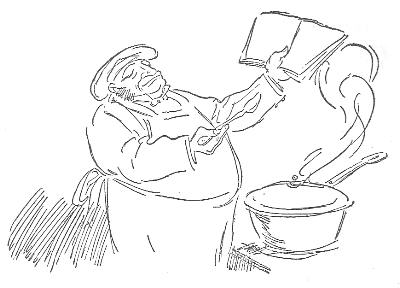
MR CONRAD'S NEW PREFACE
Joseph Conrad, so we learn from the March Bookman, has written a preface to a cook book about to be published by Mrs. Conrad.
We like to think about that preface. We wonder if it will be anything like this:
I remember very well the first time I became aware of the deep and consoling significance of food. It was one evening at Marlow's, we were sitting by the hearth in that small gilded circle of firelight that seems so like the pitiful consciousness of man, temporarily and gallantly relieved against the all-covering darkness. Marlow was in his usual posture, cross-legged on the rug. He was talking.... I couldn't help wondering whether he ever gets pins and needles in his legs, sitting so long in one position. Very often, you know, what those Eastern visionaries mistake for the authentic visit of Ghautama Buddha is merely pins and needles. However. Humph. Poor Mrs. Marlow (have I mentioned her before?) was sitting somewhere in the rear of the circle. I had a curious but quite distinct impression that she wanted to say something, that she had, as people say, something on her mind. But Marlow has a way of casting pregnancy over even his pauses, so that to speak would seem a quite unpardonable interruption.
"The power of mind over matter," said Marlow, suddenly, "a very odd speculation. When I was on the Soliloquy, I remember one evening, in the fiery serenity of a Sourabaja sunset, there was an old serang...."
In the ample drawing room, lit only by those flickering gleams of firelight, I seemed to see the others stir faintly—not so much a physical stir as a half-divined spiritual uneasiness. The Director was sitting too close to the glow, for the fire had deepened and intensified as the great logs slowly burned into rosy embers, and I could smell a whiff of scorching trouser legs; but the courageous man dared not move, for fear of breaking the spell. Marlow's tale was a powerful one: I could hear Mrs. Marlow suspire faintly, ever so faintly—the troubled, small, soft sigh of a brave woman indefinably stricken. The gallantry of women! In a remote part of the house a ship's clock tingled its quick double strokes.... Eight o'clock, I thought, unconsciously translating nautical horology into the dull measurements of landsmen. None of us moved. The discipline of the sea!
Mrs. Marlow was very pale. It began to come over me that there was an alien presence, something spectral and immanent, something empty and yet compelling, in the mysterious shadow and vagueness of the chamber. More than once, as Marlow had coasted us along those shining seascapes of Malaya—we had set sail from Malacca at tea time, and had now got as far as Batu Beru—I had had an uneasy impression that a disturbed white figure had glanced pallidly through the curtains, had made a dim gesture, and had vanished again.... I had tried to concentrate on Marlow's narrative. The dear fellow looked more like a monkey than ever, squatting there, as he took the Soliloquy across the China Sea and up the coast of Surinam. Surinam must have a very long coast-line, I was thinking. But perhaps it was that typhoon that delayed us.... Really, he ought not to make his descriptions so graphic, for Mrs. Marlow, I feared, was a bad sailor, and she was beginning to look quite ill.... I caught her looking over her shoulder in a frightened shudder, as though seeking the companionway.
It was quite true. By the time we had reached Tonking, I felt sure there was someone else in the room. In my agitation I stole a cautious glance from the taff-rail of my eye and saw a white figure standing hesitantly by the door, in an appalled and embarrassed silence. The Director saw it, too, for he was leaning as far away from the fire as he could without jibing his chair, and through the delicate haze of roasting tweed that surrounded him I could see something wistfully appealing in his glance. The Lawyer, too, had a mysterious shimmer in his loyal eyes, but his old training in the P. and O. service had been too strong for him. He would never speak, I felt sure, while his commanding officer had the floor.
I began to realize that, in a sense, the responsibility was mine. The life of the sea—a curious contradiction. Trained from boyhood to assume responsibility, but responsibility graded and duly ascending through the ranks of command. Marlow, an old shipmaster, and more than that, our host—a trying problem. If it had not been for the presence of Mrs. Marlow, I could not have dared. But the woman complicates the situation with all sorts of delicate reactions of tact, conduct, and necessity. It is always so. Well. Humph!
But the apparition at the other end of the room was plainly in trouble. A distressing sight, and I divined that the others were relying on me. Mrs. Marlow, poor soul, her face had a piteous and luminous appeal. It was, once more, the old and shocking question of conflicting loyalties. There was nothing else to do. I shoved out one foot, and the stand of fire-irons fell over with an appalling clatter. Marlow broke off—somewhere near Manila, I think it was.
"Charlie, my dear," said Mrs. Marlow, "Don't you think we could finish the story after dinner? The roast will be quite spoiled. The maid has been waiting for nearly two hours...."
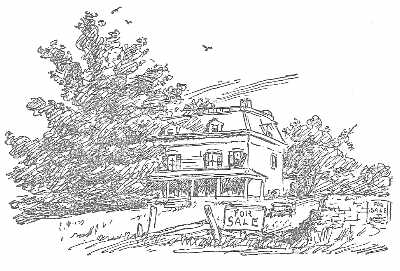
THE LITTLE HOUSE
After many days of damp, dull, and dolorous weather, we found ourself unexpectedly moving in a fresh, cool, pure air; an air which, although there was no sunlight, had the spirit and feeling of sunlight in it; an air which was purged and lively. And, so strangely do things happen, after days of various complexion and stratagem, we found ourself looking across that green field, still unchanged, at the little house.
Wasn't there—we faintly recall a saccharine tune sung by someone who strode stiffly to and fro in a glare of amber footlights—wasn't there a song about: "And I lo-ong to settle down, in that old Long Island town!" Wasn't there such a ditty? It came softly back, unbidden, to the sentimental attic of our memory as we passed along that fine avenue of trees and revisited, for the first time since we moved away, the wide space of those Long Island fields and the row of frame cottages. There was the little house, rather more spick and span than when we had known it, freshly painted in its brown and white, the privet hedge very handsomely shaven, and its present occupant busily engaged in trimming some tufts of grass along the pavement. We did not linger, and that cheerful-looking man little knew how many ghosts he was living among. All of us, we suppose, dwell amid ghosts we are not aware of, and this gentleman would be startled if he knew the tenacity and assurance of certain shades who moved across his small lawn that afternoon.
It was strange, we aver, to see how little the place had changed, for it seemed that we had passed round the curves and contours of a good many centuries in those four or five years. In the open meadow the cow was still grazing; perhaps the same cow that was once pestered by a volatile Irish terrier who used to swing merrily at the end of that cow's tail; a merry and irresponsible little creature, she was, and her phantom still scampers the road where the sharp scream of the Freeport trolley brings back her last fatal venture to our mind. It was strange to look at those windows, with their neat white sills, and to remember how we felt when for the first time we slept in a house of our own, with all those Long Island stars crowding up to the open window, and, waking in drowsy unbelief, put out a hand to touch the strong wall and see if it was still there. Perhaps one may be pardoned for being a little sentimental in thinking back about one's first house.
The air, on that surprising afternoon, carried us again into the very sensation and reality of those days, for there is an openness and breezy stir on those plains that is characteristic. In the tree-lined streets of the village, where old white clapboarded houses with green or pale blue shutters stand in a warm breath of box hedges, the feeling is quite different. Out on the Long Island prairie—which Walt Whitman, by the way, was one of the first to love and praise—you stand uncovered to all the skirmish of heaven, and the feathery grasses are rarely still. There was the chimney of the fireplace we had built for us, and we remembered how the wood-smoke used to pour gallantly from it like a blue pennon of defiance. The present owner, we fear, does not know how much impalpable and unforgotten gold leaped up the wide red throat of that chimney, or he would not dream of selling. Yes, the neighbours tell us that he wants to sell. In our day, the house was said to be worth $3,000. Nowadays, the price is $7,000. Even at that it is cheap, if you set any value on amiable and faithful ghosts.
Oh, little house on the plains, when our typewriter forgets thee, may this shift key lose its function!
TADPOLES
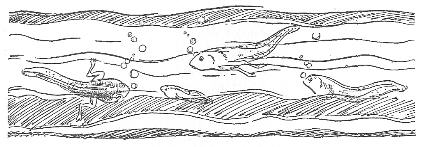
Near our house, out in the sylvan Salamis Estates, there is a pond. We fear we cannot describe this pond to you in a way to carry conviction. You will think we exaggerate if we tell you, with honest warmth, how fair the prospect is. Therefore, in sketching the scene, we will be austere, churlish, a miser of adjectives. We will tell you naught of sun-sparkle by day where the green and gold of April linger in that small hollow landskip, where the light shines red through the faint bronze veins of young leaves—much as it shines red through the finger joinings of a child's hand held toward the sun. We will tell you naught of frog-song by night, of those reduplicated whistlings and peepings. We will tell you naught of.... No, we will be austere.
On one side, this pond reflects the white cloudy bravery of fruit trees in flower, veterans of an orchard surviving an old farmhouse that stood on the hilltop long ago. It burned, we believe: only a rectangle of low stone walls remains. Opposite, the hollow is overlooked by a bumpy hillock fringed with those excellent dark evergreen trees—shall we call them hemlocks?—whose flat fronds silhouette against the sky and contribute a feeling of mystery and wilderness. On this little hill are several japonica trees, in violent ruddy blossom; and clumps of tiger lily blades springing up; and bloodroots. The region prickles thickly with blackberry brambles, and mats of honeysuckle. Across the pond, looking from the waterside meadow where the first violets are, your gaze skips (like a flat stone deftly flung) from the level amber (dimpled with silver) of the water, through a convenient dip of country where the fields are folded down below the level of the pool. So the eye, skittering across the water, leaps promptly and cleanly to blue ranges by the Sound, a couple of miles away. All this, mere introduction to the real theme, which is Tadpoles.
We intended to write a poem about those tadpoles, but Endymion tells us that Louis Untermeyer has already smitten a lute on that topic. We are queasy of trailing such an able poet. Therefore we celebrate these tadpoles in prose. They deserve a prose as lucid, as limpid, as cool and embracing, as the water of their home.
Coming back to tadpoles, the friends of our youth, shows us that we have completed a biological cycle of much import. Back to tadpoles in one generation, as the adage might have said. Twenty-five years ago we ourself were making our first acquaintance with these friendly creatures, in the immortal (for us) waters of Cobb's Creek, Pennsylvania. (Who was Cobb, we wonder?) And now our urchins, with furious glee, applaud their sire who wades the still frosty quags of our pond, on Sunday mornings, to renew their supply of tads. It is considered fair and decent that each batch of tadpoles should live in their prison (a milk bottle) only one week. The following Sunday they go back to the pond, and a new generation take their places. There is some subtle kinship, we think, between children and tadpoles. No childhood is complete until it has watched their sloomy and impassive faces munching against the glass, and seen the gradual egress (as the encyclopædia pedantically puts it) of their tender limbs, the growing froggishness of their demeanour.
Some time when you are exploring in the Britannica, by the way, after you have read about Tactics and William Howard Taft, turn to the article on Tadpoles and see if you can recognize them as described by the learned G.A.B. An amusing game, we submit, would be to take a number of encyclopædia descriptions of familiar things, and see how many of our friends could identify them under their scientific nomenclature.
But it is very pleasant to dally about the pond on a mild April morning. While the Urchiness mutters among the violets, picking blue fistfuls of stalkless heads, the Urchin, on a plank at the waterside, studies these weedy shallows which are lively with all manner of mysterious excitement, and probes a waterlogged stump in hope to recapture Brer Tarrypin, who once was ours for a short while. Gissing (the juvenile and too enthusiastic dog) has to be kept away from the pond by repeated sticks thrown as far as possible in another direction; otherwise he insists on joining the tadpole search, and, poking his snout under water, attempts to bark at the same time, with much coughing and smother.
The tadpoles, once caught, are taken home in a small yellow pail. They seem quite cheerful. They are kept, of course, in their native fluid, which is liberally thickened with the oozy emulsion of moss, mud, and busy animalculæ that were dredged up with them in clutches along the bottom of the pond. They lie, thoughtful, at the bottom of their milk bottle, occasionally flourishing furiously round their prison. But, since reading that article in the Britannica, we are more tender toward them. For the learned G.A.B. says: "A glandular streak extending from the nostril toward the eye is the lachrymal canal." Is it possible that tadpoles weep? We will look at them again when we go home to-night. We are, in the main, a kind-hearted host. If they show any signs of effusion....
MAGIC IN SALAMIS
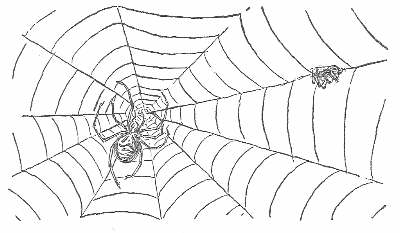
Why is it (we were wondering, as we walked to the station) that these nights of pearly wet Long Island fog make the spiders so active? The sun was trying to break through the mist, and all the way down the road trees, bushes, and grass were spangled with cob-webs, shining with tiny pricks and gems of moisture. These damp, mildewy nights that irritate us and bring that queer soft grayish fur on the backs of our books seem to mean high hilarity and big business to the spider. Along the hedge near the station there were wonderful great webs, as big as the shield of Achilles. What a surprising passion of engineering the spider must go through in the dark hours, to get his struts and cantilevers and his circling gossamer girders properly disposed on the foliage.* Darkness is no difficulty to him, evidently. If he lays his web on the grass, he builds it with a little tunnel leading down to earth, where he hides waiting his breakfast. But on such a morning, apparently, with thousands of webs ready, there can hardly have been enough flies to go round; for we saw all the appetent spiders had emerged from their tubes and were waiting impatiently on the web itself—as though the host should sit on the tablecloth waiting for his guest. Put a finger at the rim of the web and see how quickly he vanishes down his shaft. Most surprising of all it is to see the long threads that are flung horizontally through the air, from a low branch of a tree to the near-by hedge. They hang, elastic and perfect, sagged a little by a run of fog-drops almost invisible except where the wetness catches the light. Some were stretched at least six feet across space, with no supporting strands to hold them from above—and no branches from which the filament could be dropped. How is it done? Does our intrepid weaver hurl himself madly six feet into the dark, trusting to catch the leaf at the other end? Can he jump so far?
All this sort of thing is, quite plainly, magic. It is rather important to know, when you are dealing with magic, just where ordinary life ends and the mystery begins, so that you can adjust yourself to incantations and spells. As you make your green escape from town (which has magic of its own, but quite different) you must clearly mark the place where you pierce the veil. We showed it to Endymion lately. We will tell you about it.
There is a certain point, as you go out to Salamis on the railroad, when you begin to perceive a breath of enchantment in the landscape. For our own part, we become aware of a subtle spice of gramarye as soon as we see the station lamps at East Williston, which have tops like little green hats. Lamps of this sort have always had a fascination for us, and whenever we see them at a railway station we have a feeling that that would be a nice place to get off and explore.
And, of course, after you pass East Williston there is that little pond in which, if one went fishing, he could very likely pull up a fine fleecy cloud on his hook. Then the hills begin, or what we on Long Island consider hills. There are some fields on the left of the train that roll like great green waves of the sea; they surge up against the sky and seem about to spill over in a surf of daisies.
A quiet road runs up a hill, and as soon as you pass along its green channel, between rising thickets where rabbits come out to gape, you feel as though walking into a poem by Walter de la Mare. This road, if pursued, passes by a pleasing spot where four ways cross in an attenuated X. Off to one side is a field that is very theatrical in effect: it always reminds us of a stage set for "As You Like It," the Forest of Arden. There are some gigantic oak trees and even some very papier-maché-looking stumps, all ready for the duke, "and other Lords, like Foresters," to do their moralizing upon; and in place of the poor sequestered stag there is a very fine plushy cow, grazing, hard by a very agreeable morass. At the back (L.U.E.) is discovered a pleasing ruin, the carcass of an ancient farmstead, whose stony ribs are thickset with brambles; and the pleasant melancholy of an abandoned orchard rounds off the scene in the wings, giving a fine place for Rosalind and Celia and the leg-weary Touchstone to abide their cue.
Choosing the left-hand arm of the X, and moving past wild rose bushes toward the even richer rose-garden of the sunset, the fastidious truant is ushered (as was our friend Endymion the other evening) upon a gentle meadow where a solitary house of white stucco begs for a poet as occupant. This house, having been selected by Titania and ourself as a proper abode for Endymion and his family, we waited until sunset, frogsong, and all the other amenities of life in Salamis were suitable for the introduction of our guest to the scene. This dwelling, having long lain untenanted, has a back door that stands ajar and we piloted the awe-struck lyrist inside. Now nothing rages so merrily in the blood as the instinct of picking out houses for other people, houses that you yourself do not have to live in; and those Realtors whom we have dismayed by our lack of enthusiasm would have been startled to hear the orotund accents in which we vouched for that property, sewage, messuage, and all. Here, we cried, is the front door (facing the sunset) where the postman will call with checks from your publishers; and here are the porcelain laundry tubs that will make glad the heart of the washerwoman (when you can get one).
Endymion's guileless heart was strongly uplifted. Not a question did he ask as to heating arrangements, save to show a mild spark in his eye when he saw the two fireplaces. Plumbing was to him, we saw, a matter to be taken on faith. His paternal heart was slightly perturbed by a railing that ran round the top of the stairs. This railing, he feared, was so built that small and impetuous children would assuredly fall headlong through it, and we discussed means of thwarting such catastrophe. But upstairs we found the room that caused our guest to glimmer with innocent cheer. It had tall casement windows looking out upon a quiet glimpse of trees. It had a raised recess, very apt for a bust of Pallas. It had space for bookcases. And then, on the windowsill, we found the dead and desiccated corpse of a swallow. It must have flown in through a broken pane on the ground floor long ago and swooped vainly about the empty house. It lay, pathetically, close against the shut pane. Like a forgotten and un-uttered beauty in the mind of a poet, it lay there, stiffened and silent.
CONSIDER THE COMMUTER
When they tell us the world is getting worse and worse, and the follies and peevishness of men will soon bring us all to some damnable perdition, we are consoled by contemplating the steadfast virtue of commuters. The planet grows harder and harder to live on, it is true; every new invention makes things more complicated and perplexing. These new automatic telephones, which are said to make the business of getting a number so easy, will mean (we suppose) that we will be called up fifty times a day—instead of (as now) a mere twenty or thirty, while we are swooning and swinking over a sonnet. But more and more people are taking to commuting and we look to that to save things.
Because commuting is a tough and gruelling discipline. It educes all the latent strength and virtue in a man (although it is hard on those at home, for when he wins back at supper time there is left in him very little of what the ladies so quaintly call "soul"). If you study the demeanour of fellow-passengers on the 8:04 and the 5:27 you will see a quiet and well-drilled acceptiveness, a pious non-resistance, which is not unworthy of the antique Chinese sages.
Is there any ritual (we cry, warming to our theme) so apt to imbue the spirit with patience, stolidity, endurance, all the ripe and seasoned qualities of manhood? It is well known that the fiercest and most terrible fighters in the late war were those who had been commuters. It was a Division composed chiefly of commuters that stormed the Hindenburg Stellung and purged the Argonne thickets with flame and steel. Their commanding officers were wont to remark these men's carelessness of life. It seemed as though they hardly heeded whether they got home again or not.
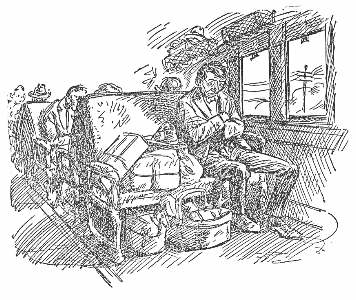
See them as they stand mobbed at the train gate, waiting for admission to the homeward cars. A certain disingenuous casualness appears on those hardened brows; but beneath burn stubborn fires. These are engaged in battle, and they know it—a battle that never ends. And while a warfare that goes on without truce necessarily develops its own jokes, informalities, callousnesses, disregard of wounds and gruesome sights, yet deep in their souls the units never forget that they are drilled and regimented for struggle. We stood the other evening with a Freeport man in the baggage compartment at the front of a train leaving Brooklyn. We two had gained the bull's-eye window at the nose of the train and sombrely watched the sparkling panorama of lights along the track. Something had gone wrong with the schedule that evening, and the passengers of the 5:27 had been shunted to the 5:30. As fellow mariners will, we discussed famous breakdowns of old and the uncertainties of the commuter's life. "Yes," said our companion, "once you leave home you never know when you'll get back." And he smiled the passive, placable smile of the experienced commuter.
It is this reasonable and moderate temper that makes the commuter the seed wherewith a new generation shall be disseminated. He faces troubles manifold without embittered grumbling. His is a new kind of Puritanism, which endures hardship without dourness. When, on Christmas Eve, the train out of Jamaica was so packed that the aisle was one long mass of unwillingly embraced passengers, and even the car platforms were crowded with shivering wights, and the conductor buffeted his way as best he could over our toes and our parcels of tinsel balls, what was the general cry? Was it a yell against the railroad for not adding an extra brace of cars? No, it was good-natured banter of the perspiring little officer as he struggled to disentangle himself from forests of wedged legs. "You've got a fine, big family in here," they told him: "you ought to be proud of us." And there was a sorrowing Italian who had with him a string of seven children who had tunnelled and burrowed their way down the packed aisle of the smoking car and had got irretrievably scattered. The father was distracted. Here and there, down the length of the car, someone would discover an urchin and hold him up for inspection. "Is this one of them?" he would cry, and Italy would give assent. "Right!" And the children were agglomerated and piled in a heap in the middle of the car until such time as a thinning of the crowd permitted the anxious and blushing sire to reassemble them and reprove their truancy with Adriatic lightnings from his dark glowing eyes.
How pleasing is our commuter's simplicity! A cage of white mice, or a crated goat (such are to be seen now and then on the Jamaica platform) will engage his eye and give him keen amusement. Then there is that game always known (in the smoking car) as "pea-knuckle." The sight of four men playing will afford contemplative and apparently intense satisfaction to all near. They will lean diligently over seat-backs to watch every play of the cards. They will stand in the aisle to follow the game, with apparent comprehension. Then there are distinguished figures that move through the observant commuter's peep-show. There is the tall young man with the beaky nose, which (as Herrick said)
Is the grace And proscenium of his face.
He is one of several light-hearted and carefree gentry who always sit together and are full of superb cheer. Those who travel sometimes with twinges of perplexity or skepticism are healed when they see the magnificent assurance of this creature. Every day we hear him making dates for his cronies to meet him at lunch time, and in the evening we see him towering above the throng at the gate. We like his confident air toward life, though he is still a little too jocular to be a typical commuter.
But the commuter, though simple and anxious to be pleased, is shrewdly alert. Every now and then they shuffle the trains at Jamaica just to keep him guessing and sharpen his faculty of judging whether this train goes to Brooklyn or Penn Station. His decisions have to be made rapidly. We are speaking now of Long Island commuters, whom we know best; but commuters are the same wherever you find them. The Jersey commuter has had his own celebrant in Joyce Kilmer, and we hope that he knows Joyce's pleasant essay on the subject which was published in that little book, "The Circus and Other Essays." But we gain-say the right of Staten Islanders to be classed as commuters. These are a proud and active sort who are really seafarers, not commuters. Fogs and ice floes make them blench a little; but the less romantic troubles of broken brake-shoes leave them unscotched.
Of Long Island commuters there are two classes: those who travel to Penn Station, those who travel to Brooklyn. Let it not be denied, there is a certain air of aristocracy about the Penn Station clique that we cannot waive. Their tastes are more delicate. The train-boy from Penn Station cries aloud "Choice, delicious apples," which seems to us almost an affectation compared to the hoarse yell of our Brooklyn news-agents imploring "Have a comic cartoon book, 'Mutt and Jeff,' 'Bringing Up Father,' choclut-covered cherries!" The club cars all go to Penn Station: there would be a general apoplexy in the lowly terminal at Atlantic Avenue if one of those vehicles were seen there. People are often seen (on the Penn Station branch) who look exactly like the advertisements in Vanity Fair. Yet we, for our humility, have treasures of our own, such as the brightly lighted little shops along Atlantic Avenue and a station with the poetic name of Autumn Avenue. The Brooklyn commuter points with pride to his monthly ticket, which is distinguished from that of the Penn Station nobility by a red badge of courage—a bright red stripe. On the Penn Station branch they often punch the tickets with little diamond-shaped holes; but on our line the punch is in the form of a heart.
When the humble commuter who is accustomed to travelling via Brooklyn is diverted from his accustomed orbit, and goes by way of the Pennsylvania Station, what surprising excitements are his. The enormousness of the crowd at Penn Station around 5 p.m. causes him to realize that what he had thought, in his innocent Brooklyn fashion, was a considerable mob, was nothing more than a trifling scuffle. But he notes with pleasure the Penn Station habit of letting people through the gate before the train comes in, so that one may stand in comparative comfort and coolness downstairs on the train platform. Here a vision of luxury greets his eyes that could not possibly be imagined at the Brooklyn terminal—the Lehigh Valley dining car that stands on a neighbouring track, the pink candles lit on the tables, the shining water carafes, the white-coated stewards at attention. At the car's kitchen window lolls a young coloured boy in a chef's hat, surveying the files of proletarian commuters with a glorious calmness of scorn and superiority. His mood of sanguine assurance and self-esteem is so complete, so unruffled, and so composed that we cannot help loving him. Lucky youth, devoid of cares, responsibilities, and chagrins! Does he not belong to the conquering class that has us all under its thumb? What does it matter that he (probably) knows less about cooking than you or I? He gazes with glorious cheer upon the wretched middle class, and as our train rolls away we see him still gazing across the darkling cellars of the station with that untroubled gleam of condescension, his eyes seeming (as we look back at them) as large and white and unspeculative as billiard balls.
In the eye of one commuter, the 12:50 Saturday Only is the most exciting train of all. What a gay, heavily-bundled, and loquacious crowd it is that gathers by the gate at the Atlantic Avenue terminal. There is a holiday spirit among the throng, which pants a little after the battle down and up those steps leading from the subway. (What a fine sight, incidentally, is the stag-like stout man who always leaps from the train first and speeds scuddingly along the platform, to reach the stairs before any one else.) Here is the man who always carries a blue cardboard box full of chicks. Their plaintive chirpings sound shrill and disconsolate. There is such a piercing sorrow and perplexity in their persistent query that one knows they have the true souls of minor poets. Here are two cheerful stenographers off to Rockaway for the week-end. They are rather sarcastic about another young woman of their party who always insists on sleeping under sixteen blankets when at the shore.
But the high point of the trip comes when one changes at Jamaica, there boarding the 1:15 for Salamis. This is the train that on Saturdays takes back the two famous club cars, known to all travellers on the Oyster Bay route. Behind partly drawn blinds the luncheon tables are spread; one gets narrow glimpses of the great ones of the Island at their tiffin. This is a militant moment for the white-jacketed steward of the club car. On Saturdays there are always some strangers, unaccustomed to the ways of this train, who regard the two wagons of luxury as a personal affront. When they find all the seats in the other cars filled they sternly desire to storm the door of the club car, where the proud steward stands on guard. "What's the matter with this car?" they say. "Nothing's the matter with it," he replies. Other more humble commuters stand in the vestibule, enjoying these little arguments. It is always quite delightful to see the indignation of these gallant creatures, their faces seamed with irritation to think that there should be a holy of holies into which they may not tread.
A proud man, and a high-spirited, is the conductor of the 4:27 on weekdays. This train, after leaving Jamaica, does not stop until Salamis is reached. It attains such magnificent speed that it always gets to Salamis a couple of minutes ahead of time. Then stands the conductor on the platform, watch in hand, receiving the plaudits of those who get off. The Salamites have to stand patiently beside the train—it is a level crossing—until it moves on. This is the daily glory of this conductor, as he stands, watch in one hand, the other hand on the signal cord, waiting for Time to catch up with him. "Some train," we cry up at him; he tries not to look pleased, but he is a happy man. Then he pulls the cord and glides away.
Among other articulations in the anatomy of commuting, we mention the fact that no good trainman ever speaks of a train going or stopping anywhere. He says, "This train makes Sea Cliff and Glen Cove; it don't make Salamis." To be more purist still, one should refer to the train as "he" (as a kind of extension of the engineer's personality, we suppose). If you want to speak with the tongue of a veteran, you will say, "He makes Sea Cliff and Glen Cove."
The commuter has a chance to observe all manner of types among his brethren. On our line we all know by sight the two fanatical checker players, bent happily over their homemade board all the way to town. At Jamaica they are so absorbed in play that the conductor—this is the conductor who is so nervous about missing a fare and asks everyone three times if his ticket has been punched—has to rout them out to change to the Brooklyn train. "How's the game this morning?" says someone. "Oh, I was just trimming him, but they made us change." However thick the throng, these two always manage to find seats together. They are still hard at it when Atlantic Avenue is reached, furiously playing the last moves as the rest file out. Then there is the humorous news-agent who takes charge of the smoking car between Jamaica and Oyster Bay. There is some mysterious little game that he conducts with his clients. Very solemnly he passes down the aisle distributing rolled-up strips of paper among the card players. By and by it transpires that some one has won a box of candy. Just how this is done we know not. Speaking of card players, observe the gaze of anguish on the outpost. He dashes ahead, grabs two facing seats and sits in one with a face contorted with anxiety for fear that the others will be too late to join him. As soon as a card game is started there are always a half dozen other men who watch it, following every play with painful scrutiny. It seems that watching other people play cards is the most absorbing amusement known to the commuter.
Then there is the man who carries a heavy bag packed with books. A queer creature, this. Day by day he lugs that bag with him yet spends all his time reading the papers and rarely using the books he carries. His pipe always goes out just as he reaches his station; frantically he tries to fill and light it before the train stops. Sometimes he digs deeply into the bag and brings out a large slab of chocolate, which he eats with an air of being slightly ashamed of himself. The oddities of this person do not amuse us any the less because he happens to be ourself.
So fares the commuter: a figure as international as the teddy bear. He has his own consolations—of a morning when he climbs briskly upward from his dark tunnel and sees the sunlight upon the spread wings of the Telephone and Telegraph Building's statue, and moves again into the stirring pearl and blue of New York's lucid air. And at night, though drooping a little in the heat and dimness of those Oyster Bay smoking cars, he is dumped down and set free. As he climbs the long hill and tunes his thoughts in order, the sky is a froth of stars.
THE PERMANENCE OF POETRY
We heard a critic remark that no great sonnets are being written nowadays. What (he said morosely) is there in the way of a recent sonnet that is worthy to take its place in the anthologies of the future beside those of Sir Philip Sidney, Milton, Wordsworth, Keats, Mrs. Browning, Louise Guiney, Rupert Brooke, or Lizette Reese? (These were the names he mentioned.)
This moves us to ask, how can you tell? It takes time for any poem to grow and ripen and find its place in the language. It will be for those of a hundred or more years hence to say what are the great poems of our present day. If a sonnet has the true vitality in it, it will gather association and richness about it as it traces its slender golden path through the minds of readers. It settles itself comfortably into the literary landscape, incorporates itself subtly into the unconscious thought of men, becomes corpuscular in the blood of the language. It comes down to us in the accent of those who have loved and quoted it, invigorated by our subtle sense of the permanent rightness of its phrasing and our knowledge of the pleasure it has given to thousands of others. The more it is quoted, the better it seems.
All this is a slow process and an inscrutable. No one has ever given us a continuous history of any particular poem, tracing its history and adventures after its first publication—the places it has been quoted, the hearts it has rejoiced. It could only be done by an infinity of toil and a prodigal largesse to clipping bureaus. It would be a fascinating study, showing how some poems have fought for their lives against the evaporation of Time, and how they have come through, sometimes, because they were carried and cherished in one or two appreciative hearts. But the point to bear in mind is, the whole question of the permanence of poetry is largely in the hands of chance. If you are interested to observe the case of some really first-class poetry which has been struggling for recognition and yet shows, so far, no sign of breaking through into the clear light of lasting love and remembrance, look at the poems of James Elroy Flecker.
Generally speaking, one law is plain: that it is not until the poet himself and all who knew him are dead, and his lines speak only with the naked and impersonal appeal of ink, that his value to the race as a permanent pleasure can be justly appraised.
There is one more point that perhaps is worth making. It is significant of human experience that the race instinctively demands, in most of the poetry that it cares to take along with it as permanent baggage, a certain honourable sobriety of mood. Consider Mr. Burton E. Stevenson's great "Home Book of Verse," that magnificent anthology which may be taken as fairly indicative of general taste in these matters. In nearly 4,000 pages of poetry only three or four hundred are cynical or satirical in temper. Humanity as a whole likes to make the best of a bad job: it grins somewhat ruefully at the bitter and the sardonic; but when it is packing its trunk for the next generation it finds most room for those poets who have somehow contrived to find beauty and not mockery in the inner sanctities of human life and passion. This thought comes to us on reading Aldous Huxley's brilliant and hugely entertaining book of poems called "Leda." There is no more brilliant young poet writing to-day; his title poem is nothing less than extraordinary in pagan and pictorial beauty, but as a whole the cynical and scoffish tone of carnal drollery which gives the book its appeal to the humorously inclined makes a very dubious sandal for a poet planning a long-distance run. Please note that we are not taking sides in any argument: we ourself admire Mr. Huxley's poems enormously; but we are simply trying, clumsily, to state what seem to us some of the conditions attaching to the permanence of beauty as arranged in words.
It is not to be supposed that you have done your possible when you have read a great poem once—or ten times. A great poem is like a briar pipe—it darkens and mellows and sweetens with use. You fill it with your own glowing associations and glosses, and the strong juices seep through, staining and gilding the grain and fibre of the words.
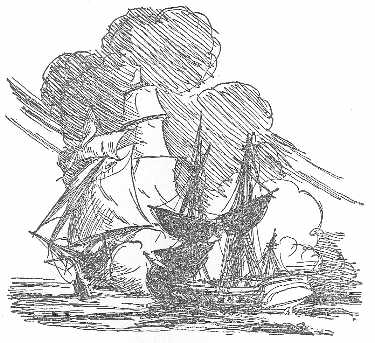
BOOKS OF THE SEA
The National Marine League asks, What are the ten best books of the sea? Without pondering very deeply on the matter, and confining ourself to prose, we would suggest the following as our own favourites:
Typhoon, by Joseph Conrad
The Nigger of the "Narcissus," by Joseph Conrad
The Mirror of the Sea, by Joseph Conrad
Captains Courageous, by Rudyard Kipling
The Brassbounder, by David W. Bone
Salt of the Sea, by Morley Roberts
Mr. Midshipman Easy, by Captain Marryat
The Wreck of the "Grosvenor," by Clark Russell
Moby Dick, by Herman Melville
An Ocean Tramp, by William McFee.
If one is allowed to include books that deal partially with salt water, one would have to add "Treasure Island," "Casuals of the Sea," by McFee, and "Old Junk," by Tomlinson. The kind of shallow-water sea tales that we love to read after supper, with our feet on the nearest chair and a decent supply of tobacco handy, are the delicious stories by W.W. Jacobs. Dana's "Two Years Before the Mast," which is spoken of as a classic, we have never read. We have always had a suspicion of it, we don't know why. Before we tackle it we shall re-read "The Water Babies." We have always found a good deal of innocent cheer in the passages in John Woolman's Journal describing his voyage from Philadelphia to London in 1772. Friend Woolman, like the sturdy Quaker that he was, was horrified (when he went to have a look at the ship Mary and Elizabeth) to find "sundry sorts of carved work and imagery" on that part of the vessel where the cabins were; and in the cabins themselves he observed "some superfluity of workmanship of several sorts." This subjected his mind to "a deep exercise," and he decided that he would have to take passage in the steerage instead of the cabin. Having our self made use of the steerage aforetime, both in the Mauretania and humbler vessels, we feel a certain kindred sympathy for his experiences. We have always enjoyed his remark: "The wind now blew vehemently, and the sea wrought to that degree that an awful seriousness prevailed."
To come to poetry, we suppose that the greatest sea-poet who never ventured on anything more perilous than a ferry-boat was Walt Whitman. Walt, one likes to think, would have been horribly sea-sick if he had ventured out beyond the harbour buoy. A good deal of Walt's tempestuous uproar about the glories of America was undoubtedly due to the fact that he had never seen anything else. Speaking of Walt reminds us that one book of the sea that we have never read (for the best of reasons: it has not been written) might be done by Thomas Mosher, the veteran tippler of literary minims. Mr. Mosher, we understand, "followed" the sea in his youth. Not long ago, when Mr. Mosher published that exquisite facsimile of the 1855 "Leaves of Grass," we asked him when and how he first came in contact with Whitman's work. He said:
I don't suppose there was anything particularly interesting about my first acquaintance with Whitman, which at 14 years of age I made in my old family mansion situated at Smith's Corner, America. I had been taking "The Galaxy" from its start, only a few months previous to the date I mention. I can still see myself in the sitting room of the old house. Smith's Cor., America, I will remind you, is a portion of Biddeford, Me. An extra "d" has got into the old English name—which, by the way, only a year later I passed through after a shipwreck on the Devonshire coast. (That was in 1867.) No one ever told me anything about Walt.
These amateurish speculations on maritime books are of no value except for the fact that they elicited an interesting letter from an expert on these matters. William McFee wrote us as follows:—
"The first thing I laid my hands on this evening, while hunting for some forgotten nugget of wisdom in my note-books filled with Mediterranean brine, was that list of books for a projected sea library. Perpend....
The Sea Farer's Library
Tom Cringle's LogMichael Scott
Two Years Before the MastDana
Midshipman EasyMarryat
Captains CourageousKipling
The Flying CloudMorley Roberts
The Cruise of the Cachalot Frank T. Bullen
Log of a Sea WaifFrank T. Bullen
The Salving of a DerelictMaurice Drake
The Grain CarriersEdward Noble
MaroonedClark Russell
TyphoonConrad
Toilers of the SeaHugo
An Iceland FishermanLoti
The Sea SurgeonD'Annunzio
The Sea HawkSabatini
"A good many of these need no comment. Attention is drawn not to the individual items, but to the balance of the whole. That is the test of a list. But there is a good balance, a balance of power, and a balance of mere weight or prestige. It is the power we are after here. Regard for a moment the way 'Tom Cringle' balances Dana's laconic record of facts. No power on earth could hold 'Tom Cringle' to facts, with the result that his story is more truly a representation of sea life in the old navy than a ton of statistics. He has the seaman's mind, which Dana had not.
"Then again 'Captains Courageous' and 'The Flying Cloud' balance each other with temperamental exactitude. Each is a fine account of sea-doings with a touch of fiction to keep the sailor reading, neither of them in the very highest class. 'The Cruise of the Cachalot' is balanced by the 'Log of a Sea Waif,' each in Bullen's happier and less evangelical vein. I was obliged to exclude 'With Christ at Sea,' not because it is religious, but because it does not balance. It would give the whole list a most pronounced 'list,' if you will pardon the unpardonable.... I regret this because 'With Christ at Sea' has some things in it which transcend anything else Bullen ever wrote.
"Now we come to a couple of books possibly requiring a little explanation. 'The Salving of a Derelict' is a remarkably able story of a man's reclamation. I believe Maurice Drake won a publisher's prize with it as a first novel some years ago. It was a winner among the apprentices, I remember. 'The Grain Carriers' is a grim story of greedy owners and an unseaworthy ship by an ex-master mariner whose 'Chains,' while not a sea story, is tinged with the glamour of South American shipping, and is obviously a work written under the influence of Joseph Conrad. 'Marooned' and 'Typhoon' balance (only you mustn't be too critical) as examples of the old and new methods of telling a sea story.
"'The Sea Surgeon' is one of a collection of stories about the Pescarese, which D'Annunzio wrote years ago. They are utterly unlike 'II Fuoco' and the other absurd tales on which translators waste their time. In passing one is permitted to complain of the persistent ill-fortune Italian novelists suffer at the hands of their English translators.
"Assuming, however, that our seafarer wants a book or two of what is euphemistically termed 'non-fiction,' here are a few which will do him no harm:
"Southey's 'Life of Nelson.'
"'The Influence of Sea Power Upon History,' Mahan.
"Admiral Lord Beresford's 'Memoirs.'
"The Diary of Samuel Pepys, F.R.S., Secretary to the Admiralty in the Reign of Charles II and James II. It is most grievously overlooked that Samuel was the first to draft a naval Rate Book, which is a sort of indexed lexicon of everything one needs 'for fighting and sea-going efficiency.' And it is a pleasure, chastened by occasional fits of ill-temper, to discover that the present British Naval Rate Book hath in it divers synonyms coeval with Samuel and his merry monarchs. As when the present writer tried to order some hammer-handles and discovered after much tribulation that the correct naval equivalent for such is 'ash-helms.' Whereupon he toilfully rewrote his requisitions 'and so to bed.'
"Another suggestion I might make is a volume to be compiled, containing the following chapters:
I."Landsmen Admirals," Generals Blake and Monk.
II."A Dutch Triumvirate," Van Tromp, De Witt and De Ruyter.
III."Napoleon as a Sea Tactician."
IV."Decatur and the Mediterranean Pirates."
V."The Chesapeake and the Shannon."
VI."The Spanish-American Naval Actions."
VII."The Russo-Japanese Naval Actions."
VIII."The Turko-Italian Naval Actions."
Conclusion."Short Biography of Josephus Daniels."
"Only deep-water sailors would be able to take this suggested library to sea with them, because a sailor only reads at sea. When the landward breeze brings the odours of alien lands through the open scuttle one closes the book, and if one is a normal and rational kind of chap and the quarantine regulations permit, goes ashore."
Gruesome as anything in any seafaring pirate yarn is Trelawny's description (in "Recollections of the Last Days of Shelley and Byron") of the burning of Shelley's body on the seashore near Via Reggio. The other day, in company with two like-minded innocents, we visited a bookshop on John Street where we found three battered copies of this great book, and each bought one, with shouts of joy. The following day, still having the book with us, we dropped in to see the learned and hospitable Dr. Rosenbach at his new and magnificent thesaurus at 273 Madison Avenue. We showed him the book, because every time one shows the doctor a book he can startle you by countering with its original manuscript or something of that sort. We said something about Shelley and Trelawny, in the hope of starting him off. He smiled gently and drew out a volume from a shelf. It was the copy of "Prometheus Unbound" that Shelley had given Trelawny in July, 1822, with an inscription. As the poet was drowned on July 8, 1822, it probably was the last book he ever gave away.
One wonders what may have become of the log of the American clipper that Shelley and Trelawny visited in the harbour of Leghorn shortly before Shelley's death. Shelley had said something in praise of George Washington, to which the sturdy Yankee skipper replied: "Stranger, truer words were never spoken; there is dry rot in all the main timbers of the Old World, and none of you will do any good till you are docked, refitted, and annexed to the New. You must log that song you sang; there ain't many Britishers that will say as much of the man that whipped them; so just set these lines down in the log!"
Whereupon Shelley autographed the skipper's log for him, with some sentiments presumably gratifying to American pride, and drank some "cool peach brandy." It was his last drink.
We ourself, just as much as Shelley, enjoy visiting ships, and have had some surprising adventures in so doing. We remember very clearly our first call upon William McFee, when he was First Assistant Engineer in S.S. Turrialba. But getting aboard vessels is a much more complicated and diplomatic task than it was in Shelley's day. Even when armed with Mr. McFee's autographed card, it was by no means easy. We went dutifully up to the office of the United Fruit Company at Pier 9, to apply for a pass, and were surveyed with grim suspicion. Why, we asked gently, in these peaceful times is it so difficult to visit a friend who happens to be in a ship? Prohibition, said the candid clerk, and a whole province of human guile was thereby made plain to our shrinking mind. Mortals incline readily to sin, it seems, and apparently evil and base men will even go so far as to pretend a friendship with those who go down to wet territory in ships, simply for the sake of—well, we cannot bring ourself to mention it. "How do you know Mr. McFee wants to see you?" we were asked. Luckily we had Mac's card to prove it.
We had long wanted to see Mr. McFee in his sea-going quarters, where he writes his books and essays (so finely flavoured with a rich ironical skepticism as to the virtues of folk who live on shore). Never was a literary sanctum less like the pretentious studios of the imitation litterateurs. In a small cabin stood our friend, in his working dungarees (if that is what they are called) talking briskly with the Chief and another engineer. The conversation, in which we were immediately engulfed, was so vivacious that we had small chance to examine the surroundings as we would have liked to. But save for the typewriter on the desk and a few books in a rack, there was nothing to suggest literature. "Plutarch's Lives," we noticed—a favourite of Mac's since boyhood; Frank Harris's "The Bomb" (which, however, the Chief insisted belonged to him), E.S. Martin's "Windfalls of Observation," and some engineering works. We envied Mac the little reading lamp at the head of his bunk.
We wish some of the soft-handed literary people who bleat about only being able to write in carefully purged and decorated surroundings could have a look at that stateroom. In just such compartments Mr. McFee has written for years, and expected to finish that night (in the two hours each day that he is able to devote to writing) his tale, "Captain Macedoine's Daughter." As we talked there was a constant procession of in-comers, most of them seeming to the opaque observation of the layman to be firemen discussing matters of overtime. On the desk lay an amusing memorandum, which the Chief referred to jocularly as one of Mac's "works," anent some problem of whether the donkeyman was due certain overtime on a Sunday when the Turrialba lay in Hampton Roads waiting for coal. On the cabin door was a carefully typed list marked in Mr. McFee's hand "Work to Do." It began something like this:
Main Engine Pump-Link Brasses
Fill Up Main Engine Feed Pump and Bilge Rams
Open and Scale After Port Boiler
Main Circulator Impeller to Examine
Hydrokineter Valve on Centre Boiler to be Rejointed
The delightful thing about Mr. McFee is that he can turn from these things, which he knows and loves, to talk about literary problems, and can out-talk most literary critics at their own game.
He took us through his shining engines, showing us some of the beauty spots—the Weir pumps and the refrigerating machinery and the thrust-blocks (we hope we have these right), unconsciously inflicting upon us something of the pain it gives the bungling jack of several trades when he sees a man who is so fine a master not merely of one, but of two—two seemingly diverse, but in which the spirit of faith and service are the same. "She's a bonny ship," he said, and his face was lit with sincerity as he said it. Then he washed his hands and changed into shore clothes and we went up to Frank's, where we had pork and beans and talked about Sir Thomas Browne.
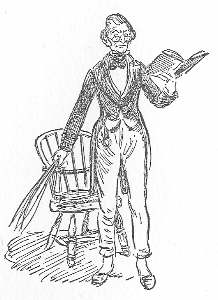
FALLACIOUS MEDITATIONS ON CRITICISM
I
There are never, at any time and place, more than a few literary critics of genuine incision, taste, and instinct; and these qualities, rare enough in themselves, are further debilitated, in many cases, by excessive geniality or indigestion. The ideal literary critic should be guarded as carefully as a delicate thermal instrument at the Weather Bureau; his meals, friendships, underwear, and bank account should all be supervised by experts and advisedly maintained at a temperate mean. In the Almost Perfect State (so many phases of which have been deliciously delineated by Mr. Marquis) a critic seen to become over-exhilarated at the dining table or to address any author by his first name would promptly be haled from the room by a commissionaire lest his intellectual acuity become blunted by emotion.
The unfortunate habit of critics being also human beings has done a great deal to impair their value to the public. For other human beings we all nourish a secret disrespect. And therefore it is well that the world should be reminded now and then of the dignity and purity of the critic's function. The critic's duty is not merely to tabulate literary material according to some convenient scale of proved niceties; but to discern the ratio existing in any given work between possibility and performance; between the standard the author might justly have been expected to achieve and the standard he actually attained. There are hierarchies and lower archies. A pint pot, full (it is no new observation), is just as full as a bathtub full. And the first duty of the critic is to determine and make plain to the reader the frame of mind in which the author approached his task.
Just as a ray of sunshine across a room reveals, in air that seemed clear, innumerable motes of golden dancing dust and filament, so the bright beam of a great critic shows us the unsuspected floating atoms of temperament in the mind of a great writer. The popular understanding of the word criticize is to find fault, to pettifog. As usual, the popular mind is only partly right. The true critic is the tender curator and warden of all that is worthy in letters. His function is sacramental, like the sweeping of a hearth. He keeps the hearth clean and nourishes the fire. It is a holy fire, for its fuel is men's hearts.
It seems to us probable that under present conditions the cause of literature is more likely to suffer from injudicious and excessive praise rather than from churlish and savage criticism. It seems to us (and we say this with certain misgivings as to enthusiasms of our own) that there are many reviewers whose honest zeal for the discovering of masterpieces is so keen that they are likely to burst into superlatives half a dozen times a year and hail as a flaming genius some perfectly worthy creature, who might, if he were given a little stiff discipline, develop into a writer of best-readers rather than best-sellers. Too resounding praise is often more damning than faint praise. The writer who has any honest intentions is more likely to be helped by a little judicious acid now and then than by cartloads of honey. Let us be candid and personal. When someone in The New Republic spoke of some essays of our own as "blowzy" we were moved for a few moments to an honest self-scrutiny and repentance. Were we really blowzy, we said to ourself? We did not know exactly what this meant, and there was no dictionary handy. But the word gave us a picture of a fat, ruddy beggar-wench trudging through wind and rain, probably on the way to a tavern; and we determined, with modest sincerity, to be less like that in future.
The good old profession of criticism tends, in the hands of the younger generation, toward too fulsome ejaculations of hurrahs and hyperboles. It is a fine thing, of course, that new talent should so swiftly win its recognition; yet we think we are not wholly wrong in believing that many a delicate and promising writer has been hurried into third-rate work, into women's magazine serials and cheap sordid sensationalism, by a hasty overcapitalization of the reviewer's shouts. For our own part, we do not feel any too sure of our ability to recognize really great work when we first see it. We have often wondered, if we had been journalizing in 1855 when "Leaves of Grass" appeared, would we have been able to see what it meant, or wouldn't we have been more likely to fill our column with japeries at the expense of Walt's obvious absurdities, missing all the finer grain? It took a man like Emerson to see what Walt was up to.
There were many who didn't. Henry James, for instance, wrote a review of "Drum Taps" in the Nation, November 16, 1865. In the lusty heyday and assurance of twenty-two years, he laid the birch on smartly. It is just a little saddening to find that even so clear-sighted an observer as Henry James could not see through the chaotic form of Whitman to the great vision and throbbing music that seem so plain to us to-day. Whitman himself, writing about "Drum Taps" before its publication, said, "Its passion has the indispensable merit that though to the ordinary reader let loose with wildest abandon, the true artist can see that it is yet under control." With this, evidently, the young Henry James did not agree. He wrote:
It has been a melancholy task to read this book; and it is a still more melancholy one to write about it. Perhaps since the day of Mr. Tupper's "Philosophy" there has been no more difficult reading of the poetic sort. It exhibits the effort of an essentially prosaic mind to lift itself, by a prolonged muscular strain, into poetry. Like hundreds of other good patriots, Mr. Walt Whitman has imagined that a certain amount of violent sympathy with the great deeds and sufferings of our soldiers, and of admiration for our national energy, together with a ready command of picturesque language, are sufficient inspiration for a poet.... But he is not a poet who merely reiterates these plain facts ore rotundo. He only sings them worthily who views them from a height.... Mr. Whitman is very fond of blowing his own trumpet, and he has made very explicit claims for his book.... The frequent capitals are the only marks of verse in Mr. Whitman's writing. There is, fortunately, but one attempt at rhyme.... Each line starts off by itself, in resolute independence of its companions, without a visible goal ... it begins like verse and turns out to be arrant prose. It is more like Mr. Tupper's proverbs than anything we have met.... No triumph, however small, is won but through the exercise of art, and this volume is an offence against art.... We look in vain through the book for a single idea. We find nothing but flashy imitations of ideas. We find a medley of extravagances and commonplaces.
We do not know whether H.J. ever recanted this very youthful disposal of old Walt. The only importance of it at this moment seems to us this: that appreciation of all kinds of art is so tenderly interwoven with inherited respect for the traditional forms of expression by which they are conveyed that a new and surprising vehicle quite unfits most observers for any reasonable assessment of the passenger.
As for Walt himself, he was quite unabashed by this or any other onslaught. He was not gleg at argument, and probably rolled up the issue of the Nation in his pocket and went down to Coney Island to lie on the sand and muse (but no, we forget, it was November!). In the same issue of the Nation he doubtless read, in the "Literary Notes," that "Poems Relating to the American Revolution," by Philip Freneau, was "in press under the scholarly editing of Evart A. Duyckinck to form a complete presentment of the genius of an author whose influence in the affairs of his time would alone impart a lasting value to his works." At this Walt smiled gently to himself, wondered how soon "When Lilacs Last in the Dooryard Bloomed" would get into the anthologies, and "sped to the certainties suitable to him."
II
These miscellaneous thoughts on the fallibility of critics were suggested to us by finding some old bound volumes of the Edinburgh Review on a bookstall, five cents each. In the issue for November, 1814, we read with relish what the Review had to say about Wordsworth's "Excursion." These are a few excerpts:
This will never do.... The case of Mr. Wordsworth, we perceive, is now manifestly hopeless; and we give him up as altogether incurable, and beyond the power of criticism ... making up our minds, though with the most sincere pain and reluctance, to consider him as finally lost to the good cause of poetry.... The volume before us, if we were to describe it very shortly, we should characterize as a tissue of moral and devotional ravings, in which innumerable changes are rung upon a few very simple and familiar ideas.
The world of readers has not ratified Jeffrey's savage comments on "The Excursion," for (to reckon only by the purse) any frequenter of old bookshops can pick up that original issue of the Edinburgh Review for a few cents, while the other day we saw a first edition of the maligned "Excursion" sold for thirty dollars. A hundred years ago it was the critic's pleasure to drub authors with cruel and unnecessary vigour. But we think that almost equal harm can be done by the modern method of hailing a new "genius" every three weeks.
For example, there is something subtly troublesome to us in the remark that Sinclair Lewis made about Evelyn Scott's novel, "The Narrow House." The publishers have used it as an advertising slogan, and the words have somehow buzzed their way into our head:
"Salute to Evelyn Scott: she belongs, she understands, she is definitely an artist."
We have been going about our daily affairs, climbing subway stairs, dodging motor trucks, ordering platters of stewed rhubarb, with that refrain recurring and recurring. Salute to Evelyn Scott! (we say to ourself as we stand in line at the bank, waiting to cash a small check). She belongs, she understands. And then, as we go away, pensively counting the money (they've got some clean Ones down at our bank, by the way; we don't know whether the larger denominations are clean or not, we haven't seen any since Christmas), we find ourself mumbling, She is definitely an artist.
We wonder why that pronouncement annoys us so. We haven't read all Mrs. Scott's book yet, and doubt our strength to do so. It is a riot of morbid surgery by a fumbling scalpel: great powers of observation are put to grotesque misuse. It is crammed with faithful particulars neither relevant nor interesting. (Who sees so little as he who looks through a microscope?) At first we thought, hopefully, that it was a bit of excellent spoof; then, regretfully, we began to realize that not only the publishers but even the author take it seriously. It feels as though it had been written by one of the new school of Chicago realists. It is disheartening that so influential a person as Mr. Lewis should be fooled by this sort of thing.
So there is something intensely irritating to us (although we admire Mr. Lewis) in that "She belongs, she understands, she is definitely an artist." In the first place, that use of the word artist as referring to a writer always gives us qualms unless used with great care. Then again, She belongs somehow seems to intimate that there is a registered clique of authors, preferably those who come down pretty heavily upon the disagreeable facts of life and catalogue them with gluttonous care, which group is the only one that counts. Now we are strong for disagreeable facts. We know a great many. But somehow we cannot shake ourself loose from the instinctive conviction that imagination is the without-which-nothing of the art of fiction. Miss Stella Benson is one who is not unobservant of disagreeables, but when she writes she can convey her satire in flashing, fantastic absurdity, in a heavenly chiding so delicate and subtle that the victim hardly knows he is being chidden. The photographic facsimile of life always seems to us the lesser art, because it is so plainly the easier course.
We fear we are not acute enough to explain just why it is that Mr. Lewis's salute to Mrs. Scott bothers us so. But it does bother us a good deal. We have nourished ourself, in the main, upon the work of two modern writers: Robert Louis Stevenson and Joseph Conrad; we like to apply as a test such theories as we have been able to glean from those writers. Faulty and erring as we are, we always rise from Mr. Conrad's books purged and, for the moment, strengthened. Apparent in him are that manly and honourable virtue, that strict saline truth and scrupulous regard for life, that liberation from cant, which seem to be inbred in those who have suffered the exacting discipline of the hostile sea. Certainly Conrad cannot be called a writer who has neglected the tragic side of things. Yet in his "Notes on Life and Letters," we find this:
What one feels so hopelessly barren in declared pessimism is just its arrogance. It seems as if the discovery made by many men at various times that there is much evil in the world were a source of proud and unholy joy unto some of the modern writers. That frame of mind is not the proper one in which to approach seriously the art of fiction.... To be hopeful in an artistic sense it is not necessary to think that the world is good. It is enough to believe that there is no impossibility of its being made so.... I would ask that in his dealings with mankind he [the writer] should be capable of giving a tender recognition to their obscure virtues. I would not have him impatient with their small failings and scornful of their errors.
We fear that our mild protest is rather mixed and muddled. But what we darkly feel is this: that no author "belongs," or "understands," or is "definitely an artist" who merely makes the phantoms of his imagination paltry or ridiculous. They may be paltry, but they must also be pitiable; they may be ridiculous, but they must also be tragic. Many authors have fallen from the sublime to the ridiculous; but, as Mr. Chesterton magnificently said, in order to make that descent they must first reach the sublime.
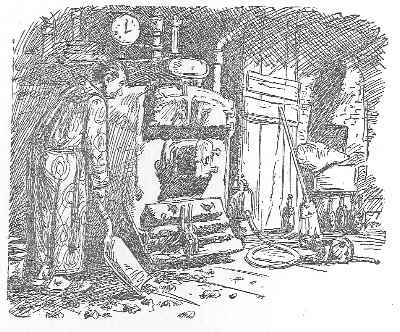
LETTING OUT THE FURNACE
The prudent commuter (and all commuters are prudent, for the others are soon weeded out by the rigours of that way of life) keeps the furnace going until early May in these latitudes—assuming that there are small children in the house. None of those April hot waves can fool him; he knows that, with cunning management, two or three shovelfuls of coal a day will nurse the fire along, and there it is in case of a sudden chilly squall. But when at last he lets the fire die, and after its six months of constant and honourable service the old boiler grows cold, the kindly glow fades and sinks downward out of sight under a crust of gray clinkers, our friend muses tenderly in his cellar, sitting on a packing case.
He thinks, first, how odd it is that when he said to himself, "We might as well let the fire go out," it kept on sturdily burning, without attention or fuel, for a day and a half; whereas if he had, earlier in the season, neglected it even for a few hours, all would have been cold and silent. He remembers, for instance, the tragic evening with the mercury around zero, when, having (after supper) arranged everything at full blast and all radiators comfortably sizzling, he lay down on his couch to read Leonard Merrick, intending to give all hands a warm house for the night. Very well; but when he woke up around 2 a.m. and heard the tenor winds singing through the woodland, how anxiously he stumbled down the cellar stairs, fearing the worst. His fears were justified. There, on top of the thick bed of silvery ashes, lay the last pallid rose of fire. For as every pyrophil has noted, when the draught is left on, the fire flees upward, leaving its final glow at the top; but when all draughts are shut off, it sinkst downward, shyly hiding in the heart of the mass.
So he stood, still drowsily aghast, while Gissing (the synthetic dog) frolicked merrily about his unresponsive shins, deeming this just one more of those surprising entertainments arranged for his delight.
Now, on such an occasion the experienced commuter makes the best of a bad job, knowing there is little to be gained by trying to cherish and succour a feeble remnant of fire. He will manfully jettison the whole business, filling the cellar with the crash of shunting ashes and the clatter of splitting kindling. But this pitiable creature still thought that mayhap he could, by sedulous care and coaxing, revive the dying spark. With such black arts as were available he wrestled with the despondent glim. During this period of guilty and furtive strife he went quietly upstairs, and a voice spoke up from slumber. "Isn't the house very cold?" it said.
"Is it?" said this wretched creature, with great simulation of surprise. "Seems very comfortable to me."
"Well, I think you'd better send up some more heat," said this voice, in the tone of one accustomed to command.
"Right away," said the panic-stricken combustion engineer, and returned to his cellar, wondering whether he was suspected. How is it, he wondered, that ladies know instinctively, even when vested in several layers of blankets, if anything is wrong with the furnace? Another of the mysteries, said he, grimly, to the synthetic dog. By this time he knew full well (it was 3 a.m.) that there was naught for it but to decant the grateful of cinders and set to work on a new fire.
Such memories throng in the mind of the commuter as he surveys the dark form of his furnace, standing cold and dusty in the warm spring weather, and he cleans and drains it for the summer vacation. He remembers the lusty shout of winter winds, the clean and silver nakedness of January weather, the shining glow of the golden coals, the comfortable rustling and chuckle of the boiler when alive with a strong urgency of steam, the soft thud and click of the pipes when the pressure was rising before breakfast. And he meditates that these matters, though often the cause of grumbles at the time, were a part of that satisfying reality that makes life in the outposts a more honest thing than the artificial convenience of great apartment houses. The commuter, no less than the seaman, has fidelities of his own; and faithful, strict obedience to hard necessary formulæ favours the combined humility and self-respect that makes human virtue. The commuter is often a figure both tragic and absurd; but he has a rubric and discipline of his own. And when you see him grotesquely hasting for the 5:27 train, his inner impulse may be no less honourable than that of the ship's officer ascending the bridge for his watch under a dark speckle of open sky.
BY THE FIREPLACE
We were contemplating our fireplace, in which, some of the hearth-bricks are rather irregularly disposed; and we said to ourself, perhaps the brick-layer who built this noble fireplace worked like Ben Jonson, with a trowel in one hand and a copy of Horace in the other. That suggested to us that we had not read any Ben Jonson for a very long time: so we turned to "Every Man in His Humour" and "The Alchemist." Part of Jonson's notice "To the Reader" preceding "The Alchemist" struck us as equally valid as regards poetry to-day:
Thou wert never more fair in the way to be cozened, than in this age, in poetry; wherein ... antics to run away from nature, and be afraid of her, is the only point of art that tickles the spectators ... For they commend writers, as they do fencers or wrestlers; who if they come in robustuously, and put for it with a great deal of violence, are received for the braver fellows.... I deny not, but that these men, who always seek to do more than enough, may some time happen on some thing that is good, and great; but very seldom ... I give thee this warning, that there is a great difference between those, that utter all they can, however unfitly; and those that use election and a mean. For it is only the disease of the unskilful, to think rude things greater than polished; or scattered more numerous than composed.
Ben Jonson's perpetual allusions to tobacco always remind one of the odd circumstance that of two such cronies as he and Will Shakespeare, one should have mentioned tobacco continually, the other not at all. Undoubtedly Ben smoked a particularly foul old pipe and was forever talking about it, spouting his rank strangling "Cuban ebolition" across the table; and Will, probably rather nice in his personal habits, grew disgusted with the habit.
At any rate, Shakespeare's silence on the subject has always been a grief to smokers. At a time when we were interested in that famous and innocent way of wasting time, trying to discover ciphers in Shakespeare's sonnets, we spent long cryptogrammarian evenings seeking to prove some anagram or rebus by which the Bard could be supposed to have concealed a mention of tobacco. But the only lurking secret we ever discovered seemed to suggest that the sonnets had been written by an ex-President of the United States. Observe the 131st sonnet:
Thou art as tyrannous, so as thou art As those whose beauties proudly make them cruel; For well thou know'st to my dear doting heart Thou art the fairest and most precious jewel.
And evidently Shakespeare intended to begin the 51st sonnet with the same acrostic; but, with Elizabethan laxity, misspelled Mr. Taft's name as TOFT.
Reading Elizabethan literature always encourages one to proceed, even though decorously, with the use of the pun. Such screams of mirth as (we doubt not) greeted one of Ben Jonson's simpletons when he spoke of Roger Bacon as Rasher Bacon (we can hear them laughing, can't you?) are highly fortifying.
But we began by quoting Ben Jonson on poetry. The passage sent us to the bookcase to look up the "axioms" about poetry stated by another who was also, in spirit at least, an habitué of The Mermaid. In that famous letter from Keats to his publisher and friend John Taylor, February 27, 1818, there is a fine fluent outburst on the subject. All Keats lovers know these "axioms" already, but they cannot be quoted too often; and we copy them down with additional pleasure because not long ago, by the kindness of the two librarians who watch over one of the most marvellous private collections in the world—Mr. J.P. Morgan's—we saw the original letter itself:—
1st. I think poetry should surprise by a fine excess, and not by singularity. It should strike the reader as a wording of his own highest thoughts, and appear almost a remembrance.
2d. Its touches of beauty should never be half-way, thereby making the reader breathless, instead of content. The rise, the progress, the setting of Imagery should, like the sun, come natural to him, shine over him, and set soberly, although in magnificence, leaving him in the luxury of twilight. But it is easier to think what poetry should be than to write it—and this leads me to
Another axiom—That if poetry comes not as naturally as the leaves to a tree, it had better not come at all.
Some people can always find things to complain about. We have seen protests because the house in Rome where Keats died is used as a steamship office. We think it is rather appropriate. No man's mind ever set sail upon wider oceans of imagination. To paraphrase Emily Dickinson:
Night after night his purple traffic Strews the landing with opal bales; Merchantmen poise upon horizons, Dip, and vanish with fairy sails.
Another pleasing fact is that while he was a medical student Keats lived in Bird-in-Hand Court, Cheapside—best known nowadays as the home of Simpson's, that magnificent chophouse. Who else, in modern times, came so close to holding unruffled in his hand the shy wild bird of Poetry?
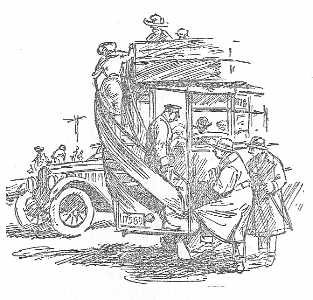
A CITY NOTE-BOOK
Well, now let us see in what respect we are richer to-day than we were yesterday.