FOUR PLAYS FOR DANCERS
Reading edition
333
PREFACE
Two of these plays must be opened by the unfolding and folding of the cloth, a substitute for the rising of the curtain, and all must be closed by it. The others, The Dreaming of the Bones and Calvary, should have the same opening, unless played after plays of the same kind, when it may seem a needless repetition. All must be played to the accompaniment of drum and zither and flute, but on no account must the words be spoken ‘through music’ in the fashionable way; and the players must move a little stiffly and gravely like marionettes and, I think, to the accompaniment of drum taps. I felt, however, during the performance of The Hawk’s Well, the only one played up to this, that there was much to discover. Should I make a serious attempt, which I may not, being rather tired of the theatre, to arrange and supervise performances, the dancing will give me most trouble, for I know but vaguely what I want. I do not want any existing form of stage dancing, but something with a smaller gamut of 334expression, something more reserved, more self-controlled, as befits performers within arm’s reach of their audience.
Mr. Edmund Dulac designed the masks and costumes used in the first performance of The Hawk’s Well. The beautiful mask of Cuchulain may, I think, serve for Dervorgilla, and if I write plays and organise performances on any scale and with any system, I shall hope for a small number of typical masks, each capable of use in several plays. The face of the speaker should be as much a work of art as the lines that he speaks or the costume that he wears, that all may be as artificial as possible. Perhaps in the end one would write plays for certain masks. If some fine sculptor should create for my Calvary, for instance, the masks of Judas, of Lazarus, and of Christ, would not this suggest other plays now, or many generations from now, and possess one cannot tell what philosophical virility? The mask, apart from its beauty, may suggest new situations at a moment when the old ones seem exhausted; The Only Jealousy of Emer was written to find what dramatic effect one could get out of a mask, changed while the player remains upon the stage to suggest a change of personality. At the end of this book there is some music by Mr. Rummell, which my friends tell me is both difficult 335and beautiful, for The Dreaming of the Bones. It will require, I am told, either a number of flutes of which the flute-player will pick now one, now another, or an elaborate modern flute, which would not look in keeping. I prefer the first suggestion. I notice that Mr. Rummell has written no music for the dance, and I have some vague memory that when we talked it over in Paris he felt that he could not without the dancer’s help. There is also music for The Hawk’s Well by Mr. Dulac, which is itself an exposition of method, for it was written after a number of rehearsals and for instruments that have great pictorial effect….
At the Hawk’s Well and The Only Jealousy of Emer are the first and last plays of a series of four dealing with Cuchulain’s life (see Plays in Prose and Verse).
That I might write The Dreaming of the Bones, Mr. W. A. Henderson with great kindness wrote out for me all historical allusions to ‘Dervorgilla’; but neither that nor any of these plays could have existed if Mr. Edmund Dulac had not taught me the value and beauty of the mask and rediscovered how to design and make it.
W. B. YEATS.
July 1920.
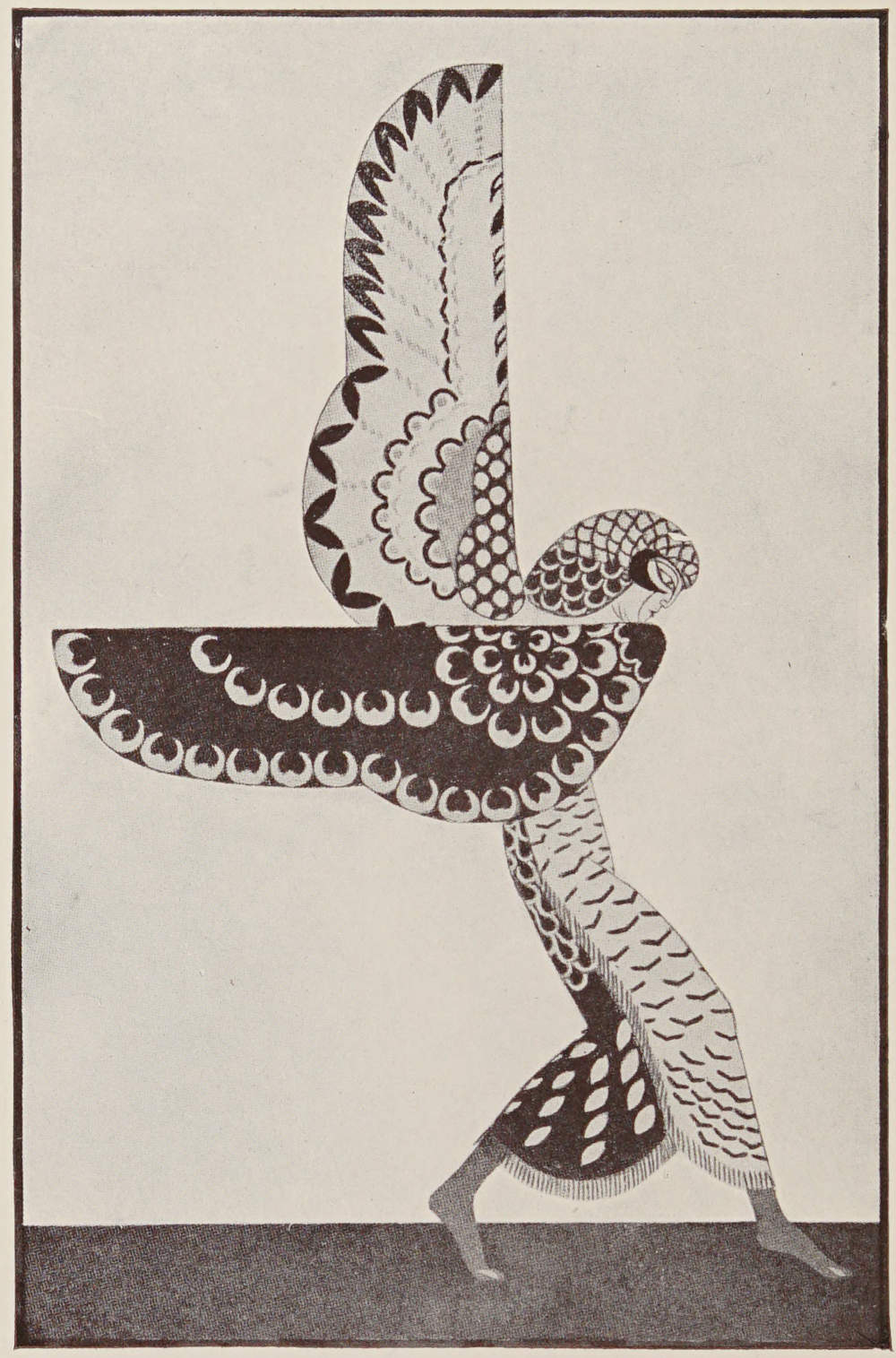
The Guardian of the Well in ‘At the Hawk’s Well.’
AT THE HAWK’S WELL
PERSONS OF THE PLAY
THREE MUSICIANS (their faces made up to resemble masks).
THE GUARDIAN OF THE WELL (with face made up to resemble a mask).
AN OLD MAN (wearing a mask).
A YOUNG MAN (wearing a mask).
The Time—the Irish Heroic Age.
339The stage is any bare space before a wall against which stands a patterned screen. A drum and a gong and a zither have been laid close to the screen before the play begins. If necessary, they can be carried in, after the audience is seated, by the FIRST MUSICIAN, who also can attend to the lights if there is any special lighting. We had two lanterns upon posts—designed by Mr. Dulac—at the outer corners of the stage, but they did not give enough light, and we found it better to play by the light of a large chandelier. Indeed, I think, so far as my present experience goes, that the most effective lighting is the lighting we are most accustomed to in our rooms. These masked players seem stranger when there is no mechanical means of separating them from us. The FIRST MUSICIAN carries with him a folded black cloth and goes to the centre of the stage towards the front and stands motionless, the folded cloth hanging from between his hands. The two musicians enter and, after standing a moment at either side of the stage, go towards him and slowly unfold the cloth, singing as they do so:
340I call to the eye of the mind
A well long choked up and dry
And boughs long stripped by the wind,
And I call to the mind’s eye
Pallor of an ivory face,
Its lofty dissolute air,
A man climbing up to a place
The salt sea wind has swept bare.
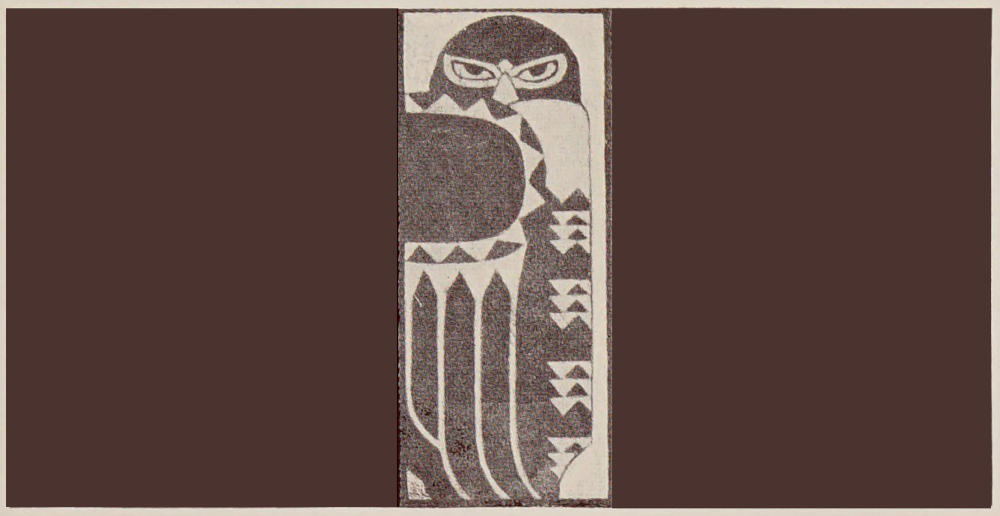
Design for Black Cloth used in ‘At the Hawk’s Well.’
As they unfold the cloth, they go backward a little so that the stretched cloth and the wall make a triangle with the FIRST MUSICIAN at the apex supporting the centre of the cloth. On the black cloth is a gold pattern suggesting a hawk. The SECOND and THIRD MUSICIANS now slowly fold up the cloth again, pacing with a rhythmic movement of the arms towards the FIRST MUSICIAN and singing:
What were his life soon done!
Would he lose by that or win?
A mother that saw her son
Doubled over a speckled shin,
Cross-grained with ninety years,
Would cry, ‘How little worth
Were all my hopes and fears
And the hard pain of his birth!’
The words ‘a speckled shin’ are familiar to readers of Irish legendary stories in descriptions of old men bent double over the 341fire. While the cloth has been spread out, the GUARDIAN OF THE WELL has entered and is now crouching upon the ground. She is entirely covered by a black cloak. The three musicians have taken their places against the wall beside their instruments of music; they will accompany the movements of the players with gong or drum or zither.
FIRST MUSICIAN [singing]
The boughs of the hazel shake,
The sun goes down in the west.
SECOND MUSICIAN [singing]
The heart would be always awake,
The heart would turn to its rest.
[They now go to one side of the stage rolling up the cloth. A GIRL has taken her place by a square blue cloth representing a well. She is motionless.
FIRST MUSICIAN [speaking]. Night falls;
The mountain-side grows dark;
The withered leaves of the hazel
Half-choke the dry bed of the well;
The guardian of the well is sitting
Upon the old grey stone at its side,
Worn out from raking its dry bed,
Worn out from gathering up the leaves.
Her heavy eyes
342Know nothing, or but look upon stone.
The wind that blows out of the sea
Turns over the heaped-up leaves at her side;
They rustle and diminish.
SECOND MUSICIAN. I am afraid of this place.
BOTH MUSICIANS [singing]
‘Why should I sleep?’ the heart cries.
‘For the wind, the salt wind, the sea wind,
Is beating a cloud through the skies;
I would wander always like the wind.’
An OLD MAN enters through the audience.
FIRST MUSICIAN [speaking]. That old man climbs up hither,
Who has been watching by his well
These fifty years.
He is all doubled up with age;
The old thorn-trees are doubled so
Among the rocks where he is climbing.
[The OLD MAN stands for a moment motionless by the side of the stage with bowed head. He lifts his head at the sound of a drum tap. He goes towards the front of the stage moving to the taps of the drum. He crouches and moves his hands as if making a fire. His movements, like those of the other 343persons of the play, suggest a marionette.
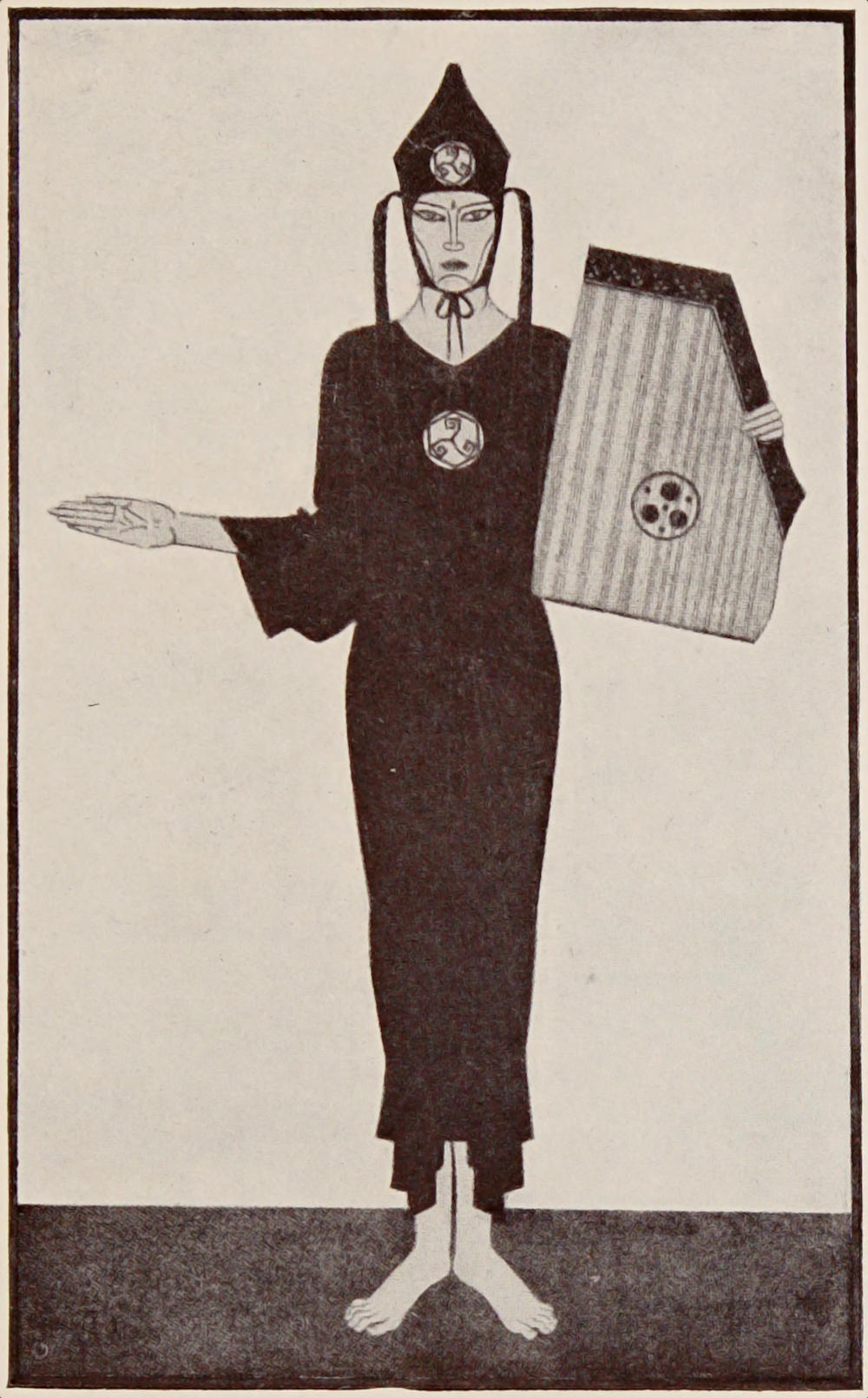
Musician in ‘At the Hawk’s Well.’
FIRST MUSICIAN [speaking]. He has made a little heap of leaves;
He lays the dry sticks on the leaves
And, shivering with cold, he has taken up
The fire-stick and socket from its hole.
He whirls it round to get a flame;
And now the dry sticks take the fire
And now the fire leaps up and shines
Upon the hazels and the empty well.
MUSICIANS [singing]
‘O wind, O salt wind, O sea wind!’
Cries the heart, ‘it is time to sleep;
Why wander and nothing to find?
Better grow old and sleep.’
OLD MAN [speaking]. Why don’t you speak to me? Why don’t you say,
‘Are you not weary gathering those sticks?
Are not your fingers cold?’ You have not one word,
While yesterday you spoke three times. You said:
‘The well is full of hazel leaves.’ You said:
‘The wind is from the west.’ And after that:
‘If there is rain it’s likely there’ll be mud.’
To-day you are as stupid as a fish,
344No, worse, worse, being less lively and as dumb.
[He goes nearer.
Your eyes are dazed and heavy. If the Sidhe
Must have a guardian to clean out the well
And drive the cattle off, they might choose somebody
That can be pleasant and companionable
Once in the day. Why do you stare like that?
You had that glassy look about the eyes
Last time it happened. Do you know anything?
It is enough to drive an old man crazy
To look all day upon these broken rocks,
And ragged thorns, and that one stupid face,
And speak and get no answer.
YOUNG MAN [who has entered through the audience during the last speech]. Then speak to me,
For youth is not more patient than old age;
And though I have trod the rocks for half a day
I cannot find what I am looking for.
OLD MAN. I cannot find what I am looking for.Who speaks?
Who comes so suddenly into this place
Where nothing thrives? If I may judge by the gold
On head and feet and glittering in your coat,
345You are not of those who hate the living world.
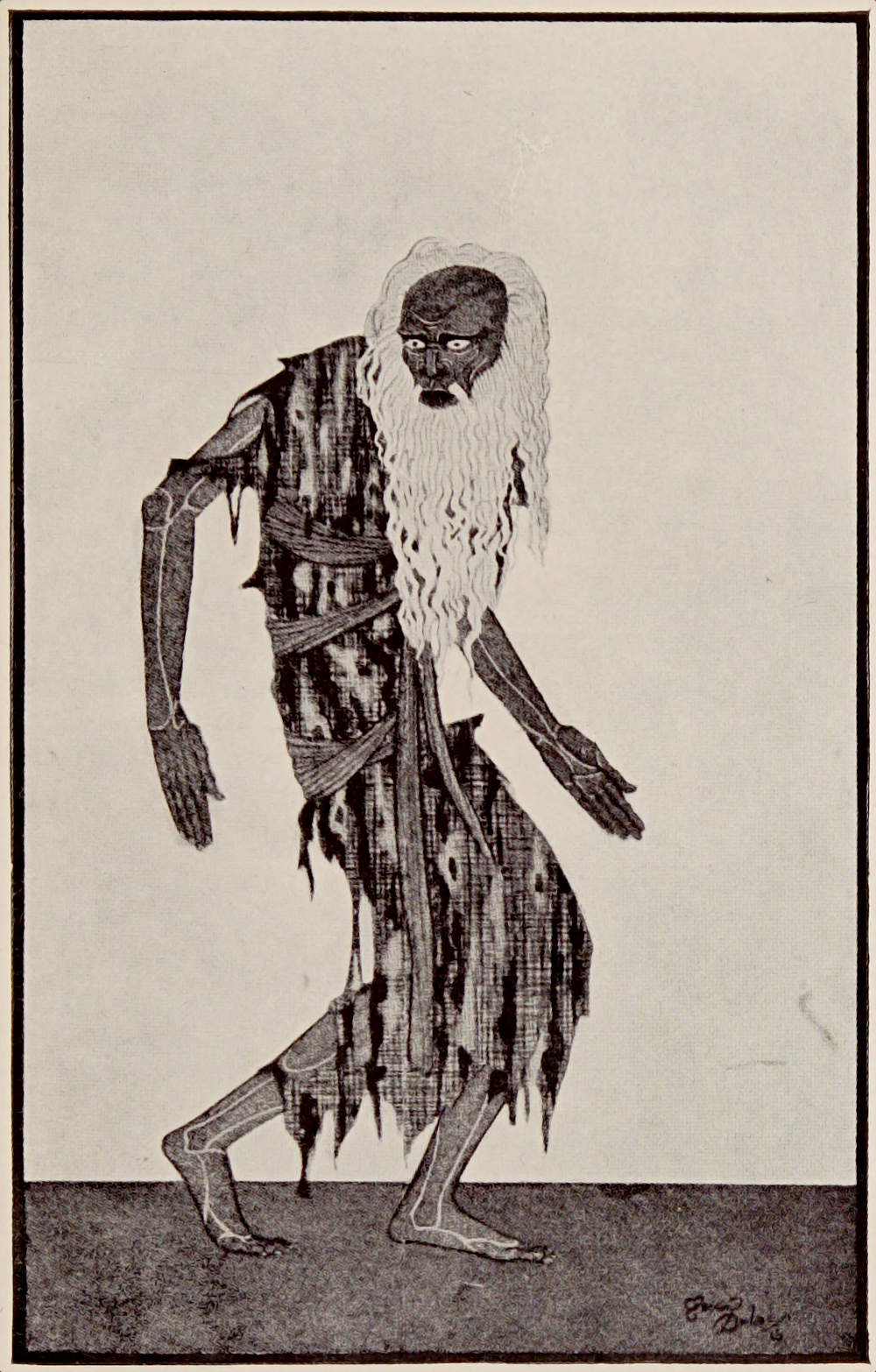
Old Man in ‘At the Hawk’s Well.’
YOUNG MAN. I am named Cuchulain, I am Sualtam’s son.
OLD MAN. I have never heard that name.
CUCHULAIN. OLD MAN. I have never heard that name.It is not unknown.
I have an ancient house beyond the sea.
OLD MAN. What mischief brings you hither—you are like those
Who are crazy for the shedding of men’s blood,
And for the love of women?
YOUNG MAN. And for the love of women?A rumour has led me,
A story told over the wine towards dawn.
I rose from table, found a boat, spread sail
And with a lucky wind under the sail
Crossed waves that have seemed charmed, and found this shore.
OLD MAN. There is no house to sack among these hills
Nor beautiful woman to be carried off.
YOUNG MAN. You should be native here, for that rough tongue
Matches the barbarous spot. You can, it may be,
Lead me to what I seek, a well wherein
Three hazels drop their nuts and withered leaves,
And where a solitary girl keeps watch
Among grey boulders. He who drinks, they say,
346Of that miraculous water lives for ever.
OLD MAN. And are there not before your eyes at the instant
Grey boulders and a solitary girl
And three stripped hazels?
YOUNG MAN. And three stripped hazels?But there is no well.
OLD MAN. Can you see nothing yonder?
YOUNG MAN. OLD MAN. Can you see nothing yonder?I but see
A hollow among stones half-full of leaves.
OLD MAN. And do you think so great a gift is found
By no more toil than spreading out a sail,
And climbing a steep hill? Oh, folly of youth,
Why should that hollow place fill up for you,
That will not fill for me? I have lain in wait
For more than fifty years to find it empty,
Or but to find the stupid wind of the sea
Drive round the perishable leaves.
YOUNG MAN. Drive round the perishable leaves.So it seems
There is some moment when the water fills it.
OLD MAN. A secret moment that the holy shades
That dance upon the desolate mountain know,
And not a living man, and when it comes
The water has scarce plashed before it is gone.
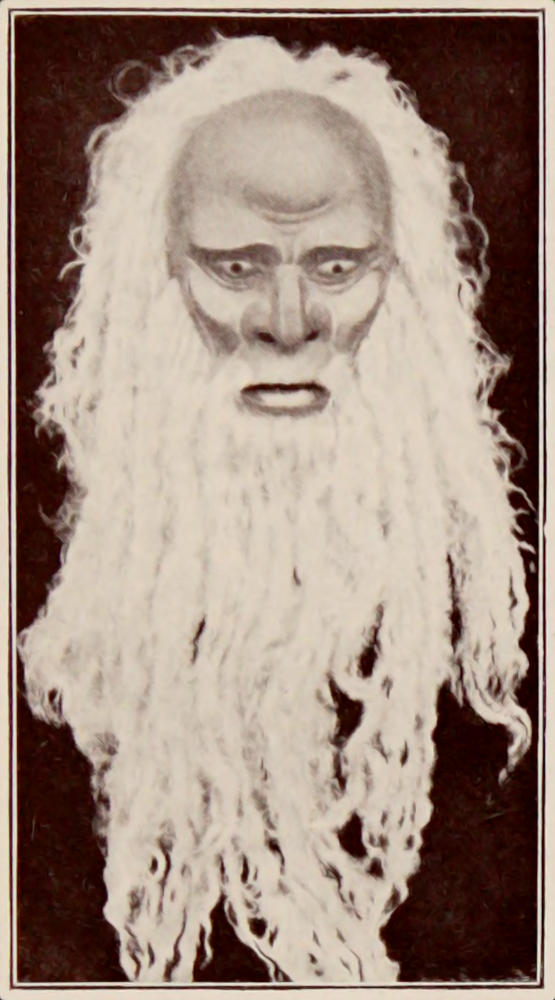
Mask for Old Man in ‘At the Hawk’s Well.’
347YOUNG MAN. I will stand here and wait. Why should the luck
Of Sualtam’s son desert him now? For never
Have I had long to wait for anything.
OLD MAN. No! Go from this accursed place, this place
Belongs to me, that girl there and those others,
Deceivers of men.
YOUNG MAN. Deceivers of men.And who are you who rail
Upon those dancers that all others bless?
OLD MAN. One whom the dancers cheat. I came like you
When young in body and in mind, and blown
By what had seemed to me a lucky sail.
The well was dry, I sat upon its edge,
I waited the miraculous flood, I waited
While the years passed and withered me away.
I have snared the birds for food and eaten grass
And drunk the rain, and neither in dark nor shine
Wandered too far away to have heard the plash,
And yet the dancers have deceived me. Thrice
I have awakened from a sudden sleep
To find the stones were wet.
348YOUNG MAN. To find the stones were wet.My luck is strong,
It will not leave me waiting, nor will they
That dance among the stones put me asleep;
If I grow drowsy I can pierce my foot.
OLD MAN. No, do not pierce it, for the foot is tender,
It feels pain much. But find your sail again
And leave the well to me, for it belongs
To all that’s old and withered.
YOUNG MAN. To all that’s old and withered.No, I stay.
[The GIRL gives the cry of the hawk.
There is that bird again.
OLD MAN. There is that bird again.There is no bird.
YOUNG MAN. It sounded like the sudden cry of a hawk,
But there’s no wing in sight. As I came hither
A great grey hawk swept down out of the sky,
And though I have good hawks, the best in the world
I had fancied, I have not seen its like. It flew
As though it would have torn me with its beak,
Or blinded me, smiting with that great wing.
I had to draw my sword to drive it off,
And after that it flew from rock to rock.
I pelted it with stones, a good half-hour,
And just before I had turned the big rock there
349And seen this place, it seemed to vanish away.
Could I but find a means to bring it down
I’d hood it.
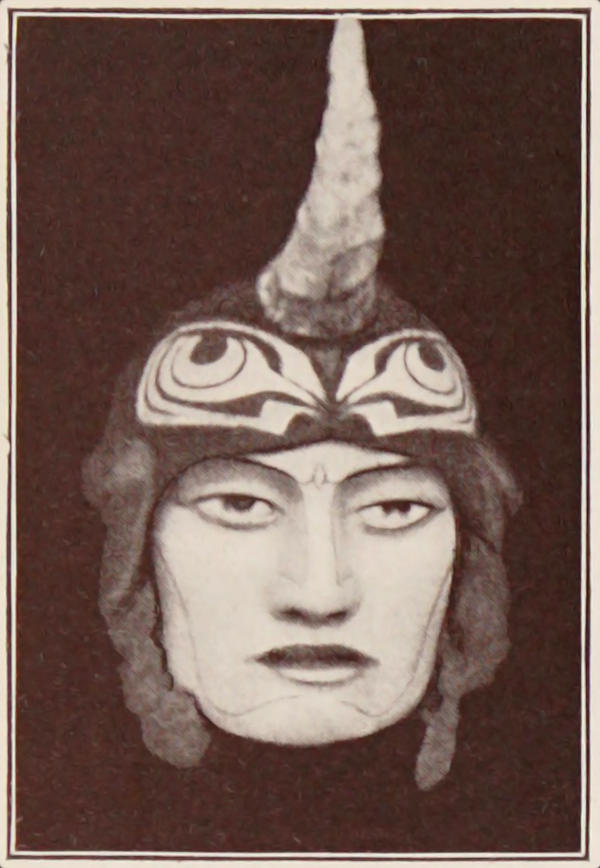
Mask for Young Man in ‘At the Hawk’s Well.’
OLD MAN. The woman of the Sidhe herself,
The mountain witch, the unappeasable shadow.
She is always flitting upon this mountain-side,
To allure or to destroy. When she has shown
Herself to the fierce women of the hills
Under that shape they offer sacrifice
And arm for battle. There falls a curse
On all who have gazed in her unmoistened eyes;
So get you gone while you have that proud step
And confident voice, for not a man alive
Has so much luck that he can play with it.
Those that have long to live should fear her most,
The old are cursed already. That curse may be
Never to win a woman’s love and keep it;
Or always to mix hatred in the love;
Or it may be that she will kill your children,
That you will find them, their throats torn and bloody,
Or you will be so maddened that you kill them
With your own hand.
350YOUNG MAN. With your own hand.Have you been set down there
To threaten all who come, and scare them off?
You seem as dried up as the leaves and sticks,
As though you had no part in life.
[GIRL gives hawk cry again.
As though you had no part in life.That cry!
There is that cry again. That woman made it,
But why does she cry out as the hawk cries?
OLD MAN. It was her mouth, and yet not she, that cried.
It was that shadow cried behind her mouth;
And now I know why she has been so stupid
All the day through, and had such heavy eyes.
Look at her shivering now, the terrible life
Is slipping through her veins. She is possessed.
Who knows whom she will murder or betray
Before she awakes in ignorance of it all,
And gathers up the leaves! But they’ll be wet;
The water will have come and gone again;
That shivering is the sign. Oh, get you gone,
At any moment now I shall hear it bubble.
351If you are good you will leave it. I am old,
And if I do not drink it now, will never;
I have been watching all my life and maybe
Only a little cupful will bubble up.
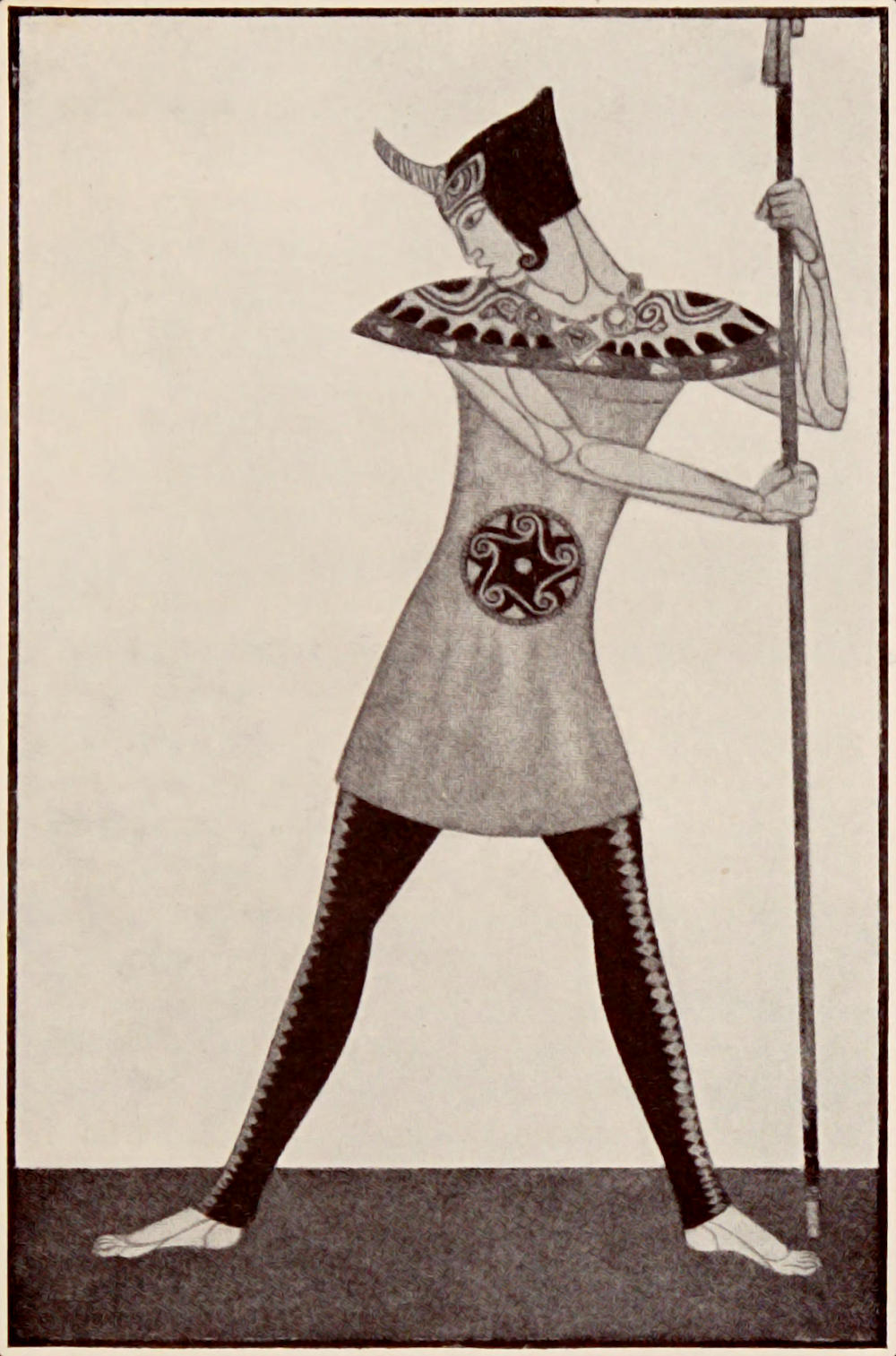
Young Man in ‘At the Hawk’s Well.’
YOUNG MAN. I’ll take it in my hands. We shall both drink,
And even if there are but a few drops,
Share them.
OLD MAN. But swear that I may drink the first;
The young are greedy, and if you drink the first
You’ll drink it all. Ah, you have looked at her;
She has felt your gaze and turned her eyes on us;
I cannot bear her eyes, they are not of this world,
Nor moist, nor faltering; they are no girl’s eyes.
[He covers his head. The GUARDIAN OF THE WELL throws off her cloak and rises. Her dress under the cloak suggests a hawk.
YOUNG MAN. Why do you gaze upon me with the eyes of a hawk?
I am not afraid of you, bird, woman, or witch.
[He goes to the side of the well, which the GUARDIAN OF THE WELL has left.
352Do what you will, I shall not leave this place
Till I have grown immortal like yourself.
[He has sat down, the GIRL has begun to dance, moving like a hawk. The OLD MAN sleeps. The dance goes on for some time.
FIRST MUSICIAN [singing or half-singing]
O God, protect me
From a horrible deathless body
Sliding through the veins of a sudden.
[The dance goes on for some time. The YOUNG MAN rises slowly.
FIRST MUSICIAN [speaking]. The madness has laid hold upon him now,
For he grows pale and staggers to his feet.
[The dance goes on.
YOUNG MAN. Run where you will,
Grey bird, you shall be perched upon my wrist,
Some were called queens and yet have been perched there.
[The dance goes on.
FIRST MUSICIAN [speaking]. I have heard water plash! it comes, it comes;
It glitters among the stones and he has heard the plash;
Look, he has turned his head.
[The Hawk has gone out. The YOUNG MAN drops his spear as if in a dream and goes out.
353MUSICIANS [singing]
He has lost what may not be found
Till men heap his burial mound
And all the history ends.
He might have lived at his ease,
An old dog’s head on his knees,
Among his children and friends.
[The OLD MAN creeps up to the well.
OLD MAN. The accursed shadows have deluded me,
The stones are dark and yet the well is empty;
The water flowed and emptied while I slept;
You have deluded me my whole life through.
Accursed dancers, you have stolen my life.
That there should be such evil in a shadow!
YOUNG MAN [entering]. She has fled from me and hidden in the rocks.
OLD MAN. She has but led you from the fountain. Look!
The stones and leaves are dark where it has flowed,
Yet there is not a drop to drink.
[The Musicians cry ‘Eofe! Eofe!’ and strike gong.
YOUNG MAN. Yet there is not a drop to drink.What are those cries?
What is that sound that runs along the hill?
Who are they that beat a sword upon a shield?
354OLD MAN. She has roused up the fierce women of the hills,
Eofe, and all her troop, to take your life,
And never till you are lying in the earth
Can you know rest.
YOUNG MAN. Can you know rest.The clash of arms again!
OLD MAN. Oh, do not go! The mountain is accursed;
Stay with me, I have nothing more to lose,
I do not now deceive you.
YOUNG MAN. I do not now deceive you.I will face them.
[He goes out no longer as if in a dream, but shouldering his spear and calling:
He comes! Cuchulain, son of Sualtam, comes!
[The Musicians stand up; one goes to centre with folded cloth. The others unfold it. While they do so they sing. During the singing, and while hidden by the cloth, the OLD MAN goes out. When the play is performed with Mr. Dulac’s music, the Musicians do not rise or unfold the cloth till after they have sung the words ‘a bitter life.’
[Songs for the unfolding and folding of the cloth.]
Come to me, human faces,
Familiar memories;
355I have found hateful eyes
Among the desolate places,
Unfaltering, unmoistened eyes.
Folly alone I cherish,
I choose it for my share;
Being but a mouthful of air,
I am content to perish;
I am but a mouthful of sweet air.
O lamentable shadows,
Obscurity of strife,
I choose a pleasant life,
Among indolent meadows;
Wisdom must live a bitter life.
[They then fold up the cloth, singing.
‘The man that I praise,’
Cries out the empty well,
‘Lives all his days
Where a hand on the bell
Can call the milch cows
To the comfortable door of his house.
Who but an idiot would praise
Dry stones in a well?
‘The man that I praise,’
Cries out the leafless tree,
‘Has married and stays
By an old hearth, and he
356On naught has set store
But children and dogs on the floor.
Who but an idiot would praise
A withered tree?’
[They go out.
THE ONLY JEALOUSY OF EMER
PERSONS OF THE PLAY
THREE MUSICIANS (their faces made up to resemble masks).
THE GHOST OF CUCHULAIN (wearing a mask).
THE FIGURE OF CUCHULAIN (wearing a mask).
EMER EITHNE INGUBA(masked, or their faces made up to resemble masks).
WOMAN OF THE SIDHE (wearing a mask).
359Enter Musicians, who are dressed and made up as in ‘At the Hawk’s Well.’ They have the same musical instruments, which can either be already upon the stage or be brought in by the FIRST MUSICIAN before he stands in the centre with the cloth between his hands, or by a player when the cloth has been unfolded. The stage as before can be against the wall of any room, and the same black cloth can be used as in ‘At the Hawk’s Well.’
[Song for the folding and unfolding of the cloth.]
FIRST MUSICIAN. A woman’s beauty is like a white
Frail bird, like a white sea-bird alone
At daybreak after stormy night
Between two furrows upon the ploughed land:
A sudden storm and it was thrown
Between dark furrows upon the ploughed land.
How many centuries spent
The sedentary soul
360In toils of measurement
Beyond eagle or mole,
Beyond hearing or seeing,
Or Archimedes’ guess,
To raise into being
That loveliness?
A strange unserviceable thing,
A fragile, exquisite, pale shell,
That the vast troubled waters bring
To the loud sands before day has broken.
The storm arose and suddenly fell
Amid the dark before day had broken.
What death? what discipline?
What bonds no man could unbind
Being imagined within
The labyrinth of the mind,
What pursuing or fleeing,
What wounds, what bloody press
Dragged into being
This loveliness?
[When the cloth is folded again the Musicians take their place against the wall. The folding of the cloth shows on one side of the stage the curtained bed or litter on which lies a man in his grave-clothes. He wears an heroic mask. Another man with exactly similar clothes and mask crouches near the front. EMER is sitting beside the bed.
361FIRST MUSICIAN [speaking]. I call before the eyes a roof
With cross-beams darkened by smoke;
A fisher’s net hangs from a beam,
A long oar lies against the wall.
I call up a poor fisher’s house;
A man lies dead or swooning,
That amorous man,
That amorous, violent man, renowned Cuchulain,
Queen Emer at his side.
At her own bidding all the rest have gone;
But now one comes on hesitating feet,
Young Eithne Inguba, Cuchulain’s mistress.
She stands a moment in the open door,
Beyond the open door the bitter sea,
The shining, bitter sea, is crying out,
[singing] White shell, white wing!
I will not choose for my friend
A frail unserviceable thing
That drifts and dreams, and but knows
That waters are without end
And that wind blows.
EMER [speaking]. Come hither, come sit down beside the bed;
You need not be afraid, for I myself
Sent for you, Eithne Inguba.
EITHNE INGUBA. Sent for you, Eithne Inguba.No, Madam,
I have too deeply wronged you to sit there.
EMER. Of all the people in the world we two,
362And we alone, may watch together here,
Because we have loved him best.
EITHNE INGUBA. Because we have loved him best.And is he dead?
EMER. Although they have dressed him out in his grave-clothes
And stretched his limbs, Cuchulain is not dead;
The very heavens when that day’s at hand,
So that his death may not lack ceremony,
Will throw out fires, and the earth grow red with blood.
There shall not be a scullion but foreknows it
Like the world’s end.
EITHNE INGUBA. How did he come to this?
EMER. Towards noon in the assembly of the kings
He met with one who seemed a while most dear.
The kings stood around; some quarrel was blown up;
He drove him out and killed him on the shore
At Baile’s tree, and he who was so killed
Was his own son begot of some wild woman
When he was young, or so I have heard it said;
And thereupon, knowing what man he had killed,
And being mad with sorrow, he ran out;
And after, to his middle in the foam
363With shield before him and with sword in hand,
He fought the deathless sea. The kings looked on
And not a king dared stretch an arm, or even
Dared call his name, but all stood wondering
In that dumb stupor like cattle in a gale,
Until at last, as though he had fixed his eyes
On a new enemy, he waded out
Until the water had swept over him;
But the waves washed his senseless image up
And laid it at this door.
EITHNE INGUBA. And laid it at this door.How pale he looks!
EMER. He is not dead.
EITHNE INGUBA. EMER. He is not dead.You have not kissed his lips
Nor laid his head upon your breast.
EMER. Nor laid his head upon your breast.It may be
An image has been put into his place,
A sea-borne log bewitched into his likeness,
Or some stark horseman grown too old to ride
Among the troops of Mananan, Son of the Sea,
Now that his joints are stiff.
EITHNE INGUBA. Now that his joints are stiff.Cry out his name.
All that are taken from our sight, they say,
Loiter amid the scenery of their lives
For certain hours or days, and should he hear
364He might, being angry, drive the changeling out.
EMER. It is hard to make them hear amid their darkness,
And it is long since I could call him home;
I am but his wife, but if you cry aloud
With that sweet voice that is so dear to him
He cannot help but listen.
EITHNE INGUBA. He cannot help but listen.He loves me best,
Being his newest love, but in the end
Will love the woman best who loved him first
And loved him through the years when love seemed lost.
EMER. I have that hope, the hope that some day somewhere
We’ll sit together at the hearth again.
EITHNE INGUBA. Women like me, the violent hour passed over,
Are flung into some corner like old nutshells.
Cuchulain, listen.
EMER. Cuchulain, listen.No, not yet, for first
I’ll cover up his face to hide the sea;
And throw new logs upon the hearth and stir
The half-burnt logs until they break in flame.
Old Mananan’s unbridled horses come
Out of the sea, and on their backs his horsemen;
But all the enchantments of the dreaming foam
365Dread the hearth-fire.
[She pulls the curtains of the bed so as to hide the sick man’s face, that the actor may change his mask unseen. She goes to one side of platform and moves her hand as though putting logs on a fire and stirring it into a blaze. While she makes these movements the Musicians play, marking the movements with drum and flute perhaps.
Having finished she stands beside the imaginary fire at a distance from CUCHULAIN and EITHNE INGUBA.
Dread the hearth-fire.Call on Cuchulain now.
EITHNE INGUBA. Can you not hear my voice?
EMER. EITHNE INGUBA. Can you not hear my voice?Bend over him;
Call out dear secrets till you have touched his heart
If he lies there; and if he is not there
Till you have made him jealous.
EITHNE INGUBA. Till you have made him jealous.Cuchulain, listen.
EMER. Those words sound timidly; to be afraid
Because his wife is but three paces off,
When there is so great a need, were but to prove
The man that chose you made but a poor choice:
366We’re but two women struggling with the sea.
EITHNE INGUBA. O my beloved, pardon me, that I
Have been ashamed and you in so great need.
I have never sent a message or called out,
Scarce had a longing for your company
But you have known and come; and if indeed
You are lying there, stretch out your arms and speak;
Open your mouth and speak, for to this hour
My company has made you talkative.
What ails your tongue, or what has closed your ears?
Our passion had not chilled when we were parted
On the pale shore under the breaking dawn.
He cannot speak: or else his ears are closed
And no sound reaches him.
EMER. And no sound reaches him.Then kiss that image;
The pressure of your mouth upon his mouth
May reach him where he is.
EITHNE INGUBA [starting back]. It is no man.
I felt some evil thing that dried my heart
When my lips touched it.
EMER. When my lips touched it.No, his body stirs;
367The pressure of your mouth has called him home;
He has thrown the changeling out.
EITHNE INGUBA [going further off]. Look at that arm;
That arm is withered to the very socket.
EMER [going up to the bed]. What do you come for; and from where?
FIGURE OF CUCHULAIN. EMER [going up to the bed]. What do you come for; and from where?I have come
From Mananan’s court upon a bridleless horse.
EMER. What one among the Sidhe has dared to lie
Upon Cuchulain’s bed and take his image?
FIGURE OF CUCHULAIN. I am named Bricriu—not the man—that Bricriu,
Maker of discord among gods and men,
Called Bricriu of the Sidhe.
EMER. Called Bricriu of the Sidhe.Come for what purpose?
FIGURE OF CUCHULAIN [sitting up parting curtain and showing its distorted face, as EITHNE INGUBA goes out]. I show my face and everything he loves
Must fly away.
EMER. Must fly away.You people of the wind
Are full of lying speech and mockery:
I have not fled your face.
FIGURE OF CUCHULAIN. You are not loved.
EMER. And therefore have no dread to meet your eyes
And to demand him of you.
368FIGURE OF CUCHULAIN. For that I have come.
You have but to pay the price and he is free.
EMER. Do the Sidhe bargain?
FIGURE OF CUCHULAIN. EMER. Do the Sidhe bargain?When they would free a captive
They take in ransom a less valued thing.
The fisher when some knowledgeable man
Restores to him his wife, or son, or daughter,
Knows he must lose a boat or net, or it may be
The cow that gives his children milk; and some
Have offered their own lives. I do not ask
Your life, or any valuable thing;
You spoke but now of the mere chance that some day
You’d be the apple of his eye again
When old and ailing, but renounce that chance
And he shall live again.
EMER. And he shall live again.I do not question
But you have brought ill luck on all he loves;
And now, because I am thrown beyond your power
Unless your words are lies, you come to bargain.
FIGURE OF CUCHULAIN. You loved your mastery, when but newly married,
And I love mine for all my withered arm;
369You have but to put yourself into that power
And he shall live again.
EMER. And he shall live again.No, never, never.
FIGURE OF CUCHULAIN. You dare not be accursed, yet he has dared.
EMER. I have but two joyous thoughts, two things I prize,
A hope, a memory, and now you claim that hope.
FIGURE OF CUCHULAIN. He’ll never sit beside you at the hearth
Or make old bones, but die of wounds and toil
On some far shore or mountain, a strange woman
Beside his mattress.
EMER. Beside his mattress.You ask for my one hope
That you may bring your curse on all about him.
FIGURE OF CUCHULAIN. You’ve watched his loves and you have not been jealous
Knowing that he would tire, but do those tire
That love the Sidhe?
EMER. That love the Sidhe?What dancer of the Sidhe,
What creature of the reeling moon has pursued him?
FIGURE OF CUCHULAIN. I have but to touch your eyes and give them sight;
But stand at my left side.
370
[He touches her eyes with his left hand, the right being withered.
EMER. But stand at my left side.My husband there.
FIGURE OF CUCHULAIN. But out of reach—I have dissolved the dark
That hid him from your eyes, but not that other
That’s hidden you from his.
EMER. That’s hidden you from his.Husband, husband!
FIGURE OF CUCHULAIN. Be silent, he is but a phantom now
And he can neither touch, nor hear, nor see;
The longing and the cries have drawn him hither.
He heard no sound, heard no articulate sound;
They could but banish rest, and make him dream,
And in that dream, as do all dreaming shades
Before they are accustomed to their freedom,
He has taken his familiar form; and yet
He crouches there not knowing where he is
Or at whose side he is crouched.
[A WOMAN OF THE SIDHE has entered and stands a little inside the door.
EMER. Or at whose side he is crouched.Who is this woman?
FIGURE OF CUCHULAIN. She has hurried from the Country-Under-Wave
And dreamed herself into that shape that he
May glitter in her basket; for the Sidhe
Are dextrous fishers and they fish for men
371With dreams upon the hook.
EMER. With dreams upon the hook.And so that woman
Has hid herself in this disguise and made
Herself into a lie.
FIGURE OF CUCHULAIN. A dream is body;
The dead move ever towards a dreamless youth
And when they dream no more return no more;
And those more holy shades that never lived
But visit you in dreams.
EMER. But visit you in dreams.I know her sort.
They find our men asleep, weary with war,
Or weary with the chase, and kiss their lips
And drop their hair upon them; from that hour
Our men, who yet knew nothing of it all,
Are lonely, and when at fall of night we press
Their hearts upon our hearts their hearts are cold.
[She draws a knife from her girdle.
FIGURE OF CUCHULAIN. And so you think to wound her with a knife.
She has an airy body. Look and listen;
I have not given you eyes and ears for nothing.
[The WOMAN OF THE SIDHE moves round the crouching GHOST OF CUCHULAIN at front of stage in a 372dance that grows gradually quicker, as he slowly awakes. At moments she may drop her hair upon his head but she does not kiss him. She is accompanied by string and flute and drum. Her mask and clothes must suggest gold or bronze or brass or silver, so that she seems more an idol than a human being. This suggestion may be repeated in her movements. Her hair, too, must keep the metallic suggestion.
GHOST OF CUCHULAIN. Who is it stands before me there
Shedding such light from limb and hair
As when the moon, complete at last
With every labouring crescent past,
And lonely with extreme delight,
Flings out upon the fifteenth night?
WOMAN OF THE SIDHE. Because I long I am not complete.
What pulled your hands about your feet
And your head down upon your knees,
And hid your face?
GHOST OF CUCHULAIN. Old memories:
A dying boy, with handsome face
Upturned upon a beaten place;
A sacred yew-tree on a strand;
A woman that held in steady hand,
In all the happiness of her youth
373Before her man had broken troth,
A burning wisp to light the door;
And many a round or crescent more;
Dead men and women. Memories
Have pulled my head upon my knees.
WOMAN OF THE SIDHE. Could you that have loved many a woman
That did not reach beyond the human,
Lacking a day to be complete,
Love one that though her heart can beat,
Lacks it but by an hour or so?
GHOST OF CUCHULAIN. I know you now, for long ago
I met you on the mountain-side,
Beside a well that seemed long dry,
Beside old thorns where the hawk flew.
I held out arms and hands; but you,
That now seem friendly, fled away
Half woman and half bird of prey.
WOMAN OF THE SIDHE. Hold out your arms and hands again;
You were not so dumbfounded when
I was that bird of prey, and yet
I am all woman now.
GHOST OF CUCHULAIN. I am not
The young and passionate man I was
And though that brilliant light surpass
All crescent forms, my memories
Weigh down my hands, abash my eyes.
WOMAN OF THE SIDHE. Then kiss my mouth. Though memory
374Be beauty’s bitterest enemy
I have no dread, for at my kiss
Memory on the moment vanishes:
Nothing but beauty can remain.
GHOST OF CUCHULAIN. Nothing but beauty can remain.And shall I never know again
Intricacies of blind remorse?
WOMAN OF THE SIDHE. Time shall seem to stay his course;
When your mouth and my mouth meet
All my round shall be complete
Imagining all its circles run;
And there shall be oblivion
Even to quench Cuchulain’s drouth,
Even to still that heart.
GHOST OF CUCHULAIN. Your mouth.
[They are about to kiss, he turns away.
O Emer, Emer.
WOMAN OF THE SIDHE. So then it is she
Made you impure with memory.
GHOST OF CUCHULAIN. Still in that dream I see you stand,
A burning wisp in your right hand,
To wait my coming to the house,
As when our parents married us.
WOMAN OF THE SIDHE. Being among the dead you love her
That valued every slut above her
While you still lived.
GHOST OF CUCHULAIN. O my lost Emer.
375WOMAN OF THE SIDHE. And there is not a loose-tongued schemer
But could draw you, if not dead,
From her table and her bed.
But what could make you fit to wive
With flesh and blood, being born to live
Where no one speaks of broken troth,
For all have washed out of their eyes
Wind-blown dirt of their memories
To improve their sight?
GHOST OF CUCHULAIN. Your mouth, your mouth.
[Their lips approach, but CUCHULAIN turns away as EMER speaks.
EMER. If but the dead will set him free
That I may speak with him at whiles
By the hearth-stone, I am content—
Content that he shall turn on me
Eyes that the cold moon, or the vague sea,
Or what I know not’s made indifferent.
GHOST OF CUCHULAIN. What a wise silence has fallen in this dark!
I know you now in all your ignorance
Of all whereby a lover’s quiet is rent.
What dread so great as that he should forget
The least chance sight or sound, or scratch or mark
On an old door, or frail bird heard and seen
In the incredible clear light love cast
All round about her some forlorn lost day?
376That face, though fine enough, is a fool’s face
And there’s a folly in the deathless Sidhe
Beyond man’s reach.
WOMAN OF THE SIDHE. I told you to forget
After my fashion; you would have none of it;
So now you may forget in a man’s fashion.
There’s an unbridled horse at the sea’s edge;
Mount; it will carry you in an eye’s wink
To where the King of Country-Under-Wave,
Old Mananan, nods above the board and moves
His chessmen in a dream. Demand your life
And come again on the unbridled horse.
GHOST OF CUCHULAIN. Forgive me those rough words. How could you know
That man is held to those whom he has loved
By pain they gave, or pain that he has given,
Intricacies of pain.
WOMAN OF THE SIDHE. I am ashamed
That being of the deathless shades I chose
A man so knotted to impurity.
[The GHOST OF CUCHULAIN goes out.
WOMAN OF THE SIDHE [to FIGURE OF CUCHULAIN]. To you that have no living light, being dropped
377From a last leprous crescent of the moon,
I owe it all.
FIGURE OF CUCHULAIN. Because you have failed
I must forego your thanks, I that took pity
Upon your love and carried out your plan
To tangle all his life and make it nothing
That he might turn to you.
WOMAN OF THE SIDHE. Was it from pity
You taught the woman to prevail against me?
FIGURE OF CUCHULAIN. You know my nature—by what name I am called.
WOMAN OF THE SIDHE. Was it from pity that you hid the truth
That men are bound to women by the wrongs
They do or suffer?
FIGURE OF CUCHULAIN. You know what being I am.
WOMAN OF THE SIDHE. I have been mocked and disobeyed—your power
Was more to you than my good-will, and now
I’ll have you learn what my ill-will can do;
I lay you under bonds upon the instant
To stand before your King and face the charge
And take the punishment.
FIGURE OF CUCHULAIN. I’ll stand there first,
And tell my story first, and Mananan
378Knows that his own harsh sea made my heart cold.
WOMAN OF THE SIDHE. My horse is there and shall outrun your horse.
[The FIGURE OF CUCHULAIN falls back, the WOMAN OF THE SIDHE goes out. Drum taps, music resembling horse hoofs.
EITHNE INGUBA [entering quickly]. I heard the beat of hoofs, but saw no horse,
And then came other hoofs, and after that
I heard low angry cries and thereupon
I ceased to be afraid.
EMER. I ceased to be afraid.Cuchulain wakes.
[The figure turns round. It once more wears the heroic mask.
CUCHULAIN. Your arms, your arms. O Eithne Inguba,
I have been in some strange place and am afraid.
[The FIRST MUSICIAN comes to the front of stage, the others from each side and unfold the cloth singing.
[Song for the unfolding and folding of the cloth.]
THE MUSICIANS
Why does your heart beat thus?
Plain to be understood
379I have met in a man’s house
A statue of solitude,
Moving there and walking;
Its strange heart beating fast
For all our talking.
O still that heart at last.
O bitter reward
Of many a tragic tomb!
And we though astonished are dumb
And give but a sigh and a word,
A passing word.
Although the door be shut
And all seem well enough,
Although wide world hold not
A man but will give you his love
The moment he has looked at you,
He that has loved the best
May turn from a statue
His too human breast.
O bitter reward
Of many a tragic tomb!
And we though astonished are dumb
Or give but a sigh and a word,
A passing word.
What makes your heart so beat?
Is there no man at your side?
When beauty is complete
380Your own thought will have died
And danger not be diminished;
Dimmed at three-quarter light
When moon’s round is finished
The stars are out of sight.
O bitter reward
Of many a tragic tomb!
And we though astonished are dumb
Or give but a sigh and a word,
A passing word.
[When the cloth is folded again the stage is bare.
THE DREAMING OF THE BONES
PERSONS OF THE PLAY
THREE MUSICIANS (their faces made up to resemble masks).
A YOUNG MAN.
A STRANGER (wearing a mask).
A YOUNG GIRL (wearing a mask).
Time—1916.
383The stage is any bare place in a room close to the wall. A screen, with a pattern of mountain and sky, can stand against the wall, or a curtain with a like pattern hang upon it, but the pattern must only symbolise or suggest. One musician enters and then two others; the first stands singing, as in preceding plays, while the others take their places. Then all three sit down against the wall by their instruments, which are already there—a drum, a zither, and a flute. Or they unfold a cloth as in ‘At the Hawk’s Well,’ while the instruments are carried in.
[Song for the folding and unfolding of the cloth.]
FIRST MUSICIAN
[or all three musicians, singing]
Why does my heart beat so?
Did not a shadow pass?
It passed by a moment ago.
Who can have trod in the grass?
What rogue is night-wandering?
384Have not old writers said
That dizzy dreams can spring
From the dry bones of the dead?
And many a night it seems
That all the valley fills
With those fantastic dreams.
They overflow the hills,
So passionate is a shade,
Like wine that fills to the top
A grey-green cup of jade,
Or maybe an agate cup.
[The three Musicians are now seated by the drum, flute, and zither at the back of the stage. The FIRST MUSICIAN speaks.
The hour before dawn and the moon covered up;
The little village of Abbey is covered up;
The little narrow trodden way that runs
From the white road to the Abbey of Corcomroe
Is covered up; and all about the hills
Are like a circle of Agate or of Jade.
Somewhere among great rocks on the scarce grass
Birds cry, they cry their loneliness.
Even the sunlight can be lonely here,
Even hot noon is lonely. I hear a footfall—
A young man with a lantern comes this way.
He seems an Aran fisher, for he wears
385The flannel bawneen and the cow-hide shoe.
He stumbles wearily, and stumbling prays.
[A young man enters, praying in Irish.
Once more the birds cry in their loneliness,
But now they wheel about our heads; and now
They have dropped on the grey stone to the northeast.
[A man and a girl, in the costume of a past time, come in. They wear heroic masks.
YOUNG MAN [raising his lantern]. Who is there? I cannot see what you are like.
Come to the light.
STRANGER. Come to the light.But what have you to fear?
YOUNG MAN. And why have you come creeping through the dark?
[The girl blows out lantern.
The wind has blown my lantern out. Where are you?
I saw a pair of heads against the sky
And lost them after; but you are in the right,
I should not be afraid in County Clare;
And should be, or should not be have no choice,
I have to put myself into your hands,
Now that my candle’s out.
STRANGER. Now that my candle’s out.You have fought in Dublin?
386YOUNG MAN. I was in the Post Office, and if taken
I shall be put against a wall and shot.
STRANGER. You know some place of refuge, have some plan
Or friend who will come to meet you?
YOUNG MAN. Or friend who will come to meet you?I am to lie
At daybreak on the mountain and keep watch
Until an Aran coracle puts in
At Muckanish or at the rocky shore
Under Finvarra, but would break my neck
If I went stumbling there alone in the dark.
STRANGER. We know the pathways that the sheep tread out,
And all the hiding-places of the hills,
And that they had better hiding-places once.
YOUNG MAN. You’d say they had better before English robbers
Cut down the trees or set them upon fire
For fear their owners might find shelter there.
What is that sound?
STRANGER. What is that sound?An old horse gone astray.
He has been wandering on the road all night.
YOUNG MAN. I took him for a man and horse. Police
Are out upon the roads. In the late Rising
I think there was no man of us but hated
To fire at soldiers who but did their duty
And were not of our race, but when a man
387Is born in Ireland and of Irish stock,
When he takes part against us—
STRANGER. When he takes part against us—I will put you safe,
No living man shall set his eyes upon you;
I will not answer for the dead.
YOUNG MAN. I will not answer for the dead.The dead?
STRANGER. For certain days the stones where you must lie
Have in the hour before the break of day Been haunted.
YOUNG MAN. But I was not born at midnight.
STRANGER. Many a man that was born in the full daylight
Can see them plain, will pass them on the high-road
Or in the crowded market-place of the town,
And never know that they have passed.
YOUNG MAN. And never know that they have passed.My Grandam
Would have it they did penance everywhere;
Some lived through their old lives again.
STRANGER. Some lived through their old lives again.In a dream;
And some for an old scruple must hang spitted
Upon the swaying tops of lofty trees;
Some are consumed in fire, some withered up
By hail and sleet out of the wintry North,
And some but live through their old lives again.
388YOUNG MAN. Well, let them dream into what shape they please
And fill waste mountains with the invisible tumult
Of the fantastic conscience. I have no dread;
They cannot put me into jail or shoot me,
And seeing that their blood has returned to fields,
That have grown red from drinking blood like mine,
They would not if they could betray.
STRANGER. They would not if they could betray.This pathway
Runs to the ruined Abbey of Corcomroe;
The Abbey passed, we are soon among the stone
And shall be at the ridge before the cocks
Of Aughanish or Bailevelehan
Or grey Aughtmana shake their wings and cry.
[They go round the stage once.
FIRST MUSICIAN [speaking]. They’ve passed the shallow well and the flat stone
Fouled by the drinking cattle, the narrow lane
Where mourners for five centuries have carried
Noble or peasant to his burial;
An owl is crying out above their heads.
389[Singing.]
Why should the heart take fright?
What sets it beating so?
The bitter sweetness of the night
Has made it but a lonely thing.
Red bird of March, begin to crow,
Up with the neck and clap the wing,
Red cock, and crow.
[They go round the stage once. The FIRST MUSICIAN speaks.
And now they have climbed through the long grassy field
And passed the ragged thorn trees and the gap
In the ancient hedge; and the tomb-nested owl
At the foot’s level beats with a vague wing.
[Singing.]
My head is in a cloud;
I’d let the whole world go;
My rascal heart is proud
Remembering and remembering.
Red bird of March, begin to crow,
Up with the neck and clap the wing,
Red cock, and crow.
[They go round the stage once. The FIRST MUSICIAN speaks.
They are among the stones above the ash
Above the briar and thorn and the scarce grass;
390Hidden amid the shadow far below them
The cat-headed bird is crying out.
[Singing.]
The dreaming bones cry out
Because the night winds blow
And heaven’s a cloudy blot.
Calamity can have its fling.
Red bird of March, begin to crow,
Up with the neck and clap the wing,
Red cock, and crow.
STRANGER. We’re almost at the summit and can rest.
The road is a faint shadow there; and there
The Abbey lies amid its broken tombs.
In the old days we should have heard a bell
Calling the monks before day broke to pray;
And when the day has broken on the ridge,
The crowing of its cocks.
YOUNG MAN. The crowing of its cocks.Is there no house
Famous for sanctity or architectural beauty
In Clare or Kerry, or in all wide Connacht,
The enemy has not unroofed?
STRANGER. The enemy has not unroofed?Close to the altar
Broken by wind and frost and worn by time
Donogh O’Brien has a tomb, a name in Latin.
He wore fine clothes and knew the secrets of women,
391But he rebelled against the King of Thomond
And died in his youth.
YOUNG MAN. And died in his youth.And why should he rebel?
The King of Thomond was his rightful master.
It was men like Donogh who made Ireland weak—
My curse on all that troop, and when I die
I’ll leave my body, if I have any choice,
Far from his ivy tod and his owl; have those
Who, if your tale is true, work out a penance
Upon the mountain-top where I am to hide,
Come from the Abbey graveyard?
YOUNG GIRL. Come from the Abbey graveyard?They have not that luck,
But are more lonely; those that are buried there,
Warred in the heat of the blood; if they were rebels
Some momentary impulse made them rebels,
Or the commandment of some petty king
Who hated Thomond. Being but common sinners,
No callers in of the alien from oversea,
They and their enemies of Thomond’s party
Mix in a brief dream battle above their bones;
Or make one drove; or drift in amity;
Or in the hurry of the heavenly round
Forget their earthly names. These are alone
Being accursed.
YOUNG MAN. But if what seems is true
392And there are more upon the other side
Than on this side of death, many a ghost
Must meet them face to face and pass the word
Even upon this grey and desolate hill.
YOUNG GIRL. Until this hour no ghost or living man
Has spoken though seven centuries have run
Since they, weary of life and of men’s eyes,
Flung down their bones in some forgotten place
Being accursed.
YOUNG MAN. I have heard that there are souls
Who, having sinned after a monstrous fashion,
Take on them, being dead, a monstrous image
To drive the living, should they meet its face,
Crazy, and be a terror to the dead.
YOUNG GIRL. Crazy, and be a terror to the dead.But these
Were comely even in their middle life
And carry, now that they are dead, the image
Of their first youth, for it was in that youth
Their sin began.
YOUNG MAN. I have heard of angry ghosts
Who wander in a wilful solitude.
YOUNG GIRL. These have no thought but love; nor joy
But that upon the instant when their penance
393Draws to its height and when two hearts are wrung
Nearest to breaking, if hearts of shadows break,
His eyes can mix with hers; nor any pang
That is so bitter as that double glance,
Being accursed.
YOUNG MAN. But what is this strange penance—
That when their eyes have met can wring them most?
YOUNG GIRL. Though eyes can meet, their lips can never meet.
YOUNG MAN. And yet it seems they wander side by side.
But doubtless you would say that when lips meet
And have not living nerves, it is no meeting.
YOUNG GIRL. Although they have no blood, or living nerves,
Who once lay warm and live the live-long night
In one another’s arms, and knew their part
In life, being now but of the people of dreams,
Is a dream’s part; although they are but shadows,
Hovering between a thorn tree and a stone,
Who have heaped up night on winged night; although
No shade however harried and consumed
394Would change his own calamity for theirs,
Their manner of life were blessed could their lips
A moment meet; but when he has bent his head
Close to her head, or hand would slip in hand,
The memory of their crime flows up between
And drives them apart.
YOUNG MAN. And drives them apart.The memory of a crime—
He took her from a husband’s house it may be,
But does the penance for a passionate sin
Last for so many centuries?
YOUNG GIRL. Last for so many centuries?No, no;
The man she chose, the man she was chosen by
Cared little and cares little from whose house
They fled towards dawn amid the flights of arrows,
Or that it was a husband’s and a king’s;
And how, if that were all, could she lack friends,
On crowded roads or on the unpeopled hill?
Helen herself had opened wide the door
Where night by night she dreams herself awake
And gathers to her breast a dreaming man.
YOUNG MAN. What crime can stay so in the memory?
395What crime can keep apart the lips of lovers
Wandering and alone?
YOUNG GIRL. Wandering and alone?Her king and lover
Was overthrown in battle by her husband,
And for her sake and for his own, being blind
And bitter and bitterly in love, he brought
A foreign army from across the sea.
YOUNG MAN. You speak of Dermot and of Dervorgilla
Who brought the Norman in?
YOUNG GIRL. Who brought the Norman in?Yes, yes, I spoke
Of that most miserable, most accursed pair
Who sold their country into slavery, and yet
They were not wholly miserable and accursed
If somebody of their race at last would say:
‘I have forgiven them.’
YOUNG MAN. ‘I have forgiven them.’Oh, never, never
Shall Dermot and Dervorgilla be forgiven.
YOUNG GIRL. If some one of their race forgave at last
Lip would be pressed on lip.
YOUNG MAN. Lip would be pressed on lip.Oh, never, never
Shall Dermot and Dervorgilla be forgiven.
You have told your story well, so well indeed
I could not help but fall into the mood
And for a while believe that it was true
Or half believe; but better push on now.
The horizon to the East is growing bright.
[They go round stage once. The musicians play.
396So here we’re on the summit. I can see
The Aran Islands, Connemara Hills,
And Galway in the breaking light; there too
The enemy has toppled roof and gable;
And torn the panelling from ancient rooms;
What generations of old men had known
Like their own hands, and children wondered at,
Has boiled a trooper’s porridge. That town had lain,
But for the pair that you would have me pardon,
Amid its gables and its battlements
Like any old admired Italian town;
For though we have neither coal, nor iron ore,
To make us wealthy and corrupt the air,
Our country, if that crime were uncommitted,
Had been most beautiful. Why do you dance?
Why do you gaze, and with so passionate eyes,
One on the other; and then turn away,
Covering your eyes, and weave it in a dance?
Who are you? what are you? you are not natural.
YOUNG GIRL. Seven hundred years our lips have never met.
YOUNG MAN. Why do you look so strangely at one another,
397So strangely and so sweetly?
YOUNG GIRL. So strangely and so sweetly?Seven hundred years.
YOUNG MAN. So strangely and so sweetly. All the ruin,
All, all their handiwork is blown away
As though the mountain air had blown it away
Because their eyes have met. They cannot hear,
Being folded up and hidden in their dance.
The dance is changing now. They have dropped their eyes,
They have covered up their eyes as though their hearts
Had suddenly been broken—never, never
Shall Dermot and Dervorgilla be forgiven.
They have drifted in the dance from rock to rock.
They have raised their hands as though to snatch the sleep
That lingers always in the abyss of the sky
Though they can never reach it. A cloud floats up
And covers all the mountain head in a moment;
And now it lifts and they are swept away.
[The STRANGER and the YOUNG GIRL go out.
I had almost yielded and forgiven it all—
This is indeed a place of terrible temptation.
398
[The Musicians begin unfolding and folding a black cloth. The FIRST MUSICIAN comes forward to the front of the stage, at the centre. He holds the cloth before him. The other two come one on either side and unfold it. They afterwards fold it up in the same way. While it is unfolded, the YOUNG MAN leaves the stage.
[Songs for the unfolding and folding of the cloth.]
THE MUSICIANS [singing]
I
At the grey round of the hill
Music of a lost kingdom
Runs, runs and is suddenly still.
The winds out of Clare-Galway
Carry it: suddenly it is still.
I have heard in the night air
A wandering airy music;
And moidered in that snare
A man is lost of a sudden,
In that sweet wandering snare.
What finger first began
Music of a lost kingdom?
They dream that laughed in the sun.
Dry bones that dream are bitter,
They dream and darken our sun.
399Those crazy fingers play
A wandering airy music;
Our luck is withered away,
And wheat in the wheat-ear withered,
And the wind blows it away.
II
My heart ran wild when it heard
The curlew cry before dawn
And the eddying cat-headed bird;
But now the night is gone.
I have heard from far below
The strong March birds a-crow,
Stretch neck and clap the wing,
Red cocks, and crow.
CALVARY
PERSONS OF THE PLAY
THREE MUSICIANS (their faces made up to resemble masks).
CHRIST (wearing a mask).
LAZARUS (wearing a mask).
JUDAS (wearing a mask).
THREE ROMAN SOLDIERS (their faces masked or made up to resemble masks).
403At the beginning of the play the FIRST MUSICIAN comes to the front of the bare place, round three sides of which the audience are seated, with a folded cloth hanging from his joined hands. Two other musicians come, as in the preceding plays, one from either side, and unfold the cloth so that it shuts out the stage, and then fold it again, singing and moving rhythmically. They do the same at the end of the play, which enables the players to leave the stage unseen.
[Song for the folding and the unfolding of the cloth]
FIRST MUSICIAN
Motionless under the moon-beam,
Up to his feathers in the stream;
Although fish leap, the white heron
Shivers in a dumbfounded dream.
SECOND MUSICIAN
God has not died for the white heron.
THIRD MUSICIAN
Although half famished he’ll not dare
Dip or do anything but stare
404Upon the glittering image of a heron,
That now is lost and now is there.
SECOND MUSICIAN
God has not died for the white heron.
FIRST MUSICIAN
But that the full is shortly gone
And after that is crescent moon,
It’s certain that the moon-crazed heron
Would be but fishes’ diet soon.
SECOND MUSICIAN
God has not died for the white heron.
[The three musicians are now seated by the drum, flute, and zither at the back of stage.
FIRST MUSICIAN. The road to Calvary, and I beside it
Upon an ancient stone. Good Friday’s come,
The day whereon Christ dreams His passion through.
He climbs up hither but as a dreamer climbs.
The cross that but exists because He dreams it
Shortens His breath and wears away His strength.
And now He stands amid a mocking crowd,
Heavily breathing.
405
[A player with the mask of Christ and carrying a cross has entered and now stands leaning upon the cross.
Heavily breathing.Those that are behind
Climb on the shoulders of the men in front
To shout their mockery: ‘Work a miracle,’
Cries one, and ‘Save yourself’; another cries,
‘Call on your father now before your bones
Have been picked bare by the great desert birds’;
Another cries, ‘Call out with a loud voice
And tell him that his son is cast away
Amid the mockery of his enemies.’
[Singing]
Oh, but the mockers’ cry
Makes my heart afraid,
As though a flute of bone
Taken from a heron’s thigh,
A heron crazed by the moon,
Were cleverly, softly played.
[Speaking]
Who is this from whom the crowd has shrunk,
As though he had some look that terrified?
He has a deathly face, and yet he moves
Like a young foal that sees the hunt go by
And races in the field.
[A player with the mask of Lazarus has entered.
406LAZARUS. And races in the field.He raised me up.
I am the man that died and was raised up;
I am called Lazarus.
CHRIST. I am called Lazarus.Seeing that you died,
Lay in the tomb four days and were raised up,
You will not mock at me.
LAZARUS. You will not mock at me.For four whole days
I had been dead and I was lying still
In an old comfortable mountain cavern
When you came climbing there with a great crowd
And dragged me to the light.
CHRIST. And dragged me to the light.I called your name.
‘Lazarus, come out,’ I said, and you came out
Bound up in cloths, your face bound in a cloth.
LAZARUS. You took my death, give me your death instead.
CHRIST. I gave you life.
LAZARUS. CHRIST. I gave you life.But death is what I ask.
Alive I never could escape your love,
And when I sickened towards my death I thought
I’ll to the desert, or chuckle in a corner
Mere ghost, a solitary thing. I died
And saw no more until I saw you stand
In the opening of the tomb; ‘Come out!’ you called;
You dragged me to the light as boys drag out
407A rabbit when they have dug its hole away;
And now with all the shouting at your heels
You travel towards the death I am denied.
And that is why I have hurried to this road;
And that is why I claim your death.
CHRIST. And that is why I claim your death.I have conquered death
And all the dead shall be raised up again.
LAZARUS. Then what I heard is true. I thought to die
When my allotted years ran out again;
And that, being gone, you could not hinder it;
But now you will blind with light the solitude
That death has made; you will disturb that corner
Where I had thought I might lie safe for ever.
CHRIST. I do my Father’s will.
LAZARUS. CHRIST. I do my Father’s will.And not your own;
And I was free four days, four days being dead.
Climb up to Calvary, but turn your eyes
From Lazarus that cannot find a tomb
Although he search all height and depth: make way,
Make way for Lazarus that must go search
Among the desert places where there is nothing
But howling wind and solitary birds.
[He goes out.
408FIRST MUSICIAN. The crowd shrinks backward from the face that seems
Death stricken and death hungry still; and now
Martha, and those three Marys, and the rest
That live but in His love are gathered round Him.
He holds His right arm out, and on His arm
Their lips are pressed and their tears fall; and now
They cast them on the ground before His dirty
Blood-dabbled feet and clean them with their hair.
[Sings]
Take but His love away
Their love becomes a feather
Of eagle, swan or gull,
Or a drowned heron’s feather
Tossed hither and thither
Upon the bitter spray
And the moon at the full.
CHRIST. I felt their hair upon my feet a moment
And then they fled away—why have they fled?
Why has the street grown empty of a sudden
As though all fled from it in terror?
JUDAS [who has just entered]. I am Judas
409That sold you for the thirty pieces of silver.
CHRIST. You were beside me every day, and saw
The dead raised up and blind men given their sight,
And all that I have said and taught you have known,
Yet doubt that I am God.
JUDAS. Yet doubt that I am God.I have not doubted;
I knew it from the first moment that I saw you;
I had no need of miracles to prove it.
CHRIST. And yet you have betrayed me.
JUDAS. CHRIST. And yet you have betrayed me.I have betrayed you
Because you seemed all-powerful.
CHRIST. Because you seemed all-powerful.My Father
Even now, if I were but to whisper it,
Would break the world in His miraculous fury
To set me free.
JUDAS. To set me free.And is there not one man
In the wide world that is not in your power?
CHRIST. My Father put all men into my hands.
JUDAS. That was the very thought that drove me wild,
I could not bear to think you had but to whistle
And I must do; but after that I thought
Whatever man betrays Him will be free;
And life grew bearable again. And now
410Is there a secret left I do not know,
Knowing that if a man betrays a God
He is the stronger of the two.
CHRIST. He is the stronger of the two.But if
’Twere the commandment of that God Himself
That God were still the stronger?
JUDAS. That God were still the stronger?When I planned it
There was no live thing near me but a heron
So full of itself that it seemed terrified.
CHRIST. But my betrayal was decreed that hour
When the foundations of the world were laid.
JUDAS. It was decreed that somebody betray you—
I’d thought of that—but not that I should do it,
I the man Judas, born on such a day,
In such a village, such and such his parents;
Nor that I’d go with my old coat upon me
To the High Priest, and chuckle to myself
As people chuckle when alone, and that I’d do it
For thirty pieces and no more, no less,
And neither with a nod, a look, nor a sent message,
But with a kiss upon your cheek. I did it,
I, Judas, and no other man, and now
You cannot even save me.
CHRIST. You cannot even save me.Begone from me.
411Three Roman soldiers have entered.
FIRST ROMAN SOLDIER. He has been chosen to hold up the cross.
[During what follows, JUDAS holds up the cross while CHRIST stands with His arms stretched out upon it.
SECOND ROMAN SOLDIER. We’ll keep the rest away; they are too persistent;
They are always wanting something.
THIRD ROMAN SOLDIER. They are always wanting something.Die in peace.
There’s no one here but Judas and ourselves.
CHRIST. And who are you that ask your God for nothing?
THIRD ROMAN SOLDIER. We are the gamblers, and when you are dead
We’ll settle who is to have that cloak of yours
By throwing dice.
SECOND ROMAN SOLDIER. Our dice were carved
Out of an old sheep’s thigh at Ephesus.
FIRST ROMAN SOLDIER. Although but one of us can win the cloak
That will not make us quarrel; what does it matter?
One day one loses and the next day wins.
SECOND ROMAN SOLDIER. Whatever happens is the best we say
So that it’s unexpected.
412THIRD ROMAN SOLDIER. Had you sent
A crier through the world you had not found
More comfortable companions for a death-bed
Than three old gamblers that have asked for nothing.
FIRST ROMAN SOLDIER. They say you’re good and that you made the world,
But it’s no matter.
SECOND ROMAN SOLDIER. Come; now let us dance
The dance of the dice-throwers, for it may be
He cannot live much longer and has not seen it.
THIRD ROMAN SOLDIER. If he were but the God of dice he’d know it,
But he is not that God.
FIRST ROMAN SOLDIER. One thing is plain,
To know that he has nothing that we need
Must be a comfort to him.
SECOND ROMAN SOLDIER. In the dance
We quarrel for a while, but settle it
By throwing dice, and after that, being friends,
Join hand to hand and wheel about the cross.
[They dance.
CHRIST. My Father, why hast Thou forsaken Me.
413[Song of the folding and unfolding of the cloth]
FIRST MUSICIAN
Lonely the sea-bird lies at her rest
Blown like a dawn-blenched parcel of spray
Upon the wind, or follows her prey
Under a great wave’s hollowing crest.
SECOND MUSICIAN
God has not appeared to the birds.
THIRD MUSICIAN
The geer-eagle has chosen his part
In blue deep of the upper air
Where one-eyed day can meet his stare;
He is content with his savage heart.
SECOND MUSICIAN
God has not appeared to the birds.
FIRST MUSICIAN
But where have last year’s cygnets gone?
The lake is empty; why do they fling
White wing out beside white wing?
What can a swan need but a swan?
SECOND MUSICIAN
God has not appeared to the birds.
NOTES AND MUSIC
417
NOTE ON THE FIRST PERFORMANCE OF ‘AT THE HAWK’S WELL’
A couple of years ago I was sitting in my stall at the Court Theatre in London watching one of my own plays, The King’s Threshold. In front of me were three people, seemingly a husband, a wife, and a woman friend. The husband was bored; he yawned and stretched himself and shifted in his seat, and I watched him with distress. I was inclined to be angry, but reminded myself that music, where there are no satisfying audible words, bores me as much, for I have no ear or only a primitive ear. Presently when the little princesses came upon the stage in their red clothes, the woman friend, who had seemed also a little bored, said: ‘They do things very well,’ and became attentive. The distinguished painter who had designed the clothes at any rate could interest her. The wife, who had sat motionless from the first, said when the curtain had fallen and the applause—was it politeness or enthusiasm?—had come to an end, ‘I would not have missed it for the world.’ She was perhaps a reader of my poetry who had persuaded the others to come, and she had found a pleasure, the book could not give her, in the combination of words and speech. Yet when I think of my play, I do not call her to the mind’s eye, or even her friend who found the long red gloves of the little princesses amusing, but always that bored man; the worst of it is that I could not pay my players, or the seamstress, or the owner of the stage, unless I could draw to my plays those who prefer light amusement 418or have no ear for verse, and fortunately they are all very polite.
Being sensitive, or not knowing how to escape the chance of sitting behind the wrong people, I have begun to shrink from sending my muses where they are but half-welcomed; and even in Dublin, where the pit has an ear for verse, I have no longer the appetite to carry me through the daily rehearsals. Yet I need a theatre; I believe myself to be a dramatist; I desire to show events and not merely tell of them: and two of my best friends were won for me by my plays, and I seem to myself most alive at the moment when a room full of people share the one lofty emotion. My blunder has been that I did not discover in my youth that my theatre must be the ancient theatre that can be made by unrolling a carpet or marking out a place with a stick, or setting a screen against the wall. Certainly those who care for my kind of poetry must be numerous enough, if I can bring them together, to pay half-a-dozen players who can bring all their properties in a cab and perform in their leisure moments.
I have found my first model—and in literature if we would not be parvenus we must have a model—in the ‘Noh’ stage of aristocratic Japan. I have described in Certain Noble Plays of Japan what has seemed to me important on that most subtle stage. I do not think of my discovery as mere economy, for it has been a great gain to get rid of scenery, to substitute for a crude landscape painted upon canvas three performers who, sitting before the wall or a patterned screen, describe landscape or event, and accompany movement with drum and gong, or deepen the emotion of the words with zither or flute. Painted scenery after all is unnecessary to my friends and to myself, for our imagination kept living by the arts can imagine a mountain covered with thorn-trees in a 419drawing-room without any great trouble, and we have many quarrels with even good scene-painting.
Then too the masks forced upon us by the absence of any special lighting, or by the nearness of the audience, who surround the players upon three sides, do not seem to us eccentric. We are accustomed to faces of bronze and of marble, and what could be more suitable than that Cuchulain, let us say, a half-supernatural legendary person, should show to us a face, not made before the looking-glass by some leading player—there too we have many quarrels—but moulded by some distinguished artist? We are a learned people, and we remember how the Roman theatre, when it became more intellectual, abandoned ‘make-up’ and used the mask instead, and that the most famous artists of Japan modelled masks that are still in use after hundreds of years. It would be a stirring adventure for a poet and an artist, working together, to create once more heroic or grotesque types that, keeping always an appropriate distance from life, would seem images of those profound emotions that exist only in solitude and in silence. Nor has any one told me after a performance that he has missed a changing facial expression, for the mask seems to change with the light that falls upon it, and besides, in poetical and tragic art, as every ‘producer’ knows, expression is mainly in those movements that are of the entire body.
At the Hawk’s Well was performed for the first time in April, 1916, in a friend’s drawing-room, and only those who cared for poetry were invited. It was played upon the floor, and the players came in by the same door as the audience, and the audience and the players and I myself were pleased. A few days later it was revived in Lady Islington’s big drawing-room at Chesterfield Gardens for the benefit of a war charity. And round the platform upon three 420sides were three hundred fashionable people, and once more my muses were but half welcome. I remember, however, with a little pleasure that we found a newspaper photographer planting his camera in a dressing-room, and explained to him that as fifty people could pay our expenses, we did not invite the press, and that flashlight photographs were not desirable for their own sake. He was incredulous and persistent—a whole page somewhere or other was at our disposal—and it was nearly ten minutes before we could persuade him to go away. What a relief after directing a theatre for so many years—for I am one of the two directors of the Abbey Theatre in Dublin—to think no more of pictures unless Mr. Dulac or some other distinguished man has made them, nor of all those paragraphs written by young men, perhaps themselves intelligent, who must applaud the common taste or starve!
Perhaps I shall turn to something else now that our Japanese dancer, Mr. Itow, whose minute intensity of movement in the dance of the hawk so well suited our small room and private art, has been hired by a New York theatre, or perhaps I shall find another dancer. I am certain, however, that whether I grow tired or not—and one does grow tired of always quarrying the stone for one’s statue—I have found out the only way the subtler forms of literature can find dramatic expression. Shakespeare’s art was public, now resounding and declamatory, now lyrical and subtle, but always public, because poetry was a part of the general life of a people who had been trained by the Church to listen to difficult words, and who sang, instead of the songs of the music-halls, many songs that are still beautiful. A man who had sung ‘Barbara Allan’ in his own house would not, as I have heard the gallery of the Lyceum Theatre, receive the love speeches of Juliet with an ironical chirruping. 421We must recognise the change as the painters did when, finding no longer palaces and churches to decorate, they made framed pictures to hang upon a wall. Whatever we lose in mass and in power we should recover in elegance and in subtlety. Our lyrical and our narrative poetry alike have used their freedom and have approached nearer, as Pater said all the arts would if they were able, to ‘the condition of music’; and if our modern poetical drama has failed, it is mainly because, always dominated by the example of Shakespeare, it would restore an irrevocable past.
W. B. Y., 1916.
422
MUSIC FOR ‘AT THE HAWK’S WELL’[18]
By EDMUND DULAC
A Note on the Instruments
In order to apply to the music the idea of great simplicity of execution underlying the whole spirit of the performance, it was necessary to use instruments that any one with a fair idea of music could learn in a few days.
The following offer hardly any difficulty, while they provide a sufficient background of simple sounds which the performer can, after a very little amount of practice, elaborate at will.
A plain bamboo flute giving the appropriate scale.
A harp, a drum and a gong. For these last two, any instruments on oriental lines with a good shape and a deep mellow sound.
For the harp an ordinary zither, such as shown in the design of the musician, can be used. The strings, beginning by the lower ones, are grouped in nine or ten chords of four notes consisting of: the key-note, two strings in unison giving the fifth above, and the octave of the key-note.
Ex.:
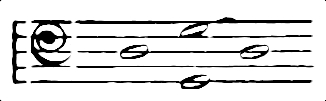
Audio content is not currently supported on your device.
[Download as MusicXML]
Beyond these chords there are seven double strings tuned to any pentatonic scale that suits the play.
The tuning of the chords and free strings would 423be altered according to the performance, and several flutes giving different scales would be required.
The same chords and scales should be used throughout any one play.
The instruments are distributed as follows: one musician plays the drum and gong, one the flute, the singer takes the harp.
The drum and the gong must be used at times during the performance to emphasise the spoken word; no definite notation of this can be given, and it is left to the imagination and taste of the musician.
SCALES FOR THE INSTRUMENTS
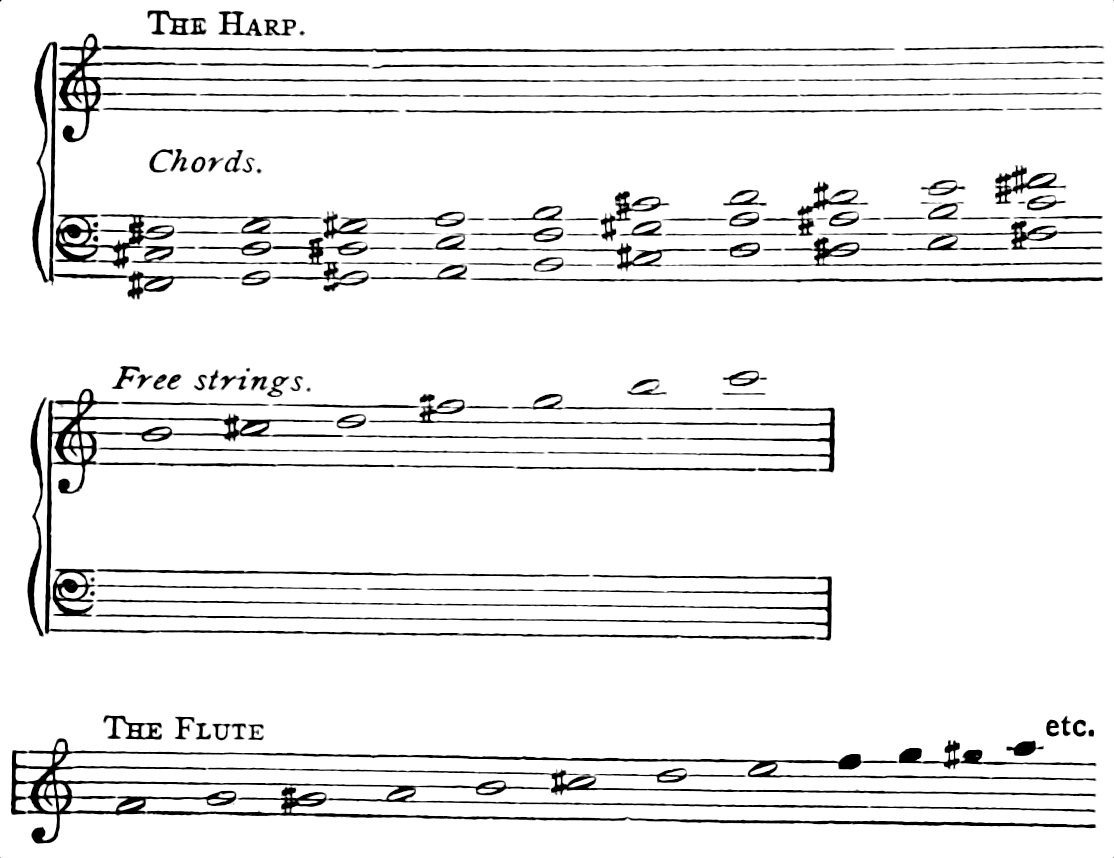
The Harp: Chords.
Audio content is not currently supported on your device.
[Download as MusicXML]
The Harp: Free strings
Audio content is not currently supported on your device.
[Download as MusicXML]
The Flute
Audio content is not currently supported on your device.
[Download as MusicXML]
424MUSIC FOR “AT THE HAWK’S WELL”
To be sung without accompaniment as they unfold the curtain.









Audio content is not currently supported on your device.
[Download as MusicXML]
425To be sung as they sit down
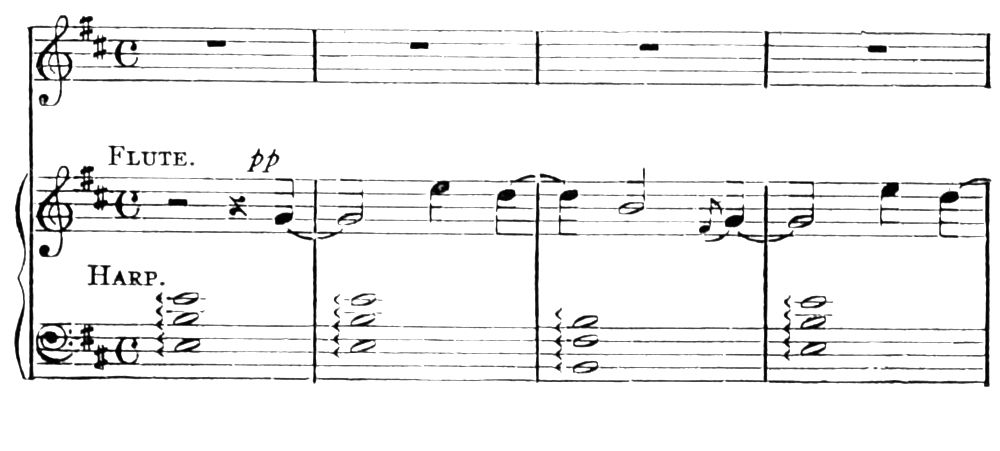
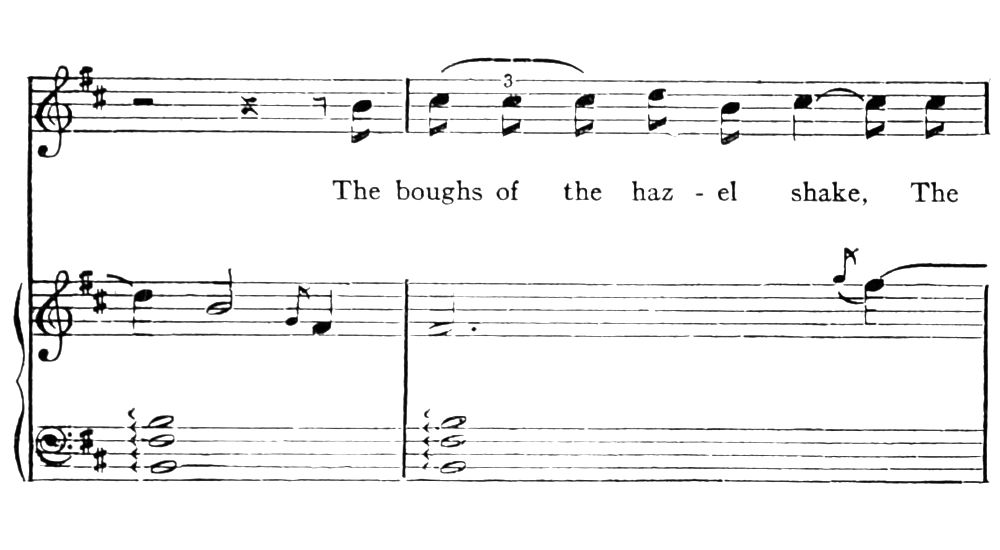
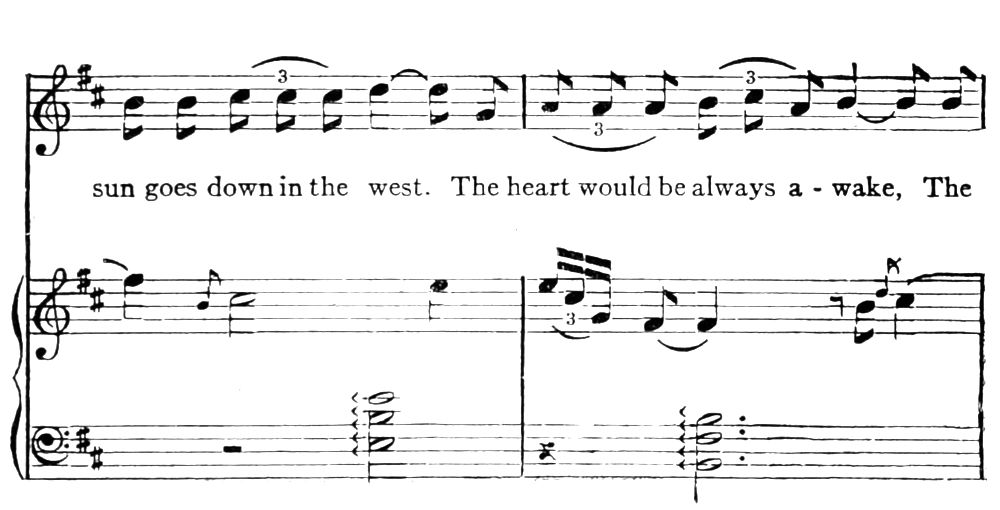
426
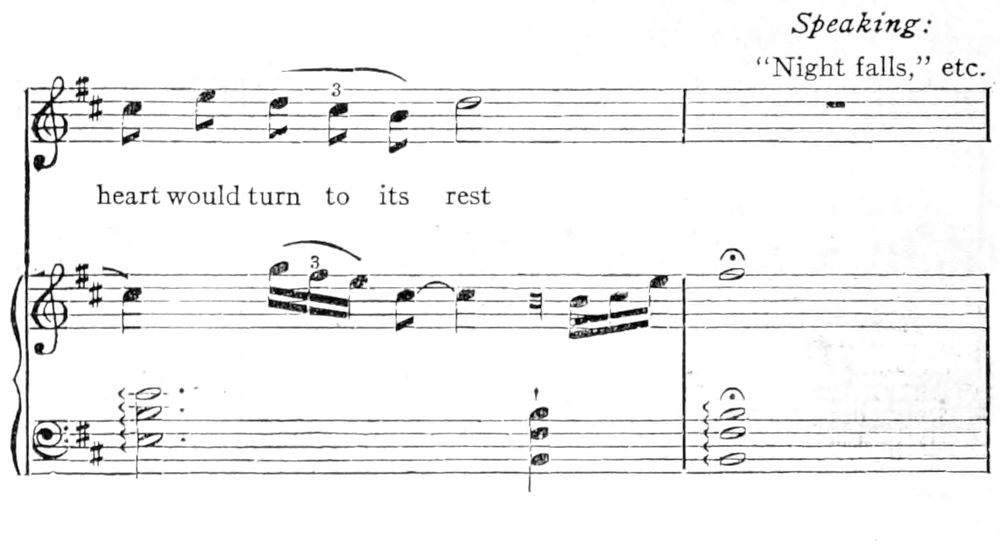
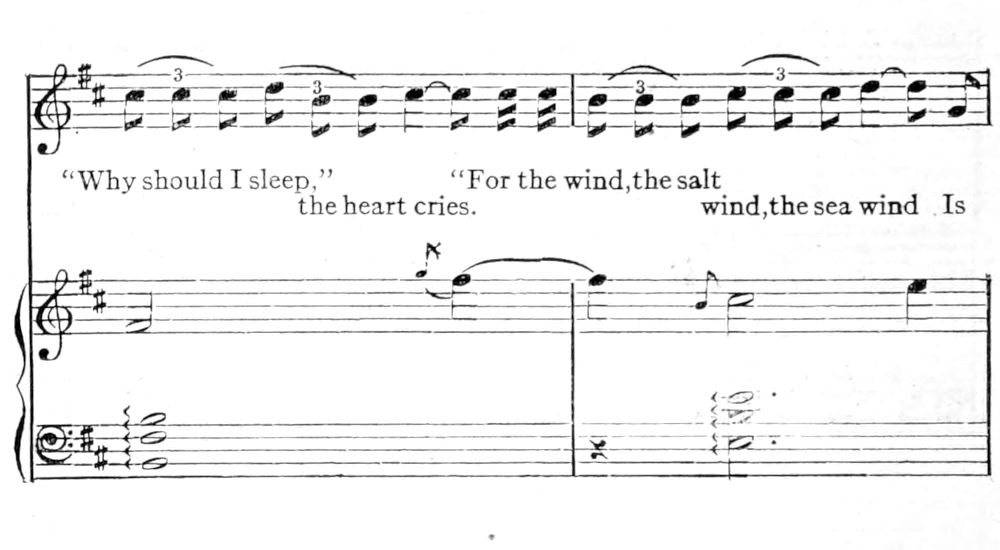
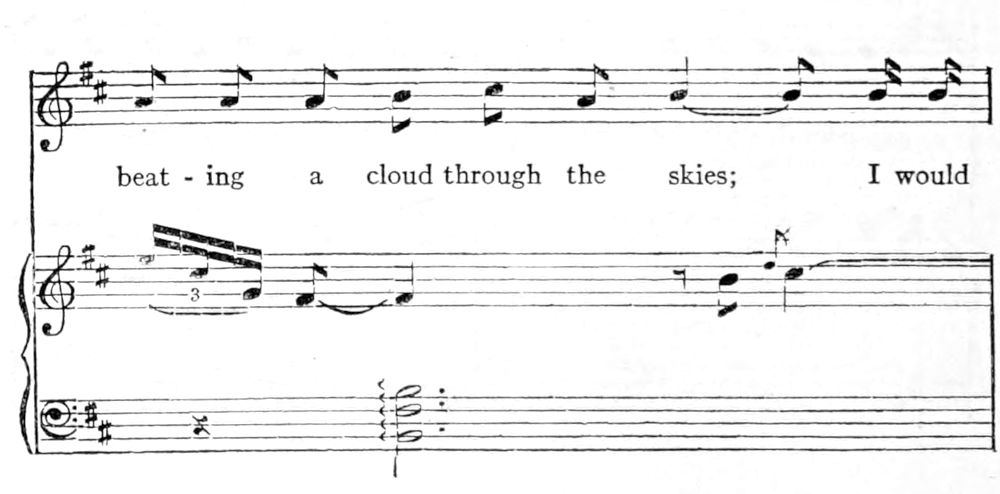
427
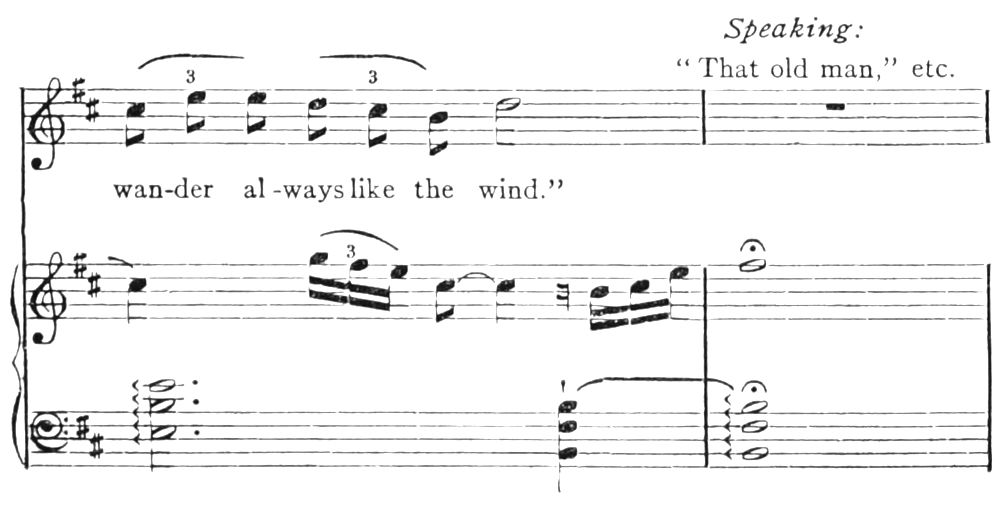
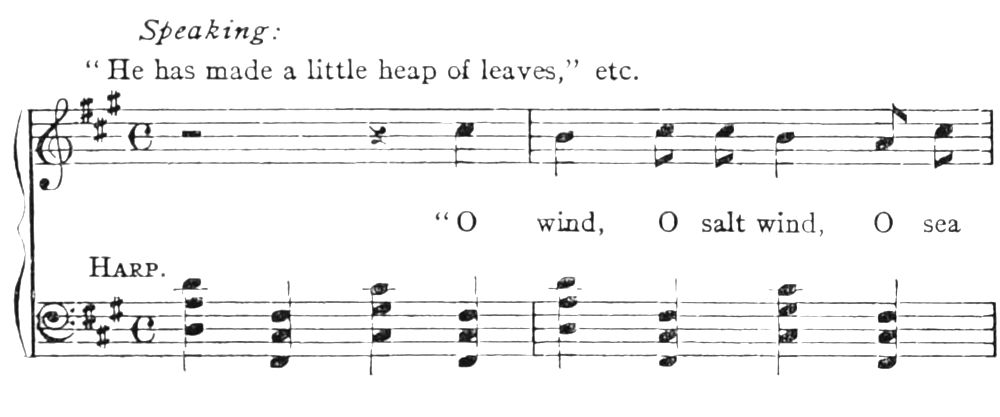
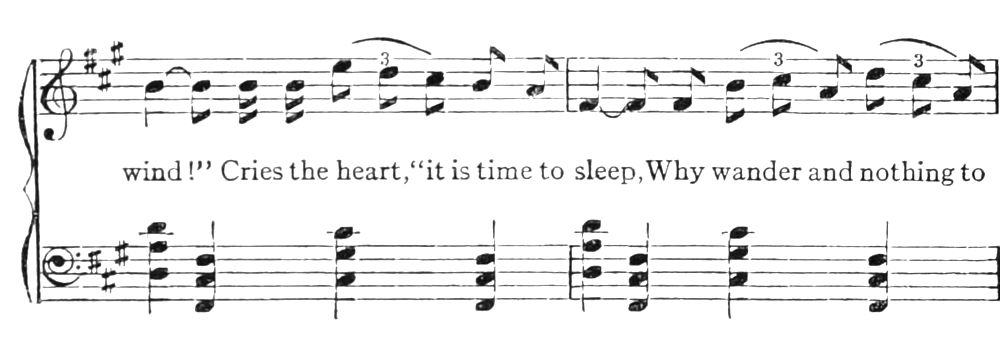
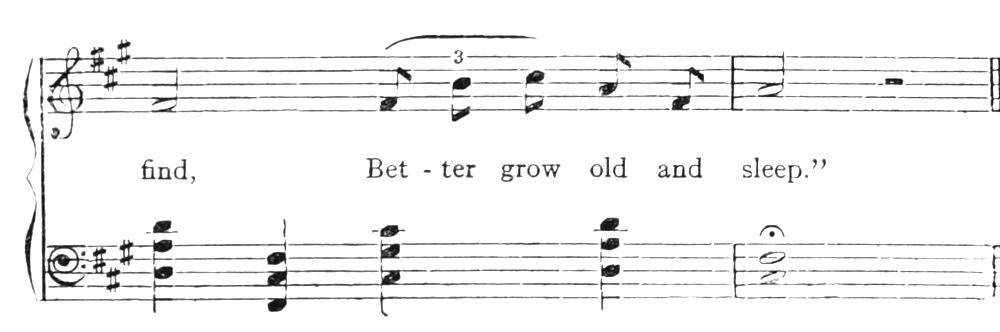
Audio content is not currently supported on your device.
[Download as MusicXML]
428PRELUDE TO THE DANCE
To begin when the Young Man says:
“Ah, you have looked at her….”]
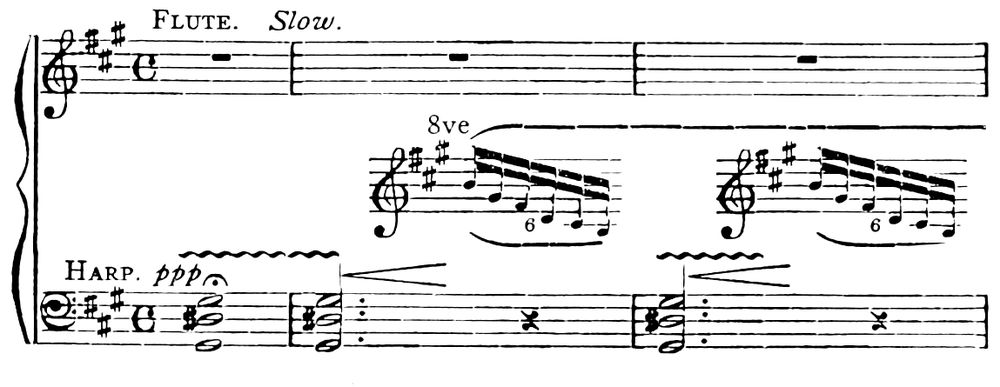
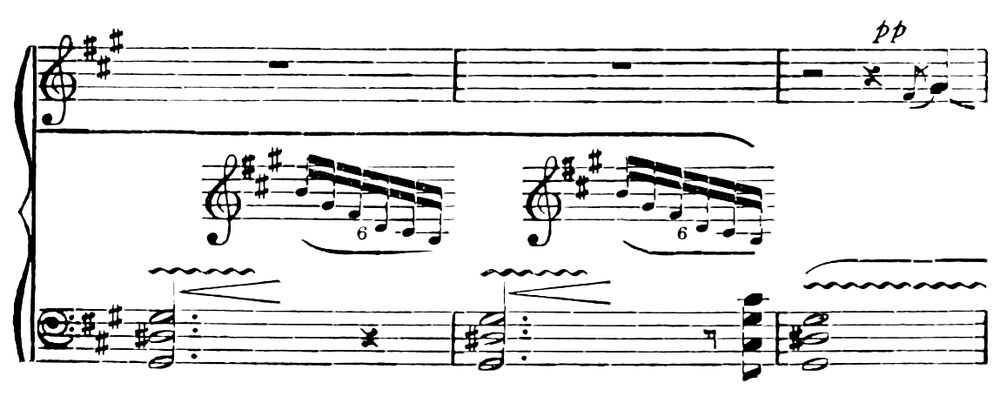
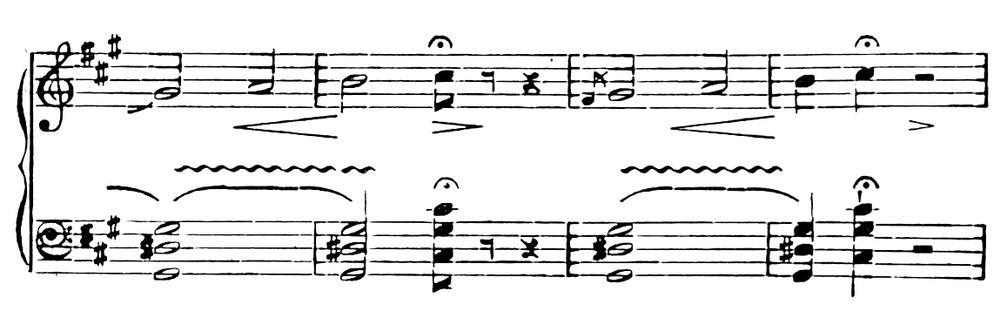
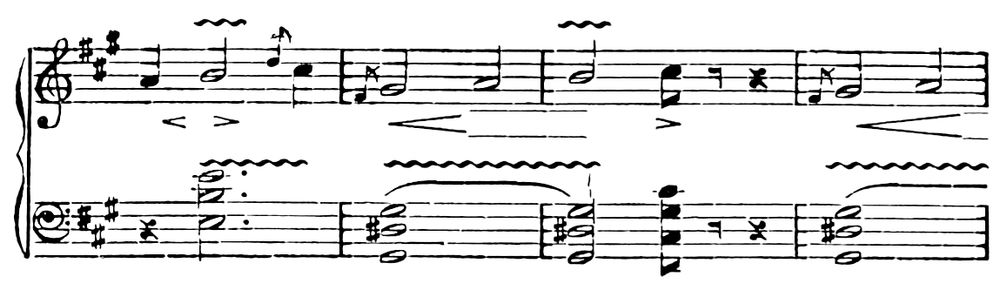
429
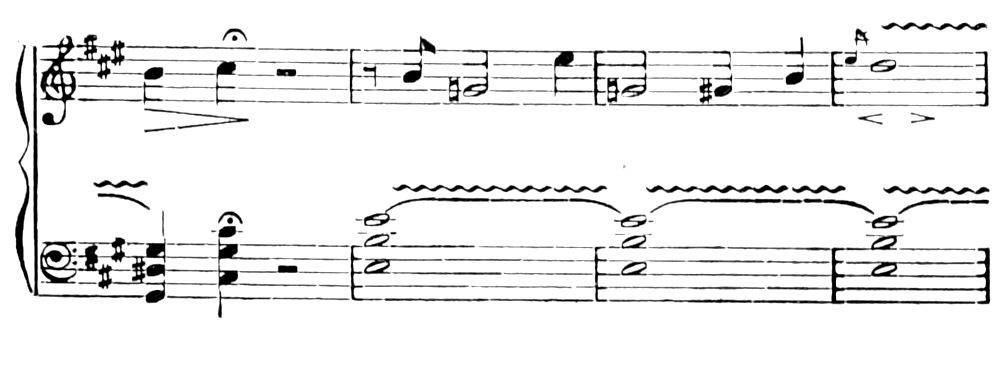
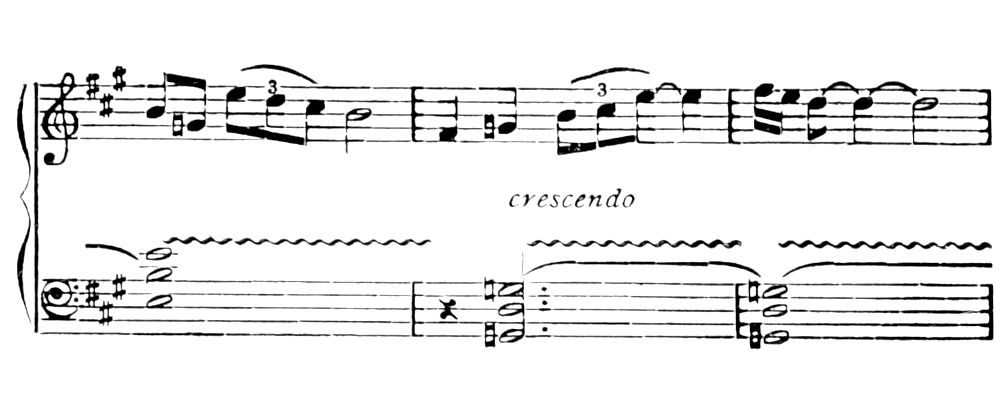
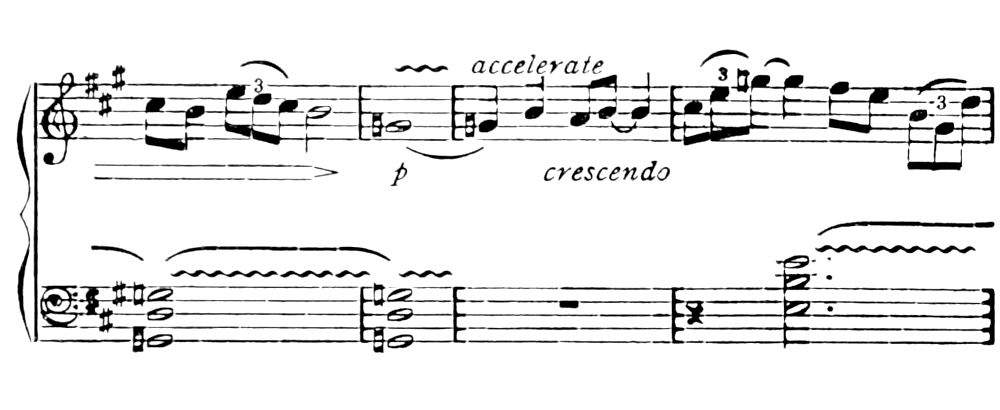
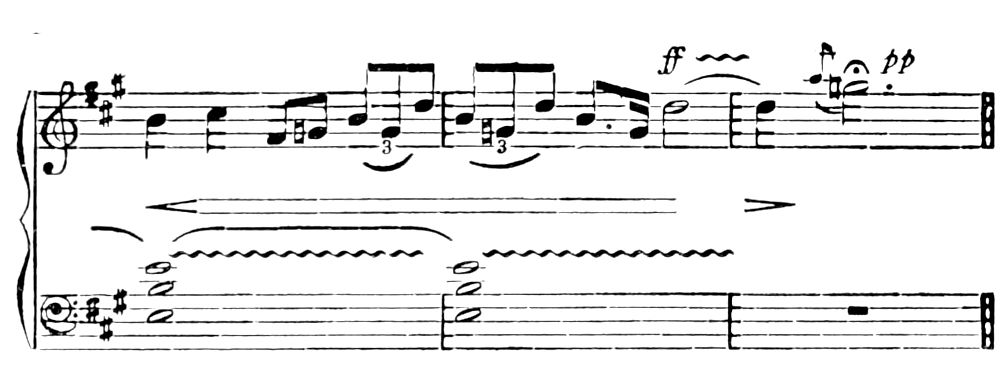
Audio content is not currently supported on your device.
[Download as MusicXML]
430THE DANCE
The Dance is played through to ⨁ A, begun again at ⨁ going to B, begun again at ⨁ and played to the end, omitting the passage from A to B. Thus it ought to last about 3½ minutes.
This Dance is joined on to the Prelude by a soft roll on the gong while the girl begins to move.
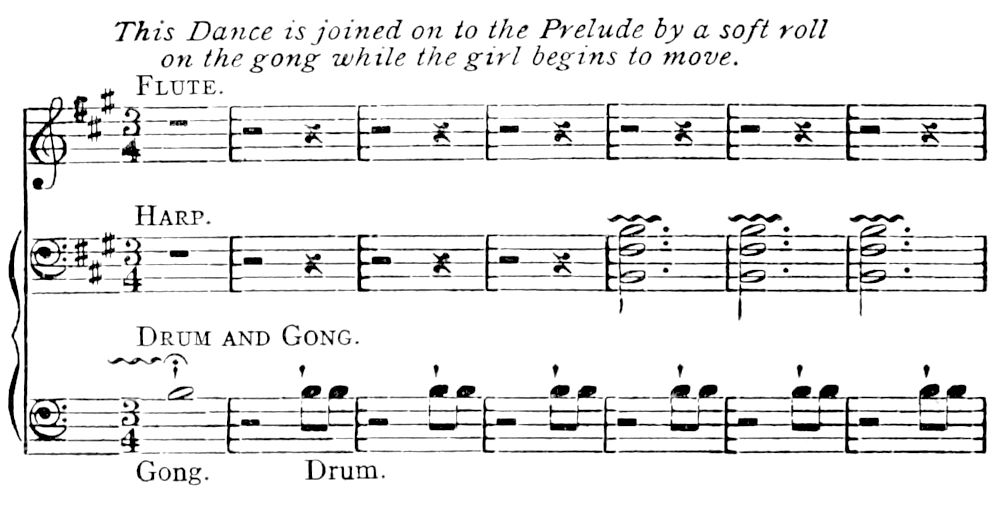
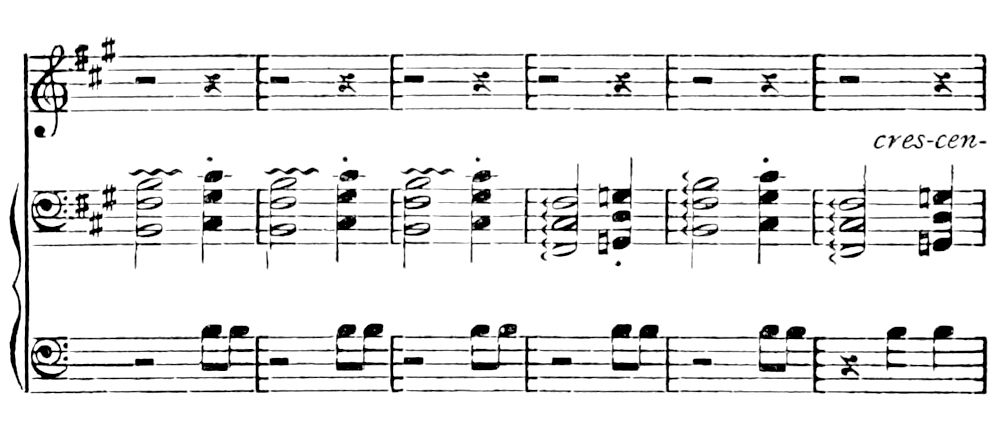
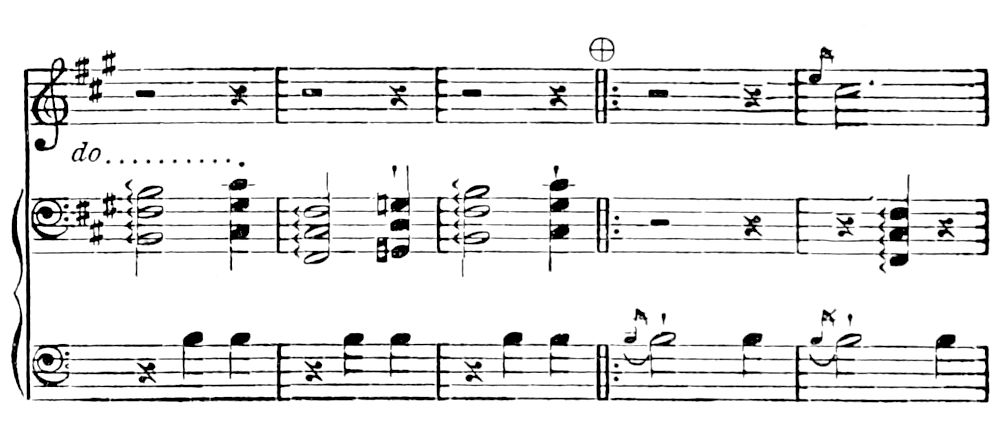
431
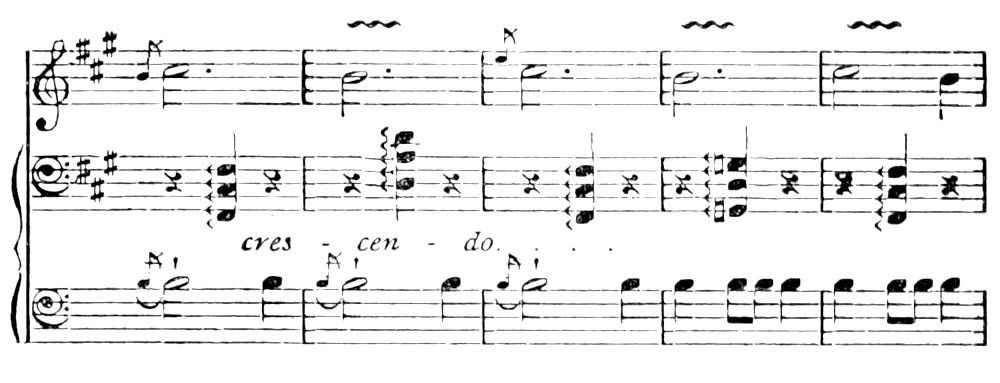
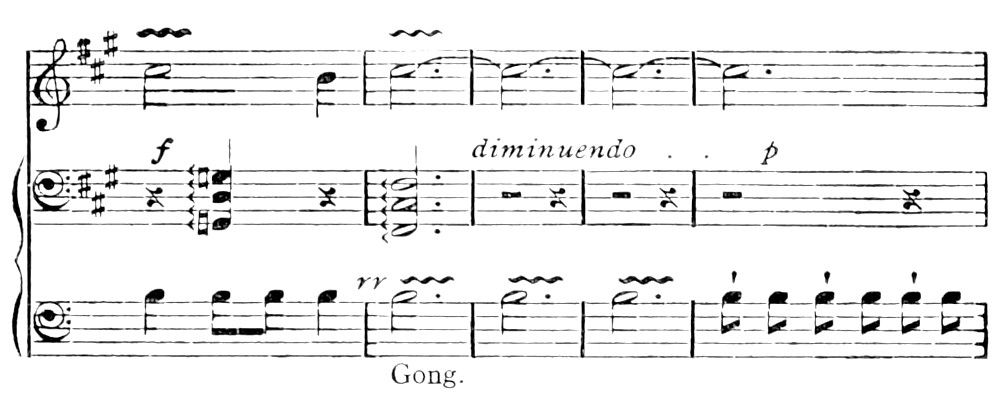
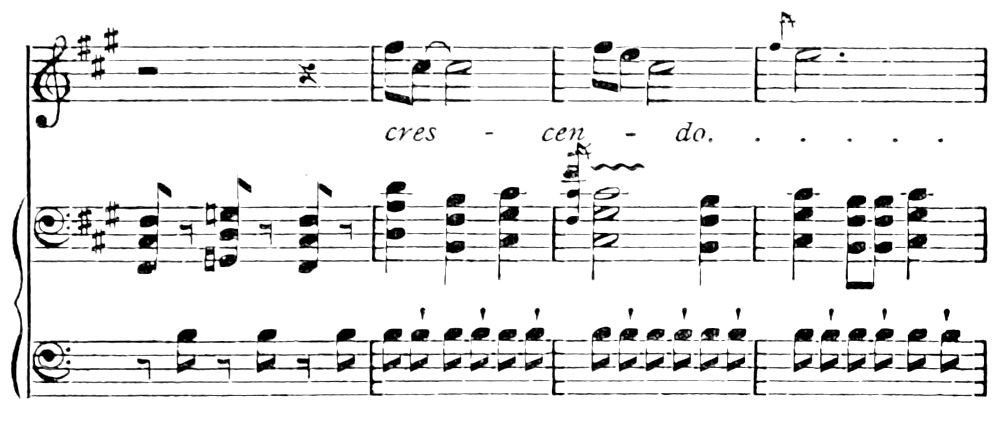
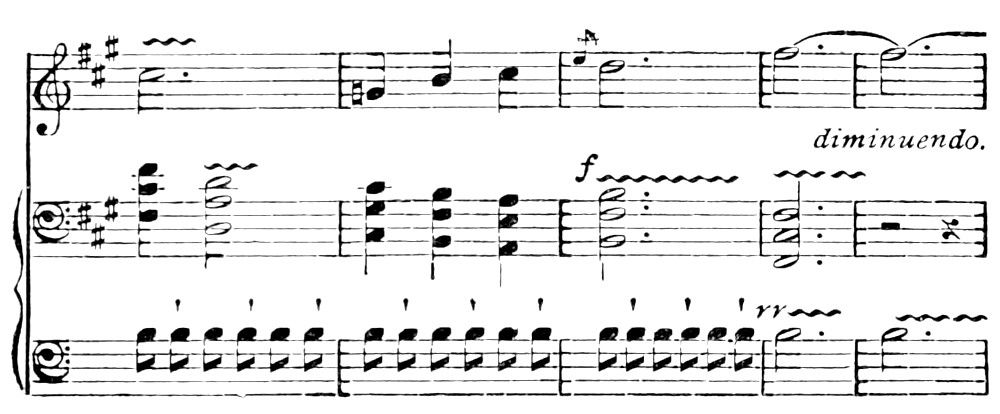
432
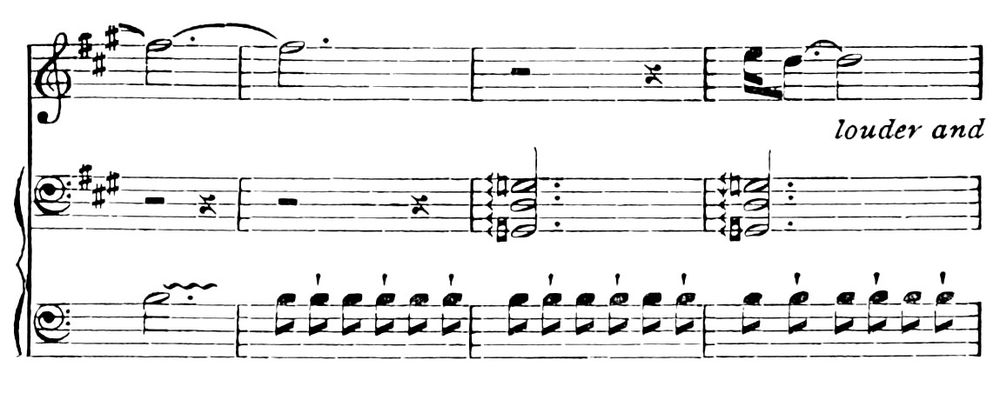
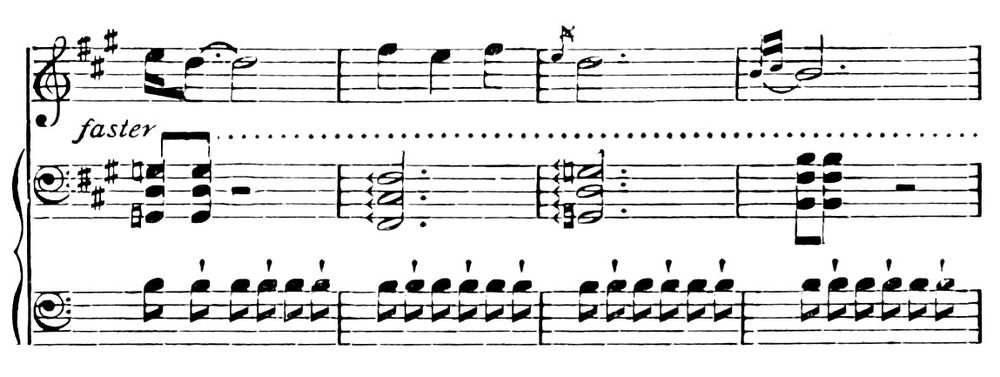
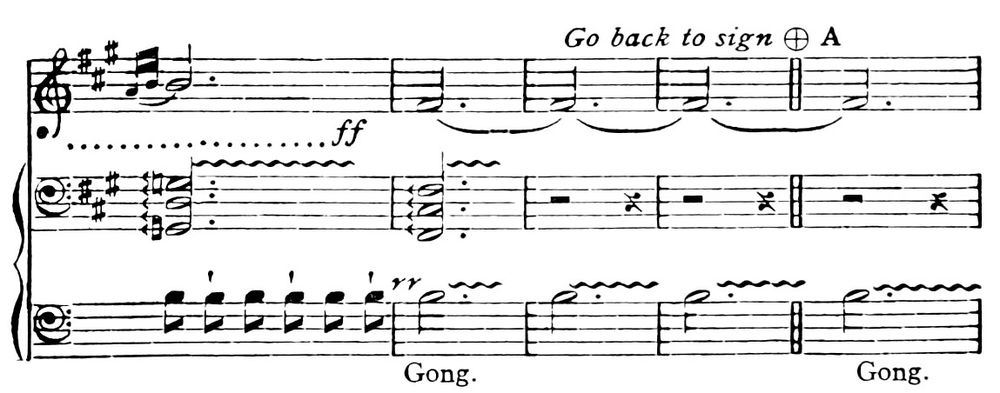
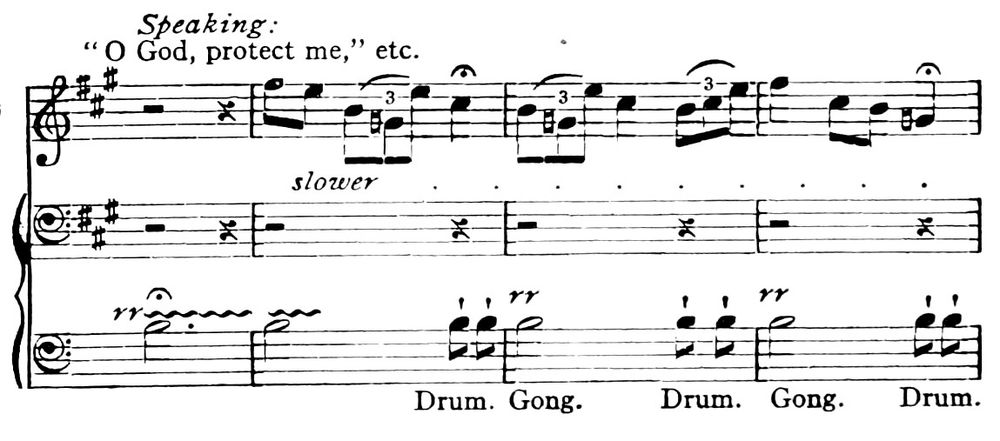
433
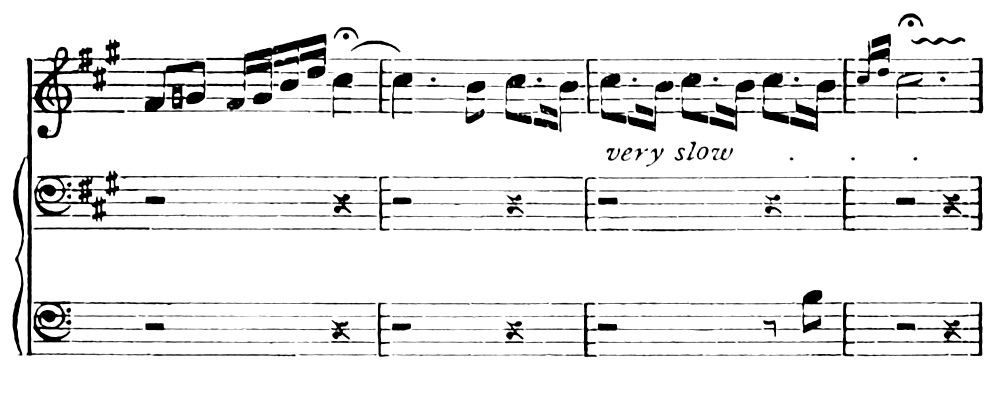
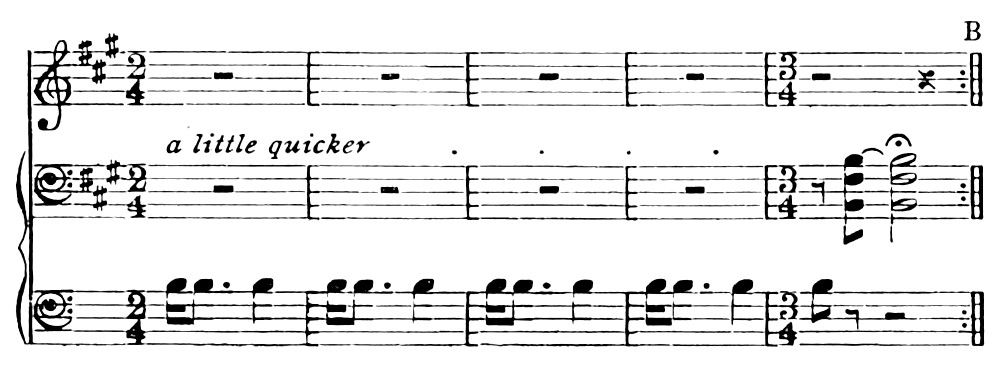
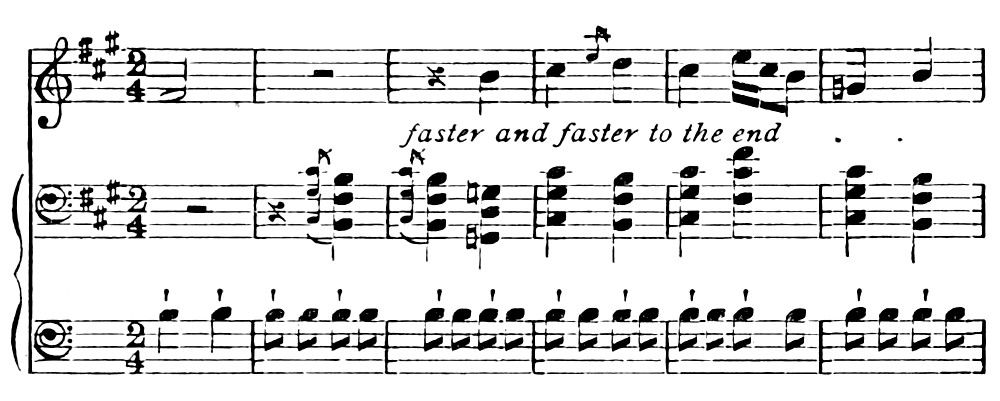
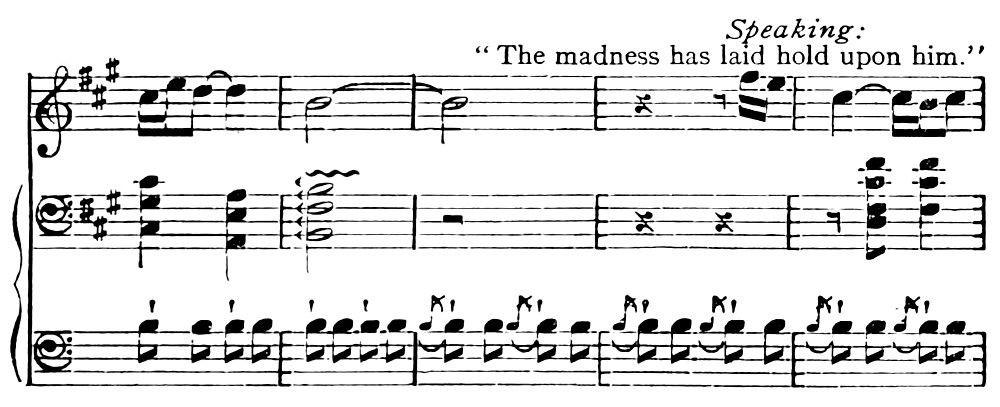
434
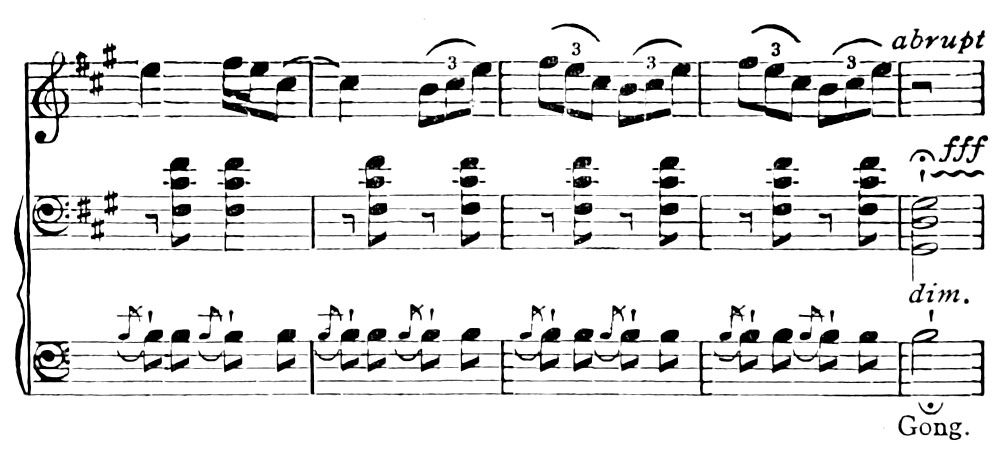
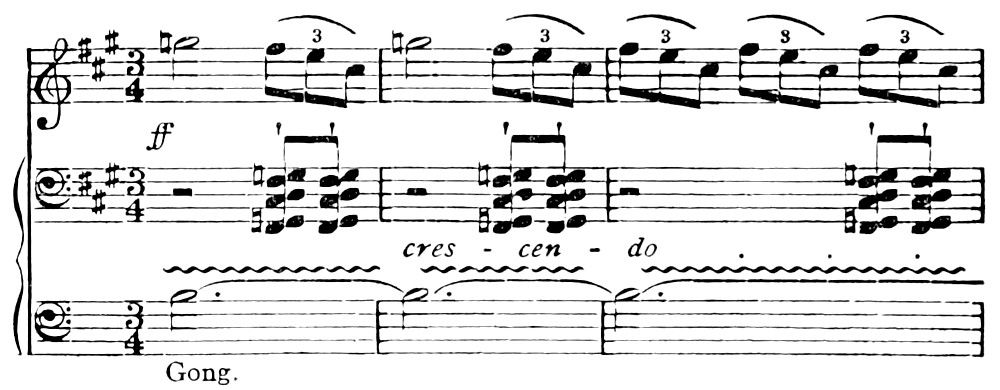
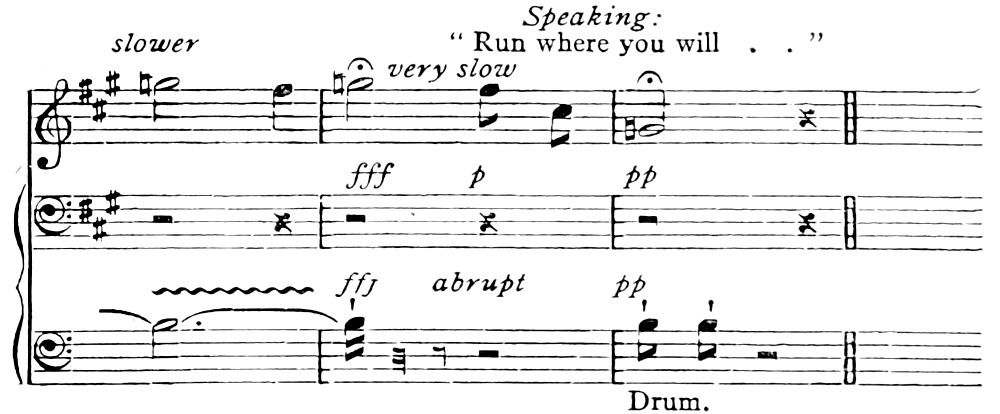
Audio content is not currently supported on your device.
[Download as MusicXML]
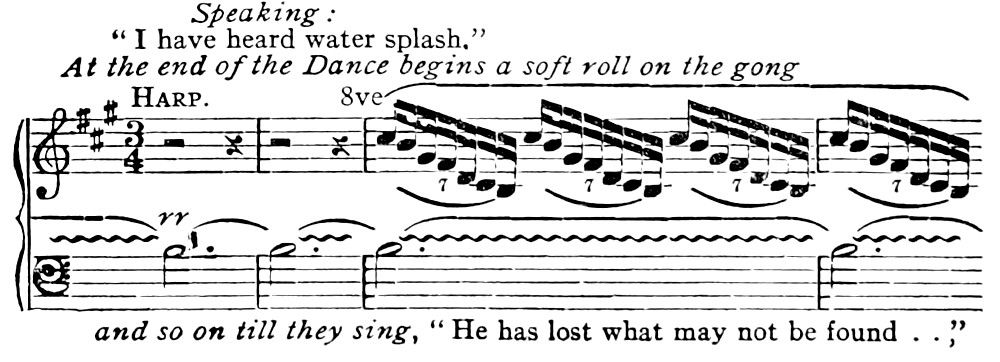
435
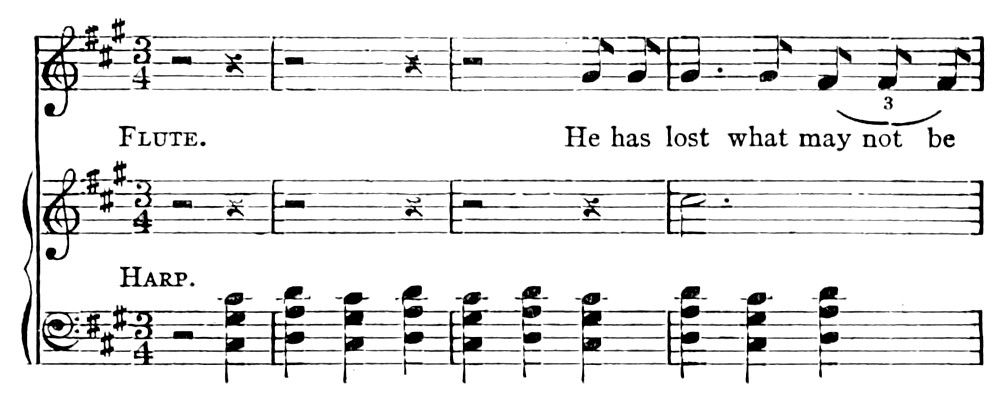
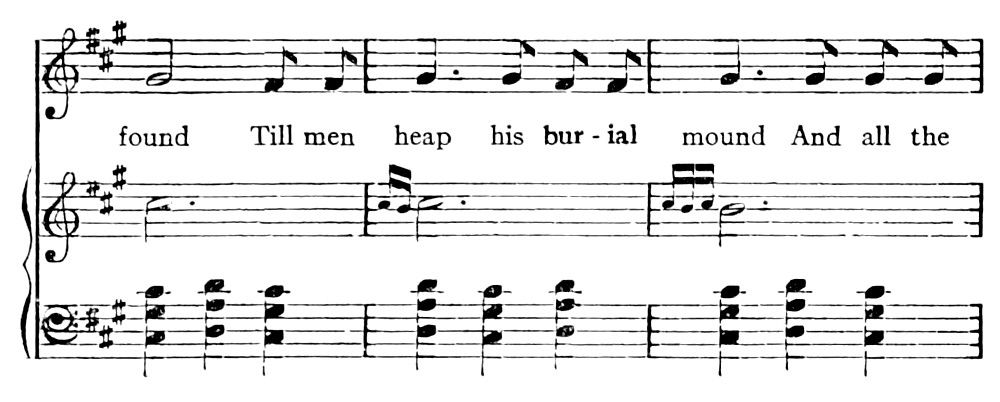
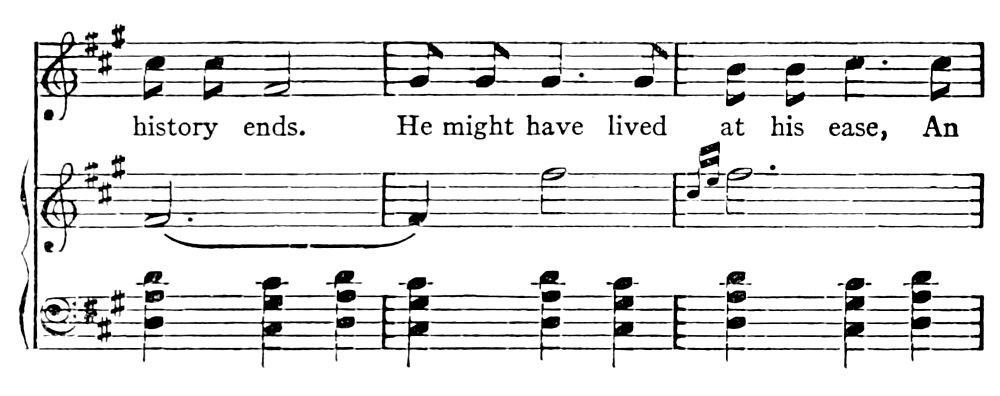
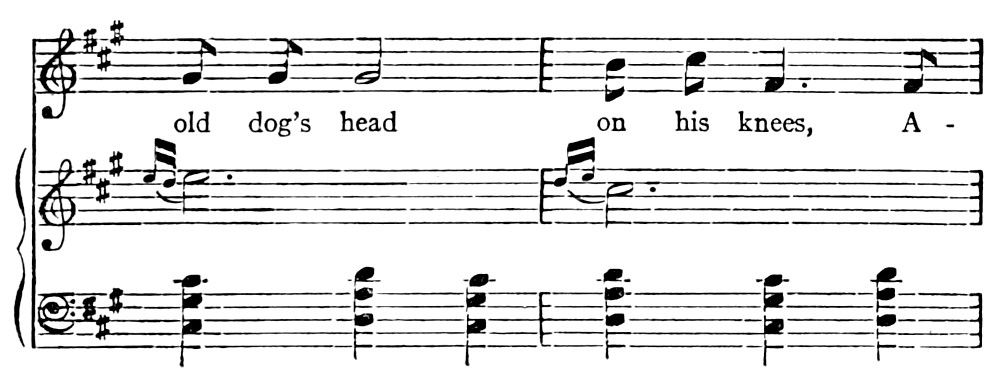
436
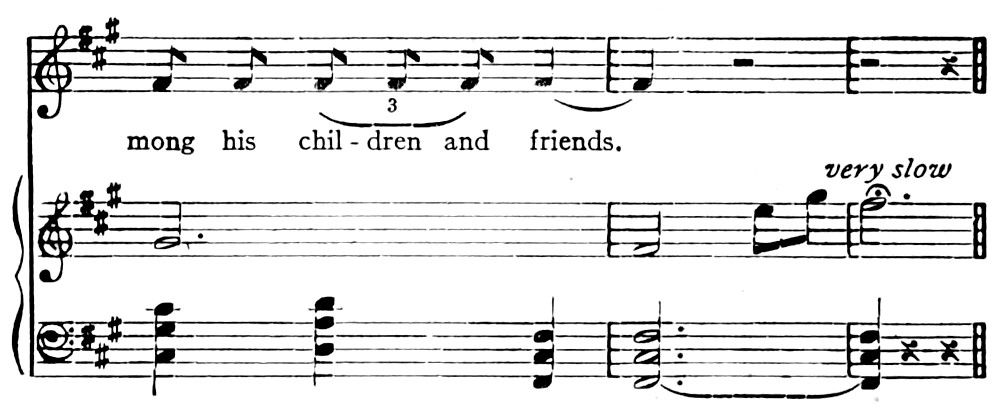
Audio content is not currently supported on your device.
[Download as MusicXML]
To be sung before they rise to unfold the curtain.
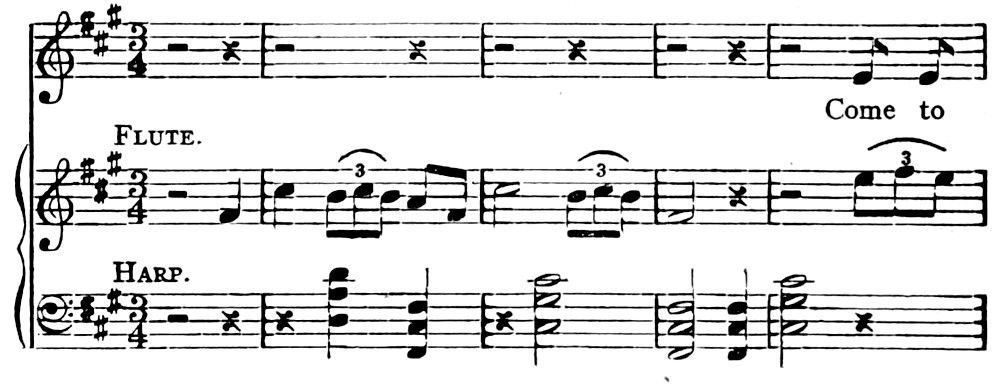
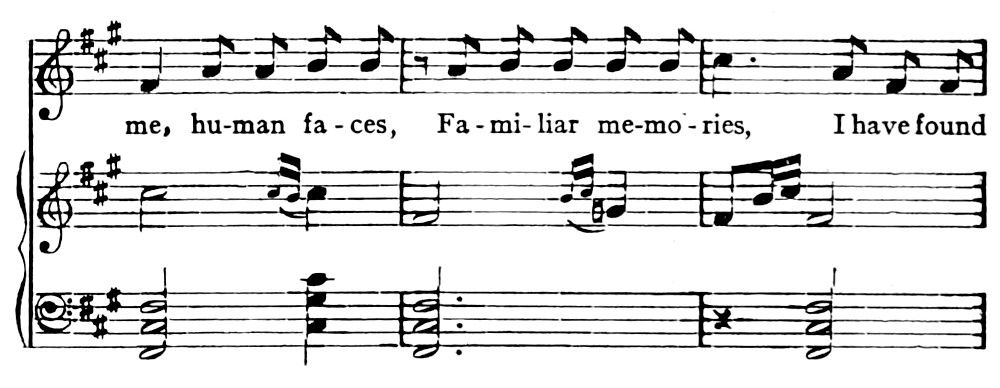
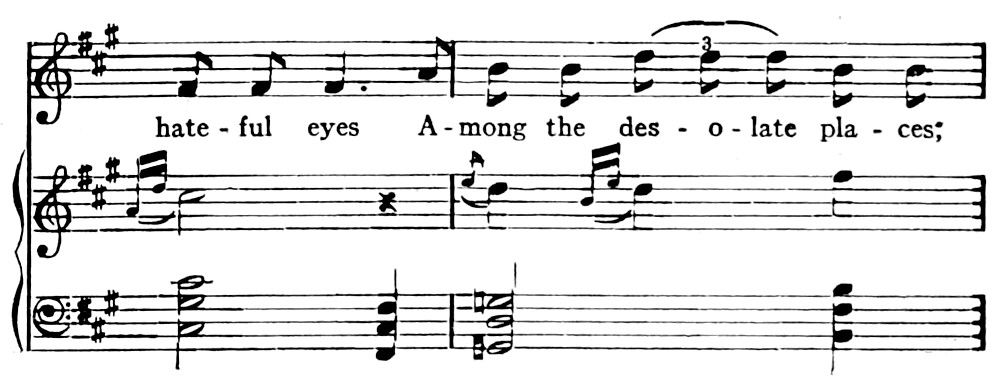
437
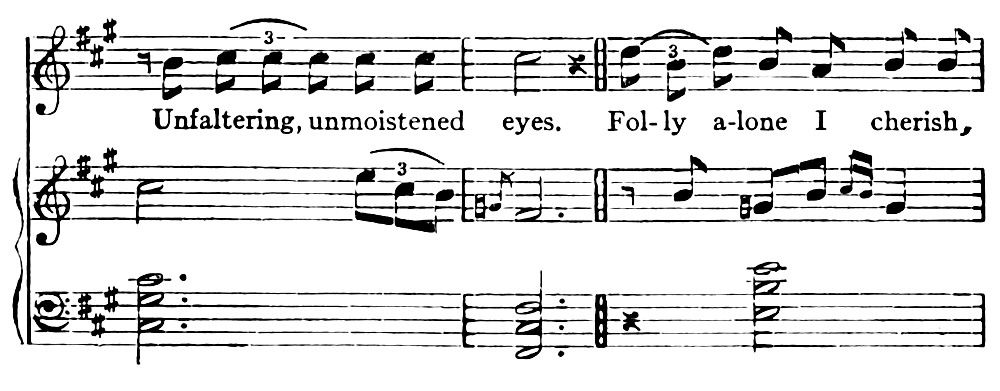
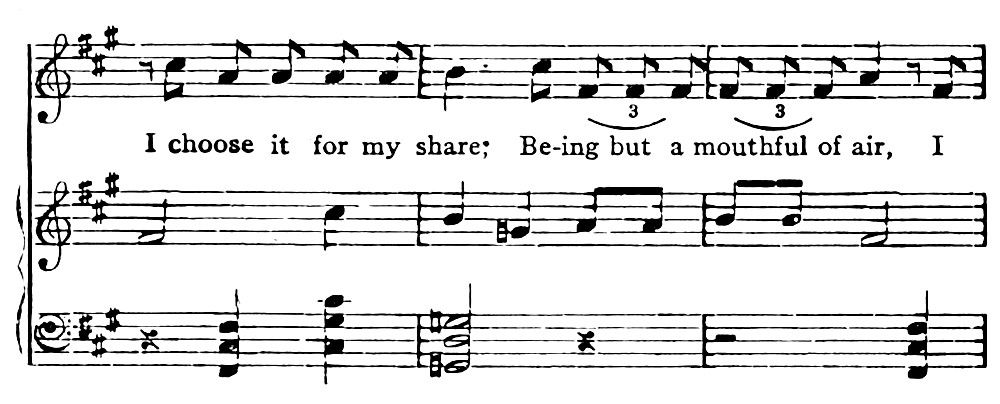
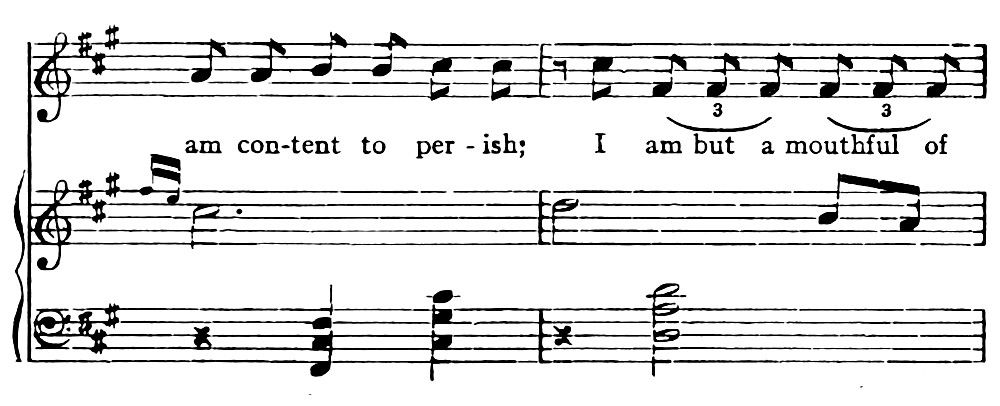
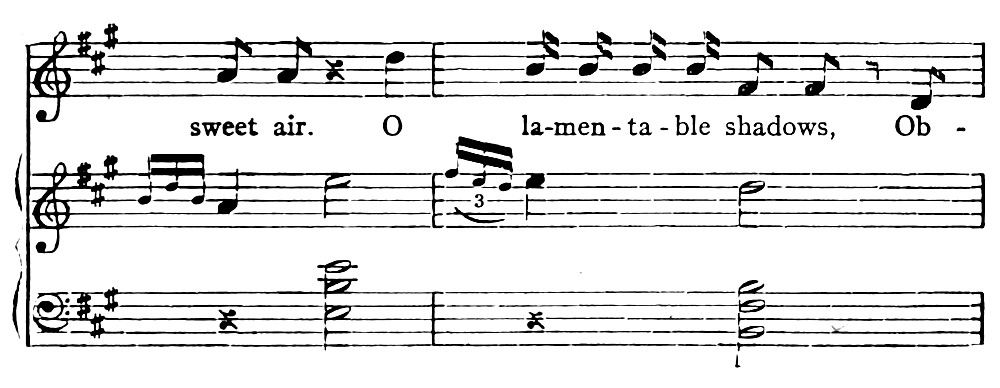
438
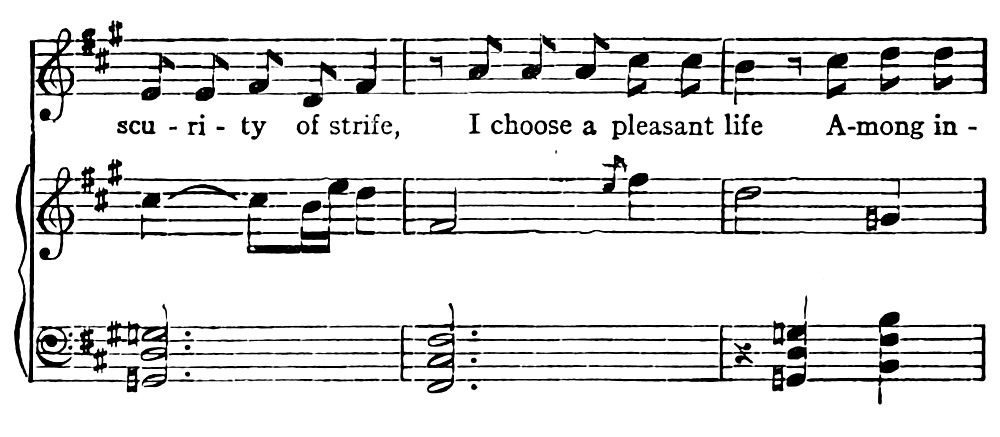
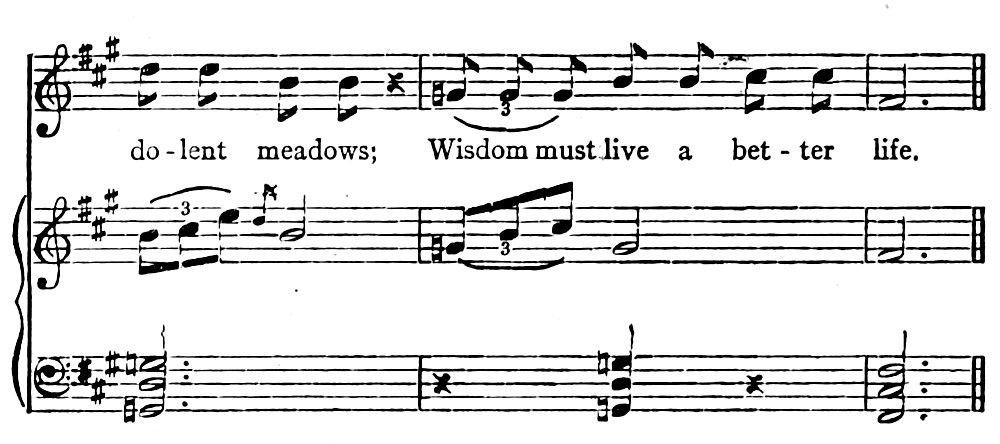
Audio content is not currently supported on your device.
[Download as MusicXML]
To be sung while they unfold and fold up the curtain.




439




Audio content is not currently supported on your device.
[Download as MusicXML]
440
NOTE ON ‘THE ONLY JEALOUSY OF EMER’
While writing these plays, intended for some fifty people in a drawing-room or a studio, I have so rejoiced in my freedom from the stupidity of an ordinary audience that I have filled The Only Jealousy of Emer with convictions about the nature and history of a woman’s beauty, which Robartes found in the Speculum of Gyraldus and in Arabia Deserta among the Judwalis. The soul through each cycle of its development is held to incarnate through twenty-eight typical incarnations, corresponding to the phases of the moon, the light part of the moon’s disc symbolising the subjective and the dark part the objective nature, the wholly dark moon (called Phase 1) and the wholly light (called Phase 15) symbolising complete objectivity and complete subjectivity respectively. In a poem called ‘The Phases of the Moon’ in The Wild Swans at Coole I have described certain aspects of this symbolism, which needs, however, 100 pages or more for its exposition, for it purports to be a complete classification and analysis of every possible type of human intellect, Phase 1 and Phase 15 symbolising, however, two incarnations not visible to human eyes nor having human characteristics. The invisible fifteenth incarnation is that of the greatest possible bodily beauty, and the fourteenth and sixteenth those of the greatest beauty visible to human eyes. Much that Robartes has found might be a commentary on Castiglione’s saying that the physical 441beauty of woman is the spoil or monument of the victory of the soul, for physical beauty, only possible to subjective natures, is described as the result of emotional toil in past lives. Objective natures are declared to be always ugly, hence the disagreeable appearance of politicians, reformers, philanthropists, and men of science. A saint or sage before his final deliverance has one incarnation as a woman of supreme beauty.
In writing these little plays I knew that I was creating something which could only fully succeed in a civilisation very unlike ours. I think they should be written for some country where all classes share in a half-mythological, half-philosophical folk-belief which the writer and his small audience lift into a new subtlety. All my life I have longed for such a country, and always found it quite impossible to write without having as much belief in its real existence as a child has in that of the wooden birds, beasts, and persons of his toy Noah’s ark. I have now found all the mythology and philosophy I need.
442
MUSIC FOR ‘THE DREAMING OF THE BONES’[19]
By WALTER MORSE RUMMEL
(1917)
Music of tone and music of speech are distinct from each other.
Here my sole object has been to find some tone formula which will enhance and bring out a music underlying the words. The process is therefore directly opposed to that of tone-music creation, which from the formless directly creates its tone form, whereas I seek to derive a formless overflow from the already formed.
FIRST MUSICIAN: A medium voice, more chanting than singing, not letting the musical value of the sound predominate too greatly the spoken value.
The First Musician uses a Plucked Instrument (harp or zither) to reinforce the notes of his song in unison or in the octave. (It is advisable not to reinforce each note sung, but only each beat, unless certain difficulties of pitch would necessitate the reinforcing of such note.)
During the symphonic moments of the play the Plucked Instrument assumes a more individual part.
SECOND MUSICIAN: Using a Flute, of a soft and discreet quality.
443THIRD MUSICIAN: Using a Bowed Instrument, one-stringed, more like a Hindu Sarinda, perhaps with a sympathetic vibrating string, giving a nasal sound. This part furnishes a bass, a sort of horizon to the song, and becomes more individual in the symphonic parts of the play.
FOURTH MUSICIAN: Using a Drum, preferably also an oriental model, played with the palm and the fingers of the hand. The drum part is indicated by ¯ (long) and ˘ (short). The numbers below these indications signify the fingers employed. The using of the palm of the hand is indicated by P.
In case there are only Three Musicians, the Second and Third Musicians can alternatively take the Drum part in places where they are unoccupied.
All instrumental music, especially during the speaking parts, must always leave the voice in the foreground.
W. M. R.
444THE DREAMING OF THE BONES
The stage is any bare place in a room with a wall beyond it. A screen or curtain hung with a pattern of mountain and sky can stand against it, but the pattern must only symbolize or suggest.
Three (four) Musicians enter. One stands singing while the others sit down against the wall by their instruments which are already there: a plucked instrument, a bowed instrument, and flute and drum.
First Musician (singing).
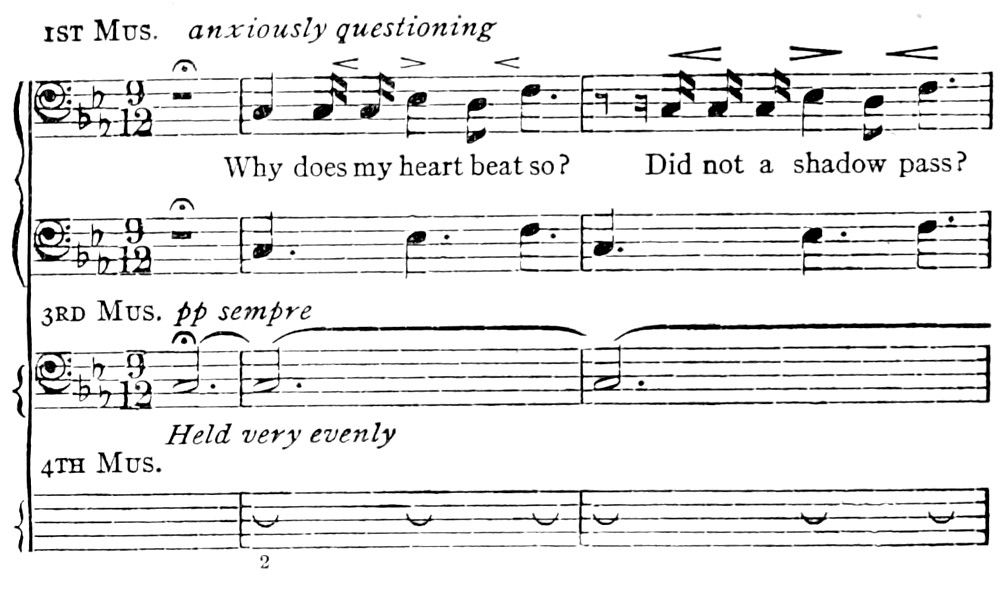
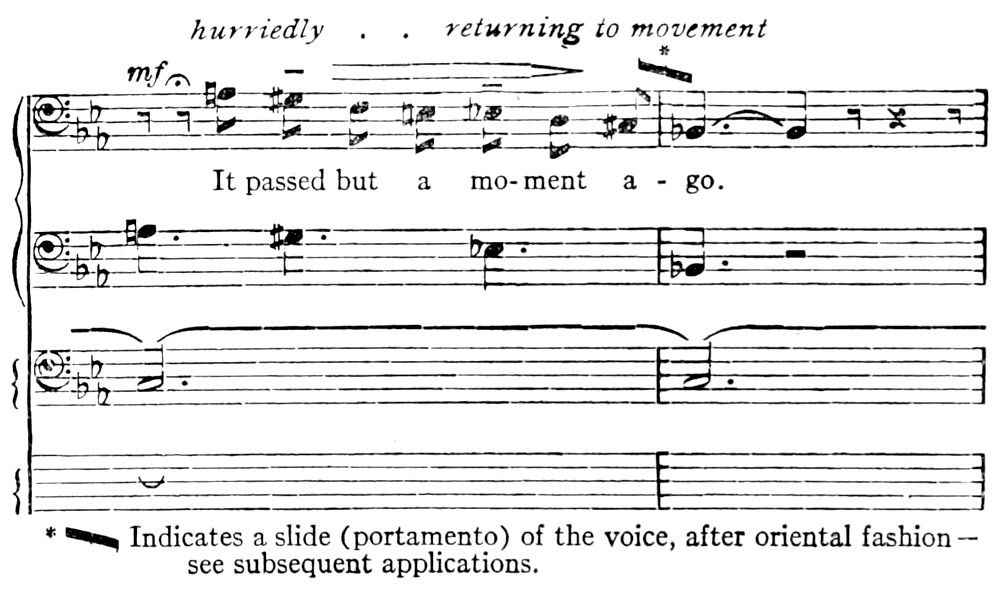
445
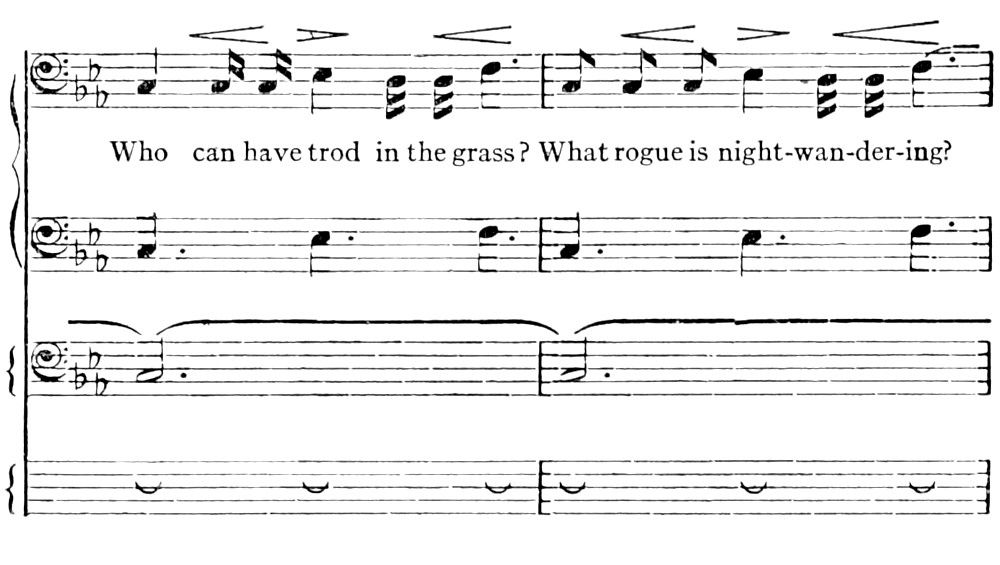
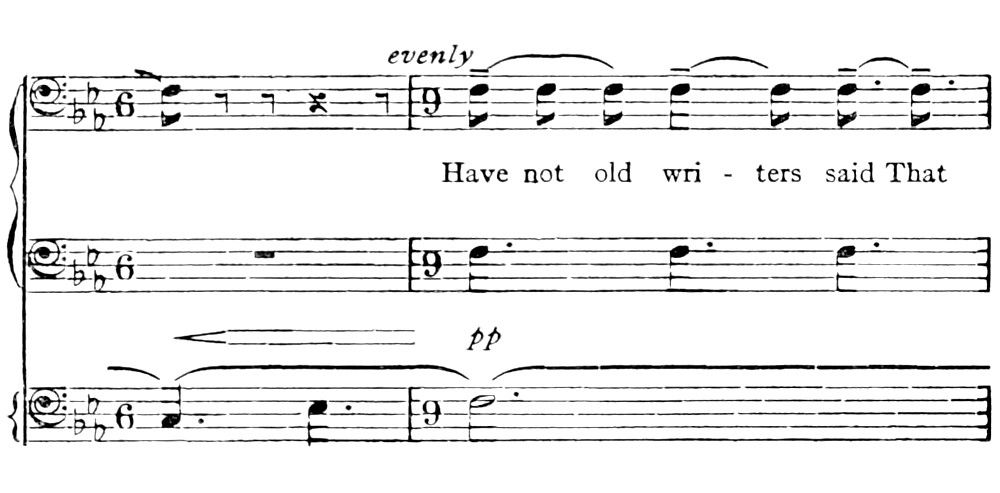
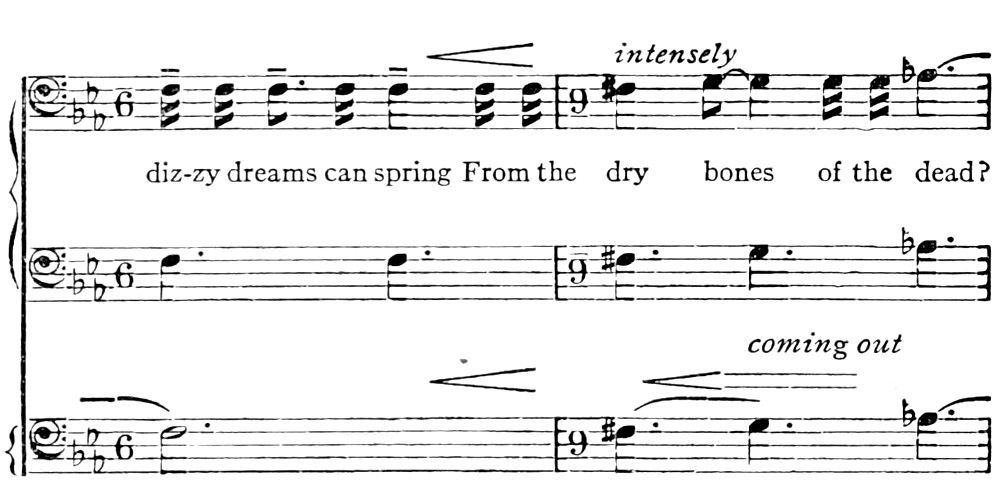
446
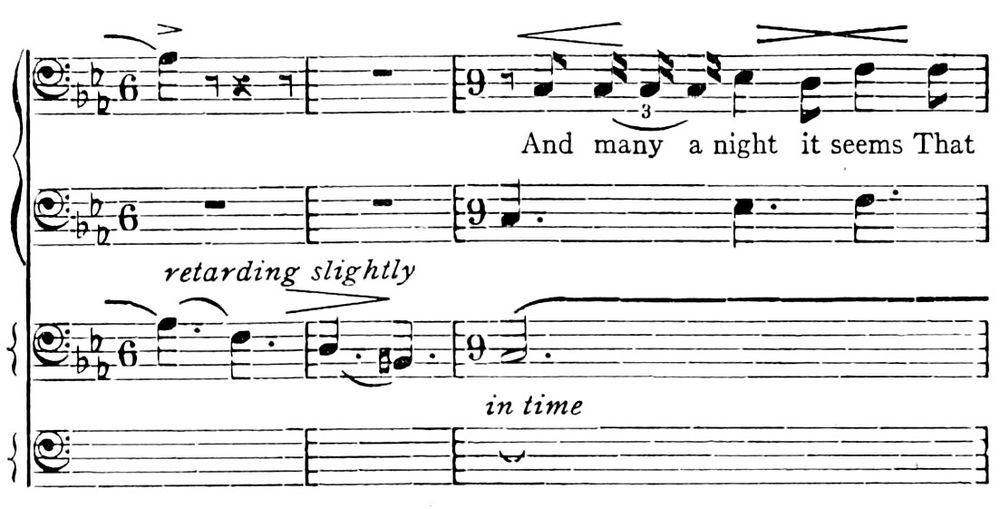
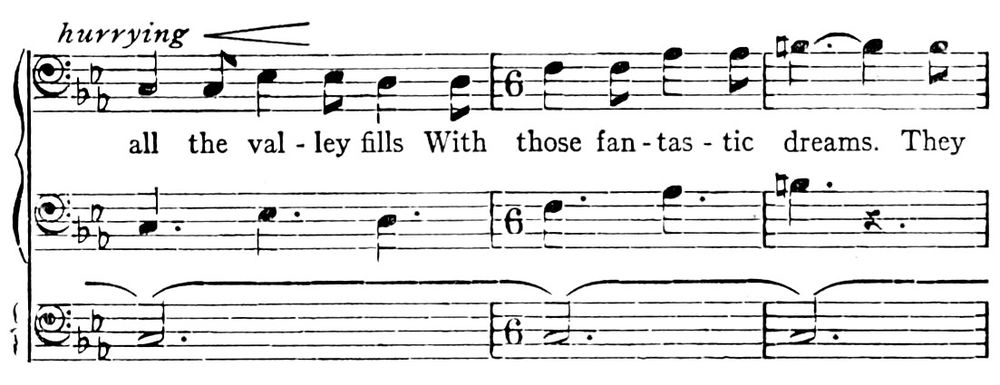
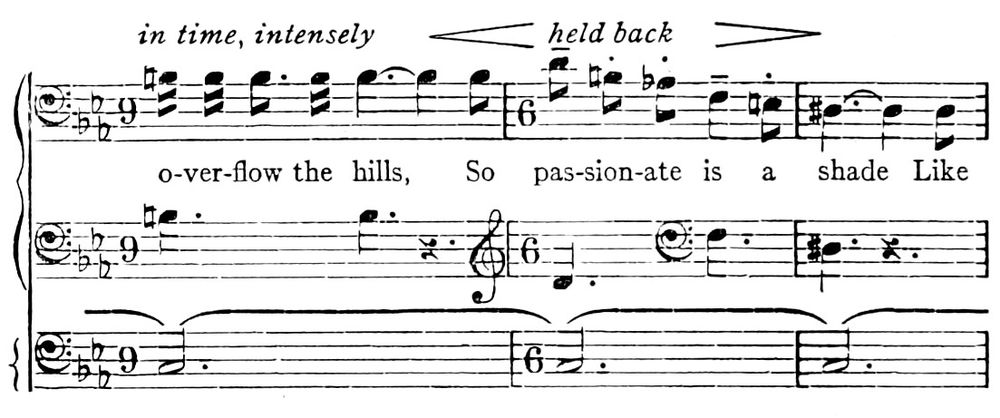
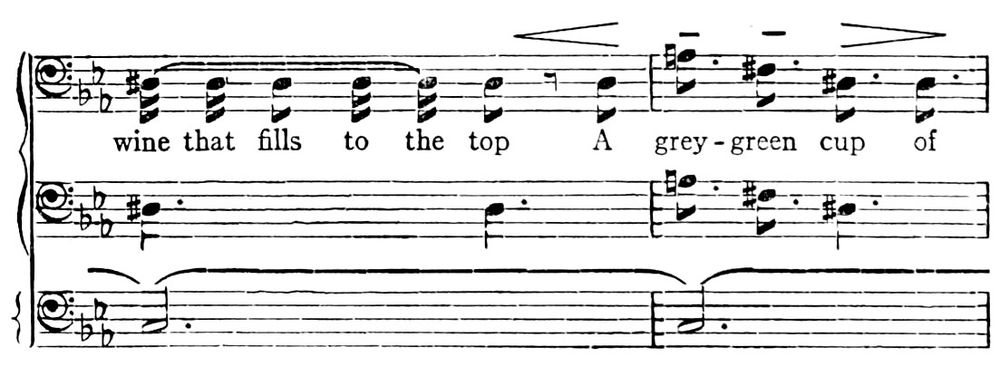
447
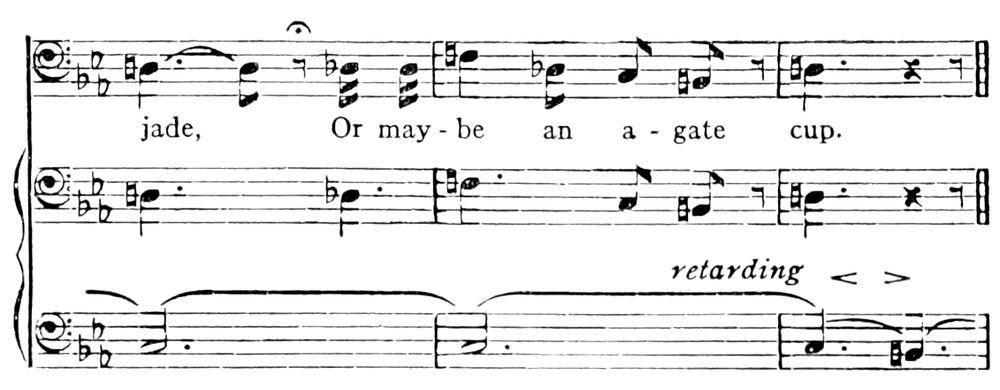
Audio content is not currently supported on your device.
[Download as MusicXML]

Audio content is not currently supported on your device.
[Download as MusicXML]
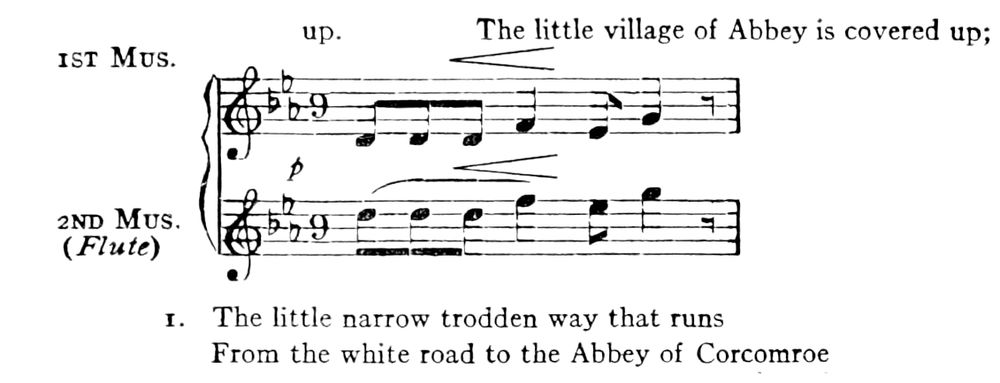
Audio content is not currently supported on your device.
[Download as MusicXML]
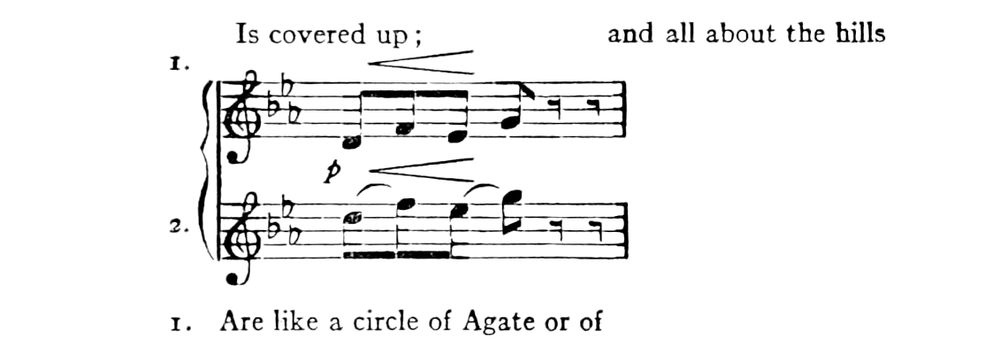
Audio content is not currently supported on your device.
[Download as MusicXML]
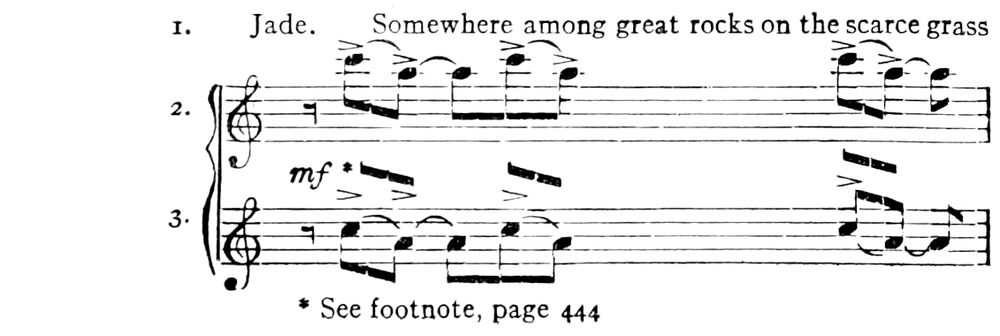
Audio content is not currently supported on your device.
[Download as MusicXML]
448
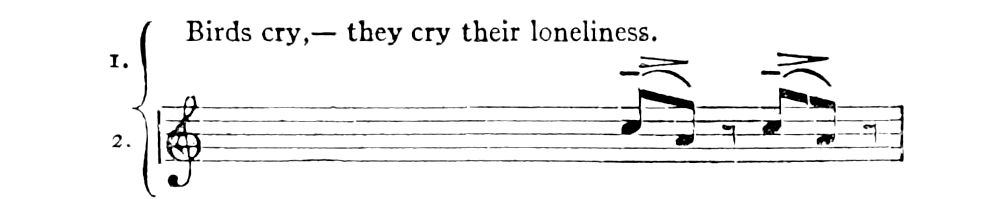
Audio content is not currently supported on your device.
[Download as MusicXML]
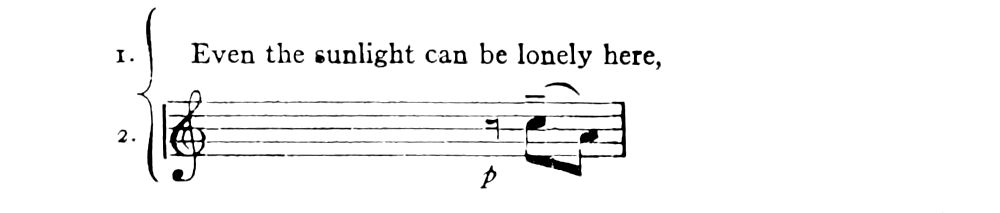
Audio content is not currently supported on your device.
[Download as MusicXML]
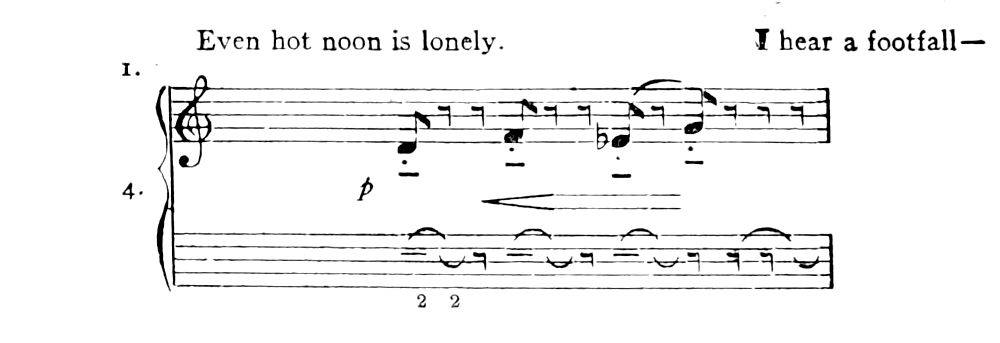
Audio content is not currently supported on your device.
[Download as MusicXML]

Audio content is not currently supported on your device.
[Download as MusicXML]
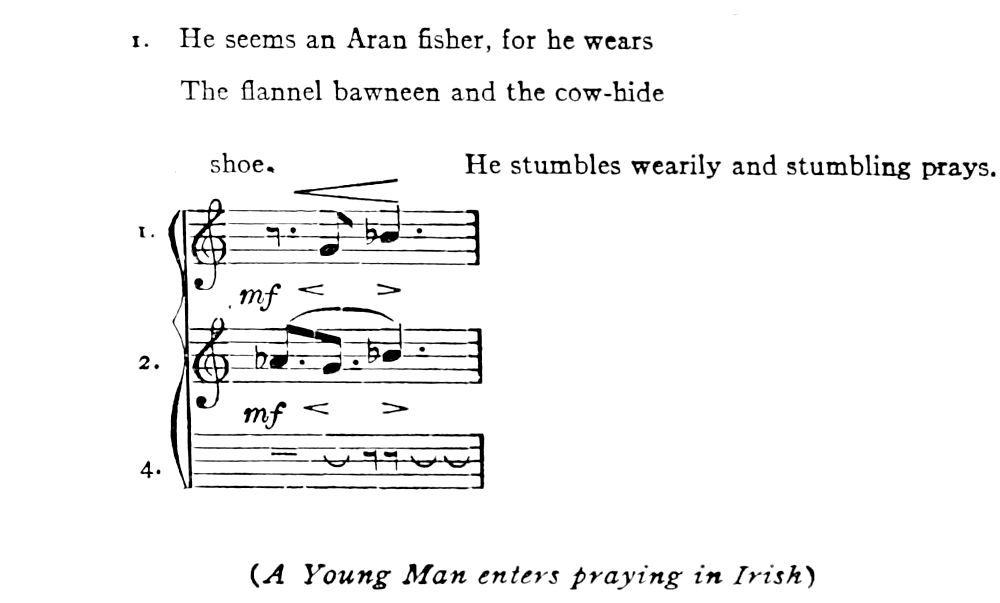
Audio content is not currently supported on your device.
[Download as MusicXML]
449
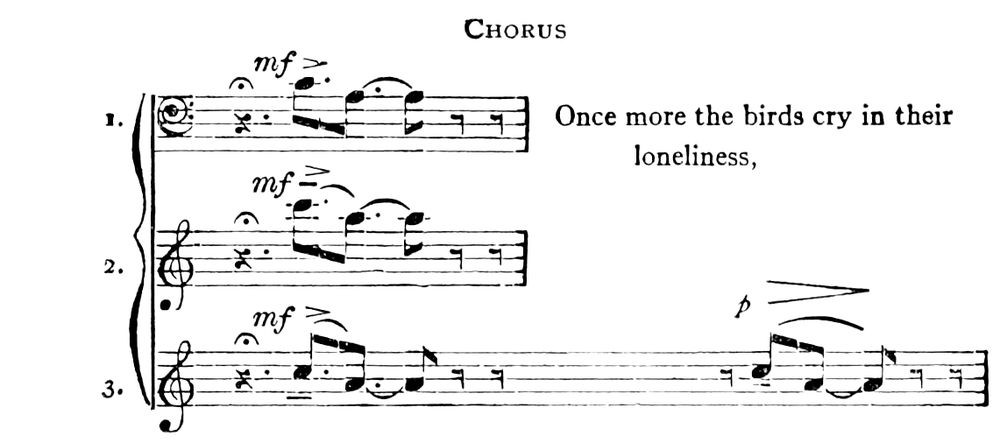
Audio content is not currently supported on your device.
[Download as MusicXML]
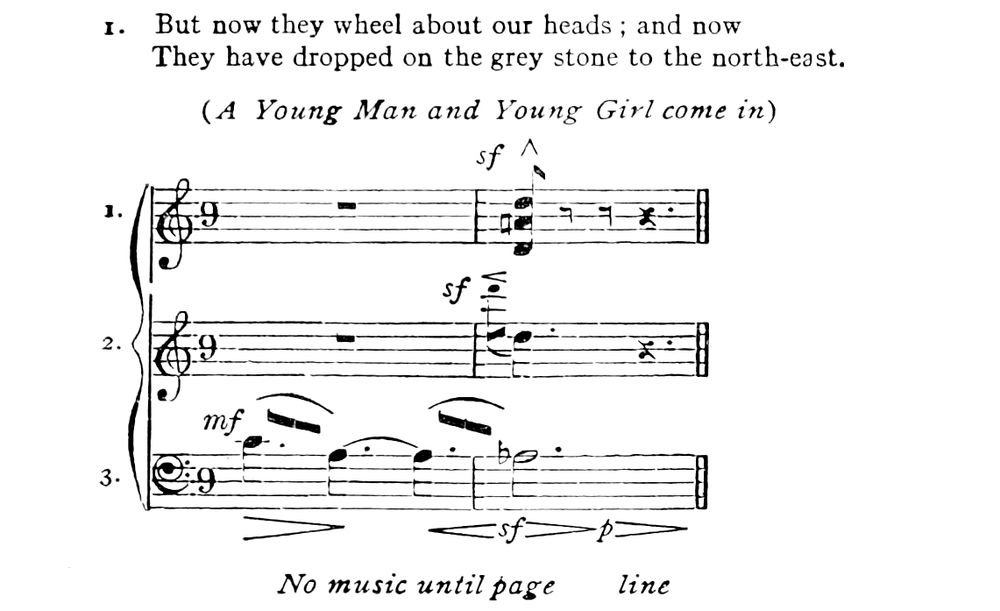
Audio content is not currently supported on your device.
[Download as MusicXML]
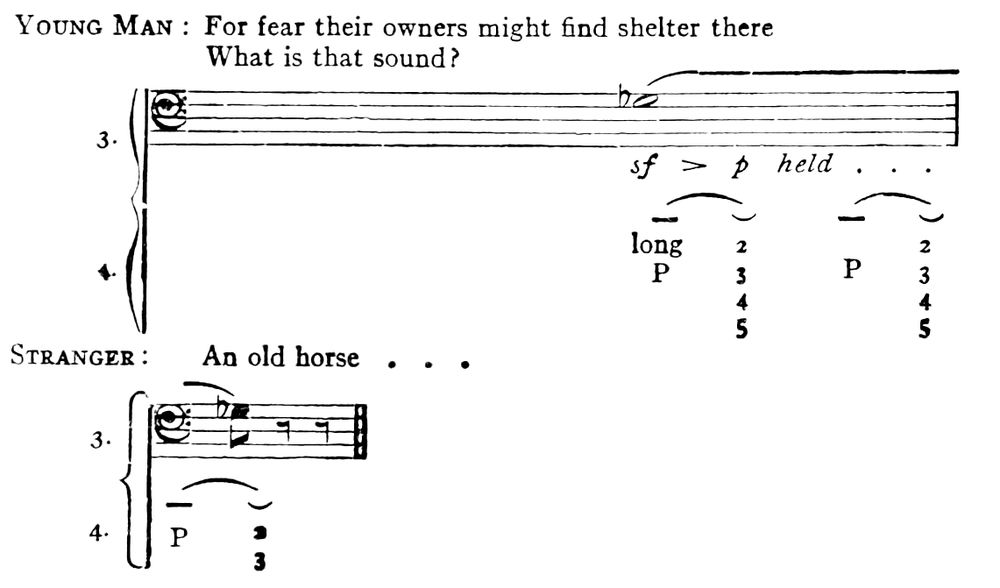
Audio content is not currently supported on your device.
[Download as MusicXML]
450
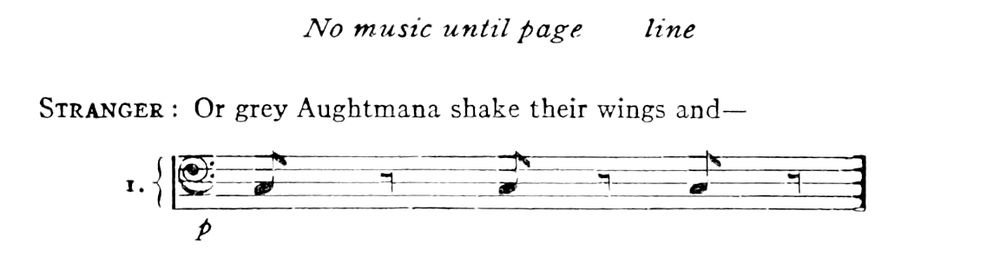
Audio content is not currently supported on your device.
[Download as MusicXML]
THE WALK AROUND THE STAGE
Two steps may be taken to each musical measure, making it a very slow figurative step. This will mean about 24 steps to one walk around the stage (Round). The last two steps may be twice as long (in time), accompanied by certain movements of expectancy. In calculating that each step amounts to half a metre, the length of the stage would have to be five metres.