FOUR PLAYS FOR DANCERS (continued 2)
Reading edition

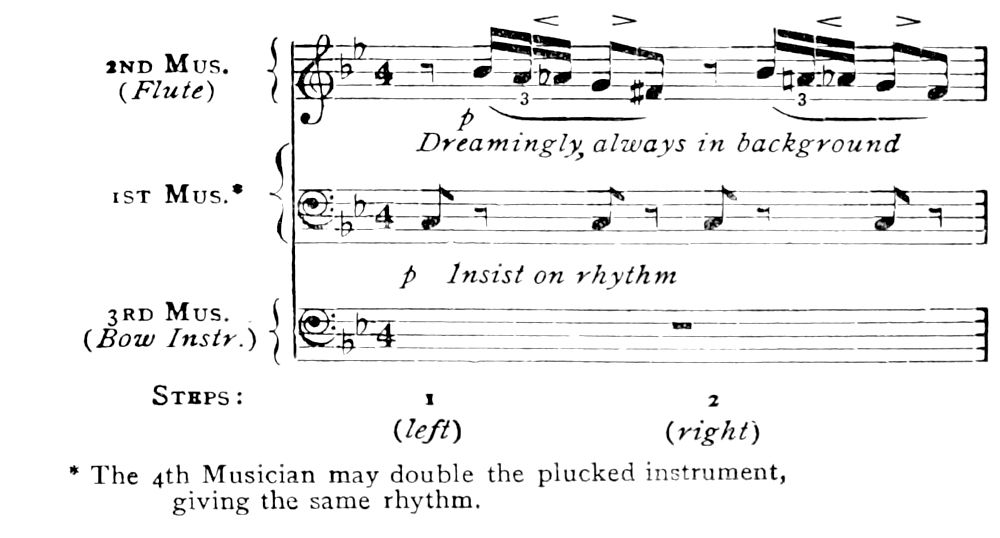
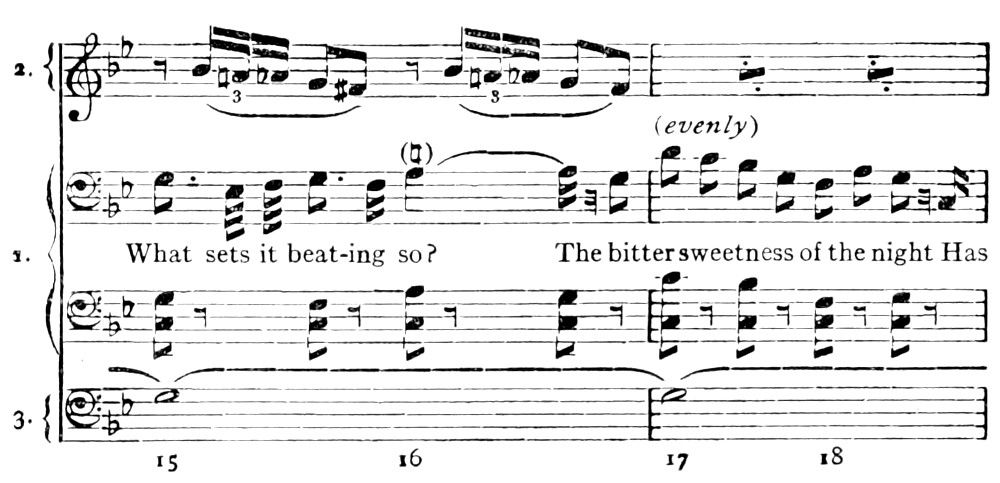
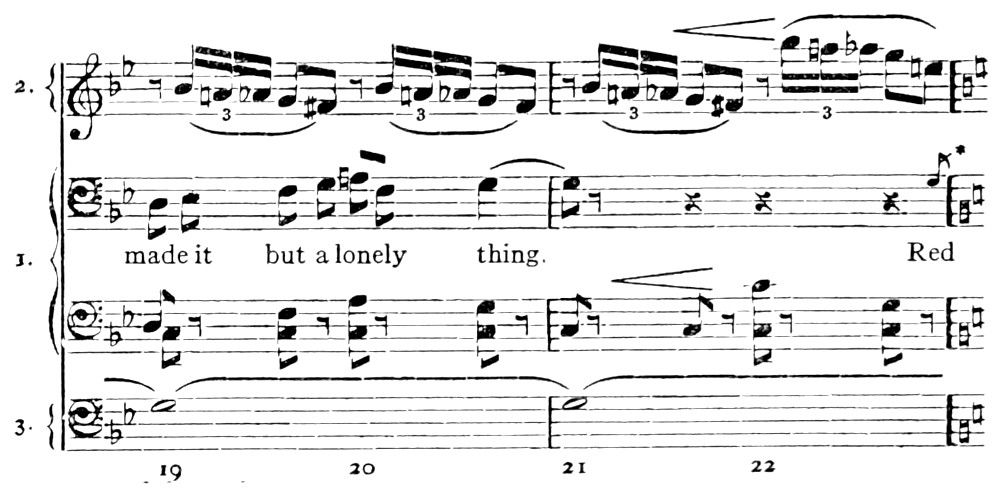
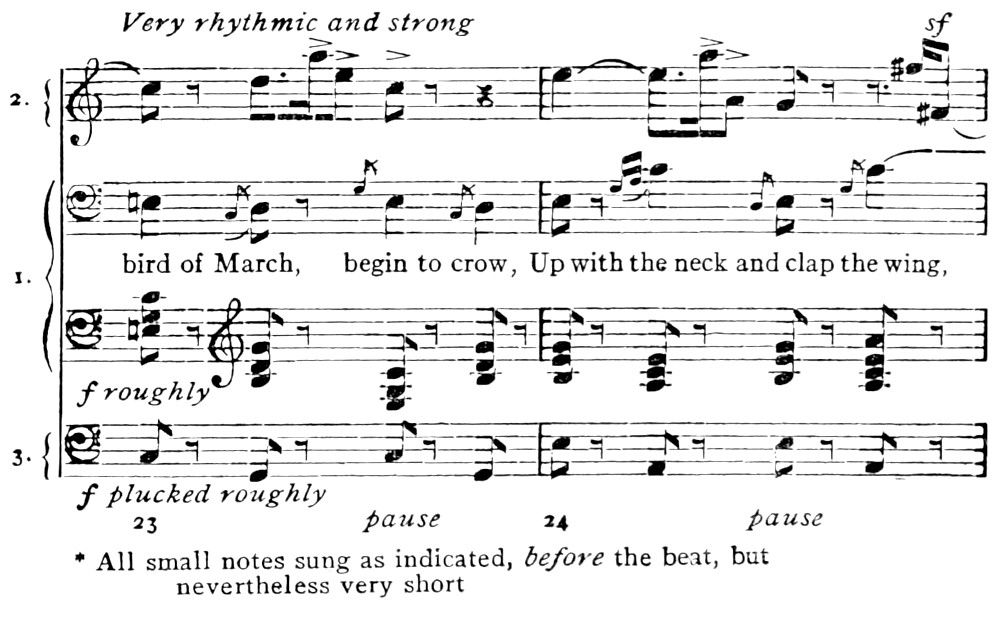
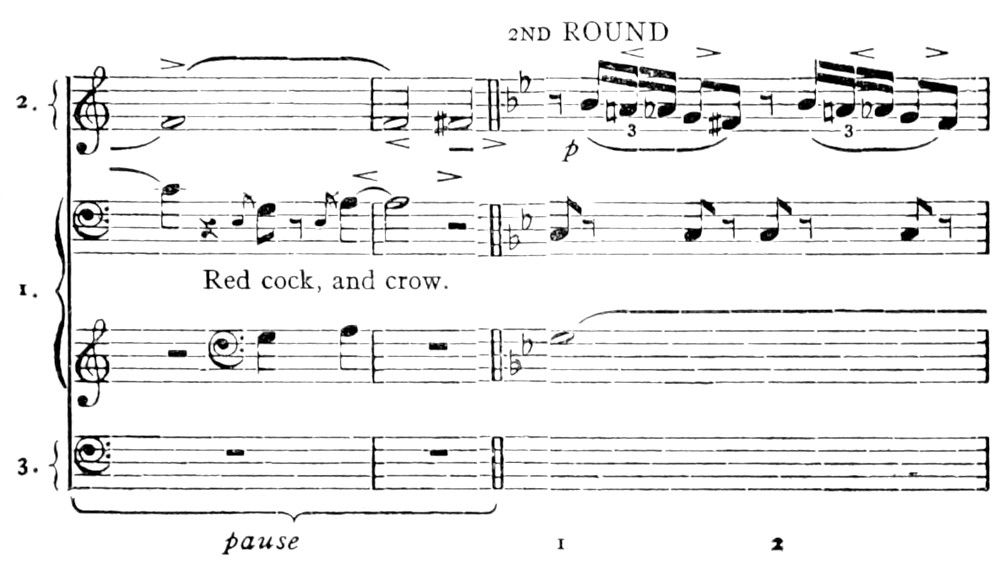
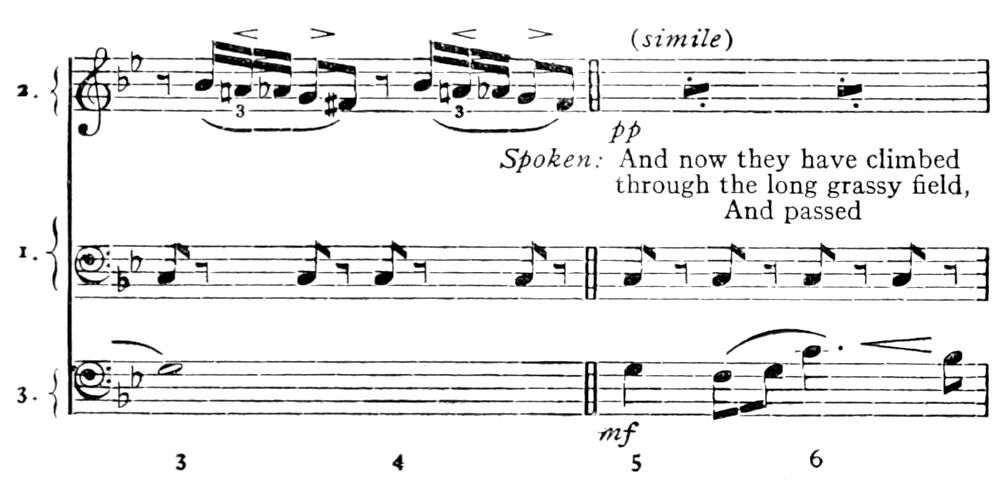
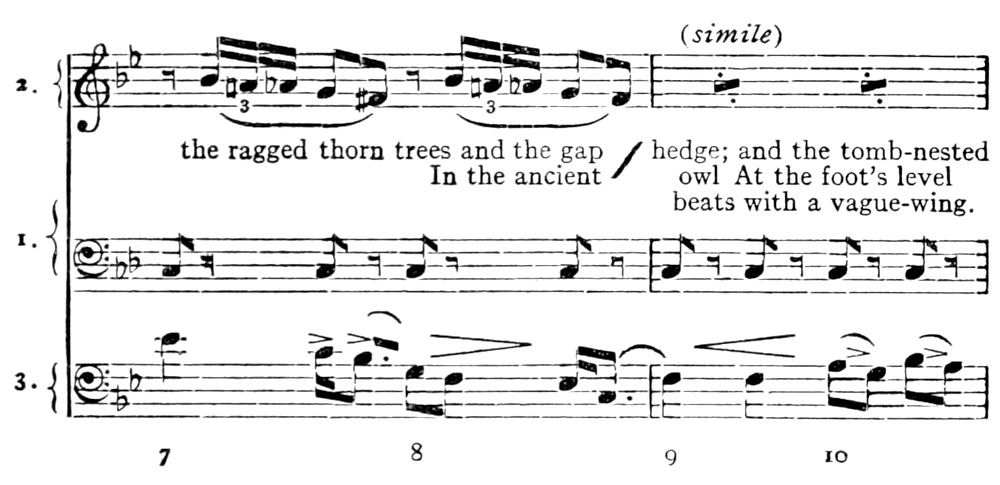
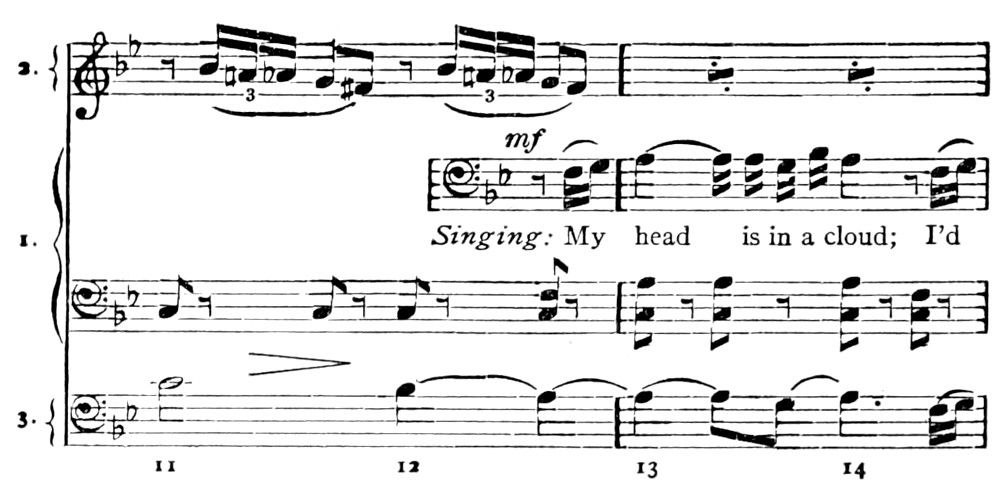
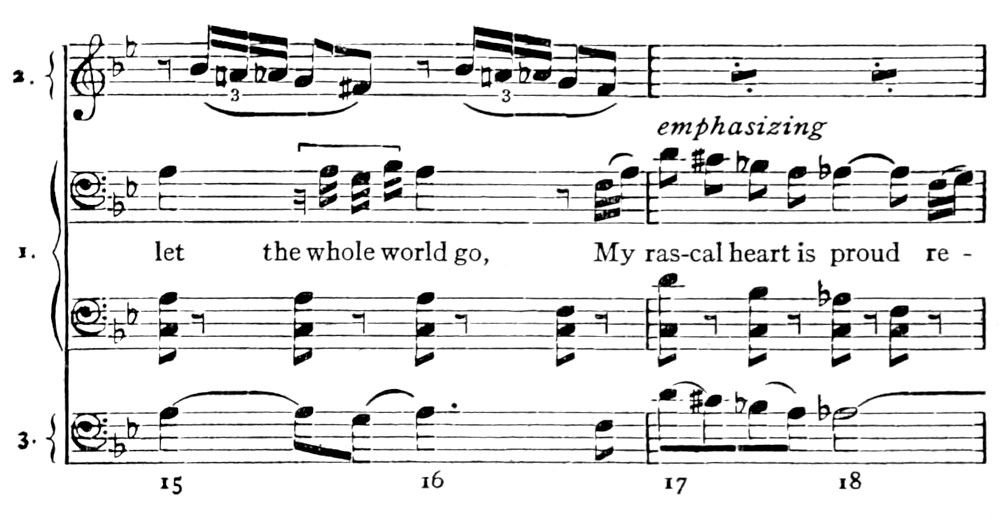
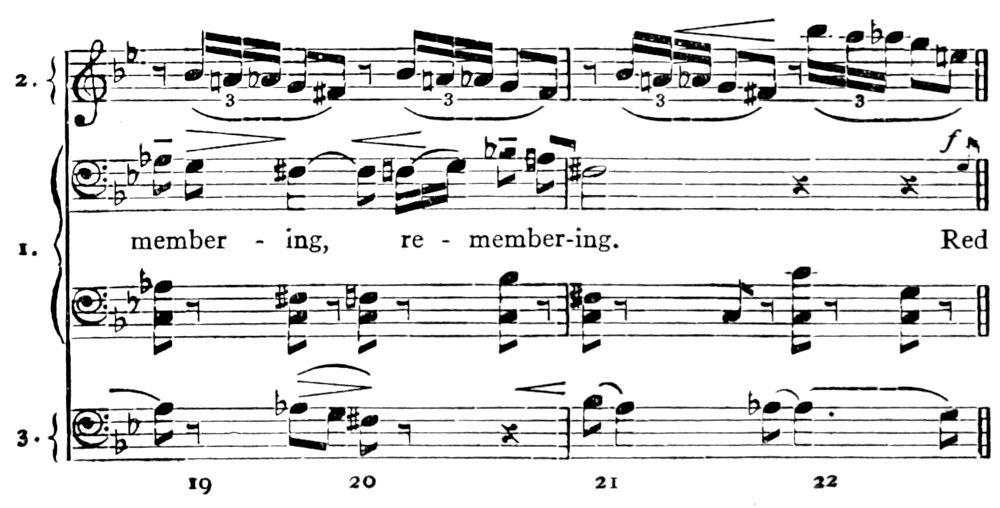
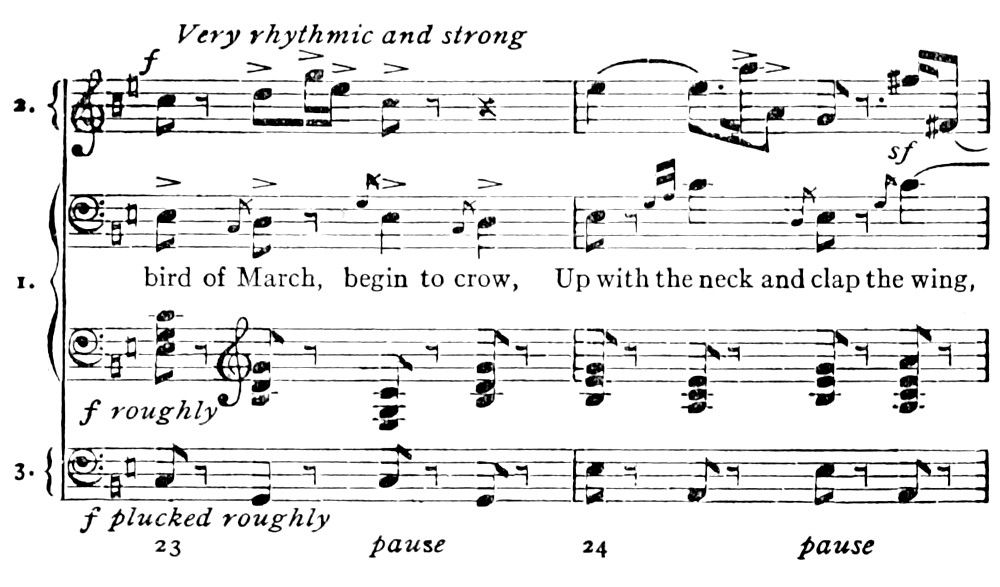
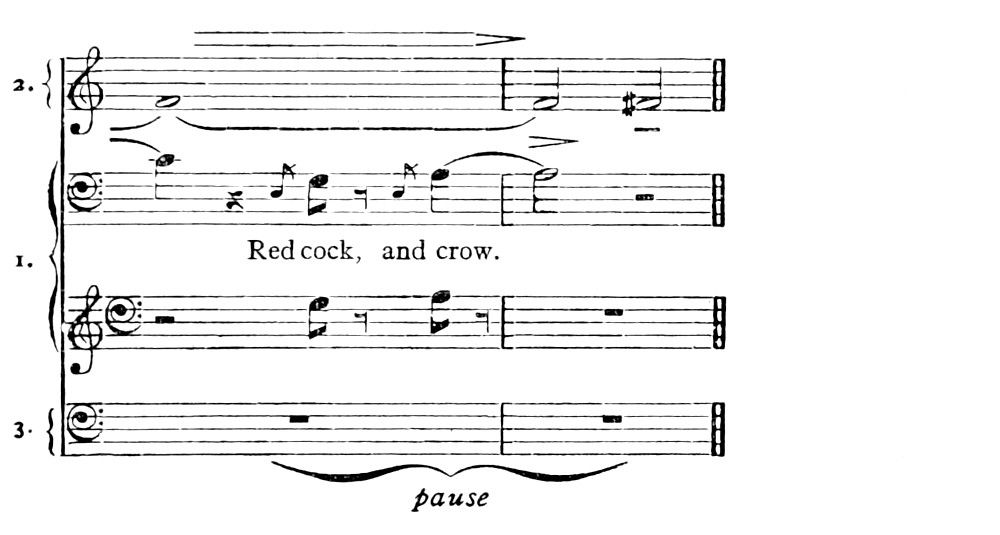
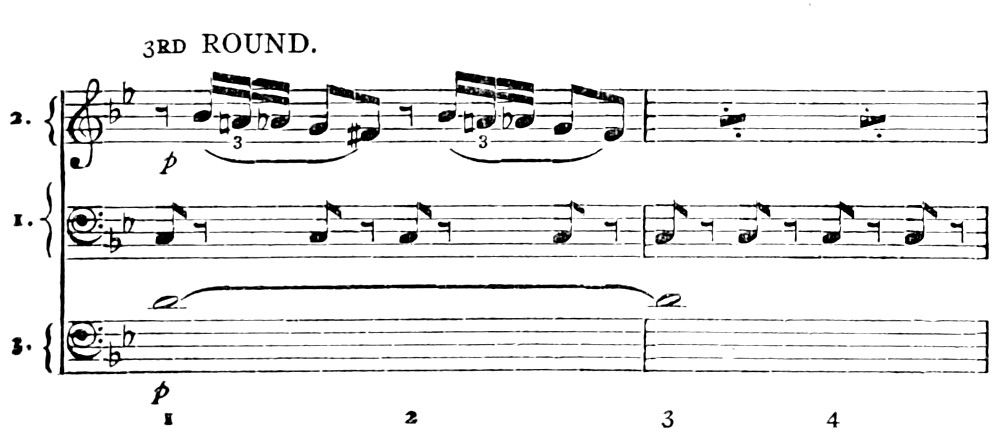
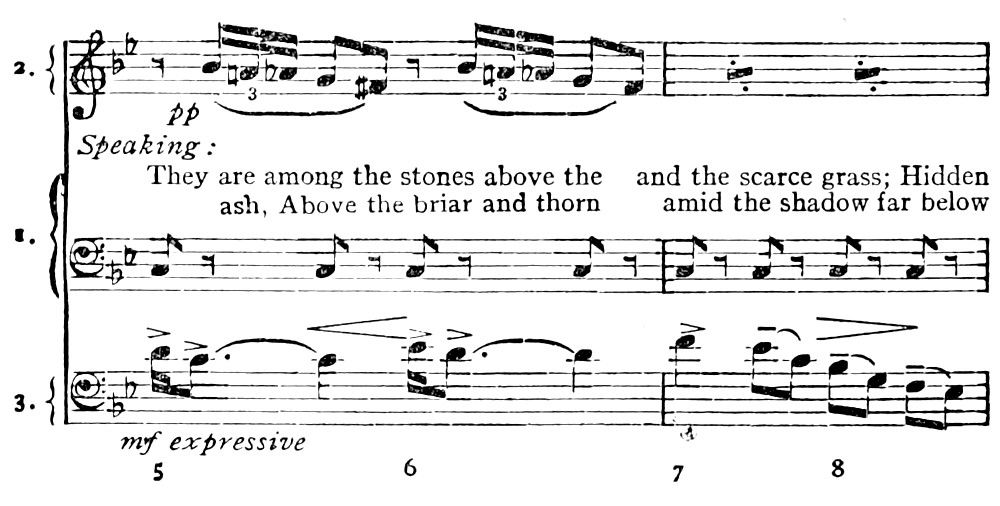
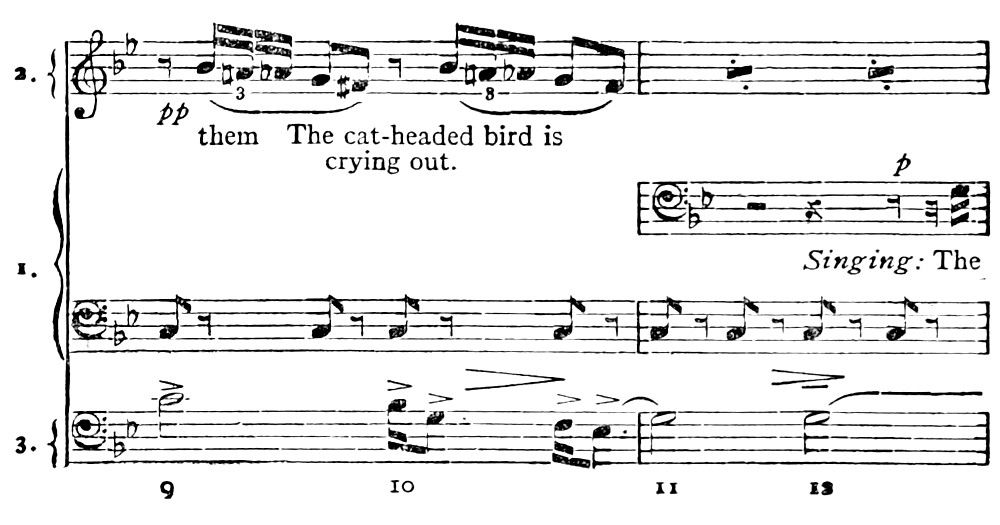
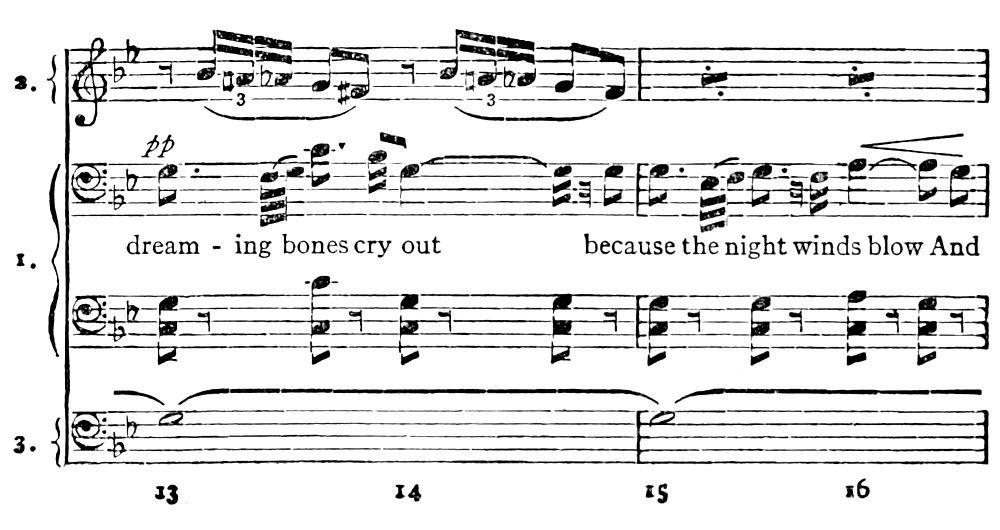
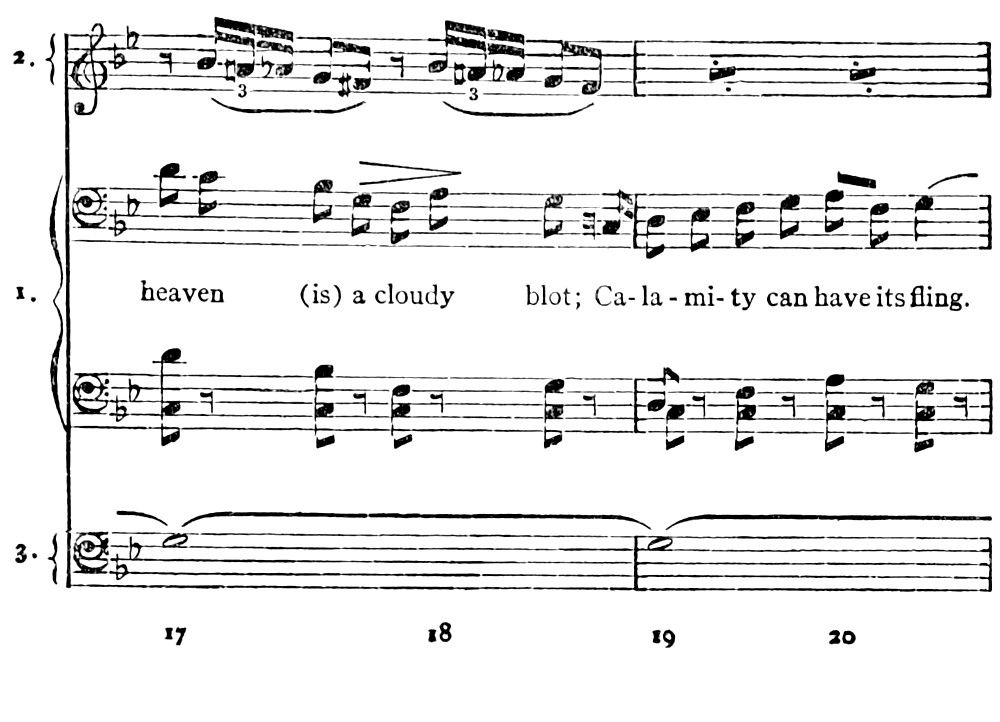
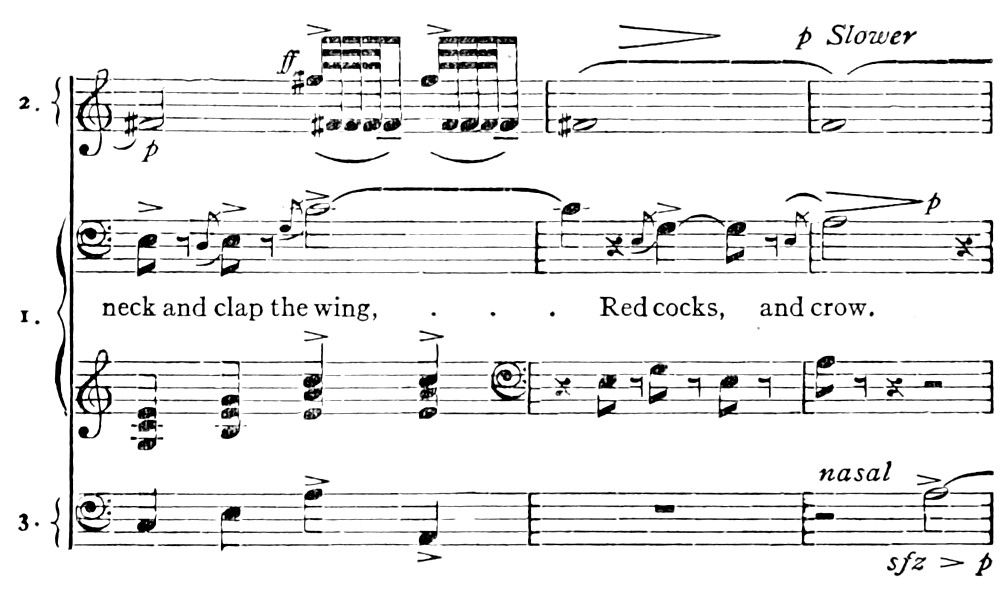
If necessary the two opening measures may be repeated at will, the same at beginning of each round.
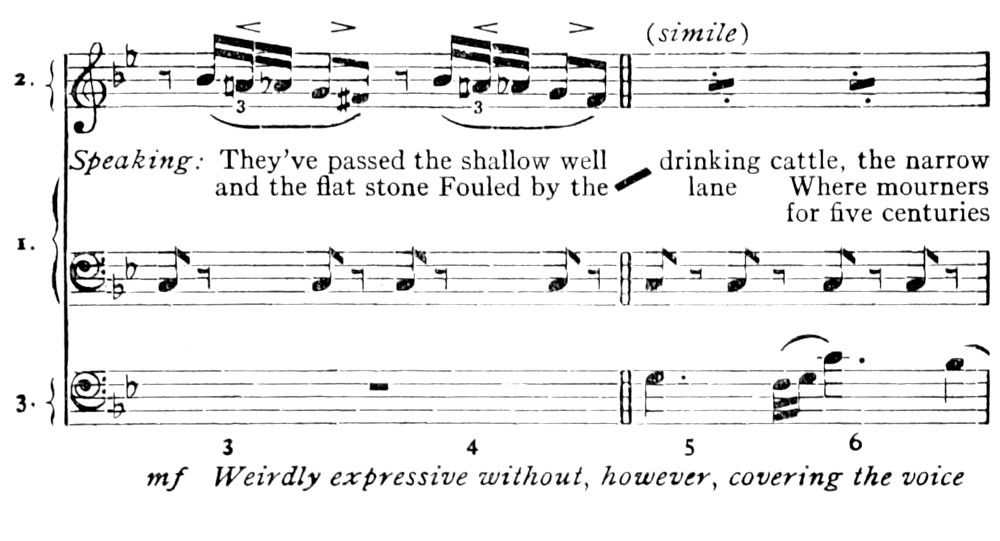
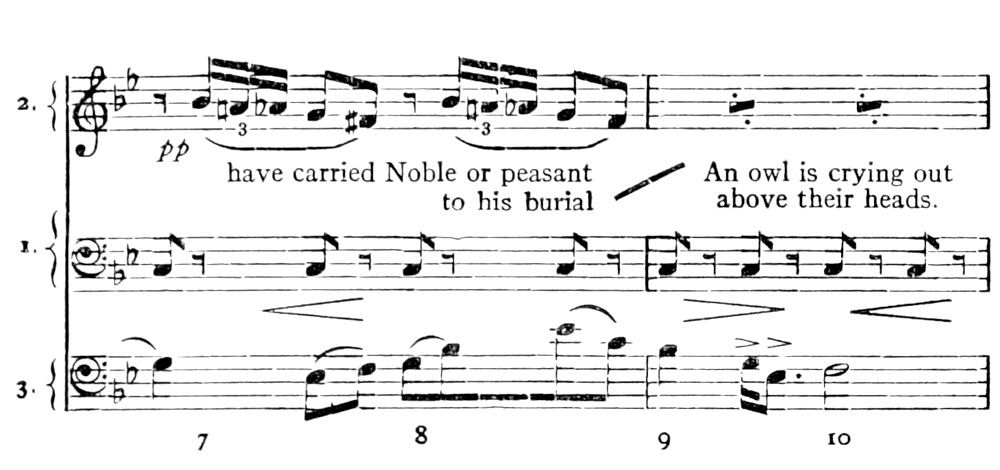
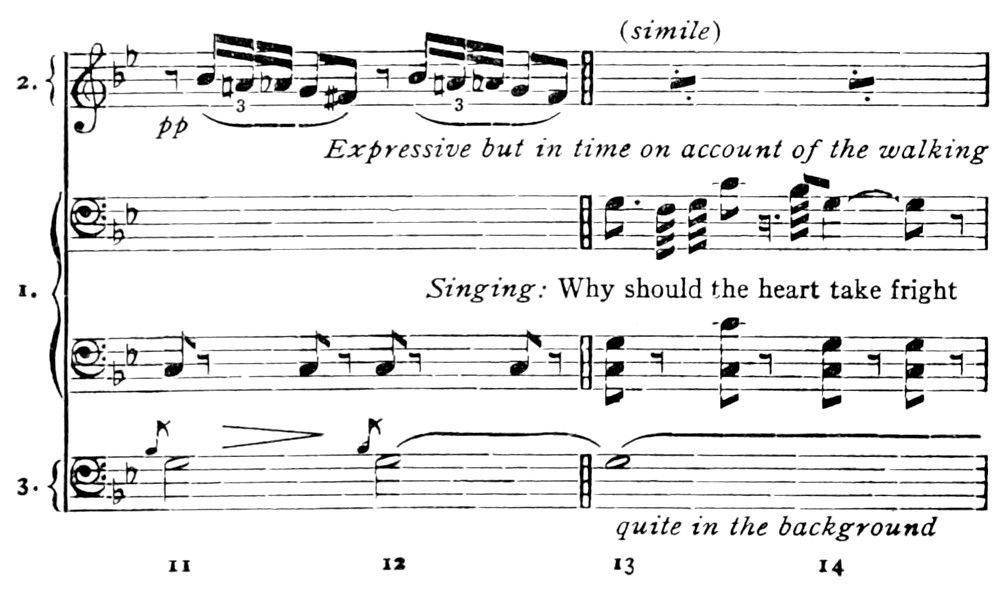
As to the spoken part preceding the song in each round, this must be arranged for by the singer. The singing voice must be able to easily enter in time at its proper place. The spoken part, however, can be begun before the time indicated for it in the music, or after, according to the speed of speech. The rhythm of the music should be slow.
Stranger:—cry
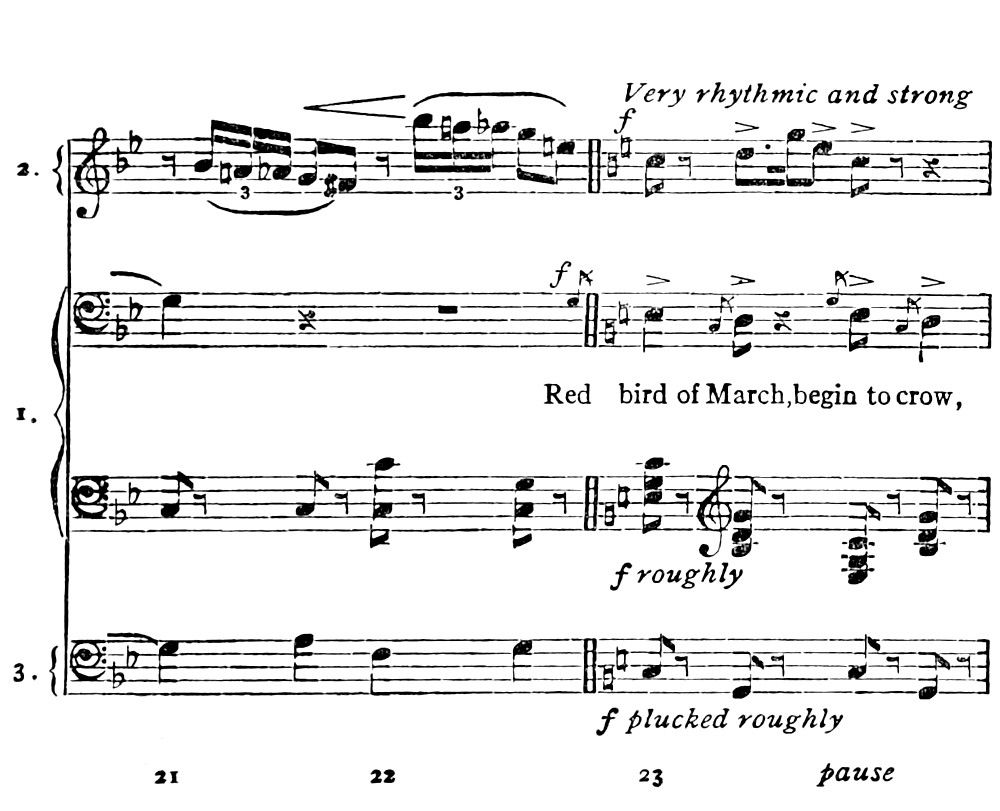
1st ROUND. In a slow mysterious rhythm
451
452
453
454
455
456
457
458
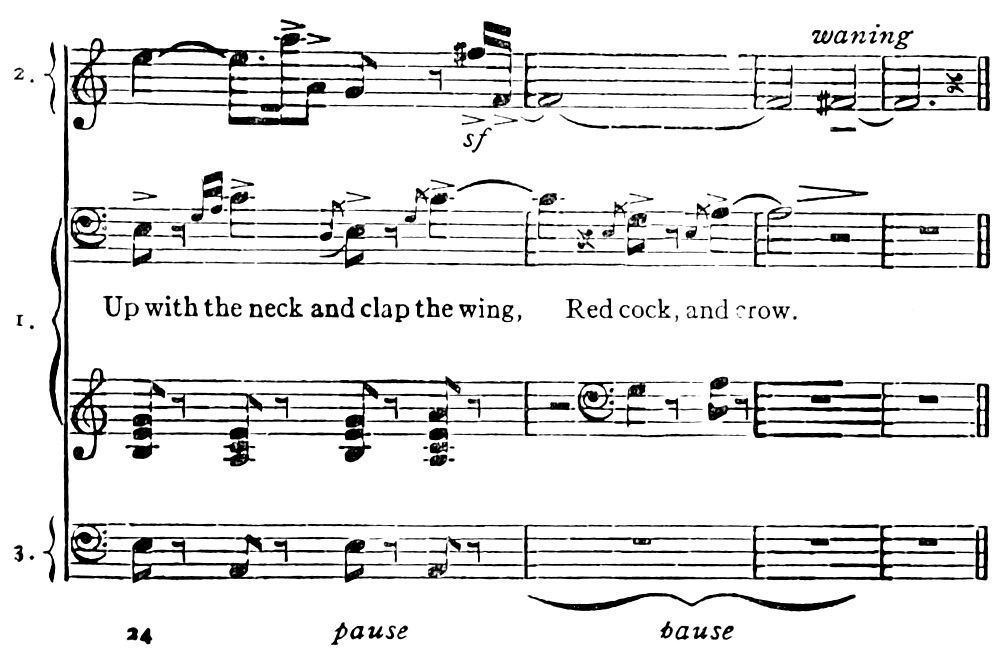
Audio content is not currently supported on your device.
[Download as MusicXML]
Speaking:—The Stranger: We’re almost, etc. No music
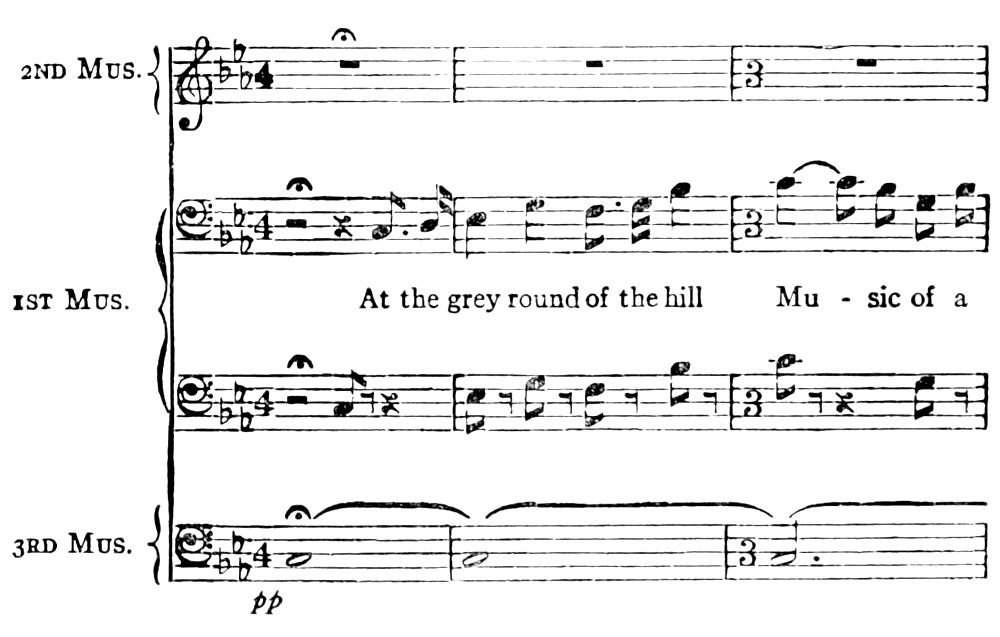
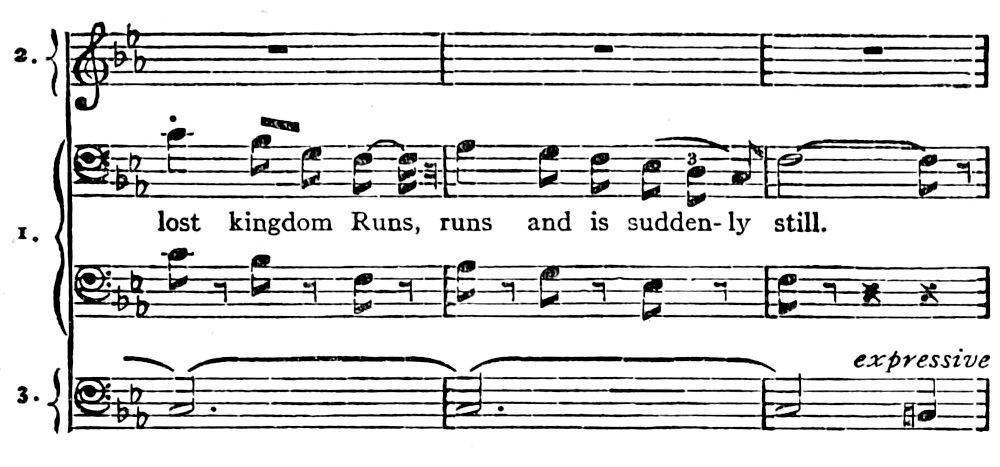
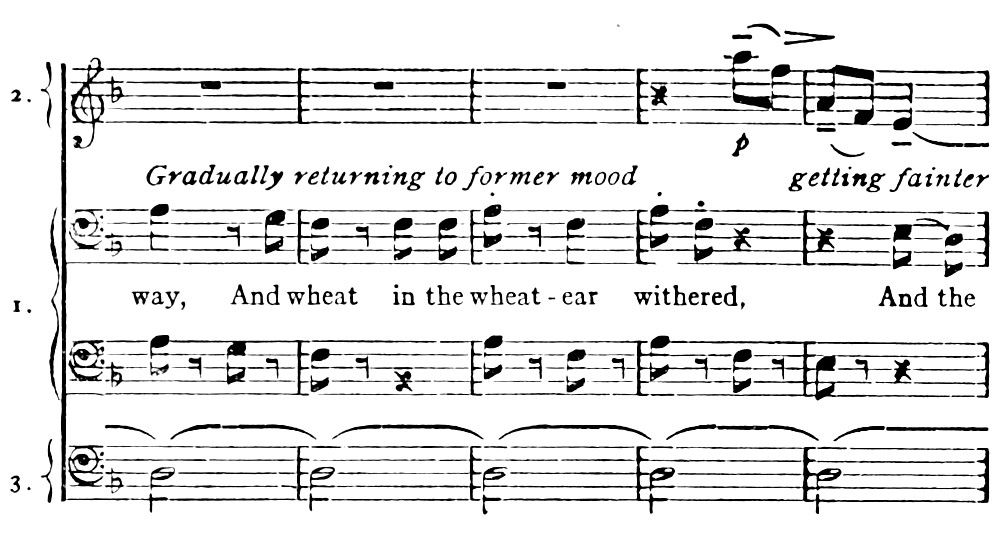
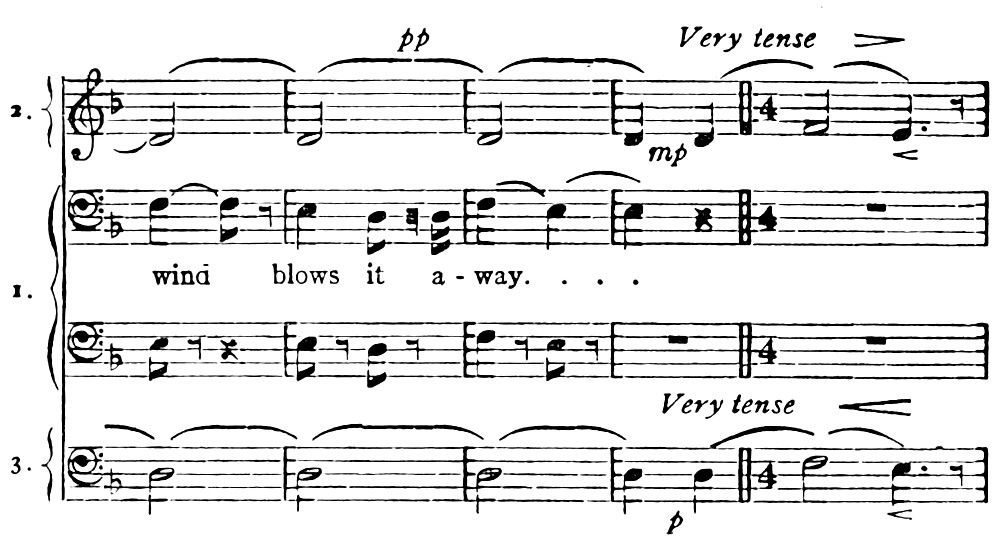
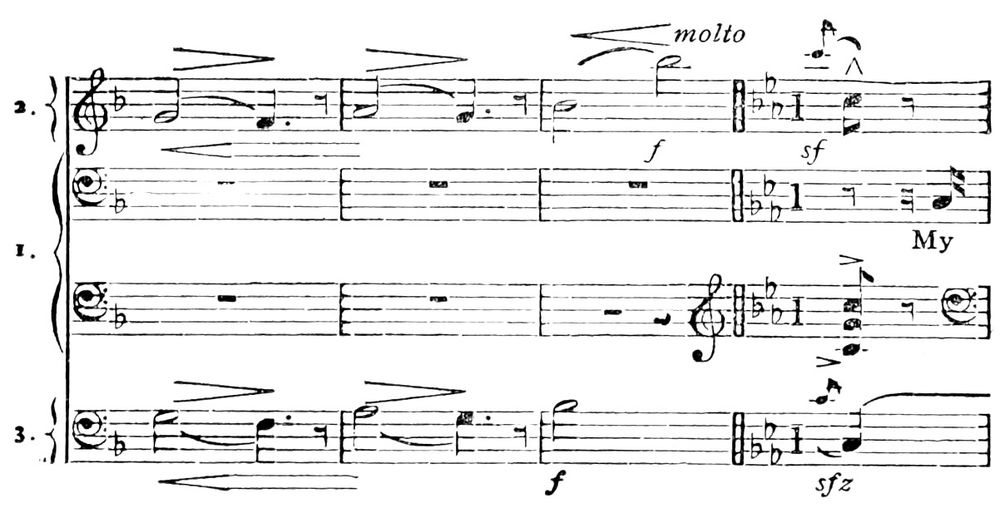
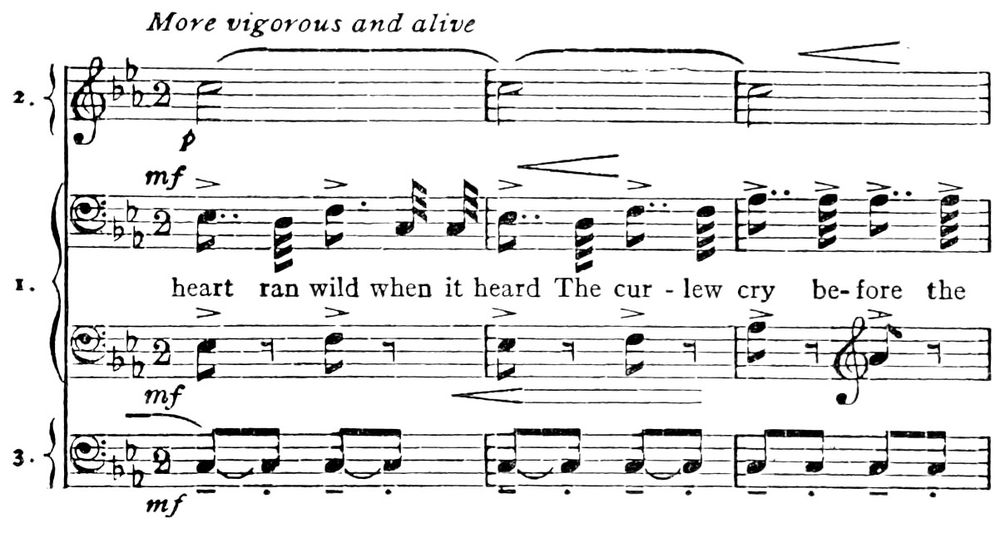
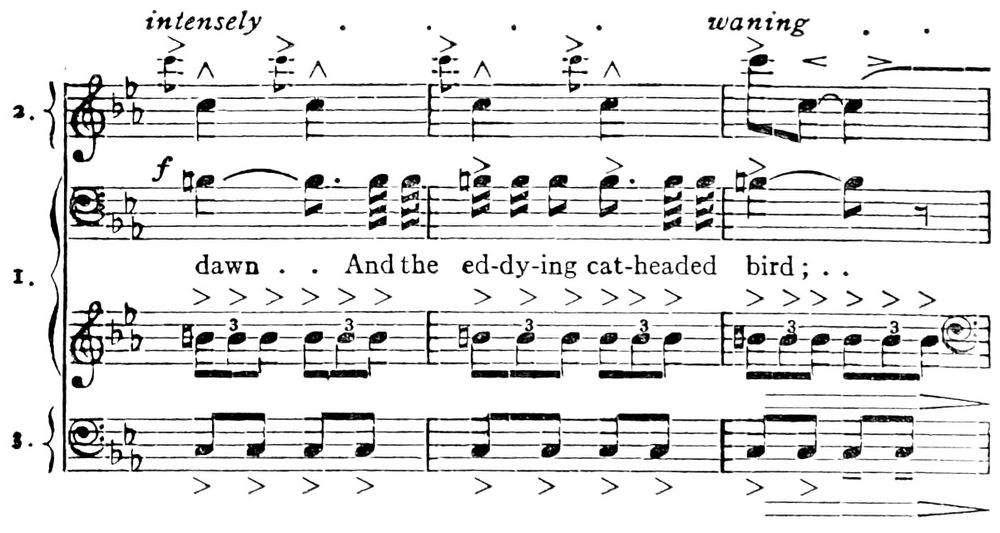
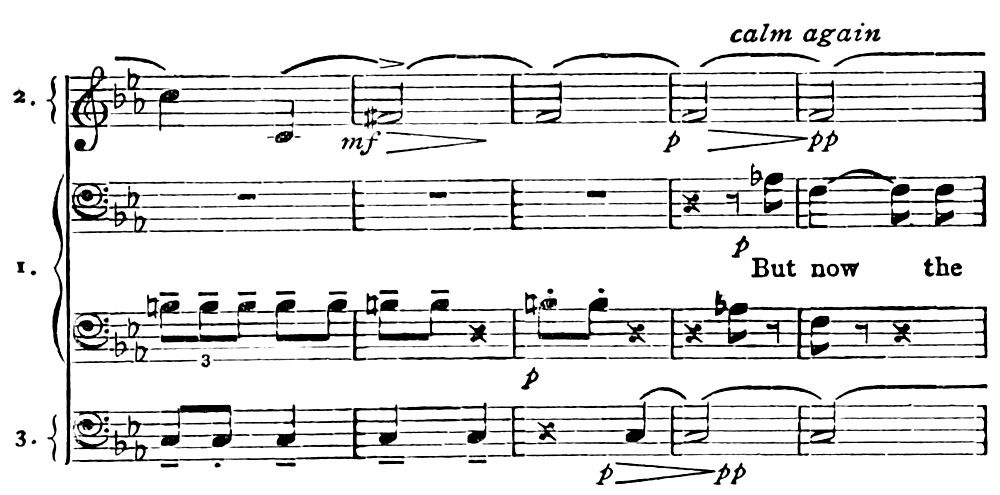
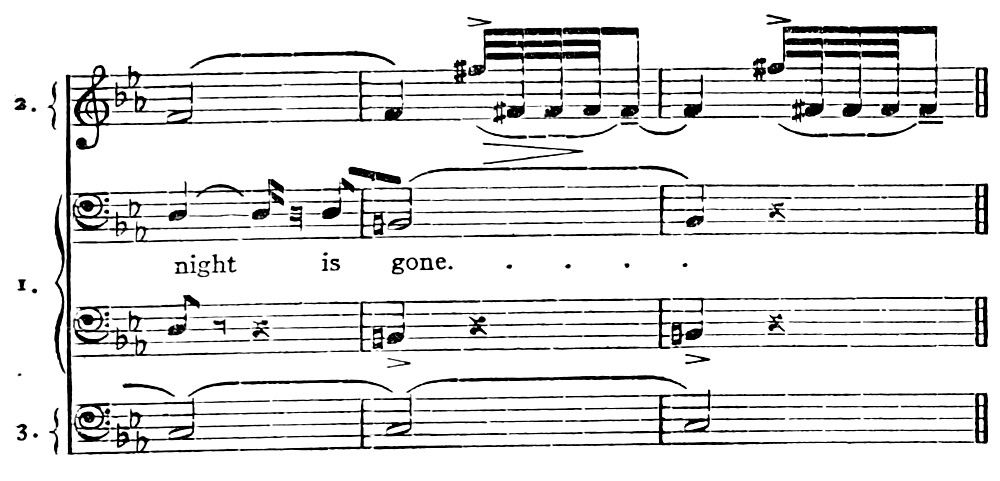
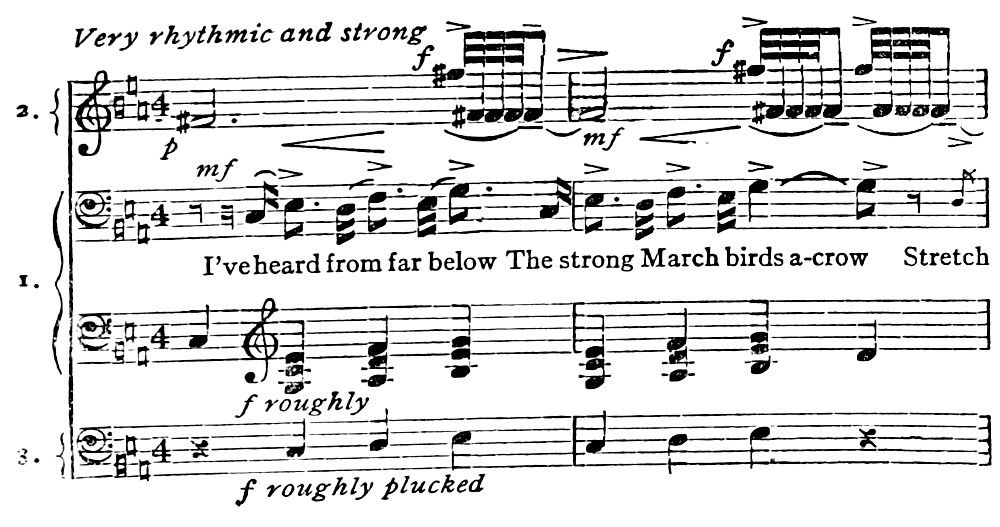
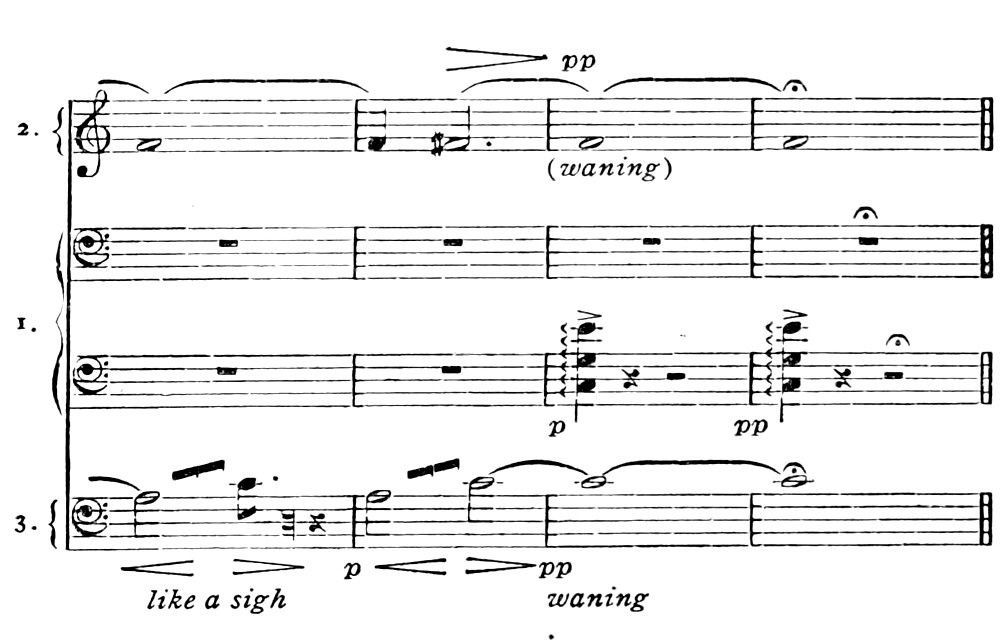
CLOSING SONG
The Musician singing
459
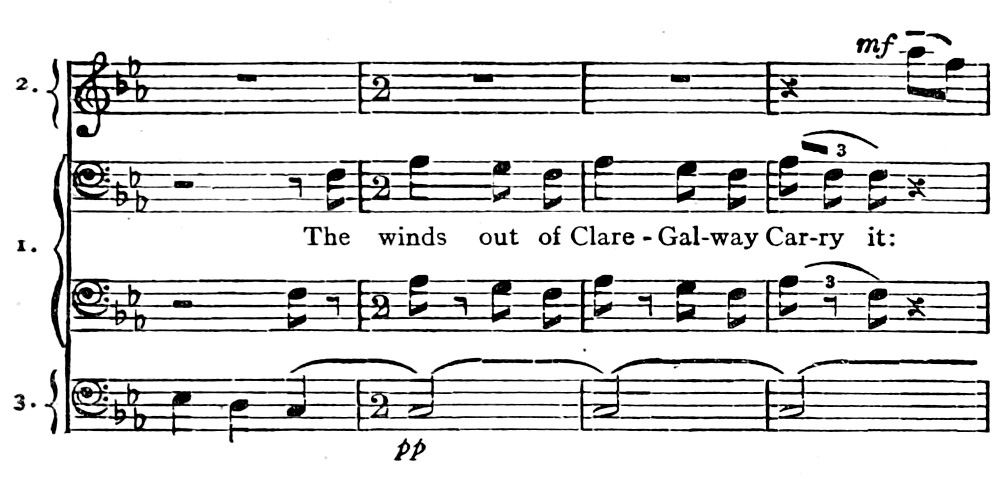
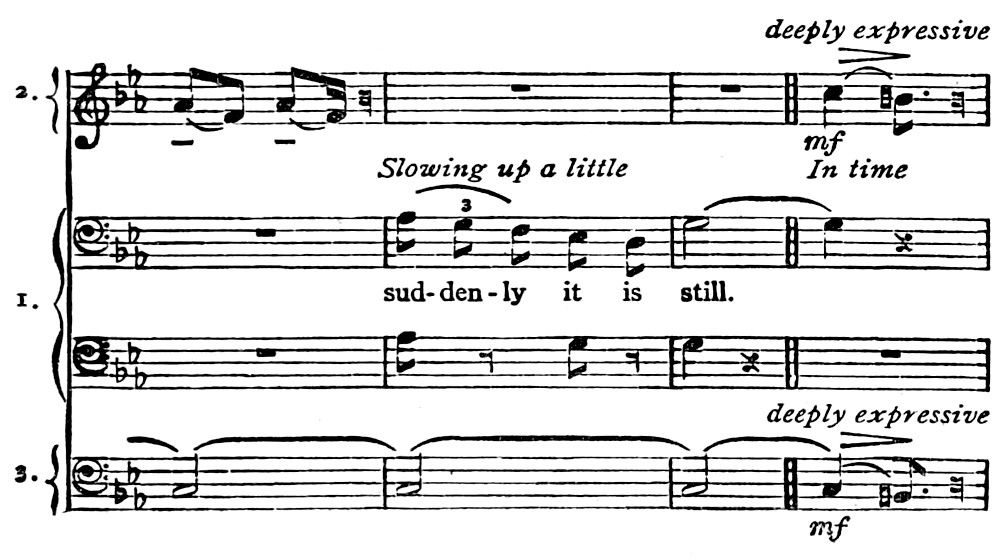
460
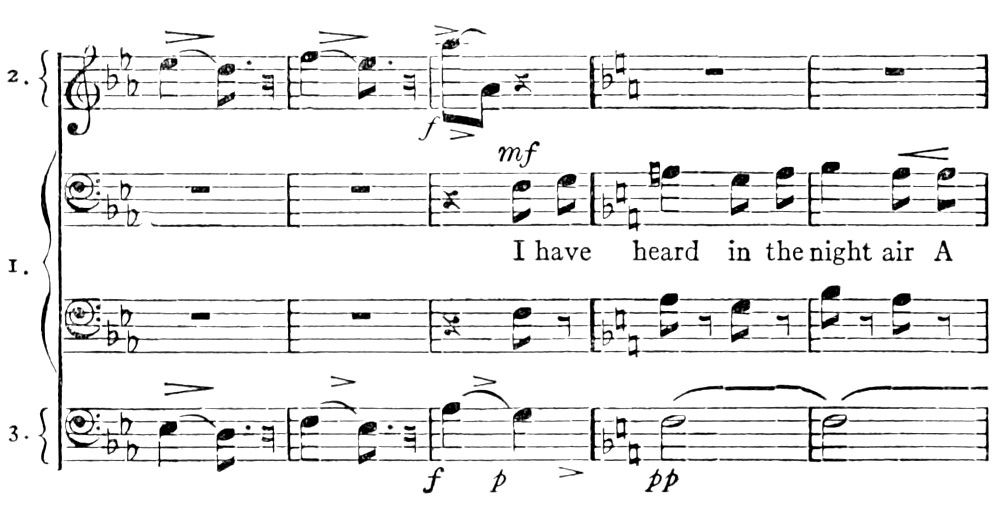
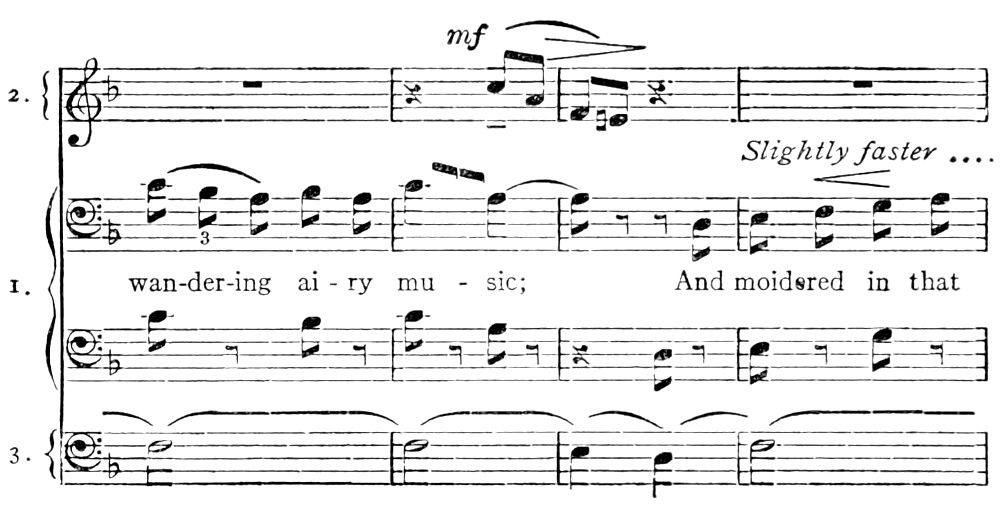
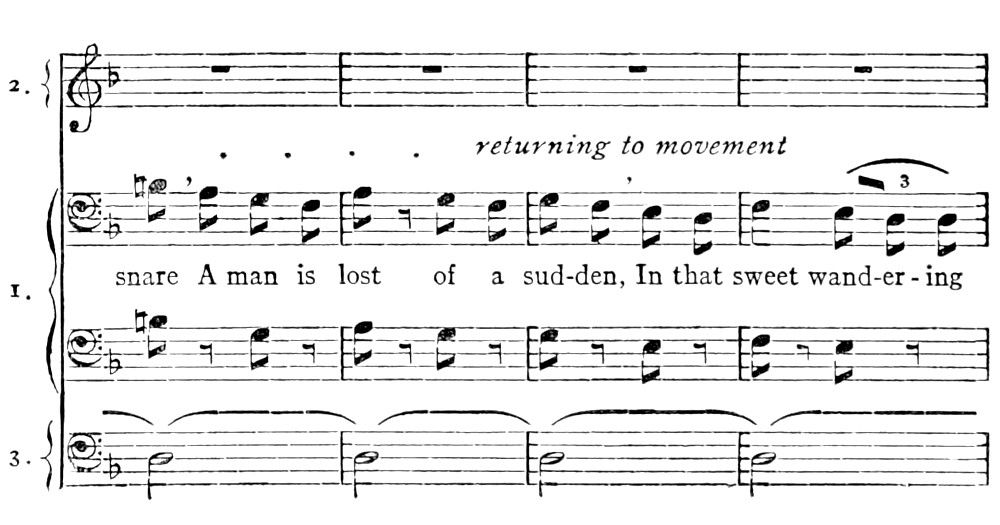
461
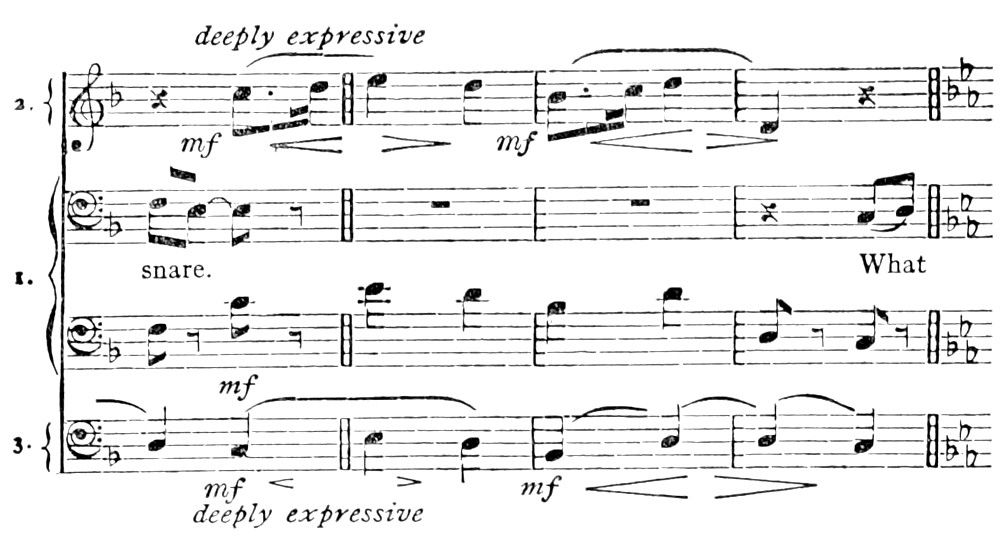
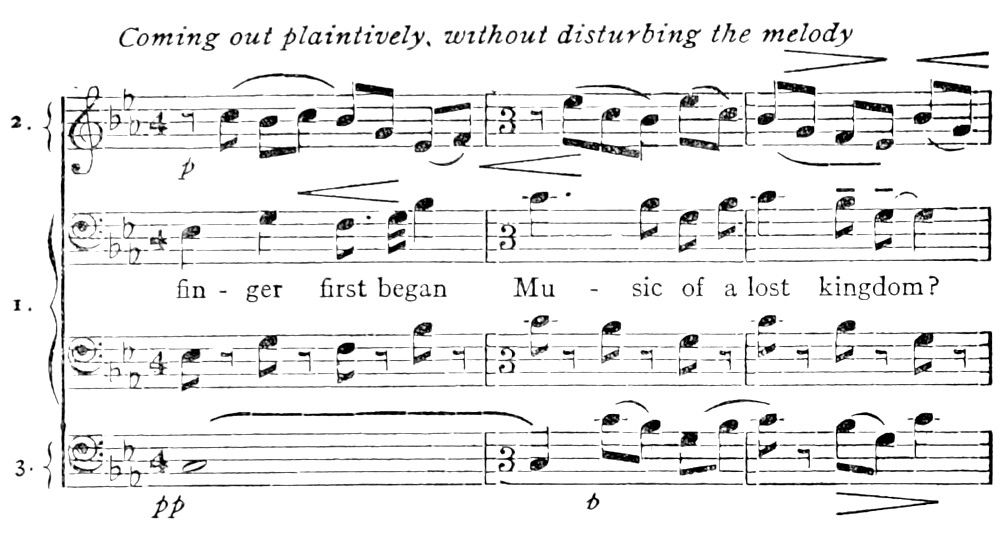
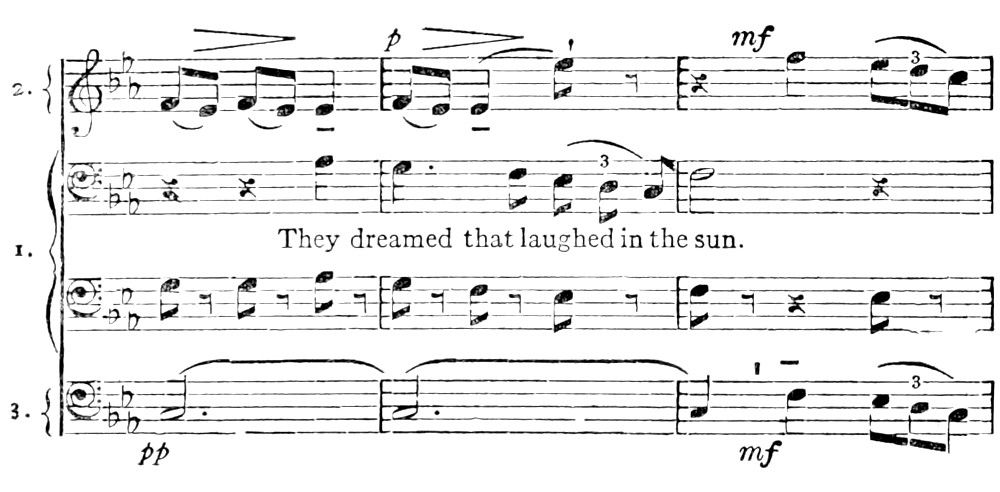
462
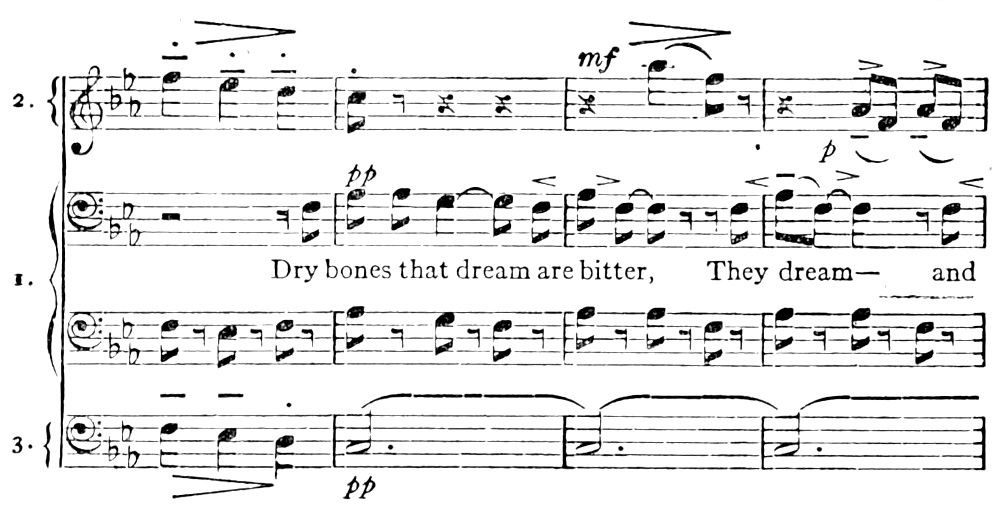
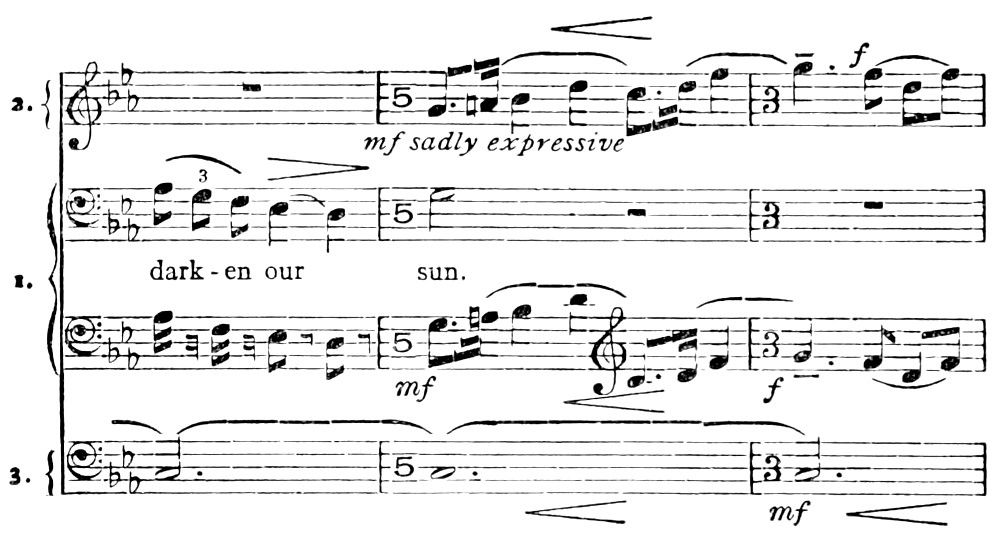
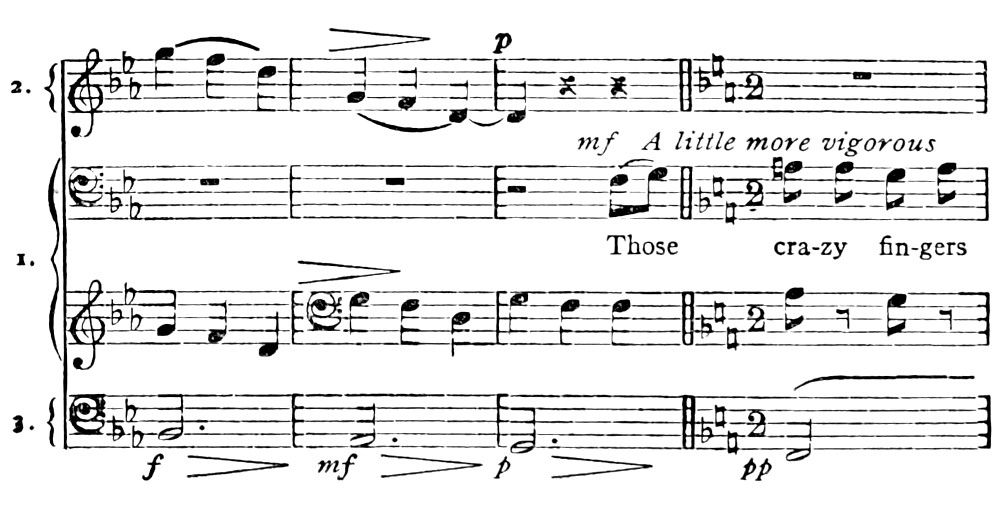
463
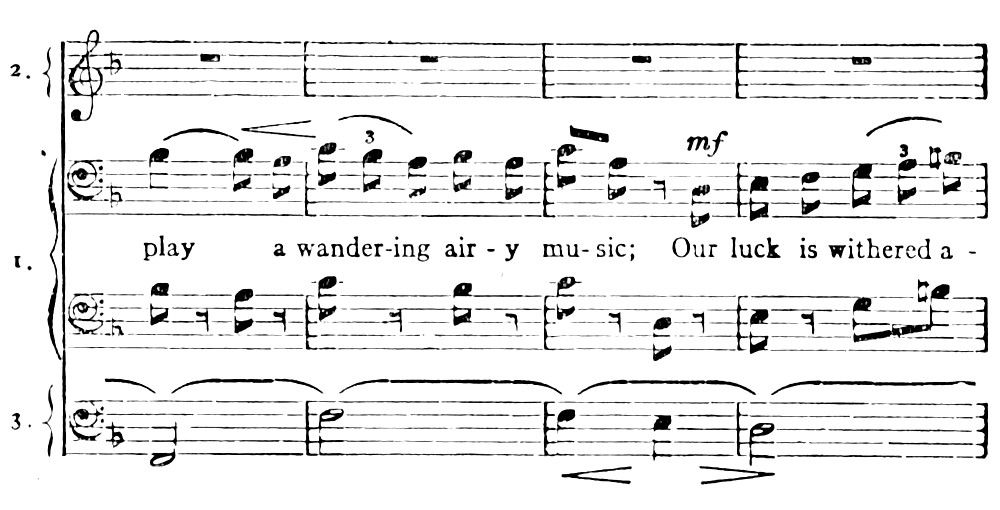
464
465
466
Audio content is not currently supported on your device.
[Download as MusicXML]
Paris, September 1917.
467
NOTE ON ‘THE DREAMING OF THE BONES’
Dervorgilla’s few lines can be given, if need be, to Dermot, and Dervorgilla’s part taken by a dancer who has the training of a dancer alone; nor need that masked dancer be a woman.
The conception of the play is derived from the world-wide belief that the dead dream back, for a certain time, through the more personal thoughts and deeds of life. The wicked, according to Cornelius Agrippa, dream themselves to be consumed by flames and persecuted by demons; and there is precisely the same thought in a Japanese ‘Noh’ play, where a spirit, advised by a Buddhist priest she has met upon the road, seeks to escape from the flames by ceasing to believe in the dream. The lovers in my play have lost themselves in a different but still self-created winding of the labyrinth of conscience. The Judwalis distinguish between the Shade which dreams back through events in the order of their intensity, becoming happier as the more painful and, therefore, more intense wear themselves away, and the Spiritual Being, which lives back through events in the order of their occurrence, this living back being an exploration of their moral and intellectual origin.
All solar natures, to use the Arabian terms, during life move towards a more objective form of experience, the lunar towards a more subjective. After death a lunar man, reversing the intellectual order, grows always closer to objective experience, which in the spiritual 468world is wisdom, while a solar man mounts gradually to the most extreme subjective experience possible to him. In the spiritual world subjectivity is innocence, and innocence, in life an accident of nature, is now the highest achievement of the intellect. I have already put the thought in verse.
He grows younger every second
That were all his birthdays reckoned
Much too solemn seemed;
Because of what he had dreamed,
Or the ambitions that he served,
Much too solemn and reserved.
Jaunting, journeying
To his own dayspring,
He unpacks the loaded pern
Of all ’twas pain or joy to learn,
Of all that he had made.
The outrageous war shall fade;
At some old winding whitethorn root
He’ll practise on the shepherd’s flute,
Or on the close-cropped grass
Court his shepherd lass,
Or run where lads reform our daytime
Till that is their long shouting playtime;
Knowledge he shall unwind
Through victories of the mind,
Till, clambering at the cradle side,
He dreams himself his mother’s pride,
All knowledge lost in trance
Of sweeter ignorance.
The Shade is said to fade out at last, but the Spiritual Being does not fade, passing on to other states of existence after it has attained a spiritual state, of which the surroundings and aptitudes of early life are a correspondence. When, as in my poem, I speak of events while describing the ascent of the Spiritual Being, I but use them as correspondence or symbol. Michael Robartes writes to Aherne, under the date of May 1917, a curious letter on this subject: ‘There is an analogy between the dreaming 469back of the Body of Passion’ (I have used instead of this term the more usual term Shade), ‘and our ordinary dreams—and between the life of Spirit and Celestial Body taken together’ (I have substituted for both terms the less technical, though, I fear, vague term Spiritual Being), ‘and those coherent thoughts of dreamless sleep, which, as I know on my personal knowledge, coincide with dreams. These dreams are at one time their symbols, and at another live with an independent life. I have several times been present while my friend, an Arab doctor in Bagdad, carried on long conversations with a sleeping man, and I have myself joined in those conversations. I do not say a hypnotised man, or even a somnambulist, for the sleep seemed natural sleep produced by fatigue, though sometimes with a curious suddenness. The sleeper would discuss the most profound truths and yet while doing so make, now and again, some movement that suggested dreaming, although the part that spoke remained entirely unconscious of the dream. On waking he would often describe a long dream, sometimes a symbolic reflection of the conversation, but more often produced by some external stimulus—a fall in temperature in the rooms, or some condition of body perhaps. Now and again these dreams would interrupt the conversation, as when he dreamed he had feathers in his mouth and began to blow. Seeing, therefore, that I have observed a separation between two parts of the nature during life, I find no difficulty in believing in a more complete separation, affirmed by my teachers, and supported by so much tradition, when the body is no longer there to hold the two parts together.’
I wrote my play before the Robartes papers came into my hands, even before I myself had received much of their thought from a different source, and in making the penance of Dermot and Dervorgilla last 470so many centuries I have done something for which I had no warrant in these papers or from that source, but warrant there certainly is in the folklore of all countries. At certain moments the Spiritual Being, or rather that part of it which Robartes calls ‘the Spirit,’ is said to enter into the Shade, and during those moments it can converse with living men, though but within the narrow limits of its dream.
471
NOTE ON ‘CALVARY’
I have written the little songs of the chorus to please myself, confident that singer and composer, when the time came for performance, would certainly make it impossible for the audience to know what the words were. I used to think that singers should sing a recipe for a good dish, or a list of local trains, or something else they want to get by heart, but I have changed my mind and now I prefer to give him some mystery or secret. A reader can always solve the mystery and learn the secret by turning to a note, which need not be as long as those Dante put to several of the odes in the Convito. I use birds as symbols of subjective life, and my reason for this, and for certain other things, cannot be explained fully till I have published some part at any rate of those papers of Michael Robartes, over which I have now spent several years. The following passage in a letter written by Robartes to Aherne in the spring of 1917 must suffice. ‘At present I rather pride myself on believing all the superstitions of the Judwalis, or rather in believing that there is not one amongst them that may not be true, but at first my West European mind rebelled. Once in the early morning, when I was living in a horse-hair tent among other similar tents, a young Arab woke me and told me to come with him if I would see a great wonder. He brought me to a level place in the sand, just outside the tent of a certain Arab, who had arrived the night before and had, as I knew, a reputation as a wonder-worker, and showed me certain marks on the sand. I said they were the 472marks of a jackal, but he would not have this. When he had passed by a little after sunrise there was not a mark, and a few minutes later the marks were there. No beast could have come and gone unseen. When I asked his explanation he said they were made by the wonder-worker’s “Daimon” or “Angel.” “What,” I said, “has it a beast’s form?” “He goes much about the world,” he said; “he has been in Persia and in Afghanistan, and as far west as Tripoli. He is interested in things, in places, he likes to be with many people, and that is why his Daimon has the form of a beast, but your Daimon would have a bird’s shape because you are a solitary man.” Later on, when I mastered their philosophy, I came to learn that the boy had but classified the wonder-worker and myself according to their division of all mankind into those who are dominated by objects and those who are dominated by the self or Zat, or, as we would say, into objective and subjective natures. Certain birds, especially as I see things, such lonely birds as the heron, hawk, eagle, and swan, are the natural symbols of subjectivity, especially when floating upon the wind alone or alighting upon some pool or river, while the beasts that run upon the ground, especially those that run in packs, are the natural symbols of objective man. Objective men, however personally alone, are never alone in their thought, which is always developed in agreement or in conflict with the thought of others and always seeks the welfare of some cause or institution, while subjective men are the more lonely the more they are true to type, seeking always that which is unique or personal.’
I have used my bird-symbolism in these songs to increase the objective loneliness of Christ by contrasting it with a loneliness, opposite in kind, that unlike His can be, whether joyous or sorrowful, sufficient to itself. I have surrounded Him with the images of 473those He cannot save, not only with the birds, who have served neither God nor Cæsar, and await for none or for a different saviour, but with Lazarus and Judas and the Roman soldiers for whom He has died in vain. ‘Christ,’ writes Robartes, ‘only pitied those whose suffering is rooted in death, in poverty, or in sickness, or in sin, in some shape of the common lot, and He came especially to the poor who are most subject to exterior vicissitude.’ I have therefore represented in Lazarus and Judas types of that intellectual despair that lay beyond His sympathy, while in the Roman soldiers I suggest a form of objectivity that lay beyond His help. Robartes said in one of the conversations recorded by Aherne: ‘I heard much of Three Songs of Joy, written by a certain old Arab, which owing to the circumstances of their origin were considered as proofs of great sanctity. He held the faith of Kusta ben Luki, but did not live with any of the two or three wandering companies of Judwalis. We lived in the town of Hâyel as servant to a rich Arab merchant. He himself had been a rich merchant of Aneyza and had been several times to India. On his return from one of these journeys he had found his house in possession of an enemy and was himself driven from Aneyza by the Wahâbies on some charge, I think of impiety, and it was then he made his first song of joy. A few years later his wife and child were murdered by robbers in the desert, and after certain weeks, during which it was thought that he must die of grief, his face cleared and his step grew firm and he made his second song. He gave away all his goods and became a servant in Hâyel, and a year or two later, believing that his death was near, he made his third song of joy. He lived, however, for several months, and when I met him had the use of all his faculties. I asked him about the “Three Songs,” for I knew that even on his deathbed, as 474became the votary of a small, contentious sect, he would delight in exposition. I said (though I knew from his songs themselves, that this was not his thought, but I wanted his explanation in his own words): “You have rejoiced that the Will of God should be done even though you and yours must suffer.” He answered with some emotion: “Oh, no, Kusta ben Luki has taught us to divide all things into Chance and Choice; one can think about the world and about man, or anything else until all has vanished but these two things, for they are indeed the first cause of the animate and inanimate world. They exist in God, for if they did not He would not have freedom, He would be bound by His own Choice. In God alone, indeed, can they be united, yet each be perfect and without limit or hindrance. If I should throw from the dice-box there would be but six possible sides on each of the dice, but when God throws He uses dice that have all numbers and sides. Some worship His Choice; that is easy; to know that He has willed for some unknown purpose all that happens is pleasant; but I have spent my life in worshipping His Chance, and that moment when I understand the immensity of His Chance is the moment when I am nearest Him. Because it is very difficult and because I have put my understanding into three songs I am famous among my people.”’
Transcriber’s Notes
New original cover art included with this ebook is granted to the public domain. The music files are the music transcriber’s interpretation of the printed notation and are placed in the public domain. Full page illustrations have been moved to an appropriate break in the text.
The following changes and corrections have been made:
p. 44: Replaced “year” with “year’s” in phrase “The two plays in this year’s Samhain.”
p. 154: Added closing single quotation mark after phrase “what I have made of her is very living.”
p. 194: Replaced “is” with “it” in phrase “even if hundreds desired that it should not be silenced.”
p. 229: Replaced period with comma after phrase “So you are starving even in this wood.”
p. 229: Replaced period with comma after phrase “being weak with hunger and thirst.”
p. 286: Replaced “éte” with “été” in phrase “car le soleil avait été rare.”
p. 353: Removed extra quotation mark after first “Eofe!” in phrase “The Musicians cry ‘Eofe! Eofe!’ and strike gong.”
p. 360: Replaced “Archimedes” with “Archimedes’” in phrase “Beyond hearing or seeing, / Or Archimedes’ guess.”
p. 368: Moved period outside of closing bracket after direction “to FIGURE OF CUCHULAIN.”
p. 378: Added period after phrase “Knows that his own harsh sea made my heart cold.”
p. 398: Added period after phrase “Songs for the unfolding and folding of the cloth.”
p. 443: Added closing single quotation mark after phrase “They do things very well.”
p. 450: Replaced “neccessary” with “necessary” in phrase “If necessary the two opening measures may be repeated at will.”