Chapter III · BLUES.
Reading edition
Cobalt Blues.—Some of the compounds of cobalt with alumina, phosphoric acid, silica, and tin, are remarkable for possessing a fine blue colour of great permanency and indestructibility, and still find a limited application. They are chiefly as follows:—
Cœruleum—a mixture of the oxides of cobalt and tin.
Cobalt blue—a mixture of the oxides of cobalt and alumina.
Smalts—a double silicate of cobalt and potash.
Cœruleum.—This is a light-blue slightly greenish colour, with no purple tendency in artificial light. It is non-granular, covers well, mixes with water or oil, and is a good artists’ colour for sky effects. It is permanent in strong sunlight and impure atmosphere, and resists acids and alkalies at normal temperatures. Hot hydrochloric acid dissolves it, and addition of water to the pale blue solution produces a violet red; evaporation to dryness restores the original pigment. The green tint of a nitric acid solution is due to iron and nickel impurites. Dilute sulphuric acid causes partial decomposition of cœruleum, but it is proof against caustic potash, acetic acid, and concentrated sulphuric acid. Its composition is given as
Cobalt oxide18·66
Tin oxide49·66
Silica and sulphate of lime31·68
100·00
There are several methods of preparing cœruleum:—
(1) A solution of stannate of potash is added to one of cobalt. A blue precipitate is thrown down, which, on washing, becomes first light-red and then brown. When calcined at a white heat it assumes a blue colour.
(2) A solution of stannate of soda is mixed with a solution of nitrate of cobalt, and the resulting precipitate calcined to bright redness forms a blue pigment.
(3) Solutions of cobalt and tin are mixed and precipitated by soda, the precipitate washed free from soda being calcined as in all the other cases. The silicate of soda is the most satisfactory sodium salt for a precipitant.
Cobalt Blue.—This rich pure blue pigment is not alone permanent, but actually develops its full intensity only after exposure to the air. With age, however, it acquires a greenish tendency, and in artificial light it inclines to a violet tint. It is proof against acids and alkalies, and mixes particularly well with water. In combination with other pigments it is unaltered and has no effect on them. Its tones are different from those of ultramarine. It slowly decomposes when heated in strong sulphuric acid, yielding a violet solution and a white precipitate, which latter dissolves and affords a blue liquid on dilution with water. It consists principally of about 80 per cent. alumina, and 15 per cent. oxide of cobalt.
There are several ways of preparing it:—
(1) By Thénard’s original process, roasted cobalt, from Tunaberg, Sweden, is dissolved under heat in an excess of nitric acid. The solution, evaporated nearly to dryness, is boiled in water, and the deposit of arseniate of iron is filtered out. Into the filtrate is poured a solution of basic phosphate of soda, which throws down a precipitate of basic phosphate of cobalt, varying in hue from violet to pink. This precipitate is washed on a filter, and, while still gelatinous, 1 lb. of it is intimately mixed with 8 lb. of hydrated alumina, recently precipitated by ammonia from a solution of potash-alum. The mass is first dried to brittleness and then calcined in a covered clay vessel for half an hour at a cherry-red heat. The resultant blue pigment is stored in glass receptacles.
The preparation of the gelatinous alumina is conducted as follows. The potash-alum is dissolved in at least three times as much water as is necessary, and is then precipitated by an abundant excess of ammonia, with frequent stirring. When settled, the supernatant liquor is siphoned off, and the precipitate is thoroughly washed several times on a filter.
Thénard blue will vary in tint according to the proportions of alumina used. A pure colour is obtained with 4-5 parts alumina to 1 of phosphate of cobalt; a greenish hue with equal parts of alumina and cobalt salt; and almost any intermediate tone by varying the proportions between these limits.
(2) To 16 parts of gelatinous alumina add 1 part of arseniate of cobalt, obtained by precipitating the solution of cobalt by arseniate of potash.
(3) A richer and more velvety blue is got by using oxide of cobalt and substituting phosphate of lime for the alumina (Boullai-Marillac).
(4) Binder’s process is as follows:—Dissolve by boiling 6 lb. alum, free from iron, in a leaden or earthenware vessel, and filter it into a vat 5½ ft. high and 3 ft. across, one-third full of clean water. Precipitate the alumina by solution of potash, fill up the vat with water, settle, decant the clear liquor, and wash repeatedly till barium chloride gives no precipitate. Dissolve ½ lb. sesquioxide of cobalt in 1½ lb. hydrochloric acid at 22° B., and evaporate to dryness. Dissolve the residue in 3 lb. hydrochloric acid, and pass a stream of sulphuretted hydrogen through it, to throw down any foreign metals. Filter clear, evaporate again to dryness, and dissolve the residue in enough water to produce 4½-5 lb. of solution. Next precipitate the cobalt solution (3 to 6 lb., according to depth of tint required) by ammonia, avoiding excess. Wash the precipitate, and add it to the water, holding the gelatinous alumina in suspension, stirring thoroughly for ½ an hour. A reddish tint in the supernatant liquor shows that some of the cobalt has been dissolved. Add a little ammonia, and allow the precipitate to settle. Decant and add new waters repeatedly. Finally collect on a fine filter cloth, drain, press, stove dry, and calcine for 2-2½ hours at red heat in clay crucibles: then cool, grind first in a mill and then on a slab, and sift.
Smalts.—This pigment has not maintained its position in competition with artificial ultramarine. Formerly it was very largely used to correct the yellow tone of cottons, papers, and pottery. It has a pale violet-blue tint, which, however, is not constant in artificial light. Being a silicate it is very permanent, and proof against the action of acids, alkalies, and sunlight, besides being inert when mixed with other pigments. It can be used with either water or oil as a medium, but is not a successful paint owing to its weak colouring power. It is virtually a double silicate of cobalt and potash, or a cobalt glass, containing a few impurities, of which the chief are aluminium, iron, and lead oxides. The colour varies somewhat according as these impurities fluctuate, and the finest ground sample is always the palest. It is hardly ever adulterated, and the chief point to secure is that it be ground to the finest possible degree.
Its manufacture is most extensively and successfully carried on in Saxony. The raw materials used are cobalt speiss (an arsenide of cobalt and iron), potash, and sand. The ore is broken up into convenient sized pieces and roasted at red heat in a reverberatory furnace provided with a tall shaft for discharging the sulphurous and arsenical fumes at a high altitude. When the evolution of these fumes has ceased and the mass begins to assume a pasty consistence, the roasted ore is removed from the furnace, cooled, reduced to a fine pulverulent condition (then known as “zaffre”) and passed through a silken sieve. Should it be necessary,
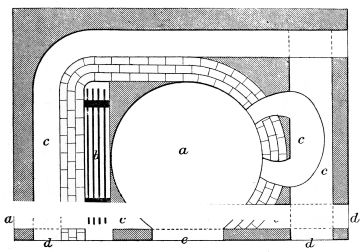
Fig. 12.—Furnace for Roasting Cobalt Ores.
the cobalt ore is first spalled and hand-picked to remove the ores of foreign metals which are associated with it; and then reduced to a very fine state in an edge runner or mortar mill, and freed from earthy impurities by washing. The concentrated ore is then dried and dead-roasted in small charges at a time (about 4 cwt.) in a specially designed reverberatory furnace such as shown in Fig. 12, of which a is the hearth on which the ore is spread; b, the fireplace, the products of combustion from which pass over the ore on the hearth, and thence into the flues c, which repeatedly circle round the furnace so as to provide abundant opportunity for the arsenious oxide derived from the combustion (oxidation) of the arsenic in the ore to condense; this highly poisonous arsenious oxide is collected in a solid form from the flues at convenient intervals by means of the doors d. The ore is charged and discharged at the door e. The roasting should not be carried to such a point that the whole of the sulphur and arsenic are removed when making smalts, as by leaving a portion of these substances in the ore at this stage, the ultimate purification is better accomplished.
The next stage is to fuse the roasted ore with potash and silica so as to form a blue glass. The proportions in which the ingredients are mixed depend upon the depth of colour in the zaffre operated upon and the tint desired in the finished smalts; hence it is always determined by a preliminary experiment, and is then most carefully adhered to, each material being accurately weighed out. Only the best potash can be used, as it must be quite free from soda, and iron or other metal; the effect of soda is to render the blue greenish tinted. Quartz affords the requisite silica, and is hand-picked to ensure freedom from alumina, iron, and lime, which import dullness into the colour, and then ground to a fine powder in an edge runner mill. The duly weighed quantities of the several ingredients are intimately mixed in wooden or cement lined vessels, so as to preclude the possibility of any metallic iron finding its way in; and as a further protection against this risk a little white arsenic is often added so that the iron may be carried down in the regulus which is formed during the fusion in the crucible.
These crucibles are of refractory earthenware quite free from lime, and measure about 18 inches across at top, gradually diminishing to 14 inches at bottom, so that an ordinary charge is about ¾ cwt. They are placed in rows in a furnace which generally bears a close resemblance to a glass furnace, the operation being very similar. The form of furnace common in Saxony, where most of the smalts is made, is shown in Fig. 13. By means of a series of openings a in the walls of the furnace the pots b are introduced on to the hearth of the furnace, whereupon the openings a are bricked up again and remain closed during the operation. The ingredients are charged into the pots b
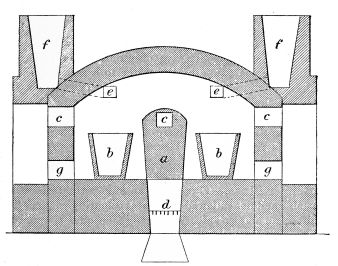
Fig. 13.—Furnace for making Smalts.
by means of long iron ladles which are introduced through the small square apertures c, which can be temporarily closed by a half-brick or other simple article. The fire is then lit in the fireplace d, and the products of combustion circulate around the pots b, and finally escape at the orifices e at the top of the furnace into flues leading to the chimney f. After about 8 hours’ firing fusion commences in the pots, whereupon the contents are thoroughly stirred by rods inserted through the working holes c. The temperature is then increased till a white heat is attained, this being necessary for the formation of a glass. The fused mass is repeatedly sampled, and when it has become quite homogeneous, and the regulus or speiss containing the iron, antimony, bismuth, arsenic, copper, nickel, sulphur and other impurities has completely separated itself and collected at the bottom of the pots, the blue glass is ladled out and dropped at once into cold water, by which it is disintegrated and rendered very brittle ready for the subsequent grinding. The regulus is then drawn off from the pots through holes provided for the purpose, and removed by the orifices g, after which the pots are ready for another charge. They ordinarily remain serviceable for about six months.
The grinding needs to be done with great thoroughness, and is accomplished partly by stamps and partly by edge-runner mills in the presence of water. The particles as reduced are floated off by the water to a series of settling tanks communicating one with another. The portion which settles in the first of the series is too coarse for use, and is returned to the edge-runner for further grinding; while the portion in the last of the series possesses such a weak colour that it is rejected, or put into the crucible to undergo a second fusion. The selected portions are dried ready for the consumer.
Copper Blues.—These form an unimportant class, being unstable and not endowed with great colouring power. Their tint is pale and greenish, and though opaque in water, they are not particularly so when mixed with oil. Exposed to the action of sulphur or its compounds, whether present as sulphuretted hydrogen in the air, or in combination with a metal, forming another pigment with which they may be mixed, copper blues undergo an important chemical change, the carbonates and oxides of copper being converted into the sulphide, which is black. Under the influence of heat too the blue carbonate will lose its carbonic acid, and be turned into the black oxide. Ammonia and the acids dissolve them, but other alkalies are resisted until heat is applied. The chief kinds of copper blue are Bremen blue, cæruleum, lime blue, mountain blue, Péligot’s blue, and blue verditer.
Bremen Blue.—This is a more or less pure hydrated oxide of copper, varying in its qualities according to the method of preparation. When made by precipitating a neutral salt of copper from solution, it forms a dense and compact mass; whereas a porous and pulverulent pigment results when basic and insoluble copper salts are treated with alkalies.
(1) The foundation of the manufacture of this colour was waste copper scrap, such as ship’s sheathing, from which, in various ways, was prepared a basic chloride or oxy-chloride. Some of the methods adopted were:—(a) 100 lb. scrap copper, 99 lb. powdered sulphate of potash, and 100 lb. salt, moistened with clean water; (b) 100 lb. copper fragments, 60 lb. salt, and 30 lb. diluted sulphuric acid (3 volumes of water to 1 of acid); (c) a solution of copper oxide (scales) in pure hydrochloric acid poured over the scrap copper. The method (a) produces a chloride of copper which, in contact with more metal, becomes a sub-chloride; this, absorbing more oxygen from the air, is converted into the basic green “oxide” of the factories. By the (b) process, the hydrochloric acid set free, and the atmospheric oxygen produce the same result. In the (c) process a similar effect is obtained.
It is of primary importance that no trace of this sub-chloride of copper shall be allowed to remain, as it undergoes decomposition by caustic alkalies, and throws down an orange-yellow sub-oxide of copper. Hence it has sometimes been the practice to prepare the basic oxy-chloride twelve months in advance, and to stir it frequently before use. Complete oxidation, however, can be as satisfactorily accomplished by alternately wetting and completely drying the mass.
An interesting phenomenon takes place during the transformation of this green magma into a hydrated oxide of copper. On this magma being introduced by degrees into a caustic potash or soda lye of about 22° B., the thoroughly washed and dried product is exceedingly fine, with great covering power, and deepens on addition of a little water. When the magma is diluted with an equal volume of water, and the mixture at once poured into an excess of caustic lye, with constant agitation, a few minutes’ rest will suffice for the mass to assume a most compact consistence. The colour thus produced, when washed and dried, is much lighter in colour, and has less body. A blue derived from any of these products is unsatisfactory as regards freshness and intensity of colour; whereas by adding a small quantity of concentrated solution of sulphate of copper to the magma before treating it with the alkaline lye, apparently a highly basic sulphate of copper is produced which deepens the colour.
A pigment with good body can be made in the following manner. To 100 lb. of the thick magma of basic oxychloride add a concentrated solution of 7 lb. sulphate of copper, and then 40 lb. of a concentrated caustic lye (32°-36° B,), with vigorous and rapid stirring, finally adding about 150 lb. of caustic lye at 20° B. When the decomposition is quite complete, the precipitate is carefully washed, passed through a fine hair sieve, and filtered. Drying is effected at a low temperature, to ensure that the hydrated state of the oxide is not changed; and the air of the drying chamber must be free from acid or sulphuretted vapours.
(2) If neutral nitrate of copper be decomposed by an insufficiency of potash carbonate solution, the flocculent precipitate of copper carbonate resulting is by degrees transformed into a sub-nitrate of copper, which goes down as a heavy green powder. On treating this sub-nitrate with a potassic solution of zinc oxide, a dark-blue coloured pigment is formed, which is apparently a zincate of copper mixed with a very small proportion of a highly basic nitrate of copper. Though very light it has great covering power. In practice the manufacture is conducted as follows.
Calcine copper scales in a reverberatory or muffle furnace till the sub-oxide is entirely converted into protoxide, or until it dissolves in nitric acid without evolving red nitrous fumes. Heat is applied to the solution of nitrate of copper, which is decomposed by addition of a clear solution of potash carbonate. After effervescence has subsided, small doses of potash carbonate solution are added till but little undecomposed copper is left. This residue is recovered by decanting the clear liquor, and repeatedly washing the green precipitate with small quantities of clean water, collecting all the washings, and finally precipitating by potash solution. On introducing the green carbonate of copper into a new solution of copper nitrate, it is transformed into a basic salt. Crystals of nitrate of potash are obtained by evaporating the previous liquors.
To obtain an economic solution of zinc oxide, clippings of metallic zinc are treated with a solution of caustic potash or soda in a cast-iron vessel. The immediate result is a disengagement of hydrogen, and saturation of the alkali with zinc oxide, which behaves as an acid. The cleared liquor serves for decomposing the basic nitrate of copper. The pigment produced is a handsome blue, and the potash liquor can be evaporated down till it yields crystals of saltpetre. The economy of this method lies in producing nitric acid cheaply from soda nitrate and obtaining saltpetre as a bye-product.
(3) An inferior and cheaper pigment is made in the following manner. To a solution of copper sulphate add one of barium or calcium chloride till a white precipitate ceases to go down, and from the cleared blue liquor all the copper is precipitated by addition of fresh milk of lime. Usually the weight of quicklime required is 20 per cent. of the copper sulphate. The settled, washed, and dried precipitate is the pigment desired. The cleared barium or calcium chloride solution may be used anew as a precipitant for the next batch.
Cæruleum.—This name has been given to the beautiful blue pigment used in Egyptian and Pompeian mural paintings, and exhibiting the same bright blue after 1000 years’ exposure to the weather as when first used. Its composition has been given by Fouqué as approximately 63½ per cent. silica, 21 per cent. copper oxide, and 14 per cent. calcium oxide, and he regards it as a double silicate of copper and calcium. It is supposed to have been produced by fusing together copper ore, sand and lime, but experiments have not yet resulted in a successful imitation of the pigment, a difficulty being encountered in the fact that if too high a temperature be permitted, destruction of the blue colour ensues, and a green glass results instead. This is unfortunate, as its remarkably bright and stable hue would make it very popular if it could be manufactured at a moderate cost. It withstands sulphuretted hydrogen, and even prolonged boiling with any of the acids or alkalies.
Lime Blue.—This pigment is essentially a mixture of hydrated oxide of copper and calcium sulphate. It resists the action of alkalies in the cold, but turns black when boiled in caustic soda, and is completely soluble in hydrochloric acid. Ultramarine has largely, if not entirely usurped its place. There are several ways of making lime blue:—
1. Any soluble copper salt the acid of which will make a soluble salt with lime is suitable, the only precaution necessary being that if in the decomposition of the copper and lime salts, the combination of the whole of the sulphuric acid with the lime is not attained, there should be an excess of copper sulphate in the liquor rather than of the lime salt. The resulting copper solution, containing very little lime sulphate, is settled in a cool place for 24-36 hours, filtered, and diluted with clean water down to about 18° B. Meantime a milk of lime is prepared with very white and well-burned lime, slaked and mixed with abundance of pure water, and kept stirred for a long time in a lead-lined vat. After a short rest to permit sand, &c., to precipitate itself, the milk is drawn off, and left to settle in lead-lined or copper pans. The deposit is collected, ground in a mill where contact with iron is impossible, and passed through a very fine sieve.
The mixture of lime and copper solution is made in the proportion of 100 lb. dry lime with 175 dry copper salt, if the most intense coloration is desired, but the proportion of lime may be much increased without detriment to the pigment beyond lessening its intensity of colour. After complete settlement of the precipitate, the clear liquor is decanted; the pigment is carefully washed with clean soft water, and drained on filter cloths till it is of a convenient consistence forming a green paste. A definite weight of this paste calculated on the dry pigment is taken for further incorporation, consequently it is first necessary to ascertain how much water is in the paste. Usually it amounts to 75 per cent., and on this basis 5 lb. of the paste are stirred up with 1 gal. clean water in a lead-lined vat, with addition of ½ lb. wet lime under constant agitation. Subsequently ¼ pint of clear solution of best potash at 15° B. is well stirred in, and the mixture is immediately taken to the mill and most thoroughly ground.
Further, for each 10 gal. of green paste is prepared a clear solution of 1 lb. pure salammoniac in 2 gal. water and another solution of 2 lb. copper sulphate in 2 gal. water. The liquid paste is drawn off from the mill into a stoneware vessel, and the two solutions of salammoniac and copper sulphate are immediately added. After complete agitation and combination, the mixture is left for 4 or 5 days to settle, and turned into a lead-lined vat, where it is repeatedly washed with clean waters until turmeric paper is not discoloured.
(2) Precipitation of copper sulphate by excess of thin milk of lime in the cold, followed by washing and drying, will give a lime blue which will dry without turning black. Or 100 lb. of the copper sulphate may be treated with a milk of lime prepared from 30 lb. quicklime and addition of 12½ lb. salammoniac. When the liquor has become colourless, the pigment is prepared from the precipitate; but the lime should be ground after slaking, and the milk of lime left to stand for some days, before use. The salammoniac seems to be essential to the production of a pure full blue. Milk of lime poured drop by drop into the ammoniacal copper solution gives a precipitate which redissolves on agitation, and remains long in solution under heat, but finally throws down a permanent precipitate, while the liquor on standing gives beautiful blue crystals. From experiments it appears that out of seven atoms of copper sulphate in the liquor, five are precipitated by milk of lime and the last two are decomposed by ammonia. A greater proportion of lime will produce a precipitate holding a certain quantity of less valuable pigment. A smaller proportion of lime yields a finer coloured and more crystalline pigment, because it crystallises partly in the excess of solution, so that by incomplete decomposition a smaller yield of superior pigment is obtained. The proportions necessary for formation of the colour are 7 equivalents of copper sulphate, 5 of lime, and 2 of ammonia, and if the 2 equivalents of ammonia be replaced by 2 of lime and 2 of salammoniac, the proportions furnishing the best colour will be 100 lb. copper sulphate, 24 lb. lime, and 22½ lb. salammoniac.
Both caustic soda and caustic potash produce a fine blue precipitate in a solution of ammoniacal copper sulphate with excess of ammonia, but the liquor decolorises only on evaporation of the ammonia. The precipitate becomes lighter-hued the more it is washed, and consists of hydrated oxide of copper with a little carbonic acid; it does not turn brown even when heated in presence of excess of potash or soda. Moreover the presence of ammonia renders the hydrated oxide of copper much more permanent. The composition of this pigment is given by Gentele as 33½ per cent. copper oxide, 23½ sulphuric acid, 16 lime, and the remainder water, &c.
Mountain Blue or Azurite.—This natural blue pigment consists essentially of a basic carbonate of copper, and is found in quartz rocks in England, France, Bohemia, Hesse, Saxony, the Tyrol, and Siberia. It affords a rich sky-blue paint of a permanent character, but being comparatively costly is not largely employed. Its composition is about 69 per cent. copper oxide, 25½ carbonic acid, and 5 water. The only preparation needed is exceedingly fine grinding.
Péligot Blue.—(1) Whereas the hydrated oxide of copper precipitated from a solution of a salt of copper by excess of potash or soda rapidly blackens even though washed with cold water, Péligot obtains a blue hydrated oxide which resists boiling and heating at 212° F. He uses any soluble copper salt, but preferably the sulphate. A very dilute solution of the copper sulphate is treated with ammonia in excess (aqua ammoniæ or an ammoniacal salt) and precipitated by soda or potash.
(2) On adding water in excess to a slightly ammoniacal solution of copper nitrate, the same pigment is obtained.
(3) A mixture of 73 parts silica, 16 oxide of copper, 8 lime, and 3 soda, is fused together at a temperature not much exceeding 800° F. At higher temperatures there is risk of the pigment turning black.
Verditer.—This sky-blue and not very durable pigment, used in water-colour painting, closely resembles Bremen blue (see p. 34) in composition and manufacture. It consists chiefly of copper carbonate, mixed with a lesser proportion of hydroxide, sulphate, or oxide, and occasionally a small quantity of sulphate of lime; and is most satisfactorily prepared from copper chloride or nitrate, though almost any salt of copper may be used. The mode of fabrication varies.
(1) To a solution of the nitrate or sulphate is added one of potash or soda carbonate so long as any precipitate is formed, and this precipitate, when filtered and washed, is treated with a weak caustic soda solution.
(2) A hot solution of chloride of lime is added to a hot solution of sulphate of copper at 62½° Tw. till the precipitate ceases to go down. The solution of chloride of copper which constitutes the liquor is filtered off, diluted with water to about 31½° Tw., and treated with repeated small doses of slaked lime ground exceedingly fine in water till no more copper is precipitated. The resulting green paste is drained, filtered, washed, and put into wooden vats; here 8 lb. of lime paste and 5 pints of potash carbonate solution at 25½° Tw. are added for every 70 lb. of dry colour contained in the green paste, the whole mass being thoroughly agitated, then allowed to rest till the development of the required shade is accomplished, when it is filtered, washed, and dried.
(3) In some German works the final green paste as prepared in (2) is put into air-tight vessels, and a solution of 3 lb. ammonium chloride and 4 lb. sulphate of copper in 7 gal. of water is introduced for each 70 lb. of dry colour in the green paste. After complete admixture of all the ingredients, the receptacles are fastened up for several days so that the reactions may proceed out of contact with the air, and finally the pigment is removed, washed, and dried for use.
Indigo.—The well-known blue colouring matter termed indigo is produced by a great number and variety of plants, distributed throughout all the tropical countries of the globe. Commercially, it is obtained chiefly from species of Indigofera, as I. tinctoria, the cultivated species of India, furnishing the chief article of commerce, found also in Madagascar, St. Domingo, &c.; and I. Anil, in the Punjab, W. Indies, and on the Gambia river. Some is also obtained from I. argentea, in Africa and America: I. Caroliniana; I. disperma, the cultivated plant of Spain, America, and some of the E. Indies; I. cærulea, the “black indigo” of India; I. glauca, in Egypt and Arabia; I. pseudo-tinctoria, cultivated in some parts of the E. Indies, and said to yield the best dye; I. cinerea, I. erecta, I. hirsuta, and I. glabra, in Guinea. Considerable local supplies are obtained from the following plants:—Isatis tinctoria, in Europe and China (see Woad); I. indigotica, cultivated in some parts of China; Amorpha fruticosa, in Carolina; Baptisia tinctoria, wild, in the United States; Gymnemia (Asclepias) tingens, in Burmah; Polygala tinctoria, in Arabia; Polygonum Chinense, P. tinctorium, P. perfoliatum, P. barbatum, P. aviculare, in China and Japan, and introduced into Belgium; Ruellia indigotica, largely cultivated in Assam, as well as in India, and at Che-king, in China; Tephrosia tinctoria, and T. apollinea, in India and Egypt; Wrightia tinctoria (Nerium tinctorium), the Palas indigo of the Carnatic.
The cultivation of indigo (chiefly Indigofera tinctoria) is very extensively carried on in India, especially in the district included between 20° and 30° N. lat. The soil best suited for the culture is a rich loam, with a subsoil which is neither too sandy nor too stiff; alluvial soils give the best returns, but good crops are sometimes raised on higher grounds. The land is ploughed in October-November, after the rains; the seed, about 12 lb. to the acre, is sown in February-April. Too rapid growth diminishes the yield of dye. In July-September, the plants are in full blossom, and the harvest takes place. The preparation of the dyestuff may be performed in either of two ways, which are distinguished as the “dry-leaf,” and the “green-leaf” process. The latter is considered the better, and is the more general; it is conducted as follows:—The flowering plants are cut down at about 6 in. from the ground, and immediately taken to the steeping vats, within which they are spread out and pressed down by beams fitted to the side posts of the tanks. Enough water is then admitted to cover the plants; if this be delayed, fermentation may set in and spoil the product. The duration of the steeping is liable to considerable modification, and needs much judgment and experience; with a temperature of 96° F. in the shade, 11-12 hours may suffice; in cooler weather, 15-16 hours may be necessary. Moreover, very ripe plants require less time than young and unripe ones. The following general conditions indicate the time for suspending the maceration:—(1) The sinking of the water in the vat; (2) the immediate bursting of the bubbles that arise; (3) an orange tint mingled with the green, when the surface water is disturbed; (4) the emission of a sweetish, pungent odour, quite distinct from the raw odour of the unripe liquor. At this point, men enter the vat, and stir up its contents either by hand or by a wooden paddle. The agitation is at first gentle, but increases as the fecula begins to separate; this is known by the disappearance of the froth, and by the colour of the liquor changing from green to blue. The “beating,” as it is called, is continued for 1¾-3 hours, the following conditions being a guide as to its sufficiency:—(1) The ready precipitation of the fecula from a sample of the liquor, and the madeira-wine colour of the latter; (2) a brownish colour observed on dipping a cloth into the liquor, and wringing it out; (3) the appearance of a glassy surface on the liquor, and the subsidence of the froth with sparkling and effervescence.
Next a little pure cold water, or weak lime-water, is sprinkled over the surface of the liquor, to hasten the settlement of the fecula, which occupies 3-4 hours. After this, the water is drained away from the top, by means of plug-holes in the side of the vat. The precipitated fecula is then removed to a boiler. Here it is made to boil as promptly as possible, and is kept boiling for 5-6 hours; it is constantly stirred, and skimmed with a perforated ladle. After boiling, it is run off to a straining table, where it stays for 12-15 hours to drain; next it is pressed for about 12 hours, and then cut, stamped, and placed to dry. The ordinary dimensions of a steeping-vat are 16 ft. by 14 ft. by 4½ ft. deep; this will contain about 100 maunds (8200 lb.) of plants, which may yield from 40 lb. downwards of indigo. The beating-vat is less deep.
Such are the methods of cultivation and manufacture most generally in use throughout India. In limited districts, however, some modifications are in vogue. On land subject to inundation, the plants last only one year. South of the Ganges, the seed is sown at the beginning of the rains, and the plants remain on the ground for two years, thus giving a double crop, the second of which is the larger and better. In very strong land, a third crop is sometimes secured. Occasionally, sesame is sown on the same ground, and harvested before the indigo is cut. Small quantities of indigo are grown on poppy lands, and irrigated. The seed is sown in March-April, and the crop is gathered at the end of the rains, in time for an opium crop to be taken off the land. Indigo is sometimes manufactured by collecting the fecula, and dropping it in cakes to harden in the sun; this is “gaud” indigo, of very inferior quality. The fecula is improved by boiling it in coppers and pressing it into boxes. The production of the indigo blue is the result of the decomposition of the colouring principle of the plant, which exists as a glucoside. Plants grown on poor soils, and in dry climates, yield almost the whole of this glucoside to the ordinary process of steeping and beating described above; but plants raised on rich alluvial soil, and in damp heat, contain an amount of glucoside which cannot be utilised by the ordinary process. In order to prevent this waste, which causes the richest plants to give the least return, it is necessary either to prolong the fermentation, and raise the heat to 95°-100° F., or to add a solution of sugar or glucose to the vat-liquor. Olphert adopts the use of steam, to raise the temperature of the vat to 111° F., and thus obtains 25 per cent. more colouring matter.
Japan possesses several large factories for preparing indigo from the native Polygonum tinctorium. The plants, 2-3 ft. high, are cut into three parts, the uppermost being the most valuable. The best dye is made from the leaves alone, which, after a few hours’ exposure to air and sun, are placed in straw bags. They are afterwards removed from the bags and moistened with water, which must be proportioned with the greatest exactitude. They are then spread upon, and covered by, mats, for a few days, after which the sprinkling is repeated. The process continues for about 80 days, the moistening being renewed about 25 times for the best leaves, and 9 for the inferior. After this fermentation, the leaves are pounded in wooden mortars for two consecutive days, by which they are reduced to a pulp; this is then formed into balls of dark-blue colour.
The central provinces of Java yield large quantities of indigo, which are exported to Holland, and thence widely distributed. The indigo prepared by the natives is of an indifferent quality, in a semi-fluid state, and contains much quicklime; but that prepared by Europeans is of a very superior quality. An inferior variety, having smaller seeds, and being of quicker growth, is usually planted as a second crop on land where one rice crop has been raised. In these situations, the plant rises to a height of about 3½ ft. It is then cut, and the cuttings are repeated three, or even four times, till the ground is again required for the annual rice crop. But the superior plant, when cultivated on a naturally rich soil, not impoverished by a previous heavy crop, attains a height of 5 ft., and grows with the greatest luxuriance. The plants intended for seed are raised in favourite spots, on the ridges of rice-fields in the neighbourhood of the villages, and the seed of one district is frequently exchanged for that of another. That of the rich mountainous districts, being esteemed of best quality, is occasionally introduced into the lowlands, and is thought necessary to prevent that degeneration which would be the consequence of cultivating for a long time the same plant upon the same soil. The climate, soil, and state of society of Java seem to offer peculiar advantages for the extensive cultivation of this plant. The periodical droughts and inundations of the Bengal provinces are unknown in Java, where the plant, in favoured situations, may be cultivated nearly throughout the whole year, and where it would be secure of a prolonged period of that kind of weather necessary for the cutting. The dye is prepared in a liquid state by the natives, by infusing the leaves with a quantity of lime; in this state, it forms by far the principal dye-stuff of the country. The indigos prepared in Java by Sayers’s process are of unusually high and constant quality. They contain an average of 70½ per cent. of indigotine, and a minimum of 65-66 per cent.; and an average of 2·77 per cent. of ash. Ordinary commercial indigos seldom attain 65-66 per cent. of indigotine; and their ash averages about 16½ per cent.
The Philippines produce considerable quantities of indigo, the best coming from Luzon. The plants suffer from locusts and storms, but the cultivation is very profitable. The yield of indigotine is large, but the preparation is conducted in such a primitive manner that the value of the product is much deteriorated.
In many parts of Africa, as Sierra Leone, Liberia, Abeokuta, the Niger valley, Natal, Cape Colony, Tunis, and the Soudan, species of indigo plants are found in a wild state, and from them the natives prepare an inferior dye-stuff.
In some of the S. States of America, notably S. Carolina, indigo culture has been attended with more or less success. The method of preparation pursued here varies but very slightly from the ordinary Indian process, almost the only important modification being the addition of a little oil to the liquor in the beating-vat, when the fermentation becomes too violent. The precipitated fecula is placed in coarse linen bags, and hung up to drain. The drying is finished by turning it out of the bags upon a floor of porous timber, and working it up. It is frequently exposed to the sun for short periods at morning and evening, and is then placed in boxes or frames, to cure till it is fit for the market.
Several of the Central American States have figured conspicuously as indigo producers. The dye is precipitated in the beating-vat by the sap contained in the bark of Tihuilate (Yonidium), Platanillo (Myrosma Indica), or Cuaja tinta. The fecula is left during the night; and, on the following day, is boiled, filtered, pressed, and sun-dried. In most districts, the cultivation is declining, partly owing to the carelessness exhibited in the preparation of the dye.
Indigo is judged commercially by its lightness, by a copper gloss on the surface, and by exhibiting no foreign ingredients when broken. There are several ways of testing it chemically, to ascertain the exact proportion of indigotine present; one method is as follows:—Finely pulverised indigo, 1 part; green copperas, 2 parts; and water containing 10 per cent. of caustic soda, 200 parts; are well boiled in a flask, and left to cool. The clear liquor is exposed in shallow vessels to the air, when the soluble indigo is oxidised, and precipitated as pure indigotine. The residue in the flask is thus treated three times; the whole indigotine is then collected on a filter, dried, and weighed. The consumption of indigo is still very large. Artificial indigo has not, as yet, been manufactured on a commercial scale, nor at a commercial price; but it has been produced, in the laboratory, from coal-tar derivatives, and further experiment may reveal a process for preparing the article at a sufficiently low price to compete with the natural colour.
Several preparations of indigo are in use:—(1) Sulphopurpuric acid, phenicine, or indigo-purple, is made by mixing 1 part of indigo with 4 parts of sulphuric acid (sp. gr. 1·845), and heating for ½-1 hour; the acid mass is thrown into 40-50 parts of water, when the purple falls down; it is collected on a filter, and washed with dilute hydrochloric acid. (2) Sulphindigotic acid is prepared by mixing indigotine, 1 part, with sulphuric acid (sp. gr. 1·845) 6 parts; the operation must be performed in a leaden vessel, cooled outside, and the indigo must be added by degrees, to avoid heating; the mixture is then left for 8 days, when the conversion will be complete. Fuming or anhydrous acid may be used, in less proportion, but the reaction is more difficult to manage. Weaker acid will require a longer period, say a month for “brown acid” (145° Tw.). (3) Sulphindigotic acids are transformed into neutral paste, or “carmine,” by neutralising with carbonate of soda, and washing the paste, on a woollen filter, with a solution of chloride of sodium (common salt).
Manganese Blue.—(1) Kuhlmann found a blue mass of manganate of lime in furnaces used for making calcium chloride by calcining a mixture of chalk and residues from chlorine making. The formation of this beautiful coloured manganate he attributes to the decomposition of the calcium chloride by steam, and to a certain solubility of the lime in undecomposed calcium chloride. Unsuccessful attempts to reproduce this result were apparently due to the lime not being under such favourable conditions for acting upon the manganese oxide as when it is in solution in the calcium chloride. As accidentally produced in reverberatory furnaces, the manganate of lime is of an ultramarine tint, and is insoluble in water though not permanent under its influence; it is acted upon by the weakest acids.
(2) Bong has proposed several formulæ for making manganese blues, the ingredients in each case being heated to redness in an oxidising atmosphere, taking special care to avoid iron. The following are his recipes:—(a) 6 parts soda ash, 5 of calcium carbonate, 3 of silica, and 3 of manganese oxide; (b) 8 of barium nitrate, 2 of kaolin, and 3 of manganese oxide; (c) 8 of barium nitrate, 3 of silica, and 3 of manganese oxide. The tint can be varied from violet to green by altering the proportions.
Prussian Blue.—This blue owes its colour to a combination of iron and ferrocyanogen. The commercial products vary very much in tint, depth of colour, covering power, and solubility. They are used for a variety of purposes, nearly all of which require the blue to have some property different from what it should have for other uses. For some purposes a green shade blue is wanted, for others a violet shade blue; some users want the blue to be soluble in water, others for it to be soluble in oxalic acid, others require it to be insoluble. Ordinary Prussian blue is insoluble in water, acids, and alkaline salts; bleaching powder has no action on it, and therefore it is largely used for tinting paper. It is capable of resisting acids; but alkalies, such as caustic soda, caustic potash, the carbonates of the same metals, lime and ammonia, decompose it, oxide of iron and a solution of a ferrocyanide of the alkali being formed, the decomposition being shown by a change of colour from blue to a reddish brown. On this account Prussian blues cannot be used for colouring soaps and alkaline products, or used as a pigment in distemper painting along with lime. The change of colour, from blue to brown, by the action of alkalies, distinguishes this blue from other blues.
Prussian blues require to be tested for their solubility in oxalic acid, by taking about 20 gr. of the blue, mixing with 1 oz. of water and 20 gr. of oxalic acid, in which a good blue ought to dissolve completely. Some brands are soluble in strong hydrochloric acid while others are not. It is decomposed by boiling sulphuric acid, and turned green by boiling nitric acid. For all the ordinary uses of a pigment Prussian blue is quite durable, and possesses a depth of colour and a definite tint which is proof against the destructive agencies of light and air; and though its covering powers are not great, it is one of the most important blue pigments in use.
When a salt of the higher oxide of iron is added to a solution of yellow prussiate of potash (or ferrocyanide of potassium) a blue compound is formed which is called Prussian blue. But this is not the method adopted for its commercial manufacture. In that case a ferrous salt, the proto-sulphate of iron, is added to a potassium ferrocyanide solution, the result of which is that a dirty bluish white precipitate is thrown down. On adding to this a little solution of bichromate of potash and sulphuric acid, the full deep blue is obtained. This is the industrial method of manufacturing Prussian blue.
Yellow Prussiate.—The first step is the preparation of the yellow prussiate of potash. The manufacture of this substance, although an industry of considerable importance, is comparatively little understood, either from a scientific or a practical point of view. At all events, many prussiate makers seem completely at sea with regard to the most favourable conditions for carrying on the manufacture, and there can be no doubt that in many cases great waste occurs, through ignorance of the various reactions which take place during the process. The raw materials usually consist of carbonate of potash, iron filings or turnings, and organic matters containing carbon and nitrogen—such as dried blood, woollen rags, horn, hair, leather scraps, &c. The most suitable substances for use are, of course, those containing the largest proportion of nitrogen. The following are the percentages of nitrogen in various kinds of animal matter:—
Horn15 to 17
Dried blood15 to 17
Woollen rags10 to 16
Sheep shearings16 to 17
Calves’ hair15 to 17
Bristles9 to 10
Feathers16 to 17
Hide clippings4 to 5
Old shoes6 to 7
Horn charcoal2 to 7
Rag charcoal2 to 12
Animal matters always contain more carbon than is necessary for the formation of cyanogen by combining with the nitrogen also present. Consequently, when such substances are heated with pearlash, the excess of carbon reduces a portion of the carbonate to the metallic state, and this potassium combines with the cyanogen to produce potassium cyanide. The manufacture of yellow prussiate of potash may be conveniently divided into three stages: (1) The production of the molten mass technically known as “metal”; (2) the lixiviation; and (3) the crystallisation.
(1) The “metal” is made by fusing animal matters with pearlash, almost invariably with the addition of iron scrap. The animal substances are sometimes used in their original condition, whilst sometimes they are previously charred. Generally speaking, however, a judicious mixture of the fresh and charred materials has been found to give the best results. The charcoal which is left on carbonising animal matters contains a certain amount of nitrogen, decreasing in proportion as the temperature rises; but a smaller quantity of charcoal is also thereby produced. For example: 100 parts of rags carbonised at a certain temperature left 75 parts charcoal containing 12 per cent. of nitrogen, while the same rag carbonised at a higher temperature yielded 25 parts of charcoal, which contained only 2 per cent. of nitrogen. The animal matters employed should not leave much ash on ignition, as this would both thicken the mass and decompose a portion of the potash. In this respect sand is specially objectionable, for on ignition 1 part will decompose 2 of pearlash, owing to formation of silicate of potash. It is not necessary that the pearlash should be quite pure; in fact, a certain proportion of sulphate is stated to be useful, as it is changed into sulphide by ignition with the carbonaceous materials.
The theory of the formation of yellow prussiate of potash may be briefly stated as follows: The carbonate and sulphate of potash react with the carbon, nitrogen, and iron, forming in the first instance sulphide of potassium, which afterwards converts the iron into sulphide, whilst potassium cyanide is simultaneously produced. It should be here explained that ferrocyanide of potassium (yellow prussiate) is not formed during the ignition of the above mentioned materials, but results from the lixiviation of the fused mass with water, when the cyanide of potassium and iron sulphide decompose each other, producing ferrocyanide and sulphide of potassium. It is quite obvious that even if any ferrocyanide were produced during the process of fusion, it would almost immediately be decomposed, at the intense heat to which the mass is subjected, into potassium cyanide, iron carbide, and nitrogen gas. If any doubt were felt on this point, the experiments of Liebig conclusively prove that the formation of ferrocyanide takes place on dissolving the ignited mass in water, but not previously. Liebig found that if the fused mixture be allowed to cool, and then treated with moderately strong alcohol, potassium cyanide alone is extracted, and the residue when dissolved in water no longer yields ferrocyanide. As ferrocyanide is not formed during the process of fusion, the presence of iron in the preliminary stages may appear superfluous; but such is not the case. The presence of iron is necessary for two reasons, firstly, because the sulphate of potash which is generally present is converted into sulphide and bisulphide, and these, in the absence of iron, would decompose some of the cyanide of potash into sulphocyanate, thereby causing a loss of cyanogen so far as yellow prussiate is concerned; and secondly, because potassium bisulphide has a very corrosive action on the iron pot in which the fusion takes place. When iron is present it readily decomposes any alkaline sulphides, thereby preventing formation of sulphocyanate, and being itself converted into iron sulphide, which is again changed into prussiate by the action of the aqueous cyanide.
Pear-shaped iron pots were formerly used for fusing the raw materials. The arrangement now generally adopted in large English works consists of a series of iron pots almost hemispherical in shape, set in brickwork, and each heated by a separate fire and circular flue. These vessels are closed by iron lids, with apertures for the admittance of animal matters, the aperture being at once closed by a slide after each addition. Through every lid there passes a vertical spindle, carrying a set of blades for mixing the materials, and set in motion by a suitable shaft worked by steam power. Instead of the ordinary iron pots, reverberatory furnaces are often employed, especially in Germany. The reason for this preference is, that ordinary iron vessels are worn out in a comparatively short time, the destructive action being greatest on the under surface of the muffle. A much larger quantity of raw material can also be operated upon at one time if a reverberatory furnace be used. The mode of procedure depends to some extent upon the condition of the organic materials employed. If fresh, the muffle or furnace must be left open, so as to permit the mixture to be well and frequently stirred, and additions to be made at intervals until eventually ammonia ceases to be evolved. The furnaces are arranged in such a manner that when the carbonate of potash has once become fused the doors of the fire-place may be shut, and no fresh firing is required during the introduction of the animal matters. The molten mass is kept well stirred by means of a thick iron bar, suspended by a chain, and fixed in an aperture in the side of the furnace. By the use of this arrangement the stirring is much more easily and thoroughly effected than is the case with the old fashioned pots. Ordinary reverberatory furnaces cannot be used for the fusion, because the silica in the hearth would combine with the potash to form silicate of potash. Gas generators with air blast are now sometimes employed instead of ordinary fuel in the manufacture of yellow prussiate of potash. Several advantages are gained by operating in this manner, especially that of permitting the regulation of temperature and the admission of oxygen, so as to obtain an ordinary, a neutral, or a reducing flame, according to requirements. In the preparation of the “metal,” for every 100 parts of pearlash from 100 to 125 parts of fresh animal substances are required, together with 6 or 8 parts of iron in some form or other. The pearlash, or a mixture of 1 part of pearlash with 2 to 4 parts “blue salt” or “blue potash” (this substance will be referred to later on), is melted in the furnace and heated to bright redness, so that the temperature of the mass may not be reduced too much by the addition of the animal matters. These, in their original condition, or an equivalent quantity of carbonised materials, together with the proper proportion of iron, are then introduced—first pretty frequently, afterwards at longer intervals. Each addition of animal matter causes a somewhat violent frothing and escape of combustible gases, along with water and carbonic acid, and the whole becomes thick—not so much owing to the introduction of solid substances as by the fall of temperature, resulting from the production of such large quantities of gas. In order to hasten the decomposition, vigorous stirring must be applied. When the reaction is at an end, the semi-fluid mass is transferred to cast-iron dishes, and the furnace is again filled with carbonate of potash and heated. In this way four or five charges may be accomplished every day, and the process carried on continuously. The most favourable conditions for effecting the melting part of the process are attained when the heat approaches whiteness, and a bright, clear flame is produced as soon as the raw materials are introduced. According to one authority, woollen rags and good pearlash, with a small proportion of waste iron, have produced the largest yield of yellow prussiate, although even in this case two-thirds of the total nitrogen present was lost in the form of ammonia.
(2) Lixiviation.—The fused mass, if properly prepared, should yield about 16 per cent. of prussiate on dissolving in water. In this part of the process, the “metal” when cold is broken into lumps and placed in cold water mixed with the weak lyes from former operations. Heat is then applied until the temperature rises to about 180°-190° F., and the liquid is stirred vigorously so as to promote rapid solution, because some of the potassium cyanide is apt to be decomposed during lixiviation. When the solution attains a density of 30°-40° Tw. it is left to clarify, the heat being withdrawn. The clear solution is decanted, and evaporated in pans, which are generally heated by the waste heat of the furnaces. When it has a density of 54° Tw. it is run off into the crystallisers, where it deposits the crude salt.
(3) Crystallisation.—This is a very important stage of the manufacture, as it is the final process by which the crude prussiate is rendered sufficiently pure to be placed on the market. The impure substance is dissolved in warm water until the solution stands at 54° Tw.; after all insoluble matter has deposited, the clear liquor is placed in the crystallising vessels. These are occasionally made of wood; but when such vessels are used, the crystallised salt generally possesses a green colour, which is believed to be due to the tannin present in the wood. On this account cast-iron crystallisers are more frequently employed. The crystallisation proceeds slowly—often going on for several weeks in large vessels. The mother liquor is then drawn off, and if not too impure is used for dissolving fresh quantities of the crude prussiate. The ferrocyanide is deposited in crusts in the crystallisers; but by hanging lumps of the solid salt in the solution, long clusters of crystals may be obtained, and by suspending these in fresh prussiate lyes immense crystals are produced. From 100 parts crude prussiate about 90 parts pure potassium ferrocyanide are obtained, or sometimes in the case of purer materials 97 parts.
Sulphate of potash is often present in commercial yellow prussiate. The separation of this impurity is best effected on the large scale by evaporating the prussiate solution to a density of 62° Tw., at which point most of the sulphate will crystallise out. If the clear liquor be then drawn off, diluted to 52° Tw., and allowed to cool, almost pure potassium ferrocyanide will gradually deposit. This may be rendered absolutely pure by gently fusing the crystals, dissolving in water, and treating with a small quantity of acetic acid, which will decompose any carbonates and cyanides. On adding sufficient strong alcohol, the ferrocyanide is precipitated, and when crystallised once or twice more from water it may be regarded as chemically pure.
Blue salt.—This substance, to which we have previously referred, is a residue obtained in the manufacture of prussiate of potash. The last mother-liquor contains a large quantity of carbonate of potash, along with smaller amounts of hydrate, silicate, chloride, and sulphocyanate. It is concentrated until the liquid has a density of 90° Tw., when most of the chloride, silicate, &c., separates out, and the strong liquor containing the greater proportion of the carbonate is evaporated to dryness, and calcined in a reverberatory furnace. The dry residue constitutes the “blue salt” or “blue potash,” and contains from 70 to 80 per cent. carbonate of potash. It may be employed instead of pearlash, or mixed with it, for the next batch of yellow prussiate. The composition and amount of the insoluble residue left on lixiviation of the “metal” vary according to the proportions and character of the raw materials used. Other conditions being equal, horn gives the lowest percentage of insoluble matter on lixiviation.
The large proportions of potash and phosphates contained in the insoluble residues render them well suited for use in the manufacture of artificial manures. As already mentioned, when regarded from a scientific or economical point of view, the yellow prussiate industry is carried on under very imperfect conditions. In addition to the amount of potash, there is a very considerable waste of nitrogen, firstly, because the larger proportion of that element present in the animal substances is not converted into cyanogen at all, but passes off chiefly in the form of ammonia salts; and, secondly, because part of the potassium cyanide which is actually produced is lost by decomposition, and another portion is left in the mother liquor. It has been calculated that out of every 100 parts of ferrocyanide which should theoretically be obtained, 4 parts are lost when fairly pure materials have been employed, and 14 in the case of impure ingredients.
The following analyses indicate the percentage composition of two samples of insoluble residue:—
No. 1...No. 2.
Sulphate of potash, &c.9·06..3·21
Phosphates of lime, magnesia and iron13·74..6·24
Oxide of iron13·34..19·58
Lime and magnesia5·08..7·23
Sand and silica23·97..29·24
Charcoal and moisture34·81..34·50
100·00..100·00
According to Karmrodt, the following proportions of the nitrogen contained in various animal substances are actually converted into cyanogen during the manufacture of yellow prussiate of potash:—
Per cent.
Woollen rags16
Horn20
Leather cuttings33
Cow hair14
Dried blood16
Horn charcoal56
Rag charcoal33
As is well known, human excreta contain a considerable proportion of nitrogen, and there seems no reason why this should not be employed in the manufacture of yellow prussiate. It is quite possible that municipal bodies might find this a convenient and profitable plan of disposing of a portion of the sewage with which they have to deal. It is obvious to all persons who have given this subject much consideration, that the nitrogen required in the manufacture of yellow prussiate of potash might be obtained with comparative ease from the surrounding atmosphere. Indeed, from a theoretical point of view this seems a charming process. About fifty years ago the Society of Arts awarded Lewis Thompson a medal in connection with this very process. Thompson ignited a mixture of 2 parts pearlash, 2 parts coke, and 1 part iron turnings in an open crucible for a considerable time at a full red heat. The resulting black mass was found to contain a large quantity of ferrocyanide, together with excess of carbonate of potash, &c. This process, or a similar one, in which a current of air was passed over a mixture of charcoal and iron saturated with carbonate of potash, was tried on a large scale for two years at Bramwell’s works at Newcastle. About 1 ton of yellow prussiate was made daily by this process; but it was not found to work profitably, and was eventually abandoned, chiefly, it is said, owing to the large amount of fuel required, and because the cylinders, whether of iron or fireclay, were not able to stand for any length of time the intense heat to which they were subjected.
The annexed illustrations, Figs. 14 to 17, show the arrangement of a prussiate of potash furnace at Sir E. Buckley’s works, at Clayton, Manchester, which are well designed to prevent nuisance: A, iron pot; B, fire-place; a, cover of pot; b, stirrer; c, hinged pipe conveying vapours to the flues; d, flues surrounding the pot, and leading to the chimney-shaft; e, chain to lift up cast-iron vapour hood.
Brunquell, a German manufacturer, has criticised the present method of conducting operations, and proposes that it is necessary as far as practicable to aid the secondary formation of cyanogen by ammonia and incandescent charcoal, and to avoid loss of potash by using pure animal substances, and preventing contact with the solid products of combustion from the furnace. With this view he adopts a horizontal reverberatory furnace, the hearth of which is a cast-iron tray about 4½ ft. long, 4 ft. wide, and 3½ in. deep. The crown of the furnace is built as flat as possible, the working space is limited, and the charge is kept from contamination by the fire. Such a furnace, despite certain drawbacks, presents important advantages. Fuel is economised; the process is hastened so that seven or eight charges can be dealt with in a day, instead of only four; and the furnaces cost less and endure longer. The charge consists of 220 lb. potash, of which two-thirds is from evaporated mother-liquors, and one-third fresh; 44 lb. animal charcoal from the carbonisation of substances poor in nitrogen; 140-150 lb. of pure animal matters as dry as practicable; and 17½ lb. iron. The firing is urged and the charge is stirred till all the potash is fused, when the ash-pit is closed, and the damper turned on for charging half the animal charcoal. The firing and stirring are again pushed on till the proper consistency is attained, and potassium vapour begins to burn off. In this state the mass is ready to receive the animal
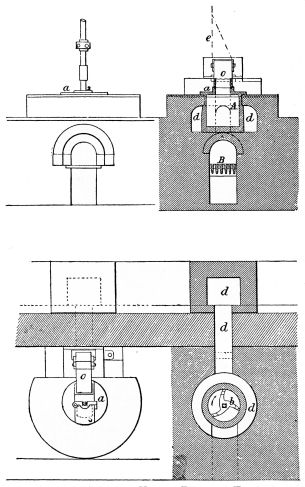
Figs. 14, 15, 16, 17.—Yellow Prussiate Furnace.
substances, those rich in nitrogen being first added in small portions at a time. Their effect is to render the mass hard, dry, and difficult of fusion, whereupon the remainder of the animal charcoal should be promptly introduced. After thorough agitation, the working door is closed for a short time, and the contents of the furnace are rapidly discharged into a covered iron pan.
The character of the animal matters employed varies so much that it is impossible to lay down hard and fast rules for the proportions of the several ingredients, or the duration of the roasting. Nor is the value of a raw material always in proportion to its richness in nitrogen, because the poorer material may waste less potash, consume less fuel, and require less labour. The addition of iron filings or turnings is useful only in prolonging the life of the cast-iron crucibles.
Combination of the Cyanide and Iron Solutions.—A great number of recipes are in vogue for combining the two solutions of ferrocyanide and an iron salt, both with reference to their proportions, and to the addition of foreign matters of various kinds. These variations in the formulæ give rise to distinct names for some kinds of Prussian blue, which will be referred to below. The ordinary common Prussian blue has a greenish tendency, and is chiefly made according to one or the other of the following directions:—
(1) Mix a solution of 100 lb. yellow prussiate with a solution of 100 lb. green copperas (ferrous sulphate) and 18 lb. alum, to which 9 lb. sulphuric acid has been added, and let the mixture stand for 2-3 hours, or until the solid portion has completely settled out. Decant the clear supernatant liquor, and well wash the precipitate with clean waters. Finally throw it on a filter and subject it to repeated disturbance, so as to ensure the admission of air to every particle, in order that the requisite oxidation may take place. The proportion of alum used is subject to very great variation according to individual fancy; it renders the subsequent grinding of the pigment a very much easier matter, but it causes the shade of blue to be paler than it otherwise would be.
(2) The simple solutions of green copperas and yellow prussiate in equal proportions are mixed together without any other ingredient being added, and the precipitate produced is washed, filtered, and aërated as in (1). It is, however, inferior by reason of the oxide of iron formed in the pigment spoiling the purity of the colour, and necessitating the treatment of the wet mass with hydrochloric acid, at some expense, for removal of the iron oxide.
Antwerp Blue.—This pale variety of Prussian blue has but little importance now. It is prepared by adding a solution of 4 lb. yellow prussiate in 5-6 gallons of water to one of 2 lb. sulphate of iron, and 1 lb. each of alum and sulphate of zinc in an equal quantity of water. The resulting pigment consists of a mixture of the ferrocyanides of iron, alumina, and zinc; it is washed, filtered, aërated, and dried as other forms of Prussian blue.
Bong’s Blue.—When cyanide of potassium is added to an acid solution of a copper salt, a red colour is produced, which has already been mentioned by different observers. The substance formed is very changeable, at least in the liquid where it is formed. It is decomposed by acids, alkalies, cyanide of potassium, and even decomposes spontaneously, the colour changing to yellow. It is precipitated by insoluble cyanides; hence when a dilute acid is added to the red solution, the dye is at once thrown down along with the cyanide of copper. If the precipitate thus obtained is treated with sulphuretted hydrogen, it is decomposed and the substance is set free. This substance can combine with iron, like cyanogen, so as to conceal the properties of the iron. This compound is very permanent, and has lately been studied by Bong, who gives the following directions for its preparation:—
Cyanide of potassium is added in excess to an acid solution of a copper salt until the red colour at first formed has disappeared, when a ferric salt is at once added. On the addition of the iron salt, of course, a copious precipitation of Prussian blue takes place, and the liquid again turns to a dark purple-red. To separate the colouring substance from the alkaline salts in the liquid, a dilute acid is added, which precipitates it and the cyanide of copper. This precipitate is combined with the Prussian blue, which also contains a considerable quantity of the colouring substance, and then treated with a boiling solution of carbonate of ammonia, in which it dissolves. As the cyanide of copper also goes into solution, it is separated by again precipitating it with an acid, and treating the precipitate with sulphuretted hydrogen. The colouring substance thus liberated now contains a certain amount of hydroferrocyanic acid, which is removed after neutralisation by acetate of lead. It is now filtered, and the purification is completed by precipitating with a silver salt and treating the precipitate with sulphuretted hydrogen.
This purple-coloured compound crystallises very indistinctly. To determine its composition, Bong precipitated it with acetate of copper. When dried at 212° F., the rose-coloured precipitate had the following composition: Carbon 24·31, nitrogen 28·04, hydrogen 1·88, iron 13·66, copper 17·67, oxygen 14·44. Total 100·00. These numbers correspond to the formula Cu, Fe Cy4 (HO)4.
This substance is likewise precipitated by salts of zinc, mercury, and silver. All these precipitates are pink or purple, very beautiful, and of remarkable brilliancy. They are soluble in alkalies. Iron salts yield no precipitate, nor do lead salts, except in the presence of ammonia, when a blue-violet precipitate is formed. When treated with sulphuretted hydrogen, these precipitates yield purple-red and acid liquids, which undergo change in the air, especially if warm, forming Prussian blue. When these liquids are neutralised with alkali, purple compounds are formed, which are permanent in the air, soluble in water, slightly so in alcohol, and insoluble in ether. Their colouring power is exceptionally great. These pigments will unite with ferrocyanides, and in its preparation such a compound is produced in considerable quantity; it is likewise of a purple colour, and gives a rose-coloured precipitate with acetate of lead. Both alone and in this compound it is very permanent; it resists the action of sulphurous acid, concentrated and boiling alkalies, and dilute acids, but is rapidly destroyed by chlorine and nitric acid. If this pigment could be prepared cheaply enough, it would probably be used with advantage in the arts, on account of its resistance to chemical reagents and light, the variety of its shades, and its brilliancy. It does not colour fibres directly, but can readily be fixed on them from slightly acid solutions, if they are previously mordanted with metallic oxides.
Brunswick Blue.—This pigment is made in pale, medium, and deep shades, and is an extremely useful colour, being very fine, requiring no grinding, thoroughly permanent in light and air, hardly acted upon by acids, but turned brown by alkalies, and liable on standing to separate into two portions—a white and a blue—the latter coming to the surface while the former sinks, and necessitating a thorough stirring of the paint before use.
It generally consists simply of barytes, or gypsum, or china clay, coloured by a small percentage of Prussian blue, with or without the addition of a lesser proportion of ultramarine. The barytes or other base is very thoroughly agitated in water, while a solution of green copperas and a solution of yellow prussiate are gradually added without ceasing the agitation. When the incorporation of the ingredients has been completely accomplished, the precipitate is settled, washed, filtered, and dried. Following are a few recipes:—
Pale. (1) 1 cwt. barytes, 1 lb. green copperas, 1 lb. yellow prussiate.
Pale. (2) 1 cwt. china clay, 2 lb. green copperas, 2 lb. yellow prussiate.
Pale. (3) 1 cwt. gypsum, 1½ lb. green copperas, 1½ lb. yellow prussiate.
Medium. (1) 1 cwt. barytes, 3 lb. green copperas, 3 lb. yellow prussiate.
Medium. (2) 1 cwt. china clay, 6 lb. green copperas, 6 lb. yellow prussiate.
Medium. (3) 1 cwt. gypsum, 4½ lb. green copperas, 4½ lb. yellow prussiate.
Deep. (1) 1 cwt. barytes, 5 lb. green copperas, 5 lb. yellow prussiate.
Deep. (2) 1 cwt. china clay, 10 lb. green copperas, 10 lb. yellow prussiate.
Deep. (3) 1 cwt. gypsum, 7½ lb. green copperas, 7½ lb. yellow prussiate.
In each case about 50-60 gallons of water are required.
To determine the amount of barytes present in a sample, boil about 50 gr. with caustic soda, filter, wash the residue free from soda, treat with sulphuric acid, well wash the insoluble residue, dry, and weigh.
Chinese Blue.—This well-known and favourite form of Prussian blue is prepared with great care, and is usually sold in fine powder or little cubes. Its composition is virtually identical with that of ordinary Prussian blue, but it is more free from impurities, and shows a fine bronze bloom or lustre on newly fractured surfaces. Being pure, it is entirely dissolved by oxalic acid; and its composition is about 52 per cent. oxide of iron, 43½ cyanogen, and 4½ water. In dyeing and calico-printing it is extensively employed. Its tint varies from greenish to violet, according to modifications in the method of manufacture, the chief difference being that yellow prussiate gives a greenish tone and red prussiate a violet.
The process of preparation is mainly as follows. In about 40 gallons of cold water dissolve 1 cwt. of green copperas selecting it carefully for freedom from insoluble oxide; add about 5 pints of sulphuric acid. This liquor very rapidly undergoes oxidation, by which oxide of iron is thrown down, and the solution is rendered unfit for making the best quality pigment. Therefore it should be prepared only immediately before it is used. In another vessel containing about 40 gallons of cold water, dissolve 1 cwt. of yellow prussiate (if a green shade is desired), or of red prussiate (if a violet tint is wished for). Even larger quantities of water may be used for the solutions, as the more dilute they are the finer is the colour precipitated and the greater the lustre on the surface of the finished pigment.
When the two solutions of yellow or red prussiate and acidified green copperas are brought together, a bluish-white precipitate is thrown down. This is allowed to completely separate itself, and then the clear supernatant liquid is drawn off.
The next step is to thoroughly oxidise the precipitate. This cannot be satisfactorily accomplished by utilising the oxygen of the atmosphere, as is done in other cases, because that method entails the production of a certain amount of oxide of iron, which prejudicially affects the purity of colour of the finished article. Of the chemical oxidising agents which are available, the most satisfactory in point of cost and efficiency is chloride of lime (bleaching powder). For each cwt. of green copperas, mix about 20 lb. of bleaching powder into a thin cream with water, and add it, in small quantities at a time, to the precipitate, constantly stirring so as to ensure the absorption of the whole of the chlorine by the blue. Without the addition be made gradually and under agitation, the chlorine will be generated more quickly than it can be absorbed, entailing a waste of gas and a noxious vapour to be breathed by the workmen. Sometimes the bleaching powder is added at an earlier stage, viz. to the green copperas solution, and in that case the blue assumes a violet tone.
After the addition of the bleaching powder solution to the bluish-white precipitate, it is acidified with hydrochloric acid, which develops the blue. When the whole has settled, the supernatant liquor is drawn off, and the blue powder is well washed and strained on a filter, then placed in pans and dried very gradually indeed in the dark, at a temperature never exceeding 130° F. The slower the drying the better is the gloss of the pigment. It is most essential that iron be excluded during the final grinding operation, or it may cause ignition of the mass, and its conversion into oxide of iron would speedily follow.
It has been proposed to treat the white precipitate (obtained in the usual manner from green copperas and yellow prussiate) by the chlorine contained in aqua regia (nitro-hydrochloric acid). The copperas, however, must be as free as possible from basic sulphate (oxide), which is ensured by keeping a little metallic iron in the acid solution of copperas. It is also desirable to effect the precipitation with crude prussiate, so as to avoid absorption of oxygen and premature development of the blue colour. Habich considers that the mistake is generally made of using too little copperas, and he has found that when 90 lb. of copperas have been added to 100 lb. of yellow prussiate, a drop of iron solution in the filtered liquor produces no precipitate, while the white precipitate has carried with it a certain proportion of prussiate, which can be washed out. He therefore proposes to avoid this waste by pouring the copperas solution into the prussiate solution, with constant agitation, till no further precipitate goes down, then adding one volume of the copperas solution equal to one-ninth of that already used. After fifteen minutes stirring, it is certain that all the prussiate carried down is decomposed.
The drained precipitate is blued (peroxidised) by adding aqua regia prepared several days previously, and in proportions depending on the strengths of the two acids. Generally, the aqua regia mixture will be 100 lb. of commercial nitric acid at 30° B. (containing 35·4 lb. of anhydrous acid) and 62·2 lb. commercial hydrochloric acid at 23° B. (containing 23·9 lb. of the anhydrous acid); and 40 lb. of this mixture will suffice for bluing the precipitate resulting from 100 lb. yellow prussiate. The addition of the aqua regia should take place in a wooden vessel with constant agitation.
According to another modification, the white precipitate obtained in the usual way is blued by adding a solution of perchloride of iron, which may be made from a hematite ore free from clay and carbonate of lime, or from rouge. The iron oxide, from whatever source, is ground to a very fine state, and treated with crude hydrochloric acid in a lead-lined tank, where the mixture remains for several days, and is constantly stirred. When saturated with iron the clear liquid is withdrawn for use. To receive it, the white precipitate is rapidly heated to boiling in a copper vessel, and is then transferred to a wooden vat, and the iron perchloride solution is stirred in till the desired tint is produced. The pigment is washed and dried in the ordinary way, while the supernatant liquor (essentially protochloride of iron) is poured over old scrap iron and used instead of copperas for a fresh batch of yellow prussiate.
A solution of perchloride of manganese may be used instead of perchloride of iron. Inferior qualities of manganese ore can be employed, and the residues left after treatment with hydrochloric acid may be washed and dried for sale as purified or peroxidised manganese.
Paris Blue.—(1) A synonym for the violet-tinted kind of Prussian blue.
(2) A series of compounds described below. [a] A thorough mixture of 2 parts sulphur and 1 part dry carbonate of soda is gradually heated in a covered crucible to redness or till fused; a mixture of silicate of soda and aluminate of soda is then sprinkled in, and the heat is continued for an hour; the little free sulphur present may be washed out by water. [b] An intimate mixture of 37 parts china-clay, 15 parts sulphate of soda, 22 parts carbonate of soda, 18 parts sulphur, and 8 parts charcoal, is heated in large crucibles for 24-30 hours; the mass is re-heated in cast-iron boxes at a moderate temperature till the desired tint appears, and is finally pulverised, washed, and dried. [c] Gently fuse 1075 oz. crystallised carbonate of soda in its water of crystallisation; shake in 5 oz. finely-pulverised orpiment, and, when partly decomposed, as much gelatinous alumina hydrate as contains 7 oz. anhydrous alumina; add 100 oz. finely-sifted clay, and 221 oz. flowers of sulphur; place the whole in a covered crucible, and heat gently till the water is driven off, then to redness, so that the ingredients sinter together without fusing; the mass is then cooled, finely pulverised, suspended in river-water, and filtered. The product is heated in a covered dish to dull redness for 1-2 hours, with occasional stirring. Colourless or brownish patches may occur, and must be removed.
Saxon Blue.—Following is a recipe for the preparation of this pigment, which possesses limited importance.
Dissolve 8 lb. alum and 1 lb. green copperas in 16 gallons of water. Add separate solutions of pearlash and yellow prussiate till precipitate ceases to go down. Collect the precipitate when it has completely settled; wash thoroughly, and dry.
Soluble Blue.—This term is applied to a variety of Prussian blue which, while possessing no difference in the matter of chemical composition, yet has the distinctive feature of being soluble in water, which the other varieties are not. It no longer enjoys the popularity it once had as a dye, on account of the severe competition of the coal-tar colours. Below are some of the most satisfactory formulæ for its preparation.
(1) Mix 10 lb. of Prussian blue thoroughly in about 10 gallons of cold water. Then add 5 lb. of yellow prussiate and let the whole mass boil steadily for several hours. Strain off the liquor and well wash the precipitate on a filter. Finally dry for use.
(2) Dissolve about 1 cwt. of red prussiate in water and make the solution hot. Prepare another solution of about 73 lb. of green copperas in hot water. Mix the two solutions together and boil them for about a couple of hours. Allow the solid matters to settle out, then put them on a filter and wash with clean water until a blue coloration manifests itself in the drainings. The blue residue is then dried as usual.
(3) Make one solution of 10 lb. of yellow prussiate, and another of 8 lb. of green copperas, water being the solvent in both cases. Mix these two solutions together and give them an hour’s boiling.
Add 3 lb. of a mixture of nitro-sulphuric acid, containing 2 parts of the former to 1 of the latter. Boil for another hour. Let the solid pigment precipitate itself thoroughly, and then filter, wash, and dry as in the other cases.
(4) Dissolve about 1 cwt. of perchloride of iron and 10 lb. of sulphate of soda in water. Also dissolve in another vessel 2 cwt. of yellow prussiate and 10 lb. of sulphate of soda. Pour the first solution into the second (never the contrary) and take care that the prussiate solution is always preponderant. The Glauber’s salt is useful in rendering the precipitation of the blue pigment more complete by reason of the insolubility of the latter in saline fluids. When the blue sediment is all thrown down it is drained off on a filter, and repeatedly washed till a blue tint appears in the wash-waters, when it is dried for use.
Turnbull’s Blue.—This is an old-fashioned name often applied, like the term Paris blue, to the violet shades of Prussian blue which have been prepared with red prussiate.
Ultramarine.—According to Rowland Williams, F.C.S., natural ultramarine is, perhaps, the most beautiful blue pigment known. It was formerly, and is now to a small extent, manufactured (chiefly for artists’ use) from lapis lazuli, a blue mineral which occurs, intermixed with limestone and iron pyrites, in Siberia, Thibet, and China. In order to obtain ultramarine from lapis lazuli, the roughly pulverised mineral is ignited, dipped into vinegar to remove carbonate of lime, and then reduced to the finest possible state of division. The powder is next mixed with a cement composed of rosin, linseed oil, white wax, and Burgundy pitch, and the resultant paste is worked under water until all the ultramarine is separated. The ultramarine is washed several times with water, and afterwards with alcohol, which removes any of the resinous compound which may have adhered. When treated in this manner, lapis lazuli yields from 2 to 3 per cent. of ultramarine. According to Clement and Desormes, lapis lazuli has the following composition:—
Per cent.
Soda23·2
Alumina34·8
Silica35·8
Sulphur3·1
Carbonate of lime3·1
100·0
It will be seen, therefore, that ultramarine essentially consists of alumina, silica, soda, and sulphur, and may be regarded as a sodium aluminium sulphate, in combination either with polysulphide of sodium alone, or with a polysulphide and a polythionate of sodium. Clement and Desormes believe that the iron in lazulite (lapis lazuli) is an accidental impurity, and is neither essential to the mineral itself nor to the ultramarine derived from it. There is still some doubt on this point, however, many eminent chemists holding the opinion that iron is a necessary constituent of ultramarine blue.
Natural ultramarine has been almost entirely replaced by the artificial product, since methods have been devised for the manufacture of the latter on a large scale. The possibility of preparing artificial ultramarine suggested itself in a curious manner. About seventy years ago a French alkali maker noticed the occasional appearance of a blue coloured substance in his soda furnace. On analysis, Vauquelin found the substance to have the same chemical composition as lapis lazuli, and this incident led him to believe that ultramarine might be built up from its elements. Several years passed away before Guimet succeeded in manufacturing artificial ultramarine on anything like a large scale, but Gmelin is said to have prepared it in small quantity half a dozen years previously. There are four varieties of artificial ultramarine: (1) the pure deep blue, equal in colour to average native ultramarine; (2) pale blue; (3) violet or pink ultramarine; (4) green ultramarine. The latter is obtained in the first stage of the ultramarine manufacture, being the result of incomplete ignition of the materials employed. Ultramarine is generally manufactured by one of the following processes:—(a) “Sulphate”; (b) “Soda”; (c) “Silica.”
(a) “Sulphate” Ultramarine.—This may be prepared from sulphate of soda (Glauber’s salt), charcoal, and kaolin (china clay). The materials should be as free as possible from iron, and it has been found that clay having approximately the formula Al2O2 (SiO2)2 gives the best results. The clay and sulphate of soda must be thoroughly calcined. They are then intimately mixed with charcoal in the following proportions:—
Per cent.
Clay48·3
Sulphate of soda43·5
Charcoal8·2
100·0
Sometimes a portion of the sulphate of soda is omitted, and some carbonate of soda and sulphur added instead. The composition of the mixture then becomes:—
Per cent.
Clay47·2
Sulphate of soda19·3
Carbonate of soda19·3
Charcoal8·1
Sulphur6·1
100·0
Caustic soda is also sometimes used instead of carbonate. These mixtures (whether sulphate alone or sulphate and carbonate) are made with a view to have the soda present in sufficient amount to combine with one-half the silica contained in the clay, and to leave sufficient soda to form polysulphide of sodium with a portion of the sulphur. There should then remain enough soda and sulphur to produce ordinary sulphide of sodium (Na2S). If either of the two mixtures be ignited out of contact with air, a white compound is formed, which is sometimes termed white ultramarine. On leaving this exposed to the atmosphere for some time it becomes green, and on further ignition, with free access of air, it is converted into ultramarine blue. In actual working the carefully prepared mixture of the above mentioned materials is heated for several hours to a high temperature in fire-clay crucibles, only a limited supply of air being allowed to enter, and the temperature being eventually raised to a white heat. The product of this operation, when cool, has a grey or yellowish-green appearance. It is washed several times with water, dried, reduced to a fine powder, and then represents the green ultramarine of commerce. Stölzel found that green ultramarine had the following composition:—
Per cent.
Alumina30·11
Silica37·46
Sodium19·09
Sulphur6·08
Iron·49
Calcium·45
Chlorine·37
Oxygen5·19
Sulphuric acid·76
Magnesia, potash, and phosphoric acidtraces.
100·00
Green ultramarine is transformed into blue by heating with about 4 per cent. of sulphur at a low temperature, with free access of air. Sulphur is afterwards added, if necessary, in small quantities at a time, and the heating is continued until the desired shade of blue is obtained. The mass is then powdered, the soluble matter (sulphide of soda, &c.) is removed by washing with water, and the blue is dried and assorted according to quality.
(b) “Soda” Ultramarine is sometimes made with soda alone (either carbonate or caustic), and at others with a mixture of soda and sulphate of soda. Rowland Williams found the following proportions of the respective ingredients to answer satisfactorily:—
Per cent.
China clay36·8
Carbonate of soda36·8
Sulphur22·0
Coal4·4
100·0
The proportions for soda and sulphate of soda ultramarine have been previously given under “sulphate ultramarine.” The ignition is carried on in a manner similar to that already described. The resultant green product, owing to its avidity for oxygen, is partially changed into ultramarine blue by simple contact with the air. It is entirely converted into the blue variety by roasting with an additional quantity of sulphur. With care, ultramarine blue may be manufactured in one operation, by increasing the proportions of soda and sulphur.
(c) “Silica” Ultramarine is manufactured in the same way as soda ultramarine, except that, in addition to the other materials, silica to the extent of 5 or 10 per cent. of the weight of clay is employed. By this process, ultramarine blue of a slightly reddish tint is obtained in one operation. The method has, however, one decided drawback, viz. that the materials employed are rather liable to fuse during ignition. The faintly reddish hue of “silica” ultramarine becomes more intense according to the proportion of silica present. “Silica” ultramarine is said by some to be less readily attacked by acids and by strong alum solutions than ultramarine prepared by the “sulphate” and “soda” processes; but Rowland Williams’ experience does not confirm this statement. He mentions that good artificial ultramarine withstands the action of weak acids much better than is generally imagined. He had occasion to test many samples which resisted the action of dilute acids to a remarkable degree. Most strong acids, of course, decompose both artificial and native ultramarine, with evolution of sulphuretted hydrogen. Native ultramarine is, however, less susceptible to the influence of acids (both strong and dilute) than the artificial compound. This difference of behaviour is probably due to the fact that the former contains considerably less sulphur than the latter, and it is also possible that the constituents of natural ultramarine may be combined in a somewhat different manner from those of the artificial product.
Notwithstanding the large amount of research with reference to the chemical composition of ultramarine, the origin of its blue colour still remains in doubt. According to Wilkens (Ann. Ch. Pharm., xcix. 21), ultramarine consists of two portions, one of which is easily attacked by hydrochloric acid, and is regarded by him as the essential constituent, whilst the other portion is insoluble in hydrochloric acid, and contains variable proportions of clay, sand, oxide of iron, and sulphuric acid. From his analyses of the pure blue, Wilkens deduces the formula (2Al2O3 3SiO2) (Al2O3 4SiO2) Na2S2O3 3Na2S:—
Per cent.
Silica37·6
Alumina27·4
Sulphur14·2
Soda (Na2O)20·0
99·2
Wilkens regards the blue colouring principle of ultramarine as a compound of hyposulphite and sulphide of sodium. He considers the presence of iron is not necessary for the production of the blue; whilst Dr. Elsner, in a paper published in 1841, states that about 1 per cent. of iron (which he presumes to be in the state of sulphide) is essential. Rowland Williams asks whether it is not conceivable that the blue colour of ultramarine may be due to the presence of a small quantity of black sulphide of iron, most intimately combined with a colourless or comparatively colourless compound (such as white ultramarine), the whole mass (owing to the dilution of the black sulphide) showing a blue reflection.
Ultramarine is insoluble without decomposition in any known menstruum. According to P. Ebell (Ber. 16), ultramarine, when in the most finely divided state, will remain suspended in pure water for months. The liquid may be filtered unchanged through several layers of Swedish filter paper, and appears perfectly clear when examined in a ¾ in. layer, and on evaporation deposits the ultramarine as a lustrous coating on the sides of the vessel. Rowland Williams repeated the above experiment, and can confirm Ebell’s statement. This result shows the necessity of due precautions being taken during the washing of the ultramarine in the process of manufacture, otherwise a considerable amount of the finely divided blue may be lost. Ultramarine is largely used in calico printing for pigment styles, being fixed on the fibre by means of albumen. It is also employed for blueing linen and cotton, wax candles, lump sugar, &c. Ultramarine is not adulterated to a large extent, the chief sophistication being barium sulphate (barytes), and occasionally chalk and china clay.—(Rowland Williams, in Industries.)
Another writer in Industries says that the manufacture of ultramarine has perhaps hardly received the attention it deserves in England. The importance of the industry has been recognised in Germany, however, and though the palmy days of the trade, when the whole production was in the hands of a few firms, and the price was a matter of private friendly arrangement, are gone for ever, yet the business is in a flourishing state, and should prove lucrative if properly managed. It is a characteristically English failing to overlook branches of business not dealing with large quantities of staple commodities, and thus many of the smaller but remunerative industries have passed out of our hands. When one observes that almost every sheet of ordinary blue official paper is decolorised when accidentally brought into contact with an acid, betraying the fact at once that its colouring matter is ultramarine, one realises that a very considerable consumption for this and similar purposes must take place. Like most trades based upon chemical principles, the manufacture of ultramarine has recently made rapid strides, and some of the latest developments are recorded in a paper by J. Wunder, appearing in a recent number of the Chemiker Zeitung, which is worthy of some attention.
With most people not directly interested in it, the term ultramarine is taken to mean the blue pigment known under that name, the words being reckoned almost synonymous. Others, more erudite, recognise the existence of a green variety, but that the production of such colours as red and violet is possible is scarcely suspected. Of course the blue is the most important, but even that does not correspond to one specific substance, products of different shade being prepared by modifying the process of manufacture. As usually made, ultramarine is formed by heating together carbonate of soda, kaolin, sulphur, and charcoal, with limited access of air, the resulting pigment being green; this, on roasting with sulphur, becomes blue. If the operation be conducted with complete exclusion of air, so-called ultramarine white (in reality grey) is produced, which becomes green on further heating. Ultramarine blue capable of resisting the action of alum is sometimes required, and may be obtained by the use of a highly silicious charge and much sulphur, the burning being conducted in crucibles or in mass according to the purpose for which the pigment is required. The former process is costly, while the latter gives a product containing a good deal of free sulphur, which is objectionable for such purposes as calico printing. Removal of the excess of sulphur by heat or caustic soda is not feasible, as the colour suffers in either case, but a certain amount of success has attended experiments with sodium sulphide, the colour often brightening noticeably.