MARIA THOMPSON DAVIESS (continued 3)
Reading edition
"I don't believe it, but if it is true, you won't let your father's having done my brother that way make any difference in the way you love us, Lovey and Douglass and me, will you, Phyllis? We just need you that much more to help us through with the starving and freezing for the new invention that we are going to take better care of." Through all my misery I ask myself if any girl in the whole wide world ever had a friend like Roxanne Byrd?
And as if having Roxanne hold me in both arms and love me beyond my wildest expectations was not enough, what should happen to me? The Idol came around the bush full of blooms where we stood, and did likewise. He put his long arms around Roxanne and me and hugged us both up like we were not any bigger than Lovelace Peyton.
"You two precious kiddies are not to pay any attention to disagreeable things that are not any of your business," he said in his wonderful voice that was as big and booming and comforting as any anthem sung in church where a sinner goes for help. That's what it sounded like to me.
"That's what I tell Phyllis, Douglass—she's more valuable than the loss of any kind of a big fortune, that we really don't need at all to make us happy, while we do need her." Roxanne was laughing and crying and hugging me so that she got herself mixed in her words in a perfectly beautiful and loving way.
I am glad that my affection for these kind friends inspired me so that I could answer them like I wanted to—at least I tried so hard to say how I felt that I almost succeeded.
"You are both the best friends that were ever created for a lonely girl," I answered, drawing out of both pairs of arms, and looking them both square in the face. "But I am my father's daughter and must suffer for his sins, if he has them. If he has done this dreadful thing, which I don't believe, then I don't deserve your friendliness, and I can't take what it is not right for me to have. I'm going home and stay there until he comes, and then if he can't explain and has to pay any penalty I'm going to do it with him."
"Oh, Phyllis, and what will Lovey do without you?" Roxanne begged, using the strongest thing she could have said to me when I thought of the little blind boy that wanted and needed me so badly.
"You will punish him and us for something we can't help," the Idol said to me with reproach in his eyes and voice that nearly killed me.
"You both have had your kind of pride about taking gifts from me ever since I have known you," I answered, looking them full in the eyes, "and you have taught me what the word means. I could take things to eat and wear from you, but my kind of pride won't let me take your friendship when you think my father has treated you like this. Good-by! I can't stay any longer to be tortured." And with that I turned and walked away from them both, forever, I am afraid.
It isn't true, it can't be! But if it is? One thing I have made up my mind to do: I am going to ask Father, if it is all true, to let me go away from Byrdsville. I can't stay here; it will be too empty a life for me to watch them living with me out of it. I hope he will go and take Mother too. Judge Luttrell may prosecute him so he will have to.
Is this the end of the life that bloomed out in me like the apple blossoms do on the bare trees, only to be shattered? No! I hope I will bear fruit from having had so much happiness, like the apple-trees do from their blooms, and I'm going to try.
Just here I laid down Louise and went to see what I could see going on down at the cottage before dark. And there was old Uncle Pompey hanging over our garden wall smoking his pipe and just crying into his funny red bandanna handkerchief. Something tells me that he is going to miss me very much also. I am thankful for the love of this old negro, which I am sure is just the same quality as if he were white.
I think if I could just steal in for one minute and look at Lovelace Peyton's little bandaged head it would make the pain in my heart easier for having to give him up, but even that I can't do. I've found how strong pride is as well as bitter.
CHAPTER IX
Of course, I know that there are many strange things in life that seem to contradict each other and themselves in a very puzzling manner, but my disgrace has turned out in a way that nobody could have made me believe, if they had told it to me in dictionary words of six syllables. I am being befriended and honored by the whole of Byrdsville, and I don't know what to make of it. My mind refuses to explain it and my heart is just going on rejoicing over it, as I have not been able to think up any reason why it shouldn't.
Everybody now knows about the steel process that their distinguished citizen, Mr. Douglass Byrd, invented; and they all believe that Father has had it stolen and has left Byrdsville for some place where Colonel Stockell can't find him, but they are none of them mad at me about it. Of course, a load of sympathy can be as heavy to bear as one of disgrace; and when you have both the two to stagger under, you may wobble some in your conduct, as I have done these last two days. First, though my reason is convinced about Father, there is something in me that just won't believe it, and that keeps making me hope, and be passive in life, until he comes. I say nothing about it to anybody, because the proof is too great against him, and I suppose it is really more daughterly love than hope. Anyway, it is a precious feeling to me.
But one thing that troubles me is the way one friend's sorrow can throw its shadow over the lives of many others. It troubles me that Tony and Roxanne and the Colonel and some of the others are distressed about me, especially Tony. He came to see me the morning after Belle had told me all about his scouting out the secret; and if it hadn't been such an occasion I would have had to laugh at the collapsed way he looked, like he would fall to pieces if you touched him even very gently. His grin was so entirely gone that his mouth looked only the size of an ordinary human being's, and his eyes were shut down so dolefully that they were funnier than ever.
"Go on, Bubble, and shake me," he said, with a comical sadness that was hard to bear with proper respect. "Play I'm a doormat if you want to, but I cross my heart and body I didn't mean to hurt you by letting my mouth overwork at the wrong time. The Dumpling is just a sponge that sops up any old thing and lets any old body squeeze it out of her. Please say you forgive me."
"Why, Tony," I said with difficult but becoming gravity, "don't you know that I know that you didn't mean to do anything to hurt me?" I couldn't bring myself to mention Father or the shameful circumstances and I hoped he wouldn't, either.
Tony is not a mere boy; he is a kind gentleman, also, and he ignored the subject we were discussing just as carefully as I did.
"Good for you, girliky, and I hope you fully realize that this little old burg of Byrdsville is all for you and anxious to hop rig-lit into your pocket," he said most picturesquely, with relief at my not being hurt at him beginning to pull the corners of his mouth into the grin that he had put away as not suitable for the occasion.
A person who has the smile habit fixed on his face is a very valuable friend, and I was glad to see Tony put on his grin again. There were two or three questions I wanted to ask him when he was in his normal condition, and I was just going to consult him about whether it wouldn't be easier for the other girls and boys for me not to go to school—anyway until they found Father and his innocence, or knew the worst about the prosecution and other punishments that would be given him; but before I could get the words arranged in my mind to say just what I wanted to say, he began on something like the same subject himself.
"See here, Phyllis, Roxy told me that you hadn't been in to jolly the bug-grubber to-day at all, and the poor little bubble is worried about what she thinks is going to be a grouch in your system," he said, looking at me with so much confidence in my good disposition shining in his face, that it was painful to try to make him understand just how the pride disease I had caught from the Byrds was affecting me.
"Indeed you know, Tony, that it is not because I don't love Roxanne and Lovelace Peyton that I haven't been there this morning; but I just don't think it is right for me to be taking their friendship and love when everybody thinks my own father has injured them, as he has not. It is right for me to suffer for what they think he has done, until we know better, and my pride won't let me take any more of their affection when I may not deserve it." I looked away while I was talking to Tony, for I hated to see the shock fade the grin. I also hated to bring up the subject we were ignoring.
"Oh, fudge and fiddlesticks, Phyllis, don't let any old sour idea like that ball up your naturally sweet temper. You and Roxy are just women folks and had better keep out of men's business, like this wrangle between Doug and Mr. Forsythe. Trot along and do your stocking-darning and pie-fixing together as per usual schedule. And as to this mix-up—forget it!"
"I know, Tony, that Roxanne and I are just children—and what is worse, just girls—but I have to do what I think is honorable under these circumstances; and taking friendliness from Roxanne now would be just charity—I can't do it." As I spoke I felt my head straighten itself after the manner of the grandmother portrait, just as if I had been born a Byrd.
"Now, who would have thought that you could 'throw a crank' like that, Phyllis—a girl who could brace another girl as hefty as Roxy upon her shoulder to save the whole town and Dr. Snakes from being dynamited? I'm disappointed in you."
"Why, how did you know about that explosion that Lovelace Peyton almost blew us all into pieces with?" I asked with astonishment.
"Roxy sniffled it all to me this morning when she was pouring out her trouble because you hadn't been over to cheer up the bugger to-day. She told Pink and Sam and Belle and the Sponge and me all about it, and I can tell you we thrilled some. By acclamation we have elected you to lead the Kitten Patrol of the Campfire that we Scouts have been talking about helping you bubbles set up for a month. We have already decided to put you in command of the girls, because we can then expect some real good stand-bying in case of Scout trouble or excitement. We meet in the Crotch to-night to decide all the details." Tony's eyes were shining and flaring and his red hair standing straight up in his friendly excitement.
Honors are mighty apt to shock a person when they come unexpectedly, and I don't believe expected ones bring half the joy that the surprise ones do. I feel humble to think that in less than a year the boys and girls of a place like Byrdsville have found me worthy of the leadership of such a sacred thing as a Girl Scout company will be. For, of course, of all the things that boys ever were in the world, nothing is so wonderful as being Scouts like so many hundreds and hundreds have been made all over the United States in the last three years. And when the Boy Scouts do all the noble things in the noble way they do, what will be expected of the girls, now that they are being let Into the organization? The boys have to pledge themselves to be clean and honorable and kind and just and charitable and brave; so, of course, the girls will have to be all that and still more. Could I?
I sat still and thought for a long time, and Tony, with his knowledge of girls, let me do it. Could I? Could a girl with a father that might have done the thing that my father is suspected of having done to a fellow-man, promise to be all or any of those things? How would she know that some little thing in her, like her father, wouldn't come up, just at the time when she was being depended on, to make her fail? This distinction was not for me!
"Tony," I said quietly, and I didn't let the tremble in my heart get into my voice at all, "whatever happens to me in my life I can't ever forget that you offered to make me the leader of the Campfire, but—I can't be it. Please don't make me say any more about it. I can't."
Tony understood. "Not a word more on the subject, Bubble; but I do want to say that you are one fine—"
But just here we were interrupted by Mamie Sue coming lumbering across the wall from the Byrd cottage, for Tony and I had been sitting on a bench out under the blooming peach-tree arbor. She sat pretty close to me and gave me a nice, good, fat-armed hug as she offered me a paper bag.
"Have some fudge, Phyllis," was all she said; but I saw Belle walking down the street with her head in the air and her skirts switching like Helena's and I knew that Mamie Sue had come through a hard fight to be friends with me. I can't say how I appreciated it, and I love Mamie Sue. Maybe she is not very smart, but a person that always has sweetness of disposition and in paper bags to offer a friend in trouble ought to be appreciated. And just as I had got hold of her nice big right arm to return the hug, around the other side of the house came Pink and Sam, with Miss Priscilla in between them.
"Phyllis dear," said Miss Prissy, as all of us got up to give her a seat, though she only took Tony's and part of mine, while the boys sat on the grass, "the boys are telling me about the Girl Scout ideas. I think it is naughty of them to say they are going to name you the Kitten Patrol, especially as your rescue of Lovey Byrd is more than likely to give you a life-saving medal to start with, as soon as the Colonel writes to New York about it."
"A medal—a—a medal like Tony's?" I gasped, as my heart stood still in awe of my own act.
"Why, of course, Bubble, you will get a medal," said Tony, with the delight that some boys might not have shown at the idea of a girl's getting up to the same height of distinction that they had attained. "Now, will you be good and be the leader of the Kittens?"
"Say, Phyllis, when you raised Roxy from the ground, did you use the other muscles of your body or depend a lot on the shoulder lift?" Sam is not so big and strong as the other boys and consequently has the greatest regard for the strength that he hasn't got.
I could only say that I didn't know what I had lifted Roxanne up to catch the bottle with—except prayers.
And while they all sat there in my garden and talked with Miss Priscilla about what she should get the Colonel to write to headquarters about me and about the dynamite and the steel and everything that was indirectly related to my disgrace, I sat quiet and prayed for some sort of strength to tell them that I maybe couldn't be a Scout, and couldn't have a medal and was hoping to move away from them to some other place to live, just as I had learned to like them better than I had dreamed one could like friends.
These boys and girls, including Miss Priscilla, haven't been used to having things happen to them to distress them, and they are so warm-hearted and sympathetic that it makes it hard to say a thing to them that would hurt them. But I couldn't, couldn't go on being a public and distinguished character, if my father were going to be a public character of another kind. If people should say, "How his life must mortify his poor daughter, noble girl, with a medal and friends and things!" that would just put me on the other side of the fence from my own parent, who needs me more than ever, if he is sinful. He isn't, but what right have I to bask in public favor while he is in outer darkness?
Then just as I was going to decline to be a member of the Campfire and beg them all not to mention it to me any more, and try not to worry over me but to just forget about me, something so horrible came over the wall, in the shape of the news that Mr. Douglass Byrd brought, that I and they forgot all about the Scouts and Kittens and medals and all that. The Idol was pale and quiet as he walked up the path to us, after skimming over the wall with one hand on it in a way that made Sam gasp with admiration. He looked past Miss Priscilla and the rest of his old friends of inherited generations in Byrdsville and straight at me, his new—but adoring—one.
"Miss Phyllis," he said, with such sadness in his voice that Mamie Sue gulped over a piece of fudge worse than usual, "Dr. Hughes has just examined Lovey's eyes and it has hurt him very much—also he thinks the sight has gone. The youngster is crying and fretting for you and they don't want him to do that under any circumstances. The only hope for his sight will be for him not to inflame his eyes. Will you come?"
Would I go—would I go across the dead body of my father's honor and my own and anybody's disgraces and any other old thing? I went so quickly that I upset Mamie Sue on the one side and Miss Priscilla almost on the other, and I didn't even wait to answer the Idol in the reverent and respectful manner that is always his due and that I always observe. Down that garden path I flew and over that wall I skimmed, like a bird with wings, or like the Idol himself, and in so little a time that I didn't even realize the journey, I was in Roxanne's room with her in one of my arms and Lovelace Peyton squeezed up in the other.
Roxanne choked her sobs down in my neck and I choked mine down in my heart as the little doctor kicked one fat little knee out from under the cover and began to squeal like a queer kind of pig as one of his arms went around and around.
"That's the way I cried when that old Dr. Hughes hurt my eyes to make 'em well, Phyllie, and you wasn't here to see him do it and tell me how red they looked and if they had got any blue around the edges like a carbuncle. Roxy can't tell disease like you kin, and now you was away from 'em and didn't see the nice ones I have got in both eyes."
The reproach in his voice was so funny and yet so sad that Roxanne and I both choked still more and held on to each other tight. I just simply couldn't say a word, and I was again made ashamed by that unruly lump in my throat that never seems to come unless something is the matter with the Byrds.
"I'm hungry, too, for some of the nice sweet charlock rookster that your cook makes me and I eats in the afternoon, right now. I waked up in the night and wanted it and you, too, Phyllie, and I wouldn't have old Doug or Roxy, neither. Now, it is always night time and Roxy wouldn't go and call you. Won't you stay with me always and read me about smallpox like you promised?
"Always night now!" Again Roxanne and I hugged and choked, but this time I had to conquer the lump and answer him.
"Indeed, indeed, Lovelace Peyton, I'm never going to leave you any more, only to go and get the things you want. Can't I go and get the charlotte russe for you now?"
"No, Phyllie," he exclaimed, grasping with his strong little fingers my hand that lay on his pillow. "I wants smallpox now worser than I do charlocks. Then Tony can come and let me tie bandages around his leg while you go git the rookster and maybe some nice cake and oranges and candy. No; Dumpie bringed me candy. You git more rags to tie up folks with. I want to fix Doug's head good 'fore he goes to bed. But read the smallpoxes right away. Begin where they throws up."
Roxanne got the book while I drew a chair by the bed and sat down to it, with gratitude drying the tears in my heart, for being forced into forgetting my pride and coming back to them again. Roxanne sat by me and held my left hand until we got to the worst part of the smallpox, and then she got pale around the mouth and went out of the room.
"Read the sickest part again, Phyllie, and then turn and read the medicine for it," he had just demanded when she fled.
And for the rest of the afternoon I sat by him and went through all the different stages of smallpox until, feeling each one acutely as I did, it is a wonder I was not pock-marked. When he fell asleep at last he was holding fast to one of my hands for fear I would get away with the precious book.
When I could slip his fingers from mine, I tried to steal tiptoe through the hall so as not to wake Roxanne, who was lying asleep, I hoped, on the sofa in the hall, but she opened her great, troubled, dark eyes and saw me before I got to the door.
"Oh, Phyllis," she said and held out her arms to me. Somehow it seems to me I have learned very quickly how to take a person I love in my arms without awkwardness—that is for a girl who never had anybody to take before—and I sat down and snuggled Roxanne in a manner comfortable to us both. "Do you think it is possible that Lovey is going to be—be blind?" she asked me in a small voice that could hardly dare utter the horrible words.
"I came in such a hurry when Mr. Douglass Byrd called me that I didn't quite understand what Dr. Hughes said or found," I answered.
"When he took the bandages off, Lovey didn't seem to see at all, but the lids are still so swollen that he is not sure they are closed. I don't believe he knows what to do, Phyllis, and that is what scares me. But is there any great thing a blind man can do except be a musician? Lovey can't sing much."
I verily believe that Roxanne Byrd would have gone on and planned some kind of a career of blind genius for Lovelace Peyton while waiting to see if he was to lose his eyes, if the Idol hadn't come into the hall at that moment.
He moved Roxanne over and sat down between us and began to talk seriously to us, like I was a valued member of the Byrd family.
"I have just had a long talk with Dr. Hughes, and he says that Lovelace Peyton will have to have a specialist examine his eyes and direct the treatment, if the sight is to be saved. We will have to think up a plan to get a great doctor from Cincinnati down to Byrdsville, Tennessee."
"But it will cost so much and where—?" Roxanne stopped quickly for fear of hurting the Idol's feelings and not from my presence. One of the great things about the Byrds is that they can forget riches in such a way as not even to know or realize that they haven't them.
"We'll get it," answered the Idol with his heroic look, the like of which I do not believe a man ever owned before. "Things are going to go straight, now that Miss Phyllis has got the bugger all happy with the medical course again. What would all of us do without her?" He stood up to light his pipe and his fingers trembled.
Anybody else but a great man, born of a great family like the Byrds, would have hurt my feelings by saying apologetic things about the tragedy between us, but the Idol just ignored it and I was made one of them again in their trouble. Suddenly something popped into my mind that I could do to get the money for them to save Lovelace Peyton's eyes and not hurt the family pride. There is no doubt about it, when a girl gets so she can ask God to help her and think at the same time, she can find an inspiration when she needs it. I may be in trouble and disgraced, but I've got Him on my side, and I can yet do things when my friends have such dire needs as a doctor. I am afraid to write it even to you, leather Louise.
Suddenly I stood up beside Mr. Douglass, and looked down at Roxanne, and then up at him.
"Do both of you trust me enough to let me try to help if I do it with my own brains and not—not my father's money?" I asked.
For a moment they both looked at me, and then the Idol took my hand in his and looked me in the eyes just as square as I looked at him.
"Yes," he said in a voice that grows more wonderful the more you love and know him, "you are one of us and you can plan with us all you are able to."
"Yes, Phyllis; you have never offered or asked us to do anything we ought not to, and if you can think with us I know it will help," Roxanne said, looking up at me trustfully.
Again I make record, Louise, that my course with the Byrd family pride has conquered it, even if I did display symptoms of it myself by staying away from the cottage so long. I'm in a very queer position. I have not made everybody understand that I can't be a Girl Scout and I am a dishonored person in Byrdsville, with all sorts of distinctions offered me. But this scheme I have thought up to get the doctor here has made me hold my breath so that I can hardly write, and I can't worry over honors and medals and things. I will do it! I will! Good-night!
CHAPTER X
Some people are so afflicted with energy that their days are twenty-five and a half hours long. Mine are twenty-six just now. If it were not for the fact that several hours each day I am under the influence of Roxanne's repose, I suspect I would run down like a clock that has exhausted its mainspring. Mamie Sue says that Belle says Roxanne is shiftless, but Belle is unable to distinguish shiftlessness from noble composure under difficulties. I told Mamie Sue that it would be best for her to forget all that Belle has ever said to her; and she is trying.
Still, though I understand it perfectly, it is positively queer to hear Roxanne talk about what the great doctor is going to do for Lovelace Peyton's eyes, and they haven't done one thing about getting him here from Cincinnati. The Idol has gone back to the obscurity of the shed, and I suppose he is making up some plan about the doctor, while he is working with his furnaces and retorts and things, but he hasn't told one yet, and it is two whole days. I do hope and pray that my plan will succeed without his having to bother with a common thing like money.
I have had to go to school these two days and then I have to study medicine with Lovelace Peyton almost all of every afternoon, so I haven't much time; but I think by to-morrow night I will have told about a thousand dollars' worth of things about my father and I can send it all off to Cousin Gilmore Lewis. The time the butler in our North Shore cottage, summer before last, told the newspapers so many things about the way Father and his family lived, he got three hundred dollars for it; so it does seem that if his own daughter told almost a whole small book about Father it would be worth at least a thousand dollars to a big magazine that prints things about everything in the world.
I heard Cousin Gilmore tell Father last spring that it wouldn't be long before he got to him in his magazine, and I have two reasons for wanting to beat the one who is going to write Father up. One is that I need the money for Lovelace Peyton's eyes, and the other is that before all this comes out about Father and the stolen steel patent, I want to write about him like he might be, and ignore what the world may consider him. I want to tell about him like I feel toward him and not like I know people will think he is. If the weekly comes out every week, they ought to print what I say about a week from Saturday, and maybe it will take Judge Luttrell that long to get his prosecution ready. The Judge doesn't work much harder than others in Byrdsville, and I can trust him to be slow. Of course, I couldn't write a thousand dollars' worth of things about just Father himself, but I am telling all about Byrdsville, which is his present home, and how distinguished and beloved he is in it.
A lot I have written I have just copied down from you, Louise—who are a better friend than I knew when I bought you—such as the descriptions of the apple-trees and landscape and Father's charity to Mr. and Mrs. Satterwhite. It filled up two pages just to mention the things he gave them, and it was a page more when I told a few of the grateful things they said to me. I left myself out and had them say the things right to him. What his generosity in the matter of buying jewelry from Mr. Snider did for the seven children—with just three of the names mentioned, because I think Sally Geraldine, Judy Claudia, and Tom Roderick are interesting as names—made more than a page more.
I wrote until nearly twelve o'clock last night about the Byrds and their family history and how wonderful it is for Father to have made such friends as they are. I just described the Idol as he really is and told what a great inventor he is without dwelling on what he invented, because that will be published when Judge Luttrell gets out the injunction.
I mentioned Lovelace Peyton's accident in detail, because some day when he is a world-famous surgeon a good account of it will be valuable. That took up fourteen pages. I am going to send that kodak picture Tony took of Roxanne, with a good description of her to be printed under it.
Nobody could really give a good history of the Byrd cottage without at least a half dozen pages of Uncle Pompey and what he cooks. I am going to get the nutcake recipe and paste it on the margin. All women readers will like that if they try it once.
And just as I was so tired that I was about to fall into the ink-well it occurred to me to describe faithfully the great-grandmother Byrd portrait, especially about her being such a friend of George Washington's wife and about the English earl who fell in love with her, but grandfather Byrd was the victor to carry off the prize. It gave Father credit just to have bought the house they lived in.
I got up early this morning and wrote about what good friends he has made of Judge Luttrell and Mr. Chadwell, and some of the other gentlemen. I told what a great lawyer the Judge is and I here mentioned Tony's Scout medal, too, for if a Scout medal is not distinguished, I don't know what is.
And writing about Tony's medal reminded me that I would have to write something about myself, or seem to be prudish. I left that until to-night, and I have just finished it. I had to get in two pages about Miss Priscilla and the Colonel before I began on myself. I defended her for not marrying him unless she wants to, and I moralized five sentences on a woman's right not to marry.
Then I thought that when it is published all over the United States, Mamie Sue might accidentally see a copy and be hurt that she was not in it, so I put her recipe for fudge in with her name signed to it. I grouped Pink and Sam and the two Willises and some others as prominent citizens who were all Father's friends, with just slight mention of their being his guest on the hay-ride. I left Belle and Helena and the Petway silk-tie-boy out. I thought it was kindness.
Then when I got to myself I hadn't a word to say because I had used all the words in the dictionary several times over about the others, so I just wrote this that I copy down in order to see again how it looks: "Mr. Forsythe has one child, Phyllis. She is a tall, strong girl with tan hair, and she shares his friendship for Byrdsville enthusiastically." Now, if that isn't the truth, I don't know what is, and what more could I say about myself? That is a very dignified and correct account of me.
I have only to write the note to Cousin Gilmore to tell him that a thousand dollars is the price and not to let it come out later than next Saturday, and tie it up in a box for the express. As I say, I think just lately I have worked more than twenty-four hours a day. Good-night!
I am glad that article for the weekly was finished yesterday, and expressed, for if I hadn't finished it, I might have had to wait some time. I must study hard now, for examinations begin next week, and I am so far behind that it is difficult for me to even understand what they are talking about in class, and I have been able to recite purely by accident. It is one of the strange and unaccountable things that happen in a person's life that hard study or the lack of it has no real influence on the way a girl or boy recites. If I am well prepared on a lesson, the teacher always asks me something that had slipped my most diligent hunt, and if I don't know a thing about the lesson she asks me a question about something I do know about. Such is school life!
And it is a fortunate thing for me that next week is examination, for everybody is too worried and busy to notice me and my affairs, and they don't talk Scouts or parties or anything that I might be embarrassed about on account of my position. Quadratics are embarrassing to everybody. I have to study. Good-night.
I did the Idol a dreadful injustice when I felt that he had gone to work on another of his inventions and had not made a plan for Lovelace Peyton's eyes. I didn't write down that I had felt hard toward him, for that would have seemed disloyal, but I did. He wrote right up to the doctor in Cincinnati and asked him to come on the next train and the heartless man telegraphed that it would cost a thousand dollars for him to come and it would have to be guaranteed. No wonder the Idol was white and still for a whole day. Now he has thought up a plan and it is a sacrifice, but he and Roxanne are going to do it, if I can't get the thousand by telegram, as I asked Cousin Gilmore to send it by Monday morning—which they don't know about yet. I hate to write the sacrifice down—it seems a desecration! They are going to sell one of the foundation stones of the Byrd family pride for this vulgar money they need for the doctor from Cincinnati. I can't bear to think about it, though I have never seen the ancestral stone, and it is only a few musty papers, kept in the vault at the Byrdsville County Bank. They are letters from George Washington and other generals to one of the Byrd ancestors, written during the Revolution about some of the great stratagems they wanted him to execute for them with his regiment, which was a very fine one. They hope that they're worth much more than any thousand dollars, and they are to be the price of Lovelace Peyton's eyes. The Idol has written about them and he hopes to get the money immediately by telegraph, and send for the doctor the first of next week. That is, if God doesn't let me get my telegram before theirs. He is going to, my faith makes me believe.
And Oh! I do want my composition to be printed so the world may know what a good man my father could be, if he would just give up his thirst for money. It may keep other young men from following in his footsteps, instead of doing like Judge Luttrell and other Byrdsville men.
"Of course, Phyllis, it is an awful thing to give up a part of your inheritance like those papers are, but then Lovey's eyes are still more valuable to the Byrd family," Roxanne said, as we were discussing the sacrifice. "He is going to be such a great doctor that he will make history himself and, of course, we will have copies of the originals; and when people are writing Douglass's and Lovey's biographies they can go and see the originals. And after the eye-doctor is paid, we will have a lot left over for this new thing Douglass is inventing. He just told me about it last night, and I can tell you now."
"Don't tell me, Roxanne, don't!" I interrupted her quickly. The blood dyed my face so red that I felt as if I could wipe it off with my handkerchief, if I tried.
And Roxanne, instead of blushing, got pale and put her arm around my neck. Real love always has the right thing to say at the right time.
"Phyllis," she whispered in a tickling fashion right against my ear, "when Douglass told me about it last night he came back in my room to say, 'Don't tell a single soul but Phyllis.'"
If some accident should happen to make me famous, I wish the person that writes my biography could put down how I felt when Roxanne whispered that to me. I choked a little bit and Roxanne hugged the choke and was just beginning to tell me about the experiment when Lovelace Peyton called us to come to him.
He is dreadfully spoiled since he has had to keep so still all the time, but we try to do just as he says. He lies there in bed and thinks up all the impossible things that might be done and then asks us to do them. He longed so for "squirms" that Tony got a wooden box and made little divisions and brings him in a lot of new ones almost every day. They fill Roxanne's days and nights with terror. And it is upsetting to see the fishing-worms in the dirt, while the hop-toad stays out on the bed a good deal of the time; but we have to stand it and smile at it in our voices while talking to him, even if we have terror in our faces. Yesterday Uncle Pompey spent most of his time catching the chickens and bringing them in for him to feel, and Lovelace Peyton has a box of straw on a chair by the bed, with a hen tied in it, setting on a dozen eggs.
But a thing that stops my breath with pain is, that I am fraid that Lovelace Peyton is beginning to think about being blind, and my throat aches while I write what happened when Roxanne left him with me after he had called us.
"Do you want me to read the medicine book, now, Lovelace Peyton? Mumps comes next," I said, as I sat down by the head of the bed, nearer than I liked to the setting hen.
"No, Phyllie," he answered in a queer, unlifelike way. "Please find blind eyes and read all about them to me."
"Oh, they are not interesting," I said, and the lump rose so I could hardly breathe. "Let me read measles, if you don't think you will like mumps. Do you remember that experiment about cutting away a piece of the heart itself that the man tried? Let me read that again." I was pleading with him so that my voice began to tremble.
"Please let me put my hand on your face, Phyllie, so if I kin git you to tell the truth to me, I kin feel if you cry," he said as he reached up and put one little hand that is getting white and weak against my cheek. I forced my eyes to drink up the tears that they had let get as far as my lashes, and put my arm under his head and cuddled him against my shoulder, my shoulder that has had to learn to cuddle since he got hurt.
"Is I going to be blind, Phyllie, and kin they be a blind doctor, if I am?" he asked, with his baby mouth set with the Byrd family expression, the first time I had ever seen it on his face.
"Oh, no, Lovelace Peyton, No!" I exclaimed, hugging him up closer. "A great big doctor is coming on the cars in just a few days to make you well."
"But kin a doctor be a blind man, Phyllie," he asked again, with his mouth still set.
"Yes, Lovelace Peyton, if you are the blind man," I answered as positively as I felt. It is true for if he is blind, then there will be a blind doctor in the world and a famous one at that.
"Will you always go with me to tell me how the folks and sores and blood and things look, Phyllie, so I kin give the right medicine?" he asked, curling his fingers around mine in a still tighter grasp.
"Yes, I will, indeed I will," I answered, with words that pushed their way from my heart.
And just then Tony came in with Pink, in such a dejected manner that I hardly knew them. I knew from their looks and my own feelings that it was the quadratics we were going to have on examination Tuesday, and my deepest sympathy went out to them.
"Say, Dr. Snakes," said Tony solemnly, as he sat down almost upon the toad on the bed by Lovey, "I've brought Pink, the Rosebud, to be operated on at my expense entirely. I have been trying to put algebra into his head for a solid hour, and now I want it split open so I can just chuck the book in whole to save my time. Shall I go get the axe?"
And Lovelace Peyton laughed just as much at Tony as the rest of us did, though the hen got frightened and began to squawk so that both Tony and Pink had to work to tie her down tighter. They didn't need me right then, so I slipped out and went home through the garden.
Oh, that doctor must come down here quick to see about those valuable eyes! I don't dare think what I will do if the article about Father fails, but I feel sure it won't. Still my heart beats as if it couldn't get all the blood it needs—and that reminds me that physiology comes on Wednesday. I ought to study, but I can't.
And another thing that is worrying me is, that I didn't go to see what Mrs. Satterwhite wanted when she sent for me, and it might be that I could have spent some money if I had found out what she would like to have. I have been so busy and so scared that I haven't been down to the Public Square this week, and now I will have to go and shop all morning if I am to keep up the amount of the monthly bills.
I wonder if Miss Priscilla would let me express my admiration for her by buying her one of those lovely boxes of paper with gold letters on each piece. I don't know anybody else in Byrdsville that they seem to match, and they cost five dollars, which the postmaster needs badly from the looks of his fringed cuffs and collars. Accepting a present is bestowing affectionate regard on the person that offers it, and I believe Miss Prissy feels that way about me. She must feel in her heart that I do not blame her course of conduct to the Colonel like the rest of Byrdsville does. I am more charitable to faults than others. I have to be. I believe I will risk the box of paper.
But on the other hand, I am very fond of the Colonel and I feel that I would like him to know that I think he is very noble not to desert Miss Priscilla, even if she doesn't want to marry him. He is a faithful friend. I wonder if he would like that lovely long-stemmed pipe that is in the drug store? And I feel like I ought to do it, not to be partial. I won't buy him tobacco, for I feel sure that is a thing that women ought to fear to do for a man.
This is a very lonely night, and I can't write any more because it reminds me to be uneasy about the express package in which I sent the article to Gilmore's Weekly.
I am going down to sit in my mother's room in a dark corner to be comforted. That is my right and hers, too. I wonder if girls that have mothers that can be real mothers, tell them all their troubles and perplexities and anxieties, or do girls that have mothers not have the other things to tell them?
But one thing before I close the ink-well I must record to my own satisfaction, though it seems mean to write it down. The Idol has no idea of paying any kind of attentions to Helena Kirby and it is all settled that he doesn't like her; or, rather, doesn't know she is living on the earth, which is still better. His lovely new gray suit didn't affect him at all in regard to her. Roxanne told me all about it several days ago.
Of course, everybody in Byrdsville has been very much interested and sorry over Lovelace Peyton's explosion and his eyes, and they have all come and said so, and they hardly ever come empty-handed. Roxanne has got nice and plump eating the things, and so has Uncle Pompey, after their long cornmeal fast during the time of invention number one.
But Belle's mother, Mrs. Kirby, and Helena hadn't come or done a single thing, until this occurred day before yesterday. Helena happened of her own accord to meet the Idol right at the cottage gate when he came home from the furnace, and she was most untastefully beautifully dressed. She had a large pink rose in her hand like a girl in a story-book. She stopped to smile on him with extreme favor and give him the rose, also out of a book. Roxanne saw and heard it all, because she couldn't help it, from the window.
"Thank you, Miss Helena," he said with a grand bow. "I know Lovey will feel complimented at your thinking about him, and the rose will be lovely for him to smell and feel. He is better to-day, we hope—at least not so nervous."
Roxanne says Helena's expression was of one completely surprised, and she went on down the street without any more use of the smile or the red silk and lace dress. If a man is at all interested in a girl, he would be sure to get more pleasure and conversation than that out of a rose, I feel sure. Oh, a genius has to be guarded from so many things!
This is unkindness I've written, but I'm so nervous to-night over the thousand dollars that might not come for the article that I cannot control my pen. Good-night again, Louise.
CHAPTER XI
This is Saturday night, or Sunday morning, I am not sure which, as I have let my clock and watch both run down, for I have not had time to wind them; but however late it is, I am going to write about all this remarkableness, to you, leather Louise, so I will never forget how it all really happened. And writing it may make me believe it is true, though now it all will seem a dream.
I got up early on account of the quadratics and had a contest, that lasted until ten o'clock, between them and a very overburdened mind. I conquered, but at what cost!
But still, from the fight, one of the gratifications of my life came to me in the shape of the chance to help Belle. Mamie Sue has given up the study of algebra forever, and is going to take botany instead, but Belle is still having dreadful struggles. Mamie Sue told me about Belle having a wet towel around her head all night and other really tragic things that made me lose all my hurt at her and filled me with extreme sympathy. I was over at Roxanne's on my way to read diphtheria to Lovelace Peyton, and just as Mamie Sue was describing how the poor girl had to put her feet in hot water to take the chill off of them, down the street came Belle looking all that Mamie Sue had said of her. My heart was so wrung that I spoke before I had time to let her manner daunt me.
"Oh, Belle," I said, with hasty enthusiasm, "I worked a lot this morning and I can solve them all now in the easiest way. Let me show you."
"I—I wish you would, Phyllis, and thank you," she answered in a meek voice that was not hers at all. It had a nice, mournful, friendly tone to it that I wish it could keep even when the cause for sorrow is removed, which I succeeded in doing in about another hour of hard manual labor, if you call pounding manual labor. It is!
Roxanne sat down beside us, and we sent Mamie Sue in to keep Lovelace Peyton quiet with her company; only to use the fudge from her pocket in case she couldn't succeed. We found them both later with chocolate smeared on their faces; but Lovelace Peyton likes Mamie Sue, for her easy nature is most lovable.
"Thank you, Phyllis," said Belle, when we had figured the last formula as simply as I had found out how to do it. "I have always thought that you are as smart as anybody in the class, and I now think—"
I wish Belle had had time to finish that sentence, for I don't believe she will be in such a nice temper for a long time; but we were interrupted by Tony and the Colonel and Miss Priscilla coming past my house and into the cottage front gate. The Colonel was dressed up in his white vest and Sunday hat, and Miss Priscilla was flying more ribbons and ruffles than usual, while I never saw Tony's grin quite so broad and his freckles shone out more than ever, as they always do when he is excited.
"Miss Phyllis," said the Colonel, in his grand manner that everybody in Byrdsville tries to copy when there is anything important to be said, especially in public, like the mayor does in his speeches, "I have come to announce to you that this morning's mail has brought a great honor to you, and through you, to Byrdsville. Allow me to hand you this medal that is given you for the heroic feat of life-saving by the Girl Scouts of America, called, I believe, the Organization of the Campfire. I wrote on to inform the authorities of the deed of the Patrol Leader of the Palefaces, as your Girl Scout band is named, and this letter, with the accompanying medal, is the result. I am informally showing you the medal now, but the letter will be read and the medal presented at the commencement exercises of the Byrd Academy." And with a low bow that crinkled the stiff white vest, the Colonel handed me the medal.
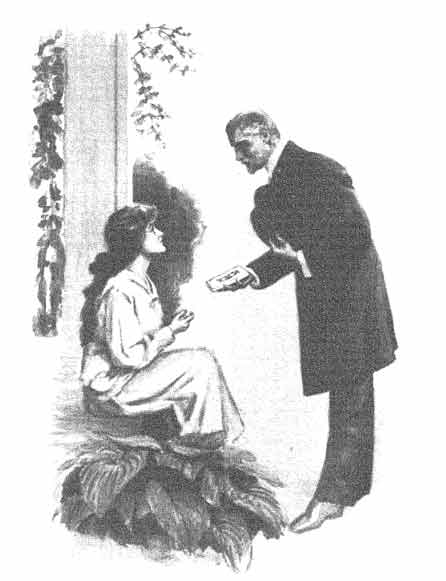
The Colonel handed me the medal
I was paralyzed—real paralysis of both mind and body, especially legs and tongue—and I believe I would have been sitting there on the front steps of the cottage yet, in a dumb and stupid manner, with them all looking at me, if Tony Luttrell who, as I have remarked before, is a very understanding person, though a boy, hadn't flared his eyes and mewed under his breath. Then we all laughed so loud that it brought Mamie Sue to the door though Lovelace Peyton called so loudly that Roxanne had to run to him; and so did Mamie Sue, with the treacherous chocolate smears on her mouth, after having promised not to give it to him unless she just had to.
"Phyllis, if Tony says Kitten Patrol to you one single time more, something will have to be done to him that is serious," said Miss Priscilla, frowning at Tony with a frown that only seemed to bring out the dimple in her left cheek. "Now congratulate her nicely, Tony!"
"Madam," said Tony, straightening up and looking so much like the Colonel that it was funny (but of course Tony has learned impersonation), "accept my heartfelt congratulations for thus achieving a triumph of kittenism. Will that do, Miss Prissy Bubble?" And again we all laughed, the Colonel the most of all, and even Belle a little, too.
"Phyllis, you are one perfectly good brick," Tony said suddenly, dropping the teasing of Miss Priscilla from his voice; and he looked at me with just as affectionate an expression in his squinty eyes as when he looks at Pink Chadwell. It is a great thing for a girl to feel that a fine boy likes her as much as he does his most chosen boy comrade. I felt that keenly.
"Thanks, everybody," I managed to say in an awkward way that mortified me into being unable to patch it up with any kind of brilliant remark following.
One of the things that had struck me so dumb was that I thought I had refused to be the Girl Scout Leader because of my disgrace, and nobody had paid any attention to my refusal. Thus it is, a person cannot escape either fame or disgrace because other people take more interest in both than you do yourself, and do not let you forget.
"And now that the Colonel has made you his speech, Phyllis," said Miss Priscilla, "I want you to come down to the Presbyterian Church parlors with me to a joint meeting of our Relief Society with the Methodist Relief. They want to make you an honorary member of both on account of the way you have dealt with the Satterwhites, who have for years been one of the greatest troubles to all of us. Of course this is not a medal, but it is an expression of hearty esteem, and I hope they will get the meeting over nicely without any discussion or argument coming up from either side on the charity question."
By that time I was so numb from having shocks that I let her and the Colonel lead me down the street, while Tony went in to keep Lovelace Peyton from fretting for the diphtheria lesson until I could come back.
Mrs. Luttrell made me the Methodist speech and Mrs. Willis the Presbyterian one, and they said so much that I felt sure they were glad that I was only expected to say "Thank you!" and then sit down while they all offered different resolutions about different things that were never exactly decided but voted on, nevertheless.
When we came out of the church, I told Miss Priscilla about the box of paper in such a determined tone of voice that she didn't refuse it at all, and went with me to buy the pipe for the Colonel, which I know will make it very valuable to him when I tell him who helped select it. It is a very interesting thing to be neighbor and friend to a mysterious love affair that is one of the traditions of Byrdsville. I believe I have solved the why of the failure of their marriage to come off, but until I am certain I won't even write it to you, Louise.
On my way home, I am glad to record, I took time to do a little shopping. I bought some buckets we didn't need from one of the littlest shops in town, some more groceries for the Satterwhites, a bolt of gingham to make Sallie Geraldine and Judy Claudia some aprons, then hurried back on the wings of anxiety to the bedside of Lovelace Peyton, to get the diphtheria started. As I ran I could just feel him thrashing around in the bed and persecuting Roxanne and Mamie Sue, if she had not already escaped for her life.
But as fast as I tried to go, I met an interruption on the way up Providence Road, that was agreeable although detaining from duty. Tony and Pink and Sam stopped me and told me that they were just on their way to bring me to the Crotch, and that I would be the first strange person that had ever seen it, since they had fixed it up in the Luttrell barn loft to have Scout meetings in. Mr. Douglass had planned and helped them with it, and they said there never was such a place of interest in Byrdsville. The reason they were going to show me was that I must get the empty room over the garage Father has turned the old family stable of the Byrds into, to make a wigwam for the Paleface Patrol to have meetings and keep things in. They had asked Mamie Sue to go with me because it would take two girls to remember all they saw, and that would be the last time we could come there, though they would come often to the Wigwam if we wanted them to show us how to be as scouty as possible.
Just then Mamie Sue came up, and she either snorted with indignation or choked with candy, I cannot tell which; but because we had to, we accepted their kind invitation with gratitude. We stopped at the house first and told Mrs. Luttrell we were going to the barn with the boys, and she said not to get hurt or fall, and gave us a tea-cake all around. Mamie Sue held the plate and happened to get two, not at all by intention, for they were stuck together.
Tony swung up from the horse trough to the loft by a pole, while Sam and Pink stayed to push us up. I went up just as easily as Tony did, before they had time to push me one inch, but poor Mamie Sue stuck halfway through the trap-door and we thought we would never be able to get her either up or down without calling out the fire-company, as Sam suggested; but she kept astonishingly cool herself and wiggled in just the way Tony told her to, and at last got up. She said she knew that she could fall down all right, when the time came to go, so for us not to worry about that, and we proceeded to enjoy the Crotch.
I never dreamed boys could get together so many remarkable things and make it so interesting to tell about them. The big kettle to boil water and the poles and the sticks and the blankets and tin cups and plates were in one corner and a shelf held the knapsacks with the "first aid" things in the opposite corner. All of Sam's bird-eggs, the collection of which he had seen the error of, and had to give up when he became a Scout, was on a table by the window, and his butterflies were pinned on large pieces of brown paper on the wall and looked like a beautiful decoration.
And while we looked at the things it had taken the boys so long to collect, I rejoiced that I could manage to spend a lot of money to fix up the Wigwam, and told them about each thing that I could buy, as I thought it up, from seeing something that they had.
"Say, Bubble, is the long pole for exercise going to be braced so the Dumpling can go over without danger?" said Tony, in the teasing voice he uses to girls, that doesn't make them mad.
"I think we ought to have every single thing that girls can use to make them as strong as boys," I answered. "When girls are strong enough not to be any burden, the boys will take them everywhere they go and everybody will have just twice as much fun."
"I suppose you would like to make the boys learn to do tatting and sewing to let them in on that sort of kitten gatherings," said Sam, with a laugh that was not so nice as Tony's.
"We would, if it wasn't for the fact that Petway does the knitting act so well that he is a perfect lady. We never could equal him," answered Tony, with jolly good humor to save our feelings from being hurt by Sam.
"Well, I don't believe it will hurt—" I was just going to say, when we heard Uncle Pompey, calling down in the barn for me to please come quick before Lovelace Peyton killed them all dead.
We all slid down, including Mamie Sue, with astonishing grace, and I promised to begin to fix the Wigwam next week. I promised, but a pain hit my heart. Did I know that I would be in Byrdsville next week or ever again? What would Father do when that prosecution found him? For ten days I had not been letting myself think about the future, but it seems that every minute I live in Byrdsville, my heart winds around my friends and theirs around mine. To take me away now would be to tear me—but where was Father, and why didn't I hear what he is going to do and have done to him?
As I once more hurried down the street to the diphtheria lesson, it seemed to me that Byrdsville broke on me all suddenly as a lovely and maybe to-be-lost vision. All the leaves have come out on the trees and vines now, and everybody's yard is in bloom and is full of sweet odors. Doors and windows stand wide open and people sit on their front porches and visit back and forth like every evening was a great big party. And amid it all I have felt like I belonged to something for the first time in my life.
Then suddenly it came true that now I do belong. This is how it happened! Just as I had got to Lovelace Peyton and soothed him by a few lines of the symptoms of fever and nausea and headache that come first in diphtheria, Roxanne stood at the door with a telegram in her hand for me, and my heart stopped beating while it took leaps all over my body, about fifty to the second. I promised Lovelace Peyton a half dozen rolls of antiseptic bandages and a paper of sticking-plaster and a June-bug, if I could find one, to let me into the living-hall to read it. I felt that if it said, "No," about the secret article I couldn't trust myself not to let him know that something was the matter.
It didn't say "No!" Wait, I'll copy it, Louise!
A payment of one thousand dollars for articles from you will be in Byrdsville on Saturday. Letter follows.
COUSIN GILMORE.
My knees shook under me, and my eyes couldn't take in the letters well, but I asked Roxanne, who was standing waiting to hear what the telegram could be about, just as a friend should feel over a telegram, to run out to the shed and get our Idol quick, and I would tell them all about it together. He came in looking perfectly beautiful with his coat off and a big apron on him. His eyes were just as excited as mine felt, now that the mist had cleared, and it seemed to me even in that moment that no other thousand dollars in the world could have brought so much suspense and excitement as this one had.
But I knew that I might have a battle to fight in which I must win, and I steadied my nerves and made myself feel like Father looks when he reads important letters and begins to dictate answers in telegrams.
"Mr. Douglass Byrd," I said, perfectly coolly over my own inward volcano, "you remember you promised me that if I could use my own brains on a plan to get the doctor here for Lovelace Peyton's eyes, you would let me do it?"
"Yes, I said just about that," he answered me, and he looked in my eyes in a depending way that was so like Lovelace Peyton used to do that again the mist came over my eyes. I am getting to have that proper mist now instead of the choke, and I am glad, because it can be hid better than a choke.
"Well, I found the plan and worked it for us, and I will have the thousand dollars by night-time, and we can get the doctor from Cincinnati by to-morrow, and have it all over before the algebra examination on Monday," I answered.
Then, in very many less words than I have used to tell about it to you, Louise, I told him what I had done, with Roxanne standing with her arm across my shoulders, that trembled with excitement. To cap off the climax of the story in proper fashion, as we are taught in the rhetoric to do, I handed him the telegram—and I felt like the Colonel looks when I did it. He stood for what seemed hours, with the telegram in his hand, and something makes me suspect that he was having the same hard time as I was having with a choke, only this was the first time and it came very near resulting in weeping, which I had never done up to that time.
"It is a wonderful thing for you to have done, dear," he said at last, with a look that got down to the core of my inexperienced heart and made it thump uncomfortably. "And if there were no other way to get the doctor for the kiddy's eyes I would accept this loan gladly, but I have heard in the morning mail, that I can sell the Washington letters and I am going immediately to arrange about it that way. You know, though, how great it was of you to do this, and how it makes us all love you. We don't have to tell—"
But here he was interrupted by an avalanche of words that must have been dammed up in me for all the fifteen years of my life for that special occasion, and I delivered them with an eloquence that must have equaled that famous valedictory of Colonel Stockell's at the Byrd Academy, the year he left for the war. I told him just what a lonely life had been broken into by the sunshine of Roxanne's and Lovelace Peyton's and his family affection for me, and now they were just the core of my heart, which he was wounding. I described in detail how I had suffered when Roxanne and Lovelace Peyton had been hungry, and had been brought to the dishonesty of feeding him in private, with never a word of my suffering to hurt that Byrd family pride that they are turning as a weapon on me. I even mentioned the patches on his trousers and the break in Roxanne's shoes that had been patches and rents in my own heart. I tried to make them see how hard it had been when I have been commanded to buy things for people that I didn't care about hardly at all, except as fellow-beings, when I was hungry to give what was needed to my most beloved. By this time I had got to the point of exaltation, and Roxanne had hid her head on my shoulder, while that Idol's eyes were so wide with astonishment that I thought he would never be able to get them to normal size again. "And after Lovelace Peyton has hurt himself in my cause, as he did from hearing that I wanted an explosion," I still ruthlessly continued, "you want to deny me the happiness of getting his eyes saved by my own unaided efforts. When I was disgraced and humiliated, I put that kind of pride I had aside and came to you when you called me because you needed me, trusting in your friendship for me and love of me, but now that the time has come for you to yield just a little bit of your pride, you won't do it for me."
Here I paused, and a thought of explanation for their cruelty came over me. "Because I am my father's daughter, do you think this money I have made is tainted, too? And is that the reason why you don't want to use it?"
"Oh, Phyllis!" Roxanne gasped under my chin, and the Idol got as white as a sheet and his eyes looked like I had struck him a blow.
"You can't get the money from the telegraph office and give it to me quick enough, kiddie," he said, with the choke coming out clear in his voice. "Forgive me! The youngster's eyes will be twice the value saved in such a way," and he took my hand and held it in both of his against his heart, in a manner to make me feel that never again would I have to struggle with that Byrd pride.
"Please forgive me for fighting you like that," I said with a horrible blush of memory coming over me as I thought of all I had said, about the patches on the trousers especially. "You made me do it and—"
But here we were interrupted as an apparition stood in the door and regarded the sad and joyful tableau we made with its head on one side, right corner of the mouth up, and left eyelid drooped. It was Father, and I had never seen him look so grand or with such a noble expression on his face! And as he stood still and looked at us, I held my breath far longer than it is safe to do. And as Father looked, the Idol drew himself up and his head took on the pose of the feminine Byrd portrait, but he still held my hand in both of his as he looked Father steadily in the face. I was scared and so was Roxanne as we hugged each other as women always do from fright.
Then, without a word, Father walked right up under the portrait and took the Idol by both shoulders and gave him one good shake that tottered us all.
"You young idiot, you! You young idiot!" he said in a tone of such affection that it was unbelievable to my ears. And as I heard it, I knew that all my trials and disgraces and puzzlings were over, and I turned my head upon Roxanne's back hair and wept tears, the first time in my life—and I hope not the last.
CHAPTER XII
"Now, see here, Phil, don't give out on the situation like that," said Father, as he slapped me on the back to still the tears while Roxanne hugged me and the Idol still held my hand.
"Please go on and tell what you did or didn't do to the 'secret,'" I sobbed, but I stood on my own feet again and was using both my natural hands to wipe my eyes.
The Idol had been for minutes standing and looking at Father like a child that has just awakened and doesn't know whether the awful thing that was pursuing him was a dream or a real bear. Roxanne was the first one to speak, and as usual she had seen the rosy side of something, even if it was not the real thing.
"You didn't really steal the secret at all, did you, Mr. Forsythe?" she asked, with her lovely and engaging enthusiasm. "I just knew it, all the time."
"Yes, I did 'steal the secret'—if that is the way you put it—pro tem, which means 'for the time being.' You are a nest of very young idiots, and I trusted to that; but you opened your puppy eyes at the time I hadn't counted on, with the help of Luttrell's scouting nose." He paused, as if not right sure that he was going to tell about everything, and as he looked at us we did look like a basket of little silly puppies with mouths and eyes wide open—the Idol most of all.
"And now first, young man," said Father, turning to Mr. Douglass, left eyelid drooping lower than usual, "I just want to say to you what I think of you for leaving not only all the traces of such a valuable discovery unprotected in a shed, but leaving your notebook and drawings, too. Any other man but a Byrd of Byrdsville, would not have trusted the book off his person a half minute, and would have destroyed the traces of each experiment the minute it was done. Those steel shavings were the most idiotic-looking things I ever saw, and when I emptied the box it was with a groan at your foolishness. Just the looks of 'em kept me from trusting you with my intentions. I couldn't afford to run the risk of your carelessness, so I took the whole thing and decamped with it."
"Oh, Father!" I gasped, beginning to get the untrustful feeling again.
"Hush, Phyllis," said the Idol, looking at Father like he was Jack, the Giant-Killer, and just about as much interested as if it was not his own tremendous fortune Father was telling about taking off with him.
"I had been down in the garden to the garage to give the new car a looking over, and I saw Rogers go into that shed and knew, from having been told by Phyllis accidentally of the steel experiments, what was happening. I followed him a little later, and saw your trustful layout, exposed to the world as is the human nature of all Byrdsville. Rogers is an expert and would run through your notebook and get the whole thing in a few seconds. I knew that he would watch his time, try out the experiments at the furnace, and get the patent while you were deliberating about proceeding in a Chesterfieldian manner with an injunction drawn slowly and literarily by your friend, Judge Luttrell. Rogers was fully equipped by his association with me to do you and—quick. I took no such chances as having you and the Judge's Byrdsvillianism mixed up in the affair. I stole your secret that had been stolen, left for a Pennsylvania furnace the next morning, had experimental furnaces built, tried out the experiments before the company, keeping dust in Rogers's eyes by demanding to be in on his robbery, patented it by push-legislation in Washington, and am back with an offer of fifty thousand dollars down and a royalty to be decided upon in a ten-year contract. I have a great mind to put it in trust for you, idiotic dreamer that you are—and perhaps the most noted man in the field of commercial invention for this year at any rate! How did you come to think out that process of a disturbance of atomic arrangement at that temperature?"
"Why, you see, Mr. Forsythe, in the laboratory at Princeton, just before I left, I had begun some atomic experiments, and out at the furnace it struck me all of a heap, what it would do if we could treat the ore at some ascertained temperature in the way I have found. Now, in another case that I am working on, I may be able even to make the process—"
"Help!" said Father. "Let's get down to business on this proposition before we get to the other one."
And we all laughed, for it was funny to see the Idol with patches on his trousers and hardly a day's living ahead, pass right over the fifty thousand dollars, with more in the contract, and all the sensation it had made, to begin to explain about what was out in the shed now. He looked pained at our interruption and tried to begin again, but Father interrupted him.
"Well, have you told this one to these 'bubbles,' as my young friend Luttrell so appropriately calls them? By the way, the economical Rogers had on the coat that Dr. Byrd had doctored for the cholera, which I had asked him to destroy for me, and the Scout Leader was right in his nose clue. I suppose that was what led him to suspect me and shadow Rogers to the telegraph office. Great boy, that Luttrell! But to return to the girls: If you have told Phyllis, I shall have to keep her in solitary confinement until it is finished. Miss Roxanne, I know, can be trusted at large."
I knew Father was just joking, by the eyelid and the corner of his mouth, but the Idol drew himself up according to the old portrait again before he spoke.
"Mr. Forsythe" he said, "I haven't any secret that Phyllis can't know. If she accidentally gave this one away to Rogers—she can the next, and the next." He took my hand again and drew me close to him. To think that that wonderful Idol should feel like that about insignificant me!
And father looked as impressed as he ought to have been, and begged my pardon in the proper manner; only I saw the bat in his eyes that showed how amused he was.
"Well," he said slowly, "Phyllis is a dangerous person to tell secrets to, or even to live an ordinary life before. Her penetration is so keen that she sees a man in his true character—and gets a thousand dollars from him for her estimate of his personality. I am glad to buy the opinion of me that you sent your cousin Gilmore at a thousand dollars, Phyllis,—it is worth more than that to me—from you!" His eyes were very tender to me though then, laughing: "Want to see yourself as she sees you in this thousand-dollar book I'm going to have printed, Byrd?" he asked teasingly.
"Oh, no!" I gasped; "I hoped he would never see that! Don't give him one, if you bought it. Don't even talk about it!" Let's go telegraph the doctor—we have forgotten the eyes too long now."
"That will not be necessary," said Father, with the lovely look that comes into his face when Lovelace Peyton is even mentioned. "When I read your letter to Gilmore, I hunted around immediately and brought the best man in New York with me to see to those eyes. He is over at the house getting rested and ready, and will have to make his examination in less than an hour now, so you two had better hustle to get Dr. Byrd ready for him. Everything must be antiseptic."
Antiseptic, with those fishing worms and the hen and the pet toad and the June bugs in his bed! Roxanne fled, calling Uncle Pompey on her way.
"Then my thousand dollars won't—won't be needed?" I asked with a contemptible feeling of disappointment that the Byrds had got so rich before I had been able to do this one thing for them. I looked up at old Grandmother Byrd over the mantelpiece and said in my heart: "You have won."
But what happened then? The Idol, with the comprehension which is one of the symptoms of all genius, turned to me quickly and put his arm across my shoulder.
"Phyllis," he said, with his most wonderful eyes shining down into mine, "that check is going to the doctor just as soon as your Father gives it to you. I told you that Lovey's eyes would be more valuable if saved by you—and—and I meant it."
I didn't have to say anything, and I couldn't—he understood! I just clung!
"Young idiots, both of you," said Father; but he blew his nose violently, and I knew from experience how the lump in his throat felt. "Now take me in to see Dr. Byrd."
"Howdy," said Lovey, as Father shook hands with him and the toad at the same time. "Did you get any more cholera? Did the medicine work?"
"Yes, the medicine worked—more ways than one," answered Father with a pleased laugh. And he talked to Lovelace Peyton all the time about a man who got blown up in a mine that he saw in Pennsylvania, so that he made no objections while Uncle Pompey took out all his "live stock."
While the Idol and Roxanne and I did up the room, with his own hands Father bathed Lovelace Peyton and put on his clean, patched little night-clothes; and I saw one big tear, that came from the very bottom of the big man's heart, I know, splash on the biggest patch, as he was guiding the little groping hands into the armhole.
Then while I was buttoning Roxanne into a clean dress and the Idol was carrying out the last mop, the doctor came in the front door. I was so dirty with the cleaning that I retired to the kitchen and helped the Idol into his collar and coat and to get his hands clean so he could hurry on in to help. Uncle Pompey had got his usual violent spell of asthma and I had just lighted his pipe for him when the Idol came back to the door of the kitchen.
"You'll have to come, Phyllis," he said, with a smile that took the anxiety off his face for an instant. "Lovey refuses to let the doctor touch him without you. Come quick! The doctor says the light is beginning to go."
I went, soiled dress and crying eyes and hair all rumpled and mussed with the excitement.
"Phyllie," said Lovelace Peyton, who was sitting up in bed defying them all, "I ain't a-going to let that doctor touch me 'thout you stand right here and tell me how it all looks just as he does it. Don't leave out any bleed that comes, or any blue flesh or nerves or nothing. You know how, 'cause I have teached you. Neither Doug or Roxy ain't no good with symptoms."
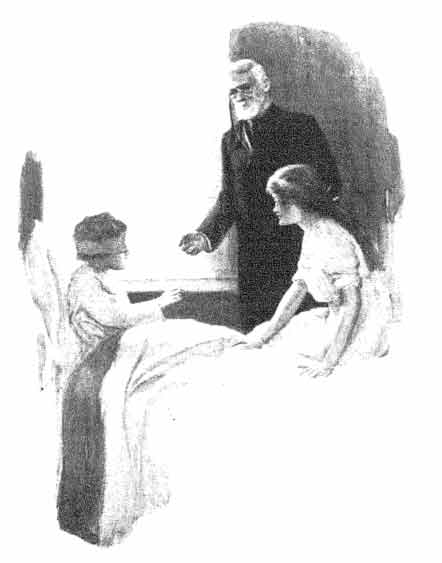
"You stand right here and tell me how it all looks"
"I will, Lovelace Peyton, I will," I answered; but I shuddered, for how could I stand to see him tortured, as I felt he was going to be?
But I did—and it makes me weak to think about it now so that I shake all over. As the instruments pried and pulled and injected the aseptic solutions I held his hand tight and talked as hard as I could. At the worst places I told the most awful lies about how horrible it looked and placed all the frightful symptoms of every disease I had read to him, right in his eyes. It sounded dreadful but I knew that it interested him and helped in a way nothing else could.
"Go on, Phyllie, tell more," he would groan as I stopped for breath—and on I would go piling inflammation on suppuration.
Finally, after what seemed an age, the doctor drew a long sigh and looked up at me with a kindly expression that I knew meant "saved." For a minute I reeled, and I do believe I would have learned what fainting meant the same day I learned crying, if those little fingers hadn't held on to me tight while the doctor gave just a whiff of chloroform to ease the twitching nerves. He had been obliged to do the operation without it, but risked just the whiff.
"Don't the chloroform smell good, Phyllie?" Lovelace Peyton whispered up to me as he floated off and his hands relaxed.
"That was the most remarkable performance I ever participated in," said the doctor out in the hall after he had finished telling us how near the sight of both eyes had come to being destroyed from not being kept drained. "And the two youngsters are the most remarkable I have yet encountered. Miss Phyllis, let me congratulate you on a nerve and a talent for imaginative description the like of which I have never met before. But please somebody explain that boy to me before I catch the train."
I was glad Roxanne was the one to begin on the subject of Lovelace Peyton, for only she had enough rosy words to describe him. She did better than I ever heard her before, and I could see how Father and the doctor both enjoyed it.
"We will take him right away to college where he can learn to read and write for himself, in just a few months, and then to operate in some big hospital before he comes down South to cure hookworm and pellagra and all the other things other doctors haven't found out about. What medical college would you advise, Doctor?" she ended by asking, and her face was so lovely and enthusiastic that it looked almost inspired. There is no telling where Roxanne's dreams will land the family now that they will have the money to start on them.
"Well, Miss Byrd," answered the doctor in a tone of voice, that made me know that he appreciated Roxanne at her true worth, "right now, for about ten years, I would keep the small doctor in Byrdsville, mostly out grubbing for experiments and 'squirms,' as he calls them. Then when the time comes we shall see—we shall see."
"Yes," answered Father, dropping his head with the corner of his mouth screwed up. "Yes, we shall see!"
And as he said it, somehow I felt that the Byrd family would never any more be unlooked after, and that it was good to have such a man as Father for a father and a neighbor. And, Oh, I felt—I can't write it, I am so tired I will have to go to sleep with a "Thank God," as big as can come from a heart the size mine is—which feels bigger to-night than it ever did before. Good-night, Louise of leather!
The quadratics were awful! I got ninety-five by a lot of it being luck that I knew the questions, and Tony got eighty by the same process, he says; but Belle and Pink just squeezed through by the skin of their teeth. Sam didn't pass and neither did the tallest Willis. The other one got seventy and the right to take another examination. Cruelty to children like that kind of examination ought to be stopped by law.
And that is the reason I haven't written in this leather confidante after that Saturday, into which at least four years of my life were crowded. By the calendar I am still just sixteen, but I am twenty by actual count.
First—Father is a Raccoon in full standing, and is going to be Scout Master for a little troop just the minute Lovelace Peyton gets old enough to organize one. And other honors have come to him like—but I must put things down in an orderly fashion for Father as he has bought you on a book, Louise.
Miss Priscilla is going to marry the Colonel. The secret of the why of her not doing it before is out. I have always felt that Miss Priscilla was honorable and not cruel. The Colonel had never asked her before, and it seems that the Stockell pride is very like the Byrd pride. He lost his fortune during the war and she is rich. His honor forbade! But Father has got him to go on a board of directors of the Cumberland Coal and Iron Company. Father says to give tone to directors' meetings, but that reason is not to be mentioned. He gets a salary of fifteen hundred dollars and is willing to marry on that, as Miss Priscilla insists on it. He told me all about it and so did she.
Tony, also, was in the confidence of both for these last few days which was a great comfort, as he is always so full of plans to accomplish things. In fact, it was Tony that made Miss Priscilla send for the Colonel with determination and it was I who got the salary fixed with Father and urged the Colonel to respond to her summons. They are as happy as "Love's young dream continued into maturity." I quote the Colonel exactly, as I think it is a literary gem.
Being the best-man at the wedding is one of the honors that has come to Father. I reminded him that the Colonel is not only a Stockell but he is a Confederate hero. Father said that he appreciated all that and that was what the salary was for.
"Bubble," said Tony, as he sat on the bench in our garden and fanned himself with his hat, "now that you have got the old town geared up and jogging along smoothly with your almost boylike energy, let's forget all about 'em and get ready a really humming Scout-Campfire ceremonial for the second night of commencement. I have got one gruesome idea I will be ready to tell you about to-morrow. We needn't let in Roxy or the Dumpling or the other Kittens until it is all fixed, for they will be frozen with fear at the very idea of what will be a Scout initiation, all right enough. But they'll do as you say when the time comes, for the whole bubble bunch, including Belle, since her algebra get-away, fall at any word you dope out to 'em from now on. Well done for you! You are not only a brick, Phyllis, but a whole wall of them that can be depended upon to line up to the mark."
I wrote that down not to be conceited, but I want to preserve that opinion of me in you, Louise, because it means that I have, in a little way, deserved the happiness that has come to me.
I came to this town a sad and lonely girl, with a great sorrow that had kept me from being like other people and with a great distrust of my father, who had had to be both Father and Mother to me. I have found friends and interests and excitement and adventure and sympathy and encouragement out here under that Old Harpeth Hill and I am always going to keep them. I hope I never will go one step out of Byrdsville as long as I live, though Roxanne has planned trips to every corner of the world for us as soon as the Idol has finished this next invention.
The Byrds have to stay in the cottage until Father can build another house for us to move into. Of course they will go back to Byrd Mansion and reign in it as they have always done. But I smile to myself that one person got ahead of that stiff-necked old portrait—I did, and once she even seemed to smile down on me.
This was the time she seemed to do it. We had all been talking about the plans for the new house down in the orchard, for Father and me, when Roxanne had to fly to Lovelace Peyton and Father tiptoed after her just to peep at him a second. That left the Idol and me alone for a few minutes. How I would have shuddered at the mere thought of such a thing happening to me a few months ago, but now it just seemed agreeable happiness. Through suffering I have grown bold, in my adoration of him.