MARIA THOMPSON DAVIESS (continued 2)
Reading edition
The tallest Willis gave me the first peony that bloomed on their bush to take to my mother, and I caught a sight of her awkward heart that did me good. I defied the nurse and told the white, white little thing on the pillow, that is all the mother I ever had, that one of my friends sent it to her, and I got a flash of a smile, such as I had never had before. The nurse said just that little bit of excitement made her worse, and I've promised never to do anything but take my daily look at her again—but—she is my mother, even if—
Well, anyway, Louise of leather, just as Roxanne and I had got the skirt ripped up and the pattern straightened out, we saw all the girls coming, and from the way they were talking we saw something interesting was surely happening, had happened, or was going to happen.
"Hide the gingham, Roxanne, while I slip over the wall and change my dress," I said quickly. "Our business arrangements are nobody else's business."
"Will you come right back?" asked Roxanne in a way that made me know she would worry if I didn't.
I would rather have stayed at home until the girls had had their visit and gone home, but I have thought out just how I ought to act about Roxanne and her friends and me. It is only fair to pay no attention to how they feel, but to do what makes Roxanne happy in case of the mix-up of us all. My pride and Roxanne's are different. Hers has been handed down for generations and she can act on it without argument with herself, but mine is my own kind and only I understand it. It is new and I have to plan it out by thinking. The girls all think that because I have finer clothes and travel and am rich, that I think I am better than they are and am proud of it. Richness is not my fault, any more than a hunched back would be, and it is my duty to forget it whether they do or not. I act accordingly.
Another thing: I believe something is making my father see the error of his ways and I hope that some day I will see him settled into being a good and great man just like Judge Luttrell and the Colonel are and Roxanne's father was. He has acted in a peculiar way just lately. Last night he drew me up close to him and stood by the window a long time without speaking.
"Phil," he finally said, not in the voice he generally uses as if he were speaking to his only son—but with a daughter tone in it—"you have made good in Byrdsville, and I want to tell you that I'm proud of you. I doubted whether you could do it. A bunch of such youngsters as you have made friends with would be a test for any man, much less a young woman. I'm their friend because they are yours, and pretty soon I am going to prove it—like the sentimental fools that all fathers of almost-grown daughters get to be. Go to bed, kiddie, and say an extra one for Father."
Now all this is directly connected with the state I found the girls in over at the Byrd cottage, when I finally dressed and got back again, after stopping to bargain with Lovelace Peyton to go without the four-o'clock cookies for half a tube of perfectly harmless tooth-paste that he wanted for some kind of plaster to put on Uncle Pompey's heel, which is always painful enough to occupy most of the snake-doctor's time.
"No, I don't see why we should always tell Phyllis every interesting thing that happens to us or is going to happen," Belle was saying in such a decided tone of voice that it carried through the front door, across the porch, and halfway down the front walk.
Disagreeability has a kind of force that knocks one down before pleasantness hardly gets to him. I knew Roxanne said something in answer to that; in my heart I knew, but I couldn't hear what it was with my ears.
"Well," came Mamie Sue's voice, muffled through a piece of fudge she always carries in her pocket, in case she goes a square away from home and is overtaken by her appetite. She always has enough for everybody else, too, I must not forget to add. "Well, if it is Miss Prissy's robber come back, that makes the boys act so, Phyllis might just as well be scared as the rest of us; and if it is something pleasant, why, let her have a share of that, too." Some day I'm going-to break loose from myself and hug Mamie Sue's funny fatness until she squeals.
"I don't believe that if it was just a frolic the boys would have got Douglass to come away from his work to the Crotch; but maybe he was going up-town anyway, and they knew that," said Roxanne as I came in the door and was given welcomes of different degrees. The tall Willis is getting so that she moves over for me to sit down by her, even if she is just sitting on one small chair. I wish she could know how that pleases me.
"Did the boys look to you as if the thing that is making them all act so important was nice or disagreeable, Phyllis?" asked Roxanne as she got out the inevitable darning bag.
The short Willis moved nearer and began to help sort and get ready for patching. I always keep a thimble in Roxanne's darning bag now, but sometimes the short girl beats me to it. The others never notice that Roxanne's hands are never empty of patching jobs. Still Mamie Sue does attentively feed her fudge in hunks while she darns.
"I don't know boys well enough to diagram their expressions," I answered. "They always look excited and queer to me, and I can't tell their jokes from their other affairs. What have they been doing?"
"Being as hateful and secret as they know how to be," answered Belle crossly. "Boys are nothing but rough, rude miseries; and the next time Tony Luttrell tells me to 'bubble along' as he did Mamie Sue and me, when Mamie Sue only wanted to stop him to give him a piece of fudge, I am going to tell him what I think of him."
"Hope I'll be there," said the tall Willis behind my shoulder, and I never enjoyed a silent remark more. Belle is as afraid of Tony's laugh as she is of a cow in the lane.
"Now I know that something awful has happened or is coming if Tony spoke that way," said Roxanne, with such anxiety coming into her face that the timid Willis dropped her stocking and Mamie Sue gulped down such a large piece of candy that she almost had to choke. "Oh, girls, do you suppose that dreadful man has got out of jail in the city and is coming back to maybe—maybe—?"
But the words were stopped in Roxanne's mouth with a great, pleasant laugh as the Idol stood in the door. You would know that "Idol" is the name for him by the way all the girls look awed and afraid of him, but interested too. Tony and Pink and Sam were in the background like the angels in the picture of Sir Galahad.
"This is an official committee to invite you to be the guests of Mr. William Forsythe on a hay-mooning on Friday next, to start from his home at the hour of seven-thirty, in honor of the birthday of his daughter, Miss Phyllis, who is quite as surprised as the rest of you. The rest of this speech will be continued on that evening." And he was gone before anybody got any breath again.
That's what my father meant by showing my friends that he appreciated them.
But Belle Kirby's expression would make anybody with a sense of humor laugh. Can live coals be showered on a person if nobody ever intended it?
CHAPTER V
The desire to be popular may be one of the unworthy ambitions of a person's heart, yet there is nothing in the world so delightful as having it happen to you. And if having almost everybody like you, and show it by being nice and friendly to you on all occasions, makes you happy your own self, how much more happy you are when somebody you love gets a slice of it all along with you!
My father is getting to be one of the beloved men of this town, like Judge Luttrell and the Colonel. It has been going on gradually for some time, but I was afraid to notice it for fear I was mistaken. Such is the result of the sincere prayers of a daughter, and I certainly was sincere in wanting this reform. And better than even his sitting and smoking and joking in the Judge's office and walking down the street in a friendly manner with Mr. Chadwell is the notice that Mr. Douglass Byrd has been taking of him lately. The Idol has been to see him twice, in the evening, and both times I have heard my father's jolly laugh boom out in a way the nurse says will have to stop, for it made Mother ask to see him and be ill because she couldn't. And just day before yesterday Father came up the street with the great inventor, and they both came in and sat with Roxanne and me on the cottage porch to smoke their cigars. Roxanne was just sweet and good and easy with Father like she always is. I don't believe that girl was ever conscious of her feet and hands and blushes In all her life. I forget mine when I am with her.
Well anyway, Father was delighted with her and showed it plainly. And if he liked her, he was positively funny when he met Lovelace Peyton. The snake-doctor came around the house, as usual galloping on the stick horse, and in one hand he had one of his best bottles full of something awful to look at and that smelled worse, even through the cork.
"Mister," he said, looking Father gravely and courteously in the face, "you got cholera bad and might die to-night if you don't take medicine quick. It's in this bottle; shake it well." And while the Idol made a grab for him he put that bottle right in Father's hand and backed off out of reach.
Roxanne was distressed at Father's having taken that awful smell into his hands, and Mr. Douglass tried to make him give it back to Lovelace Peyton; but Father wrapped it in two handkerchiefs and put it, smell and all, into his pocket.
"Thank you, Doctor Byrd," he said, just as gravely as he talks to the great surgeons and doctors that come to see Mother. "Shall I report my condition to you to-morrow?"
"That medicine will work fine," answered Lovelace Peyton; "but if it kills you, can I cut you open to see how you work inside? When Douglass dies, I'm going to cut him into little pieces; he's done promised."
"Oh, Lovey," was all Roxanne could say, while Father and the Idol both roared.
I never saw my father's face so lovely as it was when he looked down on that little raggedy boy as we left him swinging on the front gate. His heart is softening away from wealth to his fellow-man, I know. And, as if it had not made me happy enough to have Father sitting and smoking with such a great character as Mr. Douglass Byrd, what should happen but for us to meet Tony at our front gate, coming to see Father especially? They made me go in and wait on the front steps while they talked, because they didn't want me to hear; and they both laughed so that Father tried to get out his handkerchief and succeeded in dropping the awful bottle Lovelace had given him, while Tony leaned against the fence and shook with chuckles at Lovey's giving him such an awful smell. Oh, if they were to elect my father an honorary member of the Raccoon Patrol like the Colonel and the Idol, I could not stand the happiness. Tony's friendship for him gives me one of the deepest joys that ever came to me. Tony's high sense of honor cannot help but impress Father.
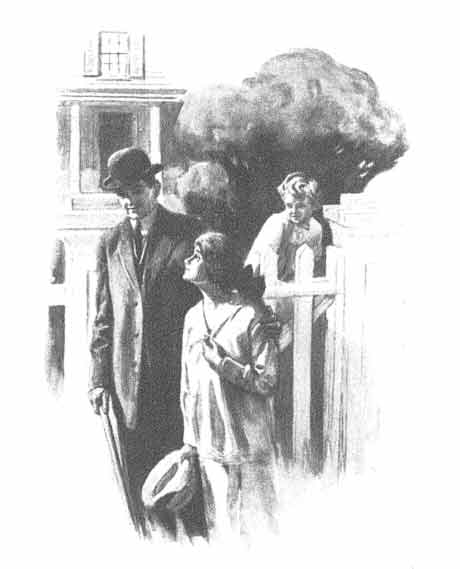
I never saw my father's face so lovely
This little town of Byrdsville, that nestles down in a hollow of the Old Harpeth Hills on the old pioneer road they called the Road to Providence, when the first settlers traveled it from Virginia to Tennessee, is the most wonderful place in the world, I think, and I wish Father could have been born and reared here, for then he wouldn't have strayed into a career of making money. Nobody in Byrdsville ever did, and Mr. Douglass Byrd will be the first one. And besides having the soul of honor and loving-kindness in it, Byrdsville looks like it might be one of the outposts of heaven, where tired souls can come to rest before going up the shining ladder.
All the houses are old-fashioned, with wide doors for welcoming and with vines running over the chimneys and up to the eaves, while blooms and buds tumble over the walls and burst from the gardens into the street. Yes, I think Byrdsville might be called the smile-place on the old earth's round face.
But to return to Father and Tony at the front gate; only I didn't. Father went on down the street and Tony came in to sit on the steps and talk to me. I wouldn't be so frivolous and growny as to have a boy come sit on my front steps talking to me like a "suitor," as Belle thinks it is smart to have; but Tony is different. He's my friend, and I would almost as soon talk to him as Roxanne.
"Well, I must say, girliky, that it was mighty considerate of you to be born about the full moon time of the first of May," said Tony, with one of those funny flares of his eyes. "Suppose you had opened your peepers along in December; we would have had to have an apple-roasting to celebrate for you, and I, for one, prefer the hay-lark. Your parent is one fine old boy, and me for him."
"Oh, Tony, I am so glad you like Father, and it was fine of him to have the hay ride for me. Do you suppose they will all go?" When I said "all," I really meant Belle.
I don't know why, but somehow I hoped this hay ride would shake up Belle's heart into being soft toward me. There are just eleven of us in the junior class in the Byrd Academy: Tony and Pink and Sam and the two Logan boys, while Roxanne and Mamie Sue and Belle and the two Willises, with me, make up the girls. Eleven is a sacred number, and I don't like for Belle and me to break the link by not being friends.
Tony is such a wise boy that he sometimes knows what a girl is thinking about when she doesn't tell him. Most of the time he just grins and leads us all on and we do tell him everything; especially Mamie Sue, if we don't warn her beforehand and make her wear a horsehair ring not to forget when he asks her questions. It makes Belle mad for him to do Mamie Sue that way, and she calls it "prying"; but I think it is just kindness. How can you sympathize with your friends' affairs if you don't make them tell you all? And sympathy applied to life is like the gasoline in a motorcar, I think.
"Well, I should say they were all going," answered Tony enthusiastically. "Even Belle, the beauty, can hardly wait for the get-away. She is putting buttermilk on her freckles so that the moon won't see 'em. Miss Prissy is over at Roxanne's now, trying to baste Roxy together for the frolic."
"I think Roxanne always looks lovelier than anybody," I said quickly; for I didn't think I could bear to have even Tony, when I know what a great love he has for her, criticize Roxanne's shabbiness. They don't any of them know what a heroine she is, and about the great cause.
"Course she looks good, 'cause she is the pretty child; but I always feel like carrying a needle and thread and a card of pins when Roxy is along. And let me tell you the bug-doctor is about to burst out into the cold world from his aprons. I know old Doug makes enough to rag the family, but Roxy is just behindhand getting rabbit skins to wrap the buntings in. Lots of girls are poky about doing around."
If Tony Luttrell had known how cruel that sounded, it would have broken his heart. But I couldn't tell him what a heroine Roxanne is and I just had to shudder in my soul to see her so misunderstood—Roxanne, whose every day is just one big patch on life.
"It is lovely of Miss Priscilla to go with us," I said, to change the subject.
"It would be a dry hay ride if the Miss Bubble wasn't sitting in the very midst of the crowd and the wagon, with the Colonel prancing along beside on old White. Your father is going to ride out with the Colonel and—but that's the surprise. Being with your gingham gang so much, I am about to get the talks." And Tony put his hand over his mouth and moved away from me as if I had the scarlet fever.
I laughed at Tony and from sheer happiness at thinking that my father was going with us in the fine company of the Colonel and Miss Priscilla. I wonder what we would do, if we had to have somebody go to places with us who thought they had to chaperon us? Miss Prissy is just one of us and would go if we had to ask somebody like Belle's mother, for instance, who is always talking about chaperons, to go also.
As I have remarked before, Byrdsville is a very different place from most of the world, and I thank God that he led me to it and "made me to lie down in its green pastures, beside its still waters." I found that in the Bible the other night, and it fitted me and Byrdsville. Good-night, Louise!
Of course when I grow up I shall have many things happen to me, like graduating from Byrdsville Academy, marrying, and being president of clubs, and going to balls and theaters in the city, if I have to; but there will never be a night like this one of my sixteenth birthday, April twenty-second.
Miss Priscilla Talbot was the first slice out of the happiness birthday cake when we met down at her house to get into the wagon. I can never have things here at my home like that, because of the precious sick thing upstairs that cannot be disturbed, but who is the core of my heart, anyway, even if she doesn't know it.
But of all astonishing things, this is what Miss Priscilla did as we were all lined up for Father and the Colonel to help us into the wagon on the great mound of hay, to the front of which four horses were hitched.
"And now to start off the birthday we must each give Phyllis a kiss, as we would do if we were blowing out the candies on the cake that is packed in the basket; and each one whisper a wish to her, as they give her a kiss. I will be first and the Colonel next," she said and she bent down and kissed me and whispered: "A happy sixteenth year."
I never had been kissed—even Father never did it to me, because I have been more like a son than a daughter, and he hasn't thought of it. To get a whole wagonload of them at one time, and unaccustomed to them, was enough to paralyze any girl, and I stood dumb and took it—them, I mean. The blow-out-the-candle-with-a-kiss-wish is one of the first family birthday customs in Byrdsville, and I felt that it was right to subscribe to it. I didn't mind when I saw the boys were going to refuse firmly to do it and just shake hands instead.
"Bully for you, Bubble, and a pound or two to cover your elbows," Tony exploded while he nearly pumped my arm out of the socket. Everybody laughed, because I am getting thin with so much growing.
The Colonel's kiss was a ceremonial, like you have in church or at graduation day, and his wish took five minutes to say, but the tall Willis choked up my throat with the lump by whispering a hope for my mother, which can never be, I know.
Next the Idol kissed my hand with grace like is in a story-book and which made my whole arm act like a poker. Father hugged me with all the energy he hadn't been using on me all my life. It hurt me happily.
Roxanne came last and she saved hers until the Colonel had packed us down together in a nest of hay at Miss Priscilla's feet like two kittens in a basket, with Lovelace Peyton squirming around as a third.
"You never encouraged me to kiss you before, Phyllis," she whispered, with her arm around my neck; "but I'm going to whenever I want to after this, and here's a wish that we will never get separated farther than kissing distance, now that we have found each other."
Only Lovelace Peyton kept me from crying out loud like a baby from happiness. He burrowed between Roxanne and me in a search for some peppermint he smelled in the hay, and stuck one knee right into my mouth to stop the sob, which was a laugh when I removed the knee for it to get out. My first hug around Roxanne's waist was mighty awkward, but I know she understood.
After that the picnic unfolded its minutes in such a cloud of moonlight and rosy happiness, accompanied by song, that I don't know very well what really did happen. For once I felt that I was looking on life from the same exalted point of view that Roxanne always has, and I hope it will become a habit with me. Only I know it won't.
Tony's surprise, that he had got Father to help him about, was a hot-air balloon that the Scout book tells them how to make, and they sent one up from the place we stopped at, out on Providence Road, with "Phyllis," cut out in great big letters and lighted with a candle inside, which wobbled and set the whole thing on fire before it got much higher than the trees. Still, it did go up and it had my name on it! When I got off the train in Byrdsville two months ago I couldn't have believed in that balloon, if it had been revealed to me in a vision. Do I deserve it all?
One of the reasons of my rosy view was that the Idol rode upon the front seat of the wagon, with the farmer who drove, and smoked one of Father's cigars and led all the songs in the most marvelously beautiful voice I ever heard. He was on the Glee Club at Princeton, and of course to have him come to the party at all was a compliment. He helped Miss Priscilla and me unpack the suppers out on Tilting Rock, and acted only a little more grown-up than Tony and Pink, I don't know whether I quite liked to have him unbend so far as to throw a biscuit back at Tony. He is too great a man for that, and I was relieved when he took the Colonel's horse and started back to town, because he said he had something to attend to. It is more comfortable for me to have him on the pedestal I keep for him, than down in the ordinary walks of life with me and the rest of my friends—fine and unusual people as they all are. Also I am afraid I might betray in some way my great affection and veneration for him if we got too familiar over a pickle jar, and he might not like it. How do I know he wants to be enthroned and "idolized" in my heart?
Yes, I was glad to see him go home early before I got so light-headed with happiness as to squabble over pie with Pink and put a lightning-bug into Tony's lemonade glass. Father went with him, and how good it did seem to see them ride away together through the moonlight down Providence Road to Byrdsville, which lay in the dim distance with its lights making it my huge birthday cake, decorated with all the lilacs and roses and redbud abloom in the Harpeth Valley. Some people are so accustomed to happiness that they don't even notice it. I'm glad I haven't had that much.
One of the nice things about Miss Priscilla and the Colonel is that they go off and sit by themselves and entirely forget to ever say go home, until we have all had our fill of fun; then they begin to hurry at a terrible rate that gets up a pleasant excitement. They seem to know just the minute when we might begin to get tired, and they never let it come. Some people are geniuses about good times, and the Colonel and Miss Priscilla are two of that kind.
The ride home was almost the best of all. The boys sang and gave Raccoon calls and practised different kinds of wood signals and ate the things we had saved from supper, with Mamie Sue to keep them company, also Lovelace Peyton, who slept part of the time with his head on Tony's knees, but waked up if any stray refreshments threatened to get past him. We all hushed at the edge of town, for the Colonel said it was after midnight, and he unpacked each one at his or her own front door so softly that not even a dog barked. He put me out at the cottage because he didn't want to stop the wagon in front of our house on account of disturbing Mother, and I went in to unfasten Roxanne's dress and to get mine done likewise, then I could slip home through the garden, which is always so lovely with the moonlight making ghost flowers of Roxanne's ancestral blossoms.
I wish I didn't have to write you, leather Louise, what happened next, at the same time as the birthday, but I can't sleep unless I do. Would God be so cruel to me as to let me get just this one little taste of being happy and then take it away from me? I won't believe it!
This is what happened, set down in black and white, and I can draw no conclusions from it. I refuse! As Roxanne and I stood in the living hall, under the stern old Byrd grandmother, giggling and having a good, girl time like I have just been learning to do, suddenly the door opened and the Idol stood in the light we had lighted, with his face so pale I thought he was going to faint.
"Roxy," he said, not seeming to notice me, "you haven't been in my shed working with my bottles, have you? Or could Lovey have got in? I have the key and the window is barred, as I always keep it."
"Oh, no, Douglass, I haven't been near the shed this week. My key is here on the hook in the left-hand bookcase," and she reached behind her, took it, and showed it to him. "I know Lovey hasn't been there either, because we can trust him on honor. Oh, what is the matter?" As Roxanne asked the question she was trembling all over, but not in the deadly cold way I was, I felt sure. She couldn't have stood it and lived.
"Some one has been in the shed, taken samples of all my material, including the steel shavings that came from the last melting, and my notebook is gone. The process is stolen, Roxy, and all the sacrifices gone for nothing. I don't care for myself—but—you." His head was up in the same old portrait pose, but his arms trembled as he held them out to Roxanne.
I stood still and cold and never said one word, but a pain hit into my heart that I didn't know I was strong enough to stand and still live.
"When did you find it out?" I asked; and I was surprised at the cool note that sounded in my voice and made it like Father's when he talks business.
"Just now," he answered me over Roxanne's head that was buried on his shoulder. "I stopped down-town to help Judge Luttrell with a brief that he was writing and came home only a few minutes ago. The thief was in the shed between the time I went on the hay ride and now. I was in the shed just before I started."
I don't know how I said good-night to them; but I did the best I could, and came home through the moonlight with a great heaviness of heart and feet. I dreaded to see Father, and yet longed for him in a way I never did before in all my life. If anything awful is true, then he is more mine than ever. But it can't be! And when I looked for him I found him—in a way I never had before. He was standing at my mother's door and the great big man was crying just like a girl, with his shoulders shaking and big sobs coming.
"Bess, Bess," he sobbed Mother's name under his breath, "she's going to be a grown woman and I don't know what to do without you. Ten long years. Oh, Bess!"
Yes, I suppose I'm nearer a grown woman than most girls of my age, and I'm tall enough to take a big man in my arms, which are so long and thin as to be a joke, and hold him close enough to make the sobs stop coming.
"Now, Phil, I leave it to you if you are not enough to upset any man, with your moonlight picnics and folderols," Father said, in just a few seconds from the time I hugged him up. He was both laughing and sniffling into his handkerchief at the same time, and I had a lovely Lovelace Peyton feeling about him, because he looked so young and ashamed of himself for being caught crying.
"I'm just as much your son as I ever was, Father," I said with a gulp and a lump in my own throat. "I'm never going to be a daughter, if you don't want one."
"I do, Phyllis, I do; but I want the son-girl sometimes, too. You go to bed." And with a sound hug that nearly broke my ribs, as neither he nor I were used to them, he went into his room and shut his door decidedly.
CHAPTER VI
A serious disposition can make more trouble for itself by its own seriousness than all the misfortunes that come can make for it. If I had just a little touch of Roxanne Byrd's foamy spirits, I would be a much more comfortable companion for myself. All night I lay awake, anchored in the middle of the huge old Byrd bedstead, and sorrowed over the misfortune that had come to Roxanne and the Idol. Over and over I went in my mind to see where I could clear Mr. Rogers of my suspicions until my thoughts were so pale in color that I could hardly make them out, and at last I fell asleep in despair.
In the morning I dressed so slowly that it was nine o'clock before I was buttoned into my dress and felt that I could go over and help Roxanne bear the calamity. It was Saturday, so I knew she would need help in doing all the things she leaves undone until this blessed day of relief from school cares and responsibilities comes.
It is strange how ignorant one can be of the disposition of the very person she loves best on earth. Did I find Roxanne Byrd dissolved in an indigo sea on the day after she had lost a huge fortune? Not at all! She was floating still higher on a still more rosy cloud and eating a large slice of the most delicious nut cake, while Lovelace Peyton did likewise.
"Oh, Phyllis, I was just going to call you to get a piece of Uncle Pompey's nut cake before it gets cold. It is famous in Byrdsville, and I've been dying to have one made to give you ever since you came; only I couldn't get the materials. It takes every good thing in a grocery, from ginger to preserved cherries, to go in it, and it is best hot. Uncle Pompey said for me to wait until the second pan came out of the stove to call you, because it is always best. He has out the Sheffield tray with the old point cover on it and one of great-grandmother Byrd's willow plates to put it on for you. I'll let him bring it to you and see you taste it. Poor Uncle Pompey is a famous cook, and economy has been agony to him. I'm going to let him make every good thing he wants to this week. He has been held down so long." Roxanne bubbled along like a lovely mountain torrent of cheerfulness, while I stood rooted to the spot in an astonishment that I could not conceal.
"Oh, Roxanne," I said weakly, as I sank into a chair.
"Yes, Phyllis, I suppose it is funny to see me enjoying the cake like this after what happened last night; but the Byrds always make other plans as soon as anything happens to the first one. Douglass and I decided to rest from the steel invention by having things we want for two or three months, and then he knows something greater to invent than steel could ever be. He hasn't told me yet, but I'll tell you when he does. Oh, there's Uncle Pompey with the cake. It's lovely, isn't it, Phyllis?"
If a person went to a funeral and met the dead friend at the door handing her a piece of cake, I suppose she would feel about like I did when that funny old black man handed me that lovely and elegant tray with a grin on his face so wide that it is a wonder it didn't meet itself at the back of his head. I wonder to this moment where I got the enthusiasm with which I accepted it.
"Eat all you want to, Phyllis, 'cause I've got a good plaster to put on the place when the ache comes," Lovelace Peyton advised from his seat on the floor where he was alternately eating his piece of cake and rolling black pills from the crumbs that he caught in a pasteboard box.
And as I sat and munched that piece of historic Byrd cookery my brain turned over in my head and settled itself in a new way. My whole nature underwent a revolution. I saw that a person can either accept life as a piece of fluffy cake when it is handed to her or look on it all as—soggy. I'm going to follow Roxanne's example after this and see the fluffiness of the cake determinedly.
"And, Phyllis, I'll tell you what else I'm going to do," continued Roxanne, rocking and nibbling and smiling so that I would like to have eaten her up, from shabby shoes to the curl down the back of the neck. "When I went down to the grocery before breakfast to get the things to console Uncle Pompey after we had told him about the robbery, I saw the loveliest blue muslin in the window at Mr. Hadley's store, and I 'in going to buy it to-day and make me a dress for commencement. I had expected to wear the family linen, but Douglass says let's spend all his salary this month in having things we want; so the blue muslin will be my part. Do you think blue will be prettier than pink, or would you have—?"
But just here we were interrupted by Tony's appearance at the door, and the expression on his face matched the one I had had of condolence as I came over through the garden; but he has known Roxanne longer than I have and boys' minds are supposed to be stronger than girls'—privately I don't think they are—so he accepted the situation and the cake with more grace than I had.
However he was cruelly insistent about questioning and talking about the robbery. The Idol had told him about it as Tony walked out to the furnace with him, which is a Saturday habit with Tony as the Jonathan to Mr. Douglass. Tony had known all along about the steel, but was surprised to know that I had been able to keep it to myself. I suppose it is best never to notice an unconscious insult, and boys are often that way with girls.
"Doug and I both think that this is not the first time the robber has been in or around the shed," Tony said thoughtfully. "Do you remember that shadow we saw dodge through the yard the evening we came from the Raccoon outing, Phyllis?"
"Yes," I answered; and the uneasy feeling I had about Mr. Rogers that night so I couldn't sleep slightly tipped the rosy cloud I had decided to climb upon and stay upon forever. "But it may have been Uncle Pompey, like I thought it was," I added hopefully.
"Well, Doug told me to come and nose around and see what I could find in the way of clues. Want to come out and have a look with me? You two Palefaces might as well learn something about gumshoeing a villain now as ever."
Lots of boys, and grown-up people for that matter, like to keep interesting things and doings to themselves; but Tony Luttrell is as generous in disposition as he is in mouth.
We went out to the shed with him, and Lovelace Peyton went too, but refused to come in the shed door because he said he was still on honor to the Idol, no matter what Roxanne said, not to come nearer than one yard, which was marked with sticks all around the shed. It was funny to see the snake-doctor lean across the dead-line and crane his sweet little neck to try to hear and see Tony inside the shed. And after Tony had squinted at and touched and nosed almost every inch of the shed, he came out with his hands in his pockets.
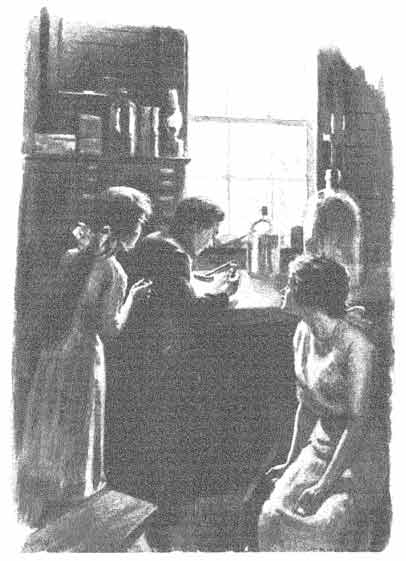
Tony ... nosed almost every inch of the shed
"Any clue?" asked Roxanne, as anxiously as Roxanne could ask about anything from the cloud.
"N—o," he said in a hesitating sort of way that seemed just as professional as the way the detectives talk in the wonderful stories in the magazines that my governess always reproved me for reading. "That was a slick artist who got away on greased heels, but there is a—smell in there that I've never felt before in the shed. And yet I have met it somewhere, I feel certain. It seems to my nose somewhat like the bug-doctor at his worst."
"No, Tony," said Lovelace Peyton, positively but perfectly calmly, "I ain't been in that shed and my bottles ain't got legs."
We all laughed and came to the house—but I had got a whiff of that odor and I knew where I had met it before. It was raw onion and tar, and it was the mixture that Lovelace Peyton had given Father in the bottle he wrapped in his handkerchief and put in his pocket. I felt weak all over for a second, but I immediately remembered my duty to respect my father even in my thoughts. I had decided that in the watches of last night, after I had found his heart and hugged it up outside of Mother's door.
In the first place, I had no business to read those magazines that my governess told me not to, even if she did have so little sense that her brain must have been made of tatting work originally, which she was always doing by the yard. And while the explanation of what an evil it is to get millions and millions of dollars together when the poor have so little, and that no man who has a human heart in his breast would want to do it is perfectly true, still that man who wrote the article might not have known about my father. I can see how a man might go on for years and do a great wrong to his brother man and really not realize what a monster it makes of him. I believe my father is just blind on that side of things like some people are in one eye. I pray God that he may wake up sometime, and die happy but poor! Of course, I know he had nothing to do with taking the steel secret, and I am going to get on the cloud again and not worry over Roxanne's troubles until she needs something; and then I will come down and get it for her while she stays in the air,—if I can.
The really important things in a person's life underlie the daily occurrence like the sand that is at the bottom of the rose-bushes. School is the sand-bank of a girl's life, rather heavy, but supporting the roses of debates and picnics and commencement and expression impersonations like the one Friday night is to be.
Of course Byrd Academy graduated Judge Luttrell and the Colonel and Roxanne's Father as well as Miss Prissy, and all the other learned ladies in the Browning Society; but for all its historical antiquity, it is one of the most advanced places of learning in the South, and mostly on account of the progressiveness of the Junior Class, which is Tony and Roxanne and the rest of us.
The Senior Class this year is a great failure, because all are girls but the Petway boy, who is terribly feminine, and crochets his own silk ties, Tony says. I don't approve of the seniors at all, and both Roxanne and I are worried over the way Helena Kirby, Belle's sister, will insist on talking to the Idol when we come out of church. We both know how important it is for a great man to have lady friends that are great enough to appreciate him. Of course, Helena can only admire his wonderful eyes, which makes no difference to us at all, for she could never gauge his high soul and genius. Roxanne says she trusts to the patches on his trousers to keep him from going to walk with her and from sitting on her front steps. Oh, if we just can keep him pure from prosperity in the shape of new clothes until he makes this second great invention, we will be so thankful, I encourage Roxanne to spend the money on food and her own clothes, so he will not be able to buy a new suit. We feel so safe with him mortifyingly shabby.
"Oh, Douglass is never going to be in love or marry anybody," said Roxanne when we were speculating on why Helena would flirt her eyes so at him. "I feel perfectly sure we'll have him always."
I felt relieved that Roxanne felt that way, but I had to remind myself often of her rose-cloud disposition and watch carefully to see that no troubles that I can avert—like Helena Kirby—shall come to her or the Idol.
But I started on the subject of the impersonations that the Expression Class of Juniors is to give the last day of April, before the whole academy is turned over to the affairs of the Seniors, like graduation essays being practised from morning to night until you speak each one in your own dreams. This is the first time they ever had such a thing in the academy, and the whole town is as excited and interested as it well can be.
Mr. Douglass Byrd thought it all up a month ago for us Juniors because of our Senior oppression and after his great loss he went on just the same helping us practise and seemed to be as interested in us as if we had been explosives in a bottle or a test-tube or a retort. His great serenity of soul is a constant lesson to me. Good-night, Louise. You are a comfort; you settle my thoughts, though just of leather.
This is the night of the impersonations and they are over. It was one of the greatest triumphs ever experienced at the Byrd Academy. It will probably be mentioned in the future with the same praise as the Colonel's valedictory that left not a dry eye in the house, because they all knew that all the boys in the Senior Class of sixty-one would go to the war the next week. I choke up whenever I hear the Colonel tell of it, as I have many times in these last two months of my life in Byrdsville. Miss Prissy always cries copiously when he gets to the place where she gave him a flower when he had walked home with her—she only fourteen years old and in short dresses—and which he wore in battle in his pocket Bible. What would she do if she should lose the Colonel by sudden death before she has rewarded his affections by marrying him? She ought to think of that.
Belle did beautifully, first on the program, dressed up in grown clothes and having a Byrdsville society conversation over an imaginary telephone. It sounded just like Helena, and I thought it was not very nice of her to impersonate her own sister, but it was a comfort to see how the Idol enjoyed it. If he liked Helena to any extent, he would have displayed indignation. Instead the corners of his mouth twitched for minutes afterward. I believe at some time Helena must have telephoned him.
Mamie Sue did a delicious old lady telling about her grandson to the two Willises, who were company to tea, that made Hie audience shake with jollity. There was a perfectly darling trace of Miss Priscilla in the way she did it, that made the Colonel almost unable to keep his seat, and Miss Priscilla laughed out loud twice. The affection I bear Mamie Sue fattens in my heart at the same rate the object does in real life.
"The way the two Willises impersonated their own silence was a triumph of art," the Idol said in my ear after it was over. It embarrassed me greatly to have him be obliged to crowd into a seat with Lovelace Peyton and me, but it was crowded everywhere else, too. If I had had my way he would have had the best seat in the house, comfortably alone.
Sam Hayes was "Old Hickory," General Andrew Jackson, the night before the battle of New Orleans. Mr. Douglass Byrd wrote his piece and Judge Luttrell, who is the son of one of that famous Tennessee hero's best friends and staff-officers, was so affected he blew his nose feelingly.
Pink would be a negro, so as for once to be rid—by the aid of burnt cork—of the disgrace of his unmasculine beauty, and he was so like Uncle Pompey that Lovelace Peyton insisted on calling out to him from the second seat until Pink had to tell him who he was before he could go on with his hen story, which was one of Uncle Pompey's own, and which was rib-aching funny.
Tony and Roxanne did the most interesting real Scout adventure, without words, and the audience sat spellbound while she fainted from heat prostration, and he put around her head a wet bandage made with his and her handkerchief, raised a signal for other Scouts to come and help, and finally took her up on his back and carried her off the platform behind the curtain. The applause was deafening, though Lovelace Peyton didn't like the scene one bit, and he kept feeling Roxanne's head after she came and sat down in front of us in the audience.
Nobody knew that I was going to be or do a thing, for I had begged them not to make me, because of the difficulty I have in managing my feet and elbows on account of their rapid growth right now. But I did! I think I have caught the family pride habit and that is what made me do it. This is how I felt. I looked down at the seats of honor reserved for the Byrdsville distinguished citizens, and saw my father sitting in one of the high places, as it were, between Judge Luttrell and Mr. Chadwell, and his face was just beaming with enjoyment of the way all those other men's sons and daughters were distinguishing themselves with their beauty and talent. And then out in the audience Judge Luttrell had Tony's mother, dressed in lovely black silk and also full of pride, while Mr. Chadwell kept nodding to Pink's mother at everything that Pink did, like there never had been a negro minstrel before. I thought of Father being the only lonely one up on the platform and with only me to be a credit to him—and me not doing it. I prayed for an immediate plan and as I prayed, as is my custom, I acted. I asked Mr. Douglass Byrd quick, if there was time for me to do an impersonation, and he answered with the most wonderfully encouraging smile:
"Go ahead, Miss Phyllis, and you can heat them all."
Now, the only person in the world I could ever be like is my own self, or Father himself, and as I sat and looked at him the idea came. Last year the governess took me to hear Father make a speech when he presented a library building to the college from which he graduated. It was such a fine one and full of so much humor and pathos, as all speeches should be to hold the attention of an audience, that it was published in all the papers in New York, and I learned it by heart from pride over it. That was what I impersonated—my own father with him looking on!
All the others had had costumes and burnt cork and things to help them; but I had on a pink flowered organdie and pink slippers with a huge pink bow on my head, and my looks were all dead against my success. But I did succeed! I knew I would when I took my stand and looked down into Father's surprised and alarmed face. I shrugged my shoulders in my dress just as he did in his dress coat, dropped my head on one side, and pursed my mouth up on the left corner and let my right eye droop as his does. Then I began—and for that five minutes I was Father. The speech just rolled off my eloquent tongue and the people laughed in the right places, just as the people at the college did, and the Colonel blew his nose like a trumpet when I said the short sentences about the memorial table to be put in the hallway to the "fellows who have gone," while the end-up, with its funny little dedication to the immortals bound in leather that would live on the library shelf and the ones hound in serge and corduroy that would sit at the tables in reading-room, brought the storm of applause that sounded like a tornado.
When I stopped being Father and came to my own self I was sitting beside the Idol in the audience and watching Judge Luttrell slap Father on the back and Mr. Chadwell laughing so that he and the Colonel looked like jolly, bald-headed boys. Mr. Chadwell is as disgracefully handsome as Pink, and doesn't look much older. And I never saw my father's face look like it did to-night, and I had never hoped to see him in a position that fitted him like the one on the platform with Byrdsville's distinguished citizens. I ought to be a happy girl, and I am.
Only Tony Luttrell troubles me, he is so quiet for him; and when he walked home with me, he was as gentle and affectionate to me as if I had been sick. Could something be the matter with me and I not know it? I felt like I did when the secret was first stolen two weeks ago, though Roxanne and the Idol seem to have forgotten all about it and nobody else knows.
There is such a lovely moon out over the garden that I can't put out the light and go to bed, though I saw Roxanne put hers out a half-hour ago. I wonder why I ever started a record of myself and my friends like I am doing? But I'm glad I did; for as I turn each leaf of you, leather Louise, things seem to get brighter and happier for me, and as I look at all these clean sheets in the future I wonder what I can find to make them as lovely as the happenings on the others have been. I'm thankful for the air that makes Mother sleep, and for the moral surroundings for Father, and for the loving-kindness of my fellow-men—girls and boys—to me. Yes, I realize that being beloved is a novelty to me, but I know better than to think it will ever wear off—the pleasures of it, I mean. Good-night!
CHAPTER VII
When you live in the city, or various cities, as I have done, you have various things that distract your attention from the miracle that is spreading all over the earth when the spring comes. Do such things happen every spring, or is it just something that has unblinded my eyes? Maybe I have really caught that rosy hue habit from Roxanne; but the apple-trees this week have been almost too much for me. There are great, gnarly, old apple-trees in every spare corner of Byrdsville, where you wouldn't even expect a tree to be; and ever since I have been in this town I have been finding a new one stretching out its crooked old arms to me as if to welcome me or bar my path. There is one that grows half in and half out of Judge Luttrell's yard, so the fence has to consider it a kind of post and stop at it to begin again on the other side, while three of them are trying to completely close up the door of the court-house on the Public Square. All the streets are bordered with them, set along at ragged intervals with the tall old maples, and all the gardens and yards have regiments of them camped about the doors and walks.
Three nights ago I went to sleep in a nice orderly old town, and I awoke the next morning in the middle of a great white and pink and green bouquet, which must smell up at least to the first of the seven heavens, and which is buzzing so with bees that it sounds like an orchestra getting ready to burst out into some kind of a new, great hymn. And everybody in Byrdsville is buzzing around in a chorus with the bees, cleaning house and going visiting and shopping at the stores down on the Square. I am as industriously doing likewise as I can, and have bought things from almost everybody until my brain is feeble from trying to think up things to ask for in the different stores. Oh, the things I could buy if Roxanne would just let me!
One trouble is, there are no really poor people in Byrdsville, and those on the verge of it are taken care of by the different church societies, which look after them so carefully that they come very near stepping on each others' toes. The incident of old Mr. and Mrs. Satterwhite came near being a case in point. Mr. Satterwhite has always been a Presbyterian, and Mrs. Satterwhite disagreed with her husband seriously enough to be a Methodist. They have no children and have been getting poorer and poorer, though keeping both honest and good, except for their religious differences. When the cold weather came this winter, they had no coal to keep their respective rheumatisms warm and they nearly froze to death arguing about which one of their respective church societies they should ask help from; and when they were both chattering cold they compromised on asking both. Then they got two loads of coal, which was more than they needed, and which offended both societies, so that when they asked for some kindling to light the fire with, both societies said let the other one send it. They had to sit up all night by turn for the rest of the winter to keep the fire, for fear it would go out while they were asleep.
Roxanne and I were terribly distressed that such a hard thing as being night watchman should happen to those old people, but the Idol said it was just as well that one should sleep while the other watched, so that they wouldn't have any mutual time to discuss religion. That was a very practical view for a genius to take of the question and I was surprised at him.
And while the situation looks very bad for churches to get into, it has been fortunate for me. I have been able to buy a lot of things at all the stores for them, because I am an Episcopalian, and just one girl can't be considered a church society. I'm the only one of my kind in town. Roxanne has helped me and we have bought with discretion as well as liberality, I think. After we had bought all the groceries Uncle Pompey could suggest to us, and in quantities as large as would go into all the corners of the kitchen of the Satterwhites' little cottage, we began to make the house as beautiful as we thought those good old people deserved, never having had anything beautiful in all their lives before.
First, we put the most expensive paper on all the walls, because we found that the largest-flowered paper was what we needed, and it happened to be a special kind that the paper man had to order by telegram to be sent by express; for neither we, nor those old people who are approaching the ends of their lives, could afford to wait. It looked lovely when it was all on and it matched the velvet carpets, which also had big flowers, good and gay.
Of course, both Roxanne and I know better than to choose plush furniture, but that was what Mrs. Satterwhite wanted, and they were going to live in the cottage, not us. Father was pleased when I told him what a big bill there would be at the furniture man's and said:
"Good for you, Phil. I didn't think you could do so well as that."
It took nearly two weeks of all our spare time, with Mamie Sue, when she could escape Belle, helping and Tony occasionally, to get the Satterwhites settled in their luxury; and then I decided to ask them both seriously and separately if there was another desire of their hearts left ungratified.
"Well," said Mr. Satterwhite, as he stretched his feet in his new velvet slippers that matched the carpet in that room, "I'd like a nice, new Methody hymn-book to be put on the table for the old lady to read outen on Sunday evenings."
It was a glorious thing to think that Father's money, ill-gotten as it is, could settle the church society quarrel; and I was so delighted that I am afraid I showed excitement when I went into the kitchen to ask Mrs. Satterwhite what she would like best now that the needs were all satisfied.
"Miss Phyllis, child, there is only one thing on earth I can think of to want. I would like to have a year's subscription to the Presbyterian Observer to read to Pa on Sunday nights, like I used to when we was young and strong and working enough to afford the two dollars." Remember, leather Louise, he is the Presbyterian and she is the Methodist, so this was permanent reconciliation.
My emotions are such that I can't write further about this incident, but I wish I could picture Father's face when I told him about it, 'though still he wasn't satisfied and said spend some more. How could I in a place where everybody had what they wanted and money is not needed to make them enjoy life?
My trouble was serious and I have had to confess to Roxanne about it.
"I wish I could give all the girls and boys in the class a nice present for some reason I haven't got," I said wistfully. "To Belle especially, for she has been so pleasantly not unpleasant to me for the last two weeks."
"Yes, it is a pity, if you have to spend all that money in getting other people what they want, that you can't get Belle's permanent pleasantness. It is something that would do us all good," answered Roxanne, with the sympathy that I always find in her.
"Friendship that you have to buy would not be very valuable, generally speaking," I answered, as I shook my brain for a plan. "But on the other hand," I continued, "some people can see friendship in the form of a present when they can't feel it from the heart. Belle is that kind, and that is not my fault. What I want to find is a 'tie to bind her'—speaking hymnally."
"Yes, you are right, Phyllis," answered Roxanne thoughtfully, as she and I both began to sew some little hand-made tucks that are to trim the waist of the lovely blue muslin that Roxanne bought herself, to our great joy. "I do wish we could think up something that would make Belle understand how you appreciate her and—"
But just here the Idol came and stood in the door with Lovelace Peyton on his shoulder, whom he let slide down him to the floor. Now, a month ago, I would rather have had anything happen to me than to sit in the presence of Mr. Douglass Byrd, but all that reverential awe has gone—changed, the awe gone and only reverence left. As we feared, he has bought the new spring clothes, but we see no alarming signs of affection toward Helena Kirby yet developed by them. How magnificent he is in them, is beyond my pen to describe to you, Louise.
"What has Miss Belle done that needs an expression of appreciation on just this particular day of May?" he asked, with that delightful interest he always shows in all of us—Roxanne's friends.
And while it is trying in a way to girls whose dresses are still just at their shoe tops to be called "Miss," we never resent it from him, because it denotes real respect and not teasing like it does from some of our friends and older relations. It is a very thin line that separates ridicule from affectionate interest in girls of our age, but he is always on the right side.
"The reason Phyllis wants to do something nice for Belle is that she has the kind of disposition that requires more to make her a friend than the rest of us. It has to be something that will shock her into seeing how fond of her Phyllis is." Roxanne's explanation was so well expressed that the Idol saw the point and reason immediately.
"You want to throw a kind of bombshell friendship into the camp of her prejudices, Miss Phyllis," he said with his mouth twitching with a laugh, as if he didn't know whether we would like it or not.
"Yes, that is just what I want—an explosion, and I can't think of anything but a gold bracelet or a ring, neither of which is a skyrocket," I answered with the flow of wit that always comes in the presence of the Idol, and which, I am sure, is just a reflection of his genius.
"I know a explode that I can git you, Phyllie," said Lovelace Peyton, looking up from the bottle he was trying to get into his apron pocket, his attention having been caught by the word that interested his scientific mind.
"Not the kind Miss Phyllis wants, bug-doctor," the Idol answered with a laugh, as he filled his bag with tobacco that he keeps in a queer old jar which the Douglass grandfathers brought from England before the Revolution.
"I kin git a 'splode that Phyllie wants," answered Lovelace Peyton indignantly. "Phyllie always wants what I git her, even squirms; don't you, Phyllie?"
"Yes, I do," I answered quickly, for I can't even write how precious to me is the way Lovelace Peyton treats me with confidence. He comes to me now just as he goes to Roxanne for things he wants, strings or sympathy, and I keep a supply of both on hand for him. And when he brings dreadful bugs and things I never let my heart quake—that is, so he will notice it. A woolly caterpillar was the last test that I stood for him.
"I think, however," said the Idol as he prepared to go on back to the office, since he had only come up to the court-house on an errand about something, "I think if I were you, Miss Phyllis, I would try a quiet little gold bracelet. Believe me, it will work."
You have to consider the source of advice like you do that of the water you drink, and then act accordingly. If Mr. Douglass Byrd advised me to buy one of my friends a gold bracelet, I ought not to hesitate any longer than it takes to put on a hat and get my pocketbook. Besides, I hadn't got a single thing from Mr. Snider, who keeps the jewelry shop and the cigar stand at the same time in the same shop. He was very cordial and glad to see Roxanne and me, and tried to stretch out the attractiveness of his few jewels in a most surprising way. He had two gold bracelets in stock, one plain and the other with a red set in it that he thought was a ruby, but I knew it to be a garnet. The plain one was really lovely, but I knew the other would suit Belle better.
When Roxanne tried on the plain one, her lovely dark eyes just sparkled, and I could see how she loved it; but I had had my experience with the Byrds' pride and I didn't even offer it to her. My self-denial brought its reward. There were two little beauty pins just alike with small pearls set along the bar. I bought them both. First, I pinned one in the tie of my middy and then, with stern determination, I handed one to Roxanne. She looked at me doubtfully, then blushed and pinned hers in exactly the same spot on the collar of her middy, which had been made to match mine since the temporary easing of their financial strain. If she had defied me, I don't know what I should have done, but I gave her a squeeze that was the most graceful one I have ever accomplished since I have commenced to practise demonstrations. No hero or ambassador ever felt so proud of a decoration on his own chest as I did of that pin on Roxanne's. It is a triumph for one person to be able to make friends despite another's haughtiness and I felt that even the old portrait grandmother would have been glad to have Roxanne make me so happy.
Then I had an addition to my first plan. Ideas have a way of splitting off and multiplying themselves like jellyfish do in the natural history, if they are in favorable environment. I asked Mr. Snider to set all the jewelry trays upon the counter again; and beginning at the first one, I bought a nice token of my regard for all eleven of my class at the Byrd Academy.
"Now, Roxanne," I said as I left the store, "I know that this action of mine looks very vulgarly rich, and if anybody did it to me I would be as mad as Tony and all the rest will be if I offer them this jewelry without an explanation. But Mr. Snider and the seven children he has are enough to excuse any amount of vulgarity. Cigars and jewelry are very little for that large family to thrive on, and that was forty-five dollars I spent. I should think my friends would sympathize with me in having to get rid of this money in a sensible and charitable way, enough to take the tokens without any indignation when I explain it to them. Don't you think so?
"Oh, Phyllis," said Roxanne, with the affection in her voice that I hope I am never going to get accustomed to, "nobody would refuse to do just like you want them to; and if they thought they could, you would make them see that it would be mean to do it. They will all be delighted with the presents. Can't you see Mamie Sue turning that ring around and around on her finger?"
I had bought a ring with a lovely green set in it for Mamie Sue in memory of the many horsehair ones she has had to wear to piece out her memory, which must be fat and lazy like she is herself. I am going to make my presentation apologies to them all tomorrow while we eat lunch out on the flat rock in the academy yard. Sometimes we take a double lunch and invite the boys to come over and share it with us. Roxanne and I have planned to do this. She is going to let Uncle Pompey make some one of his favorites for us. She is still indulging him in cooking materials, but thinks she will have to begin to starve again on June first. The new invention has got as far as needing some chemicals already. But it is best to climb away from an evil day upon the ever convenient rosy cloud and that is what we did as we walked along toward home.
But a strange thing happened, and funny, too. I'm blushing over my awkwardness even as I write just to you, leather Louise. But isn't it enough to make me blush to think of that scarf-pin, with the moonstone and pearl in it, that I got to give Pink, sticking in the Idol's necktie, if he hasn't already taken it off to go to bed? This is how it happened. As we came along the street, almost as far as to Miss Priscilla's, we met Tony and Mr. Douglass Byrd coming into town. I never saw two people as much excited as they both were, and when they saw us they stopped talking and looked at us like we were a surprise to them. For a minute I was startled, for I thought I heard Mr. Roger's name spoken excitedly by Tony; and I have never got over the uneasiness about him, though the great secret robbery is a thing of two weeks past. I can't help anxiously wondering what they were talking about. They stopped, and so did we, and of course Tony's Scout eyes landed right on those twin pins Roxanne and I were wearing; and before I could stop her Roxanne had told him about the present-luncheon out on the flat rock to-morrow, and Snider and how I had to spend money. I thought Tony was going to laugh and joke about it, as his former conduct would have been; but he got red in the face, shook as I put his pin into the lapel of his coat and spoke to me as if I were ill and needed sympathy, like he has been doing for a week. That was upsetting enough; but when the Idol looked at me with real affection beaming from his glorious eyes and said:
"Don't I get a jewel, too, Miss Phyllis?" I almost doubled up into a heap on the pavement, and it was Roxanne who came to my rescue and held all of them out for him to take his choice. He took the one I would rather have him take—a beautiful pearl, like my friendship is for him, shadowed by the moonstone, which is my unworthiness.
I'll go down early in the morning and get another pin for Pink. I wish Father was here so I could tell him about Mr. Snider and how glad he was to get the money. "Tainted money" were the words the magazine used—wouldn't feeding hungry little children take the taint off the money and the people who gave it? I believe so. I wish I had all Father's money to give away and he had to work for all we get, at something like being a lawyer or a doctor. This had been a lovely day, and I'm thankful for my happiness. Good-night!
Oh, why aren't people more careful about what they say before children, who can't always understand all that things mean! I will never forgive myself for bringing this awful thing down on Roxanne and her family as long as I live, though Mr. Douglass Byrd says it was not my fault at all. He was the one that called the present for Belle an explosion, and so put the idea into Lovelace Peyton's mind. Nobody knows yet just exactly what did happen or how bad his eyes are hurt, but the light of all the world is going out for me if Lovelace Peyton is going blind so he never can be the famous doctor he was born to be.
Old Uncle Pompey has been gasping with asthma in the kitchen since morning, and all he can tell is that Lovelace Peyton had taken some kerosene out of the can on the back porch, be thought to just mix with onions and other things he often uses to make medicines. Suddenly he heard an explosion in the back yard and ran out to find Lovelace Peyton's face all burned and him insensible. When Roxanne got to him he just moaned that he was making an explosion for me, and then the doctor gave him something to keep him from suffering with the burn while he dressed it. They can't tell about the eyes as yet.
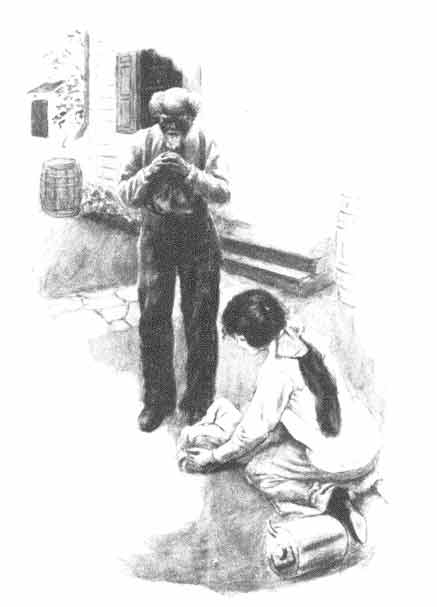
He just moaned that he was making an explosion
Miss Prissy is with Roxanne, and they won't let me stay all night, so I had to come home. Roxanne just won't believe that he won't get all right, neither will Mr. Douglass Byrd. He was lovelier than ever to me, but with that same kind of flavor in his kindness that he and Tony both had yesterday. What can they be pitying me about?
Father has been away a week and I am so sorry. I have just written to him about the accident, and I know he will be distressed, for he was as fond of Lovelace as of anybody he knew. I believe he'll come right home.
How can I go to sleep and wait until morning to know if those lovely, blue, little-boy eyes will never look up at me again? What can I do to ease this awful anxiety? As if I didn't know what to do when I have heard so often about a Person who watches every sparrow's flight.
CHAPTER VIII
These few days have been the most wonderful I have ever spent in all my life, the saddest and the most deeply happy. When a person's friends are in trouble, it is one time you can let your heart go its own pace no matter where it carries you, and for once I have had my way about pouring out my affection on the Byrds.
Lovelace Peyton is not going to die from his dreadful burns, the doctors say; but as yet they can't tell about his eyes. They don't dare remove the bandages, and whether or not he can see cannot be decided for a week or more. He has to stay in a dark room and be very quiet, and it is like trying to prove that impossible is possible to persuade him into lying in his bed in Roxanne's room, while we exert ourselves to the point of desperation to keep him happy and amused.
Since the accident Roxanne and I have just ignored the Byrd ancestors, and I bring whatever I choose across the garden into the cottage to Lovelace Peyton. In the first place, he wouldn't eat without me, and kept asking for things I had given him to eat; so I had to tell Roxanne about my dishonesty in feeding him like I had been doing, and she was so glad that he was fat and in good condition to stand the strain of his accident that she forgave me with her arms around my neck.
I wish I could put down in black and white between your brown covers, leather Louise, how happy it makes me to sit by that squirming, bandaged little boy, and feed him out of one of his thin ancestral spoons. Not one thing will he eat without me. I believe he knows how happy it makes me, and frets for me just for that special reason. That and the fact that he expects things of me made me think up the idea that has helped us through the awfulness of the days that we had to keep him quiet.
Lovelace Peyton is not like the little boy to whom you can tell stories about bears and Little Red Ridinghood and Goldilocks in ordinary form. He'll listen to it a few minutes, and then when you come to the point where the grandmother is ill for Little Red Ridinghood to go and visit, he stops and wants to know exactly what was the matter with her; and if you say you don't know, he turns over on his pillow and won't listen to the rest of it.
"Why don't folks write in books what diseases other folks have got, Phyllie?" he asked fretfully when I told him about Tiny Tim and the "Christmas Carol." "Do you reckon that little boy had rheumatiz and didn't know any plaster for it?"
I am really reverently thankful for the idea that popped into my sorely troubled head at that moment. Roxanne had gone out to walk in the garden for a little rest, for she has had to talk to him most of the night and describe over and over what the burn on his arm looked like when the doctor dressed it. I was with him by myself for a few minutes when I found the treasure of an idea.
"Lovelace Peyton," I said, with excitement in my voice more than the doctor would have approved of, "would you like me to get a real doctor's book and read you about each disease as it comes in the book and just what the doctors use to cure it with?"
"Phyllie," he said, sitting up in bed and waving the poor bandaged hand with delight shining from under the bandage above his eyes, "you go a running and git that book as fast as you kin. I will promise to lie right still and listen all day and all night forever. Hurry!"
I called Miss Priscilla to come quick as I saw her turning in the gate, and I took my hat and started down-town for the only bookstore in Byrdsville, which is kept in the post-office by the post-master. If I couldn't find a book about diseases there, I was determined to go and beg or borrow or steal one from the doctor himself. But I found the very one I wanted. It was called "First Aid in the Family," and it described more accidents and diseases than it seemed possible for mortal man to have. It was a large book and I was glad it cost five dollars. The post-master said a man had left it there for him to sell six months ago, and that it cost too much for most of the people in Byrdsville to doctor by. He offered to send it as soon as his boy came back, but I was in too much of a hurry to get back to Lovelace Peyton to wait, so I took it in my arms and started home with it.
On the way I met Helena Kirby walking down-town with the Petway boy, and they looked right into my face and passed me without speaking. It might have been because I was carrying the big book, but I didn't know Helena was that proud. It hurts me for people to treat me that way without any reason but just dislike for me and perhaps because they think it wicked about Father's money.
Just a little farther along I met Tony, and he took the book to carry for me, and I told him about Helena and the Petway boy looking at me and not offering to speak to me. Tony got red up to the roots of his hair, being mad, and looked like he would just as soon as not eat them both alive.
"Now, see here, Phyllis," he spluttered, "don't you pay one bit of attention to what a pair of jolly idiots like those two do or say. You are all right and we all know it. No matter what happens, we're for you. See?"
"Thank you, Tony," I said gratefully, but I didn't "see," and I was so puzzled over that "no matter what happens" that I felt weak in my brain.
In a few minutes still worse happened. Belle and Mamie Sue saw us, and Belle forcibly crossed Mamie Sue over and went down the side street just to keep from meeting us—that was as plain as day. Tony got still redder and talked fast about Lovelace Peyton to keep from seeming to notice the way the girls had acted toward us. I held up my head and did likewise.
Something awful has happened to me or about me in this town and I don't know what; but it is my duty to put it all out of my mind now and give my thoughts and cheerfulness to Roxanne and Lovelace Peyton, while they need me so much. I have made up my mind to forget it.
And it was fun to read to the prostrated medicine-man out of that book as I did all afternoon. I began with abscesses and got almost as far as aneurism before the sun began to set. I never saw anybody enjoy anything as much as Lovelace Peyton did each disease as I read about it; and the more bloodcurdling the description of the suffering and more awful the treatment, the more it interested him.
"I bet if I ever get a good sharp knife, I could stick it right in the pain place in Uncle Pompey's heel so it would bleed all the sore away," he said with keen enjoyment, as I read to him about the lancing of carbuncles.
"Oh, Lovey, I almost get the diseases while Phyllis reads about them," said Roxanne with a shudder. "Do you like to hear about such awful things?"
"Yes, I do," answered Lovelace Peyton decidedly. "And I wisht you would get every one of the diseases in that book, Rosy, so I could cure you like Phyllis reads—and Uncle Pompey and Doug, too. Only not Phyllis, 'cause I need her to read the cure to me, while I do it."
While we were all laughing at Lovelace Peyton and talking about the operations he is going to perform on the inhabitants of Byrdsville as soon as he gets grown, and deciding what each one is going to have, the Idol came in and stayed with us until the soft gray twilight began to come in the windows. He was so lovely and interesting that it was quite dark when I remembered that I must go home. Then he walked over through the garden with me, and out there under the stars he told me what the doctor had told him in the afternoon. Old Dr. Hughes is afraid to experiment with Lovelace Peyton's eyes, and says that a specialist must come from Cincinnati to examine them when they take off the bandages next week. Mr. Douglass has written to the doctor to see what it will cost, and he doesn't want Roxanne to know about it until he hears whether the doctor will come and give him time to pay for it.
"Oh, I don't believe the bug-hunter is going to have any trouble with seeing all right again and we'll get the big doctor down here to see him some way or other. Don't you worry, Miss Phyllis; I just told you because you are the best friend of all concerned, and I couldn't do anything without consulting you. See?" he asked, in the same protecting tone of voice that Tony had used in the afternoon when Belle and Mamie Sue did me that way.
After I was undressed I felt that I just must go into my mother's room for a minute; and I begged so hard that the night nurse who is a very kind lady, let me creep in for just a few seconds. I have got a theory about Mother and myself. I believe she knows when I am in the room, even if she can't show it by moving or even opening her eyes, and it is a comfort to her and me both to have me come and kneel at the foot of her bed well out of sight. I did get comforted to-night, too, and the thought that did it was this. If Father and I don't do as well as other people in the world, and get rich and do things that we ought not to, we have not had her to direct and control and comfort us like she would have done if she could; and no wonder we have strayed. A motherless girl and a wifeless man ought not to be judged in the same way other people are. I feel better now, and I'm leaving it all to God, who understands such situations as mine and Father's. Good-night, leather friend.
Somewhere back on your pages, Louise, I wrote that I was going to be thankful for the happiness and friends that I had, no matter what happened, and I am. It has happened. I am the lonely little child that got a peep through the high, barred gate into the garden where other children were playing in the sunshine, and then was put out into the dark street again. I ought not to say that, though, when I have got Mr. Douglass Byrd for a star in my darkness, as he has made himself by the way he has treated me.
I am glad I stopped by on my way to school this morning to see Roxanne and Lovelace Peyton while I was their light-hearted companion still: now I am a woman of sorrows and disgrace. Also, I am glad, if the blow had to be dealt me, it was Belle who did it, and not Mamie Sue nor one of the two Willises, nor anybody else. I have always had a strange feeling about that bracelet with the red set, anyway, and I am not surprised that she struck me with it.
"Miss Forsythe," she said, as she held it out to me all wrapped up in tissue paper and tied with a blood red string, "I will have to return your present to you, with thanks. I cannot keep a bracelet given me by a girl whose father would go like a chicken thief and rob a neighbor's shed of a valuable thing like an invention. Please excuse me!"
For a minute I stood struck dumb, and watched Belle's pink gingham skirt switch as she walked through the door of the school-room. They had all the lunch spread on the flat rock, and I thought were waiting for me while I put my desk in order just after the bell rang. And even while I watched Belle I was conscious of Mamie Sue's fat expression of distress as she paused with a biscuit spread with jam half-way to her mouth. The Willis girls looked struck even dumber than usual, and as if they didn't know what to do. I didn't give them a chance to decide on anything. I picked up my hat from the ground and walked out the gate with my head as high, as if my honor had not been laid low.
I was walking just as fast as I could past the cottage, hoping that nobody would see me before I got here to my room to realize my agony myself, when Roxanne ran out of the door to catch me at the gate.
"Oh, Phyllis, don't look like that," she exclaimed as she drew me through the gate and behind the big lilac bush that is full of purple blooms. "It doesn't make one bit of difference to me, and I love you just the same. Who told you?"
"Belle," I answered, trying to keep my face and voice steady. "Who found it out, Roxanne?"
"Oh, Tony scouted it all out, though he didn't mean to. It was that awful smelly bottle Lovey gave your father. Tony smelled it talking to Mr. Forsythe at the gate and then again in the shed. He couldn't connect them at first; but after a while he remembered, and then he began to suspect something awful—he oughtn't to have done it, but he did. He followed your father and Mr. Rogers out to the furnaces one night and—saw Mr. Rogers explain it to your father. Then Mr. Forsythe went away the next morning and Douglass began to watch Mr. Rogers, and just three days after that he found him out at the furnace at night with a workman getting some of the ovens ready to try the experiments. He couldn't do a thing, and had to let them take his discovery and do as they wanted to. Oh, truly Phyllis, it doesn't make a bit of difference in our love for you."
"How did Belle find it out, and why should they think Father is dishonest—even if Rogers is?" I asked, still as cold as ice though my head seemed to be on fire.
"That is what is nearly killing Tony," answered Roxanne, with a sob beginning to come in her voice; but she still held on to me tight, as stiff as I was. "He and Douglass have known it for a week, and they never wanted anybody else to know about it on your account. Douglass says he would rather give up ten fortunes than hurt such a friend as you have been to us, but Tony let the secret get out by accident, and now all the town knows it. Judge Luttrell is getting out an injunction, even if Douglass won't sign it, and the Colonel is getting ready to go on the next train to find your father and—and remonstrate with him, he says."
"Tony didn't tell Belle about it on purpose, did he?" I asked to be sure. "I couldn't have stood that."
"Oh, no, it was Mamie Sue that found out part, and told Belle, without knowing she had done it, just yesterday. Mamie Sue says she wishes she never had any eyes or ears or anything to taste with, then maybe she would never get into trouble. It is all on account of people thinking she is more stupid than she is. Tony told Douglass right before her, on the street while she was giving both of them some of that fudge she had made to bring Lovelace Peyton, that Mr. Rogers had been in the telegraph office and had telegraphed your father that the experiment night before last was a success. Tony is ambitious as a Scout should always be and has learned to read the ticking of the telegraph.
"'Anyway, Doug, it's a cinch that you have made one of the greatest practical inventions of the day,' Tony said, forgetting Mamie Sue entirely and so did Douglass, as he answered:
"'That's true, Raccoon, and if the fortune is another man's by robbery, the brains are mine. I'll get my share yet. Wait until this new idea gets into shape.'"
And then Roxanne went on to say that Mamie Sue said they hardly remembered her enough to politely thank her for the fudge, as they walked away talking. She went on down to Belle's; and when Belle began to say that Tony was stupid because he couldn't read his Cicero, Friday, she tried to defend him by telling how he can read telegraphy even if he can't read Latin.
Belle was mean enough to get it all from Mamie Sue without Mamie Sue suspecting that she was telling anything that would hurt me; and Belle told Helena and Helena told the ladylike Petway, who told his father, who told Judge Luttrell before night. The Judge sent for the Idol before breakfast this morning and told him that he was an idiot to let such a thing be stolen and he is beginning all kinds of prosecutions and things against Father, though my noble hearted friend won't sign them on account of his esteem for me. And, of course, the whole town knows of it and is excited. It is not astonishing that Byrdsville is wild to find out that it has reared a great inventor, only to have his first fruits stolen. I feel with Byrdsville, even if they feel against me. Some of this Roxanne told me and some of it is my own surmise that came to me as we stood behind that old lilac bush.