PART SECOND.
Reading edition
FIELD PHOTOGRAPHY.
That the thousands who formerly practiced photography in the fields, as an amusement and recreation, took great delight in it and found it to be an extremely fascinating pursuit, there can be no denial. When we think of the difficulties that were continually being encountered, and the trials of patience and temper that had to be submitted to—to say nothing of the disagreeable nature of the many solutions that were necessary, the stains on the hands and clothing incidental to the use of nitrate of silver and the solution of iron, and the heavy and bulky nature of the apparatus—we are constrained to believe that the rewards must have been more than commensurate to the fatigue incurred, to the disappointment occasioned by frequent failures, and to the dislike of dirty hands and stained and spoiled clothing.
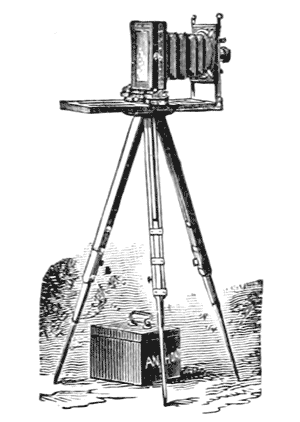
AMATEUR APPARATUS. Apparatus set up, consisting of camera box, lens, carrying case and tripod.
Now, however, by the introduction of the new process of dry plate work, all that was disagreeable has been done away with. The collodion, the silver-bath, the developer and fixing solutions—as things to be carried with you—are now of the past, and even the glass plates will soon be known no more as impedimenta to the amateur. In place of the heavy Camera and plate-holders, we have now feather-weight constructions, that are no more a burden, but rather, ornamental objects, the possession of which and their use is more of a pleasure than otherwise. It is not surprising, then, that in view of these wonderful changes, the thousands who formerly practiced photography for amusement have increased to tens of thousands. And the dry plate equipment for viewing has become a part of the impedimenta of the summer tourist, as well when he or she travels by land as when they voyage by sea. The bicyclist, too, goes out with a Camera, that may be attached to his wheel, and makes instantaneous views as he spins along the road, or dismounts and takes in some beautiful bit of scenery.
The boys, and also the girls, have seized upon this fascinating pursuit, and the gardens and conservatories have been converted into studios, where every member of the family, including the baby and the pet animals, have been posed, and their pictures bear witness to the triumph and delight of the young artists. Amateur photographers, male and female, may be found during the season at the summer resorts by the sea or at the breezy mountain house; wherever the well-to-do citizen takes his family for rest and recreation during the "dog days," there will the tripod be set up and the Camera will record the topography of the vicinity.
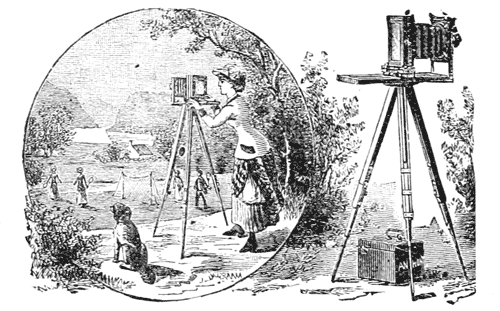
For every one of these thousands of amateurs there is something to learn before he or she can succeed in producing a picture; to know how to make a photograph never comes by intuition, but must be acquired by study and practical experiment. This need not be prolonged or difficult, and the purpose of these pages is to afford the beginners that instruction, which will enable them to surmount the difficulties of a new and untried pursuit; to open up to them the knowledge that will enable them to bring the little dry plate and the quantum of pyro together, so that they may tell a story, the constantly varying changes of which will afford ever renewing delight, a pleasure gained without undue fatigue and never followed by regret or pain. One little gem of a negative or transparency will afford the maker more real pleasure, than many a costlier amusement.
THE AMATEUR OUTFIT.
The number and variety of outfits manufactured for the use of amateurs are so great that the question of selection becomes one of more than ordinary interest and importance. Indeed, this fact is impressed upon the mind and fully established when one undertakes to inspect and examine the variety exhibited by one house alone, but when one has seen the stock of all the different large concerns and has examined the bewildering variety, he becomes aware of the immensity of the demand that has brought into existence such an enormous supply; for here, beside the toy outfit for the child of ten or twelve years, he will see the perfect equipment for the professional photographer, and every possible grade between, in every style of finish and ornamentation, and all supplied with so many appliances for easy handling and accurate adjustment as to astonish one at the amount of skill and ingenuity exhibited by the makers.
It is not the intention of the writer of these pages to describe this great variety of apparatus; having himself used with success and pleasure the instruments of the great house of E. & H. T. Anthony & Co., he will merely point out some of the advantages of and the valuable improvements lately added to their amateur photographic equipments.
The amateur preparing for the field will find it necessary to provide himself first with the apparatus necessary to the making of negatives; these articles constitute the viewing outfit. Having made himself familiar with the use of the camera and lens, he may next provide himself with the chemical constituents of the developer and proceed to develop his own plates. These chemicals and the necessary dishes, etc., constitute the developing outfit.
It is recommended that the beginner confine himself at first to the preliminary of selecting his views and making the exposures, taking his plates to some photographic establishment to be developed, where he may learn as to the correctness of exposure, and receive such information in connection therewith as may be of benefit afterwards.
Having made himself somewhat proficient in exposing, he may then take up the development and enjoy the true delight of the amateur in witnessing the growing of the picture upon his developing plate.
With this end in view, then, we will proceed to consider, describe and explain the apparatus of an outfit, the construction thereof, and how to use the same.
THE VIEWING OUTFIT CONSISTS OF:
Sensitive dry plates and
Plate holders or shields,
The Camera box,
The view lens,
The tripod or Camera stand,
The instantaneous shutter,
The focussing cloth, and a
Carrying box to contain the whole.
It is necessary that the beginner should receive some instruction in the use of each of these articles, and for that purpose we will consider them in the order above given.
DRY PLATES.
The manufacture of dry plates has now reached such a state of perfection that the purchaser may procure them of every grade of sensitiveness, each of the several grades of a perfect uniformity and all of them very free from imperfections and blemishes. And also the prices have been so reduced of late that the incentive to manufacture on the part of individuals for their own use is almost entirely lacking. However, there may be found a certain interest and fascination in preparing plates for one's own use, which would prompt some to incur the outlay and trouble incidental to such a course, and for those full instructions and formulæ may be found in the first part of this book.
It will, however, be found, after due trial, that for work of importance, and where certainty of results is desired, it will be better to procure the plates of some maker of established reputation, and of such a grade of sensitiveness as will be most suitable for the work in hand.
Certain makers of dry plates use the Sensitometer to ascertain the degree of rapidity of each and every emulsion produced in their works. The ascertained degree of rapidity is indicated on each box of plates by the Sensitometer number—the higher the number, the more sensitive the plate. The highest numbers attained up to this time are from 20 to 25, and these numbers would indicate a very high degree of sensitiveness, such as render plates of 23 to 25 quite suitable for work requiring the shortest possible, in fact, instantaneous, exposures, such as bodies in motion across the plane of focus. Views of still life are better made with plates of a lesser degree of rapidity.
The handling of dry plates of such extreme rapidity requires great care. The boxes should never be opened, even the outer wrappings should not be removed, except in the darkened room and by such a light as that produced by Carbutt's dry plate lantern or some similar device. When plates are taken from the boxes for the purpose of fitting the holders, they will be found to have one clear, smooth and shining surface. This is the back of the plate and is clear glass; the other surface is of the same color, but of a mat or dead color, not reflecting so much light. This is the sensitive surface, and before being placed in the holder or shield it should be brushed with a soft, flat camel's hair blender, to remove any dust that may be attached to the surface. This brush should be used for no other purpose; and should be used without pressure, merely touching the surface of the plate. The plate may then be put in the plate carrier of the shield, with the sensitive surface outward, and when the carrier is run into its place in the holder, the sensitive surface is next the slide or door. It is of some importance that attention should be given to this manipulation, as it not unfrequently occurs that the wrong side of the plate is turned outward and the image, when the plate is exposed, is made through the glass and against the back of the film, and is reversed and thus rendered worthless, even should a good impression have been secured.
The holders or shields for dry plates for out-door work are always—except in the largest sizes—made double, each holder containing two plates.
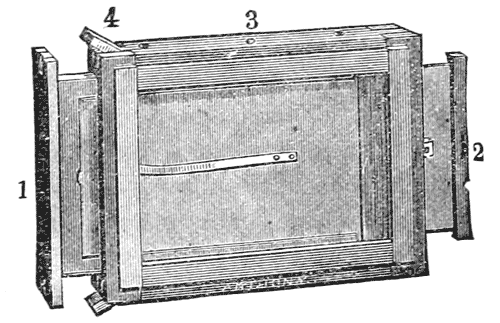
ANTHONY'S PATENT PERFECT DOUBLE DRY PLATE HOLDERS OR SHIELDS.
The diagram exhibits the plate holder, 3, with the plate carrier, 1, partly drawn out; the slide or door corresponding to 2 is withdrawn to show the interior of the holder, 3, and the spring that presses the plate into focus, when pushed into the carrier, 1. This carrier presents the same appearance on the other side and will hold two plates. When filled with plates, it is pushed into its place in the holder, 3, and the brass loops or fasteners, 4, are pressed down flat, thus securely holding it in place. When the holder is put in place at the back of the Camera the slide, 2, next the box, is pulled out quickly and in a perfectly level position, so that the spring shut-off may close instantly and permit no light to enter the opening. The lens must be covered before the slide is pulled out. The exposure is then made and the slide is returned to its place in the same manner, carefully observing that one corner is not entered first, but the end must be inserted into the groove squarely and pushed quickly home. If another exposure is to be made immediately, the holder is removed and the opposite side placed next the box, and the same process is repeated, covering the lens, removing the slide, make the exposure by removing the cover of the lens and replacing it, then return the slide to its place. When a second exposure is not made at once, with a pencil or in some other manner mark the side that has been exposed, to prevent any mistake. When both plates are exposed, return the holder to the carrying case and take the next, if you carry more than one. Usually a half dozen holders are carried, which gives command of one dozen plates, which should be quite enough for one outing.
Having exposed the plates, the holders are returned to the carrying case, and should not be removed therefrom until they are taken into the dark room for development, when, by the aid of some safe light, they may be removed from the holders, one at a time, and developed, or all taken out and put into a negative box, to be ready for development when convenient.
THE VIEW CAMERA FOR AMATEURS.
In an article on Cameras, in the first part of this work, we have given a very accurate description of the View Camera for professional photographers.
The View Camera, as manufactured for amateurs, is smaller, lighter and more compact, and, in many cases, more highly finished and ornamented than those made to stand the rough usage of hard work.
Beginning with the smallest, we have the
DETECTIVE CAMERA.
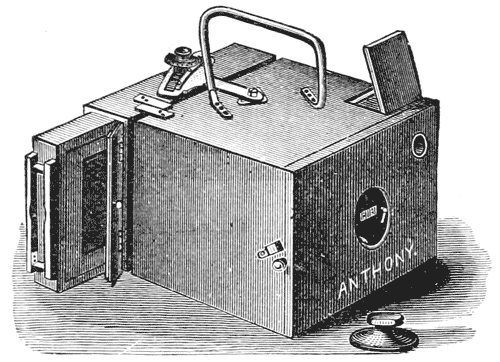
SCHMID'S PATENT DETECTIVE CAMERA. Patented January 2d, 1883.
This Camera is focussed once for all by means of a ground glass which slides in the place to be afterwards occupied by the double dry-plate holder, for objects of various distances, and the position of the focussing lever on top of the Camera is marked for each distance. After this the ground glass may be entirely dispensed with, as it is then only necessary to estimate the distance of the object to be photographed, and move the focussing lever to the mark corresponding to that distance, when the Camera will obviously be in focus.
The small lens in the upper left-hand corner serves to throw the picture on a piece of ground glass on the top of the Camera, thus showing the position of the image on the plate. When the picture appears in proper position on this ground glass, it is only necessary to touch the button on the right of the Camera, and the exposure of the plate is instantly made, its development being afterward accomplished in the ordinary manner.
The slide is then replaced in the plate-holder, which, being reversed, the shutter reset and the other slide drawn out, everything is ready for the next shot.
This Camera is made to carry in the hand, and is held against the side under the arm while exposures are made. A tripod or stand is not required. The plate-holders are carried in a small satchel, with a strap passing over the shoulder. The new sensitive paper film, however, obviates the necessity of carrying more than one holder, which will contain a band on which may be made 24 exposures, and which is of no greater weight than one of the double holders when filled with 2 glass plates.
This Camera is calculated to make pictures 3¼ by 4¼ inches in size, and they are technically called quarter plate size.
THE PATENT BIJOU CAMERA.
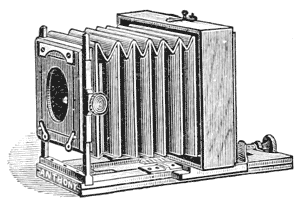
For 3¼×4¼ Plate.
This little Camera is the neatest, nattiest and altogether nicest Camera of its kind ever made. When folded it measures 5×5×3½ inches, and can readily be put in an ordinary hand-grip, or may even be carried in the overcoat pocket. It weighs only 14½ ounces, and the holders are correspondingly light and compact.
It has a sliding front, hinged ground glass, and folding bed, which is provided with a novel arrangement for fixing it in position, enabling the operator to adjust it in a few seconds. It is made of mahogany, with a new hard finish, flexible bellows and brass mountings, making a remarkably elegant little instrument.
As the plate is the same size as those used with magic lanterns, slides may be made from them by contact printing in an ordinary printing frame. By using rapid printing paper in connection with the enlarging lantern, the pictures may be made as large as desired. For tourists, to whom weight and bulk are objections, this Camera is of especial value.
The introduction of the Schmid Detective Camera was a pronounced success. The popular favor with which it was received stimulated the manufacturers to greater exertions to supply a perfect and effective instrument, against which no objections whatever could possibly be raised. With this object in view, they have placed on the market
ANTHONY'S PATENT SATCHEL DETECTIVE CAMERA.
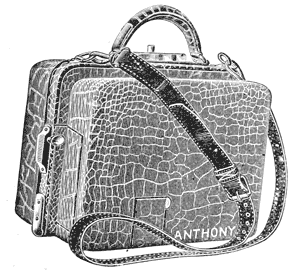
In outward appearance, and to the ordinary observer, this latest modification of the Detective Camera looks exactly like an alligator hand-satchel that is carried by a shoulder-strap at the side of the pedestrian. Upon closer observation, one sees that it consists of an artfully concealed Detective Camera, in which all the various movements to secure a picture are situated upon the under side. For use, the Camera is held so that the base of the satchel rests against the body of the operator. By means of a brass pull at the side the shutter is set. A plate in the regular holder is placed in position at the back cf the Camera, and the slide is drawn ready for exposure. The release of a short catch exposes the front of the shutter ready for action, and by raising a small leather-covered lid the little camera obscura, called the finder, on the (now) upper side of the Camera, shows the position that the object will occupy on the plate. The slightest touch upon a small brass button releases the shutter, and the exposure is made. Replacing the slide in the plate-holder, reversing the holder, and setting the shutter again, leaves the apparatus in readiness for another shot, when the plate-holder slide is withdrawn as before.
By removing a screw that takes the place of the spring lock of an ordinary satchel, the Camera proper can be removed from its cover, and a tripod screw serves to attach the Camera to a tripod for ordinary use.
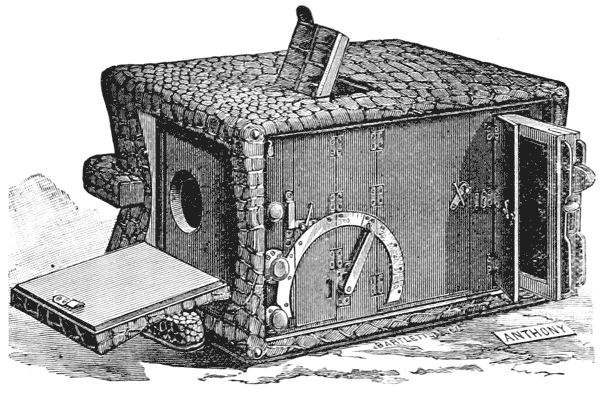
This last form of the Detective Camera allows the operator to carry with him twelve plates in the interior of the apparatus, and so carefully packed away that no light can strike them. It is also furnished with an ingenious attachment by which the speed of the shutter can be regulated to suit the speed of the object, moving with greater or less velocity; while, by simply releasing a catch, time exposures can be made at the will of the operator. In fact the whole affair is the latest achievement in ingenious and compact light photographic apparatus.
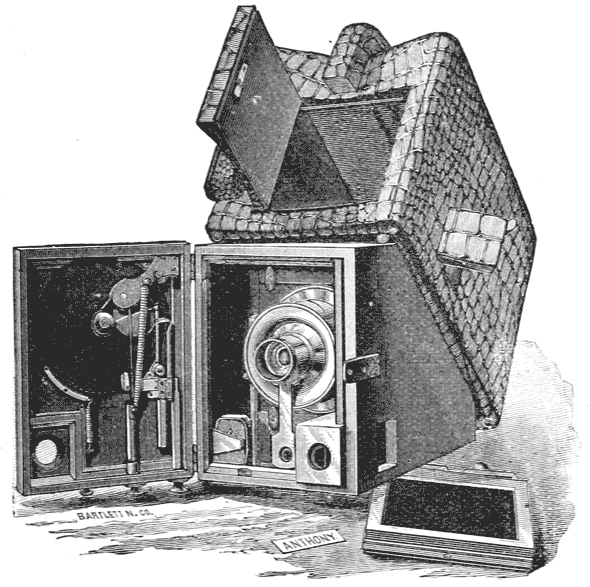
CAMERA SHOWING THE DETACHMENT OF SATCHEL.
AMATEUR EQUIPMENTS FOR FIELD WORK.
The manufacturers of these goods, for the convenience of those at a distance who might desire to order by mail, have classified and catalogued these outfits of the various sizes as view equipments, and have numbered them from 1 upwards.
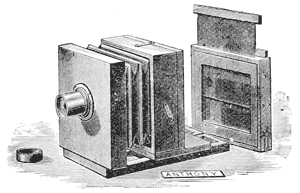
EQUIPMENT NO. 1.
Stained Camera, for making pictures vertically or horizontally, measuring 4×5 inches, with one double dry-plate holder, fine single achromatic lens, improved tripod, and carrying case.
This is called the $10 equipment, and by which very beautiful and perfect work may be done, examples of which, as negatives and transparencies, may be seen at the warerooms, and only need to be seen to be admired. For a complete descriptive catalogue of these goods, send to Messrs. E. & H. T. Anthony & Co.
THE FAIRY CAMERA.
There has long been a demand on the part of the public for a Camera that would at once embrace these most necessary requirements—portability, compactness and strength, combined with beauty and accuracy of working.
Hitherto the nearest approach to this has been the "Novel" Camera, which for a time seemed to be everything that could be desired. But urgent calls for something still better were frequently made, and the result is the Fairy Camera, by far the most attractive and elegant piece of apparatus of its kind ever offered. In presenting it, attention is invited to the following advantages it possesses over all others.
Strength.—They are put together as rigidly as wood and metal will admit of, and are therefore perfectly rigid.
Compactness.—They occupy less space than any other view Cameras of the same capacity, and the plate-holders actually require little more than one-half the room of the lightest of any others in use. The plate-holders are made of hard wood, with metal carriers for the plates, and fitted with all the later improvements.
Portability.—The small compass to which they may be reduced renders them in this respect incomparably superior to any. They are packed in canvas-covered wooden cases, and each double plate-holder has its own compartment. The cover of its case telescopes over its body.
Several new features have been availed of in the construction of this Camera, to wit: The bed may be instantly rendered rigid, without the use of screws, by means of a brace of hooks, that hold the two sections of the bed with great firmness.
Secondly.—The rabbet commonly found on the plate-holder is dispensed with, and instead, it is placed on the Camera, thus saving the otherwise additional weight rendered necessary for twelve such rabbets when made on the plate-holders (two on each of the six usually carried), and the not inconsiderable item of three-quarters of an inch in bulk.
Third.—The Camera is focussed with a long, continuous metallic rack, cog-wheel and pinion, the latter being held firmly in position by a binding screw.
The ground glass swings backward in its frame, like that in the regular Novel Camera, and is held tightly in position by metallic spring corners. When windy, this is a decided advantage.
The Fairy Camera is made in finely polished mahogany, the metal work being nickel-plated, thus making it the most elegant and perfect Camera known.
They are made with and without stereoscopic attachments. Naturally, those without stereoscopic attachments are lighter and more compact than those with, and may be preferred by persons desiring to make single views or portraits only.
These Cameras are made in four sizes only—from 4¼×6½ to 8×10. Those desiring a larger Camera should procure the Novel Camera, which is manufactured of all sizes up to 18×22.
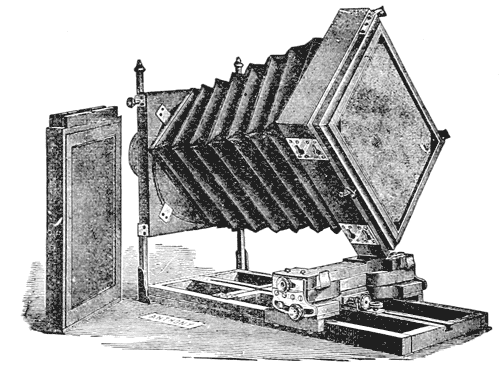
THE NOVEL CAMERA WITH DOUBLE SWING BACK IN THE ACT OF BEING REVERSED.
An ingenious improvement has been introduced in connection with the Fairy and Novelette Cameras, which is shown in the cut.
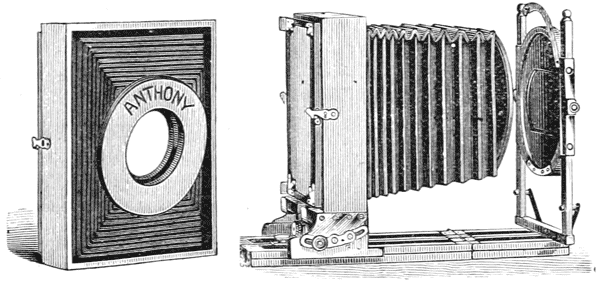
It consists in the use, with a 5×8 Camera, an additional body and bellows for 8×10, which can be attached to the front and bed of the 5×8 on removal of the 5×8 bellows to back. This substitution can be made in a few seconds, giving the user the command of two Cameras at small expense.
THE VIEW LENS. (See article on lenses in Part First.)
View lenses may be classed in two groups:
Single combination lenses and double combination lenses.
Single combination lenses are intended for producing pictures of inanimate objects, in the production of which the time of exposure is of minor importance. They are of greater focal length than the double, and, on account of their simple form, are less expensive.
The combination consists of a meniscus, composed of two lenses, one convergent, the other divergent. The two are cemented together, so that only two surfaces are presented to reflect light. This lens is well calculated for out-door work, but does not give such roundness of form nor such delicacy and finish as may be obtained by the double combination. But it has greater depth of focus, and, having but two reflexive surfaces, fits it peculiarly for views of foliage, and enables it to work into the green of the landscape more completely and vigorously.
The single lens is not free from distortion. The marginal rays are apt to give the barrel-shape figure to the view, but for landscapes this is practically of little or no consequence.
The smaller sizes of single lenses are more effective than the larger. They are quicker and have much less distortion, and when stopped very small have practically none.
THE DOUBLE COMBINATION
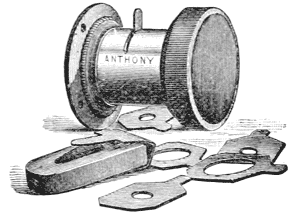
is formed by reversing the single lens and making it the front lens of the double combination, and adding a similarly constructed achromatic lens to the rear. These lenses are indispensable for very rapid work and for work requiring straight lines. As the double combination is more perfectly corrected for spherical aberration, it is better adapted for architectural and other work not admitting of distortion. Of this class of lenses we would recommend ANTHONY'S RAPID DRY PLATE LENS, which has a double achromatic combination for making instantaneous views, portraits groups, etc., and will meet all the requirements of those who do not care to incur the expense of a Dallmeyer or other first-class lens.
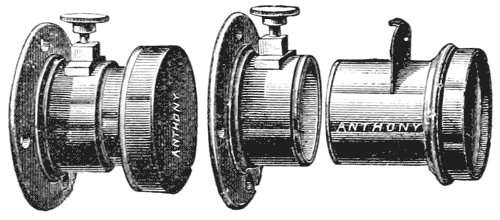
ANTHONY'S RAPID DRY PLATE LENS
THE PLATYSCOPE LENS
Of a higher class is THE PLATYSCOPE LENS, which is a rectilinear or perfectly corrected lens of great working rapidity, and is well suited for all the requirements of the amateur; and as to price, it holds a middle place and next to the DALLMEYER'S RAPID RECTILINEAR LENS, which is the most perfect instrument at present known to the profession, and is almost universally used by professional out-door photographers and by all amateurs who care to produce the finest possible work. This lens might be considered indispensable for all work requiring an instantaneous exposure, as by means of the dry plate and the drop shutter some very remarkable pictures have been made of bodies in rapid motion.
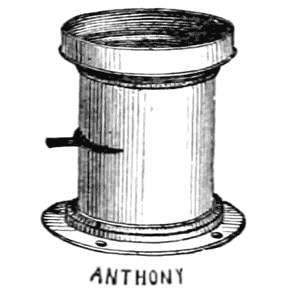
DALLMEYER'S RAPID RECTILINEAR LENS
WIDE ANGLE LENSES.
There is another class of lenses of double combination, which are called wide angle lenses. They are constructed to embrace an angle of from 90 to 100 degrees, and are therefore indispensable for use in confined situations, such as narrow streets and interiors. They are also capable of being used with advantage for all the purposes of a view-lens, their only disadvantage being that they are not so rapid as lenses of a lesser angle. For certain subjects the back lens of the combination may be removed and the front lens used in the same manner as an ordinary landscape lens.
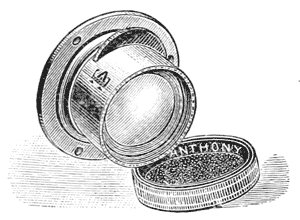
THE E. A. WIDE ANGLE-LENS
is of this class, and being of short focus and made on the rectilinear principle, it is a useful lens for all the purposes already enumerated, and for architectural subjects, as well as for copying of maps, drawings, printed matter, etc., etc.
Every amateur should possess one of these lenses, as well as one of the more rapid-acting lenses for instantaneous work, unless he can well afford to get the best.
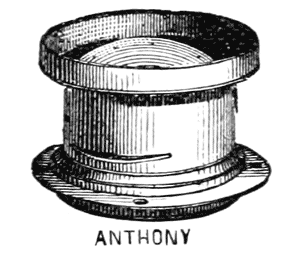
DALLMEYER'S WIDE-ANGLE RECTILINEAR LENS
will completely fill the bill. This lens consists of two cemented combinations, each composed of a deep meniscus crown and a deep concavo-convex flint glass lens.
Unlike other lenses of this class the dense refracting medium—the flint—is made to occupy the external position in both combinations, and though both are deep menisci externally, and of nearly the same focal lengths, the front combination is of larger diameter and greater curvature than the back, and between the two, dividing the space in the proportion of their respective diameters, is placed the revolving diaphragm, with graduated openings, the largest of which is F. 15.
An important characteristic of this instrument, besides the method of achromatization, is the thinness of the lenses, thus offering less obstruction to the passage of the light, constituting these lenses the quickest acting of their kind.
The outfit, which includes a Dallmeyer wide angle and a Dallmeyer rapid rectilinear, may be said to be prepared to do all work within the range of photography.
Every outfit should include a piece of fine, soft chamois skin for cleaning the lenses; it will often be found that moisture and dust obscure the image in the ground glass; when such is the case the lenses should be unscrewed and carefully cleaned with the chamois. And when carrying, it would be well to wrap each lens in a piece of chamois. Lenses thus carefully kept will repay the trouble in fine, clear and incisive work.
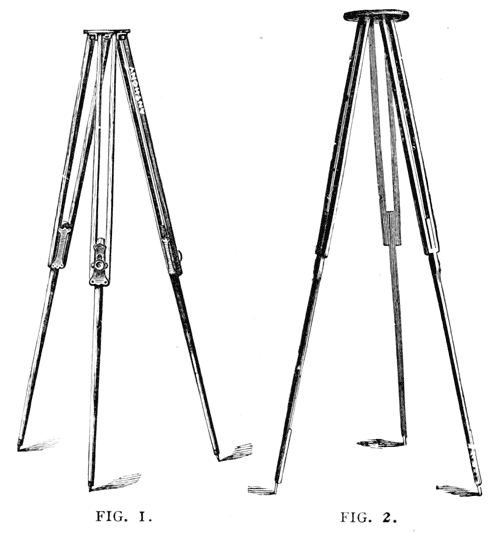
THE TRIPOD OR CAMERA STAND.
There are a variety of these stands manufactured, the two principal of which are the Telescopic leg, Fig. 1, and the Folding leg, Fig. 2. Among the lighter stands or tripods THE FAIRY TRIPOD deserves particular mention, being less than two pounds (2 lbs.) in weight and folding to a length of 16 inches only. When placed in its neat leather case, with shoulder-straps for carrying, it is the smallest and lightest practical tripod that has yet been offered to the public.
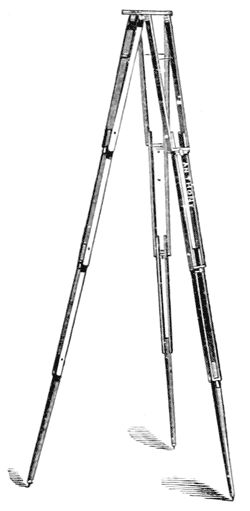
THE FAIRY TRIPOD
The tripod, when not in use, is taken apart, the top placed in the carrying box, and the legs folded or telescoped and tied together.
When set up for work be sure to have the tripod top level, which may easily be done by adjusting the legs to the inequalities of the ground.
The Camera is fastened to the tripod top by a thumb-screw, which passes up from beneath, through the tripod top, and into the leg of the box. When adjusted tighten the screw firmly.
THE INSTANTANEOUS SHUTTER.
The rapid dry plate and the quick acting lens have created a necessity for a shutter that would make an instantaneous exposure, in order that sharp pictures might be made of objects in motion.
This has been accomplished in a variety of forms, the earliest and simplest of which is
THE DROP SHUTTER,
which consists of two pieces of wood, each having a hole cut into it, and so arranged that when one piece is placed upon the end or hood of the lens (which fits into the circular opening), the other piece can be made to slide up and down against it, thus for an instant bringing the two openings opposite, and making the exposure depend upon the rapidity with which one opening passes the other.
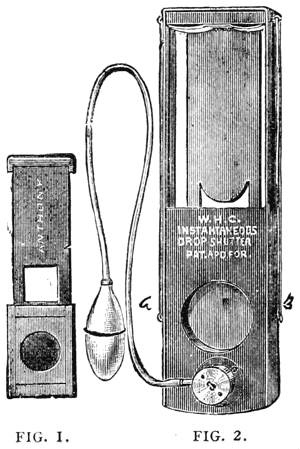
Fig. 1 represents the common form, in which the release is made by the withdrawal of a metal catch, which fits the indent in the side of the sliding upright piece. Fig. 2 represents an improved form, in which the release is made by pressing a rubber bulb connected with a rubber tube attached to a metal valve.
The action of both these styles of drop shutter may be hastened by using rubber bands to quicken the fall of the sliding piece, as represented in Fig. 2 by A and B. So that while a rapid exposure might be made by the fall of the slide, by its own weight, it would not be quick enough for an object moving across the plane of focus, but might be sufficient for an object moving away from or toward the lens. By the use of the rubber bands the exposure may be made as quick as a flash, or the small fraction of a second, thus enabling one to secure a sharp impression of the trotting horse, the railroad train, the racing yacht, and many other interesting and difficult subjects.
Another peculiarly effective form of shutter is that known as THE PROSCH ECLIPSE SHUTTER, which is a small and compact instrument, made of metal and rubber, by which an exposure of 1⁄200 part of a second may be made, with the power of reducing the speed to about one-half second.
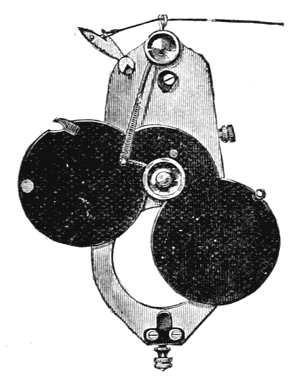
THE PROSCH ECLIPSE SHUTTER
A late and decided improvement on the Eclipse Shutter has been produced by Mr. Prosch, which he has named the "Duplex."
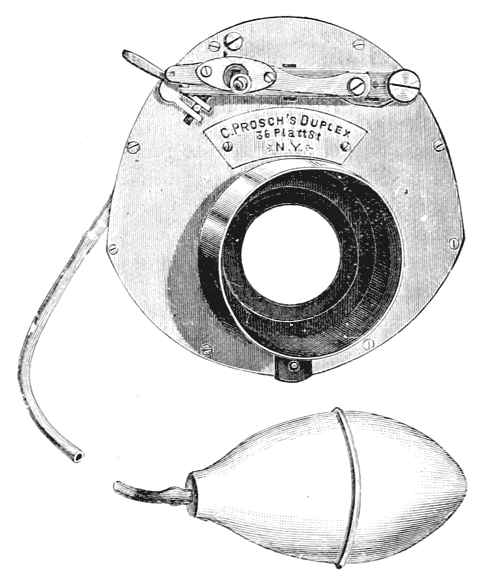
Prosch's Duplex Shutter is intended both for "timed" and instantaneous exposures.
It is equal to any requirement for the most rapid work, and as a time shutter, exposures can be made of from one-half second to any duration required.
The peculiarity of this shutter is that the exposing slides are placed between the front and back combinations of the lens, necessitating a separation of the tube at the centre.
Mr. Prosch makes a special tube to which is affixed the apparatus of the shutter. This special tube is of the exact size of that to which the lenses belong, from which the lenses are taken and fitted to the special tube. The other is kept for future use if necessary.
THE CARRYING BOX.
All this apparatus is, with the exception of the tripod, enclosed in a neat carrying case, with a telescopic cover, and is carried with a hand-strap. The box contains separate places for from one to six double holders, as may be desired. And there is room for the head-cloth, and an extra box of plates if necessary.
The head-cloth furnished with this apparatus is a light rubber-covered muslin, about a yard or a yard and a quarter square, and its principal use is to cover the head and exclude light from the ground-glass while adjusting the focus. It may also be used to cover the apparatus if caught out in a shower, or to wrap the carrying case in under the same circumstances.
THE DEVELOPING OUTFIT FOR AMATEURS.
The amateur is recommended to get some experience in making exposures before attempting to develop.
By taking plates to some photographic establishment for development, and observing carefully the method of manipulating them, one will soon learn about the proper exposure to allow; and then the advice of the operator may be of some value.
There may, however, be some who are so situated as to be unable to avail themselves of such an opportunity, and are compelled to rely on printed instructions for all they have to do. To such we have only to say,
DO NOT OVER-EXPOSE,
then go ahead and do the best you can.
The outfit for development would consist first of the apparatus or dishes; second, of the chemical components of the developer, and the clearing and fixing solutions.
The dishes or apparatus are:
Developing trays,
Tray or dish for alum solution,
Tray or dish for fixing solution,
Washing box,
Negative racks,
Glass stoppered bottles,
2 of 1 lb. each for pyro and soda,
2 of ½ gallon each for oxalate and iron,
2 of ½ gallon each for alum and hypo,
Glass graduates,
1 of 8 oz., 1 of 1 oz,
Glass funnels,
Filtering paper,
A balance scales for weighing 1 grain to ¼ lb.
The developing tray is made of japanned iron, of ebonite or of hard rubber.
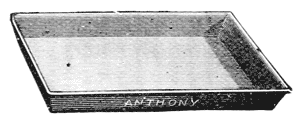
JAPANNED IRON DEVELOPING TRAYS.
These are all made to suit the various sizes of plates in use; the japanned iron trays are the cheapest, but they wear out rapidly; the ebonite trays are rather higher in price, but they are more durable, and have a clean polished surface. The hard rubber dishes are the most expensive, and perhaps the most durable.
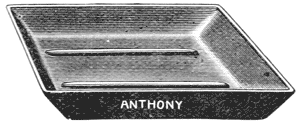
EBONITE TRAYS.
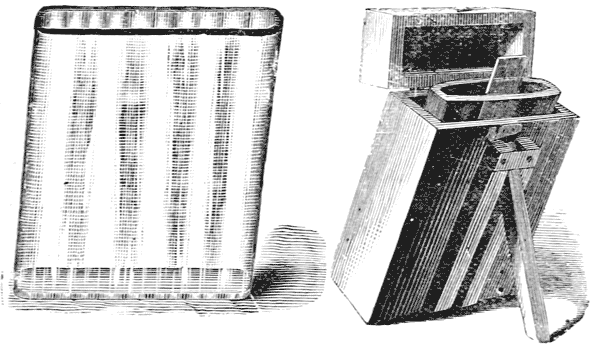
ANTHONY'S GLASS BATHS IN BOXES.
The amateur should procure his trays of a size suitable for the largest plate he uses, and should have two or more on hand always for developing purposes. These dishes are also suitable for the clearing and fixing solutions; but for these solutions the upright bath dish and dipper are better for several reasons; first, because there is less evaporation; second, all sediment sinks to the bottom, and the solution is always clean; and last, but not least, they take up less room.
THE WASHING BOX.
The gelatine plate requires much and prolonged washing to free it from the solutions by which it is developed and fixed, and which, if not thoroughly washed from the film, would ultimately injure and perhaps distroy it An apparatus has been devised for washing dry plates, which may be adapted to any size plate from 4×5 to 8×10.
It has a perforated false bottom, the water is received into the box beneath the bottom, passes up through the perforations and out through a pipe at the side; the plates are placed in the grooves and rest on the false bottom. The force of the water is checked in passing through the false bottom and flows evenly up through the plates. A half hour of washing in this box would be quite enough to thoroughly cleanse the film from hypo, etc.
Another and very effective model is the
ANTHONY SELF-CHANGING SHOWER WASHING BOX.
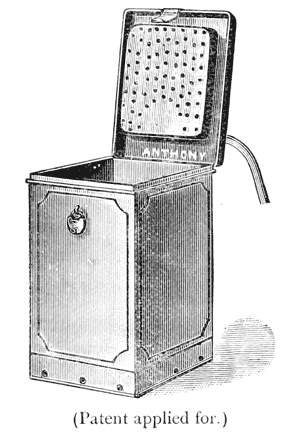
The Anthony Self-Changing Shower Washing Box for dry plate negatives is a nicely constructed and convenient apparatus. Made substantially, and well japanned inside and out, it has interior grooves in which either 5×8 or 8×10 negatives may be placed. When the negatives are introduced, the hose is attached to a faucet; the lid is now closed and locked if desired, and the water turned on.
It will be seen that the water enters the washer from above, and that the inside of the lid is made in the form of a perforated fountain, which discharges a spray over the plates. When the negatives are entirely submerged, the water is all drawn off by means of a self-acting syphon, and the process of showering is repeated.
With this apparatus the hypo can be thoroughly eliminated from the gelatine film in from fifteen minutes to half an hour. The change of water is continuous.
When the plates are well washed they are removed from the washing box and set up in
NEGATIVE RACKS,
where they will soon dry, and when dry they should be stored in boxes to be kept free from dampness and dust.
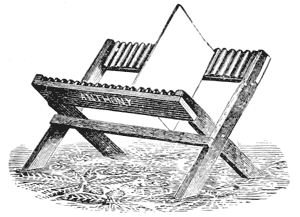
ANTHONY'S FOLDING NEGATIVE RACK.
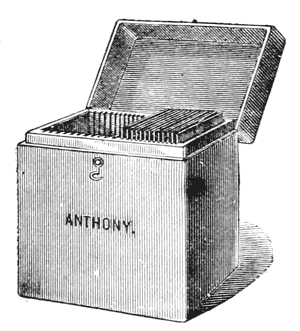
NEGATIVE BOXES.
These boxes are made of every size and are indispensable for the proper preservation of dry plates.
CHEMICAL COMPONENTS OF THE DEVELOPER.
The solutions for developments, both by the neutral oxalate and the alkaline pyro processes, should be kept in air-tight glass-stoppered bottles; in fact, rubber stoppers are superior to glass for keeping out the air, and when they can be had should be preferred.
Glass funnels and filtering paper for filtering the various solutions should always be kept handy for use.
Glass graduates are quite indispensable in preparing and mixing the developing solutions.
A balance scale is equally necessary for the same purpose.
The chemical constituents of the developing outfit are:
Neutral oxalate of potash,
Protosulphate of iron, for oxalate development,
Sulphite of soda,
Sal-soda or carbonate of soda,
Carbonate of potash,
Bromide of ammonium,
Concentrated ammonia,
Pyrogallic acid, for alkaline pyro development, etc.,
Alum and citric acid, for clearing solution,
Hyposulphite of soda, for fixing solution.
THE AMATEUR DARK ROOM.
It is not necessary that the amateur should have a thoroughly appointed dark room, although such a room is a great convenience and not at all difficult to construct nor expensive to keep up.
Those desiring to construct a convenient and safe dark room should consult the article on dark room in the first part of this book. Such a room might be put up in an out-building where running water could be had, but for occasional use the bath-room or any closet in the house that contained running water and is large enough to hold a small table would answer every purpose. It would be necessary to stop every crevice that would admit white light, by covering such places with heavy red orange paper. The window, if there is one, may be covered with the same paper or a heavy shawl. The room may then be lighted comfortably with Carbutt's Dry Plate Developing Lantern, which may set upon the table with the developing tray before, as in the cut.
When abroad making views it is sometimes necessary to change the plates in the holders; for this purpose carry with you a ruby glass gas burner chimney, which is a plain cylinder of ruby glass, about one and a half inches in diameter and six to eight inches long. Light a short piece of candle and set the chimney over it; this in any small dark closet will give plenty of light for the purpose, and indeed might do to develop by at a pinch.
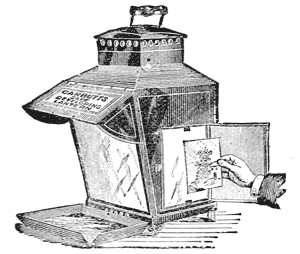
LANTERN ARRANGED FOR DEVELOPING, AND AFTER FIXING, EXAMINING NEGATIVES BY OPAL LIGHT.
FERROUS OXALATE DEVELOPMENT OF DRY PLATES. (ROCHE.)
First make two stock solutions as follows:
No. 1. A saturated solution of oxalate of potash (a pint or quart) and test with blue litmus paper. If it does not show an acid reaction dissolve a little oxalic acid in water and add enough to the solution to cause the blue test paper to turn red.
This solution should be filtered for use.
No. 2. Make a saturated solution of pure sulphate of iron, and to one quart add three or five drops of sulphuric acid, to prevent oxidation, and filter.
Now, to develop a 5x8 plate, take three ounces of No. 1 and to this add one quarter of a dram of bromide of potassium solution (which is water one ounce, bromide of potassium twelve grains), then add half an ounce of No. 2; this forms the developer.
Then transfer the plate to a developing disk, and pour over it the developer. If the picture comes out gradually and develops sufficiently, it is good so far, but if from under-exposure the details hang back and refuse to develop further, then add two drams, or half an ounce, more of No. 2, which will bring out the picture with full details, unless greatly under-exposed.
Never exceed one ounce of No. 2 (iron) to three ounces of No. 1 (potash), for if you do you will form a sandy deposit and discontinue the action of the developer.
Always develop until the picture seems sunken into the surface. Do not judge by looking through the negative only. Wash and fix in hypo, 1 ounce; water, 8 to 10 ounces. After fixing, wash well.
For pictures taken instantaneously, use no bromide in the developer.
COOPER'S SODA DEVELOPER.
"No. 1.
Anthony's Sodium Sulphite Crystals ¾ lb.
Distilled water 2 qts.
Anthony's Pyrogallic Acid 2 ozs.
No. 2.
Anthony's Sal Soda Crystals ½ lb.
Water 2 qts.
To develop, take
No. 1 2 ozs.
No. 2 2
Water 2
For restraining over-exposure use the above quantity of developer, one-half to one dram of
Bromide potassium 1 oz.
Water 6
"It is always advisable to use two developing trays, and have the normal developer in one and the restrained developer in the other. Then, by changing the plate from one tray to the other, the character of the negative is under full control. Four to six plates can be developed in one lot of developer.
"This developer can be used for a number of plates, and gives fine negatives of good printing quality.
"After development, return your old developer to a stoppered bottle, and keep for commencing development.
"The reason for doing this is as follows:
"As a rule, I give a little more time than necessary to make a full-timed negative, and, by commencing with the old developer, give the high lights a start of the shadows, which I can readily soften afterwards by the use of a stronger developer at the finish, thus obtaining the sparkling high lights so much admired in the wet plate; and so seldom found in the average Dry Plate Pictures.
"This developer never becomes muddy, and may be used repeatedly with fine effect.
"Always place plates in a strong solution of alum after developing and rinsing, and before fixing. This gives brilliancy to the negative and prevents the possibility of softening.
"In the use of the above formula it is important that the best Chemicals be employed."
It is not necessary to make up the full amount of 2 oz. pyro at one time.
In the foregoing two formulæ will be found all that is necessary for making good negatives by either process.
Every box of plates that is put up for sale carries with it the formula supposed to be best for that plate. There are other forms of development that produce good work. The following is one of them:
FERRO-CYANIDE OF POTASSIUM DEVELOPER.
Make a saturated solution of yellow prussiate of potassium and dilute with an equal bulk of water; add 2 drops of ammonia and 2 grains of dry pyro to each ounce used.
The solution can be used repeatedly until exhausted. Four ounces of this solution would contain 8 grains of pyro, which is enough to develop 2 8×10 plates, or their equivalent of smaller plates. Mix only the amount that will be used at one sitting.
It will be noticed in all the foregoing formulæ that the matter of greatest uncertainty is the exposure of the plate; you never can tell if your plate is properly exposed until you begin to develop, and then if your picture flashes out at once it is too late to correct by modifying the developer.
The theory of development is that the pyro is the developing agent and gives the strength.
The soda, or ammonia, as the case may be, gives the detail. The bromide is a restrainer, and to a certain extent will correct over-exposure. Sulphite of soda, citric acid and sulphurous acid are used to keep the pyro from oxidizing.
Therefore, when developing a plate, say a 5×7, put it in the tray and pour over it the amount of pyro necessary to develop such a plate, say two grains in four ounces of water, let the plate remain in this solution for a short time, in the meantime take of your alkaline solution the amount you would use for the same size plate, but add only a small portion to the solution covering the plate. To do this pour off the pyro solution into a graduate and add a drop or two of the alkaline solution, soda, potash or ammonia, whatever it may be, then turn the solution back on the plate and watch for the effect; if in a few minutes there is no change, then add more of the alkaline solution in the same manner, and in a short time the image will begin to appear; if it comes up too slowly, give it the remainder of the alkaline solution, and unless the plate has been under-exposed the image will come out and strengthen gradually until it has well sunken into the plate, when it may be removed and washed.
If you use the oxalate developer, proceed upon the same plan; oxalate in the place of pyro, iron in the place of alkali, but always add the iron to the oxalate, not the reverse.
Do not be persuaded that the bromide is only a restrainer; it is that and more too; it may greatly affect the quality of the negative, making it much finer in grain and clearer in the shadows.
Under-exposed plates at best make but poor negatives, and it is preferable to err, if at all, on the other side, but with the rapid plates now made exposures are very seldom too short.
When the plate has been developed it must be washed and then placed in the hypo solution to fix.
The most effective strength of hypo solution is half saturated. Make a saturated solution of hypo and dilute it with an equal bulk of water. The plate should lie in this solution until it appears perfectly clear, and about five or ten minutes longer, then it should be taken out and well washed. It should then be put in the
CLEARING SOLUTION.
Water,½ gal.
Alum,¼ lb.
Citric acid,2 oz.
Allow the plate to remain in this solution a few minutes and it will be found to have been greatly improved, having lost the color and cleared the shadows. This solution, besides clearing the negative, decomposes the hypo remaining in the film, and a short wash after being taken from it is sufficient.
EASTMAN'S IMPROVED NEGATIVE PAPER.
The Eastman Dry Plate and Film Co., of Rochester, N. Y., exhibited at the P. A. of A. Exhibition, at Buffalo, N. Y., in July, 1885, a very remarkable display of photographs, the negatives of which were made on gelatinized paper and called the Eastman flexible negative support. They gave a demonstration of their process at the same time, and also explained the working of their new holder for a continuous web or band of paper.
The sensitive gelatine emulsion is prepared in the same manner as for glass plates, and it is spread by means of ingenious machinery on continuous bands of paper, which bands are afterwards cut into sizes, or rolled on spools which will contain enough paper to make from 24 to 40 views or portraits, according to size.
They have invented a very neat apparatus to hold the paper when cut into sizes so that it may be inserted in the common dry-plate holder.
They have also invented and patented a roller holder which may be made to fit any camera, in which is inserted a spool of the paper, and by means of ingenious devices it may be drawn across a flat table and wound upon another roller with an apparatus to register each length of paper as an exposure is made. This apparatus is absolutely correct in operation, and the proper length of paper is infallibly transferred from the table to the roller by simply turning the roller with a key from the outside.
By this invention the viewist is given command of as many as 24 exposures, with no greater weight to carry than one double dry-plate holder when filled with glass, thus reducing his "tote" the weight of five double dry-plate holders and ten glass plates, and his resources are increased two-fold.
The exposures having been made the holder is taken to the dark room, the paper unwound from the spools, cut at the register marks and developed in the same manner as glass plates, but with the difference that several pieces may be developed at the same time in the same manner that paper prints are toned, thus securing a uniform intensity to the negatives; the fixing and washing are performed in the same manner as silver prints and as easily.
The paper negatives after being washed are dried between blotters, or in any other preferred manner, and they are then saturated with castor oil and ironed with a hot flat-iron, to make the oil more effectually permeate the fibre of the paper.
These negatives are more perfectly susceptible of being retouched and worked up than those on glass.
They are printed from the gelatine side, and when the prints are made the negatives are stored in portfolios. If after a time it is found that the oil has dried out of the film, they may be again oiled the same as at the first.
The roller holders are made for every size and style of camera box from the Detective and the Bijou pocket apparatus, up to the 20×24 mammoth size Novel Camera.
HOW TO USE THE EASTMAN-WALKER ROLL-HOLDER.
The Eastman paper films for the roll-holder are prepared in continuous bands, and are rolled up on wooden spools and neatly packed in paper boxes.
The spool may be removed from its box and placed in the holder in daylight, at the expense of the outside roll or length of paper necessary to extend from the spool to the winding-reel, so that if one were so situated as to find it necessary to change rolls in the field, the loss would be trifling—being at the utmost not more than would be required for two exposures from each spool.
The proper course, however, is to charge the holder with its spool of film in the dark room before going abroad.
In doing this it is necessary that the light in the room should be strong enough to enable the operator to see comfortably; but of such a quality as not to injure the paper, which is at least 25 per cent. more sensitive than the same emulsion would be if on glass instead of paper.
Figure 1 gives a general idea of the shape of the holder, with the slide partly drawn to show a portion of the film. Also may be seen the brass loops or clamps which hold the cover securely over the working parts, and the key at the bottom which turns the reel to which the loose end of the paper is attached.
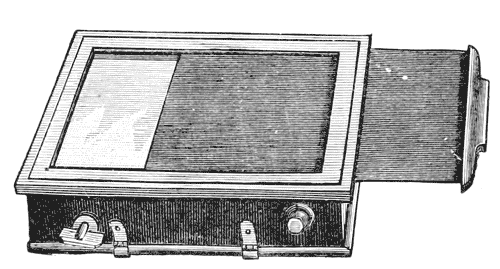
FIG. 1.
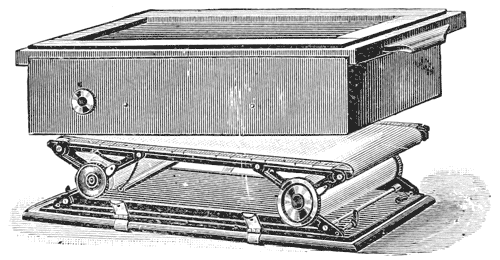
FIG. 2.
The working parts are fastened to a light metal frame, and consist of a spool of film at the right end, and the winding reel at the left, as seen in Figure 2. Both the spool and the reel are provided with spring brakes, that prevent the uncoiling or unrolling of the paper from either the spool or reel. The milled heads of the chucks which hold the near ends of the spool and reel are provided with pawls, which, while permitting them to turn easily in the right direction, prevent the possibility of turning the other way.
When the cover, as seen in Fig. 2, is to be removed, the keyhole guard and the indicator knob are pulled out as far as they will come, the two loops on each side are turned down, the cover lifted off, leaving the working parts exposed, attached to the back of the holder by spring bolts, two at each end of the frame. Now, with the thumb and fore-finger of the right hand, press these bolts, and thus release the right end of the framework, which you may turn up, as seen in Fig. 3, which is the position for removing and replacing the roll of film.
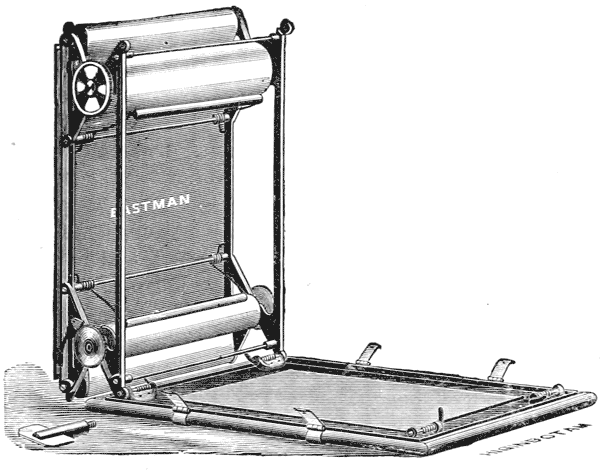
FIG. 3.
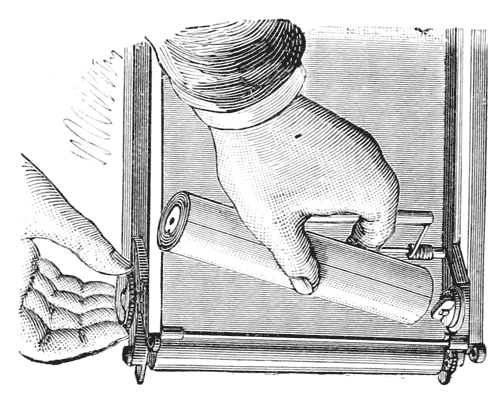
FIG. 4.
The proper method of doing this is more particularly shown in Fig. 4. With the left hand you hold the roll of film and draw back the spring brake; now press the end of the roller that has the saw-cut or groove across it against the chuck, as seen on the left, while the right hand unscrews the pivot or support for the other end of the roller, which is then placed in position; the pivot is inserted and screwed home.
This completes the operation of placing the roll of film in position. The frame is then turned down and secured by the two bolts, the paper band on the roll of film is torn off, and the end of the film is carried beneath the guide roller and over it and across the exposing table to the other end, which is next released and raised to a perpendicular position. The end of the film is now brought over the guide roller and attached to the winding reel, as shown in Fig. 5.
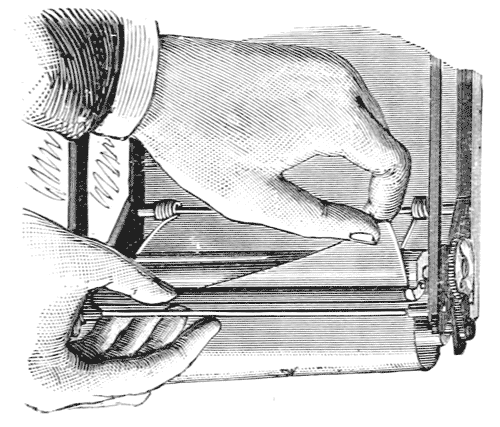
FIG. 5.
The paper is fastened to the winding reel by a metallic clamp, which is pivoted to the ends of the winding reel. Now see that the film occupies a central position across the table and over the guide rolls, and then take up the slack by means of the milled head tension screw or chuck at one end of the reel. The pawls should now be adjusted on the milled heads of the chucks, the cover replaced and fastened by raising the loops or clamps over the pins in the side of the cover, and you are ready for work.
For the purpose of indicating plainly where the first exposure will be, insert the key and screw it home then turn it slowly until you hear a sharp click, then pull out the slide and draw a pencil across the film at each end of the holder, then return the slide.
When about to make another exposure, note the position of the indicator at the right end of the holder, then turn the key slowly; the proper length will be indicated both by the sound of the sharp click within and by the position of the indicator on the outside of the holder. At every turn of the guide-roll the paper is punctured by a sharp point which occurs simultaneously with the sound of the click. For the smaller sizes, three clicks and three punctures will surely indicate that the proper length of paper has been replaced on the exposing table. For the medium sizes four clicks and punctures are required. And for the larger sizes, as many as six or eight may be necessary. The proper information is given with the holder.
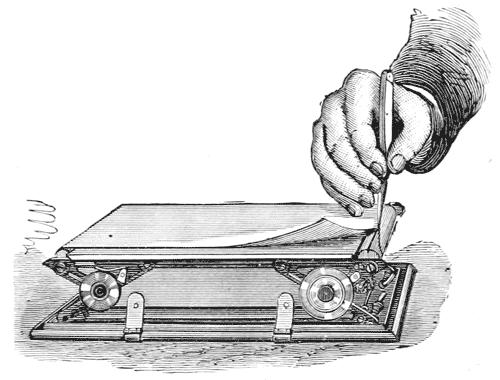
FIG. 6.
When the exposures are made, and it is desired to remove the paper from the winding reel and cut it for development, proceed as before, and remove the cover from the holder; then, with a sharp knife-blade, cut the paper, as shown in Fig. 6, by drawing the blade over the paper and in the tin-lined groove in the guide-roll Then release the spring pawl at the reel end and draw the paper from the reel across the table, then cut by measurement, or by counting the punctures.
The directions for developing and preparing the films for printing accompany each package of the paper.
THE ROCHE FILM.
The year 1885 has been remarkable for the great importance of the numerous improvements in photographic processes that have been brought before the profession, and for the great impetus thereby given to the extension of the uses of the art.
The substitution of paper for glass as a vehicle for sustaining the sensitive film has long been an aspiration of the progressive photographer; and this year has witnessed the perfection of at least two paper film processes that may be said to be perfect.
The Eastman paper film has already established itself as a practical success, and now we have a new candidate for photographic favor in the Roche Film, just perfected and patented by that able experimentalist, and assigned to Messrs. Anthony & Co.
This Roche Film is remarkable for the ingenious manner by which the disagreeable necessity for oiling the paper is avoided.
This particular improvement consists in coating both sides of the paper with the same sensitized gelatine emulsion, which has the effect of preventing any trace of the fiber of the paper showing, from the fact that the light penetrating the front film has sufficient power to impress an image on the back film as well, the interstices between the fibres of the paper permitting a more energetic action of the light on the back film than through the fibre, equalizes the intensity and thus prevents the fibre showing in the negative when examined by transmitted light, or leaving any impression on prints made therefrom. The double impression has also the power of giving a more plucky or bolder character to the prints, and greatly enhancing the atmospheric effect and beauty of both portraits and landscape pictures. Also other imperfections, either in the front film or in the body of the paper, are corrected by the back coating, as neither the fibre of the paper nor any imperfection therein can have any effect on the front coating, but both the fibre and any spots, either opaque or transparent, in the paper or front film will affect the back image in the exact ratio of the opacity or transparency of the spots or imperfections.
In other words, all the imperfections of the paper and front film will be corrected by the back, rendering the double negative quite smooth and even, whatever the character of the texture of the paper may have been. This special paper offers other advantages. It will stand a protracted washing without weakening, and does not easily tear or crack from handling in the water, and when dried it will not curl, but remains flat, ready for immediate use.
Directions for development accompany each package.
ENLARGING AND DUPLICATING SMALL NEGATIVES.
Many amateurs have of late discarded their larger equipments, and for general work use the smallest sizes, such as the Detective Camera and the Bijou or Novelette, which are of the smallest sizes, such as 3¼×4¼ and 4×5.
It is contended on their part that these small outfits, which are so light and portable as to give the minimum of trouble in their use, give also (when good lenses are used) the most brilliant and perfect negatives, which are capable of being enlarged to any desirable size. Indeed, the copying and duplicating apparatus may be found in the rooms of many of the leading amateurs. And by its use many valuable negatives are duplicated, and secured against loss by breakage; others are enlarged to more useful sizes, and most beautiful transparencies are made.
THE COPYING AND DUPLICATING CAMERA.
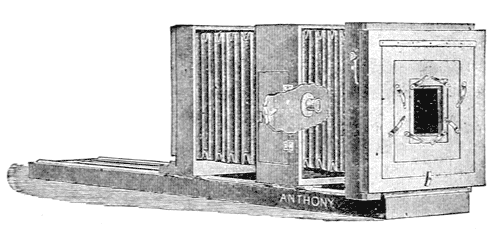
This apparatus, as will be seen in the engraving, is a camera with an unusually long bed-rail and bellows. It has a central frame which supports a lens, and a front frame supporting a negative, so placed for duplicating or enlarging, which is done by transmitted light.
The front is fitted with a kit of frames for the various sizes of negatives, from 3¼×4¼ to 8×10, or the largest size the box is capable of producing.
For copying by reflected light the lens is removed from the central frame and adjusted or attached to the front, where the negative is seen in the cut; and the picture to be copied is attached to an upright support (which is usually a part of the copying table or stand) and exposed to the strongest diffused light available, the camera being adjusted squarely in front of it.
For duplicating or enlarging negatives the adjustment of the apparatus is as shown in the engraving. Such work being done by transmitted light. The negative to be enlarged is placed in the appropriate sized frame in front and the lens in the middle frame, which is placed nearer to the negative than to the ground glass. The conjugate focus is then found by drawing out the rear or ground glass focussing screen until the image is sharply defined on the glass. When the subject is sharply in focus, if the image is found to be too small the frame supporting the lens is pushed a little nearer the front; on the contrary, if the image is too large the lens is drawn back from the front.
For all such work the camera should be directed toward a window commanding a clear view of the sky, or if trees or buildings intervene then a sheet of tissue paper or a square of ground glass should be placed immediately in front of the camera and against the window. It will be found that Anthony's "mineral paper" is superior to either tissue paper or ground glass for this purpose, and should be used when it can be procured.
When it is desired to make a duplicate negative it is necessary first to produce a dia-positive or transparency; this is merely a copy of the negative (by transmitted light, or light passing through the negative to the lens) with its lights and shadows transposed or reversed. Great care must be taken to have this transparency in sharpest focus, and full-timed in exposure to secure line detail.
When a suitable positive has been secured it should be dried and set up in the place occupied by the negative from which it was made, and with the film side toward the lens.
The process is now repeated, but with a shorter exposure, and the resulting picture is a negative (if well done) identical with the original.
The adjustment for size is, as before mentioned, effected by moving the lens support. If it is desired to enlarge, the lens is moved nearer the subject; if to reduce, move the lens back from the front. If the duplicate negative is to be of the same size as the original, the lens is moved to the position near the centre between the front and back, which will give the image on the ground glass the same dimensions by measurements as the original.
It will be observed that as there are two plates to be used the utmost care must be taken in the adjustment of the focus and in timing the exposure in both instances, to avoid loss of definition or quality.
Duplicates and enlargements of negatives made by this process and with dry plates need be in no particular inferior to the originals, if care and skill are exercised in their production.
DUPLICATE NEGATIVES BY CONTACT.
When it is not desired either to enlarge or reduce the size of the duplicate, a more direct and simple method is to make the positive by contact printing.
Place the negative in a printing frame, and upon it lay a dry plate so that the two film surfaces are together; use a thick pad and see that the pressure is strong enough to force the two surfaces into intimate contact; now expose to a gas flame for four to six seconds and develop. This will make an admirable positive or transparency if properly done. The same process repeated, serves to make a duplicate negative from the transparency.
It is advisable to make a positive by this method from every valuable negative. This positive will serve to make duplicates from, should the original be lost or broken.
Enlarged prints from small negatives can be made by the use of Anthony's enlarging camera, and their gelatino-bromide paper by artificial light, so that when one or more or only a few large prints are required from a small negative it would perhaps be more advantageous to make them direct from the original negative by the use of this instrument than by making an enlarged negative and printing by contact. However, the latter method would be the best in cases where many prints are required.
PRINTING PROCESSES.
The amateur who has secured a fine negative of some choice bit of scenery, or has made a "hit" on any subject interesting or beautiful, will naturally desire to secure prints or impressions from it, that he may gratify his friends with a copy or supply the demand for exchanges with the members of his camera club.
The accomplishment of this desire is neither difficult nor expensive, as there are several processes by which the amateur may print for himself as many impressions as will suit his purpose. If silver prints are preferred, any photographer will produce them at small expense; or if the amateur is sufficiently posted in this branch of the art, and has the facilities, he can easily make them himself. The matter is much simplified by procuring from the nearest stock dealer or photographer, ready sensitized paper. Few amateurs, however, I imagine, would care to incur the expense of a silver-printing outfit. Those who would will find in the first part of this book full instructions in the article on silver printing.
The processes by which the amateur may most easily produce prints from his own negatives by his own skill and labor are:
The Gelatino bromide paper process.
Anthony's collodio-chloride process.
Ferro-prussiate or blue process.
Transparencies in glass or opal.
PRINTING ON ANTHONY'S GELATINO BROMIDE PAPER.
This paper is prepared with a sensitive surface, similar to the dry plates commonly used, and must be handled with the same care and subject to the same conditions of light; consequently the printing must be done by artificial light only.
The paper being cut to the sizes desired, should be kept in a light-tight box, and in a dark room. When about to print, place the negative in a printing frame in the same manner as for silver printing, lay the paper with the gelatine surface down upon the negative, place a cloth pad upon the paper, then press the frame back firmly down to secure even contact of the paper with the negative.
All this should be done in a dark room by the aid of a non-actinic light, and for this purpose Anthony's Climax Dark-Room Lantern, Patented, as shown in the following cut,
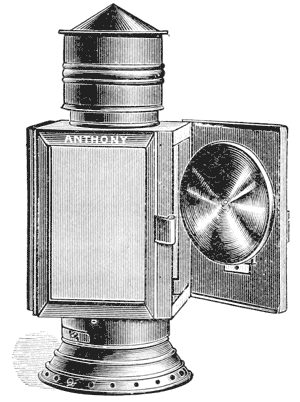
would seem to fulfil every requirement. A more expensive, but very convenient instrument, however, is
CARBUTT'S MULTUM IN PARVO DRY PLATE LANTERN
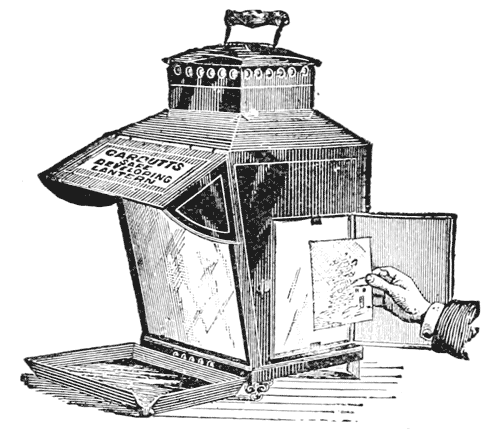
which has proved to be most suitable for this particular purpose.
The paper having been placed in the printing frame, the frame is set up,
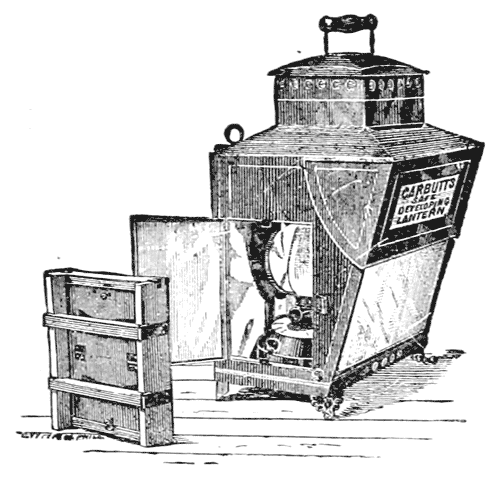
Lantern arranged for making positives by contact.
as seen in the cut, and the door in the side of the lantern opened, which permits the white light from the lamp to fall upon the surface of the negative; an exposure of from 5 to 10 seconds is all that will be necessary, even in case the negative is quite dense; a thin negative will print with less exposure, say 3 to 5 seconds, at a distance of from 12 to 15 inches from the light.
The paper when taken from the frame presents no change of surface, and must be developed in the same manner as a dry plate, to bring out the picture.
Previous to developing, lay the paper in a dish of clean water for a short time, and then transfer it to the developing tray.
The developing is done by the ferrous oxalate process. Solutions as follows:
Saturated solution oxalate potash3 oz.
Saturated solution photosulphate iron½ oz.
Bromide solution (12 grains bromide of ammonium to 1 oz. water)¼ dram.
Saturated solution tartaric acid2 drops.
This developer can be used several times successively until it becomes turbid. The best way is to first print and develop one print, to ascertain the proper time of exposure. Then make as many prints as are necessary, and develop them all together in a dish large enough, and with sufficient of the solution to cover them nicely. Observe carefully not to develop too far, as the resulting prints will be too dark. When the prints are developed, wash them well and fix them in a new solution of
Hyposulphite of soda1 ounce.
Water.8
The fixing will require from five to ten minutes; then wash and pass the prints through a clearing solution consisting of
Alum2 ounces.
Water6
then wash again and hang up, or place between clean blotters to dry.
It is necessary that the hands be free from any trace of silver or hypo when handling these prints while developing, or afterwards when wet, to avoid stains, etc. The same precautions as to the relative proportions of the oxalate solution and the iron are to be observed as for the development of negatives.
THE MAGIC LANTERN AND ITS USE
The Magic, or, more properly, the Projecting lantern, is an optical instrument, consisting of a case of wood or metal, enclosing a lamp or other illuminating agent, the light of which being gathered and condensed by a suitable condensing lens, and directed upon a small transparent picture, so powerfully illuminates it that its image, brilliantly lighted and greatly magnified, may be projected upon a distant screen by means of an objective—a combination of lenses in a tube—similar or identical in construction with a photographic portrait lens.
The modern projecting lantern, now a scientific instrument, bears very little if any resemblance to the earlier magic lantern, which was a rude construction, and, as its name implies, was first used by magicians, or professors of the magic arts, as a means of imposing upon the ignorance and superstition of their times. Later it became a toy for the amusement of young people. And occasionally it furnished amusement for popular assemblies, at what were called Magic lantern exhibitions, usually the projection upon a screen of greatly enlarged images of a series of comic pictures painted in brilliant colors upon glass.
The perfected instrument is now used in advanced schools and colleges for illustrating scientific lectures, and more popularly by public lecturers to illustrate by luminous projection scenes and incidents of travel, etc., without which the mere narrative would be exceedingly dry and devoid of interest.
Since dry plate photography became a popular amusement, the projecting lantern has greatly increased in public favor, and the members of the amateur photographic societies and camera clubs throughout the country are interested and engaged in the production, as slides for the lantern, of views of almost everything in animate or inanimate life.
The projecting lantern, in its highest development, is a complicated and costly instrument, the different designs and constructions of which have received, each, a long and high-sounding name, the antepenultimate of which is usually of Greek or Latin origin, such as panopticon, sciopticon, stereopticon, etc., etc., and requiring such powerful illumination as can only be furnished by the oxy-hydrogen or calcium lights or electricity.
A new instrument, however, suitable both in cost and in means of illumination for amateurs and amateur societies, has lately been introduced by Messrs. E. & H. T. Anthony & Co., which, to be in the fashion, has received the name Triplexicon.
The Triplexicon is the perfection of oil-burning lanterns; in it refined petroleum oil is burned in a burner having three wicks; the centre wick being opposite the centre of the condensing lens, and in its optical axis, entirely removes the most objectionable fault of such lanterns, the central shadow or flare.
The Triplexicon, therefore, being of its class the most perfect instrument, and requiring little if any skill to manage it, becomes the appropriate instrument for the amateur photographer whereby to exhibit in a very acceptable manner the trophies of his skill in the use of the camera and alkaline pyro.
A gentleman thoroughly familiar with all the various modifications of the magic lantern, in describing the Triplexicon says of it:
"We have seen many lanterns in our time, and in several respects this eclipses them all, especially those for use with kerosene oil only. The lamp itself is completely shielded with a well-made hood of Russia iron,
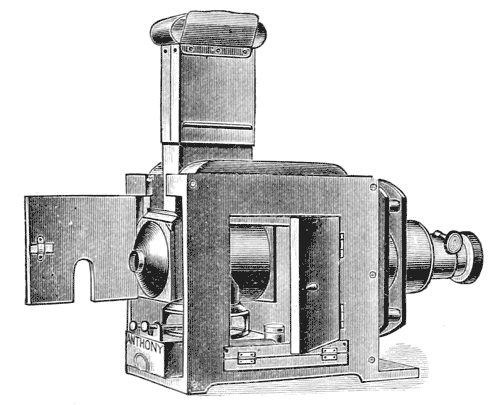
and is provided with the patent triplex wick, which affords the utmost illumination obtainable with any oil light. The back and front of the hood are closed interiorly by glass plates, specially annealed to withstand extreme heat, and the rear one is again closed by perforated sheet iron, covered interiorly with a highly polished metallic reflector, back of which is inserted an eye piece of ruby glass. The latter enables one to always observe the condition of the flame and wicks, and regulate them without disturbing or discontinuing the action of the instrument. The chimney is made telescopic, to pack more compactly."
"The diffusing lens, specially constructed for the purpose, is mounted on a cylindrical slide to extend, if necessary, the focal distance, while the condensing lenses, which are of four inch diameter and can be separated for cleaning, are inserted in a corresponding slide within the wooden case.
"The case itself is quite compact, and appears very ornamental in its highly polished mahogany, with its little bronzed ventilators on either side at the bottom. The metal front is burnished and has a spiral spring adapter for the admission of the slides. A substantial wooden box contains all, and serves also as a table for the instrument while in use. Altogether this is the finest example of its kind we have yet seen; it will also serve admirably for enlargements with the gelatino-bromide paper."
LANTERN SLIDES.
The pictures prepared for projection by the magic lantern are made on glass of one size, invariably 3¼×4 inches, and are copies of negatives made by transmitted light and by two methods. When the negative is made by the detective, or pocket cameras and on plates 3¼×4¼, the positives or slides may be made by contact printing; that is, the prepared plate is placed in contact with the negative, film sides together or touching in a printing frame, the back pressed closely down and the plate exposed to the light of a gas or lamp flame—daylight is too strong—for from five to ten seconds, according to the density of the negative; the plate is then developed perfectly with ferrous oxalate until the picture is seen clearly on the surface; when the shadows have become sufficiently dense, or before there is any discoloration of the high lights, remove and wash and fix in hypo and alum. (See Roche's formula in article on Transparencies.) Remember that all parts of the pictures that represent the whites should be clear glass.
When the negative is larger than the slide, then the copy must be made in the Camera. (See article on transparencies.)
It is claimed by some that slides made by the collodion process are superior to those made on dry plates, but in my own personal experience I have found Anthony's transparency dry plates superior to all others and better than collodion.
To protect the film surface of the slide, thin, clear glass of a corresponding size is placed against the film surface with a paper mat (the opening of which should closely correspond with the outline of the picture) between, and the two bound together neatly with adhesive paper.
PRINTING BY ANTHONY'S COLLODIO CHLORIDE.
Collodio chloride is a collodion emulsion, consisting of plain collodion and silver chloride. It is a grayish-white substance in liquid form, and being quite sensitive to light, it must be kept in a covered bottle.
Anthony's collodio chloride is supplied in 8-ounce or larger bottles, and will keep indefinitely. The formula for its preparation is not known, but it is sold at a price that renders its preparation by individuals unprofitable.
The following formula will give a superior quality of collodio chloride to those wishing to make their own.
FORMULA FOR COLLODIO CHLORIDE.
No. 1.
Nitrate silver1 drachm.
Water1 dram.
No. 2.
Chloride of calcium64 grains.
Alcohol2 oz.
No. 3.
Citric acid64 grains.
Alcohol2 oz.
To 2 oz. plain collodion add of
No. 130 drops.
No. 21 dram.
No. 3½ dram.
By the use of this emulsion most beautiful pictures may be made on paper and upon porcelain, opal, stoneware, and other plain white surfaces.
When paper or any other flexible surface is to be used, it is simply coated with the emulsion. First place the paper flat upon a square of glass and pour upon it the emulsion, causing it to flow evenly over the whole surface and the excess to flow back into the bottle from the lower corner. This must be done in a subdued light, but not necessarily in a dark room or by non-actinic light, as in the case of the use of gelatine bromide paper.
When the paper is coated it should be placed in a closet or some dark place to dry, and when dried it is printed in the same manner as silver paper, by placing it in a printing frame in contact with a negative. It is printed by sunlight, and may be examined while printing, to see the progress made. The printing should be carried a shade or two beyond the color suitable for a finished print, and when done should be washed in clean water and toned with gold, and afterwards fixed in hyposulphite soda and again well washed in the same manner as for silver prints.
Flat porcelain or other enameled surfaces, before being coated with the emulsion should be albumenized in the same manner as glass plates for the collodion process.
The white of an egg to 6 ounces of water, well beaten, will be the most suitable proportion for this purpose.
For printing on porcelain or other enamel plane surfaces, specially prepared printing frames are necessary in order that the progress of the printing may be ascertained.
All articles with uneven surfaces, such as plaques, plates, saucers, of porcelain china or stoneware, that cannot be placed in printing frames, may have pictures printed on them by the aid of the Solar Camera or by Anthony's Enlarging Camera, and the lime or the magnesium light.
See Anthony's Enlarging Camera.
THE ENLARGING CAMERA
Method of making large pictures from small negatives.
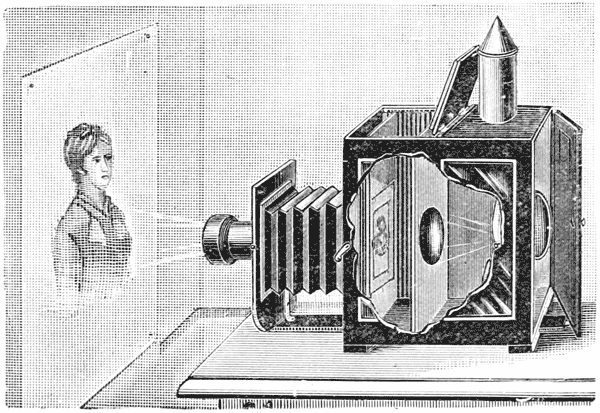
The prevalent use of the Detective Camera, and other cameras, for making pictures on small plates, has caused a demand for an apparatus whereby large pictures may be produced from such negatives.
This demand has been met by the production of Anthony's New Enlarging Camera in connection with the Gelatino bromide papers.
This enlarging box is at once simple and effective. It consists of a black wooden box containing a good kerosene lamp. The sides of the box have a number of grooves that carry a slide holding a large condensing lens, O, while another slide holds the negative, N, that is to be printed.
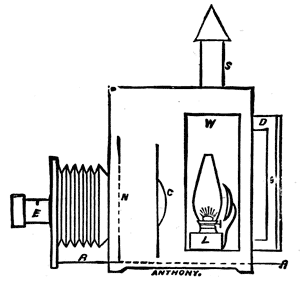
To the outside of one end of the box is attached a sliding bellows, and an objective, E, by which the picture is enlarged and thrown upon any white surface. In a few words, the enlarging box is a small solar camera, but using artificial light instead of the sun's rays; or it is a magic lantern so arranged that no light can come out of it except that which passes through the objective.
The use of the instrument is as simple as its construction. The lamp is lighted, and then adjusted in the box so that a shadowless circle of light is projected upon a white wall or other surface, all the light being utilized by means of the reflectors situated back of the lamp. This adjustment is effected by moving the condensing lens and the lamp nearer or farther apart. It is perhaps best to place the condenser in a groove near the objective, but sufficiently far from the end of the box to allow the slide containing the negative to be inserted. Having obtained a good circle of light, now place the negative in the slide and adjust the slide in the box so that it is between the condensing lens and the objective, and as close to former as may be. By means of the objective a good focus is now obtained, and we are ready for an enlargement.
With this apparatus and an artificial light, of course rapid printing paper is necessary. The cap is placed on the objective, and by the aid of red light a piece of the gelatino bromide paper is adjusted on the surface where the image was projected from the enlarging box. This part of the operation maybe assisted by removing the cap from the objective and placing a piece of ruby glass before it, allowing the image to fall on the paper through the ruby glass. A simple and effective way of holding the paper is to tack two common wooden laths upon a board in such a way that they will serve to hold the paper along two of its longer sides, in which case the board must be used to focus upon.
The exposure necessary will depend upon the density and character of the negative. With a medium density in a portrait negative, one minute appears sufficient, but something also depends upon the paper used, those of English manufacture being rather slow. With a little care and this little contrivance much pleasure and success are attainable in enlarging pictures from small negatives.
The use of the new "tooth" surface printing paper admits of the application of crayons to the enlargements.
By substituting the lime or the magnesium light for the kerosene lamps, pictures may be printed by the collodio chloride process upon a variety of uneven surfaces, such as plaques, plate, saucers, pots, etc., etc.
In fact, this instrument might very easily be converted into a solar camera by fixing it in a window and adjusting a mirror outside that would reflect the sun's rays into the condenser within the box.
TO ENLARGE NEGATIVES BY THE REVERSING ACTION OF LIGHT.
Having coated a plate with the common negative collodion and excited it in the usual nitrate of silver negative bath, expose it to the light for about a second at the door of the dark room, wash it and then apply to the surface as a wash a solution of
Iodide of potassium16 grains.
Bromide of potassium8 grains.
Water1 ounce.
The plate is now ready for exposure in the enlarging camera; the lime or the magnesium light being sufficiently powerful for the purpose. On its removal from the camera the plate is washed, immersed for a brief period in the nitrate of silver bath, or otherwise treated with a solution of this salt, after which the image is developed by the ordinary developing solution for wet plates. In this way is obtained an enlarged negative from a small one without the necessity of an intermediary transparency.
PRINTING WITHOUT SALTS OF SILVER, FROM THE "SILVER SUNBEAM."
The discovery that certain of the per salts of iron when exposed to light undergo decomposition and are reduced to proto salts, is attributed to Sir John Herschell. But we are indebted to Poitevin for numerous interesting developments in this department.
For instance, the per-chloride so exposed becomes reduced to the proto-chloride; or, as Von Monckhoven more appropriately remarks, to the state of oxy-chloride. For this purpose the sesqui-chloride must be quite neutral. The ammonia tartrate, potassa tartrate and the ammonia citrate of iron are much more sensitive to light than the sesqui-chloride, and the latter salt (ammonia citrate) most of all.
The image formed by means of these salts is much fainter than that with the chloride of silver; but it can be intensified by the application of other metallic salts.
The mode of operation consists in floating the paper on the solutions in question in the dark room, in allowing them to dry, and then exposing them afterward beneath a negative, as usual with paper prepared with chloride of silver.
THE FERRO-PRUSSIATE, OR BLUE PROCESS.
The preparation of the paper by this process is very simple, and requires very few manipulations, while the results, when prints are made, are pleasing and lasting. Prints in blue are so easily made as to be extremely convenient for making proofs from negatives, and they are well adapted for mottoes, plans, drawings, manuscript, circulars, and for representations of scenery, boats, machinery, etc., etc., and for engravers' use.
Ferro-prussiate paper can be procured from E. & H. T. Anthony & Co., or can be easily made by the following formula:
Float the paper until it lies quite flat upon a solution prepared as follows:
1. Water2 ounces fluid.
Red prussiate of potash120 grains.
2. Water.2 ounces.
Ammonia citrate of iron140 grains.
When these two are dissolved, mix them together and filter into a clean bottle.
The solution should not be exposed to a strong light, and the paper must be floated on it in a very subdued light, and in the same manner as paper is floated on a silver solution. When it no longer curls, but lies flat on the solution, take it by the corners and raise it slowly from contact, and hang it up to dry in a dark place. When dry, it can be used at once, or may be kept for future use by rolling it, prepared surface in, and placing it in a tin box or other receptacle, free from light and dampness.
To make a print on this paper, place the prepared surface in contact with the negative in a printing frame and expose to sunlight.
The time of exposure will vary according to the density of the negative and the intensity of the light. The rule is to allow the light to act long enough for the portions which first turn blue to become gray, with a slight metallic luster. At this point remove the paper from the frame and place it in a dish of clean water.
It now gradually becomes a rich blue throughout, except the parts which should remain white. Change the water from time to time, until there remains no discoloration in the whites; dry, and the picture requires no further treatment.
The blue color may be totally removed at any time by placing the print in ammonia water.
This is the standard formula.
ANOTHER PROCESS FOR BLUE PRINTS.
Float the paper for a minute in a solution of
Ferridcyanide of potash1 ounce.
Water5 ounces.
Dry in a dark room, and then expose beneath a negative until the dark shades have assumed a deep blue color, then immerse the print in a solution of
Water2 ounces.
Bichloride mercury1 grain.
Wash the print, and then immerse it in a hot solution of
Oxalic acid4 drachms.
Water4 ounces.
Wash again, and dry.
ANOTHER PROCESS—THE CYANOTYPE.
Float the paper on a solution of the sesqui-chloride of iron. Dry and expose, afterwards wash the prints, and then immerse them in a bath of ferrid cyanide of potash. The picture will appear of a blue color in all those places where the sun has acted.
PROCESS WITH SALTS OF URANIUM.
The paper, without having undergone any preceding preparation, except that of having been excluded from the light for several days, is floated on a bath of the nitrate of uranium as follows:
Nitrate of uranium2 drachms.
Distilled water10 drachms.
The paper is left on the bath for four or five minutes, it is then removed, hung up and dried in the dark room. So prepared, it can be kept for a considerable time.
The exposure beneath a negative varies from one minute to several minutes in the rays of the sun, and from a quarter of an hour to an hour in diffused light. The image which is thus produced is not very distinct, but comes out in strong contrast when developed as follows:
NITRATE OF SILVER DEVELOPER.
Distilled or rain water2 drachms.
Nitrate of silver7 grains.
Acetic acida mere trace.
The development is very rapid in this solution. In about half a minute it is complete. As soon as the picture appears in perfect contrast, the print is taken out and fixed by immersion in water, in which it is thoroughly washed.
CHLORIDE OF GOLD DEVELOPER.
This is a more rapid developer than the preceding. The print is fixed in like manner by water, in which it must be well washed, and afterwards dried. When dried by artificial heat, the vigor of the print is increased. Prints that have been developed by the solution of nitrate of silver may be immersed in the gold bath, which improves their tone.
The picture may be developed, also, by immersing the prints in a saturated solution of bichloride of mercury and afterwards in one of nitrate of silver. In this case, however, the times of exposure must be increased.
Pictures may be obtained, also, by floating the papers on a mixture of equal quantities of nitrate of silver and nitrate of uranium in about six times their weight of water.
When dry, they are exposed beneath a negative. In this case the image appears, as in the positive printing process, with chloride of silver, being effected by the decomposition of the nitrate of uranium, which, reacting on the nitrate of silver, decomposes this salt and reduces the silver. These prints require fixing in the ordinary bath of hyposulphite of soda, and then washing, as usual.
PROCESS FOR RED PICTURES.
Float the papers for four minutes in the preceding bath of nitrate of uranium, drain and dry. Next, expose beneath a negative for eight or ten minutes, then wash and immerse in a bath of
Ferridcyanide of potash30 grains.
Water3 ounces.
In a few minutes the picture will appear of a red color, which is fixed by washing thoroughly in water.
PROCESS FOR GREEN PICTURES.
Immerse the red picture, before it is dry, in a solution of
Sesqui-chloride of iron30 grains.
Distilled water3 ounces.
The tone will soon change to green; fix in water, wash and dry before the fire.
PROCESS FOR VIOLET PICTURES.
Float the paper for three or four minutes on a bath of:
Water2 ounces.
Nitrate of uranium2 drachms.
Chloride of gold2 grains.
Afterward take them out and dry. An exposure of ten or fifteen minutes will cause the necessary reduction; the picture has a beautiful violet color consisting of metallic gold. Wash and dry.
TRANSPARENCIES ON GLASS AND OPAL.
Photography, throughout its varied range, produces no more charming or satisfying picture than the transparency, whether it is on glass for the window, or on porcelain or opal for the lamp.
The beautiful and sparkling gradation of light and shade, the variety and depth and richness of tone and color inherent in a fine example of this picture, renders it most positively "a thing of beauty and a joy forever,"
It is a picture made by a peculiarly simple and easy process, the most exalted expressions of which have always commanded the popular favor and a high price, and the working of which has, both for the amateur and the professional photographer, the highest interest and attractiveness. By no other method or process can the amateur succeed in producing pictures of equal excellence, with the same outlay of time and skill, which is a peculiarly fortunate circumstance, as the tendency among amateurs at this time is to form themselves into clubs and societies for the exchange of their most beautiful and successful efforts as picture makers. And an exchange in the form of a transparency enables the receiver to command all other styles of pictures, through the negative that may be produced from it.
The production of these pictures has assumed such importance already as to have called forth a special dry plate for making transparencies, to say nothing of the other special goods for the same line, such as metal frames, ground, engraved and etched glass for mounting, the beautiful borders of which greatly enhance the beauty and elegance of the finished picture.
Transparencies are adaptable for the exhibition of every kind of picture that can be copied; paintings, engravings, portraits, landscapes, all become equally acceptable when skilfully finished and properly displayed.
By this process, also, the amateur is enabled to provide himself with slides for his magic lantern and to have the satisfaction of exhibiting to his friends the trophies of his own skill in the use of the camera and the developing solution.
The amateur, in order to succeed in producing high class work, should possess himself of one of Anthony's duplicating and copying cameras, so that he may be enabled to avail himself of both methods of work; that is to say, by the camera and by contact printing, as by the latter method he is restricted to the range and size of his negatives, while by aid of the camera he is enabled to copy all kinds of pictures to acceptable sizes, and he can make his transparencies of equal size with his negative, or vary the size to suit the requirements of the case.
The use of the duplicating and copying camera is fully detailed in the article on Duplicating Negatives. By its use the amateur is enabled to work by the wet collodion process, which has many advantages, or by the dry plate process, using Anthony's transparency plates or the gelatino albumen plates made in Philadelphia. If he confines himself to contact printing, he is restricted to the use of dry plates only.
The outfit of goods for making and finishing transparencies consists of:
Transparency frames, common and patented, made with rings for hanging horizontally or vertically.
Ground glasses, with borders.
Etched glasses, with borders.
Anthony's transparency plates.
Gelatino albumen plates.
Porcelain and opal plates for lamp shades, etc., etc.
FORMULA FOR DEVELOPING DRY PLATE TRANSPARENCIES.
When making transparencies by contact use artificial light, either gas or a common lamp. A deep printing frame is the most suitable, having a piece of thin plate glass in it to support the negative. Lay the negative down with the film side up, place upon it the dry plate, put in the back and press firmly down with the springs; expose to gas light from six to ten seconds at a distance of twelve to fourteen inches; expose longer to lamp light, say from ten to twenty seconds, or the duration of time that may be considered sufficient, judging from the density of the negative in use.