INTRODUCTION.
Reading edition
The most important improvement in photographic processes that has been introduced since Maynard first made collodion, and Archer discovered its adaptability to the production of photographic negatives, is the gelatine bromide dry plate.
Wet plate photography had reached its utmost point of adaptability to the demands of the times.
A few men of marked ability, and the skill of long study and practice, had reached the point of highest excellence in working with collodion, and the great multitude were pressing on toward that designated height to which it was given to but few to attain.
It had been demonstrated that wonderfully beautiful effects could be produced by the collodion process, but that there was a limit beyond which progress could not be made. The great range of subjects in still and animate life requiring very rapid exposures, were practically out of the power of collodion, to compass satisfactory results. At this time, when there seemed to be a very constant and increasingly urgent demand for more rapid acting lenses and for "lightning processes," there appeared the wonderful argentic bromide Gelatine Emulsion, which, in four short years, has superseded the collodion process almost, if not altogether, and besides (notwithstanding the opposition of the elite of the profession, whom for a time it leveled with the rest of the workers, but who were quick to see and acknowledge the extraordinary merits of the new candidate) it has caused such a quickening of the pulses of the business, and such an increase in its range and adaptability as never before was known, and which, in the year or two past, has caused such an activity in invention and in other ways, as to make that period of time so remarkable for the many new things that have been brought out, and the many new processes that have been adopted, as to render a detailed account of such for the profession, and also for the amateur, most desirable.
It is with such a view that this book is offered to the photographic public, and that numerous and still increasing army of amateurs, who have taken up photography as an amusement, to while away a leisure hour.
For to these latter a few hours' study of a good hand-book is about all that is necessary to enable them to expose and develop a dry plate, a little practice only being requisite to the successful performance of the same.
There may be many, however, who, having made a promising commencement, would like to proceed farther and acquire a knowledge of former photographic processes, as well as those which succeed the making of the negative, such as printing, toning, fixing, etc., and in fact, learn how to make a finished photograph.
To such, particularly, and to all photographers, this book is offered, in full confidence that it will be a useful companion in the studio and in the field.
To accomplish this end we will take the reader as an apprentice, and commencing at the beginning, instruct him in that knowledge he would have to acquire were he an actual apprentice in a photographic studio, working the wet collodion process, after which an equally full course of instruction will follow for the dry plate and other new processes, both for negative making and for printing.
In the following pages, also, will be found many useful formulæ that have been carefully culled from a mass of published contributions, from many of the leading spirits in photography, most of which have been verified practically by the author, and others bear on their faces so plainly the impression of their practicability as to need no assurance that they are reliable.
In getting up this work I have availed myself of information from any and all sources at my command, giving credit where possible, and endeavoring to make everything clearly understandable, and neglecting no details necessary to the successful working of every formula, even by the youngest learner.
GLASS.
QUALITY OF GLASS SUITABLE FOR PHOTOGRAPHIC PURPOSES AND HOW TO PREPARE IT.
Mr. Hardwick, than whom there can be no more faithful or competent guide, says that much care should be taken in the selection of glass to be used in the production of photographic negatives.
Window glass is always unsuitable, because of its inferior quality, having scratches upon its surface and air bubbles in its substance, each of which causes irregularities, as well in the negatives as in the subsequent printing; also the squares are seldom flat so that they do not lie true in the holder, and hence a part of the image may be out of focus; and also they are extremely liable to be broken by compression in the printing frames.
Formerly many photographers used a thin plate glass of very fine quality, but of late years the great demand for glass suitable for such purposes has made it possible for the manufacturers to prepare a cheaper quality, well adapted to the uses of photography.
TO PREPARE THE GLASS FOR USE.
Before proceeding to wash the glass, each square should have its edges roughened, by means of a file or a coarse stone, or the edges of two pieces of glass may be abraded against each other in such a manner as to remove the sharpness, which is so liable to injure the fingers in the various manipulations.
In the process of cleaning the glass it is not sufficient to wash it with water. Other means are necessary to remove grease, rust and dirt, which would not yield to the influence of water alone, and for this purpose a solution of caustic potash is most generally used.
The glass is immersed in the potash solution, each piece separately, and when the dish is full, it should be left not longer than is necessary for the potash to have its proper action, for when left for a considerable time the solution of potash (if strong) will attack the surface of the glass, to its injury.
When a suitable time has elapsed (which in the case of new glass should not be more than one day or night, and in the case of old negatives not longer than to cause the film to slip off), the glass should be removed and washed with water, after which it should be immersed in the same manner, in a solution composed of four parts of water to one of commercial nitric or sulphuric acid, or the two mixed, as may be the most convenient.
This latter solution removes rust or other metallic blemishes, that have not been affected by the potash, and also effectively neutralizes all traces of the potash that have remained on the surfaces of the glass.
The glass may be permitted to remain in the acid an indefinite time, as it can have no injurious effect on it, as might the potash, and when required for use, it should be carefully washed and immediately albumenized and set up in racks to dry.
ALBUMENIZING THE GLASS.
While the glass is still wet from the washing, after being taken from the acid, it should be coated with a preparation of albumen, prepared as follows:
To the albumen or white of a fresh egg, add eight ounces of water; put it in a bowl and thoroughly beat it with an egg beater, or in any manner that may be convenient, until the fibre or structure is completely destroyed, when it should be filtered through loose cotton, and after the addition of a few drops of strong ammonia, it is ready for use.
Many prefer to beat up the albumen before adding the water, in which case it should be beaten into a stiff froth, when the proper amount of water is added, and after the froth has subsided the whole is filtered and the ammonia put in last.
The albumen being prepared and the glass ready, a square is taken in the left hand, and clean water flowed over it, until no particle of dust can be seen adhering to either surface, when a small portion of the albumen is flowed on it, and after covering every part of the surface the excess is allowed to drain off the right hand lower corner, after which, if running water is at hand, the back of the same portion of the plate should be passed under the faucet, and the water will carry off any excess of albumen which might return or crawl, as it is termed, up the back of the plate from the point where it is drained.
The greatest care should be taken to avoid dust settling on the plate during the coating and afterwards while drying, and after the glass has been coated, if it is found that any dust adheres to the albumenized surface, it should be again washed and recoated.
It is important that the back of the glass should be kept free from the albumen, so that when the plate is afterward collodionized and immersed in the silver solution, there should be no albumen uncovered to contaminate the bath, and as most of the glass used has some slight inequalities of surface, the albumen should always be flowed on the concave side, for two reasons:
The first is, that when sensitized and placed in the holder, the pressure, being against the convex side, may have a tendency to counteract the curve and make the plate flatter and more perfectly adjusted to the focus.
The other reason is that the pressure of the printing frame has a less tendency to break the glass when against the concave side.
The amount of glass required having been albumenized and set up in racks, it should be carefully covered with paper to exclude dust, and it should be set away to dry, after which it should be placed in its proper receptacle in the dark room, ready for use.
The reasons for albumenizing the glass are important.
Before this process was adopted, all glass used for photographic purposes, after being subjected to the action of potash or acid, or both, had to be finely polished with rottenstone or some other polishing substance, to render its surface sufficiently free from all traces of acid, organic matter, rust, etc., which would injuriously affect the collodion or the deposit of silver iodide derived from the bath.
This polishing was very laborious, and in consequence it was often very imperfectly done, causing much loss of time and material; also the glass thus prepared did not offer to the collodion a surface to which it could adhere with much tenacity, and in consequence it would frequently slip from it in the subsequent manipulations.
The first reason for Albumenizing then, is to cover the surface with a substance chemically pure, and when dry of a crystaline nature and impervious to, or at least not soluble in the silver solution, thus saving the labor of polishing.
Another reason is that the albumen offers a surface to which the collodion will adhere with extreme tenacity, thus saving and preventing the film from slipping.
COLLODION.
"The discovery that explosive cotton was soluble in ether, was made by Mr. Maynard, who gave it the name of Collodion, and later, in 1848, published in the American Journal of Medical Science the formula for its preparation."
"This ethereal solution, having a certain proportion of alkaline iodides, and iodides of silver added thereto, constituted the collodion first employed by Mr. Archer," who thus shares with Mr. Maynard, and with a Mr. Legray (who first published an account of its use as a photographic agent) the honor of having given to the world the collodion process in photography.
The progress that has been made since Mr. Archer's time in perfecting the adaptability of collodion to photographic uses could not be better illustrated than by comparing the formulæ for collodion first published with those in use at this time.
The practice of photography in the present day by the collodion process is divided into two branches, the positive and the negative.
In the first the object is to obtain in the camera a direct image, which is to be viewed by reflected light, and as it is desired that the pictures so produced should possess pure blacks and whites, certain modifications of the collodion, silver solution and developer are resorted to, which cause these preparations to differ somewhat from those prepared for the production of superior negatives, consequently the formulæ given hereafter will be designated as positive or negative.
These modifications, however, are not of such a character as to render either of the solutions prepared for one process totally unfit to be used for the other, for in fact, many photographers at this day use the same collodion bath and developer for making both positives and negatives.
THE POSITIVE COLLODION PROCESS.
In the first place, we will take up for consideration the positive process.
The first positives on glass were called ambrotypes, and were the successors to the daguerreotype, which they superseded and displaced by the superior facility of their production.
For the same reason the ambrotype was succeeded by the ferrotype, which was a positive collodion picture, made on a thin iron plate with a black japanned surface.
The ferrotype or tintype is now about the only product of the positive collodion process of considerable importance, and is the only one that will receive consideration in these pages.
Ferrotype plates are sold by all dealers in photographic materials; they are mostly manufactured by two large concerns in Worcester, Mass.
COLLODION FOR POSITIVES.
As has before been stated, to produce the finest results in positive photography requires certain modifications of the collodion bath and developer, which, while not unfitting them altogether for negative work, yet would render them quite unsuitable for high class work.
The formula for positive collodion here given has many merits, and among those is a certain quality of film, which might be termed opacity, but not in the strict sense of the word; it is that quality in the film which enables it to cover up any small scratch or water mark on the surface of the plate that would infallibly spoil the picture, if almost any other collodion were used.
This quality, with great clearness or transparency in the shadows, and a beautiful gradation of light and shade, make it unique as a positive collodion.
There may seem to be a contradiction between the terms opacity and great transparency of shadows, which may need further explanation. As the shadows of a positive collodion picture are produced by the black surface of the plate showing through the collodion, any defect on that portion of the surface would be expected to show very plainly, and it does so with the use of the ordinary collodions sold by the dealers, but not so with the collodion under consideration, which may be because it is less permeable by the silver solution, and that consequently the deposit of iodide of silver lies more on the surface and less within the texture of the film, and is thus kept from contact with organic matter or other defects on the surface of the plate; in some such manner only, can I account for a very valuable quality that has saved thousands of plates, that would under other usage have been thrown away.
This formula has never before been published, and must be prepared as directed.
Alcohol and ether equal parts; gun cotton sufficient to make a moderately thick film, say 5 or 6 grains to the oz.; put the cotton in the ether first; when it is well saturated, pour in the alcohol. To which add:
Iodide of Ammonium4 grains to oz.
Iodide of Cadmium2
Bromide of Cadmium1
Bromide of Copper1
The latter ingredient can only be had in aqueous solution, I believe, and requires close calculation to get at the right quantity.
This formula gives 8 grains of salts to the ounce of collodion, and would require a silver solution of 50 grains to the fluid ounce to balance properly.
The silver solution may be prepared as per directions on page 29, under the heading—The Negative Bath.
HOW TO COAT PLATES.
The ferro-plate is held between the thumb and first two fingers of the left hand. The collodion bottle is held in the right hand, and the collodion is poured on the right upper end of the plate, flowed to the left upper corner, by deflecting the plate in that direction, and then down the left side toward the hand, and the excess run back into the bottle from the right lower corner, when it has all run off, the plate should be gradually brought to a perpendicular position and rocked from right to left, that is, perpendicular to the end, then to the side, until the film has set or become fixed, which may be ascertained by touching the film at the lower corner of the plate, when, if it breaks and does not run farther, it has set and should, without delay, be immersed in the silver solution, where it should remain until it has become fully sensitized, which will be in from 2 to 5 minutes.
The plate should be lowered into the bath by one continuous motion; any stoppage will cause a line and spoil the plate.
The plate is sensitized when on removing it from the bath it presents a smooth, yellowish surface; if it shows lines as of water running off a greasy surface, it is not coated; return it to the bath.
EXPOSURE OF THE PLATE.
The plate having become sufficiently coated is taken from the bath, well drained, and placed in the holder or shield, and a piece of glass of the same size put behind it, which is to receive the pressure of the spring on the door of the holder, and force the plate into its proper position evenly, so that all parts will be in focus.
The holder containing the plate is then taken to the studio, or light room, where the subject, we will say, has already been posed; the camera set and focused, the exposure is then made, after which it is returned to the dark room for development.
DEVELOPER AND DEVELOPMENT.
In the preparation of a developing solution for plate pictures, we must consider that we desire to produce a picture, which, to be admired, must have pure whites, clear shadows, be full of detail and have an easy gradation of light and shade.
That you may succeed in this object, use the following formula, and persist until you have learned its every modification:
DEVELOPER.
Water 64 ounces f.
Protosulphate of iron 4
Acetic acid 4
Alcoholic solution of tannin, 10 grains to the ounce 4
The four ounces of iron should be dissolved in the sixty-four ounces (fluid) of water, and the acetic acid and tannic alcohol added.
In using this solution, develop your plate over a large filter, which will receive all your surplus developing solution, and conduct it into a bottle for use again; drain the plate into this filter before washing, wash carefully and then place it into the fixing solution—the developing solution which has filtered through into the bottle is afterwards used in the proportion of one-half of old to one-half of the new or fresh solution. This greatly improves the high lights of the picture, and by using more or less of the old solution, effects can be produced that are impossible by any other means.
Great care should be taken to cause the developing solution to flow evenly and with one sweep, as it were, over the whole surface, so that the action may be as near as possible equal on all parts of the surface.
In a very few seconds after the action of the developer has commenced the picture will show up. The plate meanwhile should be kept in motion and the solution caused to flow from side to side and from one end to the other, in order that the development may progress evenly and with the same speed on all parts.
The picture will gradually grow and brighten, until all the detail that might be expected is seen in the shadows; then pour off the remaining solution into the filter and proceed to wash the plate until all traces of greasiness disappear; when the plate is sufficiently washed and is ready to be fixed or cleared. Another developing solution is prepared as follows:
Make a 64-ounce saturated solution of protosulphate of iron, into which drop tannin solution enough to cause a precipitate, which remains undissolved after shaking, then add drop by drop pure nitric acid, until the precipitate is taken up and the solution becomes clear. To one ounce of this add water, until it tests 18 to 20 grains to the ounce by the hydrometer, then add one ounce acetic acid, which perfects the formula and constitutes the developer.
FIXING SOLUTION.
The solvent most generally used for fixing or clearing positives is cyanide of potassium.
By the term "fixing" is meant the dissolving from the collodion film all the iodide of silver not acted on by the developer; the remaining portion of the silver is in a metallic state and constitutes the image; the cyanide very readily dissolves the iodide, but acts very slowly on the metallic silver.
This fixing solution should be contained in a glass upright dish, enclosed in a wood case, with a tight or close-fitting cover, this in order that as little exposure to the air as possible may be had, as the fumes arising from the evaporation of the solution are injurious.
Two ounces of cyanide to 64 ounces of water will make a suitable fixing solution for plate pictures; if, however, its action is thought to be too slow, add more.
The plate picture having now been developed and fixed, it only remains that it should be dried, varnished, cut into shape, placed in the proper envelopes and it is ready for delivery.
Those desiring more extended instructions in the making of plate pictures are referred to the work on that subject, entitled, "The Ferrotype and How to Make it," published by E. & H. T. Anthony & Co., of New York.
ARGENTIC DRY PLATES FOR POSITIVES.
The Phenix Plate Co., the largest manufacturers of ferrotype plates in this country, and whose name is familiar with every ferrotypist, as well as most photographers, have lately placed on the market ferrotype plates, with surfaces coated or sensitized with gelatine emulsion, which they, offer as a substitute for the ordinary collodion positive or tintype.
The plates are cut to sizes and packed in much the same manner as the Stanley or any other dry plates are, and being extremely sensitive to light, they must be handled with the same care.
The manufacturers claim, that "the 'Argentic Dry Plate' will be found far superior to any other form of positive plate, giving as it does the maximum of beautiful effects with a minimum of labor, producing a rich and brilliant picture with a rapidity and cleanliness never before attained, doing away as they do with the use of the silver bath and all its concomitant evils, pinholes, stains, fog, etc., not forgetting the vast saving in time and temper. The argentic plate is always ready-at-hand, and the working of it is simplicity itself. Their permanency and reliability is beyond question. These plates are extremely rapid. An exposure of from 1 to 3 seconds will suffice with a good light, 2 minutes to develop, 3 to fix, wash, dry and varnish, and the operation is complete, ready within ten minutes for delivery. For out-door views these plates work well with a drop shutter exposure, and the results, both for portrait and view work, are remarkable for fullness of detail, and great delicacy and softness of tone."
While these plates may be developed by the common ammonia pyro developer, the manufacturers claim, that "much finer effects may be produced by using the Phenix Stock Solution," that accompanies the plates, put up in 12 oz. bottles. By its use, greater rapidity of development, purer white, extreme brilliancy and finer detail can be obtained, the result being far superior to that produced by any other developer.
The following formula can be relied on to give excellent results, and by simply modifying the proportions, to "suit circumstances," will answer every purpose. As these plates are very rapid, six times more rapid than wet plates, guard well against white light.
Formula for development:
NO. 1.
Pyrogallic Acid 1 oz.
Water 12 oz.
Citric Acid 20 grs.
NO. 2.
Phenix Stock Solution.
Keep the Stock Solution securely corked.
NO. 3.
Bromide Potass.1 oz.
Water12 oz.
DEVELOPER.
Water4 oz.
No. 1 4 drams.
No. 24 drams.
If the plate be over exposed, add a few drops of No. 3. Should the plate, however, be under exposed, add one dram more of No. 2. When the plate is placed in the developer, the image will begin to appear in from 5 to 10 seconds. Continue the development until the details are all out. But be careful not to over-develop, and thereby obscure the shadows. Wash thoroughly after development, and fix in the following solution:
FIXING SOLUTION.
Cyanide of Potass.120 grains.
Water10 oz.
"Let the plate remain in the fixing basin until every trace of Bromide of silver disappears. Wash well after fixing, and dry with a gentle heat or flow the plate with alcohol for a few seconds. Set it aside, and it will dry in a few minutes without the aid of heat. For varnishing any good negative or positive varnish will answer. Apply a little heat to prevent chilling."
Directions accompany each box.
THE COLLODION PROCESS FOR NEGATIVES.
We now take up that more important branch of the collodion process, vis., that for negatives.
The formulæ and instructions already given for positives might enable one to make a negative, but the negatives so made would bear even a remoter relation to one made by the formula about to be given than would a positive made according to these formulæ bear to a good one made by the appropriate means. Important modifications are necessary to reach the highest excellence in either process.
NEGATIVE COLLODION.
To produce a good negative a collodion is necessary, the film of which is more permeable than that for positives, so that a heavier deposit of iodide of silver may be carried in the film, to the end that in the development a denser deposit of metallic silver may be secured on all parts of the image, but especially on the high lights, which should be sufficiently dense to prevent the transmission of light almost altogether, or at least to exclude the light sufficiently to allow the shadows and intermediate shades to print to the proper depth, while the high lights of the face and such parts of the clothing as are white shall be only slightly discolored.
There are very many formulæ for such collodions, some of which have proved to be eminently satisfactory, and among the best are classed the following:
NEGATIVE COLLODION. A.
Ether and alcohol, equal parts. Climax cotton (Anthony's), 3 grains to the oz. Negative cotton (Anthony's), 1 grain to oz. Place the cotton in the ether first, then add the alcohol and sensitize with
Iodide of Ammonium3 grains to ounce
Iodide of Lithium 1
Bromide of Cadmium 2
Collodion prepared after this formula gives very pleasing results and is rather more rapid than the average.
In many cases it is well to have two samples of collodion differing in formulæ, mixing them in varying proportions, according to the effect desired.
A good formula for mixing with the above is as follows. It can be used separately if desired, but is not primarily intended to be used alone:
Plain collodion, prepared as in the preceding formula, but with a different cotton, Anthony's snowy Cotton, for instance, to each ounce of the plain collodion add:
Iodide of Potassium2½ grains
Bromide of Cadmium2
Iodide of Cadmium2½
The iodide of potassium is insoluble in absolute alcohol and ether, therefore it must be first dissolved in the smallest quantity of water possible and then added to the collodion. A portion will even then most probably be precipitated; if it is not, it would be an indication that the alcohol or ether used were either one or both of a higher specific gravity than they should be.
It is more important that the ether should be pure than the alcohol, as the former is often contaminated or adulterated with water as well as with alcohol, and sometimes contains impurities of an acid nature.
Ether, for photographic purposes, should not have a higher specific gravity than 720, and the alcohol should never be used for collodion when below 95 per cent., as the presence of water in the collodion makes the film weak and glutinous.
Most formulæ for collodion prescribe alcohol and ether in equal parts, but these may be varied with advantage during the hot season; for instance, the alcohol may be used in somewhat larger proportion, as the tendency to evaporation is much more with a high temperature, and alcohol evaporates less rapidly than ether. Consequently the flowing quality of the collodion and the evenness of the film would be promoted by a not too rapid congelation or setting of the film. And again, during the cold season, the ether may be used in larger proportion, to promote a more rapid evaporation and setting of the film. By a moderately close observation of the action of collodion under varying temperatures, the operator might soon learn how to modify his formulæ to suit all conditions of heat and cold.
It should be mentioned that it would not be correct to vary the proportions of ether and alcohol very greatly, as an over proportion of alcohol would render the collodion weak and glutinous, and, being very soluble in water, would the sooner injure the silver solution. On the other hand too great a proportion of ether would make the collodion less sensitive.
NEGATIVE COLLODION. B.
Alcohol and ether, equal parts.
Anthony's Negative Cotton3 grains to ounce
Anthony's Climax Cotton1
Put the cotton into the ether and let it become saturated, then add the alcohol. Excite with
Iodide of Ammonium3½ grains to ounce
Iodide of Cadmium2
Bromide Cadmium2½
Collodion sometimes, from long keeping, loses sensitiveness and becomes of a deep red color. When such is the case, it should be set aside and fresh samples prepared, which would be improved in working quality by the addition of small quantities of the old, and thus old stock may be used up without deterioration in the work.
Negative collodion should not be so heavy bodied or thick as that for positives; neither should it be so highly excited. Good positive collodion should have as many as 8 grains of the iodides and bromides to the ounce, requiring a silver solution not lower than 50 grains strong and going somewhat higher in cold weather.
The standard silver solution for negatives is 45 grains of silver nitrate to the ounce of water and the collodion from 5½ to 6½ grains to the ounce, with a tendency to less in cold weather.
Collodion for negatives should be permitted to ripen a day or two before using, unless it is brought to that state by mixing with old.
NEGATIVE COLLODION. C.
Iodide Ammonium192 grains
Bromide Cadmium128
Bromide Potassium96
Ether and Alcohol32 oz. each
Cotton 320 grains
The preceding formulæ are for portrait work in studio. For other work, such as outdoor views, landscape or architectural, or for copying engravings, etc., certain modifications of the collodion, to produce greater intensity or more contrast, are desirable. Collodion suitable for such purposes can always be purchased from the photo stock dealer, in quantities desired, and for that reason it is not best for the amateur nor the professional photographer either, to prepare small samples for special purposes. If it should, however, be found at any time necessary to prepare such a collodion, the second formula of Negative Collodion A will be found suitable for views of buildings, copies of engravings and such like work.
It was at first thought to be unnecessary to give a formula for the preparation of pyroxiline or gun cotton, as no individual not in the business can possibly produce an article that can be in any way compared to that made by manufacturers of skill and experience.
For the benefit of any one wishing to experiment, this formula is given:
FORMULA FOR MAKING COLLODION COTTON.
Sulphuric Acid6 oz.
Nitric Acid4
Water2
Mix and the temperature will rise to 170° F.
Inmerse dry cotton wool (best long fibre), be sure wool is dry, draw it in long flakes and pull it under acids with a stout glass rod; do not crowd in too much, take care that each tuft is well wetted with the acids before putting in a fresh tuft. Carefully cover the vessel and put it where any slight fumes may escape; leave it for at least 12 hours—20 hours will not spoil it. When ready, lift cotton out and plunge it into a large quantity of water, quickly separating the tufts with glass rods, wash in changes of water, until no acid is left, then wring the cotton in a coarse towel until dry as possible and pull it all apart and place in the air to dry.
COLLODION WITH ABOVE.
Alcohol 5 oz.
Ether10
Cotton100 grains
TO IODIZE:
Alcohol5 oz.
Iodide Ammonium 60 grs.
Iodide Cadmium30
Bromide Cadmium20
Dissolve the iodides in the 5 oz. alcohol or in the whole 10 oz., if desired, then put in the 100 grains cotton, shake well, then add the 10 oz. ether and shake till the cotton is all dissolved; it will be ready for use in a few hours, and will improve with age.
THE NEGATIVE BATH.
The silver solution for a negative bath is prepared in substantially the same manner as for a positive.
Two thirds of the amount of silver nitrate intended to be used, should be dissolved in the quantity of water required to make the bath, and a grain or two of iodide of potassium added and placed in the sunlight until the solution has changed color, become turbid, and again clear and colorless. This change is caused by a minute portion of the silver combining with the organic matter and with other impurities in the water, if there are any; a molecular change then takes places, oxygen is evolved and the infinitesimal portion of silver changes to a metallic state and sinks to the bottom, carrying with it the impurities, which induced the chemical action or change.
The solution may now be filtered, the remaining portion of the silver nitrate added, and with a few drops of pure nitric acid, the solution will be ready for use. But if on trial it is ascertained that it will not give satisfactory results, it will be found that it has not been sufficiently excited, or an acid reaction has not been induced.
If the first supposition is true, more iodide of potassium must be used, as a silver solution must receive as much or nearly as much of the iodide as it will hold in solution, before it will work harmoniously with the collodion; the grain or two put in the solution with the first portion of nitrate of silver have not been sufficient.
A very little more may be added, which will combine with the silver, forming a white curdy precipitate, which, on shaking the bottle, will in a short time redissolve. If any remains, it should be filtered out, as no more can be held in solution.
An other plan is rather more convenient, but requires more time. It is to coat with collodion as large a plate as the bath will receive; immerse it in the bath, leaving it there some hours, usually all night.
After trying one of these remedies, if the bath refuses still to yield good results, more nitric acid should be added, until the solution will turn blue litmus paper slowly red.
I have never known a silver bath to fail to come to terms under this treatment.
The silver solution, when in constant use, rapidly deteriorates, and unless there is a very large quantity, it will soon become unfit for use, and however much or little there may be, it is only a question of time as to when it will cease to act satisfactorily.
This result is caused partly by the gradual contamination of the solution by the alcohol and ether washed from the collodionized plates that have been sensitized in it. When the bath is seriously affected in this manner, it is indicated by the difficulty experienced in getting the developer to flow evenly over the plate, and also by the strong alcoholic odor of the silver solution.
The necessity for a change of the bath may be delayed for a time by the addition of alcohol to the developer, which causes it to flow more evenly.
Another source of evil to the bath is the continual absorption from the surfaces of the plates immersed of minute portions of the salts with which the collodion is excited. After the silver solution has taken up all it can dissolve or assimilate, the surplus is held in suspension and is called free iodide, which deposits itself on the surfaces of the plates, and when in quantity causes the plate when taken from the bath to appear as if fine sand had been sprinkled over it. These small crystals prevent the action of the light on the parts they cover, and when the plate has been developed and fixed, every crystal has produced a small transparent spot or pinhole, as it is termed, and many a lovely negative has been ruined by pinholes.
This trouble may be cured by increasing the quantity of the solution and adding more silver nitrate, which, if in sufficient quantity, will dissolve the free iodide. But if it may not be convenient to do this and no other solution is ready for use, then, after immersing your plate, tip the bath dish back so that the face of the plate may be inclined downwards, when the crystals will be deposited on the back of the plate and do no harm.
The silver bath is also contaminated with organic matter, taken up from the edges and backs of the many plates used, of which some portion of the albumen is likely to be exposed to the action of the solution, and also from dust, etc., falling into the bath dish, which will be taken up and held in solution by the acid in the bath, but when the acid can hold no more in solution, its presence will be indicated by a greyish white vail forming on the surface of the plate when developed; this is called fog, and may only partially obscure the image, or it may completely veil it.
The fogging of the plates in this manner may be prevented for a time by adding more nitric acid to the bath, which will dissolve the organic matter and prevent its deposition on the plate.
When the silver bath has, from long or much use, become seriously affected by any of these evils, it should be set aside and a fresh bath put in use, until an opportunity offers to thoroughly cleanse and renew the old solution, which can be done by one series of manipulations, as thus:
Into a large bottle, which will hold the solution to be treated, and somewhat more, put from a pint to a quart of water, according to the quantity of the solution; into this bottle containing the pint of water, pour in a small stream the whole of the old solution, when it will be found to have turned to a milky whiteness or opalescence, which is the iodide of silver set free by reducing the strength of the solution; this must be filtered out, and the solution neutralized with bi-carbonate of soda, which should be put in, in small quantities until a deposit of carbonate of silver begins to be formed; then place the solution in an evaporating dish, and subject to heat until the bulk is reduced about one-half; test it with litmus paper, and if acid, give it more bi-carbonate of soda; add water and silver nitrate to bring to the required bulk and strength, set in the sunlight for a time or until required for use, then filter, and it will be found to be as good as new, but it may require a few drops of nitric acid.
Pure water may be always had ready for use, by keeping a large bottle full of the common water standing out-door in the sunlight, adding a grain of silver from time to time as the bottle is emptied and replenished.
The new "agate iron ware" pots are the best for use as evaporating dishes. They will not break or crack, and they are not nearly so expensive as porcelain dishes.
THE NEGATIVE DEVELOPER.
There are a thousand and one formulæ for developing solutions for the wet plate, but they are all composed of protosulphate of iron or a compound thereof, acetic acid, and water, with the addition of some organic substance, such as sugar, rock candy, glycerine, etc. etc.
The development of a negative is nothing more than the deposition of metallic silver in a state of fine sub-division upon a base of the same metal, which is the image latent in the collodion film after exposure in the camera. And it is supposed that the finer the deposit secured in the development the better will be the chemical effect and printing quality of the resulting negative. Therefore, the use of organic bodies in the developer is supposed to effect or induce a finer deposit. The careful observer, however, will soon discover that the success of the development depends more on the time of exposure, the temperature of the developing solution and the condition of the bath, than upon any adventitious aids, such as rock candy, etc.
A developing solution, composed alone of an aqueous solution of protosulphate of iron and acetic acid, can be made to produce the finest effects possible to the process.
DEVELOPING SOLUTION
Half fill with protosulphate of iron a wide mouth 64 oz. bottle, fill up full with water, set aside to dissolve, shaking the bottle once in awhile, so that the water may become saturated. Put a small glass funnel on a stand, so that you can place under it a 16 oz. bottle; fill the 16 oz. bottle with water and enough of the strong iron solution to make a twenty grain to the ounce solution, add one ounce of acetic acid, pour all into the filter and place the bottle beneath the funnel to receive it. This filtered solution is the developer for negatives.
Some experience is necessary to enable one to develope a negative properly and secure the best results.
Holding the plate in the left hand, take the developer bottle in the right, hold it over the plate near the left hand, let the first finger of the right hand rest against the edge of the plate, tilt the bottle so that the developer will run on the plate; at the same time move the right hand toward the other end of the plate rather quickly, letting the developer run in a steady, but not copious stream; deflect the plate with the left hand at the same time, so that the solution will flow from you in such a manner that the whole surface of the plate may be covered with the liquid at nearly the same time as possible. Now set down the bottle and keep the plate in motion, so as to cause the solution to have an equal action on every part of the surface. Very soon the image will appear and brighten, until every part of the detail comes out, and when it begins to look as if fading away or becoming less distinct the development is finished.
This can be ascertained with more certainty at this time by holding the plate so as to be able to look through it toward the light, so as to examine its density, remembering that the high lights should be quite dense and the medium shadows be full of detail. One very soon learns to know the proper density.
The plate should be now very thoroughly washed, to free the surface from the iron before fixing.
Great care should be taken in this manipulation to cover the plate quickly with the solution, holding it all on the plate. As the development is made by the precipitation of the free silver on the surface of the film upon the latent image, none of the free silver should be washed from the plate by a flood of developing solution carrying it off the surface.
FIXING SOLUTION
Hyposulphite of soda is generally considered to be the most suitable fixing agent for negatives, although some prefer cyanide of potassium.
The hyposulphite, however, is the safest, both for the plate and for the operator. One pound of hyposulphite of soda to a gallon of water will make a solution of a suitable strength to clear a negative as rapidly as is necessary, and it should be contained in a flat dish. When from much use the fixing solution becomes muddy, it should be thrown into a suitable receptacle for liquid wastes, as it is rich in silver.
Leave the negative in the fixing solution until all the iodide of silver is dissolved from the film, and no trace of the yellowish deposit can be seen by transmitted light.
When the negative is thoroughly cleared, if it is found that it lacks density or, in other words, is not intense enough, wash it very carefully to free it from every trace of the soda solution, and then proceed to strengthen it in the following manner:
INTENSIFYING THE NEGATIVE.
Keep near at hand in a 64 oz. bottle this solution:
Protosulphate of iron2 oz.
Citric acid1
Water64
and in a small bottle a ten-grain-to-the-ounce solution of silver nitrate.
When a negative is to be strengthened, from the large bottle take enough of the solution to cover the surface; to this add a half dram of the silver and flow it over the negative.
A change of color will at once take place in the film, which will become darker as the silver deposit becomes heavier; if one application is not enough to secure the required density, wash the plate and proceed again, as before.
Negatives may be strengthened before fixing, if it is found necessary, by flowing the surface with the weak silver solution and afterwards using the ordinary developer.
When one has become accustomed to the work, and can tell that the negative is not dense enough before fixing, it is the best plan to re-develop before fixing.
The mercurial intensifying solution for dry plates is very nice for wet plates.
Having described the positive and negative collodion process, there remains to give an account of the latest and greatest achievement in photographic progress.
THE BROMO ARGENTIC DRY PLATE PROCESS.
The history of dry plate photography comes within the last ten or fifteen years, and being so recent and so fully written up in current photographic literature, space in this work will not be taken for a full account of the rise and progress abroad and at home of this wonderful improvement in photography, but instead will be given some formulæ for the preparation of Gelatino Argentic Emulsion, and the most approved methods of working it.
The shortening of the time of exposure for sittings in the studio from one-tenth to one-twentieth of the time required for the old wet plate process, at its best, has rendered the dry plate such a power in the hands of the photographer as to have caused it to be almost universally adopted in the studios of this country, and has practically displaced the wet process in the field and for all out-door photography.
GELATINE EMULSION.
Since the introduction of the new process into the United States, the preparation of rapid dry plates has been and remains now in the hands of certain prominent firms, who, from the skill they have acquired and the advantages they derive from all the machinery and conveniences that large capital enables them to procure, are enabled to supply fully the demand with a much better article than could be had were each consumer to manufacture for himself. In fact, if the photographer were compelled to manufacture his own dry plates there would be a very different condition of affairs at the present time.
Gelatine is a substance so susceptible to change from the action of our climate, with its varying temperature, that of a large number who have attempted to make dry plates for the trade, many have completely failed, some of them after a partial success; and others after spending thousands of dollars never could make two batches of emulsion alike; and then again the keen competition of the successful concerns has reduced the profits to not more than fair returns to a precarious business.
There are many, no doubt, who would be glad to experiment in this field, especially among amateurs, and it is for the benefit of such that certain hints and formulæ are given in this connection to enable them to make, if successful, their own plates.
The formulæ herewith given are selected from a large number published in the German, English and American journals, and while good dry plates may be made by either of them, yet it is doubtful if the highest success would repay the outlay.
A careful study of the published formulæ and the current literature on the subject of Gelatino-Bromide Emulsion will disclose the general principles on which they are based.
A certain amount of bromide of ammonium or potassium (preferably ammonium, on account of its greater uniformity and purity) and nitrate of silver are dissolved separately, and mixed together in a thin solution of gelatine, at a moderately warm temperature. Great sensitiveness is obtained by a long exposure to the same warm temperature, or by the addition of a small amount of ammonia, and raising the heat to the boiling-point for from a half to a full hour; when it is cooled more gelatine is added and the whole allowed to congeal or set, when it is reduced to shreds, and washed in cold water to remove the excess of the preponderate salt.
The sensitiveness of the emulsion is said to depend upon the fineness of sub-division of the grain of the bromide of silver in the presence of the gelatine. This extreme fineness is secured by long emulsification, or by the use of ammonia and a boiling heat.
The strength and tenacity of the emulsion depend on the quality of the gelatine, and its freedom from deterioration during the process of emulsification and the subsequent washing. A soft gelatine is suitable for the process of emulsification; afterwards a hard quality is used to give body and resistance.
The presence of free bromide or of free nitrate of silver in the finished emulsion would be fatal to its usefulness; therefore, as both of those salts are easily soluble in water, they must be got rid of by washing; consequently, before washing, the mass of jelly should be induced by the use of a refrigerator to set firm and hard, so that it may be broken up into shreds for washing, and the smaller the shreds the less washing they will require.
Of the following formulæ the first two are copied from English photographic year books, and are believed to be reliable; the others are by Dr. Eder, the greatest German authority on gelatine emulsion, and they are comparatively simple.
GELATINE EMULSION. A.
PAGET PRIZE.
NO. 1.
Hydrochloric acid1 drachm
Distilled water12½ oz.
NO. 2.
Distilled water3 oz.
Bromide Ammonium210 grains
Gelatine50
Twenty minims of No. 1 solution are introduced into the whole of No. 2, and the Gelatine is left to swell.
In another glass vessel 330 grains of nitrate of silver are dissolved in 3 ounces of distilled water; a small quantity, about two fluid drachms, of the latter is poured into a test tube and diluted with an equal bulk of distilled water.
The solution of the bromo-gelatine is then rendered complete by immersing the bottle in hot water, and the dilute silver nitrate is added all at once.
The bottle is then shaken and the remainder of the strong silver solution added in quantities of half an ounce at a time, shaking the bottle as before after each addition.
The emulsion is then boiled for fifty-five (55) minutes, and when cooled down to 90 degrees F., one ounce of gelatine, which has been previously swelled and dissolved in water so as to measure four ounces, is added and put away in a cold place to set.
When set, squeeze through coarse canvas into cold water one half gallon and ¼ lb. salt; let it remain for five minutes, then wash thoroughly.
The addition of two ounces of alcohol and enough water to make up to twenty ounces completes the process.
In the preparation of this or any gelatine emulsion the work may be carried on in daylight as far as the mixing of the bromide and silver, which must be done in a dark room by the aid of a lamp or gas light shaded by orange or ruby glass. Sufficient of this non-actinic light may be admitted to enable the work of washing the emulsion, and afterwards the coating of the plates, to be carried on with ease and comfort, as the emulsion when wet is only half as sensitive as when dry.
GELATINE EMULSION. B.
JARMAN.
Picked white Gum Arabic 75 grains
Bromide Ammonium 200
Gelatine 150
Water 10 oz.
Nitrate of silver 300 grains
Water 7½ oz.
Dissolve in two jars in a vessel of water heated to 140 degrees F., stir each solution well with a separate rod or strip of glass, and when equally heated to 140 degrees the silver may be poured in a gentle stream into the gelatine gum solution by the aid of a safe light.
When all has been mixed and thoroughly stirred, cover the top of the dish and allow the temperature to be at 140 degrees for eight hours, occasionally stirring the emulsion during that time, which should be done in the dark.
At the end of that time there should be weighed out, of Nelson's soft gelatine 250 grains, and of French hard gelatine 150 grains.
This 400 grains of gelatine must now be added to the emulsion, and occasionally stirred until all of it is thoroughly dissolved and incorporated with the emulsion, which will take about a quarter of an hour; it is then poured out in a clean 12×10 deep porcelain dish to set, and should be allowed to set for forty-eight hours, when it may be wrung through a piece of coarse canvas and allowed to fall into a solution of
Common salt ½ lb.
Water 1 gallon
Let it remain in this for five minutes, then strain through a horse hair sieve and wash it well for an hour and a half. Allow the shreddy emulsion to drain well in the sieve for about a quarter of an hour; at the end of that time place it in a clean stone-ware jar to melt, with the addition of four drachms of saturated solution of nitrate of potash upon melting, which may be done by setting the jar into a dish of water at a temperature of about 120 degrees F.
It will be found on measurement to be nearly 25 ounces of emulsion; as soon as it is ready for filtering four ounces of methylated spirit may be mixed with it, to which have been added four drachms of an alcoholic solution of tannic acid, made by mixing ten grains of tannic acid with one ounce of alcohol; this is to prevent frilling.
The rapidity of the plates will be about eight times that of a wet collodion plate, which for all ordinary purposes will be as rapid as could be desired.
Dr. Eder, the distinguished German scientist (who is a great authority on gelatine emulsions, and has published a book on this subject), gives the two following formulæ:
GELATINE EMULSION. C.
EDER.
Bromide potassium 4 grams, equal to 61 grains.
Gelatine 7½ to 8 grams, equal to 115 grains.
Water 50 c. c., equal to 1 ounce.
Nitrate of silver 5 grams, equal to 77 grains.
Water 50 c. c., equal to 1 ounce.
Dissolve the silver in water and precipitate it with ammonia. Continue the addition a few drops at a time, until the brown oxide of silver re-dissolves and the liquid looks as bright as pure water; the strength of the ammonia is immaterial.
The nitrate of silver may be warmed to 93 degrees F., and poured into the bromized gelatine a little at a time, continually stirring with a glass rod. Rinse the silver bottle with 10 c. c. about 1½ drachms of water and add it to the emulsion, place the bottle containing the emulsion in a basin or saucepan of water heated to 90 degrees F., leave it therein from 15 to 30 minutes without further heat; after 30 minutes the emulsion is ready to be congealed previous to washing.
This emulsion never fogs, but it is imperative that in no part of the progress the temperature should exceed 100 degrees F., and it is a safe rule not to go beyond 90 degrees F. It is recommended to use French gelatine.
GELATINE EMULSION. D.
EDER.
Bromide of potassium 61 grains.
Gelatine 115
Water 1 oz. (plus)
The bromide of potassium must be pure and not alkaline, ditto the gelatine.
The bromized gelatine must be melted at 140 to 160 degrees, and then add 77 grains of silver nitrate in one ounce (plus) of water. The silver may be warmed to the same temperature as the gelatine, but this is immaterial. Rinse the silver bottle with three drachms of water and add it to the emulsion. The bottle with the emulsion is now put in a saucepan partly filled with hot water, covered to exclude all light, and the water in the saucepan set boiling, which should be continued for 25 to 30 minutes, then both water and emulsion cooled down to 90 degrees F., then add 340 minims of ammonia, stirring it thoroughly through the emulsion, which should be left for from 30 to 40 minutes at a heat of 90 degrees F., then it is ready to set and wash.
Dr. Eder says this last is quicker and better for portraits.
DESCRIPTION OF APPARATUS USED IN MAKING AND WASHING EMULSIONS.
THE DARK CHAMBER.
Any form of room that has running water in it, if there is a window, the better, unless the work is done at night. If in the daytime, shade the window with heavy red orange paper; if gas is used, shade the flame with a ruby globe or chimney, and cut a piece of tin to fit in the pipe below the burner to cut off rays of light falling through bottom opening of globe or chimney.
If there is no gas purchase a dry plate lantern.
Emulsion in the jelly and when wet on the plates is only half as sensitive as when dry, so that it is not necessary to distress one's self working in the dark.
When the silver and bromide are brought together and mixed, it should be done in this dark room. The solutions are poured into a glazed earthenware bottle, which can be tightly corked. When it is required that the emulsion should be heated, put the bottle into a tin pail, fill the pail with hot water and put on the cover and heat in any convenient manner; when it is necessary to examine the emulsion, remove the pail and contents to the dark room.
A thermometer for testing heat in liquids should be used to regulate the temperature.
A deep porcelain tray is the best dish for holding the emulsion, while it sets previous to washing. To prevent the emulsion from adhering to the tray it may be waxed carefully, but leave no surplus; when the emulsion has set as firmly as it will, it may be cut up into very small squares for washing, but probably the best way is to squeeze it through the meshes of very coarse canvas, such as ladies use for embroidering on with wool. The shreds may be permitted to fall into a fine horsehair sieve placed in a pan of very cold water and allowed to soak for a time, when the sieve may be raised, and the water will in a short time drain away from the shreds. This may be repeated until the water, when tested with silver solution, gives no precipitate of bromide.
After the emulsion is washed it must be melted and filtered before it can be used to coat plates. These manipulations must be performed in the dark room. For melting the emulsion use a small oil stove placed in a tin box, the open side placed to the wall; set the dish containing the emulsion on the tin box over the heat; or, a more perfect arrangement is to take a tin or sheet iron bake-pan, make a hole through the bottom near one end, and into the hole fix and solder a tin funnel, into which you can put a glass funnel that will hold a pint or more; set this pan on the tin box containing the oil or gas stove, the end of the pan containing the funnel projecting over the tin box towards you; fill the pan with hot water, which the heat of the stove beneath will keep hot; into it set the dish containing the emulsion to be heated or melted; when that has taken place pour into the funnel to filter, through loose absorbent cotton or a thin piece of chamois skin or flannel, as you prefer; the funnel will be kept warm by the hot water in the pan surrounding it.
Filter into a pitcher with a lip suitable for pouring from, or a small earthenware teapot would be better. You would be using the emulsion from the bottom, and thus avoid air bubbles; when all is filtered set the pitcher or pot into the hot water to keep of an even temperature.
TO PREPARE THE GLASS.
Soak the glass in strong lye or potash for a time, then wash carefully and put into acid, then wash again and albumenize with the white of one egg to six ounces of water without ammonia. The plates should be slightly warm when being coated.
COATING THE PLATES.
Hold the plate in the left hand, as you would for coating with collodion, flow with emulsion as you would with collodion, letting the surplus flow off the right hand lower corner, but do not let more than the gross surplus run off; retain enough to make a rather thick film; now move the plate so as to facilitate an even distribution of the film, then set the plate on the leveled cooling table.
THE COOLING TABLE.
This table should be a large slab of marble or slate with a perfectly plain and level surface; before using it should be cooled by placing ice or a refrigerating solution on it. The coated plates are laid on this level table, where the cold soon chills the emulsion, causing it to set, when they may be set up in racks and placed in the drying room or box, where in the course of a few hours, if the conditions are favorable, they will dry and are then ready for use.
THE DRYING ROOM.
The drying room, or box, as the case may be, must be kept cool, and if any current of air is induced it should be cool and constant, so that the drying may proceed with perfect regularity until the process is complete. Should the drying by any means be checked a line will be formed on the plate, showing where the drying stopped for the time.
Plates may be dried by a current of warm air, but they are much more likely to frill during development; and a very little heat will melt the coating.
If the plates are dried by an induced current of air, the process may be hastened by placing dishes, filled with chloride of calcium, in the air passage to the drying box or room. The chloride will absorb all the moisture from the air passing over it, and the dry air will take up the moisture from the plates.
When the chloride of calcium becomes too damp for further use, place the dishes containing it in an oven and drive off the moisture by heat, when the dry calcium may be again used. By employing such means the plates may be dried in a few hours.
After the plates have become dry, they should be packed in good light-tight boxes and kept in a dry room until wanted for use.
DEVELOPING ROOM FOR DRY PLATES.
Dry plates, ranging in rapidity from one-tenth to one-twentieth the time necessary for a wet collodion plate, are now commonly used in the studios of this country. Of course, plates of such extreme sensitiveness require great care in handling, and absolute freedom from any umpremeditated exposure to white light is necessary to their successful use.
It is therefore necessary that the dark room should be remodelled to suit the requirements necessary to the successful handling of such extremely rapid plates, and in this connection it is proposed to describe the necessary changes and alterations.
Any ordinary dark room may with little expense be fitted for dry plate work. First see that every chink or crevice which might admit white light is stopped or filled up, then fit the door or doors so that they will shut tight and remain closed.
For convenience of access to the room while work is proceeding, and for greater safety, it is well to erect a small porch or ante-room at each door, the entrance to which should be at right angles with the dark room door. The door to this porch and the dark room door should be fitted with springs to keep them closed. With this arrangement one can have access to the dark room at any time by closing one door before opening the other.
If the dark room is lighted by a window, it should be glazed with dark red orange glass, and if the exposure is toward the sun, it should be shaded with a green or ruby colored shade on a spring roller. If the sun never shines in the window, the shade is not necessary.
If the room is lighted by artificial light, the best way is to cut an opening in the wall or partition at the most convenient place, make a frame to fit or cover this opening, that will raise or slide, glaze it with red orange glass. On a shelf outside the opening place your gas-burner or lamp, with a large reflector behind, so as to reflect all the light through the glass into the room. If gas is used on the outside an argand burner will be the best, with a common white glass chimney for ordinary work, but for the most sensitive plates a light green or thin ruby chimney will be absolutely safe.
If a kerosene lamp is used, the common white chimney with full flame will be safe; and being outside, the room will not be heated by its flame, nor rendered offensive by its smoke and odor.
In front of the window or of the artificial light, erect a shelf or place a small table with a level top, which will support the developing dishes and bottles of developing solution, and on which the work of development may be carried on.
WASHING BOX.
If the room is so situated that neither window nor gas may be used in the manner suggested, then procure Carbutt's Developing Lantern, which is a most convenient lantern, not only for developing, but for other purposes. See figure.
The dark room should be supplied with running water, and the more generous the supply, the better, as a dry plate requires much washing, and a large stream will do the work much quicker than a small one.
In many instances, however, where running water may not be had, the washing box may be used with advantage. If running water is used, be careful not to use too much pressure; by attaching a rubber hose to the faucet and passing it over a nail or hook above, the pressure may be reduced so that a full but gentle stream falls upon the plate.
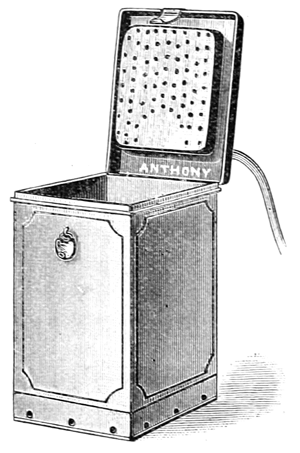
Safe closets should be provided to contain all sizes of plates; or the new made by Anthony & Co., may be used instead, both for unexposed and for exposed plates awaiting development.
NEGATIVE BOXES
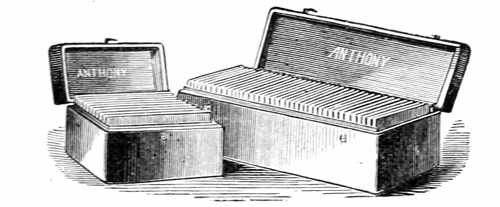
The dark room should be supplied with the necessary apparatus, such as developing trays, which are of japanned tin, of glass or india rubber; see cuts,
JAPANNED IRON DEVELOPING TRAY,
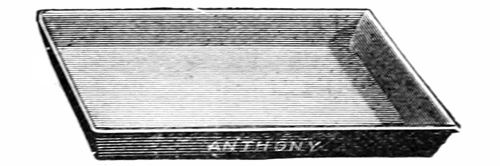
ANTHONY'S GLASS TRAYS,

or the patented article, the
GLASS BOTTOM DRY PLATE DEVELOPING TRAYS.
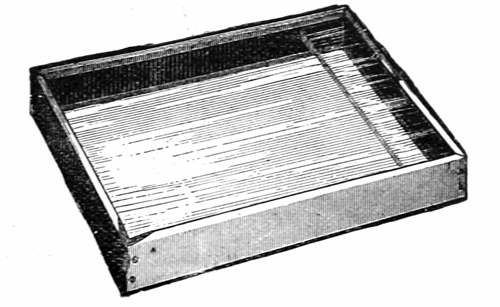
and also the dishes to contain the fixing solutions, which may be trays or upright, like silver-bath dishes.
THE COMMON SENSE TRAY
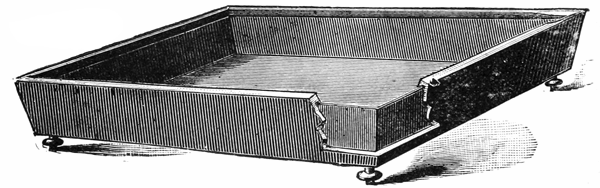
is a capital dish to contain the hypo and clearing solutions and is not expensive, and can be had of all sizes. All these dishes should be kept scrupulously clean when not in use.
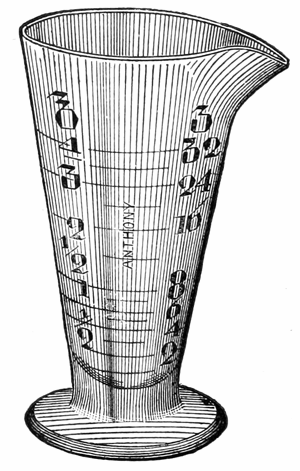
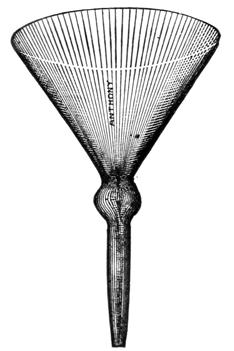
There should be Graduates of the 16 oz. and the 8 oz. sizes, and also a minim glass measuring up to one fluid ounce, also one or more of Anthony's Combined Funnel and Filter, for filtering the various solutions.
ANTHONY'S COMBINED FUNNEL AND FILTER.
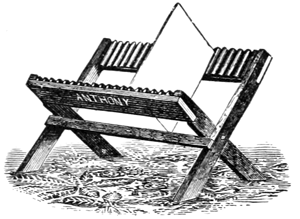
There should be glass-stoppered bottles for containing the developing solutions, especially the pyro; also racks to hold the plates while drying; FOLDING NEGATIVE RACK. one finely adjusted scale with apothecary weights weighing to a ¼ lb.; one camel's hair-brush, 3 inches wide, for dusting the plates before putting them in the holders for exposure, and also for removing sediment from the surface of the film after fixing and washing.
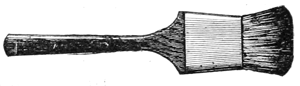
CAMEL'S HAIR DUSTERS.
Thus fitted and furnished, the dark room is ready and well adapted for the most difficult dry plate work, and we will now proceed to the consideration of the
DEVELOPMENT OF DRY PLATES.
Every manufacturer of dry plates encloses in each box of plates packed for the market a formula for the development of the same.
The various manufacturers of dry plates, whose names will be found in the advertising pages in this book, each have a formula which in some respects differs from all the others, and it is but fair to the maker of the plate, that his formula should be used, unless the operator is of much experience and understands the requirements of each particular kind of plate.
Therefore, while formulæ are given in this connection, although they are known to be of the best, yet in the hands of inexperience they may result to no better advantage than the formula appropriate to the plate used; consequently, we do not urge their use above any other, but rather that to which the operator is most accustomed.
The alkaline pyro developer is now in general use among professional photographers in this country, and there remains no doubt that it is the best developing agent for dry plates that has yet been brought into use.
This developer is composed of pyrogallic acid and an alkali, either ammonia, sal soda, or carbonate of potash, which, in solution and of proper strength, forms the medium through which the pyro is applied.
To these is added bromide of potassium or ammonium, which is the restrainer, and occupies about the same position or performs the same function as acetic acid in the wet plate developer, and besides being a restrainer it greatly aids in securing intensity and printing quality; and when plates are overtimed in exposure its prompt use may result in securing a good negative.
Some plates require double the quantity of pyro that others do to produce the same quality of negative. After ascertaining the normal amount of pyro necessary to develop plates of a certain make, if it is desired to increase intensity add more pyro, if your plate is developing too intense or hard add more of the alkali.
DRY PLATE DEVELOPER, A.
No. 1.
Carbonate of Soda (Sal) 1 lb.
Carbonate of Potash 1 lb.
Yellow Prussiate of Potash 1 oz.
Bromide of Ammonium 1 oz.
Water 64 oz.
No. 2.
Pyrogallic Acid 1 oz.
Saturated Solution Sulphite Soda 15 oz.
Keep No. 2 in glass-stoppered bottle.
To develop one 8×10 plate, take of
No. 1 1 dr.
No. 2 ½ dr.
Water 6 oz.
Put the exposed plate into the developing tray and pour the solution upon it, making sure that all parts of the plate are covered, and no air bubbles fixed to the surface; keep the dish in motion and in a short time the image will begin to appear; if properly timed the high lights will show up promptly, and in due time all parts will appear, and when detail is seen in the shadows take the plate from the dish and examine it by transmitted light. Note the gradations of light and shade; if they appear properly balanced, the plate has been properly timed in exposure. Return the plate to the dish and let the development proceed until the image sinks well into the film and you see nothing very clearly as it lies but the blacks.
Time is necessary in this process to secure enough intensity, and this stage is the most difficult in the process, there being no means by which to judge with any degree of certainty the density of the image before you. It is better then to proceed too far than not far enough, as a slow printing negative is far better than one that is too thin and weak.[1]
When the image has sunk pretty well into the film examine it again by looking through it, and note well its appearance, so that if it is about right when fixed you may remember how it appeared if you wish to increase or diminish the intensity of your next plate.
If the plate has been overtimed it will show up quickly, almost at once; when such is the case quickly pour off the developer and flow the plate with water, washing it well, then prepare more developer with nearly double the amount of pyro and a few drops of a strong solution of bromide of ammonium, which add to the 6 oz. of water and pour on the plate; then take half the usual quantity of the No. 1 solution in a graduate and pour it, a few drops at a time, into the developing tray, watching the action closely and keeping the solution in motion.
The negative at this time probably shows all the detail of the subject, but without any gradation of intensity. If the changes just described have been made promptly you will soon observe that the high lights will begin to gain in strength. Keep up the action by adding more of the alkali, drop by drop, until you can proceed no farther.
The chances are that you will secure a printable negative, but not a very good one; and if it is a portrait the best thing to do is to throw it away and make a new one.
The plate should now be very carefully washed previous to fixing.
Should the film show signs of loosening from the edges of the glass and swell so as to form folds or frills, take it from the water and immerse it in a solution of alum, which will harden the film and stop the frilling. Then wash the film again and put it in the
FIXING SOLUTION.
Hyposulphite of Soda 1 lb.
Alum ¼ lb.
Water 1 gal.
When the soda and alum are dissolved let it stand until all sediment settles to the bottom, then pour off the clear solution and use it to fix until from much use it becomes black and turbid, then make up and use a fresh solution.
The plate should be left in the fixing solution for fully five minutes after it appears thoroughly cleared, then take it out and wash until all traces of hypo are removed.
If the plate has not previously been in the alum solution it may now be put in the
CLEARING SOLUTION.
Alum ½ lb.
Citric Acid 2 oz.
Water ½ gal.
Keep this solution in a flat dish, and after the plate has been washed from the hypo put it in this solution for two or three minutes; if there are any remaining traces of hypo in the film it will be decomposed, the film will be hardened and freed from color; when this is accomplished wash again and set the plate up to dry.
While the alkaline pyro developer is the best and gives the finest printing quality to negatives, there are many who prefer (for other reasons) the
FERROUS OXALATE DEVELOPER.
No. 1.
Neutral oxalate of potash 1 lb.
Water 5 pints.
Acidify with oxalic acid and filter.
No. 2.
Protosulphate of iron 1 lb.
Water 2 quarts.
Filter and add 60 drops sulphuric acid.
No. 3.
Bromide of Ammonium 1 oz.
Water 10 oz.
The developer is prepared by mixing together in a graduate the quantity necessary to cover the plate in the following proportions:
Oxalate solution 3 parts.
Iron solution 1 part.
Bromide solution 1⁄8 part.
For instance, it will take about 8 ounces to cover an 8x10 plate in a flat dish; to make this quantity take of the
Oxalate 6 oz.
Iron 2 oz.
Bromide 2 drs.
Always pour the iron into the oxalate solution, then add the bromide, and having placed the exposed plate in the dish pour the developer upon it, covering the surface of the plate as quickly as possible and removing any air bells that may stick to the surface.
Keep the solution in motion on the surface of the plate and in a short time the image will begin to appear, the high lights first, then the intermediate shades, last of all detail will be seen in the shadows. Now pour the developer off, take the plate out of the tray and look at the back of it. If the subject or image can be distinctly seen it may be considered finished and only needs to be washed and fixed.
If the plate has been over-exposed, which will be indicated by the image appearing quickly, wash off the developer with water, add more bromide to the solution and immerse the plate again.
If, on the contrary, the plate has not had enough time, it will be indicated by developing very slowly and with a very thin and weak image; when such is the case add more of the iron solution, however, not more than to make the proportion of the iron nearly one-fourth of the whole solution. More than this proportion will cause a yellow precipitate, which will settle on the surface of the film and destroy it. If by this course you succeed in securing sufficient detail in the shadows, the negative may afterwards be strengthened.
It is as well, however, when a plate is found to be undertimed (and it is possible to make another from the same subject) to throw it away; it will scarcely repay further attention.
It will be seen that a considerable margin in time of exposure can be allowed and provided for. Yet none the less it is of the utmost importance to learn to give the correct and proper exposure to secure the finest results.
This, it is true, is not always possible, and as an under-exposed plate is lost, any error in exposure would better be in too much rather than in too little time.
It is said by some that by the use of citrate of soda almost any degree of over-exposure may be remedied, but there remains the fact that for a restraining agent to be of any value its application to a negative in development must be almost instantaneous upon the earliest discovery of the over-exposure.
When a large number of plates have been exposed and the first developed indicates that all have been overtimed, then a 50 per cent. solution of citrate of soda, used with judgment, might result in saving the lot.
When over-timing makes itself visible unexpectedly and it is feared that the development will have proceeded too far before the retarder can act, a good plan is to take the plate out of the dish and flow over it a solution of citric acid, containing a little chrome alum, which will immediately stop the action of the developer and give time to make other arrangements.
AMMONIA PYRO DEVELOPER.
No. 1.
Pyrogallic acid 1 oz.
Alcohol 4 oz.
No. 2.
Water 60 oz.
Bromide of ammonium 60 grs.
Strong liquor ammonia 2 drs.
To use, take of
No. 1 or pyro solution 1 dr.
No. 2 or ammonia solution 10 oz.
This will be enough to develop three or four 8×10 plates, if they are properly timed.
The above is one of the best forms of ammonia pyro developer; it gives negatives of very fine quality.
Many dry plates, on development with ammonia and pyro, show a green fog by reflected light, and a pink or red fog by transmitted light; this fog does not materially injure the printing quality of the plate, but spoils its appearance to the eye, and for that reason many establishments have given up the use of ammonia and in its place use soda or potash.
INTENSIFICATION OF DRY PLATE NEGATIVES.
From the difficulty of judging when the development has reached the right point, in consequence of the opacity of the gelatine film, many negatives are finished before they have acquired sufficient density in development. As a result of this, much attention has been given to the discovery and preparation of redeveloping or intensifying solutions, many formulæ for which have been published; among the best are the following:
INTENSIFYING SOLUTION. A.
Bichloride of Mercury 120 grains.
Dissolved in hot water 16 oz.
Add to this a strong solution of Iodide of Potassium drop by drop, until the red precipitate begins to redissolve, then add a few grains of hyposulphite of Soda, or enough to clear the liquid.
When required for use pour part of this solution into a tray of a suitable size for the plate, add an equal amount of water, then immerse the plate and keep the solution in motion. You will immediately notice a change in the color of the film; take the plate out, and if it has gained enough strength, wash it and set it up to dry; if not, give it more.
It is proper to state that this process is more effective if the plate has been dried after development.
When the plate has been thoroughly fixed and fully washed, it will intensify by this method, without change of color by transmitted light, and it will have secured a lovely printing quality rarely seen even in the most perfect negatives.
This solution may be used until it is exhausted.
ROCHE'S INTENSIFIER. B.
Water 10 oz.
Sulphate of Copper 100 grains.
Bromide of Potassium 100
When dissolved, this solution is ready for application and can be used repeatedly.
The negative, after fixing and washing, is immersed in the solution until it turns white.
Now remove it and wash slightly, then immerse it in old ferrous oxalate developer and allow it to remain until it becomes black entirely through the film. This method gives fine results and good printing color.
PRACTICALITIES.
Form the habit of noticing carefully the intensity of the illumination of the subject on the ground glass of the camera, so as to judge correctly the time of exposure, as much of the successful working of dry plates depends on the exposure; for although slightly under-exposed or much over-exposed plates may by suitable modification of the developer be saved and print good pictures, yet they will lack the glow and balance that are characteristic of the most perfect work.
Use a flat camel's-hair brush to remove any dust from the plate, before putting it in the shield for exposure.
Always keep your developing solution in motion on the plate.
Fix your negative very thoroughly; leave it in the hypo 5 or 6 minutes longer than it is apparently necessary.
Never use hypo after it becomes discolored or turbid and deposits a sediment.
Develop longer than you think necessary; a slow printing negative is preferable to a weak one.
Keep your dark room and its contents very clean and free from dust, and well ventilated.
RETOUCHING, OR STIPPLING THE NEGATIVE.
No photographic establishment in these days is considered to be well equipped that does not employ a skillful retoucher and provide all the apparatus and conveniences for the proper performance of this very important branch of the art.
It is within the memory of many photographers when this work of retouching was done on the positive, and some establishments were compelled to employ a large force of skilled hands to work up and finish the crude productions of the camera and the printing frame.
After the introduction of the carte de visite portrait, and later the Imperial card, and the consequent reduction in price, the expense of this work became such a burthen to photographers that they were compelled to perfect their mechanical operations to the utmost extent, and by every means to endeavor to avoid it.
It occurred then to some one of the retouching artists to do this work upon the negative once for all, and from this beginning the art of retouching the negative has reached its present high position.
Retouching, like stippling or hatching in miniature, is a work of art, skill in which is gained only by assiduous practice controlled by good taste, and it is the special work of the artist and not of the photographer.
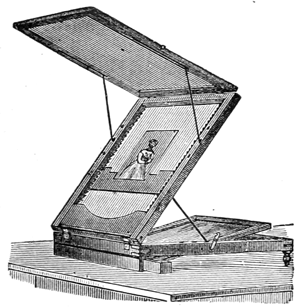
Fig. 1.
While then it is not considered wise for the photographer to be his own retoucher any more than it is for every man to be his own lawyer or doctor, yet every photographer should know enough about the art and practice of retouching to appreciate good work and to detect the bad. And for that reason he should make a study of it both from the artistic and the mechanical points of view.
By such a course of study he will learn to produce that quality of negative that will require the least amount of improvement at the hands of the retoucher.
The work of retouching requires certain appliances to facilitate it, and its own special room or atelier. A small well-ventilated room having a window with a northern exposure is the best adapted for this work. This room should be supplied with the necessary conveniences, such as the retouching stand or frame, which in its earlier form is as represented in Fig 1, but which, after a time, became much improved upon; one form of improvement is shown in Fig. 2, but neither of these forms became universally used, as many artists fashioned their stands or frames to suit their individual taste or the requirements of their room or light. The march of improvement, however, is never delayed by such a condition of affairs, and was not in this case.
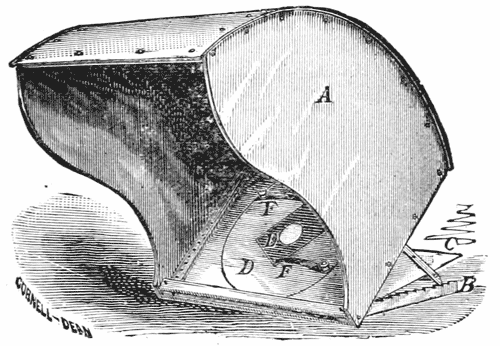
Fig. 2.
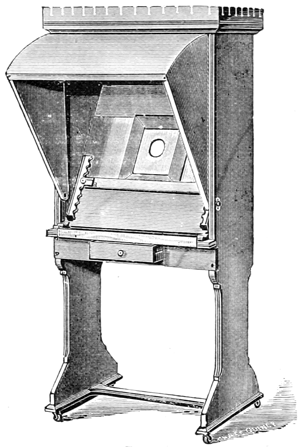
Fig. 3.
It became necessary on the part of those interested in the manufacture of such apparatus to produce something that should meet all requirements, and this has indeed been accomplished by the production of the desk represented in Fig 3, which is called the Novel Retouching Desk and is suitable for any size of negative under 25×30; it has a false top which can be pulled down to darken the space in front of the ground glass cut out.
The bed on which the negative is laid can be set at any inclination to suit the convenience of the artist.
By means of the slide-rest the negative may be moved up or down to any desired position.
It is handsomely made in hard wood, and would be quite an ornament to any retoucher's room.
Next in importance would be a varnishing table, a small table or bench supplied with a gas or oil stove. See Figs. 4 and 5.
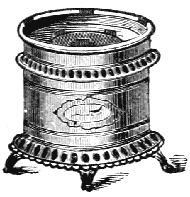
Fig. 4. Common Gas Stove.
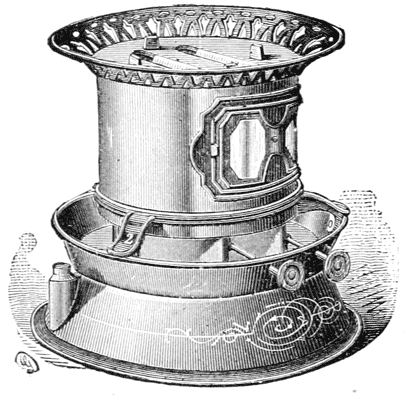
Fig. 5. Oil Stove.
Also Anthony's retouching varnish and varnish pot. See Fig 6, page 68.
A tin pot as shown in cut, with a filter and funnel in top; rubber stopper in spout.
The retoucher's room should also be supplied with
Faber's Siberian leads, full set,
Eagle lead pencils,
Metallic leads,
Camel's hair pencil brushes,
Camel's hair blender,
Guenther Wagner's retouch colors,
India ink,
Water colors, blue, white and red,
A coarse sharpening stone,
Fine emery paper.
The principal work of retouching, the stippling of the face, neck and shoulders when bare, and the hands, is done with Graphite or metallic leads, and directly upon the varnished or film surface.
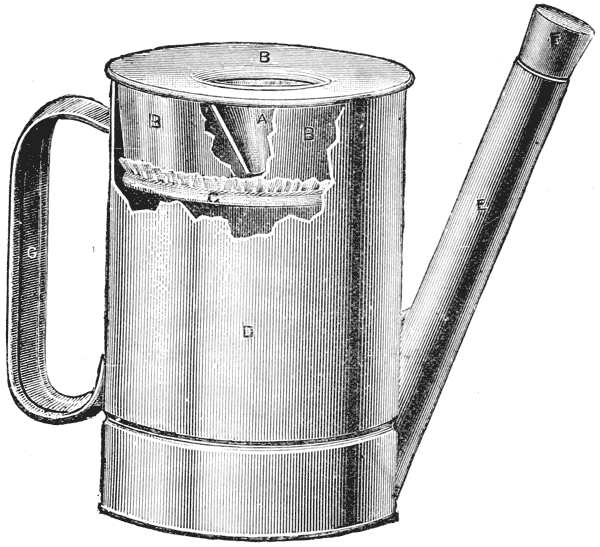
Fig. 6. Peerless Varnish Pot and Filterer.
The gelatine emulsion film is strong enough to take the pencil without varnish, and many prefer to retouch and even to print them before varnishing; but it is pretty generally conceded that gelatine negatives will receive the pencil better when varnished.
Before varnishing a gelatine plate, heat it as much as it will bear, so as to drive off all moisture from the film, then let it cool to the proper temperature before applying the varnish.
If the varnish used is too smooth or hard to take the pencil, a better tooth may be given it by the application delicately, to the parts to be retouched only, of a solution of rosin in turpentine, which should be allowed to stand and dry an hour or so before the retouching is done.
The work of retouching is very trying to the eyes; great pains should therefore be taken to ascertain the most favorable conditions of light and distance under which to work.
A negative should be kept at one angle and stationary while being retouched.
There should be as little lead used on a negative as is consistent with good work; make every touch tell to some purpose.
Note carefully the way the subject is lighted, and let the effect of the stippling be in that direction; you will thus be less likely to change the character or likeness of the face.
The lights and shadows should be caused to blend imperceptibly; this will give a harmonious effect.
Let the grain or stipple be seen in all parts suitable in fineness to the size of the head.
The refinements of negative retouching cannot be taught in books, although much has been written concerning the same.
Try to light your subject and develop your negative so as to get the utmost roundness or relief; then be careful not to destroy this modeling, but improve it by retouching, only doing so much work as to give a soft, clean-looking complexion.
Patient perseverance, close observation and trying again, will bring a certain degree of success, and while only the few can become first-class retouchers all may learn to improve their work by this great help to photography.
SILVER PRINTING.
It was long ago said that silver printing was doomed, that in a few more years it would be among the things that were.
Other processes have been introduced, have had their little day and have passed off, some of them of much merit, and, it was supposed, possessed of every element of permanency, but they were found wanting in some very important respect, and so not being able to hold their ground they passed into the limbo of neglected things.
Silver printing, however, still maintains the field against all comers, and does so by its intrinsic merits alone. No other process has equalled it in ease of production and in beauty of finish, and it is doubtful if any process has results of greater permanence, taking the best products of the process as samples.
The one defect of the process is the possibility of its products fading, but we must not judge of a process by its poorest examples, but rather by its best; if such should be the decision, there are at this day thousands of silver prints that are co-existent with the process and remain as perfect as it is possible for anything on paper to be after such a lapse of time.
A process that is so simple and easy that it can be acquired in a few hours, is predestined to careless working, slovenly manipulation, and to endless scamping at the hands of careless workers. What wonder then if prints fade which were only half made.
Suffice it that the process, intelligently and conscientiously worked, would never suffer from such an imputation.
THE PRINTING ROOM.
All professional photographers practice the silver printing process with more or less of success, as they bestow care and intelligence in the working and are zealous for the reputation of their work.
The proper handling of a negative by the printer requires as much study and skill on his part as does the posing and lighting of the subject in the studio; and the printing room should be as replete with every convenience for forwarding and improving the operations therein conducted, as any other department of the establishment.
This room is generally situated at the top of the house, and wherever situated, should be so arranged that the east, south and west sides may be opened to the sun, that his direct rays may be utilized from the earliest to the latest working hours. Part of the room should be partitioned off in such a manner, and illuminated in such a moderate degree, that the sensitized paper may not suffer from excess of light while the frames are being filled and the changes made.
The printing room outfit consists of the various sizes of printing frames, cardboard, tissue paper and cotton-wool for vignetting, and knives, long-blade scissors, and glass forms for cutting the paper to various sizes, light tight drawers to hold the prepared paper, shelves, and racks for the negatives.
Mucilage or paste and brushes.
Flat brushes for removing dust from negatives.
India ink and Opaque, with pencil brushes and lead pencils for spotting negatives.
THE SILVERING ROOM.
The silvering room may be also used for other manipulations in the process, such as fuming the paper and washing the prints, and should be furnished with all the conveniences for such work, which consist of
Nitrate of Silver.
Albumenized and plain paper.
A flat dish to hold the silver solution, of the size of the largest paper to be floated.