Suggestions on the Use of Colors in Mats.
Reading edition
Standard Colors.
The three primary colors are red, blue, and yellow. The three secondary colors are obtained by combination of the three primary colors, and are orange, green, and violet. Orange is made by a combination of yellow and red, green is a combination of blue and yellow, and violet is the combination of red and blue. Most of the dye materials explained in the preceding pages do not produce standard colors and so, when combined, do not result in the expected secondary color. Often those called red are, in point of fact, red-violet (see Plate III). Sometimes, also, dyes called yellow are yellow-orange. A mixture of yellow-orange and red-violet would produce a muddy color. Dye called green may be really blue-green or yellow-green, and combined with red, will make a muddy color.
The above remarks on standard complementary colors are only valid for pure colors and it is only by much experimentation that pleasing tones can be obtained by a combination of the dyes used on straws in the Philippines.
How to Tone Down Brilliant Colors.
Many of the colors used in Philippine mats are very brilliant. A little brilliantly colored straw, properly combined with subdued colors such as gray or one of the natural colors of Philippine straws, is pleasing, but the abundant use of brilliant straws, such as are sometimes seen in mats of solid color, is to be discouraged.
All brilliant colors may be subdued by adding to them their complementary color. Thus a brilliant red may be subdued by adding to it a small amount of green and in the same way brilliant green may be toned down by mixing with it a small portion of red. If too much of the complementary color is added the result will be gray. As will be seen, all complementary colors will subdue one another. In Plate III the principal colors have been so arranged that the complementary colors are directly opposite each other and are connected by lines. Any two colors connected by lines on this chart will tone down each other and, if mixed in proper proportions, will result in gray.
It is probable that any straw which has been dyed too brilliant, can be closely matched to one of the colors given on Plate III. Consequently its complement can be determined and, by experimentation, the brilliant color toned down. Usually only an exceedingly small amount of its complement is needed to tone down a given color.
Color Combination.
In general, too many different colors appear in the Philippine mats, and most of these are brilliant. It is often true that a large amount of a given brilliant color is offensive to the eye, and yet the addition of a little of it greatly enhances the beauty of the mat. Often color combinations are not harmonious. Particularly bad effects are obtained with red-violet and yellow or yellow-orange. Red-violet with blue-green is another unfortunate combination.
The following notes on the use and combination of the colored straws from Tanay, Rizal, and from Romblon, and those shown on the charts accompanying the dyes of Leopold Cassela & Co., are given. The figures refer to the numbers given the colored straws on these charts. These dyes were evolved for the Bureau of Education especially for Philippine mat straws and will soon be available in the market. The notes have been prepared in accordance with the rules above outlined, and, if they are followed closely, no unfortunate color combination can result.
Colors Obtained from the New Dyes.
The sample straws on these charts are made with the following dyestuffs:
Colors. Numbers on chart. Dyestuffs.
Yellow Yellow-Orange No. 1 Paraphosphine G.
Violet No. 2 Methylviolett BB 72 No. 1.
Brown No. 3 Rush Brown B.
Orange Red-Red No. 4 Rush Red S A.
Yellow-Green No. 5 Rush Green T B.
Blue-Violet No. 6 New Methylene Blue R.
Red-Violet No. 7 Magenta Prima.
Black No. 8 Rush Black M.
Chocolate No. 9 Rush Brown X.
Red No. 10 Rush Red J S.
Yellow Orange-Yellow No. 11 Auramine II.
Blue-Green No. 12 Japan Green.
Red Violet-Violet No. 13 Methylviolett R No. 1.
Red-Orange No. 14 Chrysoidine A G.
Blue Blue-Green No. 15 New Methylene Blue N.
Violet Red-Red No. 16 Safranine S 150.
Complementary or opposite colors on the color chart are said to be harmonious. Their relation is made more pleasing, however, if one color, usually the more brilliant, is used in very small amount. In many cases in the above combinations colors not exactly opposite have been united. They usually contain a mixture of a primary color common to both. Brown, Black, Chocolate, and Dark Red are complicated mixtures and may be analyzed with a chart which will appear later. Many of these dark colors would harmonize with one another, but would be so dark that they would not be pleasing. In every one of these combinations, the natural straw background figures as another color, and that is why the especially good combinations, as will be noticed, contain browns, yellows and reds, colors which blend particularly well with the background. Red-Violet No. 7 can be used with only a very few colors, and never with Yellow Yellow-Orange No. 1. Yellow Yellow-Orange should be used cautiously.
In sabutan straw, No. 1, Yellow, must be used sparingly. When used in combinations in place of No. 1, Yellow Yellow-Orange, the design should be an open one, rather than solid. Violet Red-Red, No. 16, when being used in place of Red, No. 10, must be used in the same way, and only in places where very, very little is called for. No. 11 is a color that clashes with even a natural straw, so is not advisable in any combination or alone. No. 13 is not a necessary color when No. 2 and No. 6 are available.
In placing the color upon the space to be decorated, the heavier colors should usually appear on the outside and near the edge of the space, although a border may sometimes be outlined with darker color on both inside and outside edges.
The following combinations of these colored straws will prove harmonious. The numbers correspond to those used on the chart and the different kinds of type indicate the proportions of the color to be used—little, Medium Amount, MUCH. The relative positions of the colors must also be observed and the given order followed when more than two colors are combined.
Brown (3) Yellow-Yellow Orange (1). Especially good.
Black (8) Yellow-Yellow Orange (1).
Chocolate (9) Yellow-yellow Orange (1).
RED-ORANGE (14) CHOCOLATE (9) Yellow-Yellow Orange(1). In this case, the heavy color, 9, comes in the center of the design, but is necessary to separate Nos. 14 and 1.
VIOLET (2) BLUE-GREEN (12) Red-Orange (14).
Violet (2) Red-Orange (14) Blue-Blue Green (15).
Brown (3) alone on natural background.
Brown (3) Yellow-Green (5). Especially good.
Brown (3) BLUE-GREEN (12).
BROWN (3) RED-ORANGE (14) Red (16).
Brown (3) Red-Orange (14). Especially good.
Brown (3) BLUE-BLUE GREEN (15) Red-Orange (14). Especially good.
Black (8) Brown (3) Red-Orange (14). Especially good.
ORANGE-RED RED (4) Blue-Green (12). Use No. 15 instead of 12 with sabutan.
BLUE-BLUE GREEN (15) BLUE-GREEN (12) Orange-Red Red (4). Especially good.
YELLOW-GREEN (5) BLUE-BLUE GREEN (15) Red-Orange (14).
RED-VIOLET (7) BLUE-BLUE GREEN (15) Yellow-Green (5). Especially good.
Black (8) Yellow-Green (5). Use this combination with an open design (not solid), and do not use much of each.
BLUE-GREEN (12) Yellow-Green (5).
BLUE-BLUE GREEN (15) Yellow Green (5).
Blue-Violet (6). On a natural ground.
Blue-Violet (6) Red-Orange (14).
Romblon Buri Vegetable Colors.
1—Black.
2—Gray-green.
3—Natural.
4—Orange.
5—Dark red.
In Romblon buri straw the following combinations will be harmonious:
Nos. 1, 2 and 3 in accordance with Rule 4. Nos. 2, 3 and 4 in accordance with Rule 4.
Exception to Rule 2: No. 5 is inharmonious with No. 4.
It will be noticed that these colors depend for their harmony on their order or sequence and their quantity (in this case equal parts of all three). No. 3 being a neutral color, great quantities of it may be used with any other colors. There is danger, however, in getting too much of one of the other two colors. No. 4 is a very strong color and a little will be pleasing while much will be offensive. It is not well to use it alone on a ground of No. 3. No. 5 may be used alone with a ground of No. 3; No. 1 with a ground of No. 3; No. 2 with a ground of No. 3; No. 3 with a ground of No. 2; Nos. 1 and 3 on a ground of No. 2, with a very small quantity of No. 1; equal proportions of Nos. 1 and 4 may be combined on a ground of No. 3; Nos. 2 and 4 on a ground of No. 3, a very small quantity of No. 4 being used.
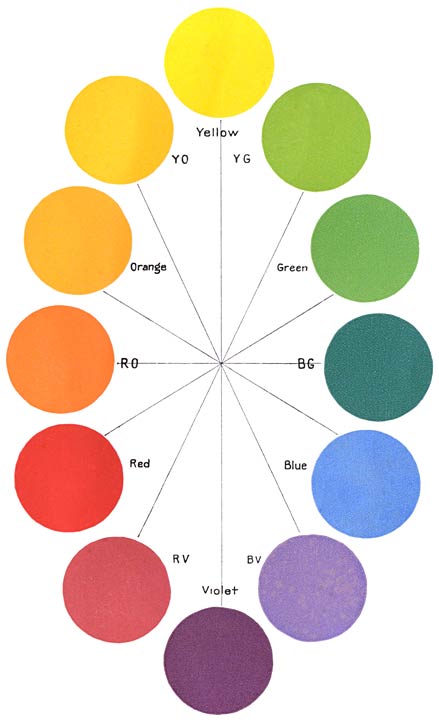
Plate III. Color Chart.
Tanay Sabutan Colors (Mostly Vegetable).
1—Black.
2—Blue-green.
3—Natural.
4—Yellow.
5—Red-orange.
6—Red-orange red.
It will be necessary to use No. 3 on a ground work. Mats made entirely of any of the other colors would hardly be harmonious on a floor or wall, if there were any other furnishings. Nos. 1, 2, 5 and 6 may be used separately upon a ground of No. 3; No. 2 in large quantity; No. 1 in small ground of No. 3; No. 2 in equal quantity with No. 5 upon a ground of No. 3; No. 5 in equal quantity with No. 6 upon a ground of No. 3; No. 6 in large quantity, with No. 2 in small quantity, upon a ground of No. 3; No. 5 in large quantity, with No. 1 small, on a ground of No. 3.
Plate IV.