Note 14 — Suggestions on the Use of Colors in Mats.
Reading edition
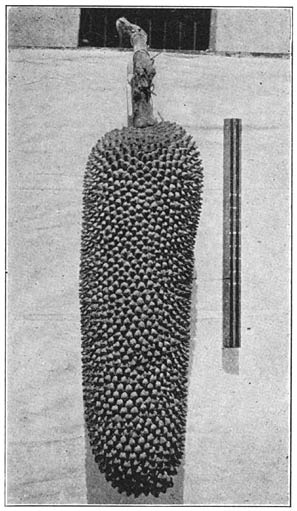
Plate XLII. Fruit of Pandanus utilissimus (Majayjay).
This pandan (P. utilissimus) is known in most places where it grows as “pandan” or “pandan totoo,” the true or tame pandan. It is extensively used in Laguna and Tayabas and is remarkable for its very large leaves and its heavy fruit. The tree occurs in groups in dry ground but thrives best in half shade near streams. It attains a height of from 4 to 8 meters. The trunk branches toward the top and is supported by a few short and thick prop roots.
The leaves are often 5 meters long and 2 decimeters wide. The lower part of the older leaves stands up straight, while the upper half droops. The younger leaves are erect with only their tips bent down. The leaf spines are short, blunt, and conical.
The fruits look like the jackfruit and are very large and heavy, being often 6 decimeters long and 2 decimeters in diameter and weighing at times 25 or more kilograms. The drupes ripen slowly and gradually; they are red in color when fully mature and possess a peculiar faint odor. It takes some time before all the drupes are shed, and in a grove of fruiting trees they can be found in all stages of maturity during the month of May.
P. utilissimus is found growing wild throughout the plateau region of Majayjay, Luisiana, and Cavinti in Laguna Province, and extending into Tayabas Province. It is only the leaves from those plants which have been set out in plots, however, that are utilized in the making of mats, hats and telescope baskets. Like sabutan, this pandan grows best in the half-shade near streams, and leaves grown in the sun are considered inferior. Nevertheless, no attempt seems to be made to select a locality for their propagation, and plots are planted wherever land is available. This pandan will not live in stagnant water and is particularly adapted to hill-sides where there is a constant flow.
The most satisfactory statistics on the propagation of P. utilissimus are obtained from Cavinti, where the plant has been introduced within recent years and suckers are still being brought in from other towns. It is stated that suckers one-half meter in height mature in about three years, while suckers one meter in height or over will produce suitable leaves in one year or less. The most satisfactory results are obtained by transplanting the mature plants, since leaves are obtainable in a few months and in half a year suckers large enough for transplanting are produced. It is stated that in setting the plants out, the undergrowth is cleared away and the suckers are placed in the ground about 1½ meters apart. Some attention is given to the young plants such as loosening the earth around them; but as soon as they obtain a good foothold no cultivation is attempted.
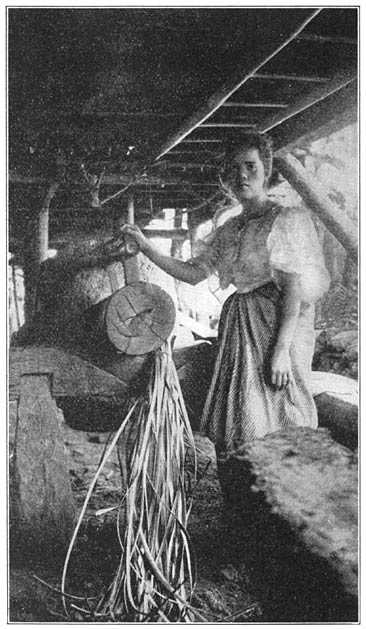
Plate XLIII. Rolling pandan, Majayjay, Laguna.
Usually weavers own their patch of pandan from which the leaves are obtained for making the straw. Several workers sometimes have a patch in common and the few weavers who do not own pandans themselves must purchase. The leaves are sold on the tree, the purchaser cutting them off with a bolo. The price is from 20 to 30 centavos per hundred, depending upon their size, softness, thickness, and imperfections. The longest, thinnest, darkest green leaves, with the fewest imperfections, are considered the best and cost the most. In Cavinti, where the leaves are imported from Luisiana and Majayjay, the price of the best leaves is 50 centavos per hundred. The estimates of the number of leaves yielded by a plant in a year differ considerably. By some it is stated that on the average one leaf is produced per month; others report that from three to five leaves are gathered in from three to six weeks.
The thorns are removed from the edges, and the midrib is cut away, thus reducing the leaf into two halves, each of which is again divided. These strips are placed in the sun for half a day. The unique process in the preparation of this pandan straw is the rolling which occurs at this point. While it is probable that any roller with sufficient weight could be used, that employed in the pandan districts of Laguna is the primitive “iluhan” by which sugar-cane and copra are also crushed. It consists essentially of three heavy wooden horses, in the grooves of which a log, heavily weighted with stones, rotates. The pandan lengths are placed in one of the grooves underneath the log and so rolled. The object of the process is to make the material thinner and more pliable. Straw is stripped from the lengths thus prepared by the use of the gauge.15 The straw is then further dried in the sunshine and is ready to be woven. Sometimes the lengths are stripped before being rolled, hence the straw is left in the sunshine for another half day and then placed under the log in the iluhan.
Mats are woven in Majayjay and Luisiana only, the weavers of Cavinti devoting their entire time to the fabrication of hats. The mats are woven of single straw, but they are fairly thick and not at all limber. The number produced per week runs probably into the thousands, of which about 75 per cent are made of coarse straw and are intended for use in drying palay, copra, etc. These mats are known as “bangkoan,” a word having about the same significance as “bastos;” that is, coarsely or poorly made. The finer and better made mats are intended for use as sleeping mats and for the floor. They are decorated with colored buri straw, usually in some shade of red produced by mordanting with kolis leaves and boiling with sappan wood as explained for buri straw. Occasionally, other colors are used, produced from the imported coal-tar (“Chino”) dyes, but in all cases the shades produced are not very pleasing. The decorations are embroidered in, and consist of simple borders in straight lines with an open center design of somewhat the same pattern. When first woven, the mats are usually of a dark green color. Before being sold, they are placed in the sun, which changes them to a grayish color somewhat resembling sabutan. After long use, however, the final shade is yellowish green.
There seems to be but little division of labor in the production of these mats. Usually the whole family goes out into the patch and cuts the leaves, removing the thorns before bringing them home. Only women weave the mats. In Majayjay a few workers color their own buri straw used in decorating the mats, but for the most part this material is obtained from dyers, one a Chinese, the other a Filipino, who prepare it for sale.
The weavers are independent of advances by brokers and sell their product to Filipinos or to the representatives of Chinese merchants in Pagsanjan and Manila. A few weavers take their mats to Lukban, whence they are distributed over Tayabas Province, but many more are gathered up by these brokers and sold in the market at Pagsanjan. The mat market there usually occupies one whole sidewalk running the length of the market building.
The pandan mats of Majayjay and Luisiana are notable for their strength and durability, and are excellent for the floor or bath. In price they range from ₱0.50 to ₱5.00. The usual price of the decorated mats is ₱1.50. The demand continues brisk and prices have recently risen. The weakest point in the mat at the present time is in the colored buri straw used to decorate it, for this tears long before the pandan shows signs of wear. If colored sabutan straw is substituted for the buri, a much stronger and probably more pleasing article will result.16