PHARMACOLOGIA. (continued 2)
Reading edition
AQUA. Water.
Water, from its extensive powers as a solvent, never occurs in a state of absolute purity, although the nature and degree of its contamination must necessarily vary according to circumstances and situation. It is generally found holding earthy matter in a state of mechanical suspension, or saline and other bodies in chemical solution. The usual varieties of common water are classed and defined by Celsus; and modern chemists have not found any reason to reject the arrangement. “Aqua levissima 285pluvialis est; deinde fontana, tum ex flumine, tum ex puteo; posthæc ex nive, aut glacie; gravior his ex lacu; gravissima ex palude.”
1. Rain Water. Aqua Pluvialis, when collected in the open fields, is certainly the purest natural water, and consequently of the least specific gravity; the bodies which it holds in solution are, carbonic acid, a minute portion of carbonate of lime, with traces of muriate of lime. Dew is said to be water saturated with air. Rain water ought, however, to be boiled and strained whenever it is collected near large towns; Hippocrates gives this advice, and M. Margraaf of Berlin has shewn the wisdom of the precaution by a satisfactory series of experiments.
2. Spring Water. Aqua Fontana, in addition to the substances detected in rain water, generally contains a small portion of muriate of soda, and frequently other salts; but the larger springs are purer than smaller ones, and those which occur in primitive countries, and in siliceous rocks, or beds of gravel, necessarily contain the least impregnation. An important practical distinction has been founded upon the fact, that the water of some springs dissolves soap, whilst that of others decomposes, and curdles it; the former has been termed soft, the latter hard water; soft water is a more powerful solvent of all vegetable matters, and is consequently to be preferred for domestic as well as medicinal purposes; the brewer knows well from experience how much more readily and copiously soft water will dissolve the extractive matter of his malt. Horses by an instinctive sagacity always prefer soft water, and when by necessity or inattention they are confined to that which is hard, their coats become rough and ill-conditioned, and they are frequently attacked with the gripes. Pigeons also refuse hard water when they have been accustomed to that which is soft.[382]
3. River Water. Aqua ex Flumine, being derived from the conflux of numerous springs and rain water, generally possesses considerable purity; that the proportion of its saline ingredients should be small, is easily explained by the precipitation which must necessarily take place from the union of different solutions; it is, however, liable to hold in suspension particles of earthy matter, which impair its transparency, and sometimes its salubrity; this is particularly observed of the Seine, the Ganges, and the Nile.[383]
4. Well Water. Aqua ex Puteo, is essentially the same as spring water, being derived from the same source; it is, however, more liable to impurity from its stagnation, or slow infiltration;[384] hence our old wells furnish much purer water than those which are more recent, as the soluble 286particles are gradually washed away. Mr. Dalton observes that the more any spring is drawn from, the softer the water becomes.
5. Snow Water. Aqua ex Nive, has been supposed[385] to be unwholesome, and in particular to produce bronchocele, from the prevalence of that disease in the Alps, but it does not appear upon what principle its insalubrity can depend; the prejudice however is a very ancient one, for Hippocrates observes that snow or ice water is unwholesome, in consequence of its finer particles being evaporated and lost during its solution: it appears to differ only from rain water in being destitute of air, to which water is certainly indebted for its briskness, and perhaps for many of its good effects upon animals and vegetables. The same observations apply to Ice Water.
6. Lake Water. Aqua ex Lacu, is a collection of rain, spring, and river waters, contaminated with various animal and vegetable bodies, which from its stagnant nature have undergone putrefaction in it.
7. Marsh Water. Aqua ex Palude being the most stagnant is the most impure of all water, and is generally loaded with decomposing vegetable matter.
To what extent the impurities of water are capable of influencing its salubrity, has been a subject of interesting inquiry from the age of Hippocrates to the present day. To many of these natural contaminations, too much importance has been certainly attached; it is an affected refinement to suppose that the presence of minute portions of such earthy and calcareous salts, as generally occur in solution, can impart any noxious quality to water;[386] whilst on the contrary, animal and vegetable impurities, or earthy bodies in a state of mechanical suspension, cannot fail to prove injurious, and must be regarded as the true “SCELERA AQUARUM.” Guided by false analogies many have supposed that they recognised the origin of all calcareous diseases in the earthy impurities of water; the researches however of chemistry have removed this delusion, by demonstrating that the substances found in water never enter into the composition of urinary calculi.[387] Metallic and other accidental contaminations are necessarily highly injurious, and the water in which their presence is suspected, should be submitted to the most careful examination.
287For the purification and preservation of water numerous methods have been adopted; the mechanical impurities may be removed by filtration, which is performed through porous stones, or alternate layers of sand or charcoal; muddy water may be also cleared by adding a few grains of alum to each pint,[388] and in that proportion, the water is not rendered in the least disagreeable: when water has contracted a putrid smell, it may be rendered sweet by agitating it with a small portion of magnesia, or with black oxide of manganese, in the proportion of 1½ parts to 250 parts of water. Dr. Black observes that nitrate of silver, which is one of the most antiseptic substances known, will preserve water from putrefaction for ever, and that it may at any time be separated therefrom in a few minutes by adding a small lump of common salt; this fact in itself is curious, but the experiment is too hazardous to be recommended. Dr. Alston prefers lime, as a preservative of the water, and proposes to remove it by the addition of a carbonate of magnesia; Dr. Henry has however found that it is more economically precipitated by the introduction of a current of carbonic acid into the cask. As that peculiar property of water which is termed hardness, generally depends upon the presence of sulphate of lime, the addition of an alkaline carbonate twenty-four hours previous to its being used, will be found to restore it, or if it should depend upon supercarbonate of lime, long ebullition without any addition will be found sufficient for its cure.
Water when kept for a long time in casks, especially on long voyages, is partially decomposed, and a volume of carburetted hydrogen is evolved,[389] imparting to such water the peculiar smell and taste which characterise it; this decomposition may in a great degree be obviated by charring the interior of the water casks; it is, however, prevented in the Navy by substituting iron tanks for wooden vessels. In Pharmacy it ought to be remembered that whenever common water is employed it should not be hard; filtered rainwater maybe recommended as the most eligible on such occasions.
AQUA DESTILLATA. L.E.D. Distilled Water.
Qualities. Taste, vapid from the absence of air, and slightly empyreumatic in consequence probably of the presence of a small quantity of extractive matter which has undergone partial decomposition; a fluid-ounce 288weighs 454½ grains. Medicinal Use. In extemporaneous prescriptions, distilled water should be always ordered whenever the formula contains any of the following substances:—Acidum Sulphuricum; Acidum Citricum; Antimonium Tartarizatum; Argenti Nitras; Cuprum Ammoniatum; Ferrum Tartarizatum; Hydrargyri Oxy-murias; Liquor Ammoniæ; Liquor Plumbi Sub-Acetatis; Liquor Potassæ; Plumbi Acetas; Solutio Muriatis Barytæ; Vinum Ferri; Zinci Sulphas; Ferri Sulphas. Distilled water ought also to be employed in preparations where much water is evaporated, as in the formation of extracts, since the residual matter of common water will remain mixed with the product of the process, and uselessly add to its bulk, or even in some cases produce in it chemical changes; unless however under such circumstances, common water purified by filtration should be ordered, as the air which it contains imparts to it a pleasant and sprightly flavour. In making infusions or decoctions, it is very important that the water should be free from those impurities which impart to it hardness, and which render it a far less powerful solvent of vegetable matter, nor indeed can resinous substances be mixed with such water, even when assisted by a mucilaginous medium. On which account, in prescribing emulsions, it may perhaps be prudent to direct the employment of distilled water. Tests of its Purity. Its transparency ought not to be disturbed by the addition of nitrate of silver, or muriate of baryta.
AQUA MARINA. Sea Water.
Until the late able researches of Dr. Murray, we possessed but an imperfect knowledge of the composition of sea water; it is not therefore surprising that the analysis performed by different chemists should be found to be so materially at variance; the true cause of such discordance is now easily understood, for it appears, that in the examination of a mineral water or any compound saline solution, the substances obtained from it are not necessarily the original ingredients, but frequently the products of new combinations established by the operation of analysis, and that consequently the nature of the result obtained may vary according to the modes in which such analysis has been conducted, or even according to the degree of dilution in which the saline substances exist.[390] The elements 289of the salts contained in a pint of sea water are Lime 2·9, Magnesia 14·8, Soda 96·3, Sulphuric Acid 14·4, Muriatic Acid 97·7, total 226·1 grains, and supposing these elements to be combined in the modes which Dr. Murray’s views appear to establish, the saline contents of a pint of sea water may be expressed as follows, Muriate of Soda 159·3, Muriate of Magnesia 35·5, Muriate of Lime 5·7, Sulphate of Soda 25·6 grains, total 226·1 grains; besides such saline contents, it is contaminated with various animal and vegetable bodies, in consequence of which it becomes, when long kept, highly offensive; it ought also to be stated that Dr. Wollaston has discovered the presence of a minute proportion of potass in sea water; and Dr. Marcet has more lately detected ammonia in combination with muriatic acid. Medicinal Use. As a cathartic, a pint is the ordinary quantity, which should be taken in the morning, at two doses, with an interval of half an hour between each; this quantity contains half an ounce of purgative salt, of which about three-fourths are muriate of soda, but it is much more active than a similar portion of any artificial combination. In procuring sea water for medicinal purposes, there is a precaution, the importance of which experience has suggested to me, that it be not hastily drank on the beach, before the particles of sand, with which under such circumstances it is generally mixed, are allowed to subside; from the neglect of this precaution I have witnessed serious consequences. The most important advantages of sea water are derived from its external use as a bath.
290AQUÆ DESTILLATÆ. L.D.
Aquæ Stillatitiæ. E. Distilled Waters.
These are waters impregnated with the essential oils of vegetables, and are principally designed as grateful vehicles for the exhibition of more active remedies; ample directions for preparing them are given in the several Pharmacopœias, and if they be rectified by redistillation they may be kept for several years; the usual mode of preserving them is by adding spirit, which has also the incidental advantage of preventing them from being frozen during the winter season. Some recommend a film of the essential oil to be diffused over the water’s surface. They may be extemporaneously prepared by adding to water what have been called Essences, which consist of essential oil and alcohol, or by rubbing any essential oil with ten times its weight of sugar, or, what answers still better, of magnesia: when however they are so prepared they never retain their transparency. The college, in the present Pharmacopœia, have directed the distillation off the essential oil, as well as off the recent herb; this alteration is one of practical convenience. The properties of each water may be learnt by referring to the vegetable from which it is distilled.
AQUÆ MINERALES. Mineral Waters.
Although all waters that flow from the earth, are, as they contain mineral bodies in solution, strictly speaking, mineral waters, yet this term is conventionally applied to such only as are distinguished from spring, lake, river, or other water, by a peculiarity in colour, taste, smell, or any obvious properties, or by the medicinal effects which they produce, or are known to be capable of producing.
To the medical practitioner the history of these waters is most interesting and instructive, involving highly important subjects of chemical and physiological inquiry. These waters are without doubt indebted for their medicinal virtues to the operation of the substances which they hold dissolved, but this is so materially aided by the peculiar state of dilution in which they exist, as well as by the mere bulk and temperature of the water itself, as to render extremely doubtful the success of every attempt to concentrate their powers by evaporation. To what extent dilution may modify the chemical condition of saline solutions has been satisfactorily demonstrated by the researches of Dr. Murray (see Aqua Marina), and to what degree an increase in the solubility of any remedy may influence its medicinal properties has been considered at some length in the first part of this work, (page 172.) It is certain that, in general, soluble salts are capable of exerting a much more powerful effect upon the animal economy, than those which are insoluble; on which account, the earthy muriates, especially that of lime, are amongst the most active ingredients of mineral waters. Although chemical analysis has frequently from its own imperfection failed in ascertaining their presence, it seems probable that muriate of lime and sulphate of soda exist in all those springs that furnish, by the usual methods of examination, sulphate of lime and muriate of soda; for the same reasons it is equally probable that iron, which in certain waters has been supposed from the analysis to exist as a carbonate, is 291in its native solution a true muriate; this is undoubtedly the fact with respect to the Bath waters. Is it then surprising, that medical practitioners should hitherto have failed in their attempts to emulate, by artificial arrangements, the medical efficacy of active and mineral springs? For the investigation of the true composition of mineral waters the researches of Dr. Murray furnish a simple and elegant formula. Determine by precipitants the weight of the acids and bases, suppose them united in such a manner that they shall form the most soluble salts, and these salts will constitute the true saline constituents of the water under examination.
Mineral Waters admit of being divided into four classes, viz.
1. Acidulous; owing their properties chiefly to carbonic acid; they are tonic and diuretic, and in large doses produce a transient exhilaration; the most celebrated are Pyrmont, Seltzer, Spa, Carlsbad, and Scarborough.
2. Chalybeate; containing iron in the form of sulphate, carbonate, or muriate;[391] they have a styptic, inky taste: Hartfell near Moffat, Peterhead, Tunbridge, Brighton, Cheltenham, Bath, Lemington Priors, Castle Horneck, near Penzance, &c.
3. Sulphureous Waters derive their character from sulphuretted hydrogen, either uncombined, or united with lime, or an alkali: Engien, Aix la Chapelle, Harrowgate, Moffat.
4. Saline; mostly purgative, and are advantageously employed in those hypochondriacal and visceral diseases that require continued, and moderate relaxation of the bowels; Cheltenham, Leamington, Seidlitz, and all brackish waters.
Some springs, as those of Bath, Matlock, and Buxton, owe their virtues rather to temperature than to any other cause, and others, as Malvern, to the diluent power of the water.
In the Codex Medicamentarius of Paris, formulæ are introduced for the preparation of several of the more distinguished mineral waters, under the head “Aquæ Minerales Arte Factæ.”[392]
293ARGENTI NITRAS. L. Nitras Argenti. E.D.
Fused Nitrate of Silver, olim, Lunar Caustic.
Qualities. Fused nitrate of silver is in small cylinders of a dark grey colour, and presenting, when broken across, a crystalline structure. Odour, none; Taste, intensely bitter, austere and metallic; it tinges the skin indelibly black; when perfectly free from copper, it is not deliquescent. Chemical Composition; oxide of silver 70, nitric acid 30, or one atom of oxide and one atom of acid. Solubility. In an equal weight of water, at 60°; it is also soluble in alcohol. The solution readily yields transparent colourless crystals, the primary form of which is a right rhombic prism. Incompatible Substances. Fixed alkalies and alkaline earths, the muriatic, sulphuric, and tartaric acids, and all the salts which contain them; Soaps, arsenic, hydro-sulphurets, astringent vegetable infusions, undistilled waters. The solutions of nitrate of silver are not disturbed by ammonia, the ammoniuret being very soluble; the carbonate of ammonia, however, produces a precipitation. Nitrate of silver tinges the skin and hair black, and has been frequently employed for the latter purpose;[394] it likewise forms the basis of permanent ink.[395] Medicinal Uses. Tonic, antispasmodic, and escharotic; it is said to prove efficacious in epilepsy, 294but during a trial for several years in the Westminster hospital, I never could discover its virtues; many of the cases in which it has been supposed to have been successful, probably derived advantage from the purgative medicines which were simultaneously administered. It possesses a bitter taste, and it has been said to act like vegetable bitters upon the digestive organs, and to offer a resource in dyspeptic complaints. It is principally useful as an external application, and may be considered as the strongest and most manageable caustic that we possess;[396] whilst in solution it acts as a useful stimulant in indolent ulcers; and being possessed of the power of coagulating animal matter, it does not spread to any extent, and is therefore extremely convenient where a large eschar is to be avoided. A weak solution of this metallic salt has lately been strongly recommended by a French surgeon, as a remedy for piles of long standing; it also forms an excellent lotion to excite the weak granulations of fungous ulcers. It is, moreover, said to be highly useful as an injection in cases of puriform discharges from the ear; before we direct however such an application, it is highly necessary that we should ascertain the tympanum to be entire, or the liquid may escape into the internal ear, and occasion very alarming irritation; an event which unhappily occurred, not long since, in the case of a noble duke of high military renown. Forms of Exhibition. For internal use, in pills made with crumb of bread, with the addition of some sugar, to prevent the mass from being too hard. Dose, gr. 1/8, gradually increased to gr. j. Adulterations. Copper may be always suspected when it deliquesces, and is to be immediately detected by its solution assuming a blue colour, when supersaturated with ammonia. The sticks should be preserved in closely stopped phials, and covered with soft and dry paper. Antidote. When this substance has been taken in excess, muriate of soda is its true antidote; indeed, so completely does it decompose, and separate it from water, that if a saturated solution of nitrate of silver be filtered through common salt, it may be afterwards drunk with impunity. This circumstance alone, would of necessity render nitrate of silver a very uncertain remedy; and yet it is evident that the basis of this salt is occasionally absorbed, for there are several cases upon record, in which the oxyd of silver has been deposited in the rete mucosum, and given a purple hue of a very singular appearance to the patient; I have lately witnessed an instance of this kind in a lady who had taken large doses of the nitrate, for the purpose of curing a dyspeptic complaint; and several other similar cases stand recorded in different works.
ARMORACIÆ RADIX. L.E. (Cochlearia Armoracia )
Raphanus Rusticanus, D. Horse[397] Radish Root.
Qualities. Taste, hot and acrid; Odour, pungent. Chemical Composition. All its virtues depend upon an essential oil. Solubility. Both 295water and alcohol extract its active principles, but they are dissipated by decoction. Medicinal Uses. As a stimulant in paralysis it is often useful; Sydenham found it successful in dropsies which were consequent on intermittent fevers; Cullen recommends a syrup made with the infusion of horse radish, to remove that species of hoarseness which depends upon local relaxation; Dr. Withering extols an infusion of this root in milk as a cosmetic both safe and effectual. Incompatible Substances. Alkaline Carbonates; Oxy-muriate of Mercury; Nitrate of Silver; the Infusion of Galls and of Yellow Cinchona Bark, produce precipitates with the infusion of this root. Forms of Exhibition. In substance, scraped or swallowed whole, or in infusion.[398] Dose of the substance ʒj, of an infusion f℥ij. See Infus Armoraciæ comp. Officinal Preparations. Infusum Armoraciæ comp: L. Spiritus Armoraciæ comp: L.D.
ARSENICUM ALBUM. (Acidum Arseniosum.)
Oxydum Arsenici. E. Arsenicum. D. White Arsenic.
Arsenious Acid. vulgo Arsenic.
Qualities. Form, shining semivitreous lumps, breaking with a conchoidal fracture, and when reduced to powder, bearing some resemblance to white sugar; Taste, acrid and corrosive, but not in any degree corresponding with its virulence, leaving an impression of sweetness. Specific gravity 3·7; it is volatilized at the temperature of 383° Fah: and by a strong heat is vitrified into a transparent glass capable of crystallizing in tetrahedra with truncated angles, or rather in octohedra. In the state of vapour it is quite inodorous, although it is asserted in many chemical works of authority to yield a smell like that of garlic; the fact is that the alliaceous or garlic-like smell is wholly confined to metallic arsenic in a state of vapour, and whenever the arsenious acid seems to yield this odour, we may infer that its decomposition has taken place; this happens when it is projected upon ignited charcoal, or when heated in contact with those metallic bodies which readily unite with oxygen, as Antimony and Tin. It is stated by Orfila and other chemists, that if it be projected upon heated copper the alliaceous odour is evolved. This assertion is undoubtedly true, but the fact requires to be explained with more precision, or we may fall into an important error respecting it. The phenomenon takes place only when the copper is in a state of ignition, at which temperature its affinity for oxygen enables it to reduce the arsenious acid; for I find by experiment that if a few grains of this substance be heated on a plate of copper, by means of a spirit lamp or blow-pipe, no odour is perceptible, for the whole of the acid is dissipated before the copper can acquire a sufficiently exalted temperature to deoxidize it. If the arsenious acid be heated on a plate of zinc, the smell is not evolved until the metal is in the state of fusion; if instead of these metals we employ in our experiments 296those of gold, silver, or platinum, no alliaceous smell whatever is produced, at any temperature. It however deserves particular notice, that the flame of the spirit lamp is itself capable of decomposing the oxyd, in consequence of the operation of its hydrogen: a fact which is very likely to betray the chemist into the fallacious belief that the oxyd does yield the odour in question.[399] It is probable that arsenical vapours which yield this peculiar odour are less noxious than those which are inodorous, but I am not aware that the knowledge of this fact can be applied to any purpose of practical importance.[400] Chemical Composition. This substance possesses many of the essential habitudes of an acid, as for instance, that of combining with the pure alkalies to saturation; it is therefore very properly denominated Arsenious Acid. It may be farther acidified by distilling it with nitrous acid, and the compound which results is a white concrete substance termed Arsenic Acid; from experiments on the quantity of oxygen absorbed by metallic arsenic, during its conversion into these two compounds, instituted by Proust and Davy, it appears that the arsenious acid consists of about 25 of oxygen and 75 of metal, and the arsenic acid of 33 of oxygen and 67 of metal; or, the quantity of metal being the same, that the oxygen in the latter compound is to that in the former nearly as three to two. Solubility. We have but lately been set right upon this point; Klaproth has shewn that it requires for its solution 400 parts of water at 60° and only 13 at 212°, and moreover, that if 100 parts of water be boiled on the arsenious acid, and suffered to cool, it will retain three grains in solution, and deposit the remainder in tetrahedral crystals; this fact shews the importance of employing boiling water in every chemical examination of substances supposed to contain arsenic. It is soluble in alcohol and oils, the former taking up two per cent.; with lime water it produces a white precipitate of arsenite of lime, which is soluble in an excess of arsenious acid; with magnesia it forms a soluble arsenite, which proves very virulent. The poisonous effects of arsenious acid are so amply detailed in medical works,[401] that it would be superfluous to dwell 297upon them in this place; it may however be interesting and useful to record an account of the pernicious influence of arsenical fumes upon organized beings, as I have been enabled to ascertain in the copper smelting works, and tin burning-houses of Cornwall. This influence is very apparent in the condition both of the animals and vegetables in the vicinity; horses and cows commonly lose their hoofs, and the latter are often to be seen in the neighbouring pastures crawling on their knees, and not unfrequently suffering from a cancerous affection in their rumps, whilst the milch cows, in addition to these miseries, are soon deprived of their milk; the men employed in the works are more healthy than we could a priori have supposed possible; the antidote upon which they all rely with confidence, whenever they are infested with more than an ordinary portion of arsenical vapour, is sweet oil, and an annual sum is allowed by the proprietors in order that it may be constantly supplied; this opinion is not solitary, for Tachenius relates that the poisonous effects, such as convulsions, gripes, and bloody stools, with which he was seized from exposure to the fumes of arsenic, were relieved by milk and oil.
It deserves notice that the smelters are occasionally affected with a cancerous disease in the scrotum, similar to that which infests chimney-sweepers, and it is singular that Stahl in describing the putrescent tendency in the bodies of those who die from this poison, mentions in particular the gangrenous appearance of these parts. It is a very extraordinary fact that previous to the establishment of the copper works in Cornwall, the marshes in their vicinity were continually exciting intermittent fever, whereas since that period a case of ague has not occurred in the neighbourhood; I have heard it remarked by the men in the works, that the smoke kills all fevers. The fact is here stated without any other comment than that the agricultural improvements which have taken place in the district, are not sufficient to afford any clue to the explanation of the circumstance. Medicinal Uses. Much has been said upon this subject, and the propriety and safety of its exhibition has been often questioned; there can be no doubt but that the greatest circumspection is required in the practitioner who administers it, and it ought not, in my opinion, to be employed until other remedies have failed; that it is capable of accumulating in the system is very evident, and this, in certain habits, may predispose the patient to serious diseases; the form in which it is most manageable and least dangerous, is that of solution. See Liquor Arsenicalis. Some practitioners have exhibited it in substance, made into pills, by rubbing one grain with ten of sugar, and then beating the mixture with a sufficient quantity of crumb of bread to form ten pills, one of which is a dose. The Chinese and other oriental nations form the sulphuret of arsenic (realgar) into medical cups, and use lemon juice, after it has stood some hours in them, by way of cathartic. As an external application, arsenic has long been extolled in the cure of cancers; the caustic so extensively used under the sanction of the late Mr. Justamond in cases of open cancer, consisted of two parts of Antimony, and one of Arsenious acid, fluxed together in a crucible, and afterwards levigated, and reduced to the requisite degree of mildness by the addition of powdered Opium.[402] But it 298deserves notice in this place, that repeated experiments have proved that arsenic kills[403] more rapidly when applied externally to an abraded part, than when internally administered. See page 132. Lionardo di Capoa relates the case of a child killed by the violent vomiting and purging arising from a slight wound made in the head by a comb, wet with oil, in which Arsenic had been infused for the purpose of killing vermin; and we have numerous instances on record, where the application of arsenical cerates and ointments has been followed by violent and dangerous symptoms. We also learn from the different historians of the Plague of London, that the arsenical amulets which were worn, as preservatives, on that occasion, were sometimes attended with deleterious consequences; Crato (Epist. 168.) observed an ulcer of the breast produced by them. Vernascha, violent pains and syncope. Amongst the foreign authors who have related cases of poisoning by the external application of Arsenic we may mention Desgranges (Recueil Period: de la Société de Med: de Paris, T. vi. p. 22.) who records the history of a chambermaid, poisoned by having rubbed her head with an arsenical ointment for the purpose of destroying vermin; and Roux (Nouveaux Elemens de Med: Operat. par. J. P. Roux,) who confessed to have killed a young girl of eighteen by an application of the “Pate Arsenicale” to a cancerous breast. To the Empirics of our own times we are indebted for many fatal illustrations of the subject. Since the last edition of this work, a Lady applied to a well known Quack, distinguished for his impudent pretensions in the treatment of cancer, and submitted to a caustic application to the breast. In a short time paralysis ensued, and the application was discovered to contain 299a large proportion of Arsenic, and that the disease, for the cure of which it had been applied, was not cancer. A somewhat analogous case occurred under the care of a bold empiric in the neighbourhood of St. George’s Fields, who undertook to remove the deformity of bow legs in a dandy drawing-master! by rasping the shin bones, and applying arsenic to the surface of the wound; in consequence of which, in addition to extensive local mischief, the unhappy dupe became paralytic. It is also necessary to inform the practitioner that Arsenious acid has been known to produce poisonous effects when applied to the unbroken skin; a case of this nature is related by Desgranges, in the sixth volume of the Recueil Periodique de la Soc: de Med: another may be found in the 22d volume of the Acta Germanica (1730); and Renault obtained similar results in his experiments on animals. When the system is under the influence of arsenic, the following symptoms will appear, viz. thickness, redness, and stiffness of the palpebræ, soreness of the gums, ptyalism, itching over the surface of the body, restlessness, cough, pain in the stomach and bowels, head-ache, and I have also occasionally noticed paucity of urine, and even stranguary, a fact of which I find no mention in other authors. Strange as it may appear, Arsenic has been inhaled, together with the vapours of frankincense, myrrh, and those of other gums during a paroxysm of asthma! This extraordinary practice arose from the practitioner mistaking the gum juniper, or Vernix of the Arabians, which by their medical authors was prescribed in fumigations under the name of Sandarach, for the Σανδαρακη of Aristotle, which was a sulphured of arsenic.
Adulterations. It is frequently sophisticated with chalk, gypsum, or sulphate of barytes; the fraud is instantly detected by its not being entirely volatilized by heat, or by any insoluble residuum occurring in preparing the Liquor Arsenicalis, according to the directions of the pharmacopœia. To many the adulteration of so active a substance may seem unimportant, but in consequence of its being thus rendered a medicine of variable activity, it is one of the most dangerous frauds which can be committed; a very unpleasant circumstance lately occurred from such a cause in one of our public institutions: arsenic had been obtained from the shop of a respectable chemist, who had not usually supplied the establishment, for the purpose of preparing the arsenical solution: the article happened to be less adulterated than that which had been previously employed; the solution however was prepared in the usual way, and the usual dose was continued, when the patients were soon seized with violent pains in the bowels, and the cause was not detected until by an examination of the bottle the usual sediment was not discovered.
Antidotes. Late researches have shewn that sulphuret of potass, on which physicians have placed so much reliance, merits no confidence. The great indication to be fulfilled in all cases of poisoning is to excite vomiting, and to administer liquids which are the least liable to act as solvents of the acrid matter, on which account lime water presents itself as a very appropriate fluid. The subject, however, is very fully considered in the first part of this work, to which I am very desirous of directing the attention of the medical practitioner; see Antidotes.
300Methods of detecting the presence of Arsenious Acid.
1. By its reduction to a metallic state. Mix a portion of the suspected powder with three times its weight of black flux;[404] put the mixture into a thin glass tube, hermetically closed[405] at one end, about eight inches in length, and one-fourth of an inch in diameter; should any of the powder adhere to the sides of the tube, it must be carefully brushed off with a feather, so that the inner surface of its upper part may be perfectly clean and dry; the closed end of the tube, by way of security, may be thinly coated with a mixture of pipe-clay and sand,[406] but this operation is not absolutely necessary; the open extremity is to be loosely plugged with a piece of paper; the coated end must be now heated on a chaffing dish of red hot coals, when the arsenic, if present, will sublime, and be found lining with a brilliant metallic crust the upper part of the tube; a portion of this reduced metal, if it be arsenic, will, when laid on heated iron, exhale in dense fumes, which are characterised by a strong smell of garlic. Mr. Phillips has lately stated that the tube may be sufficiently heated, for the purpose of metallization, by means of a spirit lamp.[407]
It merits particular notice, that in reducing by the above process the arsenious acid to the state of metal, the presence of potass in the flux is very essential, since it forms immediately an arsenite of potass, and thereby fixes the arsenious acid, and prevents it from being volatilized before the temperature is sufficiently high to enable the charcoal to decompose it; an ignorance of this fact has not unfrequently proved a source of disappointment and fallacy.
Another method of identifying white arsenic by metallization, is to form at the moment of its reduction, an alloy with copper, which is easily effected 301in the following manner,—Mix the suspected powder with black flux, as in the former experiment, and place the mixture between two polished plates of copper, bind them tight together by iron wire, and expose them to a low read heat; if the included substance contained arsenic, a silvery white stain will be left on the surface of the copper, which is an alloy of the two metals. If in this, as in the former experiment, charcoal be employed without the addition of a fixed alkali, the result may, for the same reason, prove unsatisfactory. But, with whatever care this experiment is conducted, it is, to say the least, a clumsy and unsatisfactory test, and ought never to be relied upon.
2. By the application of certain Reagents, or Tests, to its Solutions.
A great and important question has arisen in medical jurisprudence, whether any chemical proof of the presence of white arsenic, short of its actual reduction to the state of metal, can be depended upon, or ought to be received as evidence in the courts of criminal law. After a full experimental investigation of the subject, and an impartial review of all the facts which bear upon the question, I feel no hesitation in declaring it to be my conviction, that white arsenic may be detected without any fear of fallacy, by a proper application of certain tests, and that the contrary opinion is entirely founded in error, and unsupported by experiment, as will more fully appear in the sequel.[408]
(A) Fused Nitrate of Silver, or Lunar Caustic—For this test we are indebted to Mr. Hume of London, who first gave it to the public in the Philosophical Magazine for May 1809, vol. xxxiii. His method of applying it is as follows: into a clean Florence flask introduce two or three grains of the suspected powder, to which add about eight ounces of rain or distilled water, and heat the solution until it begins to boil, then while it boils frequently shake the flask, and add to the hot solution a grain or two of sub-carbonate of potass, agitating the whole to make the mixture uniform. Pour into a wine glass about two table spoonsful of the solution, and touch the surface of the fluid with a stick of lunar caustic. If arsenic be present, a beautiful yellow precipitate will instantly proceed from the point of 302contact, and settle towards the bottom of the glass as a flocculent and copious precipitate.
By this test the 60th part of a grain may be satisfactorily recognised in two ounces of water. The presence of some alkali is essential to the success of the experiment, since arsenious acid is unable, by the operation of simple affinity, to decompose the nitrate of silver.[409] The validity of this test has been questioned on the following grounds, which shall be fairly examined in order.
Objection 1. The alkaline phosphates are found to produce precipitates with silver, analogous in colour and appearance to the arsenite of silver. This is undoubtedly the case when the experiment is performed in the manner just stated, but there are other reagents which will immediately distinguish these bodies, as will be seen under the history of the Ammoniuret of silver; I have also shewn that there is a mode of so modifying the application of the silver test itself, that no error or doubt can arise in the use of it from the presence of phosphoric salts.[410] My method consists in conducting the trial on writing paper, instead of in glasses, thus—drop the suspected fluid on a piece of white paper, making with it a broad line; along this line a stick of lunar caustic is to be slowly drawn several times successively, when a streak is produced of a colour resembling that known by the name of Indian Yellow; and this is equally produced by the presence of arsenic and that of an alkaline phosphate, but the one from arsenic is rough, curdy, and flocculent, as if effected by a crayon, that from a phosphate homogeneous and uniform, resembling a water-colour laid smoothly on with a brush; but a most important and distinctive peculiarity soon succeeds, for in less than two minutes the phosphoric yellow fades into a sad green, and becomes gradually darker, and ultimately quite black; while, on the other hand, the arsenical yellow remains permanent, or nearly so, for some time, when it becomes brown. In performing this experiment the sun-shine should be avoided, or the transitions of the colour will take place too rapidly. It would be prudent also for the inexperienced operator to perform a similar experiment on a fluid known to contain arsenic, and on another with a phosphoric salt, as a standard of comparison. In this way the nitrate of silver, without the intervention of any other test, is fully capable of removing every ambiguity, and of furnishing a distinguishing mark of difference between the chemical action of arsenic and that of the phosphates. Mr. Hume states that he has repeated this experiment to his entire satisfaction,[411] and that, in a late unfortunate case of poisoning, he derived considerable information by its application. The laborious author of the London Dispensatory accepts it as an excellent test, but observes that it is rendered more luminous by brushing the streak lightly over with liquid ammonia immediately after the application of the caustic, when, if the arsenic be present, a bright queen’s yellow is produced which remains 303permanent for nearly an hour; but that when the lunar caustic produces a white-yellow before the ammonia is applied, we may infer the presence of some alkaline phosphate, rather than that of arsenic. One of the great advantages of this test is the very small quantity that is required for examination; it would be well therefore for the operator to perform the experiment in both ways on a separate paper.
Objection 2. The Muriates produce precipitates with silver so copious and flocculent as to overcome every indication which the presence of arsenic would otherwise afford. Dr. Marcet proposes to obviate this difficulty, by adding to the fluid to be examined dilute nitric acid, and then cautiously applying the nitrate of silver until the precipitation ceases; in this way the muriatic acid will be entirely removed, whilst the arsenic, if it be present, will remain in solution, and may be rendered evident by the affusion of ammonia, which will instantly produce the yellow precipitate in its characteristic form. This mode however it must be confessed appears complicated, and requires some chemical address for its accomplishment; it should be also known that the yellow precipitate thus produced is not always permanent, for it is soluble in the nitrate of ammonia formed during the process. Under these circumstances, it is surely preferable to precipitate at once from the suspected fluid all the substances which nitrate of silver can effect, and then to expose the mixed and ambiguous precipitate so obtained, to a low heat in a glass tube, when the arsenious acid will be immediately separated by sublimation. In this way the presence of muriates may even in certain cases be serviceable, especially if the quantity of arsenic be minute; for by increasing the bulk of the precipitate we shall decrease the difficulty of its examination. By this process, also, I should propose to meet the embarrassments which arise from the influence of various animal and vegetable substances, as milk, broth, wine, &c. so frequently present in the suspected liquid, and which are known to alter the character of the arsenical indications. In this case, however, we must not rely upon any single precipitant; after having thrown down all that is precipitable by the silver test, the supernatant liquid should be decanted, slightly acidified by acetic acid, and submitted to the action of Sulphuretted Hydrogen; when, should any precipitate occur, it must be separated and added to the former. Dr. Christison has demonstrated the importance of this proceeding by shewing that the precipitates, occasioned by the Ammoniurets of silver and copper, are soluble in certain vegetable infusions.[412] M. Orfila proposes to remove the difficulties and embarrassments, occasioned by the colouring matter of different media, by the application of Chlorine, so as to change the colour to a shade that will not offer any optical impediment to the characteristic indications of the different tests. I am ready to admit that such a mode of proceeding may, on certain occasions, assist the accomplished chemist in his analysis, but in the hands of a person less accustomed to chemical manipulation, I hesitate not to declare that it is subject to fatal fallacies;[413] whereas, by precipitating the 304whole, and submitting the precipitate to the process of sublimation, we shall avoid every source of error. Why then should we attempt to pursue our game through the windings of a labyrinth, when a direct road lies before us, by which we may at once drive it into the open plain? Mr. Phillips has recently proposed the addition of animal charcoal (Ivory Black) for the purpose of destroying the colouring matter. He found that by mixing this substance with the Liquor Arsenicalis, that the colouring matter was so completely destroyed in a few minutes, that the test of nitrate of silver, or any other might be readily applied. This experiment was repeated with Port wine, gravy soup, and a strong infusion of onions, and he succeeded in these cases in procuring a solution sufficiently colourless for the application of the most delicate reagents. It might be supposed, adds Mr. Phillips, that the Phosphoric acid which the animal charcoal contains, might have some share in the production of the yellow precipitate with silver; he found, however, that water, or wine, which was merely digested on the animal charcoal, produced no effect with the nitrate of silver, except a slight precipitate of chloride; and this even, was prevented by lixiviation. I have, however, a serious objection to offer to this proposal. Animal charcoal, by some mode of operation not understood, possesses the property of removing certain substances from their solution in water; I have already noticed this effect with respect to Lime water, (see p. 247, note), and I have lately found that it takes place with very dilute solutions of Arsenic.[414] Hence charcoal, as we shall presently find, may be employed for the purpose of detecting minute portions of arsenic.
Objection 3. Chromate of potass produces, with Nitrate of Silver, a yellow precipitate which, when placed side by side with one produced by Arsenious acid, cannot be distinguished by colour or appearance from it. This fact has lately been announced by Dr. Porter of the University of South Carolina. (Silliman’s Journal, iii, 355.) But as the presence of chromate of potass can never be suspected in any research after arsenic, in cases of forensic interest, the fact is of no importance to the physician.
Where the Arsenious acid is mixed with vegetable matter, and it becomes difficult to separate it by filtration, the whole may be evaporated to dryness, taking great care that the heat applied for such a purpose never exceeds 250° Fah: or we shall lose the arsenic by volatilization. The 305residue thus obtained may then be submitted to a higher temperature, in a subliming vessel, in order to procure the arsenious acid in its pure state. Should the arsenious acid have, in the first instance, been dissolved in oil, Dr. Ure proposes to boil the solution in distilled water, and to separate the oil afterwards by the capillary action of wick threads. If the arsenious acid be mixed with resinous bodies, oil of turpentine may be employed as their solvent, which will leave the arsenic untouched. Dr. Black directed the application of alcohol for this purpose, but this is obviously improper, since arsenious acid is soluble in that fluid.
It has been stated that, in consequence of the inability of arsenious acid to decompose nitrate of silver by simple elective attraction, the presence of an alkali becomes indispensable in the examination, for which purpose Dr. Marcet has suggested the superior advantages which will attend the use of ammonia, in cases where the arsenic has not been previously combined with a fixed alkali, since it does not, when added singly, decompose nitrate of silver; a circumstance which in using the fixed alkalies is very liable to occasion fallacy. This led Mr. Hume to improve his original plan, by forming at once a compound, which he calls the Ammoniaco-nitrate of silver, but which may with more propriety be designated as an Ammoniuret.[415] This is a triumph in the art of analysis; for whilst it obviates the necessity of ascertaining the exact proportion of alkali required in each experiment,[416] it possesses the valuable property of not in the least disturbing the phosphate of soda.
(B.) Sulphate of Copper. Like the preceding test, this also requires, for its success, that the arsenious acid should be combined with some alkali, in which case, by the operation of double elective attraction, an arsenite of copper is thrown down of a very striking and characteristic colour, being that of the well-known pigment called Scheele’s green; if arsenic be not present in the liquid so assayed, and a fixed alkali has been employed, the result will be a delicate sky-blue, instead of the grass-green precipitate.
Mr. Hume avails himself also of the peculiar property of ammonia to form a metallic salt, and has employed it with copper: he takes the sulphate or acetate of that metal, and by the same process as that described for the preparation of an ammoniuret of silver, forms another test. In using this, however, care must be taken that it be not too highly concentrated, for in that state it will not produce precipitation. Much controversy has taken place on the subject of sulphate of copper as a test for arsenic, and it has been stated, with more confidence than truth, that a decoction of onions has the property of imparting to the copper precipitate, which is produced by a fixed alkali, a colour and appearance analogous to that which is occasioned by arsenic. This opinion was boldly advanced 306and supported on a most important[417] trial at the Lent assizes for Cornwall in 1817. Since this event an opportunity[418] has occurred which has enabled me to examine this alleged fact, by a fair and appropriate series of experiments, the result of which satisfactorily proved that the opinion was grounded on an optical fallacy, arising from the blue precipitate assuming a green colour, in consequence of having been viewed through a yellow medium.[419] The phosphoric salts may also, under similar circumstances, be mistaken for arsenic, for the intense blue colour of the phosphate of copper will thus necessarily appear green. This instance of optical fallacy is not solitary, for corrosive sublimate has been said to possess the character of an alkali, because it turns the syrup of violets green, whereas this change is to be attributed solely to the combination of the yellow hue of the sublimate with the blue colour of the violet.
Whenever therefore such a source of fallacy can be suspected, the operator would do well to repeat his experiment on white paper, in the manner 307I have before proposed, and the results which are obtained in glasses should always be examined by day-light, and viewed by reflected and not by transmitted light. The presence of Peroxide of Iron in the Cupreous salt will also impart a green colour to the precipitate produced by an alkali. To obviate any fallacy which might arise from this circumstance, Mr. Phillips proposes to add some pure Potass to the sulphate of copper; if pure, a fine blue precipitate will be thus obtained; to this may be then added the suspected solution, and if Arsenious acid be present, it will then convert this blue precipitate to a green one.
(C.) Sulphuretted Hydrogen. This is a very delicate test for arsenic, producing with its solution a beautiful golden coloured liquor, which after a short time lets fall a precipitate. Mr. Phillips,[420] in reviewing the third edition of the present work, has stated, that no such precipitate occurs, but I find that in close, as well as in vessels exposed to the air, it takes place by repose. By this reagent, so small a quantity as 1 000,000 may be detected in solution; and it may be also stated in farther proof of the utility of this test, that it is less affected than any other by the presence of animal or vegetable matter. The method of preparing a solution of sulphuretted hydrogen gas is extremely simple. Put into an oil flask about two ounces of undiluted muriatic acid and an ounce and a half of powdered Sulphuret of Antimony; fit a cork to the flask and pass through it the short leg of a small glass tube twice bent at right angles; pass the longer leg of the tube into a phial containing distilled water, and then by the heat of a spirit lamp applied to the flask, sulphuretted hydrogen gas will be abundantly liberated, and though much of it will escape, yet a sufficient quantity will be dissolved by the water. The annexed sketch represents the apparatus proposed by Mr. Phillips, and which will require but little practical skill, either for its construction or use.
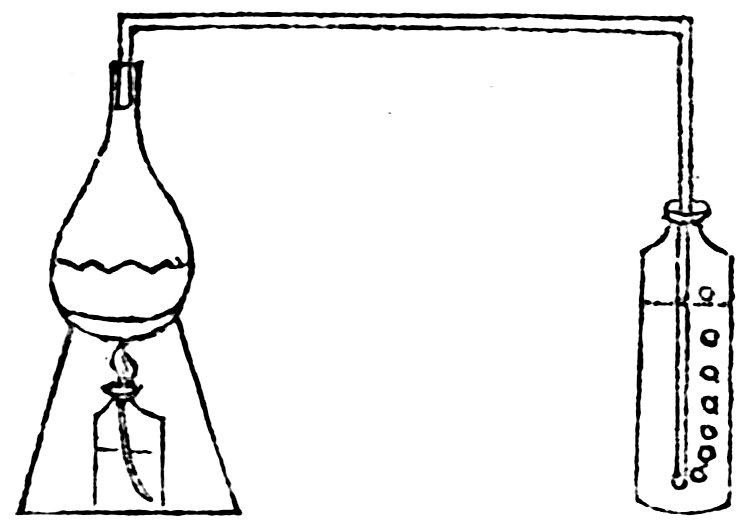
But it is not always necessary to prepare a watery solution of Sulphuretted Hydrogen, a stream of the gas, introduced into the suspected liquor by means of the above apparatus, will act with equal delicacy, and possesses, as Dr. Christison has observed, the advantage of not diluting it. Before applying this test, it is necessary to add an acid, if any alkali should exist along with the Arsenic, otherwise no precipitate will take place.
(D.) Alkaline Hydro-sulphurets. These bodies do not affect the arsenious solution, unless a few drops of acetic acid be added. To the Hydro-sulphuret, or perhaps more properly, Hydroguretted Sulphuret, of Ammonia 308there is an insuperable objection, since this fluid, when diluted, possesses the colour which we expect to produce by the action of Sulphuretted Hydrogen upon Arsenious Acid.
(E.) Charcoal Powder. This test was proposed by Mr. A. Thomson, (London Dispensatory, 2nd edition, p. 53.) Into the suspected solution stir a moderate quantity of charcoal powder, allow it to settle, then pour off the supernatant liquor, and when the powder which remains is dry, sprinkle some of it on a red hot poker, when, if the solution should contain Arsenic, the odour of Garlic will be rendered sensible. I have already offered some remarks upon the cause of this phenomenon (page 304.)
There are several other tests by which arsenic may be identified. The process described in the Dublin Pharmacopœia for the preparation of Arsenias Kali, the arseniate, or rather super-arseniate of potass, which has been long known under the name of “the arsenical salt of Macquer,” has been strongly advised as a collateral proof; it consists in decomposing the nitrate of potass[421] by the arsenious acid, but since this problem requires that the suspected poison should be in a solid and palpable form, it is impossible to examine its pretensions to our confidence, without being reminded of the story so often told to us in our infancy, of catching a bird by laying salt upon its tail.
It is necessary to observe in this place, that the arseniate, like the arsenite of potass, or that of ammonia, is obedient to the silver test, but that instead of the yellow precipitate which is produced by the latter salt, we obtain, by the former, a red or brick-coloured one.
If arsenious acid and quick-lime be heated together in a glass tube, a sudden ignition is occasioned at a certain temperature, when metallic arsenic will sublime, and an arseniate of lime be formed. In this case one portion of the arsenious acid is robbed of its oxygen to complete the acidification of the remainder.
In taking an impartial review of all the evidence which the investigation of this subject can furnish, it must appear to the most fastidious, that the silver and copper test above described are capable, under proper management, of furnishing striking and infallible indications, and that in most cases they will be equally conclusive, and in some even more satisfactory in their results, than the metallic reproduction upon which such stress has been laid, and for this obvious reason, that unless the quantity of metal be considerable,[422] its metallic splendour and appearance is often 309very ambiguous and questionable. It has to my knowledge happened to a medical person, by no means deficient in chemical address, to ascribe to the presence of arsenic that which was no other than a film of very finely divided charcoal: in this state of doubt the last resource was to ascertain whether it yielded, or not, upon being heated, an alliaceous odour. Surely an unprejudiced judge would prefer the evidence of sight, as furnished by the arsenical tests, to that of smell, as afforded in the last experiment. No one will attempt to deny that it is the duty of the medical practitioner who is called upon to decide so important a question as the presence of arsenic, to prosecute by experiment every point which admits the least doubt; he should also remember that in a criminal case, he has not only to satisfy his own conscience, but that he is bound, as far as he is able, to convince the public mind of the accuracy and truth of his researches; and he fails in his duty if he omits, through any false principle of humanity, to express the strong conviction which the success of his experiments must necessarily have produced in his mind. Let it however be remembered, that the application of chemical reagents on solutions suspected to contain arsenic, so far from throwing any obstacle in the way of the metallic reduction of that body, are the very steps which should be adopted as preparatory to the “experimentum crucis,” since the precipitates which are thus produced may be collected, and easily decomposed, as before stated. Those who for judicial purposes may require farther information upon these subjects are referred to the second volume of our work on “Medical Jurisprudence.” Tit: Poisons.
ARSENICI OXYDUM SUBLIMATUM. L.
Prepared Oxide of Arsenic.
The object of this process is to ensure a pure and uniform oxide; it has been already stated that a more dangerous fraud can scarcely be committed than the adulteration of arsenic; I am therefore not inclined to coincide with Mr. Thomson, and to regard “the present process as superfluous,” and the committee of the college entertained a similar opinion.
ASARI FOLIA. L.E.D. Asarum Europæum.
Asarabacca Leaves.
Qualities. The leaves, when recent, are nauseous, bitter, and acrimonious, and prove violently purgative and emetic, properties which are impaired by keeping. Chemical Composition, a peculiar acrid principle, not well understood. Solubility, water by infusion extracts their sensible properties, but they are lost by decoction. Uses. As an errhine, 310Dr. Cullen has remarked that they form the most useful species of this genus of local stimulants. Dose, gr. iij. to v. repeated every night until the full effect is produced. Officinal Prep. Pulvis Asari compositus. E.D.
ASCLEPIAS TUBEROSA.
Pleurisy root. Radix.
[The root of this plant, which is very abundant in every part of the United States, is the part used in medicine. It has a bitter taste, and its most soluble portions are fecula and a bitter extractive matter. Its best menstruum is boiling water. Its medicinal properties are expectorant and diaphoretic. The diseases in which it has been found useful are catarrh, bronchitis, the passive stage of pneumonia, and in rheumatism. In substance it may be taken in doses from ℈j to ʒss. Of the decoction, made by boiling half an ounce of the root in water, a tea cup full may be taken frequently during the day.]
ASSAFŒTIDA.[423] L.E.D.
Ferula Assafœtida. Gummi Resina.
Qualities. Form, small irregular masses, adhering together, of a variegated texture, and containing many little shining tears of a whitish, reddish, or violet hue. Taste, bitter and sub-acrid. Odour, fœtid and alliaceous, but this latter property is very much impaired by age. Chemical Composition. Gum (or according to Brugnatelli, extractive) 60, resin 30, and essential oil 10 parts. Solubility. It yields all its virtues to alcohol and æther; if triturated with water it forms a milky mixture, but which is not permanent, unless some intermede be employed for the suspension of the gum-resin; for this purpose egg may be added, in the proportion of one yolk to a drachm of assafœtida, or a permanent mixture may be effected by carefully triturating the gum resin with double its weight of mucilage. If ʒvj of assafœtida be triturated with ʒss of camphor, a mass results of a proper consistence for a plaster; if triturated with carbonate of ammonia, it is easily reduced to powder, but undergoes no other change. Forms of Exhibition; in mixture or in pills. The Indian physicians have an idea that on account of its stimulating powers, it will, if administered to a pregnant woman, produce abortion. Dose, gr. v. to ℈j. Form. 23, 29. Medicinal Uses, stimulant, antispasmodic, expectorant, and anthelmintic; in coughs, attended with pulmonary weakness, and a tendency to spasm, it is very beneficial; in cases of flatulent cholic, it has, in the form of enema, acted like a charm; in habitual costiveness it often proves an invigorating aperient, and may be advantageously combined with resinous purgatives in torpor of the bowels connected 311with nervous symptoms. Officinal Prep. Mist: Assafœtid: L.D. Tinct: Assafœtid: L.E.D. Spir: Ammoniæ fœtid: (B) L.E.D. Tinct: Castori, comp: (B) E. Pil: Aloes cum Assafœtid: (G) E. Pil: Galbani: comp: (B) L. Enema Fœtid: D. Impurities. Its characteristic odour should be powerful, and when broken, its fracture ought to exhibit a bluish-red appearance. It ought not to be brittle.
AURUM.
(Auri Murias.) Muriate of Gold.
[Gold was early used as a medicine. It fell however into total disrepute until its use was a few years since revived in France. Although it has attracted some attention lately, it can hardly be said to have reclaimed a permanent place in the materia medica. The most striking effects which it produces on the system, are an increase of urine and perspiration. It has been recommended in glandular swellings, gleets, schirrus of the uterus, scrofula, and dropsy. It is however as an antisyphilitic remedy that it has been principally celebrated. According to Dr. Chrestien of Montpelier, it would appear that gold was not merely adequate to the cure of syphilis in all its forms, but that it possesses very great advantages over mercury—It does not affect the gums, nor does it in any way disturb the general health of the patient. Notwithstanding this warm recommendation of Dr. Chrestien, it is still doubtful whether gold is adequate to the cure of syphilis. The best form in which the gold can be given is that of the muriate, prepared according to the directions of the Pharmacopœia of the United States; of this the dose is one fifteenth to one fourth of a grain, in pills, given every six, eight, or twelve hours.]
BALSAMUM PERUVIANUM. L.E.D.
(Myroxylon Peruiferum). Peruvian Balsam.
Qualities. Form, a viscid liquid of a reddish brown colour. Odour, fragrant and aromatic. Taste, hot and bitter. Chemical Composition. Resin, volatile oil, and benzoic acid; it is therefore a true balsam: this term was formerly applied to every vegetable resin having a strong scent and the fluidity of treacle, and which was supposed to possess many medicinal virtues; it is now restricted to those resins which contain the benzoic acid in their composition, of which there are only three, viz. the Balsams of Peru, Tolu, and Benzoin. Solubility. Water when boiled upon it dissolves only a portion of benzoic acid; æther is its most complete solvent; alcohol dissolves it completely, but the quantity of this menstruum must be considerable. Properties, stimulant and tonic, on which account in certain chronic affections of the lungs, it has been found a serviceable expectorant; Sydenham gave it in Phthisis, but wherever any inflammatory action is to be apprehended Dr. Fothergill wisely cautions us against its use. Forms of Exhibition. Diffused in water by means of mucilage, or made into pills with any vegetable powder. Dose, gr. v to ʒj. Adulterations. A mixture of resin and some volatile oil with benzoin, is often sold for Peruvian Balsam, and the fraud is not easily detected, and is probably of but little importance.
312BALSAMUM TOLUTANUM. L.E.D.
(Toluifera Balsamum.) Balsam of Tolu.
Qualities. Form, a thick tenacious liquid becoming concrete by age, in which state it is usually found in the shops. Taste, warm and sweetish. Odour, extremely fragrant, resembling that of lemons. Chemical Composition. Volatile oil, resin, and benzoic acid. Solubility. It is soluble in alcohol, forming a tincture which is rendered milky by water, but no precipitate falls. When dissolved in the smallest quantity of a solution of potass, its odour is changed into one that resembles clove pink. Medicinal Uses. It has been regarded as expectorant. In turning to the classification of expectorants, p. 102, it will be found to occupy a place in the second division of our first class, for it may be considered as capable of stimulating the pulmonary exhalants; whence its use in chronic coughs. Forms of Exhibition. It may be suspended in water by means of mucilage, or yolk of egg, but it is rarely employed except on account of its agreeable flavour;[424] its virtues are similar to those of the balsam of Peru. Officinal Prep. Tinct: Benzoin. comp: L.E.D. Tinct: Toluiferi Balsam: E.D. Syrup: Tolut: L.
BELLADONNÆ[425] FOLIA. L.E.D.
(Atropa Belladonna.) Deadly Nightshade.
Qualities. The leaves are inodorous. Taste, slightly nauseous, sweetish, and sub-acrid; their peculiar properties are not lost by drying. Chemical Composition. Vauquelin found that the leaves contained a substance analogous to albumen, salts with a base of potass, and a bitter principle on which its narcotic properties depended, and more lately the presence of an alkaline element has been detected, which has received the appellation of Atropia, the sulphate of which crystallizes very beautifully. Solubility. Water is the most powerful solvent of its active matter. Uses. It is a powerful sedative and narcotic, both as an internal medicine and as an external application; in this latter form, it alleviates local pains very effectually, but is liable to affect the nervous system. The recent leaves powdered, and made into an ointment with an equal weight of lard will be found an efficient form for many purposes; rubbed over the penis it prevents priapism and relieves chordee more effectually than any application which has been proposed. Forms of Exhibition. Every part of the plant is poisonous, and the berries from their beautiful appearance have often tempted the unwary; the leaves however furnish the most convenient and powerful form of exhibition; externally, they may be used as a poultice, internally, one grain of the dry leaves powdered, and gradually increased to 10 or 12 grains, or the leaves may be infused in boiling water in the proportion of four grains to two fluid-ounces, 313which may be given as a dose. A little of this infusion dropped into the eye permanently dilates the pupil, for which intention it has been successfully applied previous to an operation for the cataract. The extract of this plant, since its active principle is fixed, ought to possess activity, but as it occurs in commerce it is found to be very uncertain and variable, a circumstance which entirely depends upon the manner in which it has been prepared.[426] See Extractum Belladonnæ. An overdose of belladonna produces the most distressing and alarming symptoms, and so paralyzing is its influence, that vomiting can be hardly excited by the strongest doses of tartarized antimony; in such cases vinegar will be found the best antidote, or the affusion of cold water over the surface of the body, after the application of which, emetics are more likely to perform their duty, for physiological reasons explained in p. 85. Officinal Preparations. Extract: Belladonnæ L. Succus spissatus Atropæ Belladonnæ. E.
BENZOINUM. L.E. Benzoe. D. (Styrax Benzoin)
vulgo, Benjamin.
Qualities. Form, brittle masses, composed of white and brownish, or yellowish fragments; Odour, fragrant; Taste, scarcely perceptible. When heated, it exhales benzoic acid in the form of crystals. Chemical Composition. Resin, and a large proportion of benzoic acid. Solubility. It is readily dissolved by alcohol and æther, and is again separated from them by water; solutions of lime, and the fixed alkalies separate the benzoic acid from it, which can afterwards be recovered from such solutions by the addition of an acid. Uses. It is considered expectorant, and was formerly used in asthma, and other pulmonary affections; it has however fallen into disuse, and is now principally employed in perfumery, and odoriferous fumigations.[427] Officinal Preparations. Acidum Benzoicum L.E.D. Tinct: Benzoini comp:[428] L.E.D. Impurities. It is found in 314the market in various degrees of purity, the best is yellowish, studded with white spots: the worst is full of dross, and very dark or black.
BISMUTHI SUB-NITRAS L.
Qualities. Form, a white, inodorous, tasteless powder. Chemical Composition. Oxide of Bismuth in combination with some water and a little nitric acid. Solubility. It is insoluble in water and dilute acids, but is dissolved by the concentrated acids, and is again precipitated by water. The alkalies, Potass and Soda, also dissolve it, but sparingly; it is more soluble in ammonia. Uses. It was formerly employed as a cosmetic, under the name of Magistery of Bismuth, or that of Pearl White;[429] since, however, it becomes black from the operation of Sulphuretted Hydrogen and its compounds,[430] much inconvenience attends its application. Its medicinal powers appear to have been first noticed by Jacobi,[431] but the remedy attracted little or no attention until the publication of a paper upon the subject by Odier[432] of Geneva. The diseases in which its powers as a tonic have been more particularly displayed, are Gastrodynia, Pyrosis, and Dyspepsia attended with cholic. Dr. Marcet in a paper read in 1801 before the Medico-chirurgical Society of London, says, “I have had frequent opportunities of trying the oxide of Bismuth in spasmodic affections of the stomach in Guy’s Hospital, and those trials have fully confirmed the opinion which I formerly gave of the utility of this medicine.” The practitioner will receive a further confirmation of its value by referring to Dr. Bradsley’s Medical Reports: and Dr. Yeats has published in the Royal Institution Journal[433] a striking case illustrative of its efficacy.[434] Dose, gr. v to xv, in the form of pills.
315BISTORTÆ RADIX. L.E.D.
(Polygonum Bistorta.) Bistort Root.
Qualities. This root has no odour, but is highly astringent. Chemical Composition. Its active principles are tannin and gallic acid. Med. Uses. It acts as an astringent, and is accordingly used in hemorrhages and fluxes. Dose of the root ℈j-ʒj; of a decoction f℥j-f℥ij. Combined with Calamus it has been successfully administered for the cure of intermittent fevers. See p. 167.
CALAMI RADIX. L. Acori Calami Radix. E.
Acorus. D. (Acorus Calamus). Sweet Flag Root.
Qualities. This root is full of joints, crooked, and flattened on the sides, internally of a white colour, and loose spongy texture. Odour, fragrant and aromatic. Taste, bitter and pungent, qualities which are improved by exsiccation. Chemical Composition. The principles in which its qualities reside appear to be essential oil, and bitter extractive; the root likewise contains fecula, which is copiously precipitated from its infusion by sub-acetate and acetate of lead. Watery infusion extracts all its virtues, but decoction impairs them. Spirit is also an appropriate solvent, and a resinous extract may be produced accordingly. Uses. It is not employed so frequently as it deserves;[435] it would be a useful addition to many of the compound infusions of vegetable stomachics. Dose. A cupful of the infusion made by adding ʒvj of the dried root to f℥xij of boiling water. It is so favourite a remedy with the native practitioners of India, in the bowel complaints of children, that there is a penalty incurred by any druggist who will not, in the middle of the night, open his door and sell it, if demanded.
CALUMBÆ RADIX. L. (Cocculus Palmatus.)
Colomba, Radix. E.D. Calumba Root.
Qualities. Form, the dried root imported into this country is in transverse sections; the bark is thick, and easily detached; the wood is spongy and yellowish; the pieces are frequently perforated, evidently by worms. Odour, slightly aromatic. Taste, bitter and somewhat acrid. 316Chemical Composition. Cinchonia, bitter resin, volatile oil, and starch, in addition to which M. Planche has found a peculiar animal-like substance; it appears also to contain Malate and Sulphate of Lime. Solubility. Boiling water takes up about one-third of its weight, but proof spirit appears to be its most perfect menstruum. Incompatible Substances. No change is occasioned in the infusion by the solutions of nitrate of silver, sulphate of iron, muriate of mercury, or tartarized antimony; but precipitates are produced by the infusion of galls, and yellow Cinchona bark, by sub-acetate and acetate of lead, oxy-muriate of mercury, and lime-water. The infusion very soon spoils. Dose of the powdered root gr. xv to ʒss; of the infusion f℥iss to f℥ij. Uses. It is one of the most valuable tonics and stomachics which we possess. It seems to be superior to many others, from not possessing astringent, and stimulant powers, on which account it is singularly eligible in certain pulmonary and mesenteric affections; it may be given in combination with chalybeates, aromatics, saline purgatives, or with rhubarb, as circumstances may require. (Form. 34, 155.) Officinal Preparations. Infus: Calumbæ. L. Tinct: Calumbæ. L.E.D. It becomes worm-eaten by age, and, in that condition, should be rejected. Those pieces which have the brightest colour, and the greatest specific gravity, are the best. The root of white briony, tinged yellow with the tincture of Calumba, has been fraudulently substituted for this root.
CAMBOGIA. L. Gamboge. (Stalagmitis Cambogioides. ) Gambogia. E.D.
Qualities. Form, lumps of a solid consistence, breaking with a vitreous fracture; Odour, none; Colour, deep yellow, bordering on red, and becoming, when moistened, a brilliant light yellow. Sp. Grav: 1·221. Taste, slightly acrid, but which is not experienced unless it be allowed to remain long in the mouth. Chemical Composition. One part of gum, (Cerasin,) and four parts of a brittle resin; but this knowledge throws no light on the nature of its cathartic property. Solubility. When triturated with water two-thirds of its substance are speedily dissolved, and a turbid solution results; alcohol dissolves nine-tenths, and forms a yellow transparent tincture, which is rendered turbid by the addition of water; sulphuric ether dissolves six-tenths of the substance; it is also soluble in alkaline solutions, and the resulting compound is not rendered turbid by water, but is instantly decomposed by acids, and the precipitate so produced is of an extremely brilliant yellow colour, and soluble in an excess of acid. Incompatible Substances. No bodies appear to produce in gamboge such a chemical change as to destroy the chemical properties which distinguish it, but by a mechanical admixture, its solubility and consequently its operation, may be materially modified. Dr. Cullen found that the inconvenience arising from its too rapid solubility, and sudden impression upon the stomach, might be obviated by diminishing the dose, and repeating it at short intervals as directed in Form: 89. Forms of Exhibition. No form is more judicious than that of pill. Its alkaline solution has been sometimes exhibited in dropsy, when it is said to operate both on the bowels and kidneys. Dose, gr. 2 to gr. 6. Uses. It is a powerful drastic cathartic, and hydragogue, very liable to excite vomiting, and from this peculiar 317action upon the stomach it has been frequently employed with success in the expulsion of teniæ (Form: 161.) and it accordingly enters as an ingredient into many of the empirical compositions which are sold for the cure of tape worms.[436] Officinal Preparations. Pil: Cambogiæ comp: L. There is considerable difference in the degree of purity in which this substance occurs in the market; it should be estimated by its clearness and brilliancy.
CAMPHORA. L.E.D. (Laurus Camphora.[437])
Camphor.
Qualities. Form, a white brittle substance, unctuous to the touch, but possessing at the same time a degree of ductility which prevents its being easily pulverised, unless a few drops of spirit be previously added. It is capable of affecting a crystalline form.[438] Odour, peculiar, fragrant, and penetrating. Taste, bitter, pungent, and aromatic. Specific gravity, ·9887, it therefore swims on water; it is so volatile that during warm weather a considerable proportion will evaporate, especially if at the same time the atmosphere be rather moist, for the reason stated in page 175. It is readily ignited, and burns with a brilliant flame and much smoke; it melts at 288°, and boils at 400. Chemical Composition. It is a proximate vegetable principle, resembling the essential oils in many of its habitudes, and probably differs from them in composition only in containing a larger proportion of carbon. Solubility. Water may be said to dissolve about a nine hundredth part of its weight, or f℥j rather more than gr. ½, but its solvent power is considerably increased by the addition of carbonic acid gas; camphor is also rendered more soluble by trituration with magnesia; it is soluble in an equal weight of alcohol, 318but it is again separated by the addition of water; it is also dissolved by oils, both fixed and volatile,[439] especially if their temperature be a little raised, and by sulphuric and other æthers, but strong acetic acid may be said to be its most powerful solvent. By repeatedly distilling it with nitric acid it is converted into Camphoric acid, an acid distinguished by peculiar properties, and composing, with alkalies and earths, a class of salts called Camphorates, but which do not possess any medicinal value. The alkalies do not produce any effect upon camphor. Incompatible Substances. It is not affected by any substance with which we can combine it. Forms of Exhibition. It is preferable in the form of mixture, since it is very liable in the solid state to excite nausea, and, from swimming on the contents of the stomach, to occasion pain at its upper orifice. If a larger dose be required than that which water can dissolve, an additional proportion may be suspended by means of sugar, almonds, yelk of egg, or mucilage, for which purpose three times its weight of gum arabic is required. If Camphor be first dissolved by trituration in a very small portion of oil, it readily mixes with mucilage of gum arabic, and may then be conveniently blended with liquids. It has also the property of uniting with gum-resins, and of converting them into permanently soft, and uniform masses; hence they may sometimes be conveniently applied for diffusing it in water. It may be formed into pill-masses by stiff mucilage, fœtid gums, or by a confection. Medicinal Uses. In moderate doses it exhilarates, without raising the pulse, and gives a tendency to diaphoresis; and under certain conditions of the body, when opium fails, it will frequently promote sleep. As its effects are transient, its dose should be repeated at short intervals. Illustrative Formulæ 1, 6, 21, 125, 134, 164. Camphor is said to correct the bad effects of opium, mezereon, cantharides, and the drastic purgatives, and diuretics. Dose, gr. ij to ℈j. In excessive doses it occasions anxiety, vomiting, syncope, and delirium; these violent effects are best counteracted by opium. Officinal Preparations. Mistura Camphoræ. L.D. Emulsio Camphorata. E. Spiritus Camphoræ, L.E.D. Tinctura Camphoræ comp: L.E.D. Acidum Acetosum Camphoratum. E.D. Linimentum Camphoræ. L.E.D. Liniment: Camphoræ comp: L. Liniment: Saponis. (G) L.E.D. Adulterations. It has been stated that pure camphor may be known by placing it upon hot bread, when it will turn moist, whereas an adulterated specimen becomes dry—but with what can it be adulterated?
CANELLÆ CORTEX. L.E.D. Canella Bark, (Canella Alba Cortex.)
Wild Cinnamon.
Qualities. Form; it occurs in quilled and flat pieces; the former are of a whitish-yellow colour, considerably thicker than cinnamon; the latter, which are probably the bark of the larger branches, or of the stem of the tree, are yellow on the outside, and pale brown within. Odour, resembling that of cloves. Taste, warm, pungent, and slightly bitter. Chemical Composition. Its virtues depend upon an essential oil, and a 319bitter resin. Solubility. Water extracts only the bitterness, but proof spirits both the bitterness and aroma. Medicinal Uses. As a warm stimulant to the stomach, and as a corrigent to other medicines. In America it is considered as a powerful antiscorbutic. Dose of the powdered bark gr. x to ʒss. Officinal Preparations. Tinct. Gentian. comp. (B. G.) E. Vinum Aloes, (G) L.D. Pulv. Aloes cum canella, (G) D.
CANTHARIDES.[440] (Cantharis Vesicatoria.)
Blistering, or Spanish Flies.
This beautiful insect of the beetle tribe is exceedingly abundant in the southern parts of Europe, and particularly in Spain. They are collected from the leaves of the different trees on which they delight to dwell, in June and July, and are afterwards destroyed, as recommended by Dioscorides, by the fumes of strong vinegar, and dried in the sun. The chemical history of Cantharides is still involved in some obscurity; the blistering principle has been obtained by Robiquet in a separate state, when it assumes the form of small crystalline plates, having a micaceous lustre, not unlike spermaceti; Dr. Thomson has given to it the name of Cantharidin;[441] when pure, it is insoluble in water and in cold alcohol; boiling alcohol, however, dissolves it, but precipitates it again on being cooled. Æther and the oils dissolve it readily. Although not soluble in water it is rendered so by the presence of a yellow matter which exists in native combination with it. A very minute portion of this substance dissolved in sweet oil, and applied to the skin with a piece of paper, produces vesication in five or six hours. In addition to this active principle, Cantharides contain a green concrete oil; a yellow fluid oil; a peculiar black substance soluble in water and proof spirit, but not in pure alcohol; a saponaceous or yellow substance, soluble both in water and alcohol; Uric acid; Acetic acid; Phosphate of Magnesia, and a parenchymatous substance.[442] Medicinal Uses. Cantharides, when administered internally, are powerfully stimulant and diuretic;[443] and whether applied as a vesicatory to the skin, or taken into the stomach, they have a peculiar tendency to act upon the urinary organs, and especially to irritate and inflame the 320neck of the bladder, and occasion strangury. On this account they have been very successfully employed both for the cure of incontinence of urine, and suppression of this discharge, from torpor or paralysis of the bladder; they have also been used in gleet and leucorrhæa, and in cases of seminal weakness and impotence. In consulting the works of Dioscorides, Galen, and Pliny, we shall find they entertained a notion, that the virus existed only in the body of the fly, and that the head, feet and wings, contained its antidote! Hippocrates prescribed them internally in Dropsy, Jaundice, and Amenorrhœa; and yet in the end of the sixteenth century, Dr. Groenvelt was charged and sued[444] for giving them inwardly, in substance, for the cure of the stone. Dose, in substance, not exceeding gr. i, combined with opium or hyoscyamus. See Tinctura: Cantharid. A strong decoction of the Cantharides in Oil of Turpentine furnishes a most powerful Epispastic, and may be easily applied by means of dossils of lint. As the general belief, which exists with respect to the aphrodisiac powers of this substance, may induce persons to try its efficacy in large doses, either for goading the exertions of exhausted nature, or for incensing the passions of females whose seduction is meditated, it behoves the medical practitioner to become acquainted with the symptoms which it may produce, and of which the following may be considered as the most prominent;—violent retching; copious alvine evacuations, frequently bloody; very severe colics; active inflammation of the stomach and intestines; sometimes universal convulsions, attended with a horror of liquids, resembling that which occurs in hydrophobia; furious delirium, &c. But the affections of the urinary passages, and organs of generation, may be regarded κατεξοχην, as the peculiar symptoms of poisoning by Cantharides; such as heat in the bladder, bloody micturition, horrible strangury, painful and obstinate priapism, satyriasis, &c. The method of treatment to be pursued on such occasions will consist in copious bleeding, warm bath, local fomentations, mild and mucilaginous drinks; and opium, especially in the form of clyster or suppository. Officinal Prep. Tinct: Cantharid: L. Emplast: Cantharid: L. Ceratum Cantharid: L. Unguent: Infusi Cantharid: Vesicat: E. Unguent: Cantharid: D. The flies do not lose their virtues by being kept; it is, however, curious that even those acrid insects are soon reduced to dust by others feeding upon them; but since the inert parenchymatous portion is alone selected by them, the residue is extremely active.[445]
321CAPSICI BACCÆ. L.E.D. Berries of the Capsicum. (Capsicum Annum.)
Qualities. Form, pods, long, pointed, and pendulous; Colour, when ripe, a bright orange red. Odour, aromatic and pungent. Taste, extremely acrimonious and fiery. Solubility. Its qualities are partially extracted by water, but more completely by æther and spirit. Chemical Composition. Cinchonia, resin, mucilage, and an acrid principle said to be alkaline.[446] Incompatible Substances. The infusions of capsicum are disturbed by Infusion of Galls; Nitrate of Silver; Oxy-muriate of Mercury; Acetate of Lead; the Sulphates of Iron, Copper and Zinc; Ammonia, Carbonate of Potass, and Alum, but not by sulphuric, nitric, or muriatic acid. Medicinal Uses. It is a most powerful stimulant to the stomach, and is unaccompanied with any narcotic effect; as a gargle in cynanche maligna, and in relaxed states of the throat, it furnishes a valuable remedy; combined with purgatives, it proves serviceable in dyspepsia, (Form: 78,) it has lately been given with success in the advanced stages of acute rheumatism; in various diseases attended with cold feet, it has been recommended to wear socks dusted with Cayenne Pepper. Forms of Exhibition. It may be given, made into pills with crumb of bread, or in the form of tincture, diluted with water; for the purpose of a gargle, a simple infusion in the proportion of gr. j to f℥j of boiling water, or fʒvi of the tincture to f℥viij of the Infusum Rosæ, may be directed. Dose, of the substance, gr. vj to x, of the tincture fʒj to fʒij in an aqueous vehicle. Officinal Preparations. Tinct: Capsici: L.D.[447]
Cayenne Pepper is an indiscriminate mixture of the powder of the dried pods of several species of capsicum, but especially of the Capsicum baccatum, (Bird pepper.)
Adulterations. Cayenne pepper is generally mixed with muriate of soda, which disposes it to deliquesce. Red Lead may be detected by digesting it in acetic acid, and adding to the solution sulphuret of ammonia, which will produce, if any lead be present, a dark coloured precipitate; or the fraud may be discovered by boiling some of the suspected pepper in vinegar, and after filtering the solution adding to it sulphate of soda, when a white precipitate will be formed, which, after being dried and exposed to heat, and mixed with a little charcoal, will yield a metallic globule of lead.
CARBO LIGNI. L.E.D. Charcoal.
Qualities. It is a black, inodorous, insipid, brittle substance; when newly prepared it possesses the property of absorbing very considerable 322quantities of the different gases; it is also capable of destroying the smell and taste of a variety of vegetable and animal substances, especially of mucilages, oils, and of matter in which extractive abounds; and some medicines are said to be even deprived of their characteristic odour by remaining in contact with it, as Valerian, Galbanum, Balsam of Peru, and Musk. The use of charring the interior of water casks, and of wrapping charcoal in cloths that have acquired a bad smell, depends upon this property; for the same reason it furnishes a very excellent tooth powder,[448] for which purpose, that which is obtained from the shell of the cocoa nut is to be preferred. None of the fluid menstrua with which we are acquainted have any action whatever as solvents upon carbon.[449] Medicinal Uses. It is antiseptic, and has been administered internally, to correct the putrid eructations which sometimes attend dyspepsia, but in order to produce this effect it should be newly prepared, or such as has been preserved from the access of air, for it operates by absorbing the putrid gas, as well as by checking the decomposition of the undigested element.[450] Dose, grs. x to ʒj. It has been lately asserted to possess powers as an antidote to arsenic; if this be true, its action can only be mechanical by absorbing like a sponge the arsenical solution, and thereby defending the coats of the stomach from its virulence.[451] Charcoal, when mixed with boiled bread, forms a very valuable poultice for foul and gangrenous sores. In a state of impalpable powder, it is said to be effectual as a styptic; Dr. Odier informs us that the celebrated powder of Faynard, for stopping hemorrhage, was nothing more than the charcoal of beech-wood finely powdered.
Charcoal is prepared for the purposes of medicine and the arts, from a variety of substances, viz.
323Burnt Sponge. Spongia Usta. L. Consists of charcoal with portions of phosphate and carbonate of lime, and sub-carbonate of soda; it has been highly commended in bronchocele and scrophulous complaints, in the form of an electuary, or in that of a lozenge, and it has been lately asserted that it owes its power to the presence of Iodine.
Vegetable Æthiops. Pulvis Quercus marinæ. From the fucus vesiculosus, or bladder-wrack, used as the preceding.
Ivory Black. Ebur Ustum. From ivory shavings burned; used as a dentifrice and a pigment, under the name of “blue-black,” for its hue is bluish; but bone-black is usually sold for it.
Lamp Black. Fuligo Lampadum. By burning resinous bodies, as the refuse of pitch, in furnaces of a peculiar construction.
Wood Soot. Fuligo ligni, collected from chimnies under which wood is burnt. It contains sulphate of ammonia, which imparts to it its characteristic bitterness. It has been considered antispasmodic, and a tincture was formerly prepared of it.
CARDAMOMI SEMINA. L.D. ( Matonia[452] Cardamomum.)
Amomum Repens. E. Cardamom Seeds.
Qualities. Odour, aromatic and agreeable; Taste, warm and pungent, but unlike the peppers, they do not immoderately heat the stomach. Solubility. Water, alcohol and æther extract their virtues; the two latter most completely, and the result is transparent, whereas the watery infusion is turbid and mucilaginous. Chemical Composition. Fecula, mucilage, and essential oil. Medicinal Uses. They are carminative and stomachic, and prove grateful adjuncts to bitter infusions; they are principally employed to give warmth to other remedies. Dose of the powder, gr. vj to ℈j. Officinal Preparations. Extract: Colocynth: comp: (E) L.D. Tinct. Cardamomi, L.E.D. Tinct. Cardamom: comp: L.D. Tinct: Cinnamomi, co. (B) L.E. Tinct. Gentian, co. (G) L. Tinct. Rhei, (E) L.E.D. Tinct. Rhei cum Aloe, (G) E. Tinct. Sennæ, (E) L.D. Spir. Ether. Aromat. (B) L. Vinum Aloes Socot. (G) E. Confect. Aromat. (B) L. Pulv. Cinnamom. co. (B) L.E.D. Pil. Scilliticæ, (E) E. Infus. Sennæ. D. (E.)
Cardamom seeds should be kept within their husks, or their virtues will soon be considerably impaired; they are frequently mixed with grains of paradise, which are much hotter and more spicy, but less aromatic in their flavour.
324CARICÆ FRUCTUS, L.D. Fici Caricæ Fructus, E.
The preserved Fruit of the Fig.
Qualities of the dried fig are too well known to require description. The fig consists almost entirely of mucilage and sugar. Uses. It has been already stated that the most ancient cataplasm on record was made of figs, (2 Kings, chap. xx. 7.) they are employed medicinally in many demulcent decoctions, as Decoctum Hordei comp: L.D. They are gently aperient; it is curious to learn that they constituted the chief part of the food of the ancient Athletæ.
CARYOPHYLLI. L.
(Eugenia Caryophyllata. The unopened flowers dried.)
Caryophilli Aromatici Germen, E.
Caryophilli aromat. Calyx, D. Cloves.
Cloves are the unexpanded flowers, or flower-buds, of the clove tree, which are first obtained when the tree is six years old; they are gathered in October and November before they open, and when they are still green; and are dried in the sun, after having been exposed to smoke at a heat of 120°, till they assume a brown hue. It is a curious fact that the flowers when fully developed are quite inodorous, and that the real fruit is not in the least aromatic. Qualities. Form, that of a nail, consisting of a globular head, formed of the four petals of the corolla, and four leaves of the calyx not yet expanded; and a germen situated below nearly cylindrical, and scarcely an inch in length. Odour, strong, fragrant, and aromatic. Taste, acrid, aromatic and permanent. Benzoic acid has lately been discovered in them.
Solubility. Water extracts their odour, but little of their taste; alcohol and ether take up both completely. Medicinal Uses. They are more stimulant than any of the other aromatics; they are sometimes given alone, but more generally as a corrigent to other medicines. Officinal Preparations. Infusum Caryophyllorum. L. Spir. Lavand. co. D. (B) Frauds. The Dutch frequently mix the best cloves with those from which the oil has been drawn.
Caryophyllorum Oleum. This essential oil, in consequence of the resinous matter which it holds in solution, has a specific gravity of 1·020, and consequently sinks in water. When the oil has a hot fiery taste, and a great depth of colour, it is adulterated. It is imported from the spice islands. On account of its stimulant properties, it is added to griping extracts, or used as a local application in the tooth-ache. Vauquelin obtained from the leaves of the Agathophyllum ravensara an essential oil, in every respect similar to that of cloves; and I am informed by Dr. Davy that an oil exactly resembling in smell the oil of Cloves is procured in Ceylon from the leaf of the Cinnamon tree; but very little, if any, has ever been exported.
325CASCARILLÆ CORTEX. L.D. Croton Eleutheria. E. (Croton Cascarilla.)
Cascarilla Bark.
Qualities. Form, curled pieces, or rolled up into short quills; its fracture is smooth and close, of a dark brown colour; Odour, light and agreeable; when burning, it emits a smell resembling that of musk, which at once distinguishes it from all other barks. Taste, moderately bitter, with some aromatic warmth. Chemical Composition. Mucilage, bitter extractive, resin, volatile oil, and a large proportion of woody fibre; neither Cinchonia nor Quina has hitherto been discovered in it. Solubility. Its active constituents are partially extracted by alcohol and water, and completely by proof spirit. Medicinal Uses. Carminative and tonic; it is an excellent adjunct to cinchona, rendering it by its aromatic qualities more agreeable to the stomach, and increasing its powers. It is valuable in dyspepsia and flatulent cholic, in dysentery and diarrhœa, and in the gangrenous thrush peculiar to children. Forms of Exhibition. It is most efficacious in substance; it may however be given in the form of infusion, or tincture. Decoction dissipates its aromatic principle; the extract therefore merely acts as a simple bitter. See Infus. Cascarillæ. Dose of the powder, grs. xij to ʒss. Officinal Preparations. Infus. Cascarill. L. Tinct. Cascarill. L.D. Extract. Cascarill. D.
CASSIÆ PULPA. L.E.D. Cassia Pulp. (Cassia Fistula, Lomentorum Pulpa.)
The fruit is a cylindrical pod scarcely an inch in diameter, but a foot or more in length; the exterior is a hard brown bark; the interior is divided into numerous transverse cells, each of which contains an oval seed imbedded in a soft black pulp. Qualities. Odour, faint and rather sickly. Taste, sweet and mucilaginous. Solubility. Nearly the whole of the pulp is dissolved by water, partially by alcohol and sulphuric ether. Chemical Composition. Sugar, gelatine, glutine, gum, and a small portion of resin, extractive, and some colouring matter. Uses. It is gently laxative, and is adapted for children and very delicate women, but it should be always given in combination with manna or some other laxative, or it is apt to induce nausea, flatulence and griping. Officinal Preparations. Confectio Cassiæ. L.E.D. Confectio Sennæ (B.O.) L.E.D.[453] There are two kinds of this drug in the market; that from the West Indies, the pods of which are generally large, rough, thick rinded, and contain a nauseous pulp; and that from the East Indies, which is to be preferred, and which is distinguished by smaller and smoother pods, and by their containing a much blacker pulp. The pulp ought not to have a harsh flavour, which arises from the fruit having been gathered before it was ripe, nor ought it to be sour, which it is very apt to become by keeping. The heaviest pods, and those in which the seeds do not rattle, are to be preferred.