HISTORICAL INTRODUCTION.
Reading edition
AN ANALYTICAL INQUIRY INTO THE MORE REMARKABLE CAUSES WHICH HAVE, IN DIFFERENT AGES AND COUNTRIES, OPERATED IN PRODUCING THE REVOLUTIONS THAT CHARACTERISE THE HISTORY OF MEDICINAL SUBSTANCES.
“Historia quoquo modo scripta delectat.”
Before I proceed to discuss the particular views which I am prepared to submit to the College, on the important but obscure subject of medicinal combination, I propose to take a sweeping and rapid sketch of the different moral and physical causes which have operated in producing the extraordinary vicissitudes, so eminently characteristic of the history of Materia Medica. Such an introduction is naturally suggested by the first glance at the extensive and motly assemblage of substances with which our cabinets[1] are overwhelmed. It is impossible to cast our eyes over such multiplied groups, without being forcibly struck with the palpable absurdity of some—the total want of activity in many—and the uncertain and precarious reputation of all—or, without feeling an eager curiosity to enquire, from the combination of what causes it can have happened, that substances, at one period in the highest esteem, and of generally acknowledged utility, have fallen into total neglect and disrepute;—why others, of humble pretensions and little significance, have maintained their ground for so many centuries; and on what account, materials of no energy whatever, have received the indisputable sanction and unqualified support of the best and wisest practitioners of the age. That such fluctuations in opinion and versatility in practice should have produced, even in the most candid and learned observers, an unfavourable impression with regard to the general efficacy of medicines, can hardly excite our astonishment, much less our indignation; nor can we be surprised to find, that another portion of mankind has at once arraigned Physic as a fallacious 4art, or derided it as a composition of error and fraud.[2] They ask—and it must be confessed that they ask with reason—what pledge can be afforded them, that the boasted remedies of the present day will not, like their predecessors, fall into disrepute, and in their turn serve only as humiliating memorials of the credulity and infatuation of the physicians who commended and prescribed them? There is surely no question connected with our subject which can be more interesting and important, no one which requires a more cool and dispassionate inquiry, and certainly not any which can be more appropriate for a lecture, introductory to the history of Materia Medica. I shall therefore proceed to examine with some attention the revolutions which have thus taken place in the opinions and belief of mankind, with regard to the efficacy and powers of different medicinal agents; such an inquiry, by referring them to causes capable of a philosophical investigation, is calculated to remove many of the unjust prejudices which have been excited, to quiet the doubts and alarms which have been so industriously propagated, and, at the same time, to obviate the recurrence of several sources of error and disappointment.
This moral view of events, without any regard to chronological minutiæ, may be denominated the Philosophy of History, and should be carefully distinguished from that technical and barren erudition, which consists in a mere knowledge of names and dates, and which is perused by the medical student with as much apathy, and as little profit, as the monk counts his bead-roll. It has been very justly observed, that there is a certain maturity of the human mind, acquired from generation to generation, in the mass, as there is in the different stages of life, in the individual man; what is history, when thus philosophically studied, but the faithful record of this progress? pointing out for our instruction the various causes which have retarded or accelerated it in different ages and countries.
In tracing the history of the Materia Medica to its earliest periods, we shall find that its progress towards its present advanced state, has been very slow and unequal, very unlike the steady and successive improvement which has attended other branches of natural knowledge; we shall perceive even that its advancement has been continually arrested, and often entirely subverted, by the caprices, prejudices, superstitions, and knavery of mankind; unlike too the other branches of science, it is incapable of successful generalization; in the progress of the history of remedies, when are we able to produce a discovery or improvement, which has been the result of that happy combination of Observation, Analogy, and Experiment,[3] which has so eminently rewarded the labours of modern science? Thus, Observation led Newton to discover that the refractive power of transparent substances was, in general, in the ratio of their density, but 5that, of substances of equal density, those which possessed the refractive power in a higher degree were inflammable.[4] Analogy induced him to conclude that, on this account, water must contain an inflammable principle, and Experiment enabled Cavendish and Lavoisier to demonstrate the surprising truth of Newton’s induction, in their immortal discovery of the chemical composition of that fluid.
The history of Astronomy furnishes another illustration equally beautiful and instructive,—The Astronomer observed certain oscillations in the motions of Saturn and Jupiter; by Analogy he conjectured that this phenomenon was produced by the influence of a planet still more remote: a supposition which was happily confirmed by a telescopic experiment, in the discovery of Uranus, by Herschel.
But it is clear that such principles of research, and combination of methods, can rarely be applied in the investigation of remedies, for every problem which involves the phenomena of life is unavoidably embarrassed by circumstances, so complicated in their nature, and fluctuating in their operation, as to set at defiance every attempt to appreciate their influence; thus an observation or experiment upon the effects of a medicine is liable to a thousand fallacies, unless it be carefully repeated under the various circumstances of health and disease, in different climates, and on different constitutions. We all know how very differently opium, or mercury, will act upon different individuals, or even upon the same individual, at different times, or under different circumstances; the effect of a stimulant upon the living body is not in the ratio of the intensity of its impulse, but in proportion to the degree of excitement, or vital susceptibility of the individual, to whom it is applied. This is illustrated in a clear and familiar manner, by the very different sensations of heat which the same temperature will produce under different circumstances. In the road over the Andes, at about half way between the foot and the summit, there is a cottage in which the ascending and descending travellers meet; the former, who have just quitted the sultry vallies at the base, are so relaxed, that the sudden diminution of temperature produces in them the feeling of intense cold, whilst the latter, who have left the frozen summits of the mountain, are overcome by the distressing sensation of extreme heat.
But we need not climb the Andes for an illustration; if we plunge one hand into a basin of hot, and the other into one of cold water, and then mix the contents of each vessel, and replace both hands in the mixture, we shall experience the sensation of heat and cold, from one and the same medium; the hand, that had been previously in the hot, will feel cold, whilst that which had been immersed in the cold water, will experience a sensation of heat. Upon the same principle, ardent spirits will produce very opposite effects upon different constitutions and temperaments, and we are thus enabled to reconcile the conflicting testimonies respecting the powers of opium in the cure of fever: aliments, also, which under ordinary circumstances would occasion but little effect, may in certain conditions of the system, act as powerful stimulants; a fact which is well exemplified by the history of persons who have been enclosed in coal mines for several days without food, from the accidental falling in of the 6surrounding strata, when they have been as much intoxicated by a basin of broth, as a person, in common circumstances, would have been by two or more bottles of wine.[5] Many instances will suggest themselves to the practitioner in farther illustration of these views, and I shall have occasion to recur to the subject at a future period.
To such causes we must attribute the barren labours of the ancient empirics, who saw without discerning, administered without discriminating, and concluded without reasoning; nor should we be surprised at the very imperfect state of the materia medica, as far as it depends upon what is commonly called experience, complicated as this subject is by its numberless relations with Physiology, Pathology, and Chemistry. John Ray attempted to enumerate the virtues of plants from experience, and the system serves only to commemorate his failure. Vogel likewise professed to assign to substances, those powers which had been learnt from accumulated experience; and he speaks of roasted toad[6] as a specific for the pains of gout, and asserts that a person may secure himself for the whole year from angina by eating a roasted swallow! Such must ever be the case, when medicines derive their origin from false experience, and their reputation from blind credulity.
Analogy has undoubtedly been a powerful instrument in the improvement, extension, and correction of the materia medica, but it has been chiefly confined to modern times; for in the earlier ages, Chemistry had not so far unfolded the composition of bodies, as to furnish any just idea of their relations to each other, nor had the science of Botany taught us the value and importance of the natural affinities which exist in the vegetable kingdom.
With respect to the fallacies to which such analogies are exposed, I shall hereafter speak at some length, and examine the pretensions of those ultra chemists of the present day who have upon every occasion arraigned, at their self-constituted tribunal, the propriety of our medicinal combinations, and the validity of our national pharmacopœias.
In addition to the obstacles already enumerated, the progress of our knowledge respecting the virtues of medicines has met with others of a moral character, which have deprived us in a great degree of another obvious method of research, and rendered our dependance upon testimony uncertain, and often entirely fallacious. The human understanding, as Lord Bacon justly remarks, is not a mere faculty of apprehension, but is affected, more or less, by the will and the passions; what man wishes to be true, that he too easily believes to be so, and I conceive that physic has, of all the sciences, the least pretensions to proclaim itself independent of the empire of the passions.
In our researches to discover and fix the period when remedies were 7first applied for the alleviation of bodily suffering, we are soon lost in conjecture, or involved in fable; we are unable to reach the period in any country, when the inhabitants were destitute of medical resources, and we find among the most uncultivated tribes, that medicine is cherished as a blessing and practised as an art, as by the inhabitants of New Holland and New Zealand, by those of Lapland and Greenland, of North America, and of the interior of Africa. The personal feelings of the sufferer, and the anxiety of those about him, must, in the rudest state of society, have incited a spirit of industry and research to procure alleviation, the modification of heat and cold, of moisture and dryness, and the regulation and change of diet and habit, must have intuitively suggested themselves for the relief of pain;[7] and when these resources failed, charms, amulets, and incantations,[8] were the natural expedients of the barbarian, ever more inclined to indulge the delusive hope of superstition, than to listen to the voice of sober reason. Traces of amulets may be discovered in very early history. The learned Dr. Warburton is evidently mistaken, when he assigns the origin of these magical instruments to the age of the Ptolemies, which was not more than 300 years before Christ; this is at once refuted by the testimony of Galen, who tells us that the Egyptian king, Nechepsus, who lived 630 years before the Christian era, had written, that a green jasper cut into the form of a dragon surrounded with rays, if applied externally, would strengthen the stomach and organs of digestion.[9] We have moreover the authority of the Scriptures in support of this opinion; for what were the ear-rings which Jacob buried under the oak of Sechem, as related in Genesis, but amulets? and we are informed by Josephus, in his Antiquities of the Jews,[10] that Solomon discovered a plant efficacious in the cure of Epilepsy, and that he employed the aid of a charm or spell for the purpose of assisting its virtues; the root of the herb was concealed in a ring, which was applied to the nostrils of the Demoniac, and Josephus remarks that he himself saw a Jewish Priest practise the art of Solomon with complete success in the presence of Vespasian, his sons, and the tribunes of the Roman army.[11] Nor were such means confined to dark and barbarous ages; Theophrastus pronounced Pericles to be insane, because he discovered that he wore an amulet about his neck; and, in the declining æra of the Roman empire, we find that this superstitious custom was so general, that the Emperor 8Caracalla was induced to make a public edict ordaining that no man should wear any superstitious amulets about his person.
In the progress of civilization, various fortuitous incidents,[12] and even errors in the choice and preparation of aliments, must have gradually unfolded the remedial powers of many natural substances; these were recorded, and the authentic history of medicine may date its commencement from the period when such records began.
The Chaldeans and Babylonians, we are told by Herodotus, carried their sick to the public roads and markets, that travellers might converse with them, and communicate any remedies which had been successfully used in similar cases; this custom continued during many ages in Assyria; and Strabo states that it prevailed also amongst the ancient Lusitanians, or Portuguese: in this manner, however, the results of experience descended only by oral tradition; it was in the temple of Esculapius in Greece that medical information was first recorded; diseases and cures were there registered on durable tablets of marble; the priests[13] and priestesses, who were the guardians of the temple, prepared the remedies and directed their application, and thus commenced the profession of Physic. With respect to the actual nature of these remedies, it is useless to inquire; the lapse of ages, loss of records, change of language, and ambiguity of description, have rendered every learned research unsatisfactory; indeed we are in doubt with regard to many of the medicines which even Hippocrates employed. It is however clearly shewn by the earliest records, that the ancients were in the possession of many powerful remedies; thus Melampus of Argos, the most ancient Greek physician with whom we are acquainted, is said to have cured one of the Argonauts of sterility, by administering the rust of iron in wine for ten days; and the same physician used hellebore as a purge, on the daughters of king Prætus, who were afflicted with melancholy. Venesection was also a remedy of very early origin; for Podalirius, on his return from the Trojan war, cured the daughter of Damethus, who had fallen from a height, by bleeding her in both arms. Opium, or a preparation of the poppy, was certainly known in the earliest ages; it was probably opium that Helen mixed with wine, and gave to the guests of Menelaus, under the expressive name of nepenthe,[14] to drive away their cares, and increase their hilarity; and this conjecture receives much support from the fact, that the nepenthe of Homer was obtained from the Egyptian Thebes;[15] 9and if we may credit the opinion of Dr. Darwin, the Cumæan Sibyll never sat on the portending tripod without first swallowing a few drops of the juice of the Cherry-laurel.[16]
“At Phœbi nondum patiens, immanis in antro
Bacchatur Vates, magnum si pectore possit
Excussisse deum: tanto magis ille fatigat
Os rabidum, fera corda domans, fingitque premendo.”
Æneid, l. vi. 78.
There is reason to believe that the Pagan priesthood were under the influence of some powerful narcotic during the display of their oracular powers, but the effects produced would seem to resemble rather those of Opium, or perhaps of Stramonium, than of the Prussic acid. Monardes tells us that the priests of the American Indians, whenever they were consulted by the chief gentlemen, or casiques as they are called, took certain leaves of the Tobacco, and cast them into the fire, and then received the smoke, which they thus produced, in their mouths, in consequence of which they fell down upon the ground; and that after having remained for some time in a stupor, they recovered, and delivered the answers which they pretended to have received, during their supposed intercourse with the world of spirits.
The sedative powers of the Lactuca Sativa, or Lettuce,[17] were known also in the earliest times; among the fables of antiquity, we read that after the death of Adonis, Venus threw herself on a bed of lettuces, to lull her grief, and repress her desires. The sea onion or Squill, was administered in cases of dropsy by the Egyptians, under the mystic title of the Eye of Typhon. The practices of incision and scarification were employed in the camp of the Greeks before Troy, and the application of spirit to wounds was also understood, for we find the experienced Nestor applying a cataplasm, composed of cheese, onion, and meal, mixed up with the wine of Pramnos, to the wounds of Machaon.[18]
The revolutions and vicissitudes which remedies have undergone, in medical as well as popular opinion, from the ignorance of some ages, the learning of others, the superstitions of the weak, and the designs of the crafty, afford ample subject for philosophical reflection; some of these revolutions I shall proceed to investigate, classing them under the prominent causes which have produced them, viz. Superstition—Credulity—Scepticism—False Theory—Devotion to Authority, and Established Routine—The assigning to Art that which was the effect of unassisted Nature—The assigning to peculiar substances Properties, deduced from Experiments made on inferior Animals—Ambiguity of Nomenclature—The progress of Botanical Science—The application, and misapplication of Chemical Philosophy—The Influence of Climate and Season on Diseases, as well as on the properties, and operations of their Remedies—The ignorant Preparation, or fraudulent Adulteration of Medicines—The 10unseasonable collection of those remedies which are of vegetable origin,—and, the obscurity which has attended the operation of compound medicines.
SUPERSTITION.
A belief in the interposition of supernatural powers in the direction of earthly events, has prevailed in every age and country, in an inverse ratio with its state of civilization, or in the exact proportion to its want of knowledge. “In the opinion of the ignorant multitude,” says Lord Bacon, “witches and impostors have always held a competition with physicians.” Galen also complains of this circumstance, and observes that his patients were more obedient to the oracle in the temple of Esculapius, or to their own dreams, than they were to his prescriptions. The same popular imbecility is evidently allegorized in the mythology of the ancient poets, when they made both Esculapius and Circe the children of Apollo; in truth, there is an unaccountable propensity in the human mind, unless subjected to a very long course of discipline, to indulge in the belief of what is improbable and supernatural; and this is perhaps more conspicuous with respect to physic than to any other affair of common life, both because the nature of diseases and the art of curing them are more obscure, and because disease necessarily awakens fear, and fear and ignorance are the natural parents of superstition; every disease therefore, the origin and cause of which did not immediately strike the senses, has in all ages been attributed by the ignorant to the wrath of heaven, to the resentment of some invisible demon, or to some malignant aspect of the stars;[19] and hence the introduction of a rabble of superstitious remedies, not a few of which were rather intended as expiations at the shrines of these offended spirits, than as natural agents possessing medicinal powers. The introduction of precious stones into the materia medica, arose from an Arabian superstition of this kind; indeed De Boot, who has written extensively upon the subject, does not pretend to account for the virtues of gems, upon any philosophical principle, but from their being the residence of spirits, and he adds that such substances, from their beauty, splendour and value, are well adapted as receptacles for good spirits![20]
11Every substance whose origin is involved in mystery,[21] has at different times been eagerly applied to the purposes of medicine: not long since, one of those showers which are now known to consist of the excrement of insects, fell in the north of Italy; the inhabitants regarded it as Manna, or some supernatural panacea, and they swallowed it with such avidity, that it was only by extreme address, that a small quantity was obtained for a chemical examination.
A propensity to attribute every ordinary and natural effect to some extraordinary and unnatural cause, is one of the striking peculiarities of medical superstition; it seeks also explanations from the most preposterous agents, when obvious and natural ones are in readiness to solve the problem. Soranus, for instance, who was cotemporary with Galen, and wrote the life of Hippocrates![22] tells us that honey proved an easy remedy for the aphthæ of children, but instead of at once referring the fact to the medical qualities of the honey, he very gravely explains it, from its having been taken from bees that hived near the tomb of Hippocrates! And even those salutary virtues which many herbs possess, were, in these times of superstitious delusion, attributed rather to the planet under whose ascendancy they were collected or prepared, than to any natural and intrinsic properties in the plants themselves; indeed such was the supposed importance of planetary influence,[23] that it was usual to prefix to receipts a symbol of the planet under whose reign the ingredients were to be collected, and it is not perhaps generally known, that the character which we at this day place at the head of our prescriptions, and which is understood, and supposed to mean Recipe, is a relict of the astrological symbol of Jupiter, as may be seen in many of the older works on pharmacy, although it is at present so disguised by the addition of the down stroke, which converts it into the letter ℞, that were it not for its cloven foot, we might be led to question the fact of its superstitious origin.
12
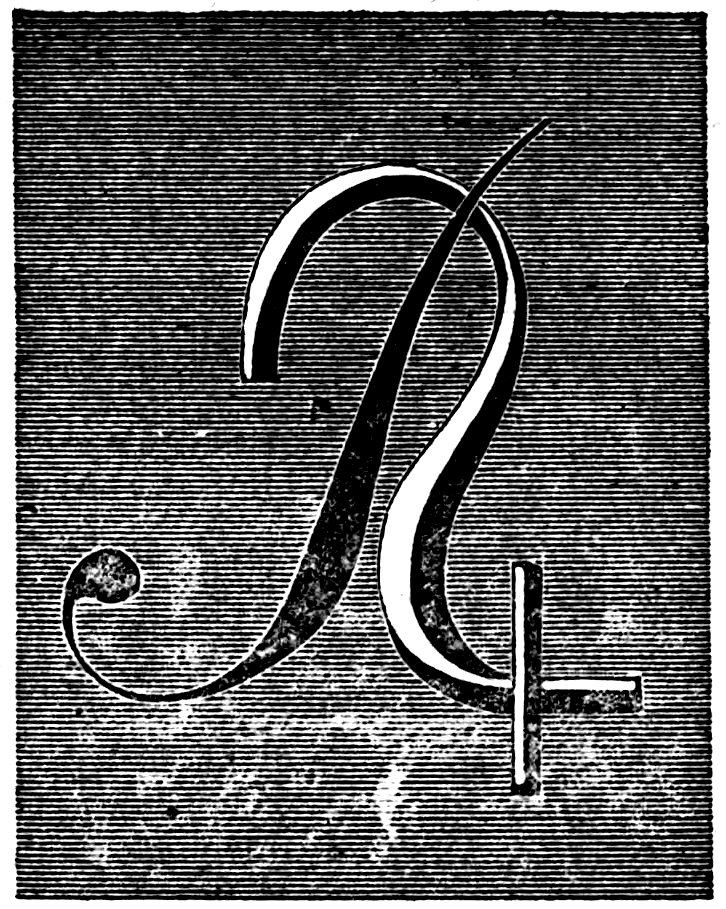
A knowledge of this ancient and popular belief in Sideral influence, will enable us to explain many superstitions in Physic; the custom, for instance, of administering cathartic medicines at stated periods and seasons, originated in an impression of their being more active at particular stages of the moon, or at certain conjunctions of the planets: a remnant of this superstition still exists to a considerable extent in Germany; and the practice of bleeding at ‘spring and fall,’ so long observed in this country, owed its existence to a similar belief. It was in consequence of the same superstition, that the metals were first distinguished by the names and signs of the planets; and as the latter were supposed to hold dominion over time, so were astrologers led to believe that some, more than others, had an influence on certain days of the week; and, moreover, that they could impart to the corresponding metals considerable efficacy upon the particular days which were devoted to them;[24] from the same belief, some bodies were only prepared on certain days in the year; the celebrated earth of Lemnos was, as Galen describes, periodically dug with great ceremony, and it continued for many ages to be highly esteemed for its virtues; even at this day, the pit in which the clay is found is annually opened, with solemn rites by the priests, on the sixth day of August, six hours after sun rising, when a quantity is taken out, washed, dried, and then sealed with the Grand Signior’s seal, and sent to Constantinople. Formerly it was death to open the pit, or to seal the earth, on any other day in the year. In the botanical history of the middle ages, as more especially developed in Macer’s Herbal, there was not a plant of medicinal use, that was not placed under the dominion of some planet, and must neither be gathered nor applied but with observances that savoured of the 13most absurd superstition, and which we find were preserved as late as the seventeenth century, by the astrological herbalists, Turner, Culpepper, and Lovel.
It is not the least extraordinary feature in the history of medical superstition, that it should so frequently involve in its trammels persons who, on every other occasion, would resent with indignation any attempt to talk them out of their reason, and still more so, to persuade them out of their senses; and yet we have continual proofs of its extensive influence over powerful and cultivated minds; in ancient times we may adduce the wise Cicero, and the no less philosophical Aurelius, while in modern days we need only recall to our recollection the number of persons of superior rank and intelligence, who were actually persuaded to submit to the magnetising operations of Miss Prescott, and some of them were even induced to believe that a beneficial influence had been produced by the spells of this modern Circe.
Lord Bacon, with all his philosophy, betrayed a disposition to believe in the virtue of charms and amulets; and Boyle[25] seriously recommends the thigh bone of an executed criminal, as a powerful remedy in dysentery. Amongst the remedies of Sir Theodore Mayerne, known to commentators as the Doctor Caius of Shakspeare, who was physician to three English Sovereigns, and who, by his personal authority, put an end to the distinctions of chemical and galenical practitioners in England, we shall find the secundines of a woman in her first labour with a male child; the bowels of a mole, cut open alive; mummy made of the lungs of a man who had died a violent death; with a variety of remedies, equally absurd, and alike disgusting.
It merits notice, that the medicinal celebrity of a substance has not unfrequently survived the tradition of its superstitious origin, in the same manner that many of our popular customs and rites have continued, through a series of years, to exact a respectful observance, although the circumstances which gave origin to them have been obscured and lost in the gloom of unrecorded ages. Does not the fond parent still suspend the coral toy around the neck of her infant, without being in the least aware of the superstitious belief[26] from which the custom originated? while the chorus of derry down is re-echoed by those who never heard of the Druids, much less of the choral hymns with which their groves resounded, at the time of their gathering the misletoe; and how many a medical practitioner continues to administer this sacred plant, (Viscus 14Quercinus) for the cure of his epileptic patients, without the least suspicion that it owes its reputation to the same mysterious source of superstition and imposture? Nor is this the only faint vestige of druidism which can be adduced. Mr. Lightfoot states, with much plausibility, that in the highlands of Scotland, evidence still exists in proof of the high esteem in which those ancient Magi held the Quicken tree, or Mountain Ash, (Sorbus Aucuparia) for it is more frequently than any other, found planted in the neighbourhood of druidical circles of stones; and it is a curious fact, that it should be still believed that a small part of this tree, carried about a person, is a charm against all bodily evils,—the dairy-maid drives the cattle with a switch of the Roan tree, for so it is called in the highlands; and in one part of Scotland, the sheep and lambs are, on the first of May, ever made to pass through a hoop of Roan wood.
It is also necessary to state, that many of the practices which superstition has at different times suggested, have not been alike absurd; nay, some of them have even possessed, by accident, natural powers of considerable efficacy, whilst others, although, ridiculous in themselves, have actually led to results and discoveries of great practical importance. The most remarkable instance of this kind upon record is that of the Sympathetic powder of Sir Kenelm Digby,[27] Knight of Montpellier. Whenever any wound had been inflicted, this powder was applied to the weapon that had inflicted it, which was, moreover, covered with ointment, and dressed two or three times a-day.[28] The wound itself in the mean time 15was directed to be brought together, and carefully bound up with clean linen rags, but, ABOVE ALL, TO BE LET ALONE for seven days; at the end of which period the bandages were removed, when the wound was generally found perfectly united. The triumph of the cure was decreed to the mysterious agency of the sympathetic powder which had been so assiduously applied to the weapon; whereas, it is hardly necessary to observe, that the promptness of the cure depended upon the total exclusion of air from the wound, and upon the sanative operations of nature not having received any disturbance from the officious interference of art; the result, beyond all doubt, furnished the first hint, which led surgeons to the improved practice of healing wounds by what is technically called the first intention.
The rust of the spear of Telephus, mentioned in Homer as a cure for the wounds which that weapon inflicted, was probably Verdegris, and led to the discovery of its use as a surgical application.
Soon after the introduction of Gunpowder, cold water was very generally employed throughout Italy, as a dressing to gun-shot wounds; not however from any theory connected with the influence of diminished temperature or of moisture, but from a belief in a supernatural agency imparted to it by certain mysterious and magical ceremonies, which were duly performed immediately previous to its application: the continuance of the practice, however, threw some light upon the surgical treatment of these wounds, and led to a more rational management of them.
The inoculation of the small-pox in India, Turkey, and Wales, observes Sir Gilbert Blane, was practised on a superstitious principle, long before it was introduced as a rational practice into this country. The superstition consisted in buying it—for the efficacy of the operation, in giving safety, was supposed to depend upon a piece of money being left by the person who took it for insertion. The members of the National Vaccine Establishment, during the period I had a seat at the board, received from Mr. Dubois, a Missionary in India, a very interesting account of the services, derived from superstitious influence, in propagating the practice of vaccination through that uncivilized part of the globe. It appears from this document, that the greatest obstacle which vaccination encountered was a belief that the natural small-pox was a dispensation of a mischievous deity among them, whom they called Mah-ry Umma, or rather, that this disease was an incarnation of the dire Goddess herself, into the person who was infected with it; the fear of irritating her, and of exposing themselves to her resentment, necessarily rendered the natives of the East decidedly averse to vaccination, until a superstitious impression, equally powerful with respect to the new practice, was happily effected; this was no other than a belief, that the Goddess Mah-ry Umma had spontaneously chosen this new and milder mode of manifesting herself to her votaries, and that she might be worshipped with equal respect under this new shape.
Hydromancy is another superstition which has incidentally led to the discovery of the medicinal virtues of many mineral waters; a belief in the divining nature of certain springs and fountains is, perhaps, the most ancient and universal of all superstitions. The Castalian fountain, and many others amongst the Grecians, were supposed to be of a prophetic nature; by dipping a fair mirror into a well, the Patræans of Greece received, as they imagined, some notice of ensuing sickness or health. At 16this very day, the sick and lame are attracted to various hallowed springs; and to this practice, which has been observed for so many ages and in such different countries, we are no doubt indebted for a knowledge of the sanative powers of many mineral waters. There can be no doubt, moreover, but that in many cases, by affording encouragement and confidence to a dejected patient, and serenity to his mind, whether by the aid of reason or the influence of superstition, much benefit may arise; for the salutary and curative efforts of nature, in such a state of mind, must be much more likely to succeed; equally evident is it, that the most powerful effects may be induced by the administration of remedies which, from their disgusting nature, are calculated to excite strong and painful sensations of the mind.[29] Celsus mentions, with confidence, several medicines of this kind for the cure of Epilepsy, as the warm blood of a recently slain Gladiator, or a certain portion of human, or horse flesh! and we find that remedies of this description were actually exhibited, and with success, by Kaw Boerhaave, in the cure of Epileptics in the poor-house at Haerlem. The powerful influence of confidence in the cure and prevention of disease, was well understood by the sages of antiquity; the Romans, in times of pestilence, elected a dictator with great solemnity, for the sole purpose of driving a nail into the wall of the temple of Jupiter—the effect was generally instantaneous—and while they thus imagined that they propitiated an offended deity, they in truth did but diminish the susceptibility to disease, by appeasing their own fears. Nor are there wanting in modern times, striking examples of the progress of an epidemic disease having been suddenly arrested by some exhilarating impression made upon the mass of the population.
In the celebrated siege of Breda, in 1625, by Spinola, the garrison suffered extreme distress from the ravages of Scurvy, and the Prince of Orange being unable to relieve the place, sent in, by a confidential messenger, a preparation which was directed to be added to a very large quantity of water, and to be given as a specific for the epidemic; the remedy was administered, and the garrison recovered its health, when it was afterwards acknowledged, that the substance in question was no other than a little colouring matter.
Amongst the numerous instances which have been cited to shew the power of faith over disease, or of the mind over the body, the cures performed by Royal Touch[30] have been generally selected; but it would appear, 17upon the authority of Wiseman, that the cures which were thus effected, were in reality produced by a very different cause; for he states, that part of the duty of the Royal Physicians and Serjeant Surgeons was to select such patients, afflicted with scrofula, as evinced a tendency towards recovery, and that they took especial care to choose those who approached the age of puberty; in short, those only were produced whom nature had shewn a disposition to cure; and as the touch of the king, like the sympathetic powder of Digby, secured the patient from the mischievous importunities of art, so were the efforts of nature left free and uncontrolled, and the cure of the disease was not retarded or opposed by the operation of adverse remedies. The wonderful cures of Valentine Greatracks, performed in 1666, which were witnessed by cotemporary prelates, members of parliament, and fellows of the royal society, amongst whom was the celebrated Mr. Boyle, would probably upon investigation admit of a similar explanation; it deserves, however, to be noticed, that in all records of extraordinary cures performed by mysterious agents, there is a great desire to conceal the remedies and other curative means, which were simultaneously administered with them; thus Oribasius commends in high terms a necklace of Pœony root, for the cure of Epilepsy; but we learn that he always took care to accompany its use with copious evacuations, although he assigns to them no share of credit in the cure. In later times we have a good specimen of this deception presented to us in a work on Scrofula, by Mr. Morley, written, as we are informed, for the sole purpose of restoring the much injured character and use of the Vervain; in which the author directs the root of this plant to be tied with a yard of whited satin ribband, around the neck, where it is to remain until the patient is cured; but mark,—during this interval he calls to his aid the most active medicines in the materia medica!
The advantages which I have stated to have occasionally arisen from superstitious influence, must be understood as being generally accidental; indeed, in the history of superstitious practices, we do not find that their application was exclusively commended in cases likely to be influenced by the powers of faith or of the imagination, but, on the contrary, that they were as frequently directed in affections that were entirely placed beyond the control of the mind. Homer tells us, for instance, that the bleeding of Ulysses was stopped by a charm:[31] and Cato the censor has 18favoured us with an incantation for the reduction of a dislocated limb. In certain instances, however, we are certainly bound to admit that the pagan priesthood, with their characteristic cunning, were careful to perform their superstitious incantations, in such cases only as were likely to receive the sanative assistance of Nature, so that they might attribute the fortunate results of her efforts, to the potent influence of their own arts. The extraordinary success which is related to have attended various superstitious ceremonials will thus find a plausible explanation: the miraculous gift, attributed by Herodotus to the Priestesses of Helen, is one amongst many others of this kind that might be adduced; the Grecian historian relates, that when the heads of ugly infants were adjusted on the altar of this temple, the individuals so treated acquired comeliness, and even beauty, as they advanced in growth: but is not such a change the ordinary and unassisted result of natural developement? Those large and prominent outlines which impart an unpleasing physiognomy to the infant, when proportioned and matured by growth, will generally assume features of intelligence in the adult face.
I shall conclude these observations, by remarking that, in the history of religious ceremonials, we sometimes discover that they were intended to preserve useful customs or to conceal important truths; which, had they not been thus embalmed by superstition, could never have been perpetuated for the use and advantage of posterity. I shall illustrate this assertion by one or two examples. Whenever the ancients proposed to build a town, or to pitch a camp, a sacrifice was offered to the gods, and the Soothsayer declared, from the appearance of the entrails, whether they were propitious or not to the design. What was this but a physiological inquiry into the salubrity of the situation, and the purity of the waters that supplied it? for we well know that in unwholesome districts, especially when swampy, the cattle will uniformly present an appearance of disease in the viscera, which an experienced eye can readily detect; and when we reflect upon the age and climate in which these ceremonies were performed, we cannot but believe that their introduction was suggested by principles of wise and useful policy. In the same manner, Bathing, which at one period of the world, was essentially necessary, to prevent the diffusion of Leprosy, and other infectious diseases, was wisely converted into an act of religion, and the priests persuaded the people that they could only obtain absolution on washing away their sins by frequent ablutions; but since the use of linen shirts has become general, and every one has provided for the cleanliness of his own person, the frequent bath ceases to be so essential, and therefore no evil has arisen from the change of religious belief respecting its connection with the welfare and purity of the soul. Among the religious impurities and rules of purification of the Hindoos, we shall be able to discern the same principle although distorted by the grossest superstition. The ancient custom of erecting “Acerræ” or Altars, near the bed of the deceased, in order that his friends might daily burn Incense until his burial, was long practised by the Romans. The Chinese observe a similar custom; they place upon the altar thus erected an image of the dead person, to which every one who approaches it bows four times, and offers oblations and perfumes. Can there be any difficulty in recognising, in this tribute to the dead, a wise provision for the preservation of the living? The original intention was, beyond doubt, to overcome any offensive smell, and to obviate the dangers that might arise from the emanations of 19the corpse. These instances are sufficient to shew the justness of my position: if time and space would allow, many others of a striking and interesting character might be adduced.[32]
CREDULITY.
Although it is nearly allied to Superstition, yet it differs very widely from it. Credulity is an unbounded belief in what is possible, although destitute of proof and perhaps of probability; but Superstition is a belief in what is wholly repugnant to the laws of the physical and moral world. Thus, if we believe that an inert plant possesses any remedial power, we are credulous; but if we were to fancy that, by carrying it about with us, we should become invulnerable, we should in that case be superstitious. Credulity is a far greater source of error than Superstition; for the latter must be always more limited in its influence, and can exist only, to any considerable extent, in the most ignorant portion of society; whereas the former diffuses itself through the minds of all classes, by which the rank and dignity of science are degraded, its valuable labours confounded with the vain pretensions of empiricism, and ignorance is enabled to claim for itself the prescriptive right of delivering oracles, amidst all the triumphs of truth, and the progress of philosophy. This is very lamentable; and yet, if it were even possible to remove the film that thus obscures the public discernment, I question whether the adoption of such a plan would not be outvoted by the majority of our own profession. In Chili, says Zimmerman, the physicians blow around the beds of their patients to drive away diseases; and as the people in that country believe that physic consists wholly in this wind, their doctors would take it very ill of any person who should attempt to make the method of cure more difficult—they think they know enough, when they know how to blow.
But this mental imbecility is not characteristic of any age or country. England has, indeed, by a late continental writer,[33] been accused of possessing a larger share of credulity than its neighbours, and it has been emphatically called “The Paradise of Quacks,” but with as little truth as candour. If we refer to the works of Ætius, written more than 1300 years ago, we shall discover the existence of a similar infirmity with regard to physic. This author has collected a multitude of receipts, particularly those that had been celebrated, or used as Nostrums,[34] many of which he mentions with no other view than to expose their folly, and to inform us at what an extravagant price they were purchased. We accordingly learn from him that the collyrium of Danaus was sold at Constantinople for 120 numismata, and the cholical antidote of Nicostratus for two talents; in short, we shall find an unbounded credulity with respect to the powers of inert medicines, from the elixir and alkahest of Paracelsus and Van-Helmont, to the tar water of bishop Berkeley, the metallic tractors of Perkins, the animal magnetism of Miss Prescott, and may I not add, with equal justice, to the nitro-muriatic acid bath of Dr. Scott? The 20description of Thessalus, the Roman empiric in the reign of Nero, as drawn by Galen, applies with equal fidelity and force to the medical Charlatan of the present day; and, if we examine the writings of Scribonius Largus, we shall obtain ample evidence that the same ungenerous selfishness of keeping medicines secret, prevailed in ancient no less than in modern times; while we have only to read the sacred orations of Aristides to be satisfied, that the flagrant conduct of the Asclepiades, from which he so severely suffered,[35] was the very prototype of the cruel and remorseless frauds, so wickedly practised by the unprincipled Quack Doctors and advertising “Medical Boards,” of our own times: and I challenge the apologist of ancient purity to produce a more glaring instance of empirical effrontery and success, in the annals of the nineteenth century, than that of the sacred impostor described in the Alexander of Lucian, who established himself in the deserted temple of Esculapius, and entrapped in his snares some of the most eminent of the Roman senators.
SCEPTICISM.
Credulity has been justly defined, Belief without Reason. Scepticism is its opposite, Reason without Belief and is the natural and invariable consequence of credulity: for it may be generally observed, that men who believe without reason, are succeeded by others whom no reasoning can convince; a fact which has occasioned many extraordinary and violent revolutions in the Materia Medica, and a knowledge of it will enable us to explain the otherwise unaccountable rise and fall of many useless, as well as important articles. It will also suggest to the reflecting practitioner, a caution of great moment, to avoid the dangerous fault imputed to Galen by Dioscorides, of ascribing too many and too great virtues to one and the same medicine. By bestowing unworthy and extravagant praise upon a remedy, we in reality do but detract from its reputation,[36] and run the risk of banishing it from practice; for when the sober practitioner discovers by experience that a medicine falls so far short of the efficacy ascribed to it, he abandons its use in disgust, and is even unwilling to concede to it that degree of merit to which in truth and justice it may be entitled; the inflated eulogiums bestowed upon the operation of Digitalis in pulmonary 21diseases, excited, for a time, a very unfair impression against its use; and the injudicious manner in which the antisyphilitic powers of Nitric Acid have been aggrandised, had very nearly exploded a valuable auxiliary from modern practice.
It is well known with what avidity the public embraced the expectations given by Stöerk of Vienna in 1760, with respect to the efficacy of Hemlock; every body, says Dr. Fothergill, made the extract, and every body prescribed it, but finding that it would not perform the wonders ascribed to it, and that a multitude of discordant diseases refused to yield, as it was asserted they would, to its narcotic powers, practitioners fell into the opposite extreme of absurdity, and declaring that it could do nothing at all, dismissed it at once as inert and useless. Can we not then predict the fate of the Cubebs, which has been lately restored to notice with such extravagant praise and unqualified approbation? May the sanguine advocates for the virtues of the Colchicum derive a useful lesson of practical caution from these precepts: it would be a matter of regret that a remedy which, under skilful management, certainly possesses considerable virtue, should again fall into obscurity and neglect from the disgust excited by the extravagant zeal of its supporters.
There are, moreover, those who cherish a spirit of scepticism, from an idea that it denotes the exercise of a superior intellect; it must be admitted, that at that period in the history of Europe, when reason first began to throw off the yoke of authority, it required superiority of understanding as well as intrepidity of conduct, to resist the powers of that superstition which had so long held it in captivity; but in the present age, observes Mr. Dugald Stewart, “unlimited scepticism is as much the child of imbecility as implicit credulity.” “He who at the end of the eighteenth century,” says Rousseau, “has brought himself to abandon all his early principles, without discrimination, would probably have been a bigot in the days of the league.”
FALSE THEORIES, AND ABSURD CONCEITS.
He who is governed by preconceived opinions, may be compared to a spectator who views the surrounding objects through coloured glasses, each assuming a tinge similar to that of the glass employed; thus have crowds of inert and insignificant drugs been indebted to an ephemeral popularity, from the prevalence of a false theory; the celebrated hypothesis of Galen respecting the virtues and operation of medicines, may serve as an example; it is a web of philosophical fiction, which was never surpassed in absurdity. He conceives that the properties of all medicines are derived from what he calls their elementary or cardinal qualities, Heat, Cold, Moisture, and Dryness. Each of these qualities is again sub-divided into four degrees, and a plant or medicine, according to his notion, is cold or hot, in the first, second, third, or fourth gradation; if the disease be hot, or cold in any of these four stages, a medicine possessed of a contrary quality, and in the same proportionate degree of elementary heat or cold, must be prescribed. Saltness, bitterness, and acridness depend, in his idea, upon the relative degrees of heat and dryness in different bodies. It will be easily seen how a belief in such an hypothesis must have multiplied the list of inert articles in the materia medica, and have corrupted the practice of physic. The variety of seeds derived its origin from this 22source, and until lately, medical writers, in the true jargon of Galen, spoke of the four greater and lesser hot and cold seeds; and in the London Dispensatory of 1721, we find the powders of hot and cold precious stones, and those of the hot and cold compound powders of pearl. Several of the ancient combinations of opium, with various aromatics, are also indebted to Galen for their origin, and to the blind influence of his authority for their existence and lasting reputation. Galen asserted that opium was cold in the fourth degree, and must therefore require some corresponding hot medicine to moderate its frigidity.[37]
The Methodic Sect, which was founded by the Roman physician Themison,[38] a disciple of Asclepiades, as they conceived all diseases to depend upon overbracing, or on relaxation, so did they class all medicines under the head of relaxing and bracing remedies; and although this theory has been long since banished from the schools, yet it continues at this day to exert a secret influence on medical practice, and to preserve from neglect some unimportant medicines. The general belief in the relaxing effect of the warm, and the equally strengthening influence of the cold bath, may be traced to conclusions deduced from the operations of hot and cold water upon parchment and other inert bodies.[39]
The Stahlians, under the impression of their ideal system, introduced Archœal remedies, and many of a superstitious and inert kind; whilst, as they on all occasions trusted to the constant attention and wisdom of nature, so did they zealously oppose the use of some of the most efficacious instruments of art, as the Peruvian bark; and few physicians were so reserved in the use of general remedies, as bleeding, vomiting, and the like; their practice was therefore imbecile, and it has been aptly enough denominated, “a meditation upon death.” They were however vigilant in observation and acute in discernment, and we are indebted to them for some faithful and minute descriptions.
The Mechanical Theory, which recognised “lentor and morbid viscidity of the blood,” as the principal cause of all diseases, introduced attenuant and diluent medicines, or substances endued with some mechanical force; thus Fourcroy explained the operation of mercury by its specific gravity,[40] and the advocates of this doctrine favoured the general introduction of the preparations of iron, especially in schirrus of the spleen or liver, upon the same hypothetical principle; for, say they, whatever is 23most forcible in removing the obstruction, must be the most proper instrument of cure; such is Steel, which, besides the attenuating power with which it is furnished, has still a greater force in this case from the gravity of its particles, which, being seven times specifically heavier than any vegetable, acts in proportion with a stronger impulse, and therefore is a more powerful deobstruent. This may be taken as a specimen of the style in which these mechanical physicians reasoned and practised.
The Chemists, as they acknowledged no source of disease but the presence of some hostile acid or alkali, or some deranged condition in the chemical composition of the fluid or solid parts, so they conceived all remedies must act by producing chemical changes in the body. We find Tournefort busily engaged in testing every vegetable juice, in order to discover in it some traces of an acid or alkaline ingredient, which might confer upon it medicinal activity. The fatal errors into which such an hypothesis was liable to betray the practitioner, receive an awful illustration in the history of the memorable fever that raged at Leyden in the year 1699, and which consigned two thirds of the population of that city to an untimely grave; an event which, in a great measure, depended upon the Professor Sylvius de la Boe, who having just embraced the chemical doctrines of Van Helmont, assigned the origin of the distemper to a prevailing acid, and declared that its cure could alone be effected by the copious administration of absorbent and testaceous medicines; an extravagance into which Van Helmont, himself, would hardly have been betrayed:—but thus it is in Philosophy, as in Politics, that the partisans of a popular leader are always more sanguine, and less reasonable, than their master; they are not only ready to delude the world, but most anxious to deceive themselves, and while they warmly defend their favourite system from the attacks of those that may assail it, they willingly close their own eyes, and conceal from themselves the different points that are untenable; or, to borrow the figurative language of a French writer, they are like the pious children of Noah,[41] who went backwards, that they might not see the nakedness which they approached for the purpose of covering.
Unlike the mechanical physicians, the chemists explain the beneficial operation of iron by supposing that it increases the proportion of red globules in the blood, on the erroneous[42] hypothesis that iron constitutes the principal element of these bodies. Thus has iron, from its acknowledged powers, been enlisted into the service of every prevailing hypothesis; and it is not a little singular, as a late writer has justly observed, that theories however different, and even adverse, do nevertheless often coincide in matters of practice, as well with each other as with long established empirical usages, each bending as it were, and conforming, in order to do homage to truth and experience. And yet iron, whose medicinal virtues have been so generally allowed, has not escaped those vicissitudes in reputation which almost every valuable remedy has been doomed to suffer: at one period the ancients imagined that wounds inflicted by iron instruments, were never 24disposed to heal, for which reason Porsenna, after the expulsion of the Tarquins, actually stipulated with the Romans that they should not use iron, except in agriculture; and Avicenna was so alarmed at the idea of its internal use as a remedy, when given in substance, that he seriously advised the exhibition of a magnet[43] after it to prevent any direful consequences. The fame even of Peruvian bark has been occasionally obscured by the clouds of false theory some condemned its use altogether, “because it did not evacuate the morbific matter,” others, “because it bred obstructions in the viscera,” others again, “because it only bound up the spirits, and stopped the paroxysms for a time, and favoured the translation of the peccant matter into the more noble parts.” Thus we learn from Morton,[44] that Oliver Cromwell fell a victim to an intermittent fever, because the Physicians were too timid to make a trial of the bark. It was sold first by the Jesuits for its weight in silver;[45] and Condamine relates that in 1690, about thirty years afterwards, several thousand pounds of it lay at Piura and Payta for want of a purchaser.
Nor has Sugar escaped the venom of fanciful hypothesis. Dr. Willis raised a popular outcry against its domestic use, declaring that “it contained within its particles a secret acid—a dangerous sharpness,—which caused scurvys, consumptions, and other dreadful diseases.”[46]
Although I profess to offer merely a few illustrations of those doctrines, whose perverted applications have influenced the history of the Materia Medica, I cannot pass over in silence that of John Brown, “the child of genius and misfortune.” As he generalized diseases, and brought all within the compass of two grand classes, those of increased and diminished excitement, so did he abridge our remedies, maintaining, that every agent which could operate on the human body was a Stimulant, having an identity of action, and differing only in the degree of its force; so that, according to his views, the lancet and the brandy bottle were but the opposite extremes of one and the same class: the mischievous tendency of such a doctrine is too obvious to require a comment.
But the most absurd and preposterous hypothesis that has disgraced the annals of medicine, and bestowed medicinal reputation upon substances of no intrinsic worth, is that of the Doctrine of Signatures, as it has been called, which is no less than a belief that every natural substance which possesses any medicinal virtue, indicates by an obvious and well-marked external character, the disease for which it is a remedy, or the object for which it should be employed![47] This extraordinary monster of the fancy has been 25principally adopted and cherished by Paracelsus, Baptista Porta, and Crollius, although traces of its existence may be certainly discovered in very ancient authors. The root of the Mandrake, from its supposed resemblance to the human form, was esteemed as a remedy for Sterility: thus did Rachael demand from her sister the Mandrakes (Dudaim) which Reuben had gathered in the field; impressed, as it would appear, with a belief in the efficacy of that plant against barrenness.[48] There would moreover appear in this case to have been some idea of additional virtue arising from the person who gathered it, for great stress was laid upon this circumstance, “my son’s Mandrakes:” such a notion is by no means uncommon in the history of charms. The supposed virtues of the Lapis Ætites, or Eagle stone,[49] described by Dioscorides, Ætius and Pliny, who assert that if tied to the arm it will prevent abortion, and if fixed to the thigh forward delivery, were, as we learn from ancient authority, solely suggested by the manner in which the nodule contained within the stone moves and rattles, whenever it is shaken. “Ætites lapis agitatus, sonitum edit, velut ex altero lapide prægnans.” The conceit however did not assume the importance of a theory until the end of the fourteenth century, at which period we find several authors engaged in the support of its truth, and it will not be unamusing to offer a specimen of their sophistry; they affirm, that since man is the lord of the creation, all other creatures are designed for his use, and therefore, that their beneficial qualities and excellencies must be expressed by such characters as can be seen and understood by every one; and as man discovers his reason by speech, and brutes their sensations by various sounds, motions, and gestures, so the vast variety and diversity of figures, colours, and consistencies, observable in inanimate creatures, is certainly designed for some wise purpose. It must be, in order to manifest these peculiar qualities and excellencies, which could not be so effectually done in any other way, not even by speech, since no language is universal. Thus, the lungs of a fox must be a specific for asthma, because that animal is remarkable for its strong powers of respiration. Turmerick has a brilliant yellow colour, which indicates that it has the power of curing the jaundice; by the same rule, Poppies must relieve diseases of the head; Agaricus those of the bladder; Cassia fistula the affections of the intestines, and Aristolochia the disorders of the uterus: the polished surface and stony hardness which so eminently characterise the seeds of the Lithospermum Officinale (Common Gromwell) were deemed a certain indication of their efficacy in calculous and gravelly disorders; for a similar reason the roots of the Saxifraga Granulata (White Saxifrage) gained reputation in the cure of the same disease; and the Euphrasia (Eye-bright) acquired fame, as an application in complaints of the eye, because it exhibits a black spot in its corolla resembling the pupil.
In the curious work of Chrysostom Magnenus, we meet with a whimsical account of the Signature of Tobacco. “In the first place,” says he, “the manner in which the flowers adhere to the head of the plant indicates the Infundibulum Cerebri, and Pituitary Gland. In the next place, the three membranes of which its leaves are composed announce their value to the stomach which has three membranes.”[50]
26The blood-stone, the Heliotropium of the ancients, from the occasional small specks or points of a blood red colour exhibited on its green surface, is even at this day employed in many parts of England and Scotland, to stop a bleeding from the nose; and nettle-tea continues a popular remedy for the cure of Urticaria. It is also asserted that some substances bear the Signatures of the humours, as the petals of the red rose that of the blood, and the roots of rhubarb and the flowers of saffron, that of the bile.[51]
I apprehend that John of Gaddesden, in the fourteenth century, celebrated by Chaucer, must have been directed by some remote analogy of this kind, when he ordered the son of Edward the First, who was dangerously ill with the small-pox, to be wrapped in scarlet cloth, as well as all those who attended upon him, or came into his presence, and even the bed and room in which he was laid were covered with the same drapery; and so completely did it answer, say the credulous historians of that day, that the Prince was cured without having so much as a single mark left upon him.
In enumerating the conceits of Physic, as relating to the Materia Medica, we must not pass over the idea, so prevalent at one period, that all poisonous substances possess a powerful and mutual elective attraction for each other; and that consequently, if a substance of this kind were suspended around the neck, it would, by intercepting and absorbing every noxious particle, preserve the body from the virulence of contagious matter. Angelus Sala, accordingly, gives us a formula for what he terms his Magnes Arsenicalis, which he asserts will not only defend the body from the influence of poison, but will, from its powers of attraction, draw out the venom from an infected person. In the celebrated plague of London, we are informed that amulets of arsenic were upon this principle suspended over the region of the heart, as a preservative against infection.
There is yet to be mentioned another absurd conceit which long existed respecting the subject of Antidotes,—a belief that every natural poison carried within itself its own antidote; thus we learn from the writings of Dioscorides, Galen, and Pliny, that the virus of the Cantharis Vesicatoria existed in the body of the fly, and that the head, feet, and wings, contained its antidote; for the same potent reason were the hairs of the rabid dog esteemed the true specific for Hydrophobia.[52]
DEVOTION TO AUTHORITY, AND ESTABLISHED ROUTINE.
This has always been the means of opposing the progress of reason—the advancement of natural truths—and the prosecution of new discoveries; whilst, with effects no less baneful, has it perpetuated many of the stupendous errors which have been already enumerated, as well as others no less weighty, and which are reserved for future discussion.
27To give general currency to an hypothetical opinion, or medicinal reputation to an inert substance, requires only the talismanic aid of a few great names; when once established upon such a basis, ingenuity, argument, and even experiment, may open their ineffectual batteries. The laconic sentiment of the Roman Satirist is ever opposed to our remonstrance—“Marcus dixit?—ita est.”
“Did Marcus say ’twas fact? then fact it is,
No proof so valid as a word of his.”
A physician cannot err, in the opinion of the public, if he implicitly obeys the dogmas of authority; in the most barbarous ages of ancient Egypt, he was punished or rewarded according to the extent of his success, but to escape the former, it was only necessary to shew that an orthodox plan of cure had been followed, such as was prescribed in the acknowledged writings of Hermes. It is an instinct in our nature to follow the track pointed out by a few leaders; we are gregarious animals, in a moral as well as a physical sense, and we are addicted to routine, because it is always easier to follow the opinions of others than to reason and judge for ourselves. “The mass of mankind,” as Dr. Paley observes, “act more from habit than reflection.” What, but such a temper could have upheld the preposterous system of Galen for more than thirteen centuries; and have enabled it to give universal laws in medicine to Europe—Africa—and part of Asia?[53] What, but authority, could have inspired a general belief, that the sooty washings of rosin[54] would act as an universal remedy? What, but a blind devotion to authority, or an insuperable attachment to established custom and routine, could have so long preserved from oblivion the absurd medicines which abound in our earlier dispensatories? for example, the “Decoctum ad Ictericos,” of the Edinburgh College, which never had any other foundation than the doctrine of signatures, in favour of the Curcuma and Chelidonium Majus;[55] and it is only within a few years, that the Theriaca Andromachi, in its ancient absurd form, has been dismissed from the British Pharmocopœia.[56] The Codex-Medicamentarius of Paris, recently edited, still cherishes this many-headed[57] 28monster of pharmacy, in all its pristine deformity, under the appropriate title of “Electuarium Opiatum Polupharmacum.”
It is, however, evidently indebted for this unexpected rescue from oblivion to a cause very remote from that which may be at first imagined; not from any belief in its powers or reliance upon its efficacy, but from a disinclination to oppose the torrent of popular prejudice, and to reject what has been established by authority and sanctioned by time. For the same reason, and in violation of their better judgment, the editors have retained the absurd formula of Diest for the preparation of an extract of opium; which, after directing various successive operations, concludes by ordering the decoction to be boiled incessantly for six months, supplying the waste of water at intervals! Many of the compound formulæ in this new Codex, it is frankly allowed, possess an unnecessary and unmeaning, if not an injurious complexity; and yet, such force has habit, and so paramount are the verba magistri, that the editors are satisfied in distinguishing the more important ingredients by printing them in Italics, leaving the rest to be supplied at the whim and caprice of the dispenser, and thus are the grand objects and use of a national Pharmacopœia defeated, which should above all things insure uniformity in the strength and composition of its officinal preparations.
The same devotion to authority which induces us to retain an accustomed remedy for pertinacity, will always oppose the introduction of a novel practice with asperity, unless indeed it be supported by authority of still greater weight and consideration. The history of various articles of diet and medicine will prove in a striking manner, how greatly their reputation and fate have depended upon authority. It was not until many years after Ipecacuan had been imported into Europe, that Helvetius, under the patronage of Louis XIV. succeeded in introducing it into 29practice: and to the eulogy of Katharine, queen of Charles II. we are indebted for the general introduction of Tea into England.[58]
That most extraordinary plant,[59] Tobacco, notwithstanding its powers of fascination, has suffered romantic vicissitudes in its fame and character; it has been successively opposed, and commended by physicians—condemned, and eulogised by priests and kings—and proscribed, and protected by governments; whilst at length this once insignificant production of a little island, or an obscure district, has succeeded in diffusing 30itself through every climate, and in subjecting the inhabitants of every country to its dominion. The Arab cultivates it in the burning desert—The Laplander and Esquimaux risk their lives to procure a refreshment so delicious in their wintry solitude—the Seaman, grant him but this luxury, and he will endure with cheerfulness every other privation, and defy the fury of the raging elements; and in the higher walks of civilized society, at the shrine of fashion, in the palace, and in the cottage, the fascinating influence of this singular plant commands an equal tribute of devotion and attachment. The history of the Potatoe is perhaps not less extraordinary, and is strikingly illustrative of the omnipotent influence of authority; the introduction of this valuable plant received, for more than two centuries, an unexampled opposition from vulgar prejudice, which all the philosophy of the age was unable to dissipate, until Louis the XVth wore a bunch of the flowers of the potatoe in the midst of his court, on a day of festivity; the people then for the first time obsequiously acknowledged its utility, and ventured to express their astonishment at the apathy which had so long prevailed with regard to its general cultivation; that which authority thus established, time and experience have fully ratified, and scientific research has extended the numerous resources which this plant is so wonderfully calculated to furnish; thus, its stalk, considered as a textile plant, produces in Austria a cottony flax—in Sweden, sugar is extracted from its root—by combustion its different parts yield a very considerable quantity of potass,—its apples, when ripe, ferment and yield vinegar by exposure, or spirit by distillation—its tubercles made into a pulp, are a substitute for soap in bleaching,—cooked by steam, the potatoe is the most wholesome and nutritious, and, at the same time, the most economical of all vegetable aliments.[60]—by different manipulations it furnishes two kinds of flour, a gruel, and a parenchyma, which in times of scarcity may be made into bread, or applied to increase the bulk of bread made from grain,—to the invalid it furnishes both aliment and medicine; its starch is not in the least inferior to the Indian arrow root, and Dr. Latham has lately shown that an extract may be prepared from its leaves and flowers, which possesses valuable properties as an anodyne remedy.[61]
The history of the warm bath[62] presents us with another curious instance of the vicissitudes to which the reputation of our valuable resources are so universally exposed; that which for so many ages was esteemed the greatest luxury in health,[63] and the most efficacious remedy in disease, fell into total disrepute in the reign of Augustus, for no other reason than because Antonius Musa had cured the Emperor of a dangerous 31malady by the use of the cold bath. The most frigid water that could be procured was, in consequence, recommended on every occasion: thus Horace, in his epistle to Vala, exclaims—
“——Caput ac stomachum supponere fontibus audent.
Clusinis, gabiosque petunt, et frigida rura.”—Epist. xv. Lib. 1.
This practice, however, was doomed but to an ephemeral popularity, for although it had restored the Emperor to health, it shortly afterwards killed his nephew and son in law, Marcellus; an event which at once deprived the remedy of its credit, and the physician of his popularity.
The history of the Peruvian Bark would furnish a very curious illustration of the overbearing influence of authority in giving celebrity to a medicine, or in depriving it of that reputation to which its virtues entitle it. This heroic remedy was first brought to Spain in the year 1632, and we learn from Villerobel that it remained for seven years in that country before any trial was made of its powers, a certain ecclesiastic of Alcala being the first person in Spain to whom it was administered in the year 1639; but even at this period its use was limited, and it would have sunk into oblivion but for the supreme power of the Roman church, by whose auspices it was enabled to gain a temporary triumph over the passions and prejudices which opposed its introduction; Innocent the Tenth, at the intercession of Cardinal de Lugo, who was formerly a Spanish Jesuit, ordered that the nature and effects of it should be duly examined, and upon being reported as both innocent and salutary, it immediately rose into public notice;[64] its career, however, was suddenly stopped by its having unfortunately failed in the autumn of 1652 to cure Leopold, Archduke of Austria, of a Quartan Intermittent; this disappointment kindled the resentment of the prince’s principal physician, Chifletius, who published a violent philippic against the virtues of Peruvian Bark, which so fomented the prejudices against its use, that it had nearly fallen into total neglect and disrepute.
Thus there exists a fashion in medicine, as in the other affairs of life, regulated by the caprice and supported by the authority of a few leading practitioners, which has been frequently the occasion of dismissing from practice valuable medicines, and of substituting others less certain in their effects and more questionable in their nature. As years and fashions revolve, so have these neglected remedies, each in its turn, risen again into favour and notice, whilst old receipts, like old almanacks, are abandoned until the period may arrive, that will once more adapt them to the spirit and fashion of the times. Thus it happens that most of our “New Discoveries” in the Materia Medica have turned out to be no more than the revival and adaptation of ancient practices. In the last century, the root of the Aspidium Filix, the Male Fern, was retailed as a secret nostrum by Madame Nouffleur, a French empiric, for the cure of tape worm; the secret was purchased for a considerable sum of money by Louis XV. and the physicians then discovered that the same remedy had been administered in that complaint by Galen.[65]
32The history of popular medicines for the cure of Gout, will also furnish us with ample matter for the illustration of this subject. The celebrated Duke of Portland’s Powder was no other than the Diacentaureon of Cælius Aurelianus, or the Antidotos ex duobus Centaureæ generibus of Ætius,[66] the receipt for which a friend of his Grace brought from Switzerland; into which country it had been probably introduced by the early medical writers, who had transcribed its virtues from the Greek volumes soon after their arrival into the western parts of Europe. The active ingredient of a no less celebrated remedy for the same disease, the Eau Medicinale,[67] has been discovered to be the Colchicum Autumnale or Meadow Saffron; upon investigating the properties of this medicine, it was observed that similar effects in the cure of the gout were ascribed to a certain plant, called Hermodactyllus[68] by Oribasius and Ætius, but more particularly by Alexander of Tralles,[69] a physician of Asia Minor in the fourth century; an inquiry was accordingly instituted after this unknown plant, and upon procuring a specimen of it from Constantinople, it was actually found to be a species of Colchicum.
The use of Prussic acid in the cure of Phthisis, which has been lately proposed by Dr. Majendie, and introduced into the Codex Medicamentarius of Paris, is little else than the revival of the Dutch practice in this complaint; for Linnæus informs us, in the fourth volume of his “Amænitates Academicæ,” that distilled Laurel water was frequently used in Holland for the cure of pulmonary consumption.
The celebrated fever powder of Dr. James was evidently not his original composition, but an Italian nostrum invented by a person of the name of Lisle, a receipt for the preparation of which is to be found at length in Colborne’s Complete English Dispensatory for the year 1756.
The various secret preparations of Opium, which have been extolled as the invention of modern times, may be recognized in the works of ancient authors; for instance, Wedelius in his Opiologia describes an acetic solution; and the Magisterium of Ludovicus, as noticed by Etmuller, was a preparation made by dissolving Opium in vinegar, and precipitating with Salt of Tartar;[70] Van Helmont recommends a preparation, similar to the black drop, under the title of Laudanum Cydoniatum: then again we have Langelott’s Laudanum, and Le Mort’s “Extract out of Rain water,” preparations which owe their mildness to the abstraction of the resinous element of opium.
33The works of Glauber contain accounts of many discoveries that have been claimed by the chemists of our own day; he recommends the use of muriatic acid in sea scurvy, and describes an apparatus for its preparation exactly similar to that which has been extolled as the invention of Wolff; he also notices the production of Pyro-acetic Acid, under the title of “Vinegar of Wood,” so that the fact of the identity of this acid and Vinegar, so lately announced by Vauquelin as a New Discovery, was evidently known to Glauber nearly two centuries ago.
We have within the last few years heard much of the efficacy of Henbane fumigations in the tooth-ache, an application which may be easily shewn to be the revival only of a very ancient practice.[71]
But while we might thus proceed to annul many other claims for originality, we ought not to close our eyes to the fallacies to which such investigations are peculiarly exposed. Nothing is more easy than to invest the doubtful sentence of an obscure author with an interpretation best adapted for the support of a favourite theory, and instances might be adduced where the medical antiquarian[72] has by violence and distortion forced the most contradictory passages into his service; treating, in short, the oracles of Physic just as Lord Peter treated his father’s will in the Tale of a Tub,—determined to discover the word “Shoulder Knots,” he picks it out, letter by letter, and is even at last obliged to substitute C for K in the orthography.
Nor has Fashion confined her baneful interference to the selection of remedies; she has ventured even to decide upon the nature of Diseases, and to change and modify their appellations according to the whim and caprice by which she is governed. The Princess, afterwards Queen Anne, was subject to Hypochondriacal attacks, which her Physicians pronounced to be Spleen, Vapours, or Hyp, and recommended Rawleigh’s Confection, and Pearl Cordial, for its cure: this circumstance was sufficient to render both the Disease and Remedy fashionable; no other complaint was ever heard of in the precincts of the court but that of the Vapours, nor any medicine esteemed but that of Rawleigh. Some years afterwards, 34in consequence of Dr. Whytt’s publication on “Nervous diseases,” a lady of Fashion was pronounced to be Nervous—the term became general, and the disease fashionable; and Spleen, Vapours, and Hyp were consigned to oblivion: the reign of Nervous Diseases, however, did not long continue, for a popular work appeared on Biliary Concretions, and all the world became bilious. We have not patience to pursue the history of these follies; a transient glance at the ephemeral productions of the last twenty years would furnish a sad display of the versatility of medical opinions, and of the instability of the practice which has been founded upon them: and they will no doubt furnish the future historian with strong and forcible illustrations.
THE ASSIGNING TO ART THAT WHICH WAS THE EFFECT OF UNASSISTED NATURE, OR THE CONSEQUENCE OF INCIDENTAL CHANGES OF HABIT, DIET, &c.
Our inability upon all occasions to appreciate the efforts of nature in the cure of disease, must always render our notions, with respect to the powers of art, liable to numerous errors and multiplied deceptions. Nothing is more natural, and at the same time more erroneous, than to attribute the cure of a disease to the last medicine that had been employed; the advocates of amulets and charms[73] have even been thus enabled to appeal to the testimony of what they call experience, in justification of their superstitions; and cases which, in truth and justice, ought to be considered most lucky escapes, have been triumphantly pronounced as skilful cures; and thus have medicines and practitioners alike acquired unmerited praise, or unjust censure. Upon Mrs. Stephens offering her remedy for the stone to Parliament,[74] a committee of professional men was nominated to ascertain its efficacy; a patient with stone was selected, and he took the remedy; his sufferings were soon relieved, and upon examining the bladder in the usual way, no stone could be felt, it was therefore agreed that the patient had been cured, and that the stone had been dissolved; some time afterwards this patient died, and on being opened, a large stone was found in a pouch, formed by a part of the bladder, and which communicated with it. When the yellow fever raged in America, the practitioners trusted exclusively to the copious use of mercury; at first, this plan was deemed so universally efficacious, that in the enthusiasm of the moment, it was triumphantly proclaimed that death never took place after the mercury had evinced its effect upon the system: all this was very true, but it furnished no proof of the efficacy of that metal, since the disease, in its aggravated form, was so rapid in its career, that it swept away its victims long before the system could be brought under mercurial influence, while 35in its milder shape it passed off equally well without any assistance from art.
Let us then, before we decree the honours of a cure to a favourite medicine, carefully and candidly ascertain the exact circumstances under which it was exhibited, or we shall rapidly accumulate examples of the fallacies to which our art is exposed; what has been more common than to attribute to the efficacy of a mineral water, those fortunate changes of constitution that have entirely or in great measure, arisen from salubrity of situation, hilarity of mind, exercise of body, and regularity of habits, which have incidentally accompanied its potation. Thus, the celebrated John Wesley, while he commemorates the triumph of ‘Sulphur and Supplication’ over his bodily infirmity, forgets to appreciate the resuscitating influence of four months repose from his apostolic labours; and such is the disposition of the human mind to place confidence in the operation of mysterious agents, that we find him more disposed to attribute his cure to a brown paper plaister of egg and brimstone, than to Dr. Fothergill’s salutary prescription of country air, rest, asses milk, and horse exercise.[75] The ancient physicians duly appreciated the influence of such agents; their temples, like our watering places, were the resort of those whom medicine could not cure, and we are expressly told by Plutarch that these temples, especially that of Esculapius, were erected on elevated spots, with the most congenial aspects; a circumstance which, when aided by the invigorating effects of hope, by the diversions which the patient experienced in his journey, and perhaps by the exercise to which he had been unaccustomed, certainly performed many cures. It follows then that in the recommendation of a watering place, something more than the composition of a mineral spring is to direct our choice,—the chemist will tell us, that the springs of Hampstead and Islington rival those of Tunbridge and Malvern, that the waters of Bagnigge Wells, as a chalybeate purgative, might supersede those of Cheltenham and Scarborough, and that an invalid would frequent the spring in the vicinity of the Dog and Duck, in St. George’s Fields, with as much advantage as the celebrated Spa at Leamington; but the physician is well aware that by the adoption of such advice, he would deprive his patient of those most powerful auxiliaries to which I have alluded, and above all, lose the advantages of the “Medicina Mentis.” On the other hand, the recommendation of change of air and habits will rarely inspire confidence, unless it be associated with some medicinal treatment; a truth which it is more easy and satisfactory to elucidate and enforce by examples than by precept—let the following story by Voltaire serve as an illustration.—“Ogul, a voluptuary who could be managed but with difficulty by his physician, on finding himself extremely ill from indolence and intemperance, requested advice:—‘Eat a Basilisk, stewed in rose-water,’ replied the physician. In vain did the slaves search for a Basilisk, until they met with Zadig, who, approaching Ogul, exclaimed, ‘Behold that which thou desirest;’ ‘but, my Lord,’ continued he, ‘it is not to be eaten; all its virtues must enter through thy pores, I have therefore enclosed it in a little ball, blown up, and covered with a fine skin; thou must strike this ball with all thy might, and I must strike it back again, for a considerable time, and by observing this regimen, and taking no other drink than rose-water for a few days, thou wilt see, 36and acknowledge the effect of my art.’ The first day Ogul was out of breath, and thought he should have died from fatigue; the second he was less fatigued, and slept better: in eight days he recovered all his strength; Zadig then said to him, ‘There is no such thing in nature as a Basilisk! but thou hast taken exercise and been temperate, and hast therefore recovered thy health!’ But the medical practitioner may perhaps receive more satisfaction from a modern illustration; if so, the following anecdote, related by Sydenham, may not be unacceptable. This great physician having long attended a gentleman of fortune with little or no advantage, frankly avowed his inability to render him any farther service, adding at the same time, that there was a physician of the name of Robinson, at Inverness, who had distinguished himself by the performance of many remarkable cures of the same complaint as that under which his patient laboured, and expressing a conviction that, if he applied to him, he would come back cured. This was too encouraging a proposal to be rejected; the gentleman received from Sydenham a statement of his case, with the necessary letter of introduction, and proceeded without delay to the place in question. On arriving at Inverness, and anxiously enquiring for the residence of Dr. Robinson, he found to his utter dismay and disappointment, that there was no physician of that name, nor ever had been in the memory of any person there. The gentleman returned, vowing eternal hostility to the peace of Sydenham; and on his arrival at home, instantly expressed his indignation at having been sent on a journey of so many hundred miles for no purpose. “Well,” replies Sydenham, “are you better in health?”—“Yes, I am now quite well, but no thanks to you,”—“No,” says Sydenham, “but you may thank Dr. Robinson for curing you. I wished to send you a journey with some object of interest in view; I knew it would be of service to you; in going you had Dr. Robinson and his wonderful cures in contemplation; and in returning, you were equally engaged in thinking of scolding me.”
AMBIGUITY OF NOMENCLATURE.
It has been already stated that we are to a great degree ignorant of the Simples used by the ancient Physicians; we are often quite unable to determine what the plants are of which Dioscorides treats. It does not appear that out of the 700 plants of which his Materia Medica consists, that more than 400 are correctly ascertained; and yet no labour has been spared to clear the subject of its difficulties; Cullen even laments that so much pains should have been bestowed upon so barren an occasion.[76] The early history of botany presents us with such a chaos of nomenclature, 37that it must have been impossible for the herbarist and physician to have communicated their mutual lights; every one was occupied with disputes upon words and names, and every useful inquiry was suspended, from an inability to decide what plant each author intended; thus, for instance, the Herba Britannica of Dioscorides and Pliny, so celebrated for the cure of the soldiers of Julius Cæsar on the Rhine, of a disease called ‘Scelotyrbe’, and supposed to resemble our sea scurvy, remains quite unknown, notwithstanding the labours of our most intelligent commentators.[77] It seems also very doubtful whether the plant which we denominate Hemlock was the poison usually administered at the Athenian executions,[78] and which deprived Socrates and Phocion of life. Pliny informs us that the word Cicuta, amongst the ancients, was not indicative of any particular species of plant, but of vegetable poisons in general; this is a circumstance to which I am particularly anxious to fix your attention; it is by no means uncommon to find a word which is used to express general characters, subsequently become the name of a specific substance in which such characters are predominant; and we shall find that some important anomalies in nomenclature may be thus explained. The term ‘Αρσενικον,’ from which the word Arsenic is derived, was an ancient epithet, applied to those natural substances which possessed strong and acrimonious properties, and as the poisonous quality of arsenic was found to be remarkably powerful, the term was especially applied to Orpiment, the form in which this metal more usually occurred. So the term Verbena (quasi Hebena) originally denoted all those herbs that were held sacred on account of their being employed in the rites of sacrifice, as we learn from the poets;[79] but as one herb was usually adopted upon these occasions, the word Verbena came to denote that particular herb only, and it is transmitted to us to this day under the same title, viz. Verbena, or Vervain, and indeed until lately it enjoyed the medical reputation which its sacred origin conferred upon it, for it was worn suspended around the neck as an amulet. Vitriol, in the original application of the word, denoted any crystalline body with a certain degree of transparency (Vitrum); it is hardly necessary to observe that the term is now appropriated to a particular species: in the same manner, Bark, which is a general term, is applied to express one genus, and by way of eminence, it has the article, The, prefixed, as The Bark: the same observation will apply to the word Opium, which in its primitive sense signifies any juice (οπος Succus) while it now only denotes one species, viz. that of the Poppy. So again, Elaterium 38was used by Hippocrates, to signify various internal applications, especially purgatives of a violent and drastic nature (from the word ‘Ελαυνω,’ agito, moveo, stimulo), but by succeeding authors it was exclusively applied to denote the active matter which subsides from the juice of the wild cucumber. The word Fecula, again, originally meant to imply any substance which was derived by spontaneous subsidence from a liquid, (from fæx, the grounds or settlement of any liquor); afterwards it was applied to Starch, which is deposited in this manner by agitating the flour of wheat in water; and lastly, it has been applied to a peculiar vegetable principle, which like starch[80] is insoluble in cold, but completely soluble in boiling water, with which it forms a gelatinous solution; this indefinite meaning of the word fecula has created numerous mistakes in pharmaceutic chemistry; Elaterium, for instance, is said to be a fecula, and in the original sense of the word it is properly so called, inasmuch as it is procured from a vegetable juice by spontaneous subsidence, but in the limited and modern acceptation of the term, it conveys an erroneous idea; for instead of the active principle of the juice residing in fecula, it is a peculiar proximate principle, sui generis, to which I have ventured to bestow the name of Elatin. For the same reason, much doubt and obscurity involve the meaning of the word Extract, because it is applied generally to any substance obtained by the evaporation of a vegetable solution, and specifically to a peculiar proximate principle, possessed of certain characters, by which it is distinguished from every other elementary body—See Extracta. On the other hand, we find that many words which were originally only used to denote particular substances, have, at length, become subservient to the expression of General Characters; thus the term Alkali, in its originally sense, signified that particular residuum which was alone obtained by lixiviating the ashes of the plant named Kali, but the word is now so generalized that it denotes any body possessed of a certain number of definite properties.
Another source of botanical ambiguity and error is the circumstance of certain plants having acquired the names of others very different in their nature, but which were supposed to possess a similarity in external character; thus our Potatoe,[81] (Solanum Tuberosum) when it was first imported into England by the colonists in the reign of Queen Elizabeth, gained its appellation from its supposed resemblance to an esculent vegetable at that time in common use, under the name of the Sweet Potatoe (Convolvulus Battatas,) and which, like Eringo Root, had the reputation of being able to restore decayed vigour, thus Falstaff—
“Let the sky rain Potatoes, hail kissing Comfits, and snow Eringoes.”
Merry Wives of Windsor, Act 5, Scene 5.
A similar instance is presented to us in the culinary vegetable well known under the name of the Jerusalem Artichoke, which derived its 39appellation in consequence of its flavour having been considered like that of the common artichoke; it is hardly necessary to observe that it has no botanic relation whatever to such a plant, it being an Heliotrope (Heliotropium Tuberosum), the epithet Jerusalem is a curious corruption of the Italian term Gira-Sole, that is, turn-sun, in English, or Heliotrope in Greek. This instance of verbal corruption is not solitary in medical botany; Castor Oil will suggest itself as another example; this oil, from its supposed efficacy in curing and assuaging the unnatural heat of the body, and in soothing the passions, was called by the French Agnus Castus, whence the inhabitants of St. Kitt’s in the West Indies, who were formerly blended with the French in that Island, called it Castor oil. In some cases again, a plant has received a modern name, compounded of two ancient ones; it appears from Pliny that the Assarum was not uncommonly confounded with the Baccharis; an English name was accordingly bestowed upon it, which is a curious compromise of the question, for it is a compound of both, viz. Assara-bacca.
In some instances the most alarming mistakes have occurred from substances of a very different nature having been mentioned under similar names, Arsenic for instance, has actually been inhaled,[82] together with the vapours of Frankincense, Myrrh, and those of other gums, during a paroxysm of Asthma! a practice which arose from the practitioner having confounded the Gum Juniper, or Vernix of the Arabians, which was prescribed for fumigations under the name of Sandarach, with the Σανδαρακη of Aristotle, and which was a sulpheret of Arsenic. The gum which we know at the present day under the name of Sanguis Draconis, or Dragon’s blood, was called by the ancient Greeks Κινναβαρὶ, a term which has been incorrectly transferred to a Sulphuret of Mercury, for no other reason than because this mineral has the same red colour as the gum.