JAMES HARVEY ROBINSON (continued 4)
James Harvey Robinson translation
AVIGNON, March 11.
III
THE FATHER OF HUMANISM
Quæ cum scholar atque ævi comitibus quædam quasi somnia viderentur, mihi jam tunc, omnia videntem testor Deum, et vera et pæne præsentia videbantur.
Fam., xxiv., 1.
Every age has a philosophy of life, which reaches and affects, in greater or less degree, the thought and action of all of its members. To the centuries before Petrarch the world was a place in which to prepare for a life beyond; the noblest subject of thought was theology; the saving of the soul was the one important task. The centuries since have realised in some measure that the present life is precious in itself and is not to be thus subordinated. This shifting of the view is of immense significance; and it is owing to Petrarch, more than to any other one man.
The process was, after all, not so much a shifting as a blending, a powerful modification of the mediæval notions by those of the ancient world. The ancients frankly delighted in sensuous beauty, and felt an unrestrained joy in mere living, and trusted nature and the natural impulses. They were thoroughly human, and the return to them humanised the narrow conceptions of the Middle Ages. And this return was largely Petrarch's work.
Men had conversed with the classics before his day. They were by no means unstudied in mediæval times. John of Salisbury, for example, in the twelfth century, had known almost as many of the Roman poets and moralists and historians as Petrarch himself. He had known them, however, and used them, in a very different fashion. He had read them with no surrender to their charm, and no response to their views concerning life and its uses. We wonder at his knowledge of the text of his classical authors, and at the aptness with which he cites them in illustration of his thought; but we wonder still more at his utter inability to understand their attitude, to find their point of view. Lifelong intercourse with them failed to widen his range of vision. Despite their influence he remained mediæval in all his thought.
But with Petrarch it was otherwise. He first, among the men of the Middle Ages, was endowed with a passionate love for the beauty of ancient literature, and an entire sympathy with its ruling ideas, and at the same time, it must be observed, with a saving incapacity to foresee the disintegration of thought and faith that in the long run would inevitably result from such sympathy. Both in his strength and in his weakness he was eminently fitted to be the founder, or furtherer, of Humanism.
Petrarch's love of the classics began in admiration of their more superficial charm, which is just what would be expected of the youth who wrote the graceful lyrics of the Canzoniere. But this feeling developed soon into a perception of their deeper beauty and significance. At the time when he first becomes thoroughly known to us as a student of antiquity we are amazed at the justness of his appreciation. Only occasionally does he betray the fact that he is a man of the Middle Ages, hampered by a narrow intellectual inheritance; and that his work is that of a pioneer, in a country which is absolutely unexplored.
Of these rare limitations we detect the fewest traces in his criticism of Cicero. This may be accounted for largely on the ground that Cicero and Petrarch were men of the same temperament and cast of mind. They were both typical men of letters. The man of letters is intellectually alert; sensitive to impressions and able to report them; hospitable to all the ideas of his time; sometimes inconsistent, because of this very catholicity; and often despised in consequence by practical men, although in reality more practical than they, inasmuch as he has the art of communicating his flashes of insight and his generous enthusiasm to others, who in the end reconcile his inconsistencies and make his dreams come true. This is an exceptional character, but Cicero sustained it fully, and so did Petrarch too. They were thus of the same stamp. Moreover, their circumstances were similar in many respects. Cicero's task as an interpreter of Greek thought was not unlike Petrarch's life-work. It was impossible, with all these likenesses, that the one, however defective his knowledge, should fail to comprehend the other.
Petrarch's letters afford countless illustrations of the truth of these statements. In outward form, to be sure, and once in a while in their material and the treatment of it, they suggest rather Seneca than Cicero. That, however, is easily explained. Petrarch's epistolary ways had been fully determined before ever he saw Cicero's correspondence, or any portion of it.[1] So it was quite impossible that he should follow him in matters of fashion and form. But in spirit and intention, in all their deeper affinities, the letters are distinctly Ciceronian, akin to Cicero's essays and treatises. Cicero's style is plainly Petrarch's ideal, although he is too wise to imitate it slavishly. And he falls, at his best, not very far short of Cicero's clearness and animation, his variety, his aptness of quotation and illustration. A clearer case of sympathetic comprehension of another, and of reproduction without imitation, it would be hard to find.
Next to Cicero, Petrarch cared most among Roman writers for Virgil. One would have expected to find this order reversed,—to find the poet of the Africa far more devoted to his great forerunner than to one who was essentially unpoetical, a rhetorician and prosaist. The explanation of the seeming anomaly is twofold. In the first place, it was in temperament only that Petrarch was a poet, and not, after the splendid lyrical outburst of the Canzoniere, in the whole compass of his thought and feeling. He could not have done the work which he did if it had been otherwise. It was necessary that the first Humanist should combine with the poet's openness of mind, and love of whatever is beautiful, scholarly patience and a willingness to lead a scholar's life. And then, in the second place, Petrarch was debarred from full appreciation of Virgil by an inability to escape from the dominion of certain mediæval conceptions of poetry.
For one thing, he valued poetry largely in proportion as it is made the vehicle of criticism of life, of the more obvious sort. One is surprised, in examining the numerous quotations from Virgil that are scattered throughout the letters, to find how invariably they are chosen either because they are strikingly rhetorical in form or in consequence of their didactic quality. Poetry seems to have become to Petrarch, as his life and his studies advanced and he drew farther away in time and temper from his early creative period, little more than a somewhat finer form of prose. Virgil, with all his reverence for him, was not unlike another Cicero. He says in one of his letters: "Our beloved Cicero is beyond doubt the father of Latin eloquence. Next to him comes Virgil. Or perhaps, since there are some who dislike the order in which I am placing them, I had better say that Tullius and Maro are the two parents of Roman literature." Such remarks, which are not infrequent, are indicative of an incapacity to feel keenly and enjoy deeply what is finest in Virgil. Petrarch seems to us to-day like a child, who values the beautiful commonplaces of the poet more highly than his occasional soundings of the depths and mysteries of life. He had no adequate appreciation of Virgil's 'majestic sadness,' his 'pathetic half lines,' his 'tears for the things that are.'
To this same insensitiveness on the æsthetic side we must ascribe Petrarch's inability to free himself from the mediæval delusion as to the profound allegorical significance of the Æneid, and of all other noble poetry as well. A true poet may entertain very strange theories concerning the nature of his art, but in his better moments he will rise above them and unconsciously belie them, both in his practice and in his criticism of others. This Petrarch, after his early youth, never did. His highest aim in his own poetical compositions was to set forth moral truths under an obscure veil of allegory, and his greatest delight in studying the poets of antiquity was to penetrate the veil under, which he believed they had hidden their wisdom. Dante's chance lines in the ninth book of the Inferno give exact expression to this ruling thought of his:
O voi che avete gl' intelletti sani, Mirate la dottrina che s'asconde Sotto il velame degli versi strani!
Dante's application of this idea, however, was one thing and Petrarch's another. Petrarch aimed at nothing worthier than a multitude of minute and trivial correspondences. The effect upon his verse is indicated by the letter to his brother Gherardo which is given toward the close of this chapter. The effect upon his criticism may be learned by examining certain other letters, in the Seniles. In one of these he says:[2]
"Virgil's subject, as I understand the matter, is The Perfect Man.... In the passage that you ask me to explain I look upon the winds as nothing more nor less than blasts of anger and mad desire, which disturb with their wild storms the quiet of our life, as tempests do some tranquil sea. Æolus is our reason, which curbs and controls these headstrong passions. If it did not do so they would sweep away sea and land and the overarching sky, that is, our blood and flesh and bones and our very souls, and plunge them down to death and destruction:
... maria ac terras cœlumque profundum quippe ferant rapidi secum.
The dark caverns where Virgil represents them as being hidden away, what are they but the hollow and hidden parts of our bodies, where, according to Plato's determination, the passions dwell in abodes of their own, in the breast and entrails? The mountain mass which is placed above them is the head, where Plato thinks the reason has its home.... Venus, who meets them in the middle of the wood, is pleasure, whose pursuit by us becomes hotter and keener toward the middle of our life. Her assumption of a maidenly look and air is for the purpose of deceiving the unwary. If we saw her as she is we should flee from her in fear and trembling; for, as there is nothing more tempting than pleasure, so there is nothing more foul. Her garments are girded up because her flight is swift. For this same reason she is compared to the swiftest of creatures and things.[3] It cannot be denied that nothing swifter exists, whether you consider her comprehensively or part by part; for pleasure as a whole passes from us very soon, and even while it still abides with us each taste of it lasts but a moment. And then, finally, she appears in the garb of a huntress, because she hunts for the souls of miserable mortals. And she has a bow, and has flowing hair, in order that she may smite us and charm us."[4]
Petrarch's love for Cicero and Virgil sprang from what one may call the fundamental humanistic impulse, delight in the free play of the mind among ideas that are stimulating and beautiful. His devotion to Livy came, in part, from a different source, from a singular sort of patriotism. He felt that he, and every other Italian of his day, was descended in a certain sense from the Romans of old; that their glory was his rightful heritage; that Rome, the ancient Rome, which he found still in existence beneath the wretched mediæval stronghold, was the city of his love and allegiance. Livy's pages accordingly were to him the record of the great deeds of his forefathers. He studied them with the utmost eagerness.
Under the influence of one or the other of these two passions, the thirst for new truth and beauty and the love of the past, or of both of them in conjunction, Petrarch laboured strenuously, until he had gathered together from a hundred obscure sources all the remains of Roman literature that were obtainable in his day, and had made himself familiar with them. Greek literature, unfortunately, it was impossible for him to know. In spite of a lifelong desire, and at least one determined effort, he was unable to acquire even a rudimentary knowledge of the Greek language.[5] He read in barren Latin translations more or less of Plato and Aristotle and Homer, but this could afford him nothing like an adequate conception of the power and beauty of the literature as a whole. It is a sad pity that he was so handicapped, for if the first Humanist had known and appreciated Homer and Plato and Sophocles, as he did Cicero and Virgil and Seneca and Livy, all our modern culture would be something far finer. We should be simpler and clearer in our conceptions, and better developed æsthetically. If Hellenic influences have never played their due part in our education, if the proportion between the Greek and the Roman elements has been unnatural, this is owing mainly to the insufficient opportunities of Petrarch and his earliest disciples.
To the classical authors that he did possess he devoted a prolonged and intense study that has very rarely been equalled. He followed faithfully his own injunctions given in the De Remediis Utriusque Fortunæ: "If you would win glory from your books you must know them, and not merely have them; must stow them away, not in your library, but in your memory, not in your bookcases, but in your brain." Annotations in his hand on the manuscripts that have been traced back to him[6] show that he weighed with care every word of his favourite writers. But external evidence like this is not necessary. Every page of his letters, and of all his other Latin writings too, is proof in itself that as far as his limitations permitted he had absorbed the very spirit of his beloved classics.
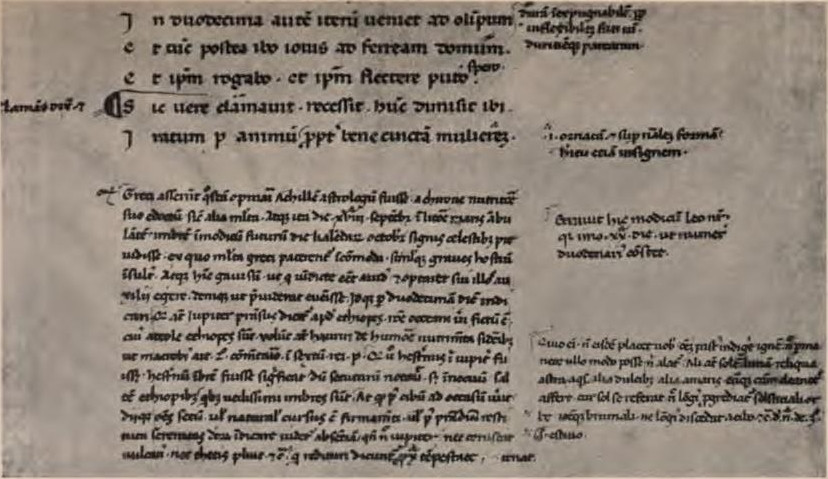
A PAGE OF PETRARCH'S COPY OF THE "ILIAD."
The letters show also how eager he was to hand on to others the light that he had gained from these studies. He had as wide and varied an acquaintance as any man of his time, thanks to the fame that he had won in his youth by his verses, and to the attraction that he exercised upon everyone in later life, through his personal charm and his remarkable intellectual powers; and one of the inevitable consequences of such a connection was a correspondence that was both active and large. He wrote to the emperor and the pope, to kings and their regents, to churchmen of every degree, to scholars in almost all parts of Europe, to men of every profession, every age, every taste; and he wrote always as a Humanist, a lover of the classics, who found in them the quintessence of human wisdom. Men everywhere were ready for broader views, deeper knowledge, keener life, and he, through these letters and through personal contact, stimulated their longing and showed them where they might find that which would satisfy it. The influence that he thus exerted is incalculable. This volume is but an effort to give some comprehension of it.
Of the letters that follow the first four are given for the sake of showing the range and quality of Petrarch's classical scholarship. They are taken, with one exception, from the letters to dead authors, which constitute a large part of the twenty-fourth book of the Familiares. The first is addressed to Cicero.
To Marcus Tullius Cicero[1]
Your letters I sought for long and diligently; and finally, where I least expected it, I found them. At once I read them, over and over, with the utmost eagerness. And as I read I seemed to hear your bodily voice, O Marcus Tullius, saying many things, uttering many lamentations, ranging through many phases of thought and feeling. I long had known how excellent a guide you have proved for others; at last I was to learn what sort of guidance you gave yourself.
Now it is your turn to be the listener. Hearken, wherever you are, to the words of advice, or rather of sorrow and regret, that fall, not unaccompanied by tears, from the lips of one of your successors, who loves you faithfully and cherishes your name. O spirit ever restless and perturbed! in old age—I am but using your own words—self-involved in calamities and ruin! what good could you think would come from your incessant wrangling, from all this wasteful strife and enmity? Where were the peace and quiet that befitted your years, your profession, your station in life? What Will-o'-the-wisp tempted you away, with a delusive hope of glory; involved you, in your declining years, in the wars of younger men; and, after exposing you to every form of misfortune, hurled you down to a death that it was unseemly for a philosopher to die? Alas! the wise counsel that you gave your brother, and the salutary advice of your great masters, you forgot. You were like a traveller in the night, whose torch lights up for others the path where he himself has miserably fallen.
Of Dionysius I forbear to speak; of your brother and nephew, too; of Dolabella even, if you like. At one moment you praise them all to the skies; at the next fall upon them with sudden maledictions. This, however, could perhaps be pardoned. I will pass by Julius Cæsar, too, whose well-approved clemency was a harbour of refuge for the very men who were warring against him. Great Pompey, likewise, I refrain from mentioning. His affection for you was such that you could do with him what you would. But what insanity led you to hurl yourself upon Antony? Love of the republic, you would probably say. But the republic had fallen before this into irretrievable ruin, as you had yourself admitted. Still, it is possible that a lofty sense of duty, and love of liberty, constrained you to do as you did, hopeless though the effort was. That we can easily believe of so great a man. But why, then, were you so friendly with Augustus? What answer can you give to Brutus? If you accept Octavius, said he, we must conclude that you are not so anxious to be rid of all tyrants as to find a tyrant who will be well-disposed toward yourself. Now, unhappy man, you were to take the last false step, the last and most deplorable. You began to speak ill of the very friend whom you had so lauded, although he was not doing any ill to you, but merely refusing to prevent others who were. I grieve, dear friend, at such fickleness. These shortcomings fill me with pity and shame. Like Brutus, I feel no confidence in the arts in which you are so proficient. What, pray, does it profit a man to teach others, and to be prating always about virtue, in high-sounding words, if he fails to give heed to his own instructions? Ah! how much better it would have been, how much more fitting for a philosopher, to have grown old peacefully in the country, meditating, as you yourself have somewhere said, upon the life that endures for ever, and not upon this poor fragment of life; to have known no fasces, yearned for no triumphs, found no Catilines to fill the soul with ambitious longings!—All this, however, is vain. Farewell, forever, my Cicero.
Written in the land of the living; on the right bank of the Adige, in Verona, a city of Transpadane Italy; on the 16th of June, and in the year of that God whom you never knew the 1345th.
With that should go the following interesting little account of a controversy between Petrarch and a certain aged scholar whom he met in the course of one of his journeys. Nothing could afford a clearer insight into either the nature of Petrarch's own feeling for the classics or the general humanistic conditions of the time. This is one of the letters, as the opening sentences show, that were carefully revised for the public.
The Old Grammarian of Vicenza,
To Pulice di Vicenza[1]
On my way I stopped overnight in one of Vicenza's suburbs, and there I found something new to write about. It happened that I had left Padua not much before noon, and so did not reach the outskirts of your city until the sun was getting low. I tried to make up my mind whether I had better put up there or push on a little farther; for I was in a hurry, and the days are long now, and it would be light for a good while yet. I was still hesitating, when lo!—for who can remain hidden from the friends who love him?—all my doubts were happily resolved by your arrival, in company with several other men of mark, such as that little city has always produced in great abundance. My mind was tossing this way and that, but you and your companions, with your pleasant varied talk, furnished the cable that bound it fast. I planned to go, but still stayed on; and did not realise that the daylight was slipping away from me until night was actually at hand. So I discovered once again what I had observed often before, that there is nothing that filches time away from us, without our perceiving it, like converse with our friends. They are the greatest of all thieves of time. And yet we ought to deem no time less truly stolen from us, less truly lost out of our lives, than such as is expended (next to God) upon them.
Well, not to review the story at too great length, you remember that some one made mention of Cicero, as will very often happen among men of literary tastes. This name at once brought our desultory conversation to an end. We all turned our thoughts toward him. Nothing but Cicero was discussed after that. As we sat and feasted together we vied with one another in singing his praises. Still, there is nothing in this world that is absolutely perfect; never has the man existed in whom the critic, were he ever so lenient, would see nothing at all to reprehend. So it chanced that while I expressed admiration for Cicero, almost without reservation, as a man whom I loved and honoured above all others, and amazement too at his golden eloquence and his heavenly genius, I found at the same time a little fault with his fickleness and inconsistency, traits that are revealed everywhere in his life and works. At once I saw that all who were present were astonished at so unusual an opinion, and one among them especially so. I refer to the old man, your fellow-citizen, whose name has gone from me, although his image is fresh in my memory, and I revere him, both for his years and for his scholarship.
Well, the circumstances seemed to demand that I fetch the manuscript of my correspondence with my friends, which I had with me in my chest. It was brought in, and added fuel to the flame. For among the letters that were written to my contemporaries there are a few, inserted with an eye to variety and for the sake of a little diversion in the midst of my more serious labours, that are addressed to some of the more illustrious men of ancient times. A reader who was not forewarned would be amazed at these, finding names so old and of such renown mingled with those of our own day. Two of them are to Cicero himself; one criticising his character, the other praising his genius. These two you read, while the others listened; and then the strife of words grew warmer. Some approved of what I had written, admitting that Cicero deserved my censure. But the old man stood his ground, more stubbornly even than before. He was so blinded by love of his hero and by the brightness of his name that he preferred to praise him even when he was in the wrong; to embrace faults and virtues together, rather than make any exceptions. He would not be thought to condemn anything at all in so great a man. So instead of answering our arguments he rang the changes again and again upon the splendour of Cicero's fame, letting authority usurp the place of reason. He would stretch out his hand and say imploringly, "Gently, I beg of you, gently with my Cicero." And when we asked him if he found it impossible to believe that Cicero had made mistakes, he would close his eyes and turn his face away and exclaim with a groan, as if he had been smitten, "Alas! alas! Is my beloved Cicero accused of doing wrong?" just as if we were speaking not of a man but of some god. I asked him, accordingly, whether in his opinion Tullius was a god, or a man like others. "A god," he replied; and then, realising what he had said, he added, "a god of eloquence." "Oh, very well!" I answered; "if he is a god, he certainly could not have erred. However, I never heard him styled so before. And yet, if Cicero calls Plato his god, why should not you in turn speak of Cicero as yours?—except that it is not in harmony with our religious beliefs for men to fashion gods for themselves as they may fancy." "I am only jesting," said he; "I know that Tullius was a man, but he was a man of godlike genius." "That is better," I responded; "for when Quintilian called him heavenly he spoke no more than the truth. But then, if you admit that he was a man, it follows necessarily that he could make mistakes, and did so." As I spoke these words he shuddered and turned away, as if they were aimed not at another man's reputation but at his own life. What could I say, I who am myself so great an admirer of Cicero's genius? I felt that the old scholar was to be envied for his ardour and devotion, which had something of the Pythagorean savour. I was rejoiced at finding such reverence for even one great man; such almost religious regard, so fervent that to suspect any touch of human weakness in its object seemed like sacrilege. I was amazed, too, at having discovered a person who cherished a love greater than mine for the man whom I always had loved beyond all others; a person who in old age still held, deeply rooted in his heart, the opinions concerning him which I remember to have entertained in my boyhood; and who, notwithstanding his advanced years, was incapable of arguing that if Cicero was a man it followed that in some cases, in many indeed, he must have erred, a conclusion that I have been forced, by common sense and by knowledge of his life, to accept at this earlier stage of my development,—although this conviction does not alter the fact that the beauty of his work delights me still, beyond that of any other writer. Why, Tullius himself, the very man of whom we are speaking, took this view, for he often bewailed his errors, bitterly. If, in our eagerness to praise him, we deny that he thus understood himself, we deprive him of a large part of his renown as a philosopher, the praise, namely, that is due to self-knowledge and modesty.
To return, however, to that day; after a long discussion we were compelled by the lateness of the hour to desist, and separated with the question still unsettled. But as we parted you asked me to send you from my first resting-place, inasmuch as the shortness of the time would not let me attend to it just then, a copy of each of these letters of mine, in order that you might look into the matter a little more carefully, and be in a position to act as a mediator between the parties, or, possibly, as a champion of Cicero's steadfastness and consistency. I approve of your intention, and send the copies herewith. I do so, strange to say, with a fear that I may be victorious, and a hope that I may be vanquished. And one thing more: I must tell you that if you do prove the victor you have a larger task on your hands than you now imagine. For Annæus Seneca, whom I criticise in my very next letter in a similar way, insists that you act as his champion too.
I have dealt familiarly with these great geniuses, and perhaps boldly, but lovingly, but sorrowfully, but truthfully, I think[2]; with somewhat more of truthfulness, in fact, than I myself relish. There are many things in both of them that delight me, only a few that trouble me. Of these few I felt constrained to write; perhaps to-day I should feel otherwise. For, although I have grouped these letters together at the end, it is only because their subject-matter is so unlike the others; they came from the anvil long ago.
The fact is, I still grieve over the fate of these great men; but I do not lament their faults any the less because of that. Furthermore, I beg you to note that I say nothing against Seneca's private life, nor against Cicero's attitude toward the state. Do not confuse the two cases. It is Cicero alone whom we are discussing now; and I am not forgetting that he as consul was vigilant and patriotic, and cured the disease from which the republic was suffering; nor that as a private citizen he always loved his country faithfully. But what of his fickleness in friendship; and his bitter quarrels upon slight provocation,—quarrels that brought ruin upon himself and good to no one; and his inability to understand his own position and the condition of the republic, so unlike his usual acumen; and, finally, the spectacle of a philosopher, in his old age, childishly fond of useless wrangling? These things I cannot praise. And remember that they are things concerning which no unbiassed judgment can be formed, by you or anyone else, without a careful reading of the entire correspondence of Cicero, which suggested this controversy.[3]
May 13th, en route.
Of the two letters addressed directly to Cicero himself, and referred to in the preceding epistle, one has already been given. The other is, in part, as follows:
To Marcus Tullius Cicero.[1]
If my earlier letter gave you offence,—for, as you often have remarked, the saying of your contemporary in the Andria is a faithful one, that compliance begets friends, truth only hatred,—you shall listen now to words that will soothe your wounded feelings and prove that the truth need not always be hateful. For, if censure that is true angers us, true praise, on the other hand, gives us delight.
You lived then, Cicero, if I may be permitted to say it, like a mere man, but spoke like an orator, wrote like a philosopher. It was your life that I criticised; not your mind, nor your tongue; for the one fills me with admiration, the other with amazement. And even in your life I feel the lack of nothing but stability, and the love of quiet that should go with your philosophic professions, and abstention from civil war, when liberty had been extinguished and the republic buried and its dirge sung.
See how different my treatment of you is from yours of Epicurus, in your works at large, and especially in the De Finibus. You are continually praising his life, but his talents you ridicule. I ridicule in you nothing at all. Your life does awaken my pity, as I have said; but your talents and your eloquence call for nothing but congratulation. O great father of Roman eloquence! not I alone but all who deck themselves with the flowers of Latin speech render thanks unto you. It is from your well-springs that we draw the streams that water our meads. You, we freely acknowledge, are the leader who marshals us; yours are the words of encouragement that sustain us; yours is the light that illumines the path before us. In a word, it is under your auspices that we have attained to such little skill in this art of writing as we may possess....
You have heard what I think of your life and your genius. Are you hoping to hear of your books also; what fate has befallen them, how they are esteemed by the masses and among scholars? They still are in existence, glorious volumes, but we of to-day are too feeble a folk to read them, or even to be acquainted with their mere titles. Your fame extends far and wide; your name is mighty, and fills the ears of men; and yet those who really know you are very few, be it because the times are unfavourable, or because men's minds are slow and dull, or, as I am the more inclined to believe, because the love of money forces our thoughts in other directions. Consequently right in our own day, unless I am much mistaken, some of your books have disappeared, I fear beyond recovery. It is a great grief to me, a great disgrace to this generation, a great wrong done to posterity. The shame of failing to cultivate our own talents, thereby depriving the future of the fruits that they might have yielded, is not enough for us; we must waste and spoil, through our cruel and insufferable neglect, the fruits of your labours too, and of those of your fellows as well, for the fate that I lament in the case of your own books has befallen the works of many another illustrious man.
It is of yours alone, though, that I would speak now. Here are the names of those among them whose loss is most to be deplored: the Republic, the Praise of Philosophy, the treatises on the Care of Property, on the Art of War, on Consolation, on Glory,—although in the case of this last my feeling is rather one of hopeful uncertainty than of certain despair. And then there are huge gaps in the volumes that have survived. It is as if indolence and oblivion had been worsted, in a great battle, but we had to mourn noble leaders slain, and others lost or maimed. This last indignity very many of your books have suffered, but more particularly the Orator, the Academics, and the Laws. They have come forth from the fray so mutilated and disfigured that it would have been better if they had perished outright.
Now, in conclusion, you will wish me to tell you something about the condition of Rome and the Roman republic: the present appearance of the city and whole country, the degree of harmony that prevails, what classes of citizens possess political power, by whose hands and with what wisdom the reins of empire are swayed, and whether the Danube, the Ganges, the Ebro, the Nile, the Don, are our boundaries now, or in very truth the man has arisen who 'bounds our empire by the ocean-stream, our fame by the stars of heaven,' or 'extends our rule beyond Garama and Ind,' as your friend the Mantuan has said. Of these and other matters of like nature I doubt not you would very gladly hear. Your filial piety tells me so, your well-known love of country, which you cherished even to your own destruction. But indeed it were better that I refrained. Trust me, Cicero, if you were to hear of our condition to-day you would be moved to tears, in whatever circle of heaven above, or Erebus below, you may be dwelling. Farewell, forever.
Written in the world of the living; on the left bank of the Rhone, in Transalpine Gaul; in the same year, but in the month of December, the 19th day.
Over against the foregoing should be placed a part at least of the long letter addressed to Homer. This will serve to correct the somewhat too favourable impression of Petrarch's critical insight that the letters to Cicero may have induced, and will reveal some of the limitations of his scholarship.
To Homer[1]
Long before your letter[2] reached me I had formed an intention of writing to you, and I should really have done it if it had not been for the lack of a common language. I am not so fortunate as to have learned Greek,[3] and the Latin tongue, which you once spoke, by the aid of our writers,[4] you seem of late, through the negligence of their successors, to have quite forgotten. From both avenues of communication, consequently, I have been debarred, and so have kept silence. But now there comes a man[5] who restores you to us, single-handed, and makes you a Latin again.
Your Penelope cannot have waited longer nor with more eager expectation for her Ulysses than I did for you. At last, though, my hope was fading gradually away. Except for a few of the opening lines of certain books, from which there seemed to flash upon me the face of the friend whom I had been longing to behold, a momentary glimpse, dim through distance, or, rather, the sight of his streaming hair, as he vanished from my view,—except for this no hint of a Latin Homer had come to me, and I had no hope of being able ever to see you face to face. For as regards the little book that is circulated under your name, while I cannot say whose it is I do feel sure that it is yours only as it has been culled from you and accredited to you, and is not your real work at all.[6] This friend of ours, however, if he lives, will restore you to us in your entirety. He is now at work, and we are beginning to enjoy not only the treasures of wisdom that are stored away in your divine poems but also the sweetness and charm of your speech. One fragment has come to my hands already, Grecian precious ointment in Latin vessels....[7]
To turn now to details, I am very eager for knowledge, and consequently was delighted beyond all measure and belief by what you wrote about your instructors, of whom I had never before heard, although now I shall reverence them because of the merits of their great pupil; and about the origin of poetry, which you explain at the greatest length; and about the earliest followers of the Muses, among whom, in addition to the well-known dwellers upon Helicon, you place Cadmus, the son of Agenor, and a certain Hercules, whether the great Alcides or not I do not fully understand; and, finally, about the place of your nativity, concerning which there used to be very vague and misty views here in my country, and no great clearness, so far as I can see, among your compatriots; about your wanderings, too, in search of knowledge, into Phœnicia and Egypt, whither, several centuries after you, the illustrious philosophers Pythagoras and Plato also made their way, and the Athenian law-giver who in his late years wooed the Pierian Muses, wise old Solon, who while he lived never ceased to admire you, and when he died doubtless became one of your cherished friends; and, last of all, about the number of your works, the majority of which even the Italians, your nearest neighbours, have never so much as heard of. As for the barbarians, who bound us upon two sides, and from whom I would that we were separated not by lofty Alps alone but by the whole wide sea as well, they scarcely have heard—I will not say of your books, but even of your very name. You see how trivial a thing is this wonderful fame which we mortals sigh for so windily....
And now what shall I say about the matter of imitation? When you found yourself soaring so high on the wings of genius you ought to have foreseen that you would always have imitators. You should be glad that your endowments are such that many men long to be like you, although not many can succeed. Why not be glad, you who are sure of holding always the first place, when I, the least of mortals, am more than glad, am in fact puffed up with pride, because I have grown great enough for others—though I scarcely can believe that this is really true—to desire to imitate and copy me? In my case the pride and joy would only increase if among these imitators there should be found some few who were capable of surpassing me. I pray—not your Apollo, but the true God of Intellect whom I worship, to crown the efforts of all who may deem it worth their while to follow after me, and to grant that they may find it an easy thing to come up with me, and outstrip me too....
But I am wandering. It was my intention to speak to you of Virgil, than whom, as Flaccus says, this earth has produced no soul more spotless; and to suggest to you, great master of us both, certain excuses for his conduct.... I admit the truth of everything that you say concerning him, but it does not necessarily follow that I lend a sympathetic ear to the charges that you base upon this failure of his to make anywhere any mention of your name, laden and bedecked though he is with your spoils,—mention, you remind me, such as Lucan made, remembering in grateful strains the honour due to Smyrna's bard. Far from that, I am even going to suggest to you additional cause for complaint. Flaccus also remembers you, in many a passage, and always with the highest praise. In one place he exalts you above the very philosophers; in another he assigns to you the highest seat among the poets. Naso remembers you too, and Juvenal, and Statius. But why try to mention all who mention Homer? There is scarcely one of our writers but that belongs in that class. Why is it then, you will say, that I find the one man from whom I deserved most gratitude proving so utterly ungrateful? Before I answer you let me furnish you still another reason for complaint. Observe that he was not equally ungrateful in every case. Musæus and Linus and Orpheus are referred to more than once. So also, and with even greater humility, Hesiod the Ascræan and Theocritus of Syracuse. And finally, a thing that he never would have done if he had had any touch of jealousy, he takes pains to speak of Varus, and Gallus, and certain others of his contemporaries.
Well, have I aggravated sufficiently the resentment which I proposed to assuage, or entirely remove? The natural conclusion, certainly, for anyone to draw, if this were all that I had to say. But it is not; we have not considered yet the reasons for all this, and given them their due weight, and that we should always do, especially when we are sitting in judgment upon others.
Is it not true, then, that he chose Theocritus for his guide and model in the Bucolics, and Hesiod in the Georgics, and, having done so, took pains to introduce the name of each in its appropriate place? Yes, you will say; but after choosing me for his third model, in his heroic poem, what was there to prevent his making some mention there, in like manner, of my name? He would have done so, believe me, for he was the gentlest and most unassuming of men, as is proved by all that is written of him and all that we know of his daily life; but impious death forbade. The others he had referred to wherever he thought of it or found it convenient; for you, to whom he owed so much more, he was reserving a place that had been determined not by mere chance but by the most careful consideration. And what place, think you? What but the most prominent and conspicuous of all? The end of his glorious work!—it was for that that he was waiting; it was there that he was intending to exalt you and your name to the stars in resounding verse, and to hail you as his leader. What better place to praise a leader than at the journey's end? You have good reason, then, for lamenting his too early death, and so has the whole Italian world; but for reproaching your friend, none whatever....
Now, in conclusion, I must run over the various little complaints that are scattered up and down the whole length of your letter. You grieve because you have been mangled so by your imitators. But do you not see that it could not possibly have been otherwise? No one could deal comprehensively with so great a genius. Then you mourn because your name, which was held in great honour by the lawyers and physicians of old, is despised by their successors of to-day. But you forget that these professions are filled now by men of a very different stamp from those who followed them in former times. If they were of the same sort they would love and cherish the same things. So put away your indignation and your grief, and be of good hope; for to have gained the disfavour of the evil and the ignorant is to have given sure sign of virtue and genius....
A word now with reference to your complaint that the valley of Fiesole and the banks of the Arno can furnish only three men who know you and love you. You ought not to wonder at this. It is enough; indeed, it is a very great deal, more than I should have expected, to discover three Pierian spirits in a city so entirely given up to gain. But even if you think otherwise you need not be discouraged; it is a large and populous place, and if you seek you will find there a fourth. And to these four I could once have added a fifth, a man who well deserves to be honoured thus, for the laurels of Peneus bind his brow—or of Alpheus rather. But alas! the great Babylon beyond the Alps has contrived to steal him away from us. To find five such men at one time and in one city, is that, think you, a little thing? Search through other cities. Your beloved Bologna that you sigh for,[8] hospitable though she is to all who are of studious mind, has yet but one such person, though you seek in every corner and crevice. Verona has two; Solmona one; and Mantua one, if the heavens have not tempted him quite away from the things of earth, for he has left your banner and enlisted under that of Ptolemy. Rome herself, the capital of the world, has been drained of such citizens almost to a man, strange though it seems. Perugia did produce one, a man who might have made a name for himself; but he has neglected his opportunities, and turned his back not on Parnassus only but on our Apennines and Alps as well, and now, in old age, is leading a vagabond life, in Spain, toiling as a copyist to earn his daily bread. And other cities have given birth to others, but all of these whom I have known have before now left this mortal home and migrated to that continuing city which one day shall receive us all....
For a long while I have been talking to you just as if you were present; but now the strong illusion fades away, and I realise how far you are from me. There comes over me a fear that you will scarcely care, down in the shades, to read the many things that I have written here. Yet I remember that you wrote freely to me.
And now farewell, forever. To Orpheus, and Linus, and Euripides, and all the others, I beg you to give my kindest greetings, when you come again to your abode.
Written in the world above; in the Midland between the famous rivers Po and Ticino and Adda and others, whence some say our Milan derives its name; on the ninth day of October, in the year of this last age of the world the 1360th.
With this, as throwing further light upon Petrarch's limitations, may be placed the letter to his brother, upon the nature of poetry, to which reference was made above in discussing the question of allegory:
On the Nature of Poetry.
To his Brother Gherardo.[1]
I judge, from what I know of your religious fervour, that you will feel a sort of repugnance toward the poem which I enclose in this letter, deeming it quite out of harmony with all your professions, and in direct opposition to your whole mode of thinking and living. But you must not be too hasty in your conclusions. What can be more foolish than to pronounce an opinion upon a subject that you have not investigated? The fact is, poetry is very far from being opposed to theology. Does that surprise you? One may almost say that theology actually is poetry, poetry concerning God. To call Christ now a lion, now a lamb, now a worm, what pray is that if not poetical? And you will find thousands of such things in the Scriptures, so very many that I cannot attempt to enumerate them. What indeed are the parables of our Saviour, in the Gospels, but words whose sound is foreign to their sense, or allegories, to use the technical term? But allegory is the very warp and woof of all poetry. Of course, though, the subject matter in the two cases is very different. That everyone will admit. In the one case it is God and things pertaining to him that are treated, in the other mere gods and mortal men.
Now we can see how Aristotle came to say that the first theologians and the first poets were one and the same. The very name of poet is proof that he was right. Inquiries have been made into the origin of that word; and, although the theories have varied somewhat, the most reasonable view on the whole is this: that in early days, when men were rude and unformed, but full of a burning desire—which is part of our very nature—to know the truth, and especially to learn about God, they began to feel sure that there really is some higher power that controls our destinies, and to deem it fitting that homage should be paid to this power, with all manner of reverence beyond that which is ever shown to men, and also with an august ceremonial. Therefore, just as they planned for grand abodes, which they called temples, and for consecrated servants, to whom they gave the name of priests, and for magnificent statues, and vessels of gold, and marble tables, and purple vestments, they also determined, in order that this feeling of homage might not remain unexpressed, to strive to win the favour of the deity by lofty words, subjecting the powers above to the softening influences of songs of praise, sacred hymns remote from all the forms of speech that pertain to common usage and to the affairs of state, and embellished moreover by numbers, which add a charm and drive tedium away. It behoved of course that this be done not in every-day fashion, but in a manner artful and carefully elaborated and a little strange. Now speech which was thus heightened was called in Greek poetices; so, very naturally, those who used it came to be called poets.
Who, you will ask, is my authority for this? But can you not dispense with bondsmen, my brother, and have a little faith in me? That you should trust my unsupported word, when I tell you things that are true and bear upon their face the stamp of truth, is nothing more, it seems to me, than I have a right to ask of you. Still, if you find yourself disposed to proceed more cautiously, I will give you bondsmen who are perfectly good, witnesses whom you may trust with perfect safety. The first of these is Marcus Varro, the greatest scholar that Rome ever produced, and the next is Tranquillus, an investigator whose work is characterised always by the utmost caution. Then I can add a third name, which will probably be better known to you, Isidore. He too mentions these matters, in the eighth book of his Etymologies, although briefly and merely on the authority of Tranquillus.
But you will object, and say, "I certainly can believe the saint, if not the other learned men; and yet the fact remains that the sweetness of your poetry is inconsistent with the severity of my life." Ah! but you are mistaken, my brother. Why, even the Old Testament fathers made use of poetry, both heroic song and other kinds: Moses, for example, and Job, and David, and Solomon, and Jeremiah. Even the psalms, which you are always singing, day and night, are in metre, in the Hebrew; so that I should be guilty of no inaccuracy or impropriety if I ventured to style their author the Christian's poet. Indeed the plain facts of the case inevitably suggest some such designation. Let me remind you, moreover, since you are not inclined to take anything that I say to-day without authority, that even Jerome took this view of the matter. Of course these sacred poems, these psalms, which sing of the blessed man, Christ,—of his birth, his death, his descent into hell, his resurrection, his ascent into heaven, his return to judge the earth,—never have been, and never could have been, translated into another language without some sacrifice of either the metre or the sense. So, as the choice had to be made, it has been the sense that has been considered. And yet some vestige of metrical law still survives, and the separate fragments we still call verses, very properly, for verses they are.
So much for the ancients. Now as regards Ambrose and Augustine and Jerome, our guides through the New Testament,—to show that they too employed poetic forms and rhythms would be the easiest of tasks; while in the case of Prudentius and Prosper and Sedulius and the rest the mere names are enough, for we have not a single word from them in prose, while their metrical productions are numerous and well known. Do not look askance then, dear brother, upon a practice which you see has been approved by saintly men whom Christ has loved. Consider the underlying meaning alone, and if that is sound and true accept it gladly, no matter what the outward form may be. To praise a feast set forth on earthen vessels but despise it when it is served on gold is too much like madness or hypocrisy....
But enough of preface, and of apology for form and style. Let me come to the point, without further explanation. You must know that three summers ago, when I was in Gaul, the heat drove me to the Fountain of the Sorgue, which we once fixed upon, you will remember, as the place where we would pass our life. By the grace of God, however, a far more safe and tranquil abode was being prepared for you; while I was to be denied the enjoyment of even the little tranquillity that would have been possible there, since fortune was planning to raise me to a much higher station, very little to my liking.
Well, here I was, with my mind divided, afraid to undertake a task of any magnitude while I was under such a burden of care, and yet quite unable to be altogether idle, because I have been nourished from my infancy on activity, an activity which I hope has been praiseworthy, but which I know has been incessant. So I chose a middle course, postponing all work that was of much importance but doing little odds and ends of writing, trifles that would help me pass away the time. Now the very nature of the region, the forest recesses to which the coming of dawn made me long to flee and forget my cares, and from which only the return of night could bring me home, suggested that I sing a woodland strain. Accordingly I began to compose a pastoral poem, in twelve eclogues, a thing that I had long had in mind; and you would scarcely believe me if I told you in how few days I had it all completed, under the stimulus of the place.
Now the first of these eclogues, in accordance with the intention that I had all along entertained, was about our two selves. Consequently it has won the distinction of being chosen to be sent to you; whether with the result of giving you pleasure or of completely spoiling all your pleasure I scarcely can decide. But that is neither here nor there. In either case this kind of poetry is one that cannot be understood unless a key to it is furnished by the person who constructed it. So, as I would not have you weary yourself to no purpose, I must give you a brief outline, first of what I say, then of what I mean by it.
Two shepherds are introduced, for it is of the pastoral style. Pastoral names are given them, naturally: Silvius and Monicus. Silvius, seeing Monicus lying all alone in a cave, happy and at his ease, envies him and speaks to him, expressing amazement at his good fortune, and lamenting his own estate. Monicus may forget his flocks and fields, and think of rest alone, while he must make his painful way over the rough hills. He marvels the more at this great difference in their lot from the fact that, as he expresses it, one and the same mother bore them both,—so that we may understand that they are brothers. Monicus, in response, throws all the blame for this hard life on Silvius himself, saying that he is under no constraint whatever, but is wandering of his own free will through the trackless forests and over the mountain summits. Silvius replies that there is a reason for these wanderings; the reason is love, nothing less than love of the Muse. To make this clear he begins a rather long story of two shepherds, who sing very sweetly. He tells how he heard one of them in his boyhood, and afterwards the other, and was so captivated by them that he began to neglect everything else. He has been following them eagerly through the mountains, and while doing so has learned to sing, with a skill that others have praised, although he himself is not yet satisfied with it; and he intends to struggle on toward the summit, and either reach it or perish in the attempt.
Monicus now begins to urge Silvius to come into the cave, for he will hear there even sweeter singing. Presently, though, he breaks off, suddenly, as if he saw signs of agitation in the other's face. Silvius, however, offers some excuse, and Monicus continues. When he has finished, Silvius asks who this shepherd is that sings so sweetly; never before has he heard him mentioned. Thereupon Monicus, in the roundabout way that would be natural in an artless shepherd, instead of giving his name describes the land of his birth, making mention, after the fashion of rustics, who often wander in telling a story, of two rivers that spring from one source. Then immediately, as if he saw that he had made a mistake, he turns his words round, and where he had begun to speak of two rivers he goes on to tell of one, which flows from two sources. Both of these are in Asia. Silvius declares that he knows this river, citing in confirmation the fact that a certain youth who goes clad in hairy raiment bathes Apollo in it. In that region, continues Monicus, a singer has arisen. Silvius, upon hearing these words, remembers that he has heard of this man, and proceeds to speak slightingly of his voice and mode of singing, exalting his own by comparison. But Monicus objects, and heaps upon the far-away singer well-deserved praise. Thereupon Silvius after a time pretends to acquiesce, and says that later he will return and test the sweetness of these songs; now he must hurry away. Monicus, wondering at this, begs to know the reason of his haste, and learns that Silvius is intent upon a song of his own which he has begun to compose, concerning a certain famous youth whose deeds he is briefly reviewing, and that he consequently has no leisure now for other things. Monicus accordingly brings the conversation to an end. He bids Silvius good-bye, concluding with an earnest exhortation to weigh well the dangers and chances of such delay. And there you have the sum and substance of the narrative.
Now as to its meaning. The shepherds who converse are ourselves. I am Silvius, you are Monicus. These names are chosen for the following reasons: the former, partly because the scene of the eclogue is of a sylvan character, partly because I always have felt, from my earliest childhood, a hatred of cities, implanted in me by nature, and a love of sylvan life, which has led many of our friends to style me Sylvanus much more frequently than Francesco. Then the other name comes from the fact that there was one of the Cyclops who was called Monicus, that is to say, one-eyed, and there seemed a certain fitness in applying the name to you, since of the two eyes which we mortals all use, one to behold heavenly things and the other those of the earth, you have cast away that which looks earthward and are content to employ the nobler one alone.
The cave, where Monicus dwells in solitude, is Montrieux, where you are living your life in the midst of grottoes and woods. Or it may be taken for the very cave of Mary Magdalene, close by your monastery, the place where she passed her period of penitence, and where God lent the props of his grace to your vacillating heart and made you steadfast in the holy purpose which you had so often discussed with me.
For flocks and fields, which you are said to care for no longer, understand your fellow-men and their haunts, which you abandoned when you fled away into solitude. The statement that we had one and the same mother, and father too for that matter, is not allegory but naked truth. The word sepulchre[2] is to be taken as referring to our final abode. The meaning is that heaven awaits you, but Tartarus me, unless divine mercy comes to my rescue. Or the sentence can be taken literally, just as it reads, for you have now a sure abode, and consequently a fairly sure hope of sepulture, while I am still wandering about at random, and everything in my future is quite unsure.
The inaccessible peak, which Monicus upbraids Silvius for struggling toward, panting and exhausted though he is, is the height of fame, the rarer sort of fame, which but few succeed in attaining to. The deserts where Silvius is said to wander are scholarly pursuits. These to-day are desert places indeed, being in some cases forsaken outright, through love of money, in others despaired of and neglected, in consequence of intellectual sluggishness. The mossy rocks are the rich and great, the moss being their inherited wealth, which has slowly gathered about them. Murmuring fountains can be used of men of letters and of those who have the gift of eloquence, inasmuch as little streams of intellectual influence flow from the well-springs of genius that are within them, with a sound, so to speak, that charms and delights us. As for Silvius' swearing by Pales, that is a shepherd oath, for Pales is the shepherds' goddess. We may understand there Mary, who is not a goddess, to be sure, but yet is the mother of God. Parthenias is Virgil himself. It is not a name of my devising. We read in his biography that he well deserved to be styled Parthenias, or the virgin; so his whole life showed. That the reader may be sure to understand this reference the place is added; the region, as I express it, where Benacus, a lake of Cisalpine Gaul, produces a son that closely resembles himself. This son is the Mincius, a river that we associate with Mantua, which is Virgil's native town.
On the other hand, the shepherd of noble blood who has been brought here from another land signifies Homer. In that passage almost every word has a meaning. Even the inde, which is put for deinde, is used not without a certain mysteriousness, seeing that I came in contact with Virgil when I was a boy, but with Homer afterwards, when I was somewhat advanced in years....[3] The epithet noble is of course Homer's by right, for what is more truly noble than his language or mind? Again, I know not from what valley he has come was added because there are varying opinions as to the place of his birth, no one of which have I accepted in that place in the eclogue. Finally, that Virgil drank at the Homeric spring is a fact which is known to everyone who has to do with poetry. The mistress of whom they both are said to be worthy is Fame, for whose sakes they are poets. Except for their mistresses lovers would not sing. The bristling forest and the mountains that rise into the air, at which Silvius is amazed because they do not follow after these sweet singers, are the uncultivated multitude and the persons who occupy high stations. The descent from the mountain-tops to the bottom of the valleys, and the ascent from the valleys into the mountains again, which Silvius refers to in speaking of himself, are the transition from the heights of theory to the low and level ground of practice, and, conversely, the movement in the opposite direction, when our attitude changes. The fountain which praises the singer is the chorus of scholars. The dry and barren crags are the ignorant and illiterate, who, like the rocks where echo dwells, possess mere voice and power of agreement, without any power of discrimination. The nymphs, the goddesses of the fountains, are the divine minds of scholars. The threshold over which Monicus invites Silvius to pass is that of the Carthusian order, into which assuredly no one has ever been lured by deception, or against his will, as many persons have been into other religious bodies. The shepherd whose singing Monicus prefers to Homer and Virgil is no other than David. The mention of singing to the psaltery is peculiarly appropriate in his case, because of the psalms, which are his work. In the middle of the night, on account of the singing of the psalms in your churches at early dawn. The two rivers from a single source, as Monicus puts it first by mistake, are the Tigris and the Euphrates, well-known streams of Armenia. Then the single river from a double source is the Jordan, in Judæa. For this fact we have many authorities, among them Jerome, who was a diligent student of those regions and lived there for a long time. The names of the two sources are Jor and Dan. By their union both the stream and its name are formed. The Jordan empties, it is said, into the Sea of Sodom, where we are told that the fields are strewn with ashes from the burning of the cities. In this river Christ, we learn, was baptised by John. So the hairy youth is John the Baptist, who was but a youth, virgin, pure, innocent, clad in hairy raiment, unkempt, wearing the skin of a goat, with locks uncombed, with face blackened by the suns. Then by Apollo, whom I describe as son of Jupiter and god of intellect, I mean Christ, who is the son of God, and very God himself, and moreover, as I suggest, our god of intellect and wisdom. For, as all theologians know, among the attributes of the persons that constitute the Holy Trinity, one and indivisible, wisdom belongs to the Son; he is the wisdom of the Father.
Again, the hoarse voice and never-ceasing tears and oft-repeated name of Jerusalem are intended as a reference to David, because of his style, which at first seems rough and full of lamentation, and furthermore because there really is frequent mention of that city in the psalms, sometimes historical, sometimes allegorical. Now there follows a brief enumeration of the subjects which the poets whom Silvius is striving to exalt are wont to sing. To explain all this would take a long time. Besides it is sufficiently clear already to those who are proficient in such matters. And then Monicus replies, excusing this harshness of David, and running with like brevity over the list of subjects which he has treated.
The youth about whose deeds Silvius has begun to weave his song is Scipio Africanus, who laid Polyphemus low upon the African shore. The reference there is to Hannibal, the Carthaginian leader. Hannibal and Polyphemus were both one-eyed, after Hannibal's loss of an eye in Italy. The Libyan lions, in which we know that Africa abounds, are the other Carthaginian leaders, who were hurled from power by the same conqueror. The sacrifices that were consumed are the ships which he burned, the ships upon which all the hopes of the Carthaginians had hung. He destroyed five hundred of them before their very eyes, so Roman history tells us. The designation of starry youth is partly because of the heroic valour which he possessed above all other men, and which Virgil characterises as 'burning,' Lucan as 'fiery'; and partly because the Romans of his day were led by their admiration of him to credit him with divine origin. The Italians are said to praise him from the opposite shore because of the fact that the shore of Italy really was opposed to that of Africa, not alone in temper and feeling but in situation too. Rome itself is directly across from Carthage.
However, although this youth is praised so widely, nobody has sung of him; by which I meant to suggest that although all history is full of his deeds and his renown, and Ennius has written a great deal about him, in his rude and unpolished style, as Valerius calls it, there still is no carefully finished metrical treatment of his achievements as yet. So I decided long ago to sing of him myself, as best I could. My poem of Africa is about him. I began it in my youth, with a high heart. God grant that I may be permitted in my old age to bring it to the happy conclusion which I then dreamed of. The danger which always inheres in such postponement of a well-considered plan, and the mutability and uncertainty of this life of ours, Monicus bids us ponder upon, in his concluding remarks, which scarcely call for further explanation. And you will also understand the few sentences at the close, if you will reflect a little. Farewell.
Written at Padua, on the second day of December, toward evening.
This next letter gives one some notion of the difficulties of a scholar's life in Petrarch's day:
On the Scarcity of Copyists.
To Lapo da Castiglionchio.[1]
Your Cicero has been in my possession four years and more. There is a good reason, though, for so long a delay; namely, the great scarcity of copyists who understand such work. It is a state of affairs that has resulted in an incredible loss to scholarship. Books that by their nature are a little hard to understand are no longer multiplied, and have ceased to be generally intelligible, and so have sunk into utter neglect, and in the end have perished. This age of ours consequently has let fall, bit by bit, some of the richest and sweetest fruits that the tree of knowledge has yielded; has thrown away the results of the vigils and labours of the most illustrious men of genius, things of more value, I am almost tempted to say, than anything else in the whole world....
But I must return to your Cicero. I could not do without it, and the incompetence of the copyists would not let me possess it. What was left for me but to rely upon my own resources, and press these weary fingers and this worn and ragged pen into the service? The plan that I followed was this. I want you to know it, in case you should ever have to grapple with a similar task. Not a single word did I read except as I wrote. But how is that, I hear someone say; did you write without knowing what it was that you were writing? Ah! but from the very first it was enough for me to know that it was a work of Tullius, and an extremely rare one too. And then as soon as I was fairly started I found at every step so much sweetness and charm, and felt so strong a desire to advance, that the only difficulty which I experienced in reading and writing at the same time came from the fact that my pen could not cover the ground so rapidly as I wanted it to, whereas my expectation had been rather that it would outstrip my eyes, and that my ardour for writing would be chilled by the slowness of my reading. So the pen held back the eye, and the eye drove on the pen, and I covered page after page, delighting in my task, and committing many and many a passage to memory as I wrote. For just in proportion as the writing is slower than the reading does the passage make a deep impression and cling to the mind.
And yet I must confess that I did finally reach a point in my copying where I was overcome by weariness; not mental, for how unlikely that would be where Cicero was concerned, but the sort of fatigue that springs from excessive manual labour. I began to feel doubtful about this plan that I was following, and to regret having undertaken a task for which I had not been trained; when suddenly I came across a place where Cicero tells how he himself copied the orations of—someone or other; just who it was I do not know, but certainly no Tullius, for there is but one such man, one such voice, one such mind. These are his words: "You say that you have been in the habit of reading the orations of Cassius in your idle moments. But I," he jestingly adds, with his customary disregard of his adversary's feelings, "have made a practice of copying them, so that I might have no idle moments." As I read this passage I grew hot with shame, like a modest young soldier who hears the voice of his beloved leader rebuking him. I said to myself, "So Cicero copied orations that another wrote, and you are not ready to copy his? What ardour! what scholarly devotion! what reverence for a man of godlike genius!" These thoughts were a spur to me, and I pushed on, with all my doubts dispelled. If ever from my darkness there shall come a single ray that can enhance the splendour of the reputation which his heavenly eloquence has won for him, it will proceed in no slight measure from the fact that I was so captivated by his ineffable sweetness that I did a thing in itself most irksome with such delight and eagerness that I scarcely knew I was doing it at all.
So then at last your Cicero has the happiness of returning to you, bearing you my thanks. And yet he also stays, very willingly, with me; a dear friend, to whom I give the credit of being almost the only man of letters for whose sake I would go to the length of spending my time, when the difficulties of life are pressing on me so sharply and inexorably and the cares pertaining to my literary labours make the longest life seem far too short, in transcribing compositions not my own. I may have done such things in former days, when I thought myself rich in time, and had not learned how stealthily it slips away: but I now know that this is of all our riches the most uncertain and fleeting; the years are closing in upon me now, and there is no longer any room for deviation from the beaten path. I am forced to practice strict economy; I only hope that I have not begun too late. But Cicero! he assuredly is worthy of a part of even the little that I still have left. Farewell.
The two letters that follow, and that conclude this chapter, are given as indicative of the various ways in which Petrarch brought his enthusiasm for the classics to bear upon his contemporaries. It was partly through such conscious effort, and partly through the general spirit and tone of all his letters, and of his other writings too, that he affected the thought of his time.
Ignorance and Presumption Rebuked.
To Giovanni Andrea di Bologna.[1]
I find it hard to tell you how much my ears, fatigued by the clamour of the multitude, have been refreshed by your letter, which I have read and re-read several times over. You thought it verbose, as I learned at the end; but I found nothing to criticise in it except its brevity. Your threat at the close, that in the future you will be more concise, I did not like. I should prefer to have you more detailed. But that shall be as you please; you are my master; it is not for you to think of my preferences, but for me to try to adapt myself to yours.
This, however, does not necessarily mean that the game is to be entirely in your hands. Things often turn out, as you very well know, quite differently from what we expect. It is possible that you may once in a while hear something from me that would force even the most devoted lover of silence to speak out. Do you want me to show you, here and now, that I can live up to that threat? Very well; I will do it. But first of all let me protest that I entertain the same opinion concerning you that Macrobius does of Aristotle; begotten perhaps by my love for you, perhaps by the truth,—I do not attempt to decide. I consider you scarcely capable of ignorance, upon any subject whatever. If anything. does escape you that seems contrary to fact, I conclude either that you have spoken a little hastily, or, as Macrobius says, that you were indulging in a playful jest. I am not thinking now of what you wrote concerning Jerome, that you place him above all the other fathers of the church. Your opinion upon that subject is of long standing and widely known, and not at all new to me. Although it really seems to me idle to contend thus from the comparative point of view about geniuses who are all superlative, still, on the other hand, you cannot be mistaken in what you say. Whatever wins your approval will be greatest and best. And yet I remember that I used to debate this matter a great deal with your friend of glorious memory, Giacomo, Bishop of Lombez, and that, while he followed in your footsteps and always and invariably preferred Jerome, I used to give the palm among all our Catholic writers to Augustine. And—well, I believe upon reflection that I will dismiss my fears of offending either the truth or your susceptibilities, my father, and say precisely what I think. There are many bright stars, of varying magnitude; one we may call Jupiter, another Arcturus, another Lucifer, but the great Sun of the Church is surely Augustine.
This, however, as I have implied, is a matter on which I am not disposed to lay much stress. Freedom of choice can harm no one; freedom of judgment must be respected. But the statement that follows, that among ethical writers you place Valerius highest, does amaze me; that is, if you were speaking seriously and will abide by what you say, and not jestingly, just for the sake of trying me. For if Valerius is first, where pray does Plato stand? and Aristotle? and Cicero? and Annæus Seneca, whom good judges have ranked as a moralist above them all? Perhaps Plato and Tullius will have to be dropped from my list, however, on grounds that you have stated elsewhere in your letter. For, to my great astonishment—I really cannot conceive what you were thinking of—you declare that they are poets, and ought to be admitted to the poetic choir! If your saying so should make it so, you would accomplish more than you imagine. Apollo would smile upon you and the Muses applaud, when they found you introducing your distinguished new denizens to the hills and groves of Parnassus.[2]
What in the world induced you to think or say such a thing, when it is so plain that Tullius in his early works is the greatest of orators, and in his later an eminent philosopher? Besides, while we feel everywhere that Virgil, for instance, is a poet, Tullius is nowhere so. What we read in the Declamations is certainly true, that Virgil's felicity deserted him when he wrote in prose, and Cicero's eloquence when he wrote in verse. And then what am I to say of Plato, who by the consensus of all the greatest judges is not a poet at all, but the prince of philosophers? Turn to Cicero, to Augustine, to other writers who speak with authority, as many of them as you please, and you will find that wherever in their books they have exalted Aristotle above the rest of the philosophers they have always taken pains to declare that Plato is the one exception. What it is that makes Plato a poet I cannot imagine, unless it be a remark of Panætius, quoted by Tullius, where he is denominated the Homer of philosophy. This means nothing more than chief of philosophers; as preëminent among them as Homer among the poets. If we do not explain it so, what are we to say of Tullius himself, when in a certain passage in the letters to Atticus he calls Plato his God? They are both trying in every possible way to express their sense of the godlike nature of Plato's genius; hence the name of Homer, and, more explicit still, that of God.
Next, prompted by this reference to Cicero and Plato, you discourse—with wonderful eloquence and charm for one who is speaking about things that he does not understand—upon the poets in general, entering into an enthusiastic discussion of the identity of one and another of them, the time when they were born, the characteristics of their style, the particular kind of poetry that they affected, and their place upon the roll of fame. To review all this in detail would be too long a task,—so numerous are the things which none of us had ever heard of before, but you have now disclosed to such of us as are eager to learn, in this eloquent epistle. And yet on second thought, if you will concede to me, or rather not to me but to my calling, the right to offer just one objection, I shall express my wonder at finding the names of Nævius and Plautus so entirely unknown to you that you think me guilty of a solecism in inserting them in my letter, and reprove me indirectly for daring, as Flaccus puts it, to invent characters before unheard of. You do not make this charge in so many words, but your doubts are such and so stated as to amount to nothing less than a condemnation of my temerity in bringing upon the stage names that are strange and foreign. It is true, you did in the end curb your longing to speak plainly, and with your usual courtesy and modesty chose to blame rather your own ignorance. And yet, unless I am greatly mistaken, it is one of those cases where a man's words say one thing but his real convictions loudly proclaim another. I wonder at this, for Terence you seem to know very well, and he, at the very beginning of his works, in the prologue of the Andria, makes definite mention of Nævius and Plautus, and, in the same verse, of Ennius too. Then in the Eunuchushe refers to them again, and in the Adelphi speaks of Plautus alone. Cicero, too, mentions them together, in his De Senectute, and Aulus Gellius in his Nodes Atticæ, where he gives their epitaphs, in old-fashioned Latin. All this argument is needless, however, for who ever heard the name of poetry apart from the names of these two men? Your amazement therefore fills me with amaze; and I beg you, my father,—if you will let me speak freely,—not to allow these lucubrations of yours to pass into any hands but mine. The brighter one's renown, the more carefully should it be guarded. To me, indeed, you may say whatever you wish, as freely as to yourself. You may change and retract, as scholars have to do when they commune with their own past thoughts. But when your words have gone abroad all power of choice is taken away, and you must submit to whatever judgments the multitude may pronounce upon you. I send your letter back to you in safe custody, and send this with it, keeping a copy, though, simply that I may be able, if you should desire to continue the discussion, to place your arguments by the side of mine which called them forth, instead of having to tax my memory for what I had said....
In writing thus I do not for a moment forget that a letter of reproof addressed to a father by a son can scarcely fail to seem harsh and rude. But you must let my love for you excuse such boldness. My regard for your reputation compels me to speak, for if I keep silent you will be sure to hear these things from others, or, still worse, will be injured by severe judgments uttered behind your back....
Let me say, then, that I detect in your writings a constant effort to make a display. This, I take it, accounts for your tendency to roam through strange volumes, culling out fine passages to weave into your own discourses. Your pupils, amazed at such an array of names, applaud you and call you omniscient, just as if you really knew every author the titles of whose books your memory happens to retain. Scholars, however, find it easy to discriminate between a man's acquisitions and his borrowings; easy, too, to determine what portion of the latter he has a right to, what he holds by precarious tenure, and what he has simply stolen; when he has drunk deep, from a full fountain, and when he has taken only a hasty sip.
It is a childish thing to glory in a mere display of memory. As Seneca has said, it is unseemly for a grown man to go gathering nosegays; he should care for fruit rather than flowers. But you, in spite of your years and the venerableness that they have brought with them; in spite of the fact that you are of great eminence in your profession; indeed,—for this task of taking you down is a thankless one, and I am glad now and then to try smoothing you down instead,[3]—are the very first man of your time in the department of literature to which you have devoted yourself, nevertheless, like a truant child, break bounds, and go wandering away into fields where you do not belong, and spend the evening of your days in picking pretty flowers. You seem to take delight in exploring new regions, where the paths are unknown to you and you are sure to go astray once in a while or fall into a pit. You like to follow the example of those who parade their knowledge before their doors, like so much merchandise, while their houses within are empty. Ah! it is safer to be something than to be always trying to seem to be. Ostentation is difficult and dangerous. Moreover, just when you are most desirous of being deemed great, innumerable little things are sure to happen which not only reduce you to your true dimensions but bring you below them. No one intellect should ever strive for distinction in more than one pursuit. Those who boast of preëminence in many arts are either divinely endowed or utterly shameless or simply mad. Who ever heard of such presumption in olden times, on the part of either Greeks or men of our own race? It is a new practice, a new kind of effrontery. To-day men write up over their doors inscriptions full of vainglory, containing claims which, if true, would make them, as Pliny puts it, superior even to the law of the land. But when one looks within—ye gods! what emptiness is there!
So, in conclusion, I beg you, if my words have any weight, to be content within your own bounds. Do not imitate these men who are all promise and no performance; who, as the comic poet has said, know everything and yet know nothing. There is a certain wise old Greek proverb that bids everyone stick to the trade that he understands. Farewell.[4]
The Young Humanist of Ravenna.
To Boccaccio[1]
A year after your departure I had the good fortune to secure the services of a fine, generous, young lad, whom I am sorry you do not know. He knows you well, for he has often seen you, at Venice, in your house,[2] where I am now living, and also at the home of our friend Donato, and on such occasions has observed you very carefully, as is natural at his age. I want you to know him, too, so far as that is possible at such long range, and to see him with the mind's eye, when you read my letters, and so I will tell you a little about him. He was born on the coast of the Adriatic, at about the time, if I am not mistaken, when you were living there,[3] with the former lord of that region, the grandfather of him who now holds sway. The lad's own family and fortune are humble. But he is well endowed, nevertheless. He has a force of character and a power of self-control that would be praiseworthy even in old age; and a mind that is keen and flexible; and a memory that is rapacious, and capacious, and, best of all, tenacious. My bucolics, which are divided off into twelve eclogues, as you know, he committed to memory within eleven days, reciting one section to me each evening and two the last time, repeating them without a single hitch, as if he had the book before his eyes. Besides that, he has himself a great deal of invention,—a rare thing in these days,—and a fine enthusiasm, and a heart that loves the Muses; and he is already, as Maro hath it, making new songs of his own; and if he lives, and his development keeps pace with his years, as I am confident it will, he surely will be something great, as was prophesied of Ambrose by his father. There is much to be said for him even now, at an age when usually there is very little to say. Of one of his good tendencies you have just heard. You shall hear now of another, a trait that constitutes the best possible foundation for sound character and solid intellectual attainments. As the common herd loves money and longs to possess it, even so, and more, does he hate it and spurn it. To 'add to golden numbers golden numbers' he considers labour worse than lost. He is scarcely willing to acquire the necessaries of life. In his love of solitude, his fasting, his vigils, he vies with me, often surpasses me. In brief, his character has so recommended him to me that he is every bit as dear to me as a son whom I had begotten; perhaps dearer, because a son—such alas! are the ways of our young men nowadays—would wish to rule, while all his study is to obey, to follow not his own inclinations but my will, and this not from any selfish motive, such as the hope of reward, but solely from love and, possibly, an expectation of being benefited by association with me....[4]
And now I come, at the close, to what really was first in my thoughts. The lad has a decided leaning toward poetry; and if he perseveres in his efforts, till in due time he learns to think clearly and vigorously, he will compel your wonder and your congratulations. But so far he is vague and uncertain, because of the feebleness of youth, and does not always know what he wants to say. What he does want to, however, he says very nobly and beautifully. So it frequently happens that there falls from him some poem that is not only pleasing to the ear but dignified and graceful and well-considered, the sort of work that you would ascribe, if you were ignorant of the author, to some writer of long experience. I am confident that he will develop vigour of thought and expression, and work out, as the result of his experiments, a style of his own, and learn to avoid imitation, or, better, to conceal it, so as to give the impression not of copying but rather of bringing to Italy from the writers of old something new. Now, however, imitation actually is his greatest joy, as is usual at his time of life. Sometimes his delight in another's genius seems to lend to his spirit wings, and he defies all the restraints of his art and soars aloft, so high that he cannot continue his flight as he should, and has to descend in a fashion that betrays him. The strongest of all these admirations is for Virgil. It is marvellously strong. He thinks very many of our poets worthy of praise, but Virgil worthy almost of worship. He loves him so, is so fascinated by him, that he often takes pains to weave bits from his poems into his own verse. I, rejoicing to find that he is overtaking me and longing to see him press on and become what I have always aspired to be, warn him, in a fatherly and friendly fashion, to consider carefully what he is about. An imitator must see to it that what he writes is similar, but not the very same; and the similarity, moreover, should be not like that of a painting or statue to the person represented, but rather like that of a son to a father, where there is often great difference in the features and members, and yet after all there is a shadowy something,—akin to what our painters call one's air,—hovering about the face, and especially the eyes, out of which there grows a likeness that immediately, upon our beholding the child, calls the father up before us. If it were a matter of measurement every detail would be found to be different, and yet there certainly is some subtle presence there that has this effect.