THE TATTLERS
Reading edition
PIXIE AND BOB
It was a beautiful street where the dogs all lived, lined on one side by stately palms. The lawns were smooth as velvet, and always green, in spite of the fact that it seldom rained in this country. Flowers and clinging vines helped to enhance the beauty. The owners of the homes on this well kept street were rich and could afford every luxury for themselves, as well as everything appropriate to their respective positions.
That anyone or anything could be unhappy in such environment seemed unbelievable. However, one little heart was aching there. It was that of a poor little rich Pomeranian, so tiny that the amount which had been paid for her would cover her nicely, were it in bills.
Notwithstanding the fact that Pixie, for that was her name, was fondled and petted, wore beautiful clothes, slept on a silk pillow at the foot of her mistress’s bed, and won all the prizes at the fancy dog shows, indeed, had every wish gratified, she was very unhappy to-day.
Pixie’s owners, who had bought her in London, were proud of her long pedigree, which they never failed to mention, and also that she was registered along with dogs belonging to the King and Queen. This was exceedingly gratifying to everyone concerned, and the awe with which people expressed their admiration for a mite like her that had hobnobbed with royalty, was astonishing.
She was in this lovely home, and had nothing to do but go through a few silly tricks, such as sneezing when she was told to, whether she felt like it or not. To be sure she would be rewarded with some little bit of sweet for performing. But the worst was to have to sit up on her haunches, close her eyes, and say her prayers, in order that her admirers might have a hearty laugh.
Pixie never felt like laughing herself, as something in her made her feel cross at such times. Besides, where did her mistress get that idea of saying prayers in that way? Pixie never saw her mistress say prayers in that or any other way. If she had, would she have liked to be laughed at?
These were only a few of the things this mite of a dog, who was worth her weight in gold, had to trouble her, for she was possessed as we have seen of a small organ necessary to her existence, called a heart. This, we like to think, was susceptible to emotions similar to those of others of God’s creatures.
That this “angel dog,” as her mistress sometimes called her, could have a heartache never occurred to that lady, yet just now Pixie truly was troubled. Every morning Celeste, the French maid, whose ancestors came from the same country that was the home of Pixie’s, would take her out for exercise and fresh air. Pixie loved going to the park nearby. At the entrance, the maid would take the leash from her collar and allow her her liberty.
Celeste would stop to visit with other maids who had brought either children or dogs with them. The one with whom she was holding conversation to-day was the Judge’s maid, who had a young Airedale pup in tow. This young dog was also allowed to run at large. He was so homely and awkward that Pixie was ashamed to be seen with him, although he, like herself, was supposed to be of blue blood. Yet since he belonged to their set, she felt that she must be polite to him.
He became familiar and this put Pixie on her dignity. They started out together, but the Pom was haughty and disdainful.
“He is so common and ugly,” she thought.
Pixie was not wise in her reasoning, or she would have wanted just such a background to show off her own beauty. How her lovely, golden-brown coat glistened in the sun, and how stiff, bristly and fuzzy the Airedale’s coat looked in comparison. And such ears! And was there anything more ridiculous than that stub of a tail? Why, that must be why he was called Bob. Such were the observations that Pixie was making to herself.
Still Pixie was trying to be polite, as one in her position in dogdom should be, but she resented the Airedale’s friendly advances, and when Bob challenged her to a race, she became very cool indeed. She felt that sometimes one’s standing required the toleration of “impossible” dogs, but one did not have to lower her dignity in doing so.
Bob must have sensed something of what was in this haughty lady dog’s mind, for he began bragging. “She wasn’t so much after all.” His master lived in a larger, finer house than hers. Besides, his master was a Judge, who knew about everything and owned two dogs, real dogs—himself and his father—both with pedigrees and family trees planted in the north of England. They were grafted onto an Irish terrier branch, and noted for a lot of things. He failed to say that one of the traits for which they were noted was their quick tempers when they were young and undisciplined.
Bob had some things of which to be proud, too, so he began strutting before Pixie, which only made matters worse, as far as their ever being friends was concerned.
Then Bob, who, you must remember, was young and thoughtless, began making insulting growls, which meant that he knew a few things. “Hadn’t Celeste told their maid that Pixie’s great-great-grandmother was a wolf-dog, and that she had one of the largest families? She was known to have had twenty puppies, and she had to leave them to look after themselves while she helped Pixie’s great-great-grandfather shoo off the wolves.” He wound up by saying, “And my master says it is true. He looked it up in the book.”
Now Pixie was a “perfect lady,” yet there remained in her blood a taint of the fighting propensity that had enabled her great-great-grandparents to shoo off those hungry wolves, and she was not going to stand for any such unkind remarks from a mere Irish Airedale terrier pup.
She flew at him, snapping and biting his awkward legs, and barking her loudest, which only made Bob smile, though it is hard to believe that Airedales do smile, so solemn are their countenances. He decided to show her what real barking was like, and the big bass bow-bow that he let out so frightened Pixie that she scampered off to the French maid.
In this way the morning was spoiled for the little Pom, who shed tears when she thought of her poor great-great-grandmother having to leave those dear little puppies to help shoo off those terrible wolves. Looking around at her surroundings, she thought how different was her condition. She had everything to make her happy. She could sit in her mistress’s lap and eat off her plate if she wanted to. She would never have a large family of puppies to bother with; and of course there would never be any wolves to disturb her.
As this brought her thoughts back to the happenings of the morning and that dreadful Airedale pup, a shudder went through her small body. “Will I always have to encounter that dog when I go to the park?” she wondered.
There were many dogs at the park, but with most of them Pixie must not play. She could associate with only the dogs in her particular circle, and give these others only a haughty stare when she met them.
The Airedale pup, not used to being snubbed, was taking this slight seriously. After Pixie left him, he felt he was in need of sympathy. That Pixie was a lady and had very sharp teeth prevented him from demanding an apology. Had she been one of his own kind, and of his own size, Bob would have fought it out. He would have had the apology, too; but as it was he must have advice.
Looking across the park, he saw the gleam of a brass-studded collar which looked like the regulation collar for dogs in their neighborhood. Going over there, he found three dogs, all belonging in his set. They were taking the air while their attendants sat on the benches and read the morning papers.
Bob, who was still smarting from Pixie’s snub, told them his tale of woe.
“I have been mistreated by a pert little flapper of a Pom, with a ribbon around her neck—and such superior airs she was assuming, when she is only the great-great-granddaughter of a wolf-dog, who, away back there in the old country, raised dozens of puppies and shooed wolves!”
His hearers sat around on their haunches, with their tongues lolling out, and listened intently. Being unable to get an expression from them collectively, Bob questioned them one by one as to what they thought of Pixie, and what he should do about her behavior to him.
All except one expressed opinions. The exception was a young police dog, whose family tree was flourishing over there. If he was not mistaken, there were traditions in his family which bore some relation to the story about the little Pomeranian dogs being able to frighten his own ancestors, when they were hungry and weak, and wanted only a good meal from the poultry pens. Yet he hoped there was some mistake about the story. It did not seem possible that a mere Pom could frighten a noble wolf. Yet he admired Pixie.
The next dog consulted was a little pug, named Ruby. She was quite well acquainted with Pixie, had met her abroad, and had come home on the same ship with her. Both of them had been prize-winners at a dog show in England. Their respective mistresses had bought them from the same kennels. There had been considerable discussion as to the merits of the two dogs. Both had wanted the Pom, and quite a bit of feeling arose between the two ladies on the subject. In fact, the pug’s mistress, in a polite way, claimed the other lady had used questionable methods to procure the coveted dog. However, nothing could be done about it now, as Pixie’s mistress was better able to pay the purchase price.
So the pug was taken; but Ruby always felt there was a lack of sincerity in her owner’s voice when she declared to Pixie’s owner, “No amount of money would induce me to part with my dear little pug. She is the smartest, brightest dog I ever knew.” Then too, Ruby had overheard Pixie’s mistress telling some one that pugs were stupid dogs who did nothing but eat and snore.
Considering these facts, it was not difficult for Bob to enlist Ruby’s sympathy. Aside from this, Ruby was envious of Pixie’s beautiful fur coat. It was so soft and warm. Pixie had no need to wear an overcoat that made her look like a stuffed sausage when she went riding. And she didn’t snore when she slept. The pug at once became Bob’s ally.
The other one in the group was a little French poodle who was fond of Pixie, because, notwithstanding that one was of German descent and the other of French, they got along nicely together. Though unlike in color, they had many traits in common. Both had ancestors who were valiant and courageous. Having this beautiful French poodle, whose name was Petite, to champion her cause was favorable for Pixie, had she known about it; but Pixie was blissfully unaware of the controversy.
Petite’s and Pixie’s mistresses were old friends, and both dogs had heard complimentary remarks about each other, so Bob could not count on the French poodle’s sympathy. She was decidedly for Pixie. Nothing could be settled with the weight of opinion so unequally balanced.
Bob’s pride had had a jolt, and the matter must be adjusted. He would take the case to his father to decide. The elder Airedale was one of those large boned, solemn looking dogs that always look as if they were thinking deeply on some subject of importance. At the same time, there is a comical twist to their countenances that harks back to some trait in their Irish ancestry. Because of these characteristics, and the fact that his owner was on the bench, this old Airedale was called Judge.
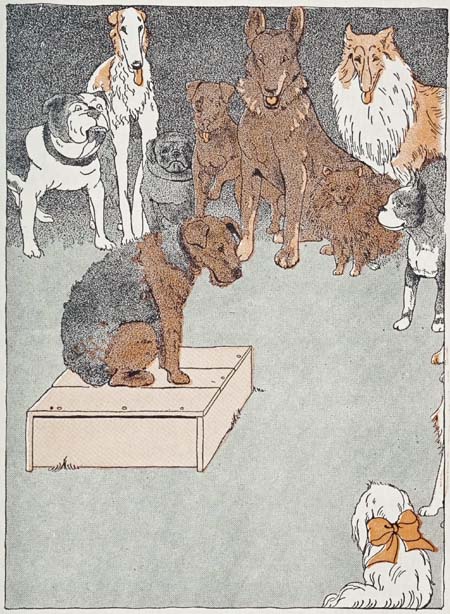
Judge Was Always Being Called Upon to Decide
Besides being Bob’s father, Judge was also a sort of father confessor to all the dogs in the neighborhood. He was always being called upon to decide the rights of the case in the squabbles of the dogs. Was there a scrap over a bone, or had some of the dogs mistreated a cat that was unable to defend itself, Judge would administer a cuffing to the offenders. Even his own son was granted no mercy when he was brought into court for some disturbance he had caused, but was given a good cuffing if Judge found him guilty.
JUDGE AIREDALE
With some misgivings, therefore, Bob approached his father on this subject. He decided he would wait until he was sure his dad was in a happy mood. After the noonday meal, when they were both comfortably full, and Judge had had his nap, was the most likely time. Then, cautiously, Bob broached the matter of his wounded pride. Having no mother to smooth the way for him, Bob was at the mercy of his father’s candor. Judge, realizing this fact, became interested in learning about the case.
He inquired as to how many families were acquainted with the story, and how much had really been said about the personal appearance of his offspring. This was a delicate subject, as there was a strong resemblance between father and son. Just how far into the family records had Pixie delved? Of course, no one in this neighborhood knew of the family skeleton. That was safe. Bob was very brief about his part in the encounter. He mentioned nothing about his terrible bow-wows, which had so frightened the pert Pom that she had turned pale under her heavy coat.
Judge, rubbing his chin with his ponderous paw, said, “I will take up the case, but I will defer a decision until more evidence can be procured. Meantime I will investigate.”
In the interval each of the dogs that knew about the affair related it to every other dog they met. It was discussed not only in the best families, but the garbage man’s dog heard of it, and he told it to the laundress’s yellow mongrel, who met the milkman’s shepherd collie. As the latter traveled around town, and was an excellent reporter, the news spread and the story grew and grew, until the owners of the dogs were also involved. When at last it came to their ears, they were puzzled to know what it was all about.
Judge, hearing about how the news of this little affair had grown until it was called a scandal, decided he must act quickly to settle the wagging of those busybodies’ tongues. He would hold a session and call the whole neighborhood of dogs into court. The police dog was to summon them. Each one that had a share in this matter, regardless of what was his standing in society, must appear before him to be punished.
It was an outrage that a dog of Judge’s high standing should be so maligned, for at last the story had grown until it was unsavory, and a great injustice had been done to the father of such a promising son. Summoning the German police dog, Judge made a list of those who were responsible for the wide spread of the story. Among these were Ruby, the pug, Petite, the white French poodle, and those to whom they had told the interesting bit of news.
In their set was an English bulldog named Bill, who was a distant relative on the terrier side of the Airedale family. Bill felt that it would be disloyal not to support the Airedales in their contention, especially as the matter had been laid before him by Ruby, who gave her own version of it, adding as much local color as she could.
Bill, in turn, told a friend, a Boston bull, and so it went. Among their select set, everyone who repeated the tale added something to it. It was left to dear little Petite, the fluffy French poodle, who always wore white, to defend the little Pom. With tears in her eyes, Petite told all her friends how that “impossible Airedale pup had insulted her dear friend, Pixie.” She wept on the shoulder of a stately Russian wolfhound, named Princess, who had been “over” only a short time, and who was bewildered by Petite’s show of emotion. For some time indeed Princess was unable to understand what it all meant.
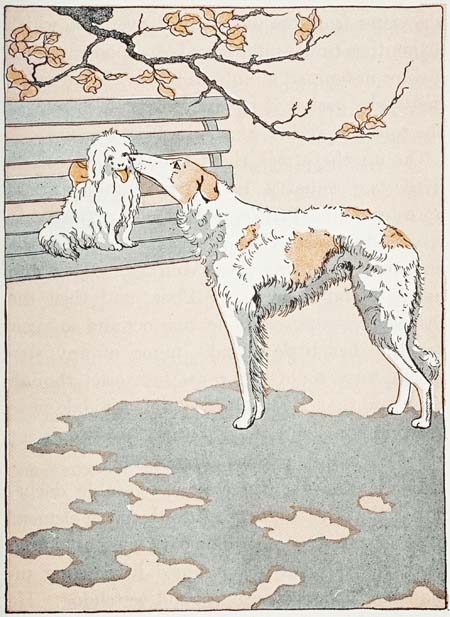
Petite and Princess
Expressing her indignation in a dignified and charming way at the effrontery of the Airedale, the Princess promised to call on the little Pom and extend her sympathy. She passed the sad news on to a water spaniel, who just then emerged from the drinking fountain basin, where he had been taking a bath. Although he shook the water from his wet coat all over her, which at another time would have been good cause for a show of temper, even from a lady dog of noble birth, she passed it by unnoticed, so eager was she to enlist all her friends in Pixie’s cause.
On up the street these two went to where lived two squatty little dachshunds, whose ancestors, like Pixie’s, were real warriors. It was said of them that they attacked badgers, an action requiring great courage. They too had a friendly feeling for Pixie; and then the Princess was so sweet in her manner and so eager to clear her little friend’s name of any suspicion, they could not resist her, even though they saw that the chances of the Airedale were growing slim, and that it was scarcely fair for all of his friends to turn against him.
It was through these little, sociable dachshunds that the story spread to the other element of society in dogdom. The garbage man’s dog, Gyp, who always accompanied his master on his collection trips, was a good watchdog. He was watching the empty cans while his master stopped to chat with the laundress. He had his hands full with the dogs who pestered him for a chance at the tidbits left in the cans. Finally, Gyp, being of a practical turn of mind, began bartering with the dogs for an exchange, just as boys do. The dachshunds had something desirable in this story they had heard, and promised they would give the details as an after-dinner speech, if they could come to terms, which they did.
While they were delivering the purchase price of their lunch, the laundress’s yellow mongrel listened in. Gyp was emphatically against the Airedale. Once Gyp had fallen into the hands of the law, and had almost been taken to the dog pound, so he was bitter against law, and everyone connected with it. This, of course, included the Judge.
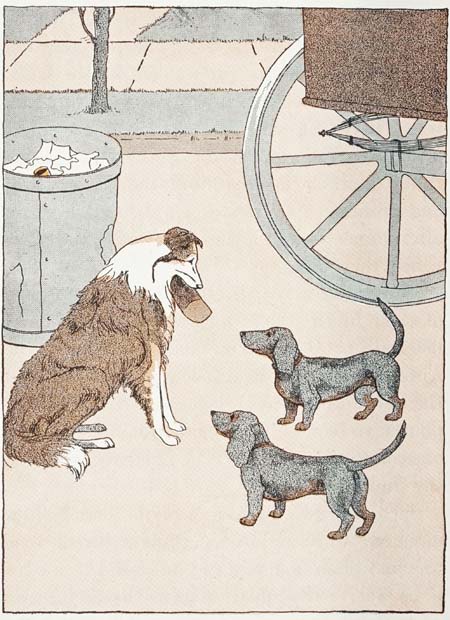
Gyp and the Dachshunds
Such was not the feeling of the little yellow mongrel, who was of no particular breed. He was just plain dog, and did not mind it one bit if he was. His mistress gave the Judge two days of her time every week, and he knew the Airedale quite well. The Judge’s folks had been kind to him, giving him many meaty bones after dinner. Sometimes the boys played with him, too, in the back yard, where it was nice and private. The fence was so high no one could see them. For all of this, he was most grateful, and intended to stand by the Judge. He was not going to say anything about it to anyone, except the milkman’s dog, and he must promise not to repeat the story. Anyway, he lived away on the other side of town, where they would probably not be interested.
This is how this contention, which, in its beginning was just a misunderstanding between two inoffensive dogs, grew until friendly relations were strained to the breaking point.
Having arranged for a hearing on a certain evening, when all the dogs were again in the park, Judge impaneled a jury. Then, upon examining the jury, he found that not one of the members was fit to serve, as all had gossiped about the case. There were not “twelve good dogs and true” to be found in the town.
Because of this state of affairs, some other plan must be followed. Judge decided that he would punish all of the worst offenders. The principals, which meant Pixie and Bob, he would talk to privately. Pixie no doubt by this time was very sorry and ready to apologize to Bob.
The gossips he would attend to first. Since they were so eager to tell stories about other dogs, he would require each of them to come, one at a time, and tell him a true story of some brave or clever happening of which they had heard. Perhaps there were family traditions that were worth repeating, as in the case of Pixie and the dachshunds. It would be a good way to train their minds, and to teach them to look for the good and to ignore the bad in all dogs. Besides, it would keep them busy. As their outings were limited to about two hours each day, it would be possible for them to hear no more than one long, or, possibly, several short stories each time.
The police dog, being next in importance to the Judge, was required to begin this series of punishment. The Judge, after the class in story-telling had paid the penalty and the law was satisfied, was to tell a very interesting story himself—one containing much human interest and moral advice.
Although he was somewhat vain and pompous, the Judge was at heart a good dog. He desired to raise the standard of morals in dogdom, and knew that the only way to do that was to fill the empty heads of the dogs with something besides gossip. A research story-telling campaign he hoped would prove the first step toward reform.
A program was arranged. Each one was, in his or her turn, to tell whatever story he or she knew on a given subject; or they could relate anything of interest that had occurred in their own families. Detective stories would be in the German police dog’s line. Also stories of German country dogs. One very interesting story he knew about a large Dane that could understand nothing but German.
All the dogs were so interested, and so eager to begin, that they ran around in circles. The court session having adjourned, the police dog escorted them out of the park, and requested that all of them be on time promptly the next evening. A happier group of dogs passed out of the park entrance to go their different ways. No haughty airs were assumed by the blue-bloods. All were interested in one theme, a common interest—the paying of a court fine, which makes all kin.
So used were the dogs in the beautiful homes on that exclusive street to having everything done for them that they had become mere puppets, and it required considerable effort for them to do any real thinking. Most of them were foreign born and several had peculiar habits, different from those of their American cousins. Although their ancestors originally came from Europe, the latter had become true Americans in every sense of the word, and were losing their love of ease and indolence.
Although the owners of these blue-blooded dogs had them registered and pedigreed, and all that, what did they really know of their families? It was by mere accident that Pixie heard that bit of history about her great-great-grandmother. Her mistress never spoke of the little Pom’s past, except to mention about the dog show in London and Pixie’s having associated with the nobility. Now that Pixie knew about her people, she was proud that she had such plucky forbears.
The rest of the dogs, after hearing how Pixie felt about it, were anxious to know something about their own family histories. This story-telling campaign was going to afford them just the excuse they wanted to get the desired information. Surely some members of their breed had won honors for themselves somewhere or somehow. Just how or where were they to hear of these things? Now the chance was to be given, for every dog was to help every other dog with his story. If the shepherd dog knew of a good story about a bull dog, he was to tell it; but it must be such a story as the bull would be pleased to know. Then, if the bull dog knew anything that would add to the happiness of the shepherd, he in turn would make it known.
Satisfied with this arrangement, the dogs went diligently to work unearthing stories.
It was early, and the Judge was on his bench under a tree at the far corner of the park. It was a quiet place where the children, who were playing in the sand piles or swinging, would not disturb them. The Judge, not needing an attendant, was allowed to roam at will. The others would have to wait to be brought, except, of course, the middle-class dogs, who would presently come romping in.
Had the respective owners of the dogs on the beautiful street been aware of what was taking place, in all probability they would have tried to buy the Judge off; but this one was not that kind of a judge. His belonging to their set would not have influenced him in the least. Back in his own family history were some sterling qualities, chief of which was honesty, that had descended to this offspring, and these, as well as other admirable traits, were manifest in all of his dealings.
The dogs were assembled at last, even Pixie, who was seen trotting along beside the Airedale pup. The police dog was keeping order and seating the class. When the gavel, which was his left paw, fell, everything was ready.
PETITE AND BOB TELL THEIR STORIES
Petite’s Story
The white poodle told her story in a winsome way. One of her sisters had attended the wedding of one of the nobility in France. The bride was so fond of her little pet that she wanted the poodle with her on this, the happiest day of her life.
The tiny poodle was bathed and combed until she looked like a fluff of cotton. Around her neck a pink ribbon was tied and arranged in a smart bow between her ears. She behaved beautifully, never stepping on the bride’s train, nor did she blush as the groom did. She made only one little break.
After the ceremony, when the groom kissed the bride, she let out one little growl, which she could never refrain from doing when this occurred. For her nice behavior, she was given a piece of the bride’s cake to put under her pillow to sleep on.
As she was a very smart poodle in many ways, she seemed to understand everything that was said to her, and she answered one and all with the tail language. This is the accepted lingo of such favored dogs, especially as they have such fine, feathery tails, that show to advantage when waved in a wig-wag message.
When the poodle was asked if she wanted to go walking, she would hop onto a chair, and look toward the place where her leash was kept and wait for her mistress to put it on her neck. As soon as it was put on, she would jump down from the chair, run to the door and wag her tail, as if to say she was ready.
On the street, she would walk along beside her mistress in a nice way, never running on ahead nor pulling on the leash, as do some rude dogs.
Petite was exceedingly proud because she belonged to such a fine breed of dogs; she waved her beautiful tail in acknowledgment of the applause which was given her.
Bob’s Story
Judge required even his own son to relate a story, in punishment for his rudeness in barking that terrible bass solo at Pixie, which a well mannered dog should not have done. The father had had Bob rehearse just what he would say, to make certain that nothing in regard to the family skeleton would be disclosed, although almost every family has some such secret to guard. However, Judge thought it best to be on the safe side in regard to theirs.
Right now I will tell you what this great secret was, but it must go no further. Some ancestor of Judge’s was killed for slaughtering sheep. That was about the most disgraceful thing of which a dog could be guilty—to be called a kill-sheep dog! Of course younger generations had done honor to the Airedale name, and nobody would hold them responsible for what had occurred in their family so long ago. Still, they seldom mentioned it among themselves, and never, never, to outsiders.
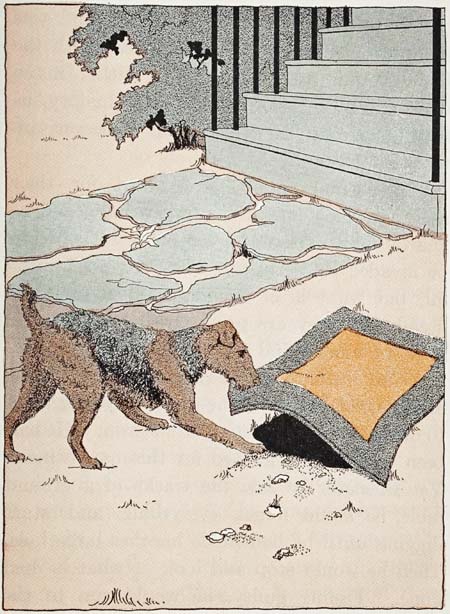
The Comical Young Airedale Terrier
Bob was inclined to be boastful, and was more than anxious to square himself with the little Pom. After asking his father many questions in regard to their family history, he finally succeeded in ferreting out some very interesting facts.
The Airedale family are noted for their ability to look after their own welfare, and as guards for children and for property liable to be invaded by burglars. They are not beautiful, but what is of far more value, they are useful. As they are partly Irish, they have a sense of humor and do many comical things.
As an instance of the cleverness and humor of the Airedale terrier, one that was young liked to dig holes in his master’s front lawn. He had been repeatedly punished for this naughtiness. Yet whenever he saw the tracks of a ground mole, he would forget everything and start digging until he had made another large hole. Then he would stop and look at what he had done. Feeling guilty, he would run to the porch, where there was a large door mat. This he would drag to the place and cover the hole. Satisfied that his guilt was hidden, he would run off to play.
Another of Bob’s stories was about a clever dog named King who took care of a baby.
King
King and Junior, a baby boy, were devoted pals. When Junior was in his pen on the lawn, King would take his place as guard and master of ceremonies. While the baby was good, King would lie quietly by, with one eye always on the child. If the baby got tired and fretted, King would jump up, run around the pen and bark to attract Junior’s attention, and would keep it up until the baby would smile.
One day when Junior’s teeth were hurting, he was unusually fretful. King did his stunts in vain. Seeing that he must try some other way to comfort his pal, he stood in thought for a moment. Then he bounded off down the street to a place where another family with children lived. Presently he came dashing back with a woolly dog in his mouth, which he dropped into Junior’s pen, much to the delight of the crying youngster.
Bob also told another story about a dog who was fond of scrambled eggs.
Scrambled Eggs
Snappy was a small Irish terrier who was fond of scrambled eggs. As his owners were obliged to buy their eggs at a good price, he did not get one as often as he would have liked. So he would go to the back of the lot and lie there until he heard a neighbor’s hen cackle. Immediately he would crawl through a hole in the fence, and presently return with an egg in his mouth. He would carry the egg to the kitchen, lay it very carefully on the floor, and wait patiently by it until some one had time to cook it for him. No objections were made, as the neighbor thought this was so clever of him.
POLICE DOG STORIES
All were eager to hear what the German police dog would have to tell, as they knew he must have been able to gather from his grandparents some thrilling tales, because they went through the war and were at the very center of activities. However, he was unable to get many of the facts from them, as their experiences had been so painful that they had come to America to recover and to forget about them.
One member of the family, however, had been cited for bravery, and they loved to sing the praises of poor old “Marne,” of whom they told the story. All of the dogs wept upon hearing about this war hero. After their eyes were dry, they asked for another story from the police dog. This time it was a detective story, with old Tip as the hero.
The police dog was a born story-teller, and his contact with so many different kinds of dogs and men had given him a store of knowledge far beyond his years. So he was applauded until he responded with a narrative about one of his own country’s species, Fritz, who was German through and through.
After this story, the police dog, who had consumed all of the time at this session, was excused and relieved of any more punishment. The Judge was pleased with his conduct through it all.
Marne, the War Hero
It is a long reach from the battlefields of France to the fashionable dog show at a notable hotel in southern California, but one of the veterans of the World War made it. With sad and solemn eyes, he viewed the scene around him, reminding one of those old men who turn up from retirement to march or to be driven in the parades at the reunions of the Grand Army of the Republic, aged and worn, so far as looks go, but with dear old souls washed white with deeds of bravery.
Thus it was with our war hero, who, surrounded by yelping, barking blue-bloods, was “sitting in” at the dog exhibit, not “listening in,” for he was almost deaf from his injuries received on the battlefield.
Marne was an ambulance dog who served with gallantry throughout the recent war. He came through, and was accepted and decorated by the French government for bravery, but for his glory he paid a dear price. He had been gassed. This, as many who served in the war can testify, takes something out of the very soul of a man. It had the same effect on Marne, who at ten years of age was an old dog.
He was lying silent and dignified among the other entries, but with an accumulation of wisdom impossible to any of the pedigreed dogs about him.
When he was only three months old, this heroic dog was given to the French government. After six months’ training, he was sent to the battlefields to find the dead and wounded. From these trips into “No Man’s Land,” he would come back with either a button or a stone on his stretcher. A button meant a wounded man, and a stone bore mute testimony of one having “gone west.”
Both the British and the French are under obligations to faithful dogs for service on the fields of battle. If these dear, brave dogs could talk, what stories they would tell!
Thanks to the gentle heart of a dear lady who appreciates real worth and brave deeds above mere good breeding in a dog, Marne has been given a pleasant home, and his wounds that have never healed are given proper care. Though there is a far-away look in his eyes, and he has the appearance of one who has known sorrow which he cannot forget, this dear old comrade seems contented.
Old Tip
Tip was not much of a dog, so far as looks go—never had been, even in his young doghood days. There was too much of just ordinary dog in his ancestry. He was part hound, which gave him those floppy, big ears and that long, lean body. His tail, which was not long enough for a real, honest-to-goodness hound to have, was somewhat like that of his grandmother, who was a mongrel with some shepherd blood. From this tail Tip acquired his name, for on the end of it was a white tip. The rest of his body was brown, shading into yellow, which, had he been of more aristocratic lineage, would have been golden brown.
Fate often picks just ordinary men in the lowly walks of life for the laurels. Such was the case with Tip, who was no longer young, and moreover was afflicted with rheumatism, caused by his having no suitable place to sleep on cold, dark nights. He was chosen in his old days to perform the crowning act of his life and to become a hero.
The old corncrib with the leaky roof was Tip’s bedroom. He had only one old grain sack to lie upon. On one of those cold, rainy nights in November, it happened. It was just the time of year when every farmer’s wife is counting on returns for her summer’s work, through the marketing of her nice, fat poultry; and it was also the season when poultry thieves thrive and are busy plying their unlawful business.
Tip had only that evening helped his mistress round up every stray fowl on the place, and she had shut them securely in the chicken house, to be ready for the buyer who was due in the morning to purchase the fat hens and turkeys. Tip had inspected the premises for the last time. Then, considering it safe to do so, he had turned around twice, as is the habit of all dogs, and laid down to sleep.
After his first nap, he awoke. Did he hear or scent something? Not yet really wide awake, he sat up, flapping back his big ears in order to hear more clearly. Surely that sound was something worth giving attention to. He would investigate. Stretching his long body to awaken it fully, he looked out, and what he saw was a small light on the end of something that looked, to him, like a stick. It was up against the poultry house door.
Now, as I told you, Tip was old and had gained wisdom with years. A younger dog would have been more rash; but not Tip. He was cautious. Slipping around the corner, he waited to see what would happen. Soon he saw the door open and two men enter the poultry house. Now was his chance for action. Bounding behind the door, he slammed it shut. As he did so, the bolt slipped into place and, as the key, which had been left in the keyhole, fell out at the same time, he had his prisoners secure. Then he did some lusty barking. Such whoops of “bow-wow!” such howls did he set up, that in a short time he had the family aroused.
This action of his was the means of breaking up an organized band of poultry thieves in that neighborhood; and this feat also earned poor old Tip his laurels.
FRITZ, WHO KNEW ONLY GERMAN
(As Told in the Presence of the Police Dog by a Lady)
Once when I was motoring through the middle states with my husband, who had dealings with the farmers of that part of the country, we drew up to the door of a German-American farmer, who, on seeing us, came out to ask what was our business. As he did so, out bounded the biggest piece of dog flesh I had ever seen. At first I thought it was a calf, but when a huge mouth opened and let out a “bow-wow,” I saw it was an immense Dane. On the dog came, ready, it seemed, to tear us to pieces; but the farmer caught him by the collar and, talking to him in German, led him back into the house.
As it was a cold, wintry day, the farmer asked me to go inside where it was warm. Wishing to do so, but still remembering that dog, I hesitated. The man insisted, saying his wife would take care of me. I went.
These people, like many of their kind, live most of their cold weather days in the kitchen, where they can cook and keep warm at the same time. Their cookstove was an old fashioned wood one. The oven, when not used for baking pies and bread, or thawing out the men’s feet, was piled full of wood to dry for fuel; I learned that it was Fritz who supplied the wood for the drying process.
I entered and was invited by the wife to take a seat near the stove. I did so, looking around to see where the Dane might be. I spied him behind the stove, pretending to sleep. Soon the stove needed more wood. The wife took some from the oven and replenished the fire. Fritz got up, came around and looked inside the oven to see how much was left. As he was quite near me at the time, I spoke to him and attempted to pet him. The look he gave me was discouraging, but he turned to his mistress, as though inquiring what was wanted of him. She spoke to him in German. Turning around, he wagged his tail, and gave me a genuine dog smile, before returning to his place behind the stove to finish his nap.
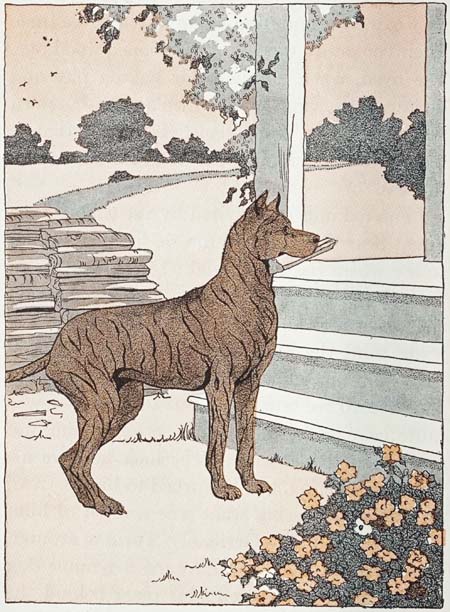
Fritz Supplied the Wood for the Fire
Presently the two men came in. The farmer took more wood from the oven. Fritz was watching the oven with evident concern; at last, when only a few sticks were left, he ran to the door, and with his paw unlatched and opened it. Soon he returned with a stick of wood in his jaws. He laid it down by the stove, and repeated the process until the little old oven was full again. This done, he went across to the cupboard, sat down, and barked until he was served with a lunch. His owners explained that they talked to him only in German, although they spoke very good English; and they added that no amount of money would induce them to part with him.
Ted the Water Spaniel
Next on the docket was Ted, the water spaniel. When Ted was called to jury duty, he gave his occupation as “mascot.” He had sailed the seas, having gone on a cruise around the world on a big battleship. When not on mascot duty, he was engaged in catching rats that infested the ship’s hold. He was an excellent sailor and loved the water. The crew, all of whom were fond of him, enjoyed teaching him many clever tricks.
He was a good sport and would allow the men to throw him into the water, which they did just for the fun of seeing him swim back to them. Also, he was a most comical looking animal when he was wet. He would dive for an egg in ten or twelve feet of water; and would pick a piece of money from a pail of water.
There was not a lazy bone in his body. He was always up to something. It was a laughable sight to see him, with his long ears and topknot, sitting up on his haunches to beg for what he wanted. When he was asked what he would do for his country, he would salute the flag and play dead. Many other interesting stunts he did to entertain the sailors and the officers of the big ship.
When the great guns boomed, he would hide and stay hidden until all the smoke had cleared away, when he would come cautiously out from his place of concealment, looking as if he were asking, “Is it all over?”
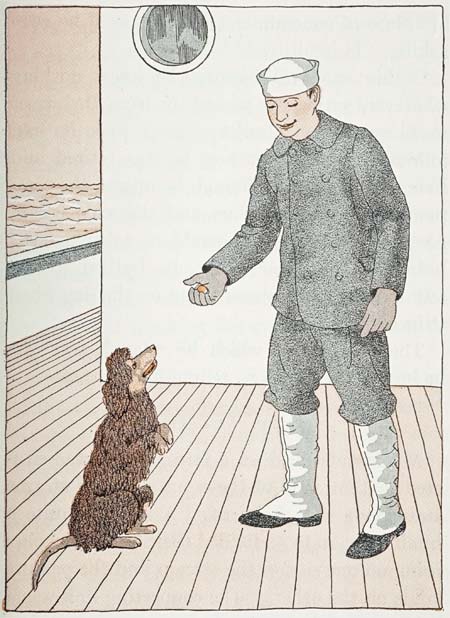
Ted Performed Many Stunts to Entertain the Sailors
Of his ancestral history, he knew nothing whatever, as he was picked up from the street in Liverpool by a sailor. Ever since he had followed the sea; but now he was retired and living a quiet life. Though he missed the companionship of the sailors and the wide ocean, he was happy when he could be taken to the beaches. At other times, he bathed in the fountains, which he was doing on the day when Princess met him.
The next story, which he related, was one he had heard some one telling his mistress.
Blood Will Tell
My friends lived on a farm, which was situated in that part of the country where storms and floods were frequent. A stream, quite a small river, in fact, divided their land, the house being on one side of the stream and the pasture lands on the other. The connecting link was a bridge over the stream.
On one occasion, after a heavy storm, this stream was swollen beyond its banks. It became a seething, rushing torrent, carrying the bridge away, leaving no way, except to make a detour of five miles, by which the cows could come from the pasture to the barn. A council was held, and ways and means were discussed. The question was, how were they to get those milkers across to the other side? Everyone had some suggestion. Their little mongrel dog, within whose veins flowed a strain of water spaniel, sat blinking his eyes, and holding his own council.
When the family had given up in despair and returned to the house, the dog swam across to the pasture. He rounded up the herd and, driving them before him, swam the stream again, keeping the cows ahead of him until they were safe on the other side. Every day he repeated this performance until the bridge was built.
The water spaniel recollected another story about a dog named Prince. This one he had heard a gentleman telling his owner.
Prince Helps His Master to Get a Job
The actions of this smart little dog show that dogs often display a degree of reason.
A young man was searching for a position. He was unsuccessful in finding the one suited to his qualifications. He returned home, tired and discouraged, and threw himself on a couch to rest. His small dog Prince saw with an understanding eye that something was worrying his master. He went off to his own corner in the lower part of the house, where the telephone was located, but he did not go to sleep as did his master. He had to think things over as to the cause of his master’s troubles.
Presently the telephone rang. Prince bounded upstairs, two steps at a time, barking lustily all the way. He pulled at the young man’s coat to awaken him, and told him as best he could to answer the phone. His master did so, with the result that he learned that a good position was open to him—a place of trust with a good firm—which he readily accepted.
GYP, THE GARBAGE MAN’S DOG
Gyp, the garbage man’s dog, was next. He was somewhat sullen, having seen life on its seamy side, and he was as full of experiences as an egg is of meat.
As has been previously related, he disliked all phases of the law, and wasn’t enjoying this court scene very much. However, a few more experiences would make little difference in his checkered life.
When he gave his name and address, he was asked if he had ever been in court before, to which he made the humiliating reply that he had, though he was not to blame for it. As Judges in general do not care to listen to excuses about the past, there was no chance for an explanation. Because this was not his first offense, and because he came from the lower ranks of life, although he had good blood; for he was a shepherd dog, and shepherd dogs are related to the great collie family, aristocrats in dogdom. But poor Gyp, being seen daily under the garbage wagon, was looked upon as a suspicious character.
Now Gyp was not deserving of this opinion from any one. He was as honest and faithful as any of them. More temptation had been thrown in his way, and he had been able to withstand it better than some weaker ones. He would not lie, would not steal nor cheat. But he would fight. And it was due to this failing that he had a story to tell. We will leave it to you, dear reader, to decide if he was not justified at least in this one case.
Gyp said he hoped that all dogs were now taking this course in “higher standards of living.” If they did, there might be no further occasion for his having to use his implements of warfare. Nevertheless, he would keep his teeth in good condition, and his claws well whetted. In fact, he thought preparedness was the best policy for all dogs. They need not actually fight, but just threaten to scrap if other dogs disregarded their rights.
His story was a thrilling one about mistaken identity, and the innocent having to suffer for the sins of others. His master was his idol. For him, Gyp would die if necessary. Neither he nor his master had always been just what they were now, for both had seen better times.
One dark night a crime was committed. Gyp’s master, though not guilty, was caught in the meshes of the police dragnet instead of the real culprit, and he was taken to jail to await trial for the crime some one else had committed.
When he failed to return in the morning, Gyp started out to find him. Taking up the trail, he found it led to the jail. Of course he was not allowed in the building, but he hung around, leaving only at night and when he was hungry. At night he had to return home to keep watch over the little boy and his mother. It was his job to take care of them, now that his master was gone.
Gyp had a double responsibility. The wife and little boy must be protected, and he must be on hand at the jail should a need come for him there. With all of this worry, he was growing very thin. Also he did not have enough to eat, for not many luxuries in the way of meat were brought into the little home now, and he was too busy just watching, to hunt for stray bones and things like that.
At last the day of the trial came, and his master was taken from the jail across the courtyard to the room where the hearing was to be held. That was Gyp’s opportunity. Following the crowd into the court room, he slipped in before any one knew he was there. Waiting his chance, he edged his way to where his master was and lay down at his feet. He was hoping he would be allowed to stay right through to the end; but he was disappointed, for hardly had he settled himself when some one took hold of his collar and roughly dragged him out, giving him a kick. Just who was the dumb brute in this case? That was the last he saw of his beloved master for some time. Do you wonder Gyp did not like courts and trials?
He returned home, for now he must devote his whole time to the family. The little boy must be protected when he went to the corner grocery. Gyp would not permit another dog to come near the child. It was at this time that the dog’s fighting blood rose. He would go ahead of the boy when he was crossing the street, and the kindly traffic officer, being their friend, would hold back the crowd until they were over.
One day, after having piloted his little charge safely home, Gyp took a walk down the street past some fine houses where a small dog was lying on a nice lawn. He saw a big hound dog come from another direction and go up to the small dog, sniffing and mumbling a war-growl. Gyp stopped to see what would happen. Presently something that gave offense to the small dog passed between the two, and he set his teeth in the left hind leg of the big dog. Then the trouble started. Seeing the small dog was getting the worst of it, Gyp entered the fray, letting the little fellow out of it, and he and the hound rolled over and over on those fine flower beds.
The ladies who lived in the house were screaming over the phone to police headquarters. But in their nervousness they succeeded only in making the chief believe some one was being killed. At once that official dispatched the police wagon. It came, bringing along with the police a newspaper reporter who wanted to get first news for his paper. All were disappointed. As the hound had sneaked off, Gyp was left to bear the entire blame. The police summoned the dog catcher.
The only protector of the little family around the corner was about to be taken away, when who should appear but the friendly traffic officer, who knew Gyp and came to his rescue. He testified to the dog’s good character and vouched for his keeping the peace. After being patted on the head and admonished by his friend “to be a good dog,” Gyp was allowed to go back to his post of duty—watching the little family.
Time dragged around to Christmas. Then the governor learned that a mistake had been made in the case of Gyp’s master. The master was released from prison and permitted to go home.
It was a joyous holiday for them all. The judge who had tried the case, desiring to make amends for the error, offered to help the good master to get work in the city’s garbage disposal division. But the poor fellow was so humiliated, and his health so broken, that he decided to go to a warmer climate, where he could be out in the sunshine and regain his strength.
The judge, feeling that an injustice had been done the man, wrote to the mayor of this southern town where Gyp and his master had gone. This recommendation caused the master to be put on the pay roll, so the faithful dog and his beloved owner were now partners in this business of gathering the waste of the city.
It was through those friendly little dachshunds that Gyp had become involved in this mess. Now, however, there seemed to be a better feeling established among all of them, and the story which Gyp told them had the effect of enlisting their sympathy and admiration, so that things looked brighter for him.
Presently Gyp was not “only the garbage man’s dog.” He was counted a real hero by the better class of dogs, and if they were free to follow their own natural inclinations, they would be real friendly with him; but there were their owners to contend with, and for their amusement, they would, they supposed, have to go on suppressing their good impulses. At any rate, all of them promised themselves that they would speak to Gyp when no one was watching them. Yes, they would even go out to the garbage wagon when they could, and they would not feel “uppish” toward him any more.
THE LAUNDRESS’S DOG
The laundress’s dog was, as everyone said, just a yellow dog. But he was one of those creatures whose “yellow” was all on the outside—there were no yellow streaks under his skin. Being just plain dog has a significance all its own, as, in order to be any kind of a dog, one must have forefathers. It is highly probable that some of those ancestors were worth while in the case of this dog, and had handed down to their offspring some good traits.
Mandy, the colored laundress, had found him one morning, when she was on her way to work. He was a little fellow then, and he was cold and hungry. They lived in the state of Texas where the cotton grows. No doubt, the pup had started to follow some worker to the fields and became lost. When Mandy coaxed him to follow her, he did not hesitate, especially as her clothing was scented with breakfast bacon.
Together they had lived ever since, with Sam, Mandy’s husband. Now, Sam had ambitions above being always a cotton field hand. He had heard there were better chances for colored people in the north. Tales of wealth accumulated by chauffeurs and waiters with nice, fat tips, had filtered through to the cotton field workers, and they were leaving as fast as the price of a Ford car could be saved. Mandy helped by going out as many days as she could spare from her home and church duties, as she was a very devoted church worker.
Buff, as Mandy called him, on account of his pale yellow color, had fallen into a good home. With Sam’s ambitions and Mandy’s piety, things ran smoothly in this home.
Having purchased a car, they loaded into it everything it would hold, and started north. Buff’s quarters were close, but he managed to be comfortable. It was better any way than riding on the running board. The chickens were riding there, while, on the other side, the family goat was enthroned. Sam was a good provider and his family were never in want of something to eat.
Having at last become fairly settled in their new home, Mandy and Buff would go out to work several days each week. One of the houses where they worked was the Judge’s, so Buff was quite well known to the Airedales.
Buff’s story, while not dealing with his ancestors, was interesting. He knew many stories about clever dogs, with whom he was acquainted, and he had done some fine things himself; but, being a modest dog, and having always been looked down upon in the south, where he came from, he was known only as Sam’s and Mandy’s “yaller cur.” All of this was depressing and made him self-conscious and bashful.
The Judge, understanding how poor Buff felt, drew him out to talk about himself. Buff, too, had his ambitions, it appeared. Always he had desired to be a hunter. How he had longed to accompany Sam and his neighbors on their coon hunting trips! But Sam would not permit it. Buff was too small. It took husky dogs, like the hounds, with their big, floppy ears. Buff must remain at home.
Lying in front of the fire, he would stretch out, fall asleep and dream. His body would tremble; the muscles of his legs would twitch; he would prick up his ears, and go through all kinds of contortions. Then, jumping up, he would run out of the house, and bark in answer to the baying of the hounds, miles away. Back he would come and lie down, with a satisfied look at Mandy, as much as to say, “We got him!” This was as near as he ever came to having his ambition gratified.
The Judge requested Buff to tell about the time little Simon Peter, who lived next door to Sam and Mandy, fell in the water. So embarrassed was Buff at having to face all these eager eyes and lolling tongues, that he stood first on one foot, then on another. In his modesty, he made as little as possible of the part he had taken in the affair.
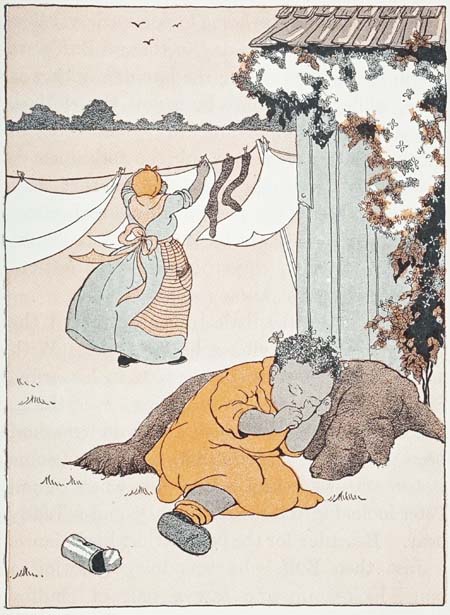
Simon Peter and Buff
Simon Peter was a little pickaninny, who would lay his woolly head on the sleeping dog and take his afternoon nap. One day, Simon Peter’s mammy was washing, as she too was a laundress, but of the home-loving variety. The pickaninny loved wash day. He and Buff were left in the kitchen, where the laundry work was done, while his mammy hung out the clothes. It gave him an opportunity to get into lots of things which otherwise would be forbidden.
On this particular day, his mother had stopped to hold a bit of conversation with Sister White, who lived at the back of their lot. There were some matters concerning a church festival of which she must know the particulars.
In the house the little brown baby and the yellow dog were having a happy time. With a dilapidated looking Teddy bear in his arms, Simon Peter was investigating everything. Among other things which the laundress had been using, was a candy pail. In it was some water. It was clean water, for, when Simon Peter looked into it, he saw a baby and a Teddy bear. Reaching for the bear, he lost his balance.
Just then Buff, who was busy gnawing a bone, looked up and saw a pair of chubby brown legs sticking up out of the pail. Sensing what had happened, he climbed up on the side of the pail, and, adding his weight to that of the baby, managed to tip the bucket over, and the pickaninny crawled out.
Buff then ran to where the two “sisters” were in the depth of a discussion about church matters, and commenced jumping up and down, and running back and forth to attract their attention. Sister White took notice and inquired, “What’s the matter with that fool dog?” Simon Peter’s mammy took the hint. Running to the house, she found her little brown baby sitting in a puddle of water, and she saw that he was dripping wet.
This was such a good story the dogs wanted another from Buff, and he promised that at the next session he would tell them about Whitey, another mongrel of his acquaintance. So when the time came he told his second story.
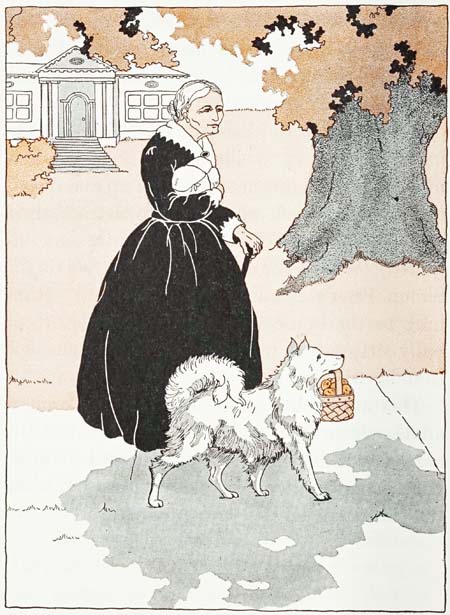
Whitey and Her Mistress
THE DEVOTION OF WHITEY
Whitey was only a mongrel, a cross between a spitz dog and an English bull.
We can imagine that Whitey had inherited from her gentle, affectionate spitz mother, the devotion which this occasion brought into play. This trait, coupled with the persistence and tenacity of her English bull father, enabled her to enact the part she did.
Whitey’s mistress, who was getting along in years, was alone in the world, having only her faithful dog for company. So the two became devoted to each other. When the little old lady went out on errands, Whitey guarded her most carefully.
One day the sun was very hot and the old lady seemed more unsteady than usual. Whitey, looking at her mistress, noticed that she was very pale. Then she saw her mistress sway and fall. The dog was frightened and barked furiously. Seeing a policeman down the street, she ran barking to him, and then back to her fainting mistress.
Understanding what had occurred, the officer called an ambulance and started with the little old lady to the hospital. Whitey, who was no longer young herself, gathered herself together. She was not invited to ride in the ambulance with her mistress. As a matter of fact, no one noticed the anxious, woe-begone little mongrel. So there was nothing for her to do but follow the ambulance.
As it threaded its way in and out, shrieking and making ear-splitting, frightful noises, Whitey followed. Dodging the traffic as best she could, and dreadfully tired, she followed her mistress to she knew not where.
Arriving shortly after her mistress was carried into the hospital, Whitey stood at the door, sniffing and barking. Finally she heard some one coming out of that door. This was her chance. In she sprang, nearly tripping up the big policeman, but getting in where her beloved mistress was. Yelping joyously, she wagged her tail with satisfaction. Her happiness was short-lived, however, for, in an instant a rough hand had her by the back of the neck and yanked her out to the street.
Then the English bull portion of Whitey manifested itself. Such scratching and clawing as she did at that door! She begged, she entreated to be admitted, until, finally, she was allowed to go in. All afternoon, she lay on the foot of her mistress’s cot, looking her sympathy and love, and hoping she would soon help to take the dear mistress back to their home, where they would again be happy. And indeed it was not long before this hope was fulfilled.
THE RUSSIAN PRINCESS
Princess, having been “over” only a short time, and being unaccustomed to American ways, could tell only of her far-away Russia.
Her story was so sad that all were glad it was not a long one. They hoped that after she had been longer in our beautiful America, she would be able to forget those dark days of her own country. They hoped too that Russia, where these graceful hounds live, would see better times, and that no more cruel wars would wreck her government.
Princess was made acquainted with all the dogs in the park. Each in turn gave her a welcoming sniff, and assured her they would try to make it pleasant for her, so she would forget the tragedies of her native land.
She became a noted figure when led along the paths in the park. No one could look at her without their minds reverting to that terrible war and those helpless princesses of Russia, and the brave women who took up arms against their enemies during the reign of terror.
The story Princess told was one she had heard in England. When she was a puppy, she was taken by an English sailor, who was returning home from the far East. At the kennel where she was finally left, she looked more like a young sheep than a dog. With her long legs, long tail, long head, small ears, and soft, silky coat, she was entirely unlike such dogs as Pixie or Ruby.
At the English kennels, which belonged to some of the nobility, she was well cared for. They were reluctant to part with her, but being in straitened circumstances since the war, they needed all the money they could get. So, when her present owners were traveling in that country and offered a good price for her, she was allowed to come to America. That was how it came about that she now was telling her story to a group of American dogs.
In discussing the merits of the wolfhounds to prospective buyers, the keeper of the kennels would tell that Princess was related to the beautiful Russian hounds belonging to the Czar. Often, he would say, before the war, the lovely princesses were seen leading these graceful white creatures through the park around the royal palace at Petrograd. When the royal family was destroyed, these dogs were scattered to the four corners of the earth, as they were sold or carried off by marauding armies. The Princess was fortunate in falling into the hands of the English, who are great lovers of dogs. She could never think of her ancestors, and of how fond they must have been of those sweet princesses, without deep emotion; but, as there were no princesses in this country, she would try to forget.
THE MILKMAN’S DOG DAN
The milkman’s dog Dan was half and half, shepherd and collie, his father being a full-blood shepherd, and his beautiful mother, whom he did not remember, being Scotch collie. Shep, his father, lived all his life—and he attained a ripe old age—on the place where he was born and raised.
Dan loved the dairy farm. The fresh, foaming milk that remained in the straining pails was always his, and the cats had all they could drink of it. Also there were lots of rats and rabbits to chase. In fact, it was an ideal place for a dog of his tastes to live. He knew all the cows by name. It was necessary only to tell him to bring up the cows—“all but Bess and Jane,” and he would do it. Starting the herd ahead, he would get in front of those two young heifers, and, separating them from the rest, chase them back to the woods pasture again.
The trip into town to deliver the milk—how much fun he got out of that! It was no hardship to be aroused from his comfortable, warm bed in the straw, and to have the driver say, “Come on, old boy, we are ready to start.”
Dan would stretch himself, yawn, and indicate by this that he, too, was ready. He would sit beside the driver, and off they would go through the early dawn and the frosty air.
Dan was always pleased when they delivered milk to houses where there were little children, and at the hospitals where the patients were waiting to have it for their breakfasts. At one house the driver would leave a double portion, because there were twin boys there. Dan hoped that some day he would get to see these little boys. Then one day something happened that they were delayed. It was later than usual when they were returning home, and, as they were passing by the house where the twins lived, Dan had his wish, for there they were, sitting on the lawn. Each had a bottle of milk, and they were drinking away as contentedly as could be.
How happy Dan was to think he had helped in this way to furnish food for those adorable twins!
They drove on down the street and passed the children’s hospital. There, out in the sun, he caught a glimpse of wheeled chairs with children in them. On stands beside many of them were glasses of milk, perhaps from Dan’s dairy. (At least he felt a proprietary interest in it.) Also at the school-lunch counters, he saw the children drinking milk. Then he got to thinking, what if he did have to work rather hard bringing up the cows and helping around the barn, wasn’t it worth while? What would become of all these children if he didn’t work?
The other dogs hoped he would keep on at his present occupation, as most of them liked milk themselves. Especially were Pixie and Petite anxious that there should always be milk for making the good things of which they were fond.
Few of them had ever seen the milkman’s dog before, as he made his trips before it was their hour for rising. They were eager for him to tell more about himself and his family, so he promised to tell the story of his grandfather, Sandy, who had been a useful and faithful member of dogdom.
In the days of horse-drawn vehicles, some dogs had a foolish habit of running in front of every horse they saw coming, and barking at their heels. Of course, none of the dogs in this group knew anything about this bad habit. It was before their day. Now, Sandy despised this ill-mannered action, and would stop it every time he had a chance. The young dogs on the place where he lived wouldn’t have dared to do it. He had them trained. But some other dogs were not so well raised. Sitting at the corner where two roads crossed, he would watch, and, whenever a dog would start barking at a horse, he would go after the dog and give him what he deserved.
THE WHIPPETS
One evening, while the story-telling class was in session, there came into the park two men and two dogs. All looked tired and dusty, as if they had come a long way afoot.
The men threw themselves down on the grass to rest. The dogs, who were different from the usual park types, were lean and graceful, clean-cut racers. They were whippets, or, as some call them, “snap dogs.”
They were indeed tired and had come a long distance to rest. After taking a drink from the fountain, they too stretched out beside the men to take a nap. But, being unable to sleep after the thrilling experiences of the day, they started up and began investigating the park and the people in it. First they visited the different groups and watched the children at play. Then they wandered over to the corner where the dog’s court was in session.
The whippets had just come from a country fair, which was being held in an adjoining county. There, besides the horse races and automobile races, one of the attractions was a whippet race, in which they had taken part.
They approached the court corner, and stood at a respectful distance until Ruby was through with a story she was telling about two little Skyes. During the applause, the whippets drew nearer. In making observations as to the size of the dogs assembled there, they noticed that the Judge was a much larger dog than they were. Also there were others there that would be more than a match for them should any unpleasantness arise. They, however, could get away from the others, with no danger of being overtaken, so swiftly could they run.
As the Judge exhibited only the friendliest feelings toward them in his welcome, they joined the circle. This, thought the Judge, is to be a test of the sincerity of the desire of the dogs in the class “to live and let live,” and he was much pleased with their behavior. The good seed he was trying to sow was taking root, and they were losing some of their selfishness.
The story which Ruby had just finished was about two little Skyes, one of whom was vain and jealous; so, if Ruby could realize how wrong it was to permit such feelings to exist in one’s nature, it was a good indication that the Judge’s plan was a good one, and they would all be better dogs for it.
The dogs all agreed to have the whippets with them during their stay in the park. The Princess recognized in them distant cousins. She too could do some sprinting when occasion called for it.
The whippets, looking the crowd over, and scenting nothing to eat at this picnic, concluded, if these other dogs could have such a gathering in a park without eating, there must be something else very absorbing about it to hold them; so they decided to remain.
When they were asked how they came to be racing dogs, one of them, who was less bashful than the other, told of their being trained when they were puppies for this very thing. They were encouraged to play tug-of-war—which all little pups love to do—and they were given a strong piece of cloth, or a rubber shoe, and they would pull and pull. This strengthened their muscles. Then a ball was thrown for them to run for, and the one who returned with it was given something to eat. Then two balls would be thrown and they would race after them. The one who had to go the farthest was rewarded. As they grew larger, they were taken on long hikes over the fields and country roads, where they would chase rabbits or any game they could scare up.
Later, they began racing with horses and bicycles, farther and farther each time, until they could run two hundred yards, the handicap distance.
One sorry thing about being a whippet is that these dogs never get to eat all they would like, as their weight must be kept down to fourteen pounds, or they become too heavy to run.
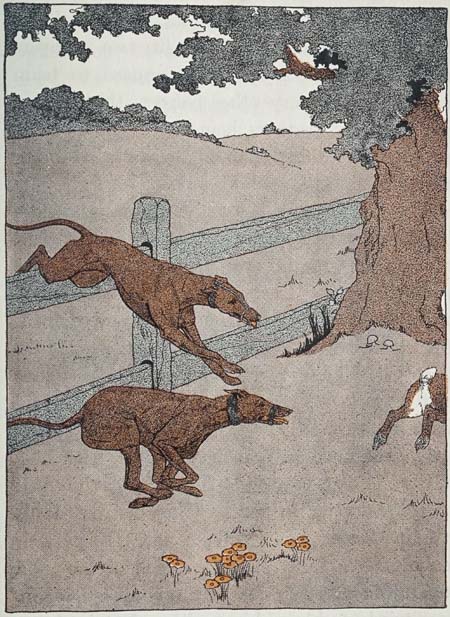
“They Would Chase Rabbits or Any Game They Could Scare Up”
At the Fair it was advertised that the Whippet Brothers, famous racers, were to run and had challenged two other equally swift dogs for the race. A large purse was made up and the betting became lively. The other two whippets were not brothers, and were unused to team work, but, in every other respect, they were a match for the brothers, being of the same weight and age, and having had the same training and all.
The bout was set for the morning, before the horse racing started. The crowd gathered around the grand stand, from where the dogs were to start. Each dog had been groomed and sleeked and their feathery tails were combed. All were clean-cut, snappy little dogs, ready for the start. The crowd was roped off on each side of the track. Then, one, two, three, the gong sounded, and they were off. Neck and neck they went until halfway to the goal, when one of the odd dogs crossed to the center of the track to get a better footing. This distracted his running mate for one fatal second. His partner leaving him alone on the off side of the road made this dog lose his grip on himself. He, too, tried to change his position, but in doing so, he tripped and fell head on. Gathering himself up, he came limping after the racing dogs. Of course he lost out, but he was game to the end. The other three kept pace, on and on, until within a foot of the goal, when the odd dog shot across the line, amid the cheers and shouts of the onlookers. The Whippet Brothers lost the race, but it made no difference to them that their backers had lost money on them; they had done their best and had played a clean game.
Running back to where the lame dog was, they both licked his sore leg and showed their sympathy. They were much better sports than their masters, who grudgingly lost to the other men, and took their ill will out on the dogs, kicking and abusing them, and, tired as they were, bringing them the whole distance to this town.
During the description of this race, the group of dogs became so excited that it was all the police dog could do to prevent a small riot. The dogs who had any racing instinct in them, like the Princess and Gyp, could scarcely make their legs behave during the narration. All were whining and yelping, and jumping up and down. It was useless to think of their quieting down again, so they were dismissed.
All clamored for more from the whippets, who, traveling as they did, knew some very interesting stories; and they agreed, if their masters remained in this place long enough, and if the kind-hearted dogs really desired them to do so, they would tell the story of two setters and a mastiff they knew about.
The whippets did remain over for another day, and they were on hand for the next session of the story-telling class. They were called on to tell their story first. They said it was a sad one, and they thought it was too bad that all dogs could not have the advantages of the good training these dogs were getting. Also, if they could do anything toward making the world better, they meant to try, always keeping their motto in mind.
FIRE-FIGHTING DOGS
Jess the Fire Company’s Dog
Jess, who was the fire company’s dog, was anxious to get as many of the dogs as he possibly could interested in joining the “Fire Brigade.” Membership in this organization was open only to dogs who were brave enough to risk their lives to protect life and property when these were endangered by fire.
Jess had been the first dog to join, having become a member by adoption of the city “Protective League,” and a life member of the city Fire Department. Jess had a good record in his home town for courage, and this helped to establish him in this place, and at once he began working for the interests of the Brigade.
He read to the dogs a report of some of the cases he had found among their fellow dogs, saying he felt encouraged that there would be no difficulty in enrolling a large percentage of the dogs.
Only that day he had heard of another case. A big retriever was often left in charge of a large home when the family was absent. He was never confined. He always had the range of the house. On this occasion the folks left early, to be gone all day. Not long after their departure, the neighbors heard the dog barking. Looking toward the house, they saw smoke issuing from the roof. The alarm was turned in, and soon everything was out of the house.
But the dog refused to leave. Returning to the gutted house, he stationed himself on guard until his master came home. The smoke and the excitement, however, were too much for him. He survived the fire, the falling timbers and the heat, but his lungs had become so inflamed from the smoke that he died.
“Such heroism,” said the Fire Brigade’s chief, “gets into our blood and makes all of us want to do something great.”
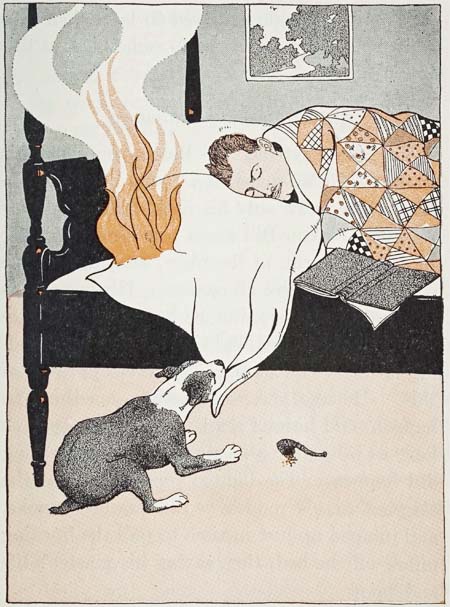
Bill Saves His Master
The only requirement, in order to become a member of this noble order, was to report some act performed in prevention of fire or loss of life. All of the dogs agreed to keep their eyes open for opportunities to do something in this line.
Bill Becomes a Member
The very next day the Boston bull had his chance. He belonged to a young bachelor who lived alone, with only his faithful dog, Bill, for company. Now Bill was a privileged character who had the run of the place, and, during the day, had to receive all comers. His owner was the best of masters, but he had one fault. He would smoke in bed, lighting his pipe and reading until he fell asleep. Bill never approved of this. He was always expecting something to happen, and himself slept with one eye open as long as he could. Then, one night something did happen. The lighted pipe fell out of the sleeping man’s mouth. Bill smelled smoke, and jumped up just in time to pull the burning pillow off the bed, thus saving his master’s life and home.
Bill became a member of the Fire Brigade.
The Fire Brigade
We hear many stories of dogs being the means of saving property and lives in times of fire. They seem never to lose their heads, as it were, but generally do the most sensible thing under the circumstances.
Here are some instances of heroic efforts on the part of these little benefactors, in recognition of which they are being enrolled in the Fire Brigade.
Lady, a German police dog, who will be the only member of our company of her sex, is entitled to first place on the list. She put out a fire all by herself in a most heroic manner. Left alone in the house, she discovered a burning paper under a gasoline stove. Drawing the fire to her, she tore the paper to bits, pawing it until the fire was out. In so doing she burned her nose and paws severely. When her mistress returned and sat down, the dog laid her head in the lap of her mistress and whined most pitifully with pain. Needless to say, her injuries were carefully anointed and bandaged.
Another member of the fire brigade won his honors by alarming the family when something from a shelf above fell down on the stove, catching fire from the lighted pilot. He was alone in the kitchen when it happened, and ran barking into the other part of the house, and then back to the kitchen, until he succeeded in getting the family to follow and put out the fire.
The Tramp Dog
And here is what was once a tramp dog, but we know he was not a tramp from choice. This dog did a good deed in return for a kindness shown him, in observance of the Golden Rule, which we should all remember.
This poor dog, who was alone in the world and desperately hungry, saw a man come out of a butcher shop with a package of meat. Hunger had made his sense of smell so keen that even at a respectful distance he knew the stranger was a fair prospect. So the dog trotted along behind the man until he reached his home.
The dog, being a tramp, knew his place was at the back door; so he lay there to wait until he should see some one come out to the garbage can, which soon happened. This person not only gave him the remains of the nice, juicy steak, but also spoke a kind word to him. Feeling that life was, after all, worth living, the dog decided to spend the night with these kindly people. During the night a fire broke out. The tramp, as he was called, ran to the window of the room where the man slept, and awakened him just in time to save his home.
Needless to say, he was no longer a tramp dog.
Small but Brave
A lady was making a call on a neighbor next door, leaving her husband asleep on the bed, and her small dog to keep guard during her absence. She felt that all was secure. However, she had hung some stockings over the gas oven to dry, leaving the gas turned on. The oven became very hot and set fire to the stockings, and the flames spread to the window curtains. The dog, seeing what had happened, ran to the bed barking, but failed to arouse his master. Then he caught the covers in his teeth and pulled them off the sleeping man, who awoke just in time to save their home from a bad fire.
Duke
A dog named Duke saved a large factory from being burned by giving the alarm to the watchman. The man and the dog had just made the rounds and had seen that everything was all right. Then, after the watchman had punched the time clock, they left that part of the factory for another. The dog, who was watching every move that his master made, returned with him to the office from where they started. There they settled down to take a nap, until the alarm clock would arouse them to make the next round.
The watchman, who was a sound sleeper, was soon snoring away, but not so with Duke. He seemed nervous and alert to every sound. In a few minutes he sprang up and barked loudly, waking his master, and ran to the door in an excited manner. The watchman, on going outside, saw a bright light at one corner of the factory. Running to this spot, he saw two men hurriedly leaving, with the dog in pursuit.
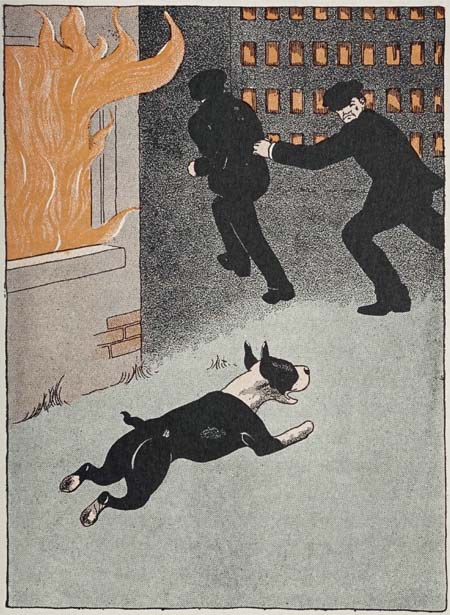
Duke Wins Honors
He turned in the fire alarm, and when he telephoned to the police headquarters, what he heard in reply was, “Men taken. Holding your dog for identification.” When Duke was reinstated at the factory, he was given a new brass-mounted collar. He was also given a pension for life for having performed this noble deed. This fine fellow is doubly welcome in the Fire Brigade.
Jess
In one of the smaller cities is a fire company that has a tawny-colored Irish setter named Jess, who is a great favorite with all of the men. Jess knows all the “ins and outs” of the fire-fighting business, and is as helpful as it is possible for him to be. When there is no call for action, he lies contentedly in the sun waiting for the summons to duty.
When an alarm is sent in, Jess is the first to respond. He runs first to one and then to another of the men, spurring them on to action and haste. Then he jumps into the chief’s car and seems to love to go tearing through the streets, having the right of way over everything. The ear-splitting screech of the siren is music to him. Arriving at the fire, he takes a position affording the best view, and where he will be the least hindrance to the firemen. He takes an intense interest in every move that is made.
Once he entered a burning building. Going in by the back door, he ran up the stairs in that part of the building and aroused a man who was asleep, thereby saving his life. It was for this that Jess became a life member of that fire company; he was serving without pay, just for the love of being useful. After a fire is put out, he rides home in triumph on the fire engine, wearing a fireman’s hat. Jess will be an honorary member of our “Fire Brigade” if everybody is willing.
THE JUDGE’S STORY
When the other dogs had finished with their stories, and the Judge was satisfied that they had done their best, he thanked them, and said he would now tell them some stories. First he would go back to his own family history, of which Bob was not able to tell a great deal, as he was young and not expected to take much interest in such things.
“The Airedales are a very old and famous family of dogs,” proceeded the Judge. “The name is romantic, having originated from a river in Yorkshire, England, the River Aire. It is something to be proud of, to have a name suggested by a river; and then, to have a dale, which means a valley, attached to it. I close my eyes,” said the Judge, “and imagine I can see that beautiful green valley, with the river winding through it, and my ancestors living so peacefully there, enjoying a free and easy life, chasing rabbits and rascally badgers, with which the hills are infested.
“It is said of the Airedales that they were good swimmers, and how they must have enjoyed a plunge in the River Aire on a warm day. They were trusty, too. Baby could be left in their care with safety. So many good qualities are seldom found in just one breed of dogs.
“While they were not noted for their beauty, nor for the sweetness of their voices, their many other good traits make amends for that. Beauty, after all, is only skin deep, and if there are no virtues below the surface to give it luster, it is not even skin deep. Whatever beauty the Airedale dog can lay claim to, is brought out by his inborn cleverness. Good deeds and good behavior have resulted in making a really homely dog into a world-wide favorite.”
While the Judge was making this modest claim for his clan, little Pixie hung her head and blushed with embarrassment to think that she had ever been ashamed to play with Bob, because of his personal appearance. She then and there resolved to be more courteous to both Bob and his father, of whom she was becoming very fond, thinking him a wise judge and a good counsellor for all dogs.
The Judge went on to say that it was recorded that one of his ancestors had won the first prize at a great dog show. The people of the country where this happened acclaimed him “King of the ring and King of the country.” Because of the fine qualities of the Airedales, he added, one of their number once became a member of the animal family at the White House, and was a favorite of the President of the United States and his lovely wife.
“Were medals to be issued to dogs for bravery in saving lives, the Airedale family would have many souvenirs to hand down to their children. A noted musician tells of his dog, Buster, having saved his wife’s life not only once, but five times.
“The almost human instinct of this tribe was manifested when one city was holding its election. One of the amendments to be voted on was the curtailing of the liberty of all dogs. To run at large, they must be muzzled, or they must be leashed when on the streets. Of course, all dog lovers were opposed to this measure. The dogs themselves, having heard so much discussion on the subject, seemed to sense that something was going to be done which concerned them.
“Such remarks as these were addressed to one Airedale, whose name was Jerry:
“‘Jerry, old pal, they are talking of interfering with your personal liberty, and not allowing you the run of the town, without a string tied to you. Now you must not think we are going to stand for any nonsense such as that. We will go down to the polls, Mother and all of us, and we’ll put this thing over strong, and show those dog haters a thing or two.’
“Jerry would look interested and try to wag his stiff tail, as much as to say he would like to do his bit to help. He had no vote, although there were some who had, who in his opinion were not deserving of it. One man he knew of hated dogs, and when he had something in him—Jerry did not know what—he was abusive to his dog—and also to the little boy who loved the dog. Yet that man was one of those who wanted all the dogs killed or tied up, and would vote for that cruel measure.
“Jerry slept over the matter, and when morning came, bright and early, he was at the polls. Taking up a position under the table where the workers were, he lay down, to see that everything was properly carried through. There he stayed until it was almost certain the dogs were going to win, when he left, satisfied that he was no longer needed.”
The Judge told the dogs they were all very fortunate to be living in this wonderful country, “where we are loved and well cared for, as there are many places where dogs are despised and mistreated, and even left to run wild, becoming scavengers, just because they are half starved. They fight and quarrel among themselves, and make the nights hideous with their howling. To be unloved and have no friends would be cause enough for howling.
“Then there are the Eskimo dogs. They too have a hard life, as they have to draw the sledges and do the work that horses and automobiles perform in this country. They are harnessed together with leather straps made from reindeer skin. There is also a long whip, made of thongs of the same leather, the lash of which is chewed by the women to make it pliable. Then it is braided to make the handle. This is lashed over the dogs’ backs to make them draw harder and go faster.”
“How terrible!” barked all of the dogs, shrugging their shoulders in pity.
“Probably their masters love these dogs, but this seems a strange way to show it. The people of that country are dependent on these faithful dogs, as they are the only means of transportation. They have no horses, no automobiles, and no airships—nothing but their dogs, so their very existence depends on these brave animals. We, with our loving masters and mistresses, can scarcely realize how differently these other dogs have to live. And how much they must miss being loved as we are!”